
Nothing says Happy Holidays and Peace on Earth like a decorated tank. (As seen in Superior, Wisconsin.)
Nothing says Happy Holidays and Peace on Earth like a decorated tank. (As seen in Superior, Wisconsin.)

My family celebrated Thanksgiving early this year. This is my favorite photo from the memorable occasion. My dog Buddy is looking longingly at the turkey carcass.
It begs a photo caption. Suggest your best one by commenting below. I (the sole judge) will send the winner a free copy of my novel, Plover Landing. I will ship it anywhere in the world, so put your creativity caps on, people!
The contest will be open through Saturday, November 25. I will contact the winner privately for their address.

Buddy. Image by Amanda Jo Dahl Sales.
Two springs ago, I decided to go to Duluth’s (Bob) Dylan Fest musical gathering at a bar downtown. I wanted to arrive early to ensure nabbing a chair to sit on. I had hurt my foot or hip or something, I don’t recall now, and knew there was no way I could stand up and listen to music for several hours without pain.
I rushed out of the house and made it to the bar in plenty of time. As I walked from the parking lot to the building, I realized that I had left my Dylan Fest tickets at home. Cursing, I got back in my car and raced home.
Apparently, I raced a little too fast, because a cop stopped me a few blocks from my house.
“Do you know how fast you were going?” he asked.
“Um, about 43 mph?” I admitted.
“Yep. This is a 30 mph zone and you were going over the speed limit.”
I explained about leaving my tickets at home and not wanting to be late to the event. (I didn’t get into my medical reasons, though.)
The policeman took my license and went back to his patrol car to run a check. When he returned to my driver’s window a few minutes later, he said, “Hey, aren’t you Buddy’s mom?”
I looked at him, dumbfounded for a few seconds. Then I realized he must be the cop who lives in my neighborhood. I had spoken to him and his wife a few times while I was out walking my goldendoodle, Buddy. They LOVE goldendoodles.
I smiled and answered in the affirmative. I told him it was nice to see him again.
“Buddy’s a great dog,” he said. “I’ll let you off with a warning.”
I drove to my house, thankful, yet a little chagrined that I got let off from a ticket not because the cop knew me and thought I was a great person, or even because I am a world-famous blogger, but because of my dog, who is way more famous than I am. 🙂

I was in the checkout line at Target the other day, about to pay for my purchases. The cashier was trying to interest me in applying for a Target credit card. This is our brief exchange, which left both of us laughing:
Cashier: “Can I tell you the story of the Target credit card?”
Me: “Sorry, no. I’ve been told it many times . . . and it doesn’t end well.”

About a week ago, I returned from the World Conference of Science Journalists, which was held in San Francisco. Although the coolest thing was seeing that there are so many of us doing science journalism in so many countries (more than 1,300 attended from seventy-three countries) — some of whom are the type who wear DNA double helix earrings — I learned many other interesting things during the five days of sessions.
Here are the highlights:

Alcatraz Island at night. San Francisco.
Walls all around us, inside us. Some built of fear, some of strength.

A typical Alcatraz prison cell.
What’s it like inside your walls? Cozy? Snug? Cold? Dark? Rotten?
Are they keeping your heart safe, or are they keeping it lonely? Are they keeping others safe?
Whispers filter through the chinks. Come out, come out and play, they say.
The voices won’t wait forever. Someone else will grasp their warm hand and walk them toward the grassy dunes, open in the ocean wind.


Alcatraz Lighthouse

I meandered over the San Francisco for a work conference and found the best concept for an eatery near my hotel. All they sell is cream puffs. A whole store devoted to the ultimate in decadence!
While growing up, I had heard about cream puffs on television, but had never eaten one. They were not sold in my city at that time. Once I was old enough to cook, I happened upon a recipe in my mother’s Betty Crocker cookbook and promptly went about making them. I was in heaven with the eggy, creamy, fluffy result.
Now cream puffs are less of a rarity. But never in my wildest “I’m a hick from Minnesota” dreams did I imagine an entire franchise devoted to the sweet.
 Beard Papa’s offers several varieties of cream puff shells. At the store I visited, these included original, chocolate-covered and green tea-covered. Filling choices were vanilla, peanut butter, and green tea. (I suppose the green tea ones are for people who are trying to trick themselves into thinking they are eating something healthy.)
I ordered an original shell with peanut butter filling, and a chocolate shell with vanilla filling. Both were divine. The shells were crispy on the outside and fluffy on the inside. The filling was cold and custardy. I preferred the vanilla filling over the peanut butter slightly, but only because it’s more classic.
With everything that’s going on in the world today, it makes me happy that cream puffs have their own store. If I’m 20 pounds heavier once I return home, you’ll know why.

At first he catches your attention because he pauses during his songs. And what’s he doing with his mouth?
Then you wonder what he’s singing about. Then you wonder how someone just out of high school can have such a powerful, gravelly voice. Then you marvel at his guitar skills. Then you notice that he sounds like Adam Sandler’s Waterboy character sometimes.
He sings a song from the perspective of a goldfish that’s about more than a fish.
He croaks a song about old people. Is he poking fun or offering a critical commentary on how society devalues the elderly?
This guy’s got talent. He’s like a male version of Lorde. Watch him go.
Perfect Duluth Day Interview: https://www.perfectduluthday.com/2017/04/06/duluth-band-profile-jacob-mahon/
KUMD Radio Christine Dean Interview:
http://kumd.org/post/55-live-studio-jacob-mahon#stream/0
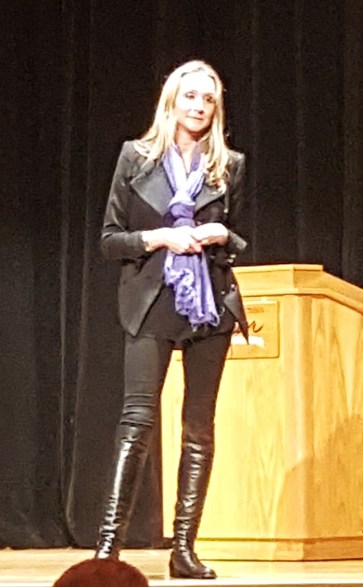
Alexandra Cousteau
Like many baby boomers, I could be found on Sunday evenings in the 1970s, cozied up to the television, watching a gnarly red-capped Frenchman exploring the depths of the ocean. The opening music to “The Underwater World of Jacques Cousteau” — full of violins and trumpets, with a playful xylophone riff — conveyed a sense of adventure and wonder that was unmatched by any other television show at the time.
The series inspired me to pursue a career as a marine biologist. Although that did not come to pass, I write about aquatic science, which is just about as good.
Like many young girls who watched the program, I had a crush on Cousteau’s son, Philippe. His other son, Jean-Michel, was okay, but Philippe – oooh la la! I was devastated when he died in an aircraft crash. And I thought Calypso crewman Falco had the coolest name.
Even as a poor college student, I donated money to the Cousteau Society and followed their adventures after the television show no longer aired.
So it was inevitable that I attended a talk last week by Philippe’s daughter, Alexandra. She was the keynote speaker at a celebration in Superior, Wisconsin, for the Lake Superior Research Institute.
The leggy blonde, whose mother was a model, is coming into her own as an icon for water issues. She founded a water organization, called Blue Legacy International, and was honored by the National Geographic Society as an Emerging Explorer.
Her talk centered on the theme of the importance of conservation and sustainable management of water for a healthy planet. However, Cousteau doesn’t like the word “sustainable.” She thinks that to most people, it means they must sacrifice something to achieve it, and that what is achieved is only marginal, not like things were before environmental problems happened.
The status of the oceans before humans started impacting it was one of abundance – huge schools of fish, giant pods of dolphins, a bay covered with oysters. Cousteau argued that we should have a vision of abundance instead of one of meager sustainability. It’s something people can be more enthused about and it’s an easier concept to imagine.
Given the realities of human abundance on the planet, this may be a pipe dream. But what a happy pipe dream!
Cousteau also thinks we focus too much on the environmental problems that exist and not on the vision we want to achieve. She gave the example of a tip from her downhill ski instructor, who told her not to look at the trees while she was skiing. “Because that’s where you’ll end up.” He advised her to focus instead on where she wanted to go.
Since I had just listened to a talk about sustainability by Andrew Revkin, I found Cousteau’s concept of abundance intriguing. I think those two should get together and compare notes, if they haven’t already!
I didn’t have my notebook with me, so am writing this all from memory. Two other things that struck me were her story about a child who was banned from watching the Cousteau TV show, and her story about how she learned scuba diving from her grandfather, Jacques.
Cousteau said that people usually gush about her grandfather’s television show (much like I did at the beginning of this post). But a man who attended one of her talks said he would get too excited by impending peril in the underwater adventures. When Cousteau would enter a cave filled with sharks, the boy would jump up and down on the couch, yelling at the divers not to go into the cave. He’d end up hyperventilating every episode until his parents took matters in hand and banned him from watching the show. Funny!
Cousteau said she learned how to swim before she could walk. At age seven, Jacques decided she was old enough to learn how to scuba dive (a technology he invented). As she sat on the edge of the boat, getting used to the regulator in her mouth and the gear on her body, she decided she didn’t like it. She was about to tell Jacques that she didn’t want to do it when he gave her a little push, and into the water she went. The undersea world has captivated her ever since.
Cousteau’s talk ended with a question and answer session. One of the last questions came from a tearful fifteen-year-old. She said that the students in her high school were all pessimistic and hopeless about the environment. She wanted to know how to offer them hope.
After taking a moment to compose herself, Cousteau, who was tearing up too, offered stories about things that are making the environment better. But perhaps, sensing the inadequacy of this in the light of teenage angst, offered to continue the conversation with the girl through her web site.
By now, most of the crowd was wiping away tears, including the director of the Lake Superior Research Institute, who closed the session in a choked voice.
Like her grandfather, this Cousteau has the ability to move people with her storytelling. I hope she inspires a whole ‘nother army of marine biologists and aquatic scientists. And a whole bunch of people who can tell the story of the environment, showing us where to go without crashing into the trees along the way.
 Marie's Meanderings