Louis Jenkins’s Favorite Poem

20170926_191607

Louis Jenkins reads at Zenith Book Store in Duluth, Minn.

Laconic prose poet Louis Jenkins gave a reading at a book store last week in Duluth.  He’s one of my favorite local writers (even though he lives in a Minneapolis suburb now instead of Duluth), so I went. I think of him as Duluth’s Earnest Hemingway. He has that larger than life quality and talent. A chance encounter with him once even inspired a poem out of me. (See “Two Poets in the Cereal Aisle.”)

The Poetry Foundation website describes Jenkins’s poems as having “a tight focus on the mundane particularities of ordinary existence, using deliberately flat language to comic and often heartbreaking effect.”

The last time I went to one of his readings years ago, I left my cell phone on. My children were home with a babysitter, and I wanted to be available. I told the sitter only to call me in an emergency. Right when Jenkins was reading a poem, my phone went off. I was in the middle of the crowd and everyone looked at me. I was too mortified even to turn off the sound; I just fled the room with my ringer intermittently blaring.

The call was not an emergency. After mildly chastising the inexperienced babysitter (I am a Minnesotan, after all, we can’t afford to get all riled up), I sheepishly returned to the reading, waiting until the crowd was applauding to cover my entrance.

At last week’s event, you can bet I turned that sucka OFF. Jenkins read from his new book, “In the Sun, Out of the Wind.” Afterward, he took requests for readings from his other books and he answered questions.

One memorable question came from my friend and partner in crime, Sharon. She asked which poem of his was his favorite. His response was, “The next one.” He went on to explain: “Sometimes you think, ‘I got pretty close with that one,’ and those are the good ones. Other times you wonder, ‘Why in the heck did I write that?’ ”

Another person asked him what he thought of living in the Twin Cities. “Bloomington’s a lot like Duluth,” he said. “It’s only got one good restaurant.”

The topic of actor Mark Rylance came up. In case you haven’t seen the Tony awards lately, Rylance is the actor who, for the last two Tonys he’s won, recites a Louis Jenkins poem instead of giving an acceptance speech. Rylance and Jenkins even did a play together based on Jenkins’s book, “Nice Fish.”

Although age has taken its inexorable toll, Jenkins still has a twinkle in his eye when he reads, and his wit is unmistakably intact. I felt privileged to see him once again, and to sit through the entire reading this time.

8 Steps Toward Sustainability

20170928_205329

Andrew Revkin, playing a right-handed guitar left-handed.

Former New York Times environmental reporter, Andrew Revkin, spoke in my neighborhood yesterday. I meandered over to hear him because he’s an acquaintance of mine and because I just think he’s cool. Little did I know he would offer ideas for making our world more sustainable, plus end his talk with a song!

His talk was part of a Peace & Justice series put on by the Alworth Center at the College of St. Scholastica. Currently the senior environmental reporter at the independent investigative newsroom ProPublica, Andy specializes in the topics of climate change, the Amazon rainforest, and sustainable development.

I met Andy years ago when I took part in a week-long science writing workshop put on by the New York Times in Santa Fe. He was my small group leader. He offered critiques on our stories and gained inspiration from us for new topics to cover for his beat.

One morning, he was reading a copy of the Times and railing at some edits made to his story. I recall being so tickled that even reporters at a venerable institution like the Times are at the mercy of their editors.

At the end of the week, we gathered for an outdoor barbeque and Andy strummed his guitar and sang for us. (He has accompanied the likes of Pete Seeger.) I added to the mix, singing the only song I have memorized, an old revolutionary war folksong called Katy Cruel.

Andy even offered to write me a letter of recommendation for my journalism grad school application, so he has a special place in my heart, and I couldn’t miss an opportunity to hear him again.

Many people don’t know that when Andy started his career, he wanted to be a marine biologist. I can’t recall the specifics, but he was working on a project about “Man and the Sea,” in a far-flung location like New Zealand, when he got distracted by an offer to crew a sailboat that was sailing the world. He joined the crew and spent a year-and-a-half at sea, broadening his literal and figurative horizons.

20170928_192357He explained all this during his talk (called “Ending Life as we Knew it”), and showed a photo that he took during his sailing travels of a modest shop in a small town that had piles of leopard skins stacked outside it for sale. This got him thinking about the sustainability of our species on the planet. In hopes of changing peoples’ attitudes toward the world in which they (we) live, he turned to journalism and started covering environmental issues.

Andy refers to climate change and sustainability as “super wicked” problems that will only be solved with multi-pronged approaches, including on the most difficult battlefield, which is inside peoples’ minds.

He offered eight strategies as a recipe for society to become more sustainable:

  • BEND. This deals with resilience. We need to learn how to live on the land in a way that takes current and future landscape changes in to account. Andy offered an example of an ocean island that is all built out. If the island had some undeveloped land around its edges, it would be less vulnerable and more adaptable to sea level changes.
  • STRETCH. We need to stretch our brains to think differently about things like land use planning and to think ahead to what conditions might be like in the future.
  • REACH. This deals with communication. We need to let people know what’s happening with their world in a way that reaches them. I thought Andy’s talk was a good example of this. He didn’t just present a bunch of facts/figures and scary graphs. He told his story and got the audience’s emotions involved.
  • TEACH our children and ourselves more sustainable ways of living.
  • REVEAL. This involves calling attention to hidden problems. Andy used the example of heat or gasses being emitted from a factory, which could only be seen with a special camera. This example reminded me of the underwater camera that was pointed at the BP oil spill gushing out of the pipe in the Gulf of Mexico. Things like that get people’s attention and lead to quicker action.
  • REFLECT. Get scientists together to cooperate on problems and give them time to reflect on solutions.
  • REJOICE. Relish the gift of life and our humanness.
  • REPEAT. Keep doing all these things over and over in a disciplined manner (like “lather, rinse, repeat”). Keep retesting systems and examining conventional ways of thought.

20170928_194201Andy said when he asked a prominent scientist what it would take to solve the issue of mankind’s sustainability, he was surprised when the man didn’t offer a lot of numbers and charts. Instead, the man said that sustainability will take “a miracle of love and unselfishness to solve” if we are to survive as a species.
Andy ended his speech by grabbing his guitar and singing a tongue-in-cheek song about how “liberating carbon” is the American way.

Let’s stop liberating that carbon people, and let’s keep thinking about how our actions affect the planet. And maybe, just maybe, things will get better.

A Visit From the Book Fairies . . .

20170917_175009

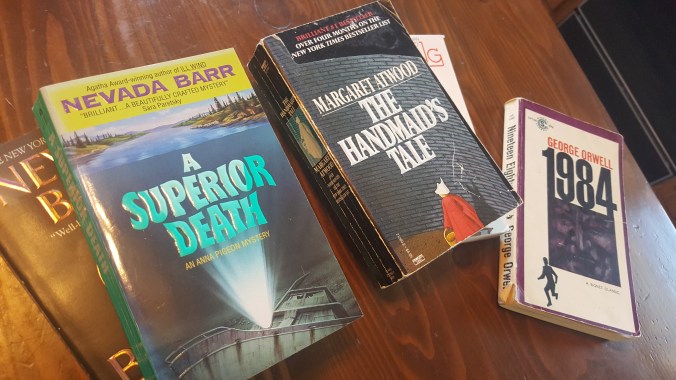
The books I hid today in a local shopping mall as part of International Hide a Book Day.

You may not know it, but today is Hide a Book Day. “Book fairies” around the world are hiding books in public places to encourage a love of reading and to celebrate the ten-year anniversary of Goodreads.

I had recently cleaned out one of my bookshelves and was going to give away these books anyway. There are some oldies, but goodies by Margaret Atwood, George Orwell and Nevada Barr. After watching the Emmys last night, I thought it especially appropriate to be giving away “The Handmaid’s Tale,” which won so many awards and fits with our current political times.

So if you’re in the Kenwood Shopping Center in Duluth today, keep an eye out for these gifts from Marie the Book Fairy. Enjoy and read in good health!

Hemingway’s Cats

61002_452570391475917_416832289_n

A descendant of Hemingway’s polydactyl (many-toed) cats sits sleepily in a box on the front porch. My son took this photo.

I read in the New York Times recently that the multi-toed descendants of Ernest Hemingway’s cats at his house in Key West, Florida, all survived Hurricane Irma. The house fared well, too.

DSC02211

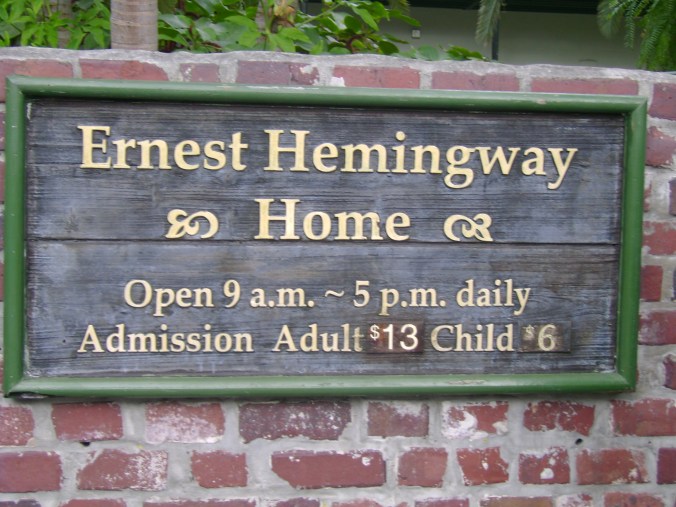
Hemingway’s home in Key West, Florida.

My youngest son and I visited Hemingway’s house about five years ago. We delighted in seeing the cats, which lounged around in the yard and in the house. One was even sleeping on Hemingway’s bed, below a painting on the wall that depicted the house surrounded by cats.

DSC02203

DSC02207

I am glad to hear that everything is okay there.

DSC02210

Hemingway’s writing studio above the pool house.

DSC02198

Thinking of St. Martin Island . . .


St. Martins 1 038

Children in a Carnival Parade on St. Martin Island, 2012.

According to the New York Times, 95% of buildings on St. Martin Island have been damaged by Hurricane Irma. This is such a tragedy, I can’t even begin to imagine it. The island is such a magical place. Please see my post about my trip there five years ago.

My thoughts are with the tourists and residents there, and on all the other islands affected by the storm.

How Donald Trump Cost me a Boyfriend

trump-frowningIt’s been almost a year, so I figure it’s safe to write about this dating mishap. I had tentatively dipped my toe into online dating after a long absence and some unsatisfactory experiences. One of my first dates was a local man who was a few years my junior. We met for lunch at a popular restaurant and had a good time.
We kept in touch and made plans to meet a few days later at an evening work event I was hosting. Then we’d go out for drinks afterwards. The event was on November 9, 2016, the day after the presidential election.

During the day, I had a lot going on at the office. My date emailed me a few times, saying his grandson ended up needing unexpected surgery in another city, and his daughter wanted him to go along with her for support. He wasn’t sure he would be able to make it back in time for our date.

I knew he had a grandson, but he never mentioned he was ill. I was understanding and told him not to worry about trying to make it back in time. I wished him and his grandson the best.

He replied that he’d let me know his logistics as the day progressed. After a few more brief exchanges, he emailed me, saying that he wouldn’t be able to make our date because the surgery took longer than expected. Again, I sent my good wishes and said I hoped we could get together some other time.

That evening, after the event, a group of us wanted to go out and have a post-election debriefing/support session. None of us were Trump supporters, and like much of the nation, we were in shock at his election. I got home from that late and depressed, with no energy to turn on my computer and check for messages from my wayward man friend.

The next morning, I dragged myself into work and checked my email. It contained a nasty note from my date. I don’t remember the exact wording, but it was something snarky about my lack of communication skills and that he no longer wanted to date me.

It was bad enough having a president elected that I didn’t like, but now I was getting dumped, too!

Both things caught me off guard. Not to mention the irony that I am a professional communicator who was getting dumped for my lack of communication skills. 🙂

Although I had doubts about the veracity of his claim of a sick grandson, I gave the man the benefit of those doubts and, after taking time to collect my thoughts and rein in my feelings, apologized to him for not “being there” when he needed someone during a stressful time, and I explained my situation.

But I also thought it was a rather knee-jerk and severe punishment to break up with someone you just met because they weren’t attached to their email at all times. So I told him I would no longer be contacting him, either.

Despite all this, the person I’d really rather blame the whole thing on is Donald Trump. If he hadn’t been elected, I wouldn’t have needed a group therapy session, and thus might have had more time and energy to be attentive to my date.

So you can add my love life to the list of things the president has dismantled since his election.

Polar Opposites: A Review of Two Frigid Books

ASHLEY_SHELBY_c-Erica_Hanna

Ashley Shelby by Erica Hanna.

SP station

Bravermanweb

By chance, I read two books about cold climates back-to-back. In some ways they are opposites, but in more ways they are similar, and both are good reads.

The reason why I am spending the fleeting Minnesota summer reading books about cold places is something you’ll have to ask my psychologist (if I had one). Maybe it’s just that it’s “safer” to read cold books during a warm summer. I certainly wouldn’t want to read them during the winter. It’s cold enough here then! That’s the best reason I’ve got for you.

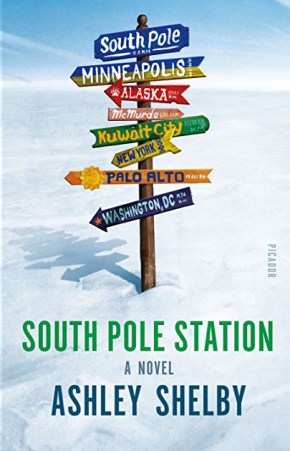
The books are “Welcome to the Goddamn Ice Cube” by Blair Braverman and “South Pole Station” by Ashley Shelby.

Ways the books are opposite: Braverman’s book is nonfiction – a memoir set in northern climes like Norway and Alaska. Shelby’s book is fiction and is set in Antarctica. So we have opposite genres and opposite geography.

Ways the book are similar: They are both written by Midwestern women. Braverman now lives in Wisconsin and Shelby lives in Minnesota. They’re also both about women who have put themselves into challenging situations, socially and physically.

Braverman, a California native, traveled to Norway as a high school exchange student, and later as a folk school student, and still later as a museum curator of sorts in an isolated town there. She also lived on a glacier in Alaska, offering dogsled rides as part of a tourist business.

She chose Norway in high school to pursue her love of cold places, but had a bad experience (well, several bad experiences) with her host family father that made her fear men and question her own mettle. To prove her mettle, she later enrolled in the folk school to learn how to train sled dogs and survive outdoors in the North.

She writes, “What I feared most was men, and what I feared for was my body, and yet my body wanted men, and there was no answer for any of it. No, that wasn’t right. There was an answer for some of it. And that answer, I felt certain, was somewhere in the north, if I would only go and find it.”

The folk school is a community unto itself where she must prove herself and earn the respect of her teachers and fellow students. She learns her crafts well enough to later on get the job in Alaska, which is another isolated community encapsulated by and encamped on a glacier. This is where the book gets its title – the workers refer to the glacier as the “ice cube” and newbies are welcomed to the hard and challenging life on the “goddamn ice cube.”

(As an aside, this reminds me of when I used to work on Isle Royale National Park, which is located on an island in the middle of Lake Superior. We referred to it as “The Rock.”)

It’s here she has her first relationship with a man, but when things start to get difficult between them, he retaliates emotionally and physically, and makes her living situation in the camp very uncomfortable.

Eventually, Braverman makes her way back to Norway again and helps out the keeper of a general store and local historical museum. Much of the book centers around conversations of the shop regulars, who gather for coffee. Even here, Braverman is isolated and feels she must prove her usefulness to the locals.

“South Pole Station” centers on the story of Cooper Gosling, an artist who earns a fellowship to spend time and paint at the South Pole. Like Braverman, Gosling and most of the other characters in “South Pole Station” put themselves in the situation because, as one character aptly states, “We’re all here because of some shit.”

They are fighting personal battles along with elemental battles. Gosling’s battle is with the suicide of her brother. When they were young, they both used to love reading about polar explorers and made up imaginary games centered around their exploits.

Gosling’s battle almost costs her her life when she walks out into the elements in a drunken stupor. But in the end, the polies all gather around her and help her pay homage to her brother at the bottom of the world in a most fitting way.

The author does a great job describing the various social cliques that develop at the South Pole. You have the beakers, who are the scientists, and the nailheads who are the maintenance crew, etc. Like Braverman in her situations, Gosling must earn her place in the social system and in the hearts of the other polies in order to survive.

The books are both interesting reads. I gave them 4 out of 5 stars on Goodreads. And although they are set at opposite ends of the world their major themes are eerily alike.

Okay, so I’m Being Lame

fountain-pen-on-paper

I think it’s lame when bloggers write about how they don’t have anything to write about. Or they start off a story by apologizing for not writing in a while. Seriously, I don’t think anyone notices they’ve been gone (well, maybe their stalkers notice – grin).

I believe bloggers should just write a story when they have an idea and get on with it. Stop apologizing first!

But here I am saying that I haven’t written in a while and that I don’t really have much to write about. I do have an idea for a book review, but I haven’t finished the book yet. So, I’m in a holding pattern of sorts. Maybe I’m gathering strength for the next four years of blogging?

Anyway, I’m still alive, still out here. Just living life, enjoying the last of a fleeting summer, and waiting for my meandering thoughts and feelings to gel into something worthy.

Author Interview on “Minnesota Reads”

20170803_081113

Lisa Johnson, multitasking radio goddess.

I had the good fortune to be in the radio studio last week with Lisa Johnson, host of KUMD’s Minnesota Reads show. We talked about the “Going Coastal” anthology project and Lake Superior Writers, the local writing group that produced it.

I had to leave home for the interview during the time of morning I’m usually just sitting down to eat breakfast. And here Lisa is, multitasking between radio songs, flipping switches, keeping records of what played, and then calming down enough between all that to sound incredibly composed on the air.

I don’t know how she does it! Plus, she reads a lot of books every month for her show about Minnesota authors. Here’s a link to my seven-minute interview. Enjoy.

Fun with Apostrophes

DSC04196

As a writer, I care about the written word. I care about proper grammar. While I have been known to dangle a preposition at the end of my sentences, I usually try to do what’s proper, especially in my writing for hire.

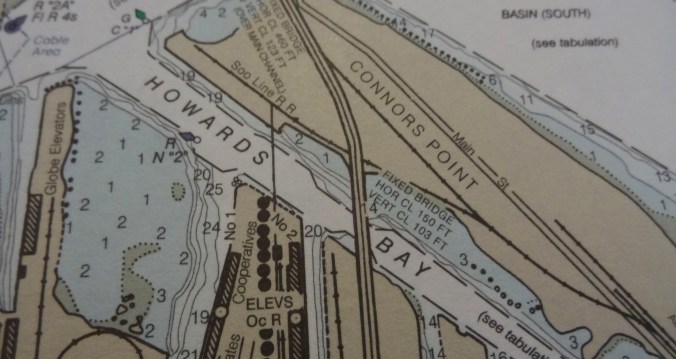
I had an instance this week where I wanted to confirm the name of a bay in the Duluth-Superior Harbor. Someone who works for an agency in another state asked me to review a web site about this bay, which is the subject of a federal cleanup project because it’s contaminated. My office coworker is also helping with the project by providing engineering advice.

The title of the web page was first thing I noticed. It was called “Howards Bay,” which just screams out for a possessive apostrophe, doesn’t it? (Howard’s Bay.) Unless, of course, the bay was named after someone with the last name of Howards vs. the first name of Howard.

I’ve run across instances before where proper grammar for place names flies out the window because some mapmaker hundreds of years ago labelled places incorrectly on local maps. As such, writers like myself are required to grit our teeth and perpetuate the mistake because what’s on the map has become the actual factual name for those places. One example is the St. Marys River, which empties out of Lake Superior and into Lake Huron. It makes me cringe every time I write it, but there’s no possessive apostrophe in that name due to a mapmaker’s error.

Hoping against hope that wasn’t the case for Howards Bay, I investigated. I looked on the internet. I found that newspaper stories about the bay gave Howards an apostrophe. I found that many government documents (but not all) did not. I asked friends if they knew which form was correct, and received helpful suggestions about where else to check. I looked it up on the U.S. Board of Geographic Names website. It had “no data available” about this name.

Along the way, I discovered that that state of Wisconsin (where Howards Bay is located) has a state Geographic Names Council. Who better to ask? So I sent them an email. While I was awaiting their reply, I learned more about the organization. They seem mainly formed to approve new names for lakes and other geographic features.

They have a list of rules for new names. Among them is one that says, “newly acquired proper names for geographic features shall not be designated with ” ‘s ” or “s”, indicating possession, following the name. For example: Mott Lake, rather than Mott’s Lake or Motts Lake.”

Geez, I wish they would have had that rule in place when Howards Bay was being named!

The next day, I received the geographic names councilperson’s reply to my apostrophe question. Here’s what he said: All of our records that I have been able to find have no apostrophe for Howards Bay. I’ve attached a state sediment sampling document as evidence. I cannot give a more definite answer to the “official” name but I would say that the consistency in our records would point to this being the correct spelling.

In the meantime, with my dogged grammatical passion, I had asked the state cleanup project manager for Howards Bay the same question. He said: The apostrophe question has come up before.  I have not been able to determine which version is correct and occasionally catch myself using both. For consistency, the project team chose to perpetuate the mistake and go with the original name shown on maps, i.e. “Howards.”

Aaargh! Why are we at the grammatical mercy of ancient map makers? I say that modern writers should rise up and free themselves from this typographical tyranny! Add the apostrophe “s” and may the mapmakers be dammed!

Who’s with me?

____________________________________________________________________________________________

**Update** August 9, 2017

A friend of mine asked a research librarian with the Superior Public Library the origin of the name of Howards Bay (also called Howards Pocket). She said it’s named for John D. Howard who held an interest in a sawmill on Connors Point. He died in 1891.

So there really should be an apostrophe because it is Howard’s Bay. Darn those mapmakers! And there should be an apostrophe in Connors Point, too, but I’m not even going to go there. 🙂