Aruban Dreams (Part 4) – Up Close and Personal With Sea Life on De Palm Island Resort

20170315_095826

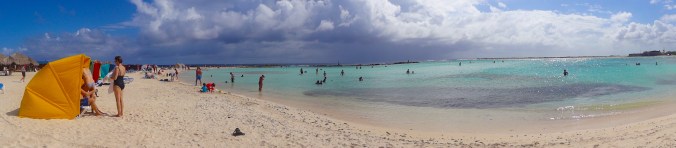
De Palm Island beach

Just off the coast of Aruba is a coral reef and sand island that’s been turned into a resort. Why would anyone ever want to leave paradise in Aruba for someplace else? Because this someplace has ziplining, all-inclusive drinks and food, fabulous snorkeling, banana boat rides, a water park, salsa lessons, and different underwater adventures like snuba, Sea Trek, and power snorkeling.

De Palm Island isn’t far off the coast – just a 10-minute boat ride. A bus picked us up at our resort, so my friend and I didn’t even need to worry about finding our way. After getting our tickets squared away on land and the short boat ride, we were there.

The first thing we did was the zipline. It isn’t one of those jungle treetop kind of ziplines, more like a straight shot zipline over the beach, but it was still fun. The most exciting part for me was wondering if the springs that were supposed to slow us down at the end of the line would actually work. I am alive to attest that they did indeed function properly.

Then we went snorkeling right off the steps of the snorkeling shack. I brought my own gear because I am a snorkeling snob, and my friend used the resort equipment (which worked just fine). She had never been snorkeling before and was a bit freaked out about the whole breathing underwater thing, but it didn’t take long for her to get the hang of it. And the fish were amazing. The island has great habitat for fish. All you need to do to find them is put your face in the water.

De Palm Island is known for its blue parrotfish, which we saw along with barracuda and a fish that looked similar to a cowfish. (Alas, if I had only finished my marine biology degree, I could tell you the name for sure.)

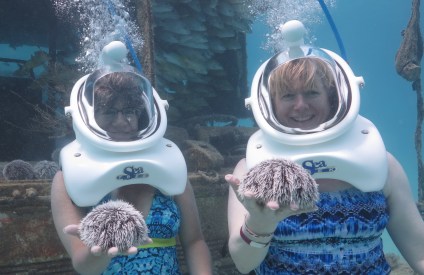
After hanging out on the beach for a while and socializing with people from a visiting cruise boat, it was time for our Sea Trek. This underwater adventure (available for an additional fee) involves having a seventy-pound helmet put over your head as you enter the water. The helmet quickly becomes lighter underwater and air is pumped into it from a hose above – kind of like a modern-day diving helmet. But the helmet is still heavy enough to allow you to walk on the bottom of the sea. And your hair won’t get wet. And you can wear your glasses.

After a short instruction period, we met the professional divers who would be helping us, and off we went into the water. I’m not sure how deep we ended up going – maybe about fifteen or twenty feet, but I would recommend renting one of the resort’s wet suits. It’s cold down there, even for hardy Minnesotans. We shivered the whole twenty minutes of the “dive.”

Along the route, the divers presented us with different forms of marine life to hold, like brittle stars, sea urchins and sea cucumbers. An underwater photographer/videographer recorded these explorations for posterity, and you can buy the photos/videos for an extra fee once you’re back up top. The diver also fed the fish to keep them swimming around for the photos, which made it look like we were in this huge school of fish.
IMG_6298

Sea urchin, anyone?

At one point, the divers had us all sitting in chairs at a table on the sea floor. One of my ears wouldn’t equalize and I thought I’d have to abort the dive, but the instructor just motioned for me to stand up. That took care of the pain and I was able to equalize and enjoy the rest of the experience.

The last thing they had us do was sit in an old Jeep and pretend like we were driving. Add some empty champagne bottles for props and you have the makings of underwater drunk driving photos.

The experience was unique and worth the price and the (minor) pain and chill. Still, we were glad to get out of the water and back into the warm sun.

Next up – the last entry about our trip: Aruba – Island of Sensual Delights . . .

Why Sea Grant is a Kick-Ass Program (And Not Just Because I Work There)

Wi Point Ladies 2016 003We interrupt all these dreams of Aruba to insert some harsh (but hopefully entertaining and educational) reality. You may recall from my recent pancake recipe posting that President Trump has zeroed out the National Sea Grant Program that I work for in his proposed budget for 2018.

If that weren’t worrisome enough, he just recently he proposed drastic cuts to Sea Grant and other environmental and health and human services programs in 2017 in order to find funds to build the wall between Mexico and the U.S. You remember his beloved wall, don’t you? The one that Mexico was supposed to pay for (and like it)?

If Congress grants his request, Sea Grant would be gone – maybe as soon as May or August of this year, and I will be out of a job.

Maybe you’re wondering what a “Sea Grant” is. Sea Grant is a kick-ass program that funnels federal money from the National Oceanic and Atmospheric Administration to universities in 33 states across the U.S. The money goes to university researchers for water studies and to people like me who let taxpayers know about the research results through the media and through other local communications outlets.

Our staff and researchers also develop tools that people can use for things like growing fish, protecting their towns from a messed-up climate, keeping invasive animals and plants out of their local lake, fixing up polluted swimming beaches, making seafood safe to eat and water safe to drink.

UWI_SeaGrant_logo_cyanI work as a writer for the Sea Grant program in Wisconsin. Why is there an ocean program in Wisconsin, you ask? Because the Great Lakes are the freshwater equivalent of oceans (Sweetwater Seas). As water sources for millions of people and home to one of the world’s largest economies, it makes sense to pay attention to the Great Lakes and to put money into understanding them and protecting them.
Nationally, Sea Grant has been around for over fifty years. The federal dollars ($67.3 million) that come into the states are matched by the universities.

One reason it’s a kick-ass program is that in 2015 alone, the work done nationally with these dollars led to an 854% economic return on investment (Turned $67.3 million into $575 million in the communities in which we work). I bet none of President Trump’s business ventures have provided such a huge impact. Seems like a bad idea to cut such a successful program.

We’ve restored over 127,000 acres of degraded ecosystems. We trained almost 2,000 people how to keep seafood safe to eat. We offered about 900 classes to people living on coastlines on how to improve their community’s resilience to storms. We also supported training and funding for 2,000 students who are the next generation of water scientists.

In Wisconsin alone, our programs save lives. Our Sea Caves Watch program, which warns kayakers about wave conditions in the Apostle Islands National Lakeshore has prevented deaths. Since it went online about seven years ago, no deaths have happened. Before, there was about one death every year. Seven people might not seem like a lot – but every person counts!

Last year, a boater who saw our video about “ghost nets” (abandoned nets lost in the lake) and how to get out of them without capsizing, remembered what the video said when his boat got into a tangle. He credits Wisconsin Sea Grant for saving his life.

In Wisconsin, we also fund a program that helps children who are going through rough times by getting them into the water and taking pictures. The underwater photography program has changed the lives of many of them, and their photos are good enough to be in public displays and even a book. Read the children’s testimonials in the book. They will make you cry!

We find cures to fish diseases. We created over 5,000 jobs during the past two years. We helped almost 12,000 anglers or aquaculture people. We helped find out what was causing the steel pilings in the Duluth-Superior Harbor to corrode (and won a national award for it). Through our sister program, the Water Resources Institute, we are changing how the state warns people about the chemical strontium in their drinking water.

If I lose my job, I can’t take any more nice vacations and write about them for your benefit. I also will be so busy finding a job that I won’t be able to write my blog any more, or my fiction.

So, if you give a rip, please email your Congressperson right away. Tell them to reject the Administration’s proposal in the Fiscal Year 2017 Security Supplemental that would cut the National Sea Grant College Program by $30 million. Also, please ask them to reject the Administration’s Fiscal Year 2018 proposal to zero out and terminate the Sea Grant program (for all the reasons I’ve just mentioned).

I had an interesting discussion with someone at my church about President Trump. She said she was finding it very hard to love him in a spiritual sort of way. I told her that I don’t like what Trump stands for, but I do like that he’s making us fight for what’s important. It’s definitely not politics as usual.

The only weapons I have to fight this with are my words. I hope you will join your words with mine to preserve a program that makes much more sense for this country than a wall with Mexico. For more information, please see the Sea Grant Association’s website (FY 2017 and FY 2018 documents).

Thank you for your support. Now back to our regularly scheduled programming.

Aruban Dreams (Part 3) – Beaches and Butterflies

DSC03881

Tourists ponder pelicans upon pilings, Druif Beach in Aruba.

My friend and I eventually came out of the caves in Aruba and into the sunlight. The first beach we saw was just outside our resort.

Used to the rootbeer-brown waters of northern Minnesota, my immediate reaction to Druif Beach/Divi Beach was to laugh at the impossibly white sugar sand and the turquoise water. I felt like I was walking through the living embodiment of a Caribbean travel magazine advertisement.

Druif/Divi Beach is in the low-rise resort part of the island, up the coast from Oranjestad, the capitol of Aruba. We spent a couple of afternoons and evenings on these beaches, which were a short walk from our resort condo.

Besides the ridiculously gorgeous scenery, the nice thing about this and the other beaches in this post is that you don’t have to fight for a spot under a cabana like you do at some resorts. No need to wake up at 6 a.m. and reserve beach chairs. We usually didn’t drag ourselves out of bed until 8 or 9 a.m., and often didn’t get to the beach until the early afternoon. We were always able to find either a cabana or a shady spot under a tree. Granted, the cabana might not have been the closest to the water, but it was nice not to have to strategize relaxation. This is a VACATION, after all.

Two drawbacks of Druif/Divi Beach are that it’s right near the roadway, and the scenery is marred by offshore oil platforms. Car motors compete with the sound of lapping waves. Baby Beach and Eagle Beach don’t have these problems.

DSC03976

Baby Beach wide-angle view.

Baby Beach is in a large cove on the southeast end of the island. The shallow waters and protection of the cove make it perfect for young children for swimming. It’s also great for snorkeling, although you have to swim out a ways to the rocky cove walls to find the fish.

One word of caution: bring your wallet with you (not into the water, though!) If you need to use the restroom, it costs $1. You also might want to spend money at the bar/restaurant and the beach equipment rental place.

DSC04006

Eagle Beach

Our last morning on the island was spent at Eagle Beach, just up the coast from Druif/Divi Beach. We were not disappointed by this decision. Eagle Beach is rated consistently high in polls of beachgoers in the world and in the Caribbean.

The beach is wide and the road is far away. There are plenty of cabanas for shade. The water is so clear, it hurts the eyes. And there’s not a rock to be found. I suppose all that nice white sand is like an underwater desert for marine life, but at least humans NEVER have to worry about stubbing toes or stepping on a sea urchin.

Just like a tanning bed fan, the prevailing winds keep you cool and keep any bugs away. (No damn biting sand flies like in Minnesota). There are Zika mosquitoes in Aruba, but we never saw even one because of the wind.

Another activity for nature-lovers in Aruba is the Butterfly Farm — housed in a low-slung building across from the high-rise resort district. Lush greenery, flowers and butterflies will fill your senses. Knowledgeable guides give tours and can explain all the different butterfly types and life stages. I also went to a butterfly farm on the island of St. Martin, and the guides in Aruba were even better.

Bonus: your entrance fee is good for an entire week, so you can visit more than once if you want. The farm opens early in the morning sometimes for people who want to see the chrysalises hatch. The time was too early for me to rise during VACATION, but I was tempted. I bet it’s inspirational.

Up next in part 4: Getting personal with underwater sea life on DePalm Island Resort.

DSC03922

Aruban Dreams (Part 2) – Caves

DSC03902

Quadirikiri Cave

In the previous episode, my friend and I were returning from a trip to the Conchi Natural Pool in Arikok National Park in Aruba. After being spared a forced death march through the desert back to our car by some kind folks who had room in their Jeep, my friend and I were set to explore two of the park’s caves.

IMG_7433

What we could see of Fontein Cave through the locked gates. Photo by Karen Brehmer.

The caves are drivable via a paved road that devolves into a gravel road. But first we needed some lunch. Boca Prins Restaurant appeared before us, an oasis in the middle of nowhere – at the edge of a sea cliff where the paved road ends.

I had THE BEST pina colada and fish stew of my life there. The cold drink felt wondrous after our morning adventure and the fish stew was light, fishy, and limey – obviously made by someone who knew what they were doing.

We tarried over lunch so long that by the time we got to Fontein Cave, the gates to it were closed (it closes at 3:30 p.m.). If we had been able to enter it, we would have seen native pictographs dating back 1,000 years, along with drawings by colonialists. Guess I will have to visit it again on my next trip to Aruba.

DSC03910

Quadirikiri Cave

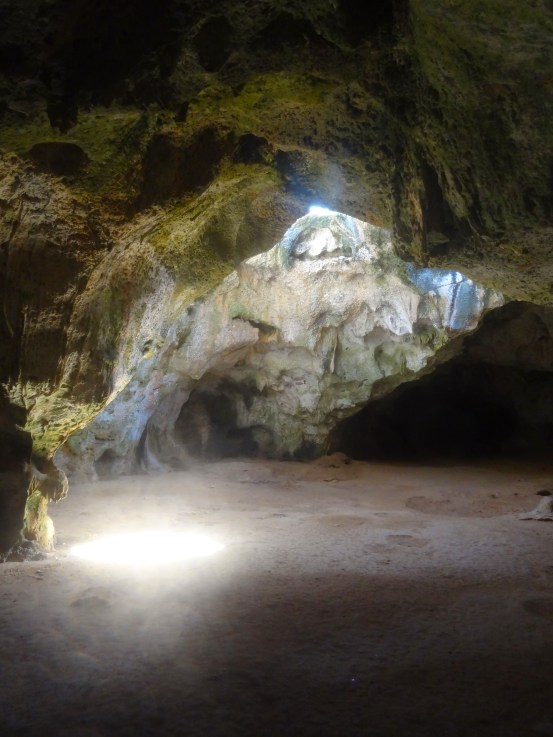
Then we traveled to Quadirikiri Cave, which is known for its two large caverns and bats. The caverns are lit from holes in the ceiling. I could immediately see the appeal of the caves to ancient peoples. They provided shelter from the relentless and ever-present Arubian tradewinds and sun, and they were very roomy. I would totally have lived there 5,000 years ago.

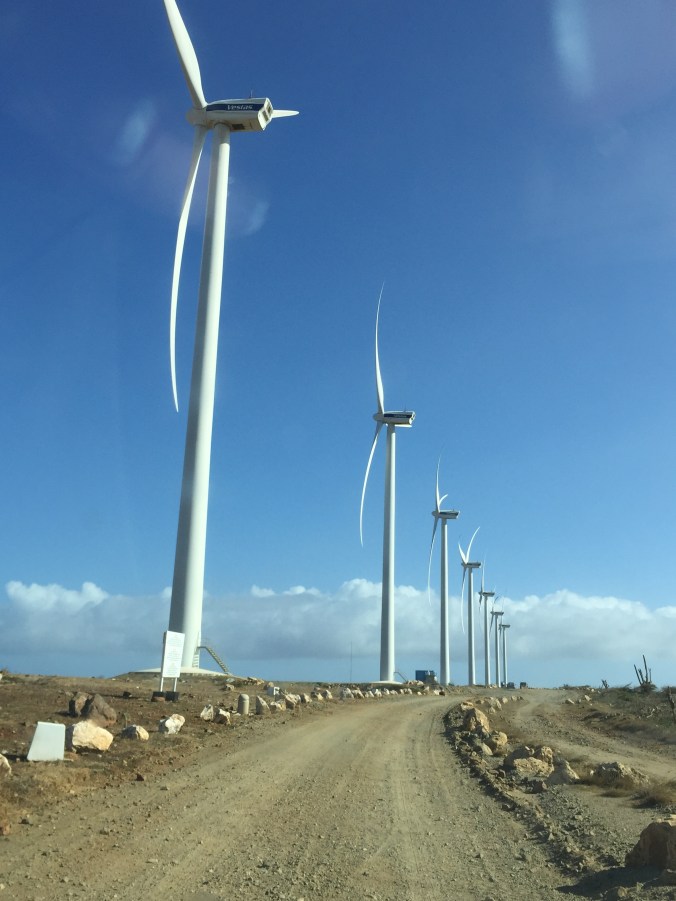
On our way out of the park, we drove past some prominent landmarks that took the form of wind turbines. Aruba gets a good percentage (15%) of its power from renewable sources, with a goal of 100% for the year 2020. The wind-farm we drove past is not part of the park, but it’s just as impressive as some of the natural landmarks.

Thus ends our time in the park. Next up: Beaches and Butterflies.

IMG_1443

Image by Karen Brehmer.

Aruban Dreams (Part 1)

DSC03897

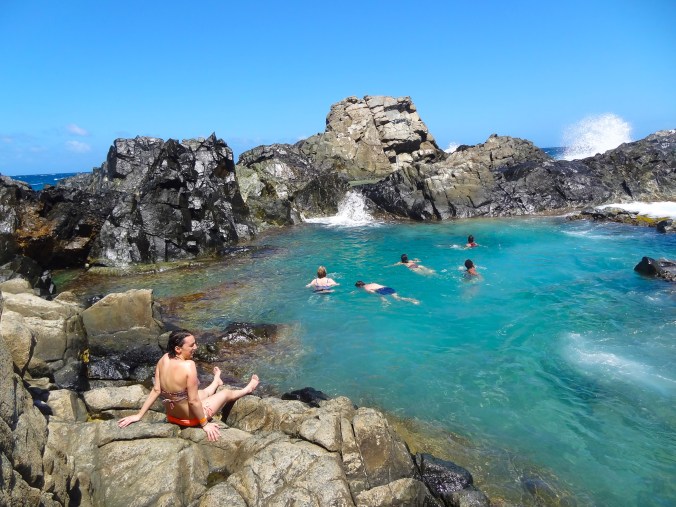
Conchi Natural Pool, Aruba.

A friend and I meandered down much closer to the equator last week to the Dutch isle of Aruba. The trip was my New Year’s Resolution and a chance to indulge my isle-o-philia. All I can say is that if every resolution was this amazing to fulfill, more people would make good on them instead of pooping out three weeks into the New Year. Enough of resolutions to lose weight or exercise more. Bah! People should make pleasurable and dreamy resolutions instead. Remember that for next year.

Our first island adventure was the most perilous undertaking of our week-long trip. We decided to visit the island’s one national park (Arikok National Park) to explore a natural ocean pool and then some caves.

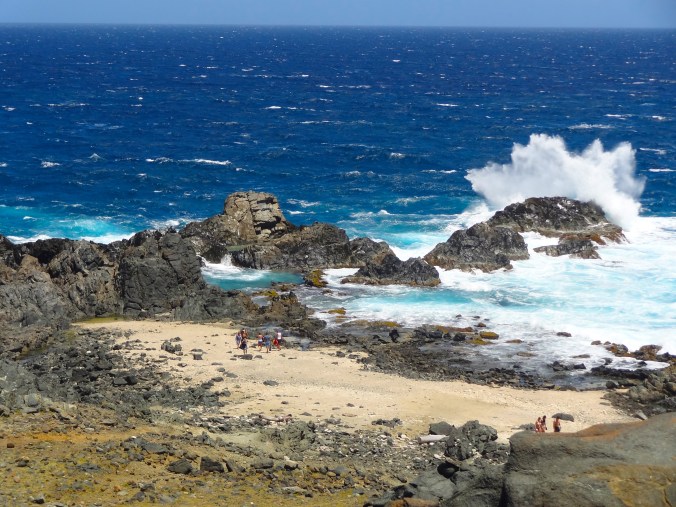
The pool was our first destination. It’s located on the coastline, formed by a ring of high rocks that keep out the waves. Periodically, a wave overtops the rocks and fills the pool with more water. It’s known for good snorkeling, and an upper pool flows into the main pool via a small waterfall. Most people travel there by reserving a Jeep or 4×4 ATV. My friend and I? We decided to walk.

I had read somewhere that it only took a half-hour to hike from the park entrance to the pool. My friend and I didn’t need no stinkin’ 4×4 to get us there. That’s what feet are for. Besides, we wanted to get a feel for what the island is really like.

Heh heh. What the island is like is a desert. Hot. With no shade from the equatorial sun. And there are rattlesnakes. But I am getting ahead of myself.

At the park visitor center the attendant told us it actually takes an hour-and-a-half to hike to the pool. (I figured out later that the info I had read started from a different location – the Shete Entrance.) Plus, we would be walking up a 600-foot mountain on the way there.

My friend and I looked at each other, a bit taken aback. But we are healthy 50-something-year-olds from Minnesota. Above average, and all that. We decided we could do it. We were wearing athletic shoes and sunscreen. Our water bottles were full. We were ready to roll.

Then he told us the pool was closed due to high waves.

My friend and I looked at each other again. This was a more serious setback. But we decided we had come this far, we might as well go see the pool. I encouraged my friend to still bring her swimsuit, just in case conditions were really better at the pool than the attendant thought.

Off among the cacti we went. Unlike what the park map shows, there is no separate hiking trail from the Jeep trail, so we had to make way for all the lazy people who opted for motors. Almost all of them stopped and asked us if we were okay, subtly gloating that they were riding and we were walking. We assured them we were fine. We smiled and waved them on their way.

DSC03888

The “trail” to the pool.

Halfway up the mountain we met a family on their way down. The top of the mountain was as far as they got, and they decided that was enough. Especially after they saw the rattlesnakes (one was alive and rattling a warning four feet away from the family’s mom, the other was dead in the road).

I could feel my friend looking at me questioningly again, but I ignored her, determined not to let a few rattlesnakes deter us.

The view from the top of the mountain was great. It was easy to see how necessary the park is for preserving wild natural space on the 20-mile-long island – houses crowded everywhere but within the park’s borders.

The rest of the trail followed a sloping plateau and then made a steep drop to the ocean. Soon, we were able to see our destination, which made the rest of the hike easier — plus the fact that no rattlesnakes crossed our path.

As we neared the steps leading down to the pool, we could clearly see people swimming in it. Yes, waves were overtopping the protective rocks and washing into the pool, but it didn’t look like a life-threatening situation.

DSC03890My friend and I changed into our suits, thankful that we brought them and that we’d soon be going for a swim. We clambered over the rocks and slid down an algae-covered formation into the pool with half a dozen other people.
It was heaven, punctuated by anxious moments when a wave would wash into the pool. My friend got thrown around a bit by one wave, but I was luckier.

While we were swimming, my mind jumped ahead to the hike back out. I wasn’t looking forward to spending another hour-plus tromping through the desert. All my foot-powered bravado seemed to melt away into the sea. When one of our poolmates mentioned to us that he and his girlfriend had a Jeep with room for two more, I was the first to take him up on the offer.

My friend looked at me again, this time in thankful wonderment. I suspect she couldn’t believe that I changed my mind about the whole foot-powered thing. But heck, we were on vacation, not a forced death march.

So thank you, Bobbie and Samantha from New Jersey, for driving us back out to our car. Along the way, we saw another duo of women walking, and of course, we felt sorry for them. We joked that we should stop and ask them if they were okay.

Blueberry Buttermilk Pancake Distraction

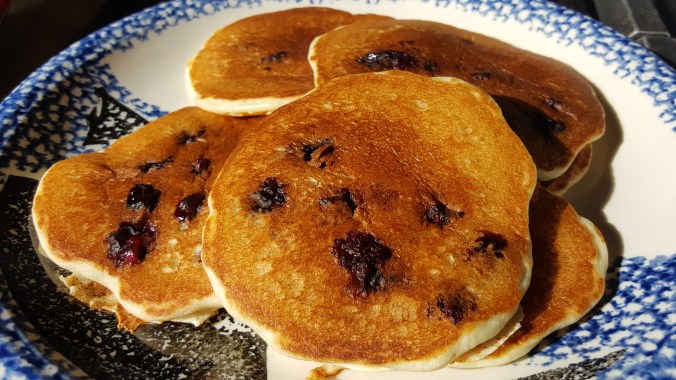
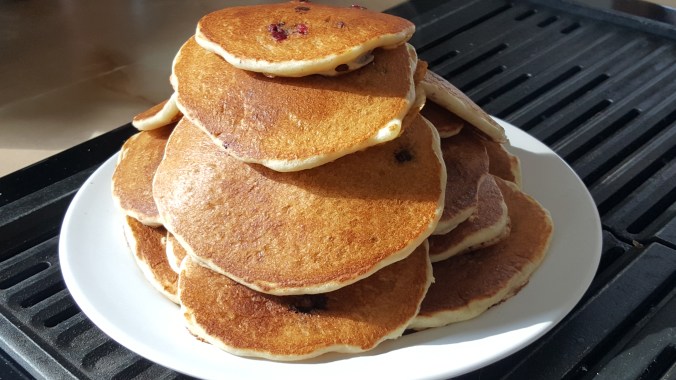
20170304_102544Never mind that President Donald Trump just zeroed out the agency I work for in his proposed federal budget. (I work for the Sea Grant Program under NOAA.) I realized I haven’t shared a recipe lately. Here’s a wheat- and corn-free version of blueberry buttermilk pancakes. I’d much rather think about them than Donald Trump’s budget.
If I let The Donald freak me out too much, he wins. I won’t let him win. But I will tell my friends to write their congressional representatives, and I’m sure I’ll blog more about this situation later. (Oh lucky readers, you!) In the meantime, I’ll cook some luscious pancakes in the sunshine on a weekend morning.

20170304_102057This recipe makes a lot of pancakes – enough for 4-6 people. If you’re sensitive to wheat, make sure to use vanilla extract that contains no grain alcohol. I make mine by soaking several vanilla beans in a bottle of potato vodka for a few weeks. For the gluten-free flour mix, I use Bob’s Red Mill all-purpose gluten-free baking flour.


And if you’re sensitive to corn products, make sure the buttermilk you buy doesn’t have a lot of extra ingredients added to it (like “natural flavor,” which can be secret code for corn syrup). Also, don’t use table salt. It usually has cornstarch added to it to make it flow more smoothly. Use sea salt instead.

Enjoy!

Blueberry Buttermilk Pancakes

2 eggs
2 cups buttermilk
4 T canola oil
1 cup rice flour
1-1/4 cups gluten-free flour mix
2 T cane sugar
½ t cream of tartar
1 t baking soda
1 t sea salt
1 t vanilla
1+ cup blueberries

Whisk eggs. Add remaining ingredients (except blueberries) in the order listed and whisk until smooth. Stir in blueberries.

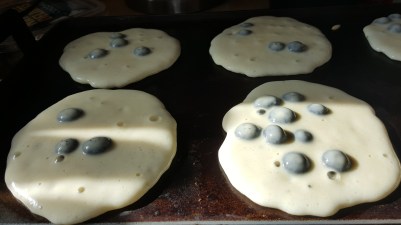
Pour batter onto hot griddle. Turn pancakes as soon as they are puffed and full of bubbles, but before the bubbles break. Bake other side until golden brown.

20170304_1035230

This recipe makes A LOT of pancakes.

That Time I was the Subject of a Federal Whistleblower Complaint

whistleblower

A page in my life story that I’d rather not have repeated, but a page that is interesting, was written back in the 1990s when I was a federal employee. I was working in public affairs for the USDA Forest Service in the Superior National Forest. This particular forest is also home to the Boundary Waters Canoe Area Wilderness (BWCAW), renowned for its canoe routes and primitive character.

As part of my job, I often helped with public meetings, and I wrote and edited documents. At the time, the agency was working on its first-ever management plan for the BWCAW. I wrote some of the background information for the plan and I edited the final version of the document. The plan required public comment, which we gathered by hosting meetings in towns across northern Minnesota. I sent out news releases about the meetings to the media and in general, just tried to ensure that people knew about the opportunity to comment.

Around that same time, I was a board member for our local chapter of the Audubon Society (you know, the environmentalist bird-lovers). I edited their newsletter and helped plan monthly programs. I can’t recall the exact timing of things, but I eventually quit the board because I was just too busy. The problem is, the new editor forgot to take my name off the board member list that was published on the back page of the newsletter.

After a few months, I noticed my name was still listed, and I asked the editor to delete it just for accuracy’s sake. A few more months later, it was still on there. I reminded the editor again, and he took it off.

As it turns out, it was too late. Somewhere during this time, the Audubon newsletter published a story in favor of the new BWCAW plan. Someone in Minnesota who was connected to the Blue Ribbon Coalition (an organization originating out West that advocates for the use of motorized vehicles on public lands) saw the newsletter story and noticed my name on the list of board members.

This person (who shall remain nameless) and the organization he was affiliated with did not like the new wilderness plan because it limited the use of motors in several areas where they had been allowed previously. He, with all the logic of the clueless, came to the conclusion that it was ALL MY FAULT that motors were being restricted in the plan because I was a board member of the Audubon group. He filed a complaint to this effect through the federal Whistleblower Program. He also complained about the manager of the BWCAW in a separate filing.

This was during a time when the Forest Service was getting political heat for not investigating claims. Heh heh, lucky us. Taxpayers got to foot the bill for an investigator to travel from Washington D. C. to Minnesota for several days to investigate us.

In the complaint about me (which I don’t think I ever got to read, but I got told about it by the investigator), the man claimed that my job within the agency put me in a position of power to influence the new rules that were being proposed in the plan, and that because I was a member of Audubon, I had a conflict of interest.

I explained to the investigator that I wasn’t even on the Audubon board when they developed their position in support of the BWCAW plan. I described the oversight that left my name on the back of the newsletter. I also explained my role in writing the plan, which did not include any omnipotent power to make up new rules against the use of motors in the wilderness. (I only WISH I had that type of power.)

Even though I was sure no wrong-doing would be found, being investigated by the feds was not comfortable, which was another outcome I’m sure the Complainer Guy wanted.

In the end, both the wilderness manager and I were found “not guilty,” and we were able to continue about our business. You can bet that we thought harder about how we did our business, but we continued it, nonetheless – savvier about the tactics used by some organizations.

On Being a “Professional Woman”

business_womanMy fair city has a group for women in business called the Professional Women’s Network. It first came to my attention when I was in high school. I was invited to one of their luncheon meetings as part of a program they had to reach out to students.
I’m not sure why I was chosen – I had no interest in business. I wasn’t even a woman yet (grin). But I went with a couple of other invited classmates anyway, because – free lunch!

I recall that the women were all very nice, but I was too young to understand the need for such a group. I decided it just wasn’t my thing.

And I also wondered about the organization’s name. The wording makes it sound like they are all women who are professionals at being women – leading to visions that their meetings are really about sharing hairstyle and clothing tips, swapping recipes, or divulging secrets on how to work their wiles on men.

Over the years, I would chuckle whenever the organization’s name floated into my field of view. If I ever did end up becoming a member, I would advocate for renaming it the Women’s Professional Network.

And Then There Were Two: An Update on the Status of Isle Royale’s Wolves

isrowolvesrolfpeterson

The remaining wolf pair on Isle Royale. Photo by Rolf Peterson.

Last week I attended a public meeting by the National Park Service to hear about their preferred plan to deal with the declining wolf population on Isle Royale, a remote island-sized park in Lake Superior.

If you’re a long-time reader of this blog, you may recall the story I wrote about the issue in 2015. At that point, there were three wolves left on the island. Now there are only two.

The deformed wolf mentioned in my last story is nowhere to be found (presumably dead) and the other two wolves, who may or may not be its parents, are still alive.

Researchers have discovered that they are a male and female wolf who are related to each other in several incestuous ways. (Hard to avoid this when you live on an island.) They are father and daughter, but also half-siblings. And they are old for wild wolves — six and eight years old. As such, it’s not likely they would have any (more?) ultra-incestuous offspring.

During the meeting, the park service staff discussed four alternative plans of action they are considering. Their preferred plan calls for the introduction of 20-30 wolves starting next fall/winter over a span of three to five years. It’s known in the Environmental Impact Statement as Alternative B.

The other alternatives involve taking no action, introducing a smaller number of wolves over a period longer than five years (20 years), and taking no action now but allowing for the option of action in the future.

Under Alternative B, the park service plans to capture packs of wolves, if they can, and to release them ASAP together on the island. They will collect wolves from the Great Lakes area, and ones that are not habituated to humans and are already used to eating moose for food. They want the wolves to spend as little time in holding pens as possible so that they don’t become habituated to them. Initially, the park service will provide moose carcasses (from Isle Royale) for the wolves to eat, but then will leave the wolves to fend for themselves. They will monitor them (with radio collars, etc.) to see how they are doing.

The fact that the park is considering messing with wolf introduction is a big deal. Normally, they are a “hands-off, let-nature-take-its-course” organization. But the wolves are so important to the island’s ecosystem and to controlling the moose population, that public pressure and human-caused global environmental changes have made the park willing to change its philosophy.

When I commented on this issue back in 2015, for nature-purist motives I was against any action. But now since it seems like the wolf population is indeed doomed, and it’s not likely that wolves will wander over to the island from the mainland on an ice bridge during the winter (especially right now as I am writing this and it’s 50-frikin’ degrees in February!), I am okay with the idea of introducing wolves.

What I am not so okay with is introducing the new wolves while the two existing wolves are still living on the island. At the meeting, when someone asked this question, the park biologist dismissed the concern, saying the existing wolves would have a survival advantage over the new wolves because they already know the island’s terrain, etc.

But come on, what chance do two old wolves have against 20-30 young whippersnapper wolves? I fear they will be shredded to pieces by the newcomers. I think it’s kind of inhumane to introduce the new ones while the old ones are alive. But for some reason, the park service is hot to do the introductions ASAP.

Another question that was dismissed at the meeting is whether the park would alter its plans for introducing the wolves if an ice bridge to the mainland was in place. The biologist said that wolf experts have told them the wolves would likely stay on the island.

I question this as well. The park service plans to get the wolves from MN, WI or Michigan. If I was a wolf, and my family and I were taken from our home not that far away (wolves can easily travel 40 miles in a day), dropped somewhere new, and there was a way to escape and go back home, I sure as heck wouldn’t stay there. Studies of wolves introduced in other situations found that they do travel away from the site of introduction toward their site of origin.

One would think the park service would want to ensure that the introduced wolves would stay in place by not introducing wolves if there was an ice bridge, but apparently not. This could be a waste of time and expense to taxpayers.

Another comment that was dismissed, and this time I’m glad it was dismissed, was the idea that people be used to control the moose population on the island instead of wolves. This would involve hunting, of course. Hunting on Isle Royale is currently prohibited by federal law. But also, I’d just rather not have the top predator on the island be humans instead of wolves. There are plenty of other places where people can hunt. And I can only imagine how hard it would be to haul a moose carcass over those island ridges. It was hard enough to haul my own carcass over them when I hiked!

Okay, enough of my ranting. If you’re interested in commenting on the plan, the deadline is March 15. And if you’d like to learn about Isle Royale’s wolves in a fun way, please read my novel, “Eye of the Wolf.”

Feeling the Loss at Paisley Park

aviary-trip-026

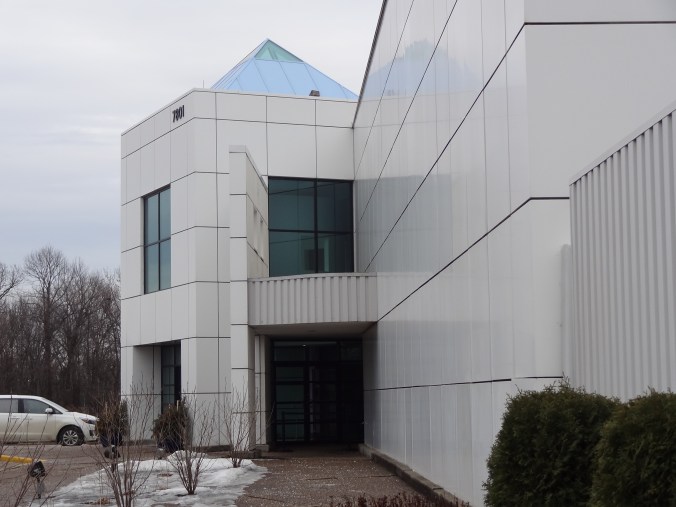
Paisley Park

Last weekend, a friend and I meandered to Prince’s home in Chanhassen, Minn. The late musician’s home, Paisley Park, has been turned into a museum and recently opened for tours.

Even though I’m not the hugest Prince fan, he’s such a Minnesota icon that visiting his home seemed the thing to do on a weekend get-away from The Great White North. And I wanted to learn more about this musician who died so unexpectedly last April.

When I was in college in the early 1980s, other than his songs over the airwaves, my introduction to Prince was via a poster on the inside of my dorm neighbors’ bathroom door. When I ended up using their bathroom because the one I shared was occupied, there was Prince, lounging around nekkid as the day he was born, while I peed.

Hardly an auspicious introduction, but surely a memorable one.

Then there was the time I took my dormmate to a restaurant in downtown Minneapolis for her birthday. As we prepared to order our food at our second-floor table, our waiter arrived, breathless. “Prince just came in!” He gushed. “He’s seated at a table on the first floor!”

My dormmate and I looked at each other and shrugged, nonplussed, not interested enough to go downstairs and gawk. Our musical tastes then tended toward the B52s, Sting, and Dire Straits. As our waiter continued his excitement over the star, I, of course, was thinking of that bathroom poster. 🙂

aviary-trip-024

Prince in Purple Rain.

Over the years, I watched Prince’s Purple Rain movie, enjoyed his music, and saw a few of his energetic and flashy performances on TV. I liked him, but not unusually so.

Then came last year. What was it about 2016 and the loss of so many musicians?! It was like they had a karmic bullseye upon them.

After Prince died, like many other people, I watched his past Superbowl halftime performance, relistened to his music, and rewatched part of Purple Rain. I couldn’t help but follow the news speculation about his death and the mess that is/was his estate.

I began to gain a greater appreciation for his talent and his style. That old cliché, “You don’t know what you’ve got until it’s gone,” fit for my belated appreciation, and was another factor that drew me to Paisley Park.

If You Go

The first thing you need to know about visiting the museum is that you can only buy tickets online in advance. The high interest and demand necessitates it. Guided tours leave every 70 minutes and they will be running at least through April of this year.

Another thing is that you can’t use your phone on the tour. You will be asked to turn it off, and the attendant will slide it into a little case, locked by one of those magnetic thingees similar to the anti-theft devices on jeans. They don’t want you taking pictures inside. But you can take photos after the tour in a tent that’s set up just outside the museum.

Impressions

The first thing that struck me is how close Paisley Park is to the freeway. I’ve probably driven past it a few times over the years and never recognized it for what it was. With its bland white exterior, I thought it was an industrial park or something.

Once inside, I was struck by the symbolism of the murals. Blue sky and clouds decorate the atrium (the sky’s the limit?) along with white doves. We craned our necks to catch a glimpse of Prince’s pet dove, Divine, in its cage on the second floor. A velvet purple couch with paisley pillows sits underneath the atrium windows and a plastic box that holds a replica of Paisley Park and Prince’s ashes. Off the atrium, you can look through glass doors to see Prince’s dining area and television room. His office is off the other side of the atrium as well as several other rooms that are now filled with memorabilia from his concert tours.

I was struck by how small the furniture was. Prince seemed so larger-than-life on television, but in reality he was only about 5’-2”.

Our tour guide knew Prince personally. He explained that the connection was made through his wife, who was Prince’s babysitter when he was young. It was very cool to have someone guide us who actually knew what Prince was like and had an emotional attachment to him.

During the rest of the tour, we saw the motorcycle Prince rode in the Purple Rain movie and outfits he wore during concerts. In his sound studio we got to hear one of the unreleased songs (an instrumental) from his mythical musical vault. Most impressive was a full-size concert venue room where he could practice for his tours and hold his own concerts.

The tour ended in the room that was Prince’s private music club. A small dining area there serves food that Prince liked (vegan rice crispy bars?!), which are available for purchase. The gift shop featured a wall bedecked with memorials that people had placed outside Paisley Park after Prince died.

I left impressed by the way Prince built Paisley Park to foster his creativity. It’s truly not a place that anyone else could just purchase and live in. Like Graceland is to Elvis, Paisley Park holds Prince literally and figuratively. It’s a monument to a Minnesota icon — one who some Minnesotans like me didn’t fully appreciate until it was too late.