Floors Castle and Crying During Movies: Adventures in Scotland, Part 9

061

Floors Castle, Kelso, Scotland

My story about Floors Castle starts, not in Kelso, but a few months ago back on my couch in the U.S. (Yes, I’m doing it again – starting a story about Kelso someplace else.) This was before I knew about the newspaper story detailing my ancestor Isabella’s childhood in the castle and before I was convinced of my family’s ties to the castle.

I knew of rumors of the ties, so I was digging through the castle’s website when I noticed a movie had been filmed at Floors Castle, called “Greystoke: The Legend of Tarzan, Lord of the Apes” (1983).

I actually saw this movie when it came out since I am something of a Tarzan fan. (I watched way too many Johnny Weismuller Tarzan shows after school while growing up.) Plus, if you’ve read my novels, you know I have a thing for animal/human communication. But the movie was rather fuzzy in my brain since I saw it so long ago.

I decided to buy the movie for a look at the castle in preparation for my trip. When I eventually watched it (sitting on my couch), I recalled why it got panned orginally. Much of the first part of the movie features Tarzan (Christopher Lambert) grunting at apes. The critics didn’t like the lack of dialog, but hey, what are you going to do? It’s a movie about apes! Nonetheless, the movie did end up receiving three Academy Award nominations. It didn’t win any, though.

The last half of the movie is set in Scotland at Floors. My dear blogging audience, because I have no pride left, I will share my reaction to the movie with you. In short, I bawled like a baby. When the castle first appears in the opening credits and the duke and his doomed son (Tarzan’s father) race toward it on horseback, tears were coursing down my face and I didn’t know why. It’s not usual for me to burst into spontaneous copious tears at movies. I’m more of a leaky-tear-wipe-away person. And the castle scenes weren’t particularly emotional, either.

But once the movie was over, I realized the tears were from an overwhelming feeling that my ancestors loved the place and their time there.

A few months later, I found the newspaper story about how my great-great grandfather worked at the castle for over fifty years, and I decided that maybe I wasn’t so crazy after all. I mean, why would he work somewhere so long if he didn’t at least like the place and the people in it?
057

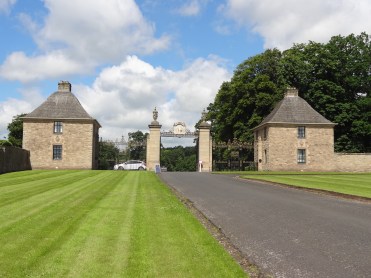
The castle gate.

My Bed and Breakfast was close enough that I could walk to Floors Castle. When I reached the gate, I asked the attendant if walkers got a reduced entrance fee, but she wasn’t buying it. 🙂

I meandered up the castle driveway with some trepidation. After all, if a movie could affect me so strongly, I wasn’t sure how I would react to seeing the real thing. This was after a search for my great-great grandfather’s gravestone at the Kelso Abbey that morning, which proved unfruitful. But I was told of another cemetery in town that I hoped to check on my next, and last day in Kelso.
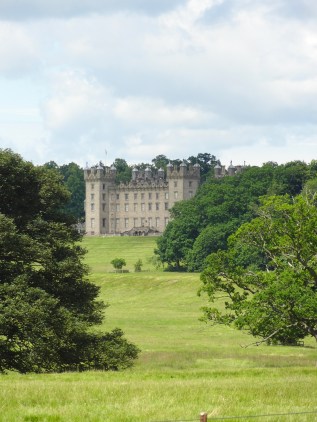
058The driveway was long and lined with tall trees and rhododendrons. It wound through fields and afforded views of the castle and the River Tweed in the distance. Set on a hill above the river, the castle appears to grow directly out of the lawn. I knew from my research that, in addition to the castle tour, Floors features a gift shop and two cafes (one with an outdoor terrace), plus a walled garden. It was still early in the day and I wasn’t hungry, so I planned to tour the castle first and eat later.

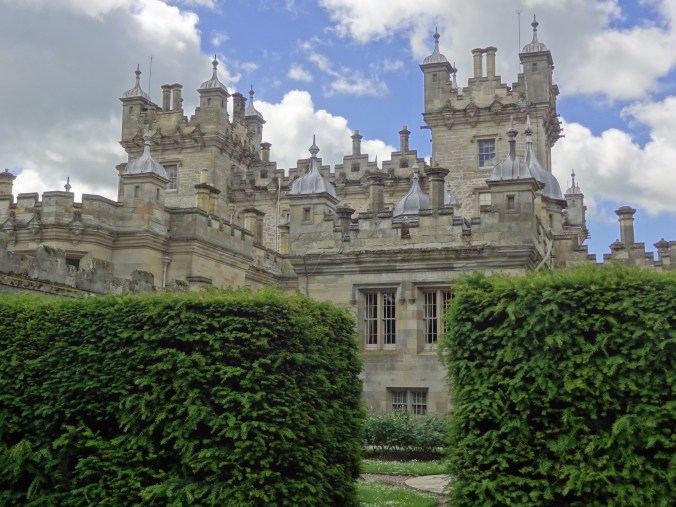
Built in 1721 for the First Duke of Roxburghe, Floors Castle is still home to the Roxburghe family and the Tenth Duke of Roxburghe. It is the largest inhabited castle in Scotland but parts of it are open to the public.

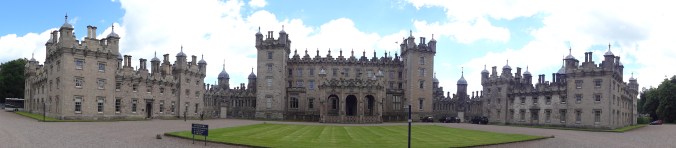
As I approached, I became confused about where to enter for the castle tour. It seemed as if the signs were pointing to the castle’s front door. Surely that couldn’t be right. Tourists entering through the impressive massive intimidatingly wealthy front door? What if I was mistaken and I walked in the front door and everyone turned to look at me in horror?
065

The front door. Intimidating, much?

I decided it was safer to enter the gift shop around the side of the castle first. I browsed the Floors Castle Christmas ornaments, Floors Castle honey, and Floors Castle dish towels, then asked the clerk where the entrance for the castle tours was. “The front door,” she said.

When I explained I couldn’t believe they’d let tourists in the front door she just laughed and said, “Of course, why not?”

Buoyed by newfound certainty, I walked to the front door. I did not get yelled at as I entered. Instead, the docent gave introductory remarks to the small group of us gathered in the entry, then he set us loose upon the castle. The tour is self-guided, although docents are in some of the rooms to answer questions and to ensure that nobody walks off with a priceless vase.

I wandered amid the tapestries, paintings and porcelain. There was even a room full of stuffed birds. Apparently one or two of the dukes were ornithologically inclined. One of the duchesses collected a few Matisse paintings. When I got to the dining room (which was originally a billiards room) I encountered a particularly friendly and knowledgeable docent named David.

slide4

The dining room where David and I talked. Image courtesy of Floors Castle.

I told him about my ancestral connections to the castle, and he was intrigued. He had a list of dates when the various dukes reigned, and we figured out my great-great grandfather must have worked for the sixth and seventh dukes of Roxburghe. David said a lot of building was going on during the reign of the sixth duke and that perhaps my grandfather was instrumental in it. The castle isn’t the only business on the estate, there’s also forests, fields, horses, wind farms and the like. It’s a huge operation.
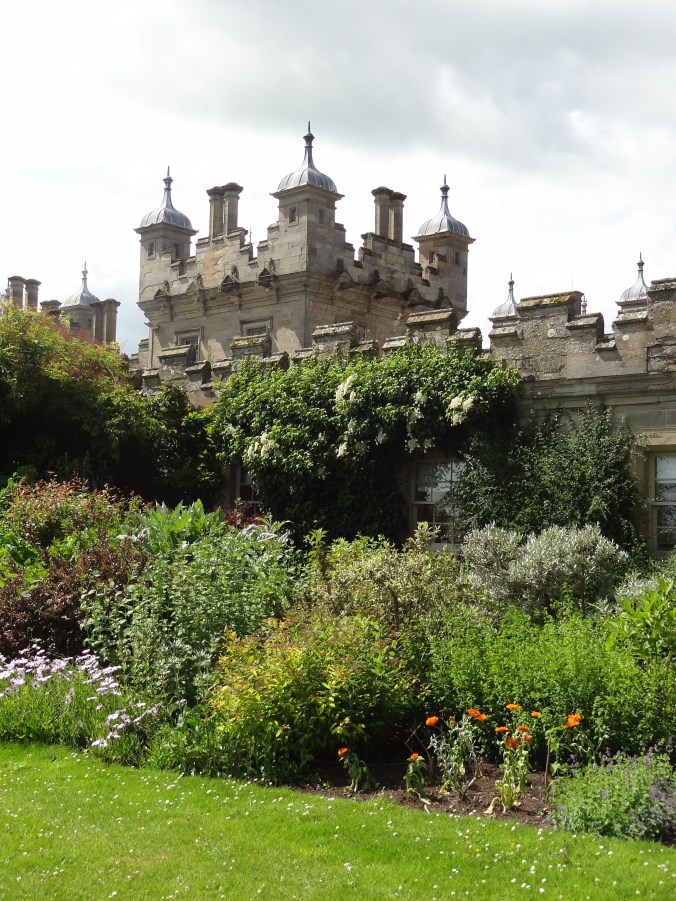
086We also got to talking about the Tarzan movie. He told me he was in the movie – he played a cleric. He said the rainy scenes at the castle were shot with the help of the local fire department up on the roof, spraying “rain” with their hoses. He also mentioned that the film directors were sticklers for historical accuracy. All the television antennas on the roof had to be hidden during the day, and were put back out in the evening so the residents could watch TV.

David promised to look into some things for me. I gave him my card. As yet, I haven’t heard anything from him, but who knows? So, although I didn’t get to totally “vindicate” my ancestors’ role with the castle estate office, at least David knows about him, and my family, and all of you!
072

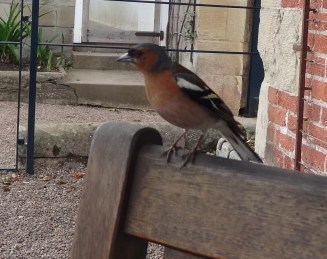
My bird friend.

By now I was hungry. Thankful that I didn’t burst into tears during my castle tour, I made my way to the terrace café. I sat outside and indulged my sweet tooth in chocolate eclairs and meringues. A friendly (and hungry) bird kept me company – reminiscent of the Kelso Welcome Swan.

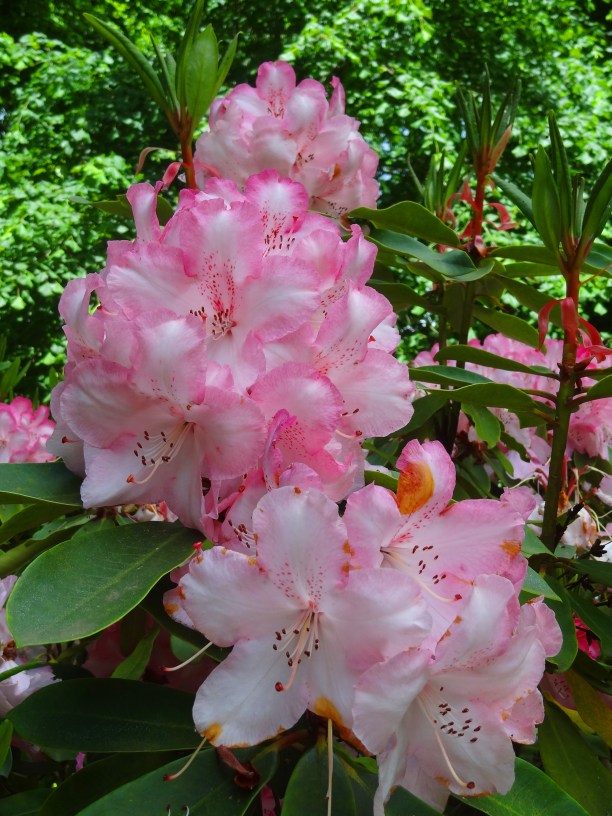
Sated and peaceful, I toured the walled gardens. But I must confess the flowers that truly impressed me were rhododendrons growing in the forest on the trail to the gardens (see photo below). After another visit to the gift shop to buy mementos, it was time to go.
069

As I left and walked down the drive, I couldn’t help but stop and turn back to look longingly at the castle several times. It was like the ancestors inside me didn’t want to leave just yet. I indulged them for a while, but then it was time for the next adventure.
Welcomed by a Kelso Swan: Adventures in Scotland, Part 8

034

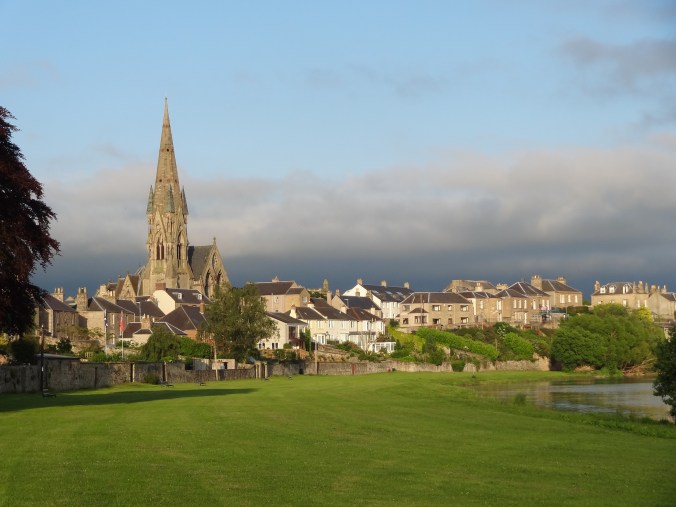
Kelso as seen from The Cobby Riverside Walk.

Three weird things happened on my trip to Kelso. The first happened before I even left the U.S., after I had already made reservations to stay at the Bellevue Guest House in Kelso. Although there are about fifteen other places to stay, I chose Bellevue because it looked nice and was the closest B&B to Floors Castle. A tingle went through me when I was visiting my parents and I looked in their scrapbook from their trip to Scotland in the late 1970s. They had saved a business card from Bellevue Guest House, where they stayed while they were visiting Kelso. (Cue the Twilight Zone music.)

The second thing was the fact that I did not get lost once on my journey from Edinburgh to Kelso. Just ask my traveling companion (who was no longer there to help navigate) — that was unusual. It was like I knew where to go. Ancestral memory, perhaps?

Actually, the drive was wonderful. The roads were wide compared to those in northeastern Scotland, and the scenery was ultra-pastoral. I sang as I drove – so happy at the ease of finding my way. By this time, I was much less terrified of driving in Scotland anyway, having a week of wrong-handed shifting and wrong-sided driving under my belt.

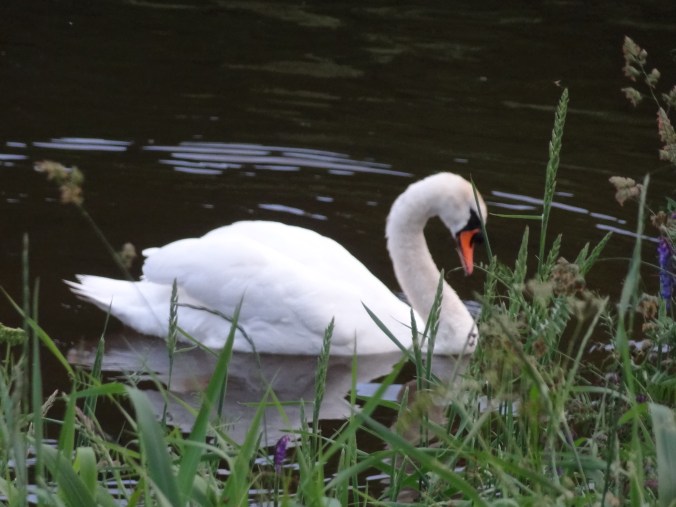
The third weird thing happened after I checked into Bellevue House. My host, Graham, suggested that I take an evening stroll along the River Tweed just a few blocks away. I unpacked and did just that. The riverside walk wasn’t on a boardwalk like we are used to in the U.S. The “walk” was a wide swath of mown grass along the riverbank. As I emerged from the neighborhood homes and came the river came in view, the first thing I saw was a huge white swan. It swam in the river directly across from me.

047

The Kelso Welcome Swan (a mute swan).

Ach – so beautiful! We kept pace with each other for quite a while, then parted, only to meet later downriver when it was with its mate. Call me weird, but I felt like the swan was welcoming me to Kelso.

037

The Kelso Abbey

I made my way along the river to the town square and the Kelso Abbey. The abbey has a graveyard, which I thought my great-great grandfather’s gravestone was in. But it was late and the gate to the abbey was locked. I’d have to come back tomorrow to look. Afterwards, I walked on the Kelso Bridge over the river and got a glimpse of Floors Castle in the murky and darkening distance.

Worn out from my long drive and walk, I retired back the Bellevue House to rest for my gravestone quest and visit to Floors Castle the next day.

Kelso Ancestor Quest: Adventures in Scotland, Part 7

Springfield Ancestor Quest 013

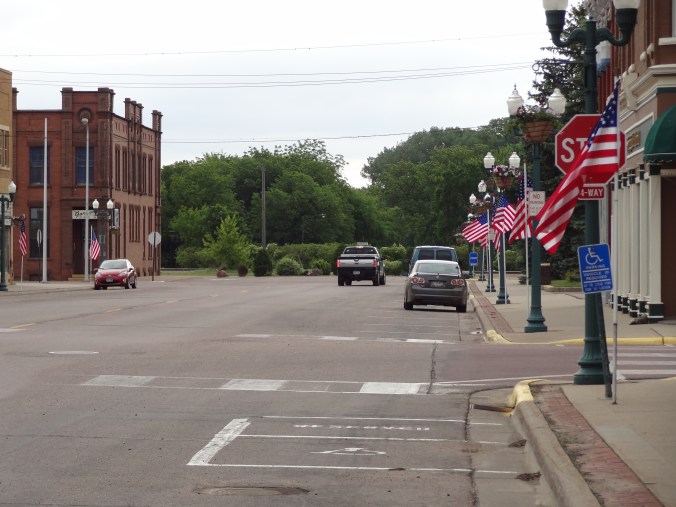
“Main Street,” Springfield, MN

My trip to Kelso starts, not in Scotland, but in the small southwestern Minnesota town of Springfield. That’s where my mother (from whom I get my Scottish blood) was born, and the museum there is home to a set of family scrapbooks she put together.

A few weeks before my Scottish trip, I visited the Springfield Museum on a quest. You see, one of my ancestors — my great-great grandfather William Dick — was rumored to have worked for Floors Castle in Kelso. He was the lead carpenter (or “joiner”). But when my parents and aunt visited Kelso in the late 1970s, they were told by the castle estate office that they had no record he worked there.

Dicks2

My Scottish great-great grandparents, Susan and William Dick.

As a journalist, I know that could mean a lot of things. It could mean the records were lost. It could mean no records were kept so far back (the mid-1800s) or it could mean nobody looked very hard for the records.

While tooling through the family genealogy book one day (months before my trip), I noticed mention of a newspaper article about William Dick working at the castle. The note said the article was in the family scrapbooks.

The castle, on its website, says it is interested in historical information about the people who worked there, so I thought a visit to the museum was in order to find records to prove that my great-great-grandfather worked there.

I also noticed in the genealogy and census records that at least one of their ten children, Isabella, was born on the castle property in 1842. Why would she be born there if my ancestors had no connections to the castle?

Since it’s a good chunk of a drive from Duluth to Springfield, my oldest son kindly offered to join me in the quest. This was also a good chance for him to learn more about his family history since he had never been to Springfield.

We took off one afternoon with tents in tow — planning to camp in the Springfield City Campground overnight so that we could get to the museum in the morning. The museum wasn’t actually open on the day we planned to visit, but I had made prior arrangements with the museum director to meet us there.

Springfield Ancestor Quest 017

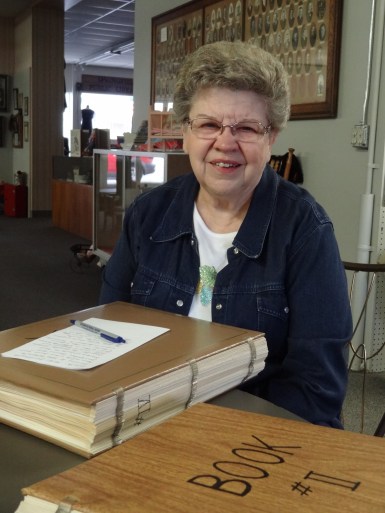
Very helpful Springfield Museum Director Carole Young with some of my family’s scrapbooks.

We met the director, Carole Young, as planned. She had the scrapbooks waiting for us, spread out on a table. It didn’t take us long to find the newspaper article in question since my dear organized mother had indexed the scrapbooks by family name.

There it was, a story from the Spirit Lake Beacon, a newspaper in Iowa. It was dated 1913 and had the title, “Scenes and Reminiscences of a Spirit Lake Lady Reared Among the Royalty of England and Scotland.” It was an interview with Isabella (the one born at the castle) and the story featured her memories of life growing up in a grand house on the castle grounds. Her father was the head state carpenter at the castle, holding the position for “upwards of fifty years” until he retired.

Their house was apparently near a cricket field and castle visitors, such as Queen Victoria and the Prince and Princess of Wales would drive down from the castle to their house to watch the games. The article says “rooms were prepared especially for them” by Isabella’s mother and the children. During these visits, Isabella said, “We children were always on our best behavior and willing to do little things to make it pleasant for the visitors,” who often stayed three or four days at a time. Isabella also met famous composers and pastors. She and her siblings were sometimes called on to “make up the required number” for a cricket game, and Isabella was proud that they could play the game well.

Eventually, Isabella, a widow with children, left the U.K. and came to America to marry a childhood neighbor who lived in Illinois. They later settled in Minnesota and then Iowa. Her brother, Francis, came to America also, settling in Minnesota. He was my great-grandfather.

Viola! Proof that William Dick worked at the castle! Unfortunately, there was no way to photocopy the article from the scrapbook, so my son and I took scans and photos with our cell phones. However, they didn’t turn out so well. Once I returned home, I searched for a digital copy of the story. I couldn’t find it in the Spirit Lake newspaper database, but I was able to find the same story in The Des Moines Register, which had published it a week later. Score!

I sent the story and a photo of William Dick and his wife to the castle. I had also emailed the castle previously, but did not receive a reply to either attempt.

Harrummph. Whatever. It was proof enough for me. And the quest was a good bonding experience for me and my son. I realize there’s almost nothing more boring than reading about someone else’s ancestors, but I hope this story wasn’t too painful.

Next posting: Kelso — for real this time!

Springfield Ancestor Quest 015

Attracting a Parade in Edinburgh: Adventures in Scotland, Part 6

022

Edinburgh, Scotland

Alas, it was time to leave our dear Crovie Cottage and depart for Edinburgh, where my friend was catching a plane to the U.S. I was going to travel on to Kelso, near the English border, but I had a small window of time to spend in Edinburgh before then. An hour-and-a-half, to be exact.

029We found my friend’s Edinburgh lodgings for the night, then took a bus to the Royal Mile. After being in the tourist-sparse northeastern part of Scotland, seeing the crowds on the Royal Mile was a shock. The “mile” is a corridor of shops, restaurants and historic buildings that span the center of the city between Edinburgh Castle and Holyrood Palace, where the queen hangs out upon occasion.

We visited shops, looking for tartan scarves and tights; saw street performers; and marveled at the diversity of voices and faces in the crowds. We also seemed to have attracted a parade. My friend and I have a talent for this (see proof from our trip to St. Martin). The parade participants seemed to be all male and were affiliated with different religious groups – their drums pounding out a warning directed at all the sins in the world.

026Was it a marketing ploy to get others to join their ranks, or a protest? I didn’t have time to find out since I had to leave for my Bed and Breakfast awaiting in Kelso. I bade my friend goodbye and was off.
031

A street performer on the Royal Mile.

Later, my friend told me she climbed to the top of Arthur’s Seat, a group of hills behind her lodgings. As the sun set, she was treated to a “peak” moment, listening to Sir Elton John who was performing in an amphitheater below. She danced up on the hill to “Candle in the Wind,” and “Crocodile Rock” – a fitting end to her magical Scottish journey.

Saving the Whales (and Dolphins): Adventures in Scotland, Part 5

038

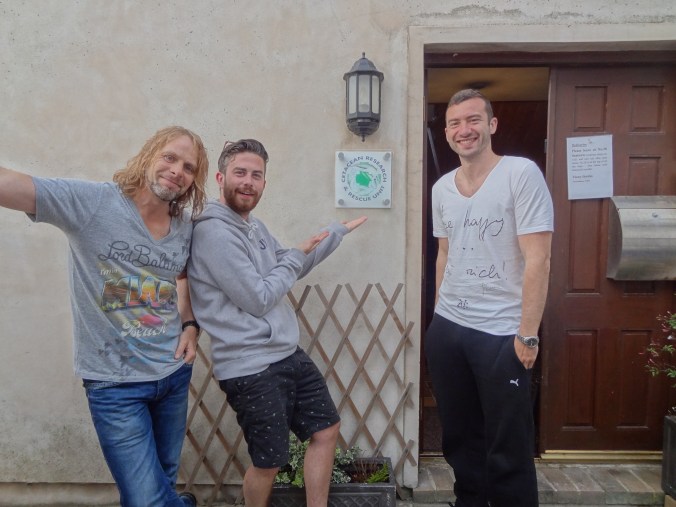
Director Kevin Robinson (left) and Theo (right). The ham in the middle is Jack Borrett.

When I was researching things to do in Scotland, I was intrigued to discover the Cetacean Research & Rescue Unit in Gardenstown, next door to our temporary Scottish home of Crovie.

I contacted the “unit” by email before our trip and asked about the opportunity to learn about what they do. We were welcomed to visit. Although it took a few tries to connect once we were in Scotland (due to vagaries in weather and schedules), we found director Dr. Kevin Robinson and research assistant Theofilos Sidropoulos (Theo for short) in their office on the shores of the Moray Coast one afternoon and they were nice enough to talk to us for over an hour.

Let me set something straight. You may have misread the name of the unit as the “Crustacean Research & Rescue Unit.” No, they do not rescue hapless mollusks. They research and rescue cetaceans, which are whales, dolphins, and porpoises.

Kevin founded the organization over twenty years ago. He explained that he got his start in the field by working in Inverness for a marine mammal organization. He saw the need for another organization that focused more on marine mammal strandings, and the Cetacean Research & Rescue Unit was born. The Unit is a nonprofit organization that tracks the population of the farthest northern pod of dolphins in the world in the Moray Firth. They do this through scouting trips and by taking photos of the dolphins and identifying them by their dorsal fins. Despite dire predictions at first, Kevin said the dolphin population in the Firth is thriving.

SCOTLAND! 039

Gardenstown, Scotland.

The unit also conducts research. Kevin explained that their latest quest was to take skin mucus samples from minke whales. The samples can then be genetically analyzed. To take such a sample, the researchers must get close enough to a whale to reach it with a pole that has the sampler attached to the end. They need only touch the whale with the sampler (no skin pricks or pain involved), but that was proving easier said than done at the time of our conversation. Also, Theo is a student at Edinburgh University and said he was researching the effects of climate change on the environment and marine mammals.

And, of course, they respond to reports of strandings. They provide 24-hour veterinary response for sick, injured and stranded marine mammals. Kevin said that unfortunately, most of the stranded animals don’t make it. But it’s nice to know that someone is looking out for them.

In our wide-ranging conversation, we also learned the organization focuses on environmental education as well. They educate school children about marine mammals and present papers at scientific conferences, and the like. They even have a Facebook page.

IMG_0921

The sign on the path between Crovie and Gardenstown. One takes their lives in their hands at every passing. And it seems the sign has seen its share of rockfalls (or bullets!)

And if, like me, you have a secret desire to save the whales, you can do so by volunteering for the unit during the summer (May-Oct.). As long as you are able-bodied enough to get out in a boat and to walk along steep coastal paths, you’re in! Kevin mentioned that a woman in her seventies volunteered for them and for other organizations around the world. She ended up coming back to them for a second time when she was in her eighties because she so enjoyed her first experience. There are still openings available for this year.

The unit is working to raise funds for a new boat to help with their conservation work and to replace their aging vessels. Click here to donate. Their goal is to raise the funds by the end of July, so please act fast if you are so inclined. They are about three-quarters of the way there.

We left their office with a better understanding of life in the waters of the Moray Firth. Kevin and Theo were also nice enough to direct us to where we could see puffins and seals locally. (And we did!) I think it would be totally fun to come back there someday as a volunteer. We’ll see if the fates will allow for that.

Next up – Visiting Edinburgh in an hour-and-a-half!


Stalking the Wild Puffin, and Seals on a Conveyor Belt: Adventures in Scotland, Part 4

007

Puffins at the Bullars of Buchan.

One of the reasons my friend and I went to Scotland in June was for the chance to see puffins before they left their breeding grounds. My friend studied these seabirds when she was in graduate school, and she wanted to see them again. Me too. As you may already know, I have a thing for birds.

SCOTLAND! 064

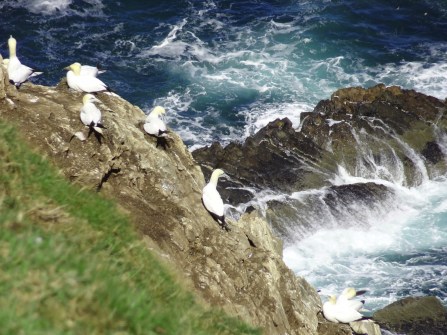
Troup Head gannets.

Our first try involved a short trip from our cottage at Crovie Village to Troup Head, a nature reserve less than a mile away. The reserve is home to a gannet colony, but puffins are sometimes sighted there, too. I had only seen one gannet in my life (in Newfoundland, sort of by accident). I was thrilled by that, so you can imagine how overwhelming it was to see so many gannets on Troup Head, they were impossible to count. And the view from the cliffs is stunning!

SCOTLAND! 058

The view from Troup Head.

But, no puffins. The next day, we ended up visiting the director and staff at the Cetacean Research and Rescue Unit (who I will write more about next) in Gardenstown, the town next door to Crovie, and mentioned our plight. They recommended we try the Bullars of Buchan, a former fishing village on the coast on the way to Aberdeen. We also wanted to see seals, and they recommended the estuary of the River Ythan in the town of Newburgh, not far from the puffins.

004

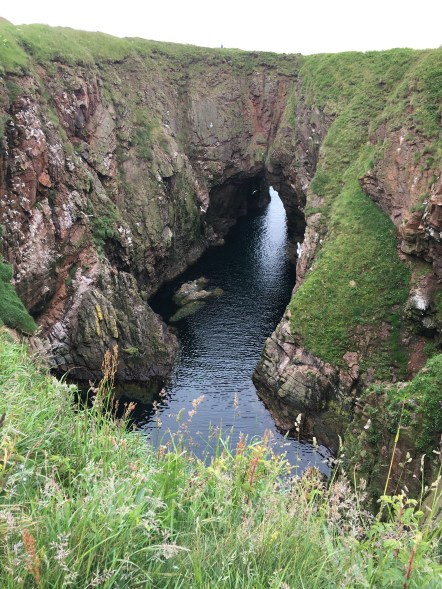
The Bullars of Buchan.

So off we went. OMG, the scenery at the bullars was as spectacular as the scenery at Troup Head. The village is set atop a headland that features a collapsed sea cave that forms a “pot” about 100 feet deep. The seabird colony was home mainly for gulls but my sharp-eyed friend did find some puffins. And a few were close enough to photograph with our low-tech cameras. Score!

Next to find the seals. You’d think they’d be in a nature preserve, too, but they’re not. To find them, drive through the town of Newburgh and follow the Beach Road. You can park right near the estuary. A short walk through the dunes finds you at the river mouth. We were expecting to see a seal colony on land, but what we got was more like a watery conveyor belt of seals.

008

Grey seals in the River Ythan.

The tide was flowing upriver. The seals were floating, somewhat evenly spaced, from the sea into the river. Their black heads bobbed past those of us watching from shore with clockwork regularity. Seal head dots everywhere – weird but amazing. Sometimes one would dive, no doubt after a fish, and then resurface farther up river. I suppose when the tide reverses, the seals just float back out into the ocean. We watched for a long time, mesmerized.

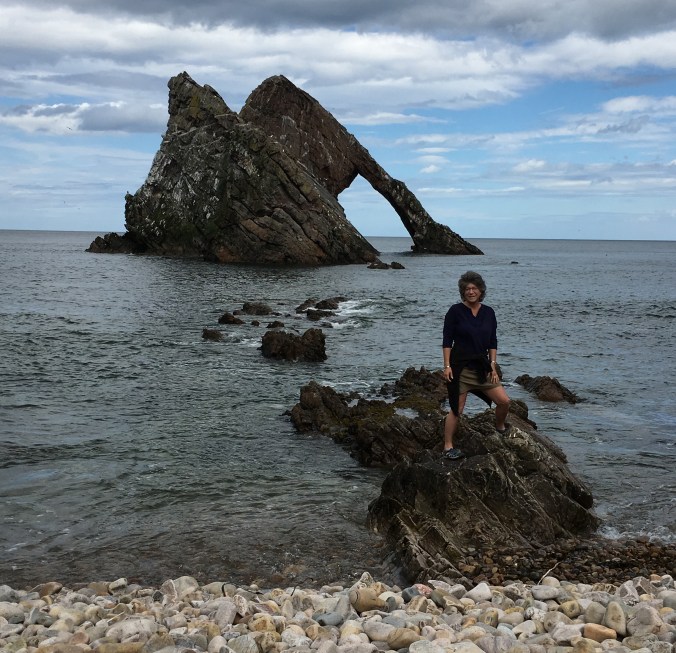
Other natural wonders we saw were of a more geologic kind. We hiked a good ways. One trip found us along the coast on the way from the town of Cullen to Portknockie, home of the famous, craggy and triangular Bow Fiddle Rock (see image at the end of this post). I can’t help but think it would make a great scene for an album cover. Too bad I’m not a musician!

001Another hike found us on the Great Glen Way above Loch Ness, making our way through primeval forests and gorse hedges with mountains in the background for accompaniment. I never got to see Loch Ness on my ill-fated European trip when I was ten, so I was especially glad to make it there.
Every place where I travel that has an aquarium, I try to visit. I “collect” aquarium visits like some people collect refrigerator magnets from their travels. In planning our trip, I was excited to discover that Macduff, a town not far away from Crovie, had a small aquarium focused on marine fish. The children in Scotland were still in school, and I was heartened to see several busloads of them gaining a greater appreciation for the sea while we were there. Although the Macduff Aquarium is small, they do a great job on interpretation.

The next day, we got a greater appreciation for marine mammals and the local people who are trying to protect them when we visited with the Cetacean Research & Rescue Unit – to come in the next installment!

IMG_0950B

Marie at Bow Fiddle Rock.

The Deflowering of a Whisky Virgin: Adventures in Scotland, Part 3

SCOTLAND! 077

Sure, I messed around a few times – kissed the rims of a few whisky glasses in my fifty-something years, took a few sips — but I didn’t know what I was doing.

In my everyday world, most of my experience was with wine, gin, and hard cider. I really can’t have much else due to an intolerance for wheat and alcohol made from grain. But scotch whisky is made from barley, so our trip to Scotland within sight of the Speyside Whisky District provided a prime opportunity to experiment and branch out into a whole new area of sensual delights.

My friend and I visited two distilleries in the Highlands during our week together: Glen Dronach in the town of Huntley, and Strathisla in Keith. As with most sensual experiences, my first at Glen Dronach, was the most memorable.

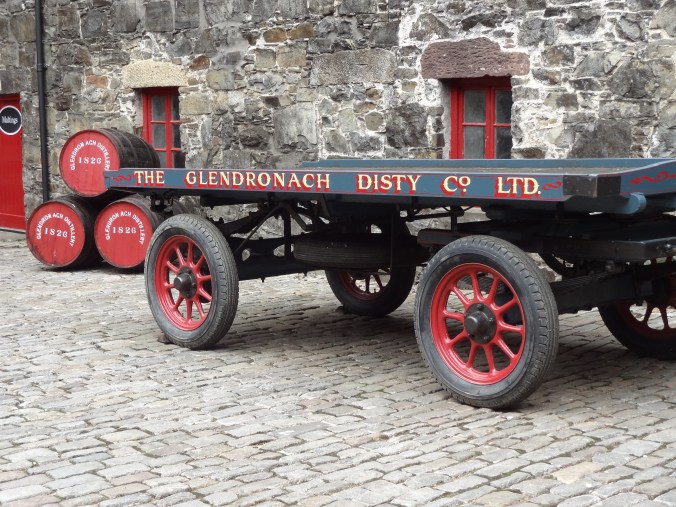
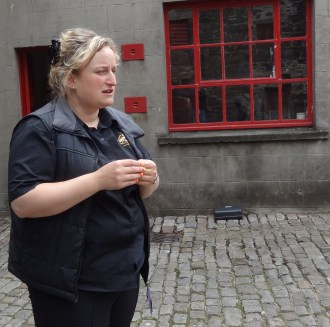
Glen Dronach is renowned as a “distiller of richly sherried single malt whiskies of inimitable and individual character” (according to their web site). Our tour guide, Karen, explained that unlike other distilleries, their whisky is aged in barrels that were once used to store sherry in Spain. The flavor of the sherry seeps into the wood, and seeps back out into the whisky stored in them.

SCOTLAND! 076B

Karen, our distillery tour guide.

The distillery was in full production mode, so we were able to see all the processes, from the malted barley being ground into flour, to the brewing, fermentation, and distillation. The smells of all those processes were earthy and wondrous. I was impressed by how huge the vats were in comparison to a gin distillery I recently visited back home in Minnesota.

As we walked out of the distillery and into the visitor center for our tasting, Karen pointed out an American flag on the lawn amongst several others. She said the flag was new and represented the fact that Glen Dronach and its parent company were recently acquired by the parent company of the Jack Daniel’s brand of whiskey. Others on our tour expressed fears that the new company would come in and change everything. Karen said she hoped that wouldn’t happen. “Why buy something that you like and then change everything?” Those Highlanders and their traditions. I expect that even if the new company wants to change things, they’ll run into a bit of resistance. 🙂

An interesting thing we learned on the tour is that while it is aging, some of the scotch evaporates from the barrels. This is unavoidable. The disappearing drams are called the “angels’ share,” since it’s the angels that get to drink it. Karen said she’d like to be one of those angels someday.

Onto the tasting. I chose the basic tasting, which featured eight-, twelve-, and eighteen-year-old scotch samples. My friend (who was our driver) took the driver’s tour, which, alas, featured no on-site tasting, but she was given a dram of twelve-year-old scotch to take home. Since the distillery is sort of in the middle of nowhere, it makes sense that they would offer this option because the only way to get there is by driving. I suppose there are legal reasons, too.

As I was sampling, my friend asked our guide what her favorite whisky was. Karen said when she has company at home, she brings out the twelve-year scotch. “But,” and here she cradled a bottle between her breasts like a child, “for my family, I save the eighteen-year scotch.”

She was right to save the oldest for her closest kin. The younger whiskies were fine, but when the eighteen-year-old version touched my tongue, I felt things I never had before. (Smirk.) No really, the flavor was so much more full-bodied and warm. The whisky assaulted my entire tongue, not just a part of it. Tastes of sherry, oak, barley fields, Highland air and Speyside water made me stop and take a step back from the table.

“Oh, that’s good,” I said, promptly ignoring the dregs of my other two whiskies, and concentrating on the eighteen-year-old.

We talked for a while more and then a blond-haired gentleman walked into the room. Karen introduced him as Billy, the master distiller. She told him about my reaction to his eighteen-year-old scotch. He smiled and looked pleased that he obviously still had the right touch.

Of course, now that I’m back in America doing research for this posting, I find out that Billy (Walker) is pretty much head of the whole frikin’ company. I can’t believe we met him!

We left Glen Dronach with a good feeling about the family atmosphere of the distillery, and with a supply of scotch to celebrate that night’s Solstice back at Crovie Cottage #13.

031

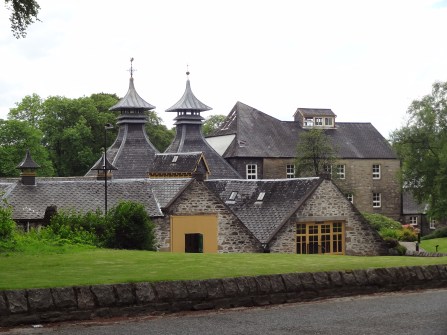
Strathisla Distillery in Keith, Scotland.

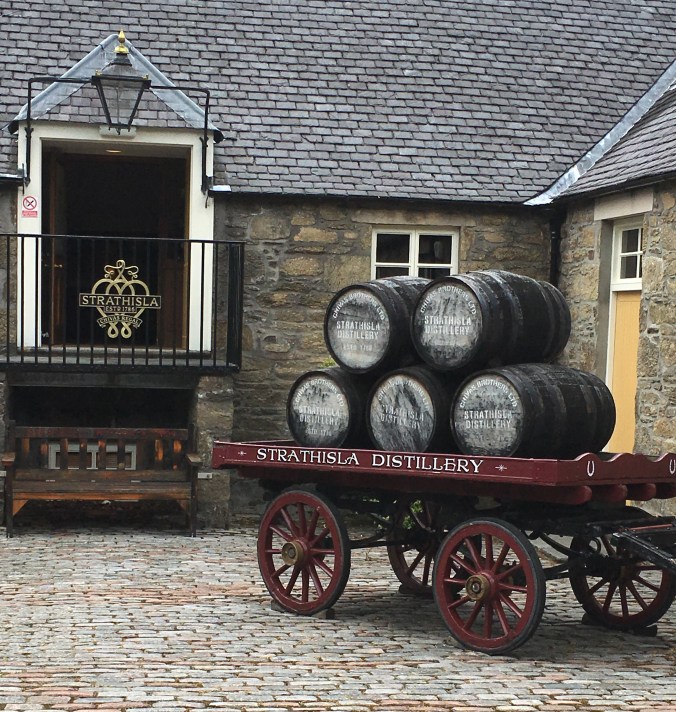
A few days later we visited Strathisla (pronounced Strath-ila), the oldest operating distillery in the Highlands, and the spiritual home of Chivas Regal scotch. Like Glen Dronach, Strathisla was purchased by an American company that had already been using Strathisla’s single-malt scotch as the basis for its blended whisky products. Strathisla’s parent company also owns The Glenlivet and Aberlour distilleries.

Unfortunately, the distillery was down for cleaning, but we decided to take the tour and do a tasting anyway since we had time. The size and scope of Strathisla were similar to Glen Dronach. But at Strathisla, we had the additional experience of going into one of the warehouses to see where the barrels rest. We learned that distilleries often warehouse other distilleries’ barrels as a kind of insurance in case some disaster befalls the parent distillery.

Another fact our tour guide mentioned is that there are 20 million barrels of whisky in Scotland. Wow! Even though there’s so much of it, it has to age at least three years before it is used. She said the distilleries are having a hard time meeting demand for their product worldwide, and that China is home to most of that demand.

All but one of the whiskies offered at their tasting was blended with grain alcohol, so I only tried the twelve-year-old single-malt Strathisla. (Besides that, I was the driver this time.) It was very good, but did not have quite the same effect on me as the eighteen-year-old Glen Dronach.

I left glad that I had lost my whisky virginity to Glen Dronach and the skillful hands of Billy Walker. Now I know a little bit more what I am doing when it comes to scotch.

As if whiskey virgin deflowering weren’t exciting enough, my next entry will focus on some of the wilder pursuits in Northeastern Scotland.

IMG_1020

Cullen Skink and Scones: Adventures in Scotland, Part 2

SCOTLAND! 037

The non-rocky part of the trail to Gardenstown.

We spent our first day at Crovie Cottage #13 on the Moray Coast exploring the small fishing village and hazarding the “Danger! Falling Rocks!” trail that leads along the sea to neighboring Gardenstown. Eventually, we stopped at a café for lunch.

The Tea Pot Cafe is the kind of place where everyone notices when somebody new walks in. Your table neighbors will advise you on menu choices, ask where you’re from, and if you’re lucky, will tell you the best places to visit.

SCOTLAND! 053

The rocky part of the trail.

We were advised to visit Delgatie Castle for the best scones and Cullen skink in the land. Scones need no explanation. Cullen skink, however, is a chowder made from smoked haddock. It was invented in the nearby town of Cullen, and is apparently all the rage. Certain restaurants along the coast even boast chefs who have won Cullen skink soup honors. The “Cullen” part of the name of this dish sounded okay to us. The “skink” part, not so much, but we were game to try it.

026

Delgatie Castle

So, the next day, after a visit to a nearby gannet colony at the Troup Head Nature Reserve, we were off to the castle. Delgatie Castle is no longer inhabited, but is run by an organization. As we approached on the dirt road and the pink tower loomed through the trees, we were stuck by the feeling we were in a fairytale.

Hungry again, we opted to visit the Laird’s Kitchen first and tour the castle later. We were not disappointed by either the scones or the soup, although as you can see from the photo below, the meal was a bit, er . . . white. The bread was homemade and the scones were meltingly hot.

The castle is primitive compared to others I’ve been in but it was interesting to see how the rooms were arranged around the large central tower staircase. There’s also a creepy story in one of the rooms about a monk being buried behind a wall.

So that was our introduction to local fare and Delgatie Castle. Next, it’s on to whisky!

SCOTLAND! 067

Cullen skink soup, homemade bread, and tea – of course.

Cruising in the Crawler Lane: Adventures in Scotland, Part 1

SCOTLAND! 014

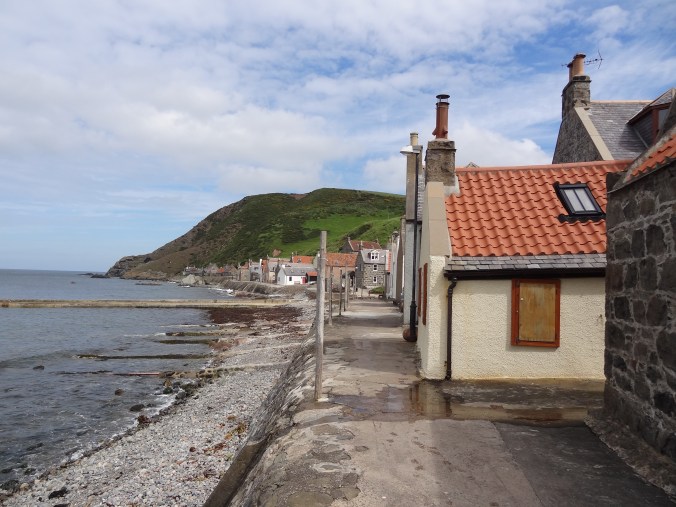
Crovie Village, Scotland. Where the sea is not only on your doorstep — it IS your doorstep!

At the time of this writing, I am almost done meandering around Scotland for ten days. I traveled with a friend and we spent most of our time in northeastern Scotland (the Moray Coast area near Banff). After that, I traveled by myself to the Borders area in the south to visit my ancestral hometown of Kelso.

First of all, I would like to apologize to all the drivers in Scotland. Yes, for the first several days at least, we were the ones stalling our manual transmission rental car while driving up hills and through round-abouts. We were the ones poking along in the far left lane (a.k.a. the crawler lane), afraid to drive over 65 m.p.h. It’s not easy driving on the left side of the road and shifting with your left hand. Just one of those things would be difficult, but add both of them together and it causes Driving Dread. It took me about four days before I could approach the car without wincing at the imagined bloody outcome.

SCOTLAND! 024

More Crovie.

Thank you Scottish drivers for not honking at us too often and for not crashing into us.

There, that’s out of the way.

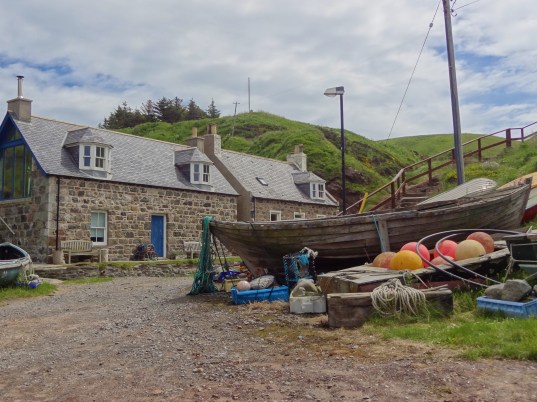
We chose to stay in the historic fishing village of Crovie (pronounced “Crivvy” by the locals). It was settled by displaced Highlanders after the Battle of Culloden. Located at the bottom of a steep bluff right near the sea, I suppose it was land that nobody else had the guts or desperation to settle, and so it was theirs for the taking.

Crovie operated as a town and fishing center, home for up to 300 people at one time, until 1953, when a severe storm damaged many homes. Most of the people moved to Gardenstown, just a mile next door. Now the town functions mainly as a tourist attraction, hosting seasonal visitors and a few residents.

We met the last of the remaining full-time residents during our stay. His name is Billy. He’s lost some fingernails, and parts of fingers. He is also missing some of his upper teeth. But Billy is a rough-cut gem, and has obviously survived a hard life near the sea.

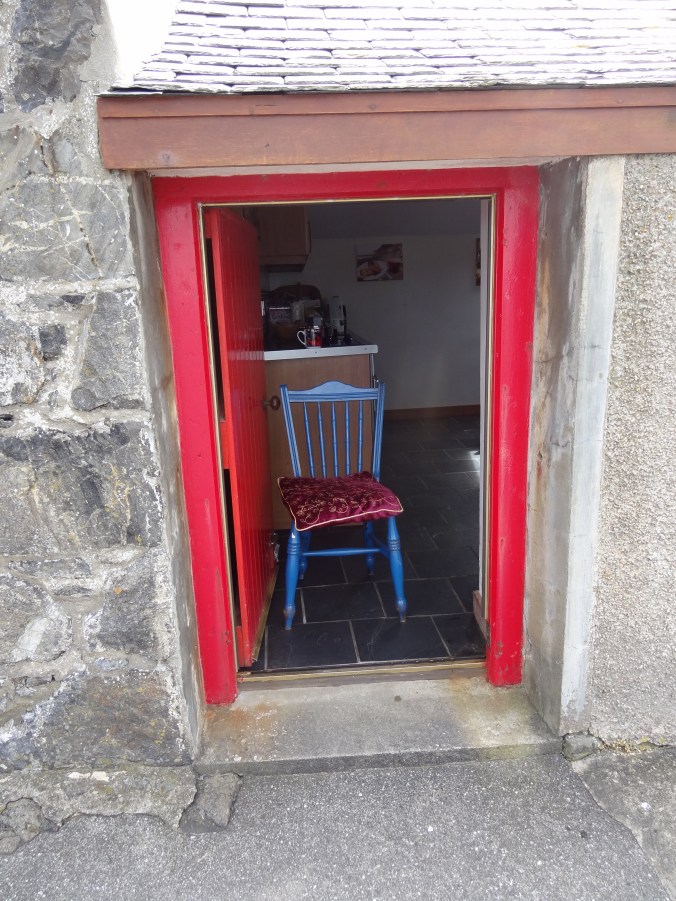
SCOTLAND! 027Our abode was Crovie Cottage Number 13. What could go wrong, right?

As the cottage ads say, abode number 13 is not suitable for triskaidekaphobics (those who fear the number 13). Fortunately, we do not suffer such a fear and found the place inspiring and charming. It took us a while to figure out which switches to flip for necessities like hot water and electricity, and how to operate the electric meter that required feeding with 1 pound coins for an uninterrupted flow of electricity, but after a day or two we had it down.

We also learned how to light a coal fire in the fireplace, and how to eat breakfast with the front door open to the sea (which is only three feet away).

Be forewarned – if you ever decide to visit or stay in Crovie, the descent into the village is extremely steep. You also can’t just park your car in front of your cottage and unload. There’s not enough room between the cottages and the sea for a road, so you have to park either at the lot above the steepest part of the road or the one at the bottom of the steepest part, and roll or wheelbarrow your supplies to your cottage.

My kind of place! More adventures to follow . . . .

SCOTLAND! 015

St. Martin Island – Where Nothing is Better

St. Martins 1 030

A Carnival parade in Marigot, on the island of St. Martin.

The weather in my town is so foggy and cold lately, it’s got me wishing I was back on St. Martin, an island where I meandered four years ago. This blog entry is a good excuse to revisit that trip and share it with you.

I travelled to St. Martin with a friend. We chose it that February because: A) It was warm. B) English is spoken. C) No visa is required, just a passport, and D) U.S. dollars can easily be used. It was foreign, but not too foreign, if you know what I mean.

The island is also extremely easy to find your way around, literally. One main road encircles the coast, so it’s hard to get lost. Also, round-abouts abound, making it easy for confused tourists to have more than one chance to choose the proper exit.

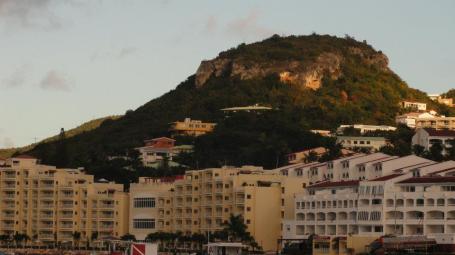
Pineapple Hill SimpsonBay

Pineapple Hill at Simpson Bay.

We stayed at a beach resort, and did plenty of frolicking in the waves and snorkeling. The first off-resort beach we went to was the one famous for having an airport runway approach right overhead (Maho Beach). It’s not often you get to take a tan and watch a plane fly only 50 feet above your prone body. I kind of wonder how long it will be before a disaster happens and either the beach or the airport gets moved. (But I hope no disasters happen.)

ButterflyFarther inland, visitors can zipline through the jungle at a nature preserve, visit a butterfly garden and open air markets, and hike to the highest point on the island (Pic Paradise).
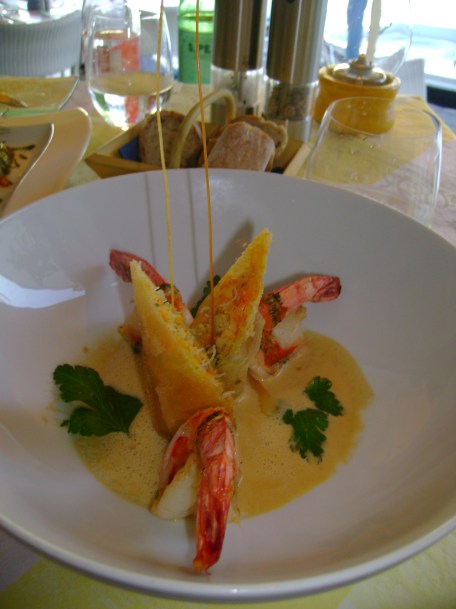
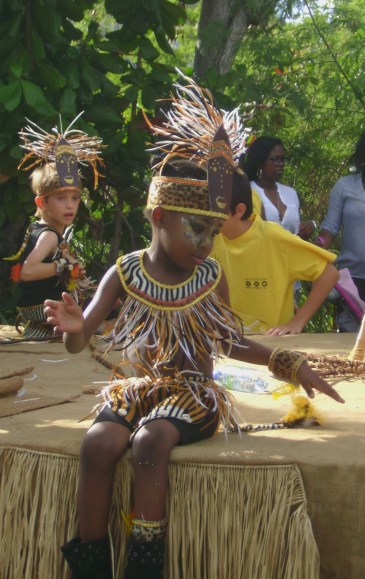
Half of the island is under jurisdiction of the Netherlands, the other half, France. The day we explored the French side, we chanced upon a Carnival parade in the French capitol city of Marigot. We also scored a fabulous French meal in a harborside bistro, Le Chanteclair, where their most-appropriate motto is: Gastronomy is the foundation of true happiness.

St. Martins 1 041

A meal at Le Chanteclair in Marigot: prawns with an egg roll and lobster sauce. To die for!

In the Netherlands capitol city of Philipsburg, we discovered an art gallery and movie museum run by the “Yoda Guy.” He was one of the original make-up artists who worked on Yoda in the Star Wars movies.

The residents of St. Martin are friendly, and unlike some Caribbean islands I’ve visited, there doesn’t seem to be a huge income disparity between the islanders and the visitors. I never felt unsafe walking around at night or driving through towns. And the bartenders are friendly, too. My middle-aged friend and I had one hit on us (he gave us his phone number with hearts drawn around it), which makes me even fonder of the island. 🙂

One note of good-natured warning. Be sure to consult your beach guide so you know what type of beach you’re going to. We stumbled upon a nude gay beach by accident, but figured things out pretty darn fast (and ran away!) The island also sports several nude resorts, Club Orient, is the most popular. Their motto is: Where “Nothing is Better.”

St. Martins 1 038Although we ran away from the nude gay beach, we did find a nude beach suitable for the adventurous introvert. Sorry, I can’t recall the name of it now (Happy Bay?), but it lies within a gated community. A couple who were leaving through the gate were good enough to give us the entry code, and we enjoyed freeing ourselves of our swimsuits on a relatively private beach.

Another note of warning: don’t step on any sea urchins. Those things hurt. My friend found out the hard way. The good news is that if you do step on one, pharmacies on St. Martin carry sea urchin spine removal ointment. I can’t say that it worked very well on my girlfriend, but maybe you’ll have better luck.

Ah, St. Martin. I would go back in a heartbeat. Thanks for the warm memories on this dismal day.

ToolsofTrade