No More Mondays!

Marie at work on Lake Michigan’s Green Bay. Wisconsin Sea Grant photo

I began counting down workday Mondays about 35 weeks ago. I loved my job as a science writer for Wisconsin Sea Grant, but I disliked waking up earlier than my body wanted on Mondays. Well, as of last week, there will be no more work Mondays for me—unless I get a parttime job, but I don’t think that will be the same.

However, I’m not officially retired yet. I’m on pre-retirement vacation, or as I like to think of it, “permanent vacation.” But I may as well call myself retired, right? I feel very fortunate to be retiring while I’m still functional.

I’ve experienced two days of this permanent vacation and it’s been stressful. There are so many things I want to do! These are things that I’ve put off due to work commitments or new things I want to try. I’ve been keeping a “Things I want to do When I Retire” list for years, and it’s large. I feel like I want to do all of them at the same time! Plus, I had an unexpected one-day deadline come up for some book promo text during my first day off, and that added to the stress.

It’s also taking time for me to adjust to the idea that I can grocery shop during the day instead of the evenings, and that I can run errands without hurrying back to my desk to check work emails.

I don’t really feel retired yet. I wonder how long it will take for that to kick in? We’re hosting a celebration in a few weeks. I hope after that, this will all feel more real. But at least for now, my body is definitely liking waking up at 8 or 9 a.m. vs 7 a.m. Let’s hear it for no more Mondays!

Retired folks out there, how long does it take to actually feel retired?

As an added bonus, here’s a poem I wrote a few years ago about my career. It’s been published in a couple of places.

Lake Superior Auntie

Today, someone called me
one of the Aunties of Lake Superior.
It must be
my gray hair.
I am now venerable,
aged, historic, learned.
No Babe of Lake Superior
anymore.

For twenty-seven years
I’ve worked along its shores,
pouring my female energy
into water issues,
drinking asbestos fibers from the tap,
preserving wilderness,
explaining research,
discovering the secret of paralyzed gulls,
and the mystery of tapioca beads washing ashore—
leftover casings from the zooplankton
Holopedium gibberum.

I’ve promoted the consumption of the lake’s fish,
promoted consumption of the lake’s lamprey
(they’re a delicacy in Portugal, you know),
encouraged boaters to rid their craft of
invasive zebra mussels and plants,
and studied the lake’s wolves and plovers.
Then there’s all the stories, fact sheets,
DVDs, CDs, videos and radio shows….

“Aunties” confers a plethora.
No Grandmother am I, one of only two.
I have been too busy living my small life,
raising sons, skipping rocks, writing words—
watching pink and orange wash from the sky.

The World According to Accordions

The World of Accordions Museum. Image courtesy of the museum.

I’m aware that I’m jumping the gun. World Accordion Day is May 6, and National Accordion Awareness Month isn’t until June. But I just couldn’t wait to write about our visit to the World of Accordions Museum in Superior, Wisconsin.

I’ve driven past the unassuming building on a busy street corner hundreds of times on my way to work and finally had time to take a peek last weekend. Inside are over 3,000 accordions and probably every ceramic figurine ever made that’s holding an accordion. The museum contains instruments from all over the world: Ireland, Spain, Germany, Scandinavia, etc. —from primitive concertinas to highly embellished accordions from the Vaudeville era that feature abalone. We even noticed a wooden accordion.

One of the fancier accordions in the museum.

The World of Accordions Museum was founded by Helmi Strahl Harrington in 1993. Our tour guide told us that Helmi’s mother was an accordionist who was conscripted in Hitler’s Germany to teach SAS wives to play the accordion. The family escaped to America and Helmi continued the family accordion tradition. She learned how to maintain accordions through a technical college in Red Wing, Minnesota. Although she currently has cancer, she hasn’t let that stop her from teaching accordion students and repairing accordions.

Christmas accordion figurines.

The nonprofit museum also houses a music and files room and a concert hall in what used to be the sanctuary of a former Episcopal Church. Our helpful tour guide said she got hooked on the museum when she came in for a tour. Now, she’s taking lessons and giving the tours herself. She even let us try our hand(s) at playing an accordion.

The performance space in the museum.
Mae West. Image courtesy of the Los Angeles Times Archives

Due to my dust allergies, I couldn’t spend as much time in the museum as I wanted. My sinuses began to ache! But before we left, one interesting thing we learned was that blond bombshell and actress Mae West was married to an accordionist. His name was Frank Szatkus, whose stage name was Frank Wallace. He agreed to keep their marriage secret to help West’s career. According to Wikipedia, the couple never lived together as husband and wife. When asked, West insisted that they had separate bedrooms, and that soon after their marriage, she sent him away in a show of his own to get rid of him. They married in 1911 and divorced in 1942. Was it because of the accordion?? We may never know.

One of my favorite store chains, Drink Wisconsibly, has made a YouTube video about the museum, which is fun to watch.

The museum has an annual festival in early May, centered around World Accordion Day. They offer workshops, talks, and concerts. Keep your eyes out for info about that. It would be a good excuse to visit if you just can’t get enough of accordions.

I don’t know who this guy is, but he seems pretty happy with his accordion.

Book Giveaway, Libraries, and a Signing

Marie and most of her books at Foxes and Fireflies Booksellers in Superior, WI.

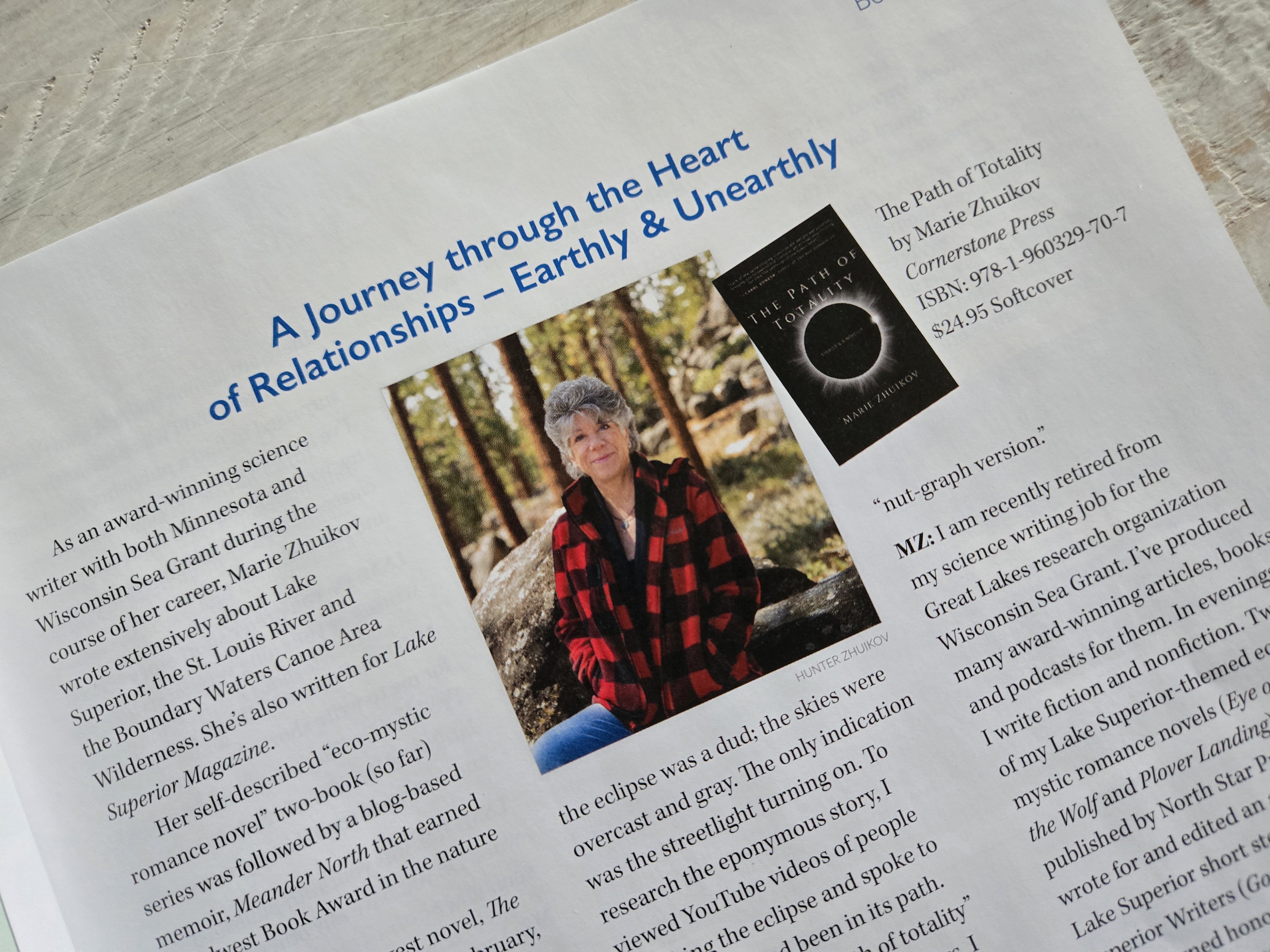
Bookish things have been happening in my world. First, I wanted to let you know that my speculative fiction/magical realism short story collection, The Path of Totality, (POT) is having a giveaway on Goodreads. Three copies will go to some lucky readers in ten days on March 12.

The second thing is something I learned from one of my fellow writers. He clued me into the WorldCat website, which is where you can see what libraries around the world carry certain books. He looked up POT and told me that it was in seven libraries already. Cool! Of course, I then looked it up and my other books. POT is available in libraries in Omaha, NE; Farmington, NM; Charleston, SC; and Orlando, FL. This exercise reminded me that I should donate a copy to my library in Duluth so that they have it.

One surprising thing I discovered is that my first novel, Eye of the Wolf, is available in the National Library of Qatar, in the Middle East. How did that happen?? Another surprising thing is that my second novel, “Plover Landing,” is available in 233 libraries! I think that might be because I offered libraries free rights to a PDF download of it. Since that happened a few years ago, I can’t recall now what service I used for that.

The last bookish thing regards a signing and reading I had yesterday at a new bookstore that opened in Superior, Wisconsin. Foxes and Fireflies Booksellers is run by a woman who’s also a reporter for the local newspaper. Maria Lockwood began the store as a lark. She was reporting on a business startup grant program and as part of that, put in a grant request to open a bookstore as an experiment to see how the process worked. Lo and behold, she was awarded the grant.

Superior hasn’t had a literary independent bookstore in many years, so the community was excited to see Foxes and Fireflies open. The store is very cozy and is filled with neat items. I probably spent any royalties I made during my signing on a cute little fox toy that is destined for our cabin. Oh, the glamorous life of a regional author! Superior writer Vickie Smith featured the bookstore recently on her blog.

Now that I’m on a countdown to retirement for my day job (not my fiction writing), I figure I’ll have more time to read writing trade magazines. I used to subscribe to Writer’s Digest but quit after a while because the copies just kept piling up and it felt too much like work to read them. I’m wondering what writing magazines are your favorites? I’d appreciate recommendations.

AI and Winter

He who marvels at the beauty of the world in summer will find equal cause for wonder and admiration in winter. — John Burroughs

I’ve been circling artificial intelligence for a while now, like it’s a dangerous wounded animal. When AI results first showed up for my Google searches, they were pretty bad. But I’ve got to admit, the responses to my esoteric search queries (like “Literary quotes about Minnesota winters”) have gotten better lately. I guess the beast is learning.

Some high school students recently asked me if I used AI in my writing. I told them that I don’t, and that I can tell when blog posts are created with AI because the writing is generic. However, I admitted that I have considered using AI to generate ideas.

Today, I took the plunge on the idea front because I didn’t have a good winter quote already in my head. I typed in that search term above about Minnesota winters. This came back: While there might not be a specific literary quote explicitly mentioning “Minnesota winter,” quotes that capture the essence of a harsh, snowy, and solitary winter landscape could be applied to a Minnesota winter experience.

In the spirit of full disclosure, one of the quotes from my search is at the beginning of this post. Maybe AI isn’t so bad? And while I’m disclosing everything right now, I might as well say that my photo editing software uses AI to enhance images. I used it on the images that accompany this post, except for the bottom one. The photography teacher who introduced me to this software said that cameras can’t capture everything our eyes see. The editing software brings the photos closer to that ideal. I admit to loving the subtle changes the software makes to the original image. I’m not going to disclose what that software is here, however. I need to keep some secrets to myself. 😊

But I don’t want this post to be about AI. I want it to be about winter. I took these photos at our cabin, which is on a small lake in northern Minnesota. The sun was setting as Russ and I cooked dinner. As with this summer sunset from a few years ago, I had to neglect cooking duties to run outside and capture the light before it disappeared. Luckily, earlier in the day we’d gone snowshoeing and had packed a path down to the lake through the deep snow. I was able to pop on my Sorrels and jog through the cold to the frozen lakeshore with ease.

As I snapped a few photos, I marveled at the still, white landscape and the way the sun tinged the small ridges of snow collected on the lake a dull orange. My camera couldn’t capture those ridge colors very well, but AI helped bring them out a bit.

Normally, we’d be travelling somewhere beachy and warm this time of year to soak up the sun and Vitamin D. We decided not to do that this winter because I am . . . drumroll . . . retiring this spring. I only have two-and-a-half weeks of workdays left! I have too many projects to wrap up before then for a vacation. We are saving our beachy-warm trip for this May.

It’s been good, so far, to stick out the winter here this year. We’ve ridden the temperature swings, complained with our neighbors about the cold, shoveled roughly a ton of snow off our cabin deck, and gotten out cross-country skiing for the first time since the winter of 2022-23. (The snow conditions were too poor after that.) Besides, if we travelled to where the temperature is eighty degrees, we’d have to worry about sunburning our Minnesota-white skin, and then reacclimatizing once we got off the plane. I have not-so-fond memories of walking to our car in the Minneapolis airport parking lot without winter coats or gloves in minus-ten-below temps, since we left our winter outerwear in the car.

To sum it all up: I’m enjoying winter in Minnesota, and I’ve prodded the AI beast. Maybe it’s friendly?

Our lake and snowshoe path. This photo was not edited using AI. Maybe you can tell that it’s not quite as sharp as the others in this post.

My Book Comes out this Week!

My collection of shorts stories, “The Path of Totality,” is being published this week by Cornerstone Press. It will still be on sale for a few more days for 20% off until the publication date, which is Feb. 11. You can order it from Cornerstone here.

I’m having a launch event Feb. 18th, 6:30 p.m., at one of my favorite cafes in Duluth—Wussow’s Concert Cafe. It’s being hosted by Zenith Bookstore. I’ll also be doing a reading/signing at Foxes and Fireflies Bookstore in Superior on March 1 from 1-3 p.m. If you’re in the area, please stop by!

Noted Superior, Wisconsin, author, Carol Dunbar is helping me with the Feb. 18th event. She is way more well-known than I am, having had two books published by a national publisher. She was nice enough to write a blurb for my book, which appears on its cover. She was also nice enough to volunteer for a question and answer discussion with me of our books and careers. We deal with many of the same themes in our writing, so it should be a cool event!

“Booklist,” which caters to libraries, recently reviewed “The Path of Totality.” Here’s what they said:

Love, in its numerous forms: romantic, parental, devotional, inspirational, and desperate, has a lingering presence in Zhuikov’s collection of tales. The title story describes a young couple’s emotional struggles after the devastating loss of a premature baby boy. While viewing the 2017 total solar eclipse, healing suddenly sprouts as something “flipped a reset switch” inside the wife. “Bog Boy” is a comically creepy tale illustrating that love truly has no limits. A teenage girl discovers the long-dead body of a young man entombed by peat in the woods, and the preserved corpse becomes her de facto boyfriend. “The Shower Singer” is a feel-good story about an aspiring musician who receives more than just a much-needed jolt of creativity when he hears a woman in the adjacent apartment singing lovely melodies in the shower. Other characters include a sleuthing widow obsessed with the strangeness of a house who ultimately pays a steep price for her curiosity, a hungry alien life form that stalks a college student in Biosphere 2, and a reference librarian with an extraordinary connection to sentient trees.

Finding Your Voice Through Writing

Last week, I had the privilege of hearing a nationally known poet read at a local college. Kimiko Hahn was flown out from New York City by the college’s English Department to be part of its annual Rose Warner Reading Series. The college brings in a poet for a day who performs a morning reading and discussion with local high school students and an evening reading for the public. After the morning reading, the students break into groups where a “Northland Writer of Distinction” talks to them about writing and how to find their voice through it.

Poet Kimiko Hahn reads at the College of St. Scholastica.

I was one of three so-called writers of distinction. The other two were Sheila Packa, a former Duluth Poet Laureate, and Nick Trelstad, a published poet and high school English teacher. Having never done this event before, I was a bit nervous. Both the other writers were repeaters; they were also both wearing plaid. I had not received that memo! But now I know in case I get invited back.

I was not familiar with Hahn’s poetry, so I was looking forward to hearing her read for the students. Hahn’s mother died in a tragic car accident, so many of the poems she read in her soothing voice were about that. She also read political poems. But, since I am a science communicator, the ones that caught my attention most were pieces she wrote based on science stories in the New York Times. Hahn commented that she’s bad at science but is fascinated by it, especially entomology (bug science). She often takes a science news story and makes it into poetry.  She does this through typical fashion but also using a technique called erasure poetry.

This was a new one on me. In erasure poetry, which began in 1965, writers take an existing text – like a newspaper story or the Declaration of Independence – and blackout or erase words to create a poem. Sometimes they leave the words in their original formatting (with lots of blank space in between) or sometimes they reformat them. Visual artists use the technique, too. Hahn read the students her poem, “Erasing Love.” Then she asked them to figure out what original article’s topic was. Several students mentioned that it was a science or medical story, but I think everyone was surprised when Hahn said it was about a giant fish called an oarfish and that the professor studying it had the last name of Love. (At the end of her poem, she links to the original article.) I enjoy creating found poems (like this one based on Chinese scooter instructions) so I’m definitely going to try erasure poetry sometime soon.

Hahn’s poems delved into grief, love, and science, often containing subtle and not-so-subtle humor. She said she gains inspiration from writing prompts and that she writes as an outlet for her opinions and rambunctiousness. Her reading persona is not rambunctious, but during the q & a afterward, more of her personality shone through.

Then the students were split into groups with their respective local writer. Hahn was a tough act to follow! For my presentation, I told the students about my professional and creative writing careers. The students were from the same high school that I went to, and I wanted to show them that a career in writing is possible. I described my books and talked about how this blog helped me find my voice. I read them two posts that offer good examples of opinion writing, which I can’t do either in my day job or my novels. These were “The Jayme Closs Case and the Importance of News Headlines,” and “The Christmas City of the North Parade: Socially Sanctioned Child Abuse or Festive Community Event?

There was no clock in the room. For the first group of students I spoke with, I blathered on about myself for so long, I ran out of time to read the Jayme Closs story, but I made up for that with the second group.

A few writer nerds were in the audience and asked good questions. After my talk, one girl introduced me to Dark Romance. If you haven’t heard of it, either, Dark Romance features kink and violence – darker themes that don’t sound all that romantic to me. I don’t think I’ll be pursuing it in any way.

My main points to the students were to write what they enjoy without worrying about what other people will think, to practice, and get feedback from people they trust. Of course, I encouraged them to start blogs since it’s a good way to practice and to get feedback from a supportive community.

Have you found that your blog is a good way to develop your writing voice?

On the Edge

I snapped this while waiting for an appointment at my clinic. (Just a routine appointment.) I spent my time watching the progression of these window washers who were working on the hospital across the way. As you can see, the window that I took the picture out of could also use a wash. Maybe our building was next?

Their job was impressive not only due to the height but because it’s the dead of winter . . . in Duluth. That’s Lake Superior below/behind them. It was a calm, sunny day but nowhere near warm.

Everyone who walked through the waiting room and noticed the workers stopped to admire their bravery and derring-do. I don’t think any of us would have traded places, however.

Slumber Party Magic

Growing up in the 1970s, I had plenty of opportunities to attend slumber parties. One of my favorite party places was the house of my best friend up the street, Jody. (She’s the one who had a horse.) She had all sorts of mysterious things at her house like a fortune-telling 8 ball. You could ask it a question, shake it, and the answer would appear through a dark, watery window in the bottom. I always thought the answers were a little lame, but it was fun to feel like I was receiving some magical advice. My friend’s family also had a Ouija Board that could supposedly be used to talk to the dead like in a séance.

One of my least favorite slumber party games was Bloody Mary. In this game, you go into the bathroom alone with a candle. You light the candle, turn out the lights, and look in the mirror. Say “Bloody Mary” three times slowly. It’s supposed to make Bloody Mary (whoever that is) appear. I didn’t like this game because I needed to be alone for it. I didn’t want to be alone if and when a creepy person appeared! I don’t recall ever doing the game myself, but I may have watched other people do it. (We bent the rules on being alone.) I don’t recall any specter appearing in the mirror, but we were scared out of our wits, which I guess was the whole point.

One of my favorite games was Light as a Feather, Stiff as a Board. We played the version where one person lays down (there’s another version where a person sits in a chair). Everyone would gather around under dim lights and placed two fingers from each hand (index fingers) underneath them. The goal was to lift the person off the ground. If we would try to lift the person at this point, it wouldn’t work because we’d be giggling and uncoordinated. But if we tried to lift as we recited the chant associated with the game, the person would rise as if levitating.

The first record of this game came from a British Naval administrator in 1665 who saw a group of French girls doing it. The leader of the game (usually the person at the head) says, “She’s looking ill.” And everyone repeats that in a call and response a few times. Then the leader says, “She’s looking worse,” in the same call and response. Then, “She’s dying,” and “She’s dead.”

This initial ritual is completed when everyone stacks their hands atop the liftee person’s forehead, alternating so that their hands are separated by the hands of another person. The leader then tells the group that they are opening the liftee’s body to supernatural influences and that outside spirits are entering the body to make it lighter.

After that, everyone puts their fingers back under the person. The leader chants, “Light as a feather, stiff as a board,” repeating the phrase many times. Then the group begins lifting the person slowly. Unlike the first lifting attempt, this one should happen easily and for only a few inches. Then the group lowers the person back to the ground.

The game was spooky, exciting, and mysterious. How could we all lift such a weight with only a few fingers? I did a little research and discovered the game is actually based on physics. The weight of the person is divided equally among each lifter. The stiffness of the lifted player also helps the trick work. As the lifters chant, the liftee will become stiff and focused. Their rigid, tense body makes the lifting easier. The supernatural references just make the game more fun.

As with many things in life, the ultimate secret to the “magic” of this game is the synchronization of the group. Many hands (in this case, fingers) working together makes for light work.

Did you ever play these games, or something like them?

Bob Dylan, Revisited

Image courtesy of ImdB.

If you’ve been reading this blog for a while, you may recall that I’ve written two other posts about Bob Dylan. Thus, the name of this post. Here’s another one!

I watched two Bob Dylan movies recently. The first, “A Complete Unknown,” inspired me to watch the second, “No Direction Home,” so I could get a better picture of the famous singer who spent his early years in my part of the world. I’m glad I watched both.

Of course, the first movie is the one that’s out in theaters now. It features Timothée Chalamet, the dishy French-American actor who portrays Dylan in his early years. Based on the book, “Dylan Goes Electric,” by Elijah Wald, the story begins with Dylan “escaping” his college experience at the University of Minnesota and traveling to New York City to meet his folk music hero, Woodie Guthrie, who was hospitalized with a neurological illness. Another folkie, Pete Seeger, takes Dylan under his wing, and his rise to stardom begins.

I liked that the story was told mainly through music; this was much more effective than a lot of talking. Chalamet’s portrayal of Dylan is superb as are the performances by the two actresses who portray his love interests from that time: Elle Fanning who plays his girlfriend Suze Rotolo/Sylvie Russo, and Monica Barbaro who plays singer Joan Baez. It helped me understand the pressures Dylan was under as a person and an artist. Even Dylan, who was an executive producer for the movie, liked it, so that’s saying something!

The movie concludes with Dylan’s performance in 1965 at the Newport Folk Festival, where he was backed by an electric band. The audience of folk purists and political activists reacted badly, with booing and shouts. Some people just couldn’t handle that something they loved had changed. As Google says, his performance, “was a shot heard round the world—Dylan’s declaration of musical independence, the end of the folk revival, and the birth of rock as the voice of a generation—and one of the defining moments in twentieth-century music.” There are still people who are upset by what they perceive as Dylan’s turning his back on acoustic folk music and political activism.

As I mentioned, “A Complete Unknown” left me wanting to know more, so I watched “No Direction Home,” a 2005 documentary by Martin Scorsese that’s available through PBS. It follows Dylan’s life for a year longer than the current movie, and features in-person interviews with Dylan, poet Allen Ginsberg, Suze Rotolo, Joan Baez, and Pete Seeger.

Seeing/hearing Dylan describe events from his life in his own words was so interesting! According to Wikipedia, the movie was well-received. It “creates a portrait that is deep, sympathetic, perceptive and yet finally leaves Dylan shrouded in mystery, which is where he properly lives.”

So, if like me, you found yourself wanting more after watching “A Complete Unknown,” I highly recommend “No Direction Home.” It helped me understand why there’s not a snowball’s chance in hell that Dylan will ever come back to Duluth no matter how we try to honor him. (The city has named a street after him, but he didn’t show up, much to the city’s dismay. He didn’t even show up for his Nobel Prize; he sure isn’t going to come back to Duluth!) We need to just leave the man alone.

Also, Suze Rotolo wrote a memoir about her time with Dylan, titled, “A Freewheelin’ Time,” which I plan to read someday.

I still remain happy that I’m not famous like Dylan. See my blog post from 2017 that explains why. Have you seen “A Complete Unknown?” If so, I’d love to hear your thoughts about the movie.

“The Path of Totality” Book Review

Fellow writer and blogging friend Vickie Smith was kind enough to review my upcoming short story collection for the Wisconsin Writers Association. You can find the review here, plus a link to preorder the book at a discount. (It’s coming out on Feb. 11.) You can find out more about Vickie at her blog, “Writing Near the Lake.”

Like me, Vickie lives near Lake Superior. We support each other as writers, and I hope to return the reviewing favor when her first book is published!

Here’s an excerpt from her review: Zhuikov’s stories explore a wide range of human emotions – grief, duplicity, curiosity, loneliness, love, obsession, and fear – against a backdrop of both rural and urban worlds filled with the inexplicable, the mystical, and the paranormal. She skillfully combines these human emotions with well-crafted imaginative worlds as she delves into the everyday desires and struggles people face, making her tales intriguing reads to be enjoyed by everyone.