How I got Jane Goodall to Stick her Head in a Potted Palm Tree

Jane Goodall

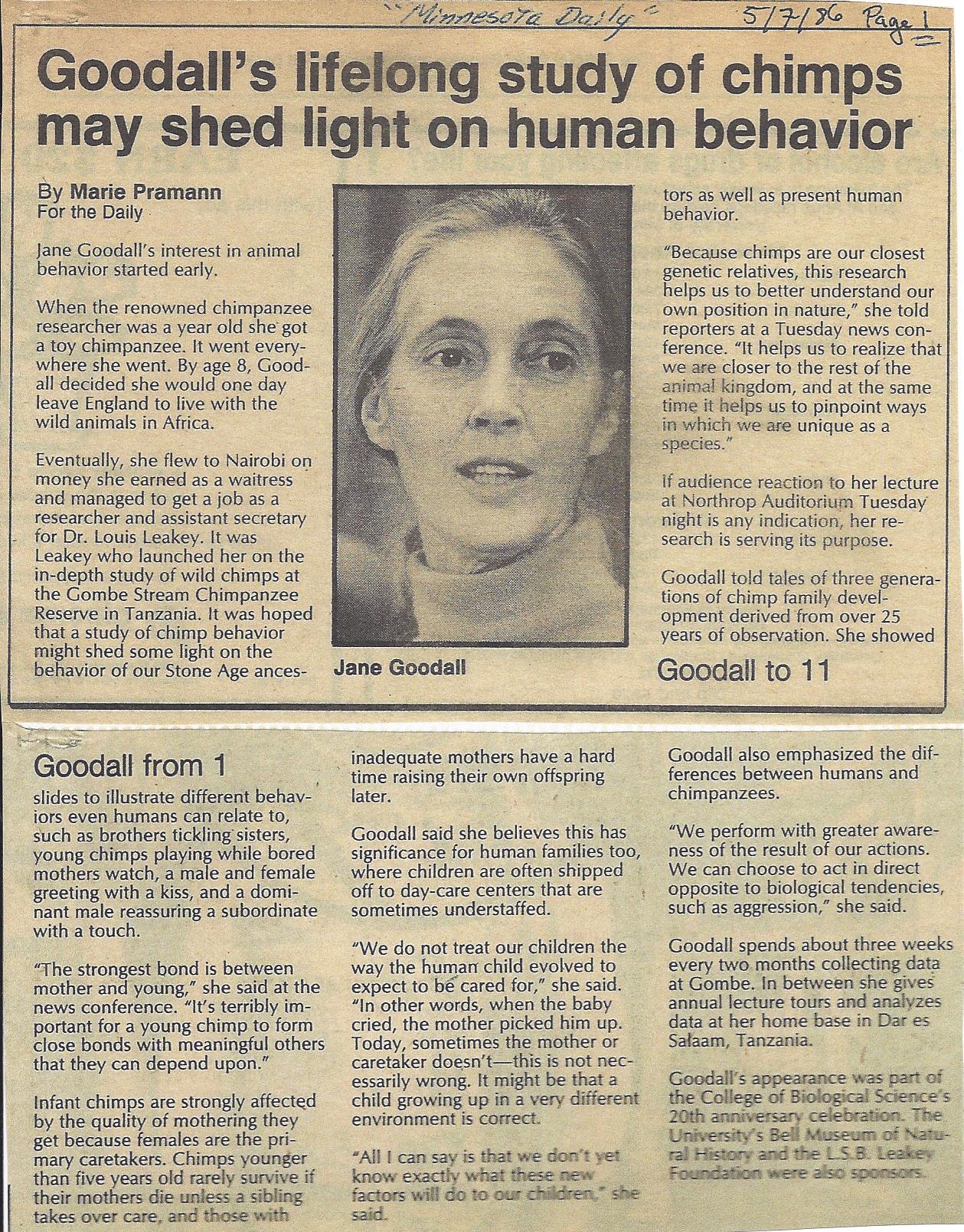
My story from the Minnesota Daily, May 7, 1986, page 1.

A recent news story about chimpanzee researcher Jane Goodall reminded me why she’s one of my favorites of the scientific glitterati. Here’s a link to the Huffington Post video story. Basically, she’s saying that researchers need to have empathy with their subjects in order to conduct ethical and meaningful science. I agree!

I had the chance to meet Jane (I don’t think she’d mind if I call her by her first name – she’s that kind of a person) back in my glory days as the environmental reporter for my college newspaper, the venerable “Minnesota Daily” (best college newspaper in the country!) Jane came to town to give a talk on chimpanzee behavior and DNA, and how similar they are to our own.

She presented to a packed auditorium and afterwards, hosted a news conference. I sat in the front row along with a photographer for the paper. I don’t remember what questions I asked, but I do recall being impressed by Jane’s seeming kindness and approachability.

During the news conference, the photographer and I surreptitiously discussed good locations in the room to take her photo afterwards, both agreeing (with the logic of college students) that the potted palm next to her podium would be ideal. She did work in the “jungle,” after all! However, the thought of asking Jane Goodall to stick her head among palm fronds filled me with anxiety. Would she be insulted? Have us thrown out of the room? Turn around and walk off in a huff?

Once the news conference was over, no other reporters seemed to want to talk to Jane, so I approached – probably gushed about what a big fan I was – and put forth to her the photographer’s plight of getting her photo against an interesting background. I couldn’t believe our luck when she pointed to the palm and said, “Well, why not here?”

Amazed and relieved, I agreed. Unfortunately, the palm tree photo did not run with the story — the photo editors ran a boring head-shot instead. But I will always remember how gracious and accommodating Jane was, and how willing she was to stick her head in a potted palm for a college reporter.

On the Ice Bucket Challenge and Apologizing for Happiness

Smileyes By Ramesh NG via Wikimedia Commons

Smileyes By Ramesh NG via Wikimedia Commons

My youngest son wanted me to video his friend dumping a bucket of cold water over his head, joining the masses participating in the ALS Ice Bucket Challenge. This was back a couple of weeks ago when it was all the rage. I agreed and probably laughed about it. My son then proceeded to make a snarky comment and went outside to join his friend who was waiting in our driveway with the bucket.

Stunned by my fifteen-year-old’s comment, I stood in the kitchen, at war over whether to call him out on it, but also feeling pressure to go outside and take the video. He doesn’t usually say such things, but the past few days, I’d noticed an edge to him that hadn’t been there before.

When he came on the porch looking for me, I motioned him into the house. I told him that if he wanted me to do something nice for him (take the video), he needed to be nicer to me and apologize for his comment (the words to which I can’t even recall any more).

He apologized and we had a rather heated discussion about what was wrong. It turns out, it’s all my fault. I was laughing too much. It annoyed him.

Now, even if I do say so myself, my laugh is not annoying. In fact, back when phone contact was the norm, my Allstate agent used to call me and crack jokes just to hear me laugh. He actually admitted this to me. My laugh is hearty, yes, but not unusually frequent. And I’m not one of those people who goes around smiling all the time. But, as you can probably tell from this blog, I do have an easy and strange sense of humor, and enjoy laughing when I have the chance.

Before I knew what was coming out of my mouth, I apologized to my son for being a happy person. In part, I did it to show him the absurdity of his complaint. I also did it because he had apologized to me and I was trying to move the discussion forward. Other parts of our conversation revolved around the need for him to find a way to deal with hearing his mother laugh. I have many things I could be sad about. I’m nowhere near as resilient as I used to be, but I’m not about to stop laughing any time soon. Afterwards, we went outside and commenced with the icewater dumping.

Last night, we had an airing out session about several things, and we talked more about the Terrible Awful Problem of having a happy mom. I told my son it’s rather normal for teenagers to get annoyed, especially when they are sleep-deprived. The day before the annoyance incident happened, he had his friend over for a “sleepover,” which usually involves almost anything but sleeping. We also talked about how annoyance over little things can be a waste of time and energy, and we both laughed about how silly it was to be annoyed by happiness. He assured me his annoyance wasn’t because he was unhappy, but because of hearing my laugh so often lately.

If having a happy mom is the worst issue for my son, I’d say we are doing all right.

“Zenith City” Offers a Broader Understanding of Duluth

Zenith_City-210“Zenith City” is a collection of stories by former Duluthian Michael Fedo (cousin of former Duluth Mayor John Fedo). The memoir chronicles his time growing up in Duluth, Minn., in the 1950s and 60s.

I enjoyed reading the book. I recognized Fedo’s references to the city’s inferiority complex (which is turning around, now, thank you, with Duluth being named things like Best Outdoors City, etc.), and Fedo’s references to Duluthians’ relationship with their hills, KDAL Radio, dear old Denfeld High, the Flame Restaurant, and the Pickwick.

However, in many instances, Fedo writes about a Duluth with which I am unfamiliar — one where relatives live next door (my parents were the northernmost transplants of their central- and southern-Minnesota families), where the vices and haunts of downtown were nearby (I grew up in more distant Piedmont Heights), and where folk music was popular (I was born about 15 years too late for that).

But that’s all right. The descriptions gave me a better understanding of the place where I live. I especially enjoyed his reminiscences about Don LaFontaine, the famous movie trailer voiceover actor (think, “In a world where….”), his encounter with Louis Armstrong, and with Bob Dylan’s mother. And because of my exposure to this book, I now intend to read “Babbitt” by Sinclair Lewis, who lived in Duluth for a time. (Also because my home economics-major mother once made and served him dinner when she was working in college for a family who entertained him.)

I noticed two punctuation errors: one where closing quotation marks are missing, another where a sentence ends with both a period and a comma. This surprised me since I’ve come to expect better from the University of Minnesota Press. I don’t know if it’s a sign of their quality slipping or of my editorial eye getting sharper with experience.

The only other thing that gave me pause was the repetition among the stories. For instance, we hear that Fedo worked at the local college radio station at least four times throughout, but I suppose this is an artifact of the book being a compilation of stories that were written for other publications. Just be aware it’s not a seamless memoir written in a singular effort.

Earlier this year, I went to an event by Fedo at Duluth Public Library. He read from many of the stories, and afterwards, he and his wife were generous with their time for a discussion with me, a newbie novelist. They were a class act. I highly recommend this book, even to non-Duluthians.

Chinese Scooter Instructions — A “Found” Poem

The moon as seen from my writing studio this past June. (The Strawberry Moon.)

The moon as seen from my writing studio this past June. (The Strawberry Moon.)

We bought a scooter from China a few years back. These are the actual words that were in the instructions (so they are not mine), but the formatting is mine. The recent Harvest Moon reminded me of it.

Chinese Scooter Instructions

When driving
please you keep the relaxing moon
and wear comfortable clothes,
obey the traffic rule
and prohibit
making the moon
impatient.

Someone Shat Upon My Fantasy Room

The culprit.

The culprit.


Inquiring minds have been asking how my new exercise room is going. I am happy to report that I’ve actually used it for its intended purpose, but not without a challenge. As with many of my fantasies, somebody shat upon it first. That somebody was my dog, Buddy, who was having a bout of gastric distress. It’s the only time he’s ever done something like that in the house, and of course, he chose the exercise room.

Although it’s not decorated yet, after a thorough cleaning, a few days, and several shots of Febreze, the smell dissipated and the room was ready to roll. Now the trick will be to keep my exercise rolling. Buddy even “exercised” with me. I had to install a sleeping pad that I use for camping so that he could have his own yoga mat in the room. Otherwise, he was going to take over mine!

Hope you are all having a great Labor Day Weekend, and that you are not laboring too hard.

A Photo From This Morning

My garden statue has been reading for a long time!

My garden statue has been reading for a long time!

This sight greeted me this morning on the way to the mailbox. The only camera I had on hand to capture it is my crappy old Sony DSC-S500 Cyber Shot. I was glad it was able to show the detail of the spider web. Please have a wonderful day, even if it’s rainy!

The Fantasy Suite (er . . . Room)

Hmmmm. What to do with an empty room?

Hmmmm. What to do with an empty room?

Have you ever had an empty room in your house? I do, and it’s wonderful! Remember my temporary roommate? Although she moved out over seven months ago, I am still housing her furniture in my spare bedroom. She wasn’t making any concrete progress to find her own apartment (she’s still living with someone else who doesn’t have room for her furniture), so I decided to move her stuff to my garage. [Thank you friend who helped me move it!]

And now I have this echo-y empty room. What to do, what to do? . . . The possibilities are limitless. I don’t need to make it into a bedroom at this point, so I’ve decided to make it into an exercise and yoga room. Why? Because these lyrics of Paul Simon’s song, “You Can Call Me Al” resonate a bit too much with me: “Why am I so soft in the middle / The rest of my life is so hard.”

I’ve already got my yoga mat, hand weights, and stepping stair in there. Now I just need to drag the elliptical strider up from the basement. I figure there’s a greater chance I’ll actually use it if I see it every day. Sure, I could join a fitness center, but as a single mom with aging parents and a needy dog, the demands on my time are varied and great. My fantasy is that now, I’ll be able to just pop into my exercise room instead of making a big production of things by driving somewhere else.

It’s not like I need to lose weight (although dropping ten pounds would not be bad), I just need to get fit again. I sit almost all day at a desk job, which is the hardest thing a person can do to their body. And in the evenings, I often sit some more blogging and writing novels. Unless a person has some form of exercise, the sitting will catch up to them. I have already learned this the hard way in the past, and I’d rather not have those back problems back, thank you.

Maybe I can wire the room with a sound system for exercise-inducing rhythms or New Age yoga music. Add some mood lighting. Put some art on the wall. Here we go. Wish me motivation!

Making Mosses Sexy (The Signature of All Things – Book Review)

SigofAllThings

I picked up this book because I like Elizabeth Gilbert’s nonfiction (I’ve read “The Last American Man,” “Eat, Pray, Love,” and “Committed”). I haven’t read any of her novels, so I wanted to see what she could do with fiction. Also, I wanted to see how/whether she could make botany interesting. Caution: this review contains spoilers, so if you don’t want to know how the novel ends, it’s best to stop reading now.

The story follows the life of Alma Whittaker, a scientifically inclined child born into a wealthy American family in the 1800s. Alma’s life is so lonely and sterile in the first part of the novel that I began to wonder why I was continuing to read. Finally, when she meets a botanical artist, Ambrose, things look up for her. Gilbert does an admirable job taking readers along with Alma’s joy and hopes/fears at this point, so that when they come crashing down, so do readers’ hearts. I liked how Alma dealt with life’s disappointments by grinding them under her boot heel. That’s a philosophy worth emulating.

Midway through the novel, when Alma is casting about for things to occupy her time, I found myself asking – why doesn’t she try to help someone else for a change? That thought doesn’t come to her at that point and she turns instead to a solitary life of studying mosses. I was thankful to see altruistic motivation finally come to her after her father dies.

So how does Gilbert make botany interesting? She combines it with a life story, sex, and spiritualism. Gilbert uses Alma’s situation to explore the dichotomies between science and the soul, and how a woman can endure a lifetime of sexual frustration, yet still function in the everyday household and business duties required of her.

I want to share a quote from the story that particularly resonated with me: “These are two things I have always observed to be in singular accord: super-celestial thoughts and subterranean conduct.” I have found this to be true, as well. Think of all the televangelists and others in positions of authority who have been brought down by sexual scandals. But I am meandering…

One thing that bothered me is that when Alma was in Tahiti, she did not even think of showing a drawing of the mysterious Tahitian boy to someone. She did mention there were some facial drawings of him that weren’t lewd. Showing one to someone she trusted, like the reverend or the ‘wild boys,’ would have saved her a lot of time trekking around the island. She could have said she found it in Ambrose’s things and was wondering who his friend was. Gilbert didn’t even have Alma consider showing someone a drawing, which bothered me and seemed unrealistic (even for fiction!)

Another thing that bothered me that one of Alma’s major goals in life was to give a man a blowjob. I mean, seriously?! The feminist in me is just so affronted by that. Alma’s character is already so intelligent, capable and self-sacrificing. I would have been much more comfortable if her goal in life was to have a man give HER oral sex. (Smirk.)

The dust jacket description says that events take place at a galloping pace. I wouldn’t say this is true. The pace is more like that of a pachyderm than a horse. Both Alma and her father are so deliberate in their speech and actions that all sides of an issue are explored before action is taken. This is hardly galloping. But the good side of this is that you come to know the characters intimately.

I ended up wanting SOMETHING good to happen for Alma – better than performing a blowjob on a lovely male Tahitian in a cave (which is not bad, but still….) Near the end, there’s another glimmer of hope when she develops her own theory of natural selection. But does she publish it? No. Like the aforementioned slow-moving pachyderm, she has to investigate all sides of her theory, which takes time. She’s not satisfied that it provides the answer to everything everyone would ever want to know about how the world works, so she lets the document sit in a valise under her couch, until it’s too late and Darwin beats her to the punch.

In a Hollywood ending, Alma would have published her theory to great fame and finally be recognized. But since this is not a Hollywood book, it ends with Alma being satisfied that just one person recognizes her for what she is. This was a good ending for the circumstances, and refreshing in some ways, but it’s much too realistic. If I wanted to realism, I would just plod along in my own daily fight for survival and grinding of life’s disappointments under my boot heels. I read to escape or to see characters overcome obstacles and succeed. However, Gilbert did manage to make mosses interesting.

Overall, I give it a mixed review. There’s no question that Gilbert knows her mosses and how the scientific mind works. Her character development is outstanding as is her insight into the human condition. I just had problems with certain aspects of the story that didn’t fit my personal escapist needs.

Saving a Skyrat – Part 2

Pogo

When my co-worker and I were debating whether to save the listless gull that appeared outside our office last week, she said something like, “Usually, I like to let nature take its course . . .” and I interjected, “But it’s often not nature that causes things like this, it’s humans.” I was remembering a gull I rescued many years ago that had been hit by a car.

As it turns out, although the gull at our office was put in distress by a natural process, the cause probably was us. As you may recall, when I brought the gull to the wildlife rehabilitation group, they said they thought the cause was a Vitamin B deficiency. (To be exact, a Vitamin B1 or thiamine deficiency.) They weren’t sure what was causing it, but suspected it had something to do with the gulls eating dead fish.

Back at the office, that got us thinking, especially after we learned the Wildwoods group had received three other gulls with the same problem that week, and after learning that two other co-workers had seen other gulls exhibiting the same symptoms: wing droop, loss of the ability to fly, and loss of the ability to “speak.”

Being of a scientific bent, we started researching the problem and came up with a paper published in 2009 about herring gulls and other birds in Europe that were dying of a thiamine deficiency. The researchers named the affliction “thiamine deficiency syndrome.”

In the paper, the researchers described the exact symptoms we were seeing: “The general course of this disease in full-grown individuals is difficulty in keeping the wings folded along the side of the body, inability to fly, inability to walk, and death. Other symptoms are tremor and seizures.” They said that the length of time between when a gull loses its ability to fly and death is 10-20 days. Turns out, this was the same paper that the Wildwoods people had discovered last year in an attempt to help more than a dozen gulls with the syndrome.

The researchers attributed the syndrome to “a causative agent(s) acting directly on the affected individual, and/or by insufficient transfer of thiamine between the trophic levels in the food web.” They cited an urgent need for investigation into the cause since bird populations in Europe were declining rapidly.

Putting together what we knew got us thinking: what kind of fish-related problem could cause a thiamine deficiency in gulls? I recalled Minnesota Sea Grant research from years ago about Great Lakes fish being low in Vitamin B1 due to a diet of smelt and alewives. Almost at the same time, my co-worker discovered similar research. Both smelt and alewives contain an enzyme that breaks down thiamine in the fish that eat them, which has caused documented problems in the lake trout, steelhead trout, brown trout, and salmon populations in the Great Lakes.

It makes sense that birds eating fish low in thiamine would become low in thiamine themselves. We didn’t find any research describing this problem in birds the U.S., but we didn’t do an exhaustive search. However, it sure seems like an interesting research project for some enterprising biologist.

It’s ironic that although the gulls are eating what they are supposed to (fish) versus an unhealthy diet of French fries, they are suffering. Remember the debate in the first paragraph about whether the cause is natural vs. human-made? Alewives and smelt are both non-native species introduced by humans into the Great Lakes. So the problem most likely is us, I hate to say.

A local reporter even did a story about the issue, which appeared on the front page of the Sunday Duluth News Tribune. (This story will be available for a week to non-subscribers.)

How is our office gull doing? The wildlife rehab folks report that it perked up after a thiamine shot. It had recovered enough for release the very next day. I am amazed that the solution was so simple, and amazed by what we learned in the process of saving what most folks around here consider as sky vermin.

Saving a Sky Rat

A Wildwoods worker inspects the "injured" gull.

A Wildwoods worker inspects the “injured” gull.

When a co-worker mentioned she spotted a wounded gull near our office yesterday, I knew I was in trouble. I’m a sucker for wanting to save injured wildlife, even if it’s a “sky rat,” which are far too abundant. And besides, we both work for the National Oceanic and Atmospheric Administration, which has a gull as part of its logo. How could we just ignore it? Not to mention that I am the author of a novel about shorebirds. I could hardly be indifferent to its plight or my readers would revolt.

My co-worker (Mary) thought the gull’s wing might be broken and that it seemed listless. When we went outside to look for it, we couldn’t find it, but a short time later when I happened to look out my window, I saw the gull standing dejectedly on our office dock.

I alerted Mary, who in the meantime had called Wildwoods, a nonprofit local wildlife rehabilitation organization, to see if they would take the gull. They said they would, but that we would have to deliver it. They instructed Mary how to handle the gull, so that when it appeared again, she was ready.

Since I am squeamish about handling wild animals (I don’t even like unhooking the fish I catch), and since it was her “find,” I allowed Mary the honor of capturing the bird. She did so easily, and placed it in a box lined with newspaper. Upon this chance for close inspection, she identified it as a ring-billed gull.

Since Wildwoods was located on my way home, I volunteered to transport the bird. When the box was in the office, the bird was quiet. But once it got in my car, the gull started rustling around. I decided to try a classical radio station to soothe the savage beast. It worked!

I found the Wildwoods building and took the bird in. I was surprised at how weightless the box was. Upon inspecting the gull, the Wildwoods workers said they didn’t think it had any broken bones– instead, they suspected its listlessness might due to a Vitamin B deficiency. They said it’s a common problem due to their diets. Who knew birds could get vitamin deficiencies? They planned to give it a shot and to see if that helps.

If I receive any updates on the gull’s progress, I’ll let you know!