Finding Your Voice Through Writing

Last week, I had the privilege of hearing a nationally known poet read at a local college. Kimiko Hahn was flown out from New York City by the college’s English Department to be part of its annual Rose Warner Reading Series. The college brings in a poet for a day who performs a morning reading and discussion with local high school students and an evening reading for the public. After the morning reading, the students break into groups where a “Northland Writer of Distinction” talks to them about writing and how to find their voice through it.

Poet Kimiko Hahn reads at the College of St. Scholastica.

I was one of three so-called writers of distinction. The other two were Sheila Packa, a former Duluth Poet Laureate, and Nick Trelstad, a published poet and high school English teacher. Having never done this event before, I was a bit nervous. Both the other writers were repeaters; they were also both wearing plaid. I had not received that memo! But now I know in case I get invited back.

I was not familiar with Hahn’s poetry, so I was looking forward to hearing her read for the students. Hahn’s mother died in a tragic car accident, so many of the poems she read in her soothing voice were about that. She also read political poems. But, since I am a science communicator, the ones that caught my attention most were pieces she wrote based on science stories in the New York Times. Hahn commented that she’s bad at science but is fascinated by it, especially entomology (bug science). She often takes a science news story and makes it into poetry.  She does this through typical fashion but also using a technique called erasure poetry.

This was a new one on me. In erasure poetry, which began in 1965, writers take an existing text – like a newspaper story or the Declaration of Independence – and blackout or erase words to create a poem. Sometimes they leave the words in their original formatting (with lots of blank space in between) or sometimes they reformat them. Visual artists use the technique, too. Hahn read the students her poem, “Erasing Love.” Then she asked them to figure out what original article’s topic was. Several students mentioned that it was a science or medical story, but I think everyone was surprised when Hahn said it was about a giant fish called an oarfish and that the professor studying it had the last name of Love. (At the end of her poem, she links to the original article.) I enjoy creating found poems (like this one based on Chinese scooter instructions) so I’m definitely going to try erasure poetry sometime soon.

Hahn’s poems delved into grief, love, and science, often containing subtle and not-so-subtle humor. She said she gains inspiration from writing prompts and that she writes as an outlet for her opinions and rambunctiousness. Her reading persona is not rambunctious, but during the q & a afterward, more of her personality shone through.

Then the students were split into groups with their respective local writer. Hahn was a tough act to follow! For my presentation, I told the students about my professional and creative writing careers. The students were from the same high school that I went to, and I wanted to show them that a career in writing is possible. I described my books and talked about how this blog helped me find my voice. I read them two posts that offer good examples of opinion writing, which I can’t do either in my day job or my novels. These were “The Jayme Closs Case and the Importance of News Headlines,” and “The Christmas City of the North Parade: Socially Sanctioned Child Abuse or Festive Community Event?

There was no clock in the room. For the first group of students I spoke with, I blathered on about myself for so long, I ran out of time to read the Jayme Closs story, but I made up for that with the second group.

A few writer nerds were in the audience and asked good questions. After my talk, one girl introduced me to Dark Romance. If you haven’t heard of it, either, Dark Romance features kink and violence – darker themes that don’t sound all that romantic to me. I don’t think I’ll be pursuing it in any way.

My main points to the students were to write what they enjoy without worrying about what other people will think, to practice, and get feedback from people they trust. Of course, I encouraged them to start blogs since it’s a good way to practice and to get feedback from a supportive community.

Have you found that your blog is a good way to develop your writing voice?

On the Edge

I snapped this while waiting for an appointment at my clinic. (Just a routine appointment.) I spent my time watching the progression of these window washers who were working on the hospital across the way. As you can see, the window that I took the picture out of could also use a wash. Maybe our building was next?

Their job was impressive not only due to the height but because it’s the dead of winter . . . in Duluth. That’s Lake Superior below/behind them. It was a calm, sunny day but nowhere near warm.

Everyone who walked through the waiting room and noticed the workers stopped to admire their bravery and derring-do. I don’t think any of us would have traded places, however.

Slumber Party Magic

Growing up in the 1970s, I had plenty of opportunities to attend slumber parties. One of my favorite party places was the house of my best friend up the street, Jody. (She’s the one who had a horse.) She had all sorts of mysterious things at her house like a fortune-telling 8 ball. You could ask it a question, shake it, and the answer would appear through a dark, watery window in the bottom. I always thought the answers were a little lame, but it was fun to feel like I was receiving some magical advice. My friend’s family also had a Ouija Board that could supposedly be used to talk to the dead like in a séance.

One of my least favorite slumber party games was Bloody Mary. In this game, you go into the bathroom alone with a candle. You light the candle, turn out the lights, and look in the mirror. Say “Bloody Mary” three times slowly. It’s supposed to make Bloody Mary (whoever that is) appear. I didn’t like this game because I needed to be alone for it. I didn’t want to be alone if and when a creepy person appeared! I don’t recall ever doing the game myself, but I may have watched other people do it. (We bent the rules on being alone.) I don’t recall any specter appearing in the mirror, but we were scared out of our wits, which I guess was the whole point.

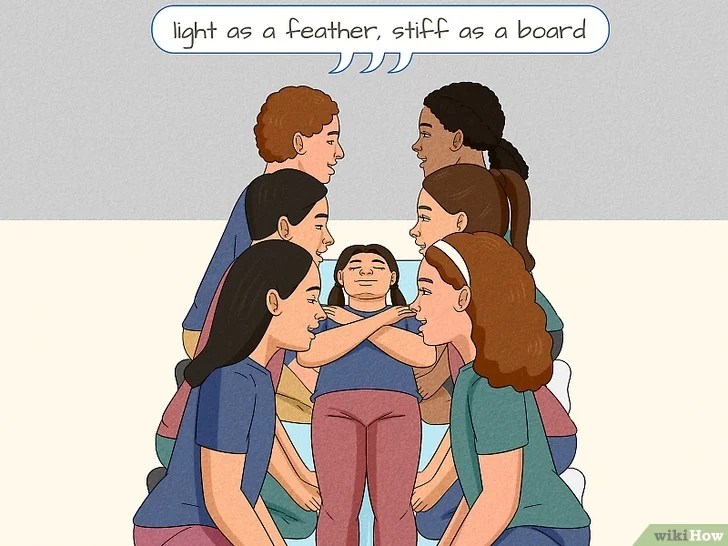
One of my favorite games was Light as a Feather, Stiff as a Board. We played the version where one person lays down (there’s another version where a person sits in a chair). Everyone would gather around under dim lights and placed two fingers from each hand (index fingers) underneath them. The goal was to lift the person off the ground. If we would try to lift the person at this point, it wouldn’t work because we’d be giggling and uncoordinated. But if we tried to lift as we recited the chant associated with the game, the person would rise as if levitating.

The first record of this game came from a British Naval administrator in 1665 who saw a group of French girls doing it. The leader of the game (usually the person at the head) says, “She’s looking ill.” And everyone repeats that in a call and response a few times. Then the leader says, “She’s looking worse,” in the same call and response. Then, “She’s dying,” and “She’s dead.”

This initial ritual is completed when everyone stacks their hands atop the liftee person’s forehead, alternating so that their hands are separated by the hands of another person. The leader then tells the group that they are opening the liftee’s body to supernatural influences and that outside spirits are entering the body to make it lighter.

After that, everyone puts their fingers back under the person. The leader chants, “Light as a feather, stiff as a board,” repeating the phrase many times. Then the group begins lifting the person slowly. Unlike the first lifting attempt, this one should happen easily and for only a few inches. Then the group lowers the person back to the ground.

The game was spooky, exciting, and mysterious. How could we all lift such a weight with only a few fingers? I did a little research and discovered the game is actually based on physics. The weight of the person is divided equally among each lifter. The stiffness of the lifted player also helps the trick work. As the lifters chant, the liftee will become stiff and focused. Their rigid, tense body makes the lifting easier. The supernatural references just make the game more fun.

As with many things in life, the ultimate secret to the “magic” of this game is the synchronization of the group. Many hands (in this case, fingers) working together makes for light work.

Did you ever play these games, or something like them?

Bob Dylan, Revisited

Image courtesy of ImdB.

If you’ve been reading this blog for a while, you may recall that I’ve written two other posts about Bob Dylan. Thus, the name of this post. Here’s another one!

I watched two Bob Dylan movies recently. The first, “A Complete Unknown,” inspired me to watch the second, “No Direction Home,” so I could get a better picture of the famous singer who spent his early years in my part of the world. I’m glad I watched both.

Of course, the first movie is the one that’s out in theaters now. It features Timothée Chalamet, the dishy French-American actor who portrays Dylan in his early years. Based on the book, “Dylan Goes Electric,” by Elijah Wald, the story begins with Dylan “escaping” his college experience at the University of Minnesota and traveling to New York City to meet his folk music hero, Woodie Guthrie, who was hospitalized with a neurological illness. Another folkie, Pete Seeger, takes Dylan under his wing, and his rise to stardom begins.

I liked that the story was told mainly through music; this was much more effective than a lot of talking. Chalamet’s portrayal of Dylan is superb as are the performances by the two actresses who portray his love interests from that time: Elle Fanning who plays his girlfriend Suze Rotolo/Sylvie Russo, and Monica Barbaro who plays singer Joan Baez. It helped me understand the pressures Dylan was under as a person and an artist. Even Dylan, who was an executive producer for the movie, liked it, so that’s saying something!

The movie concludes with Dylan’s performance in 1965 at the Newport Folk Festival, where he was backed by an electric band. The audience of folk purists and political activists reacted badly, with booing and shouts. Some people just couldn’t handle that something they loved had changed. As Google says, his performance, “was a shot heard round the world—Dylan’s declaration of musical independence, the end of the folk revival, and the birth of rock as the voice of a generation—and one of the defining moments in twentieth-century music.” There are still people who are upset by what they perceive as Dylan’s turning his back on acoustic folk music and political activism.

As I mentioned, “A Complete Unknown” left me wanting to know more, so I watched “No Direction Home,” a 2005 documentary by Martin Scorsese that’s available through PBS. It follows Dylan’s life for a year longer than the current movie, and features in-person interviews with Dylan, poet Allen Ginsberg, Suze Rotolo, Joan Baez, and Pete Seeger.

Seeing/hearing Dylan describe events from his life in his own words was so interesting! According to Wikipedia, the movie was well-received. It “creates a portrait that is deep, sympathetic, perceptive and yet finally leaves Dylan shrouded in mystery, which is where he properly lives.”

So, if like me, you found yourself wanting more after watching “A Complete Unknown,” I highly recommend “No Direction Home.” It helped me understand why there’s not a snowball’s chance in hell that Dylan will ever come back to Duluth no matter how we try to honor him. (The city has named a street after him, but he didn’t show up, much to the city’s dismay. He didn’t even show up for his Nobel Prize; he sure isn’t going to come back to Duluth!) We need to just leave the man alone.

Also, Suze Rotolo wrote a memoir about her time with Dylan, titled, “A Freewheelin’ Time,” which I plan to read someday.

I still remain happy that I’m not famous like Dylan. See my blog post from 2017 that explains why. Have you seen “A Complete Unknown?” If so, I’d love to hear your thoughts about the movie.

“The Path of Totality” Book Review

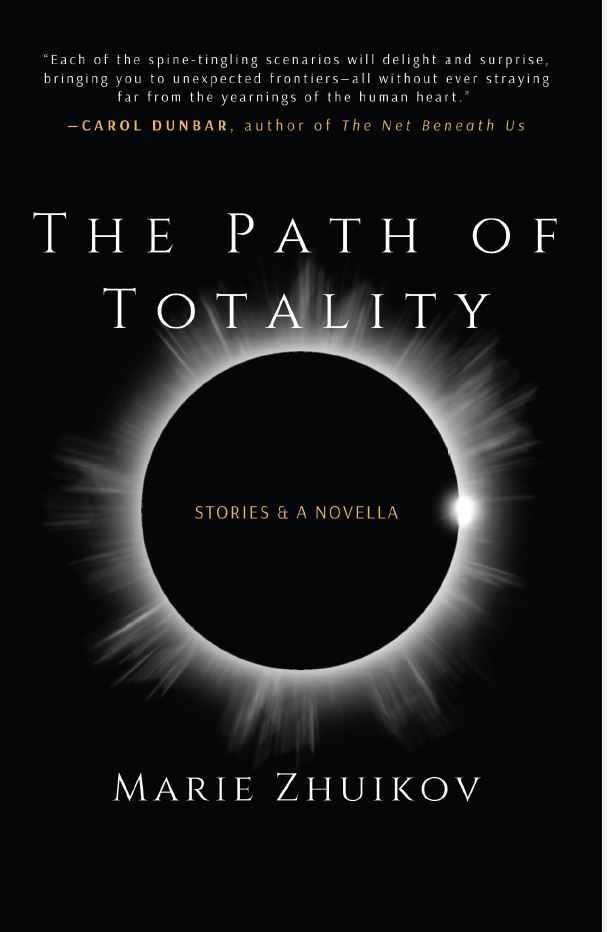
Fellow writer and blogging friend Vickie Smith was kind enough to review my upcoming short story collection for the Wisconsin Writers Association. You can find the review here, plus a link to preorder the book at a discount. (It’s coming out on Feb. 11.) You can find out more about Vickie at her blog, “Writing Near the Lake.”

Like me, Vickie lives near Lake Superior. We support each other as writers, and I hope to return the reviewing favor when her first book is published!

Here’s an excerpt from her review: Zhuikov’s stories explore a wide range of human emotions – grief, duplicity, curiosity, loneliness, love, obsession, and fear – against a backdrop of both rural and urban worlds filled with the inexplicable, the mystical, and the paranormal. She skillfully combines these human emotions with well-crafted imaginative worlds as she delves into the everyday desires and struggles people face, making her tales intriguing reads to be enjoyed by everyone.

“Hot Frosty” Movie Guest Review and an Updated Drinking Game List

Image courtesy of Netflix

Russ and I are fans of National Public Radio’s “Wait, Wait, Don’t Tell Me” news quiz humor show. In a recent edition, host Peter Sagal mentioned that holiday movies are being produced with a decidedly sexy bent. He named one in particular: “Hot Frosty.” This Netflix production is about a muscular snowman who comes to life after a young widow drapes him with a scarf that has magical properties. Needless to say, he keeps his “hot” physique once he’s human, and romance ensues. But he also keeps some of his cold properties, too, such as a penchant for eating ice and a below-freezing body temperature.

We decided that “Hot Frosty” was a good candidate for a drinking game, even though it wasn’t an official Hallmark movie. We set a date with my friend Sharon, with whom we had a riotous time four years ago enacting and enhancing this drinking game list.

This living snowman causes quite a stir while fixing a roof. Image courtesy of Netflix.

Although “Hot Frosty” didn’t contain as many troupes as a Hallmark movie, we still had fun watching it. In fact, it inspired us to enlarge our game list with a few new rules. I’ll post the revised version below Sharon’s review of the movie. Please note: Sharon provided this review after drinking to drown her sorrows after the Packers lost to the Vikings, and after playing our movie drinking game.

“It’s part PG-rated but it doesn’t go too far in the sexy category. It’s not like “Magic Mike.” Netflix, could you ramp it up a notch? The snowman had an interesting body but no substance.

“Women are usually colder than men. I dunno if it’s from our estrogen or what. We don’t want to snuggle up to men who are colder than we are. We want hot men! If someone was as cold as this guy is, it would put a damper on things.”

So, there you have it. Maybe not all that sexy, and probably too cold, but it was a fun way to spend an evening.

Here’s our freshly revised list.

RULES

Take one drink whenever:

A reference is made to a dead relative
The “Mayor” appears on screen
The main character’s name is related to Christmas (Holly, Nick, etc.)
Anytime someone disses fake Christmas trees
A newcomer partakes in an old family or town tradition
Hot chocolate, apple cider, or eggnog is on screen
A big city person is transplanted to a small town
Christmas caroling, a tree farm, baking cookies, or a snowman appears
Mistletoe or a scarf is on screen
A character makes a magic deal
Any time you hear “Jingle Bells”
The town is named something Christmas-y
An interracial couple appears
An angry, misdirected law enforcement officer appears

Take two drinks whenever:

Characters experience a ‘near-miss’ kiss
An obvious product advertisement appears
A snowball fight, ice skating, or dancing happens
An ugly sweater or tie appears
The characters are snowed in
Someone gets a makeover
A “Pride and Prejudice” reference is introduced (a character is named Darcy, a place named Pemberly)
Someone refers to a metaphor or uses intelligent phrasing
Someone refers to fishing or hunting
Someone with slicked-back hair expresses their hate for Christmas

Finish your drink whenever:

The cynic is filled with the Christmas spirit
It snows on Christmas
Someone selects a Christmas tree
The main characters bake/cook something together, or Christmas-themed food is mentioned
Bad art appears or a literary reference is made
Dissonant architecture appears (for instance, a lighthouse in Wyoming)
Accordion music happens, especially if it’s playing Jingle Bells

Take a shot whenever:

The movie stars Candace Cameron-Bure, Lacey Chabert, or Andrew Walker appear
The main characters fall in love
The main characters kiss

The Top Meanders of 2024

Putting the “Happy” Back into New Years

Twenty twenty-four began with a bang on my blog. One of my first posts of the year was its most popular. It dealt with the death of my sister many years ago during New Years and the effect it had on me and my family. I wrote it as a guest post for the Happiness Between Tails blog. (Thanks again, da-Al!) I plan to raise yet another toast to my sister this New Years.

The Minute Men and the Minister

Second-most-popular was this post about my New England colonial ancestors. I found out rather by happenstance that they founded two towns (one in Massachusetts and one in Canda) and that two statues have been erected in their memory. Also, one penned the famous words: a government of the people, by the people and for the people. All this while I was actually looking for something else! I’m not sure why this post is so popular; perhaps because it deals with some American icons.

If I Were a Real Photographer

I still utter this phrase more often than I would like. Because I remain tied to the workaday world, I cannot run off, camera in hand, to pursue the glorious shots I know that are out there. My retirement is looming, however. This spring, I hope to say that phrase a lot less often, and to have the photos to show for it.

Thank you, dear readers, for following my meanderings through Ireland, Scotland, Georgia, Wisconsin, and Minnesota this year, as well as those more internal meanderings. I wish you a good end to the year and an even better 2025!

Roasted Chestnuts and Cranberry Curd Tart for Christmas

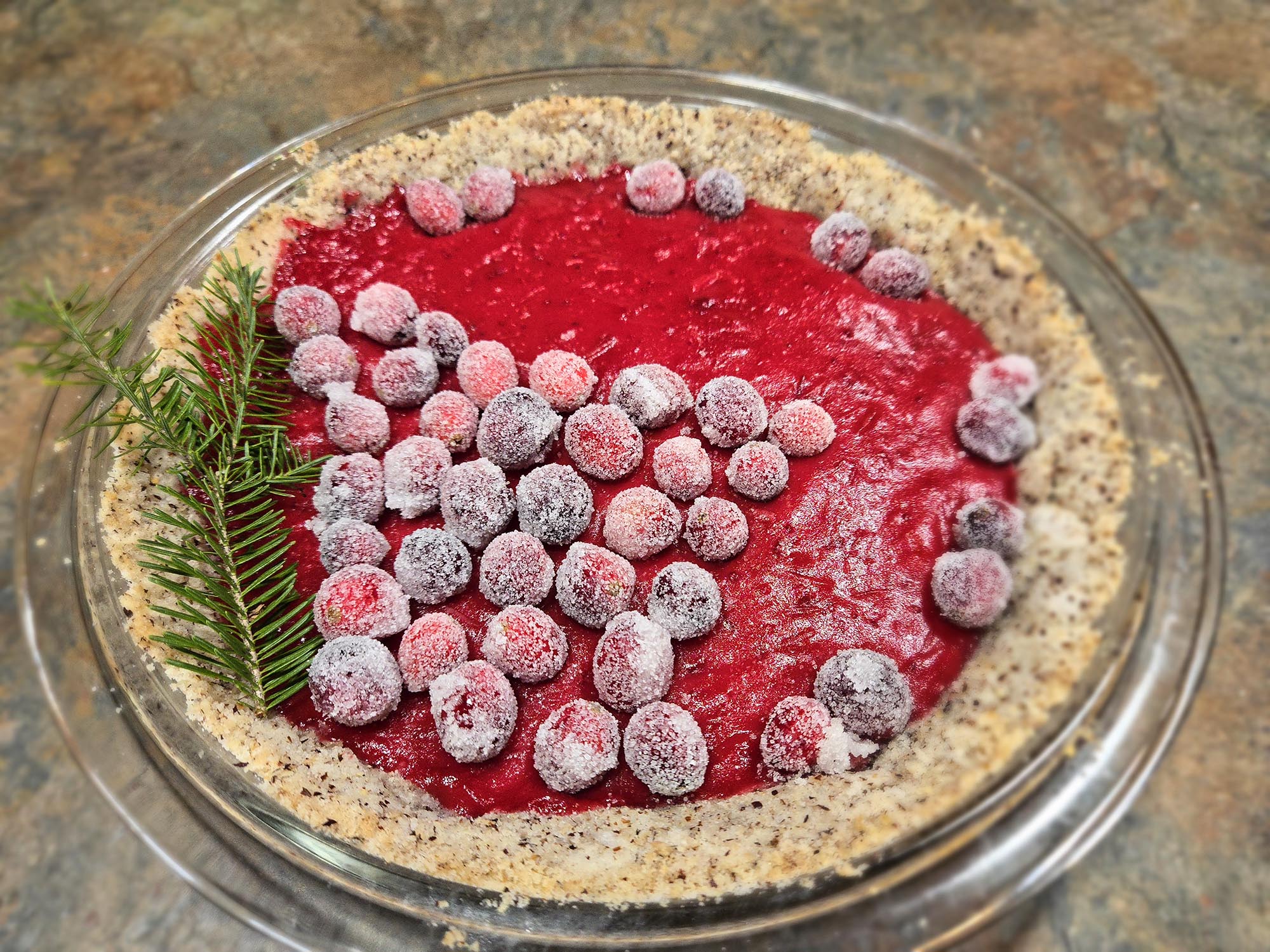
Cranberry curd tart with sugared cranberries and a hazelnut flour crust.

I’ve been trying some new foods this year to get into that Christmas spirit. One was roasted chestnuts. I happened to walk by some in the grocery story and picked them up on impulse. I once ate a roasted chestnut appetizer during a memorable meal at a restaurant in Michigan, and I wanted to see if I could recreate that dish at home.

As it turns out, I unknowingly bought one of the best kind of chestnuts for roasting. Apparently, shoppers can buy ones from Asia, Italy, and South Carolina. The package I bought was from Italy. I found a recipe online and waited until a weekend when I had time to try it. The process takes a while because the chestnuts need to soak to soften. The recipe on the package of chestnuts did not include that step, so I’m glad I looked online. I think it would have been harder to peel the chestnuts if they had not been soaked after being scored.

It also took me a while to score the pound of nuts that I had. I was being careful not to cut myself in the process and my fingers got tired about halfway through, so I took a break. It also takes a while to peel the nuts once they’re cooked. But the results were worth it! The naked nuts look like little tan brains and taste like a cross between a pecan and a walnut.

I was glad that they keep well in the refrigerator or freezer. Russ and I couldn’t eat all of them in one sitting. In fact, I think we still have a few left that we should probably eat today!

The chestnuts after roasting and peeling.

My other festive food was a cranberry curd tart with a hazelnut flour crust and sugared cranberries. I’d made the tart before a few times with a recipe from the New York Times. The recipe appealed to me because it is wheat-free. I cheat a bit—I don’t make my own hazelnut flour. I buy it from Bob’s Red Mill at my grocery store, which usually carries it during this time of year. I also made the recipe easier by not straining the cranberry mixture. I just blend it all up in a blender. That gives it a good color and extra flavor. But I do juice my own orange and grate fresh orange zest.

The sugared cranberries were my new thing for the season. I had some leftover cranberries from making the tart. I’d seen photos of tarts decorated with them and thought it looked fun to try. Like with the chestnuts, the sugaring process for the cranberries takes some time—mostly in waiting for things to dry.

I used this online recipe for the cranberries. I didn’t have any parchment paper, so I used aluminum foil, and that seemed to work just fine. The recipe also includes tips on how to sugar rosemary sprigs to make the pie look more Christmasy. I didn’t have any rosemary, so I simply went outside and clipped off a balsam sprig to decorate the pie. (Note: we did not eat the sprig, it was just for decoration!)

I would advise making the sugared cranberries the same day the pie will be eaten. If the decorated pie is stored overnight in the fridge, the sugar grains tend to “melt,” and you’ll need to take the berries off and re-sugar them. The cranberries can also be eaten by themselves as a snack. They’re great!

So, if you have some time this year and want to try something different, these are two foods to consider. I probably won’t roast chestnuts again, but I’ll for sure make the tart and cranberries during future holiday seasons.

Having Fun with Trolls

Marie and her troll friends.

Russ and I went to one of those outdoor Christmas villages for this first time last weekend. It was in Knife River, which is about 20 miles north of us along the shore of Lake Superior. The village is called Julebyen (pronounced YOOL-eh-BE-en), which (appropriately) means Christmas village in Norwegian. The quaint former fishing village that it’s located in has Norwegian roots. Proceeds from the event support the community.

Outdoor stalls at Julebyen in Knife River, Minnesota.

 Julebyen features ethnic foods (like lefse and krumkake), crafts, holiday decorations, and music. There are also food trucks from local eateries. A train brings visitors up from Duluth and Christmas-themed buses travel from the Twin Cities. We quickly learned that the event is HUGE. Lots of people and lots of fun. Shopping takes place in outdoor stalls and indoors under a couple of large tents. There are candles, pottery, clothing, teas, notecards, wooden sleds, fish, wreaths, honey, jewelry, mittens and honey.

My favorite thing, however, were the trolls. Two men in costume posed for photos and make troll-like comments and jokes with passersby. As you can see, I took advantage of the photo op. In Scandinavian folklore, trolls are supernatural creatures who are dangerous, evil, and hostile to humans. These ones weren’t, though. Trolls are thought to be able to transform themselves, offer prophesies, and steal human maidens. When exposed to sunlight, they explode or turn to stone. This is helpful to know if you ever meet one. Also helpful to know is that lightning kills them instantly.

I assume this is a Norwegian-style fishing boat, with a festive sail for the holidays.

The village also offered a sledding hill, but there wasn’t enough snow yet for that. I’m glad we got to enjoy Julebyen and get into the holiday spirit. I think it’s helping us through some hard times. I just learned by happenstance that my friend Yooper Duane died this year, on my birthday, no less. He was a special soul. We met on Isle Royale National Park in Lake Superior when I was in college and corresponded for years. I’d make a point of visiting him when I traveled across Michigan’s Upper Peninsula. The last time we touched base was by phone when I was on Isle Royale a couple of years ago. He was impressed by the phone call, since such contact was not technologically possible when we both worked on the island. Duane died at the ripe old age of 80. I’ll miss him!

The Knife River, which flows through the town.

Also, this week a family member was hospitalized. That’s all I’ll say about it to preserve this person’s privacy. But it’s a stressful situation that’s difficult for everyone.

Be sure to give your loved ones a hug this holiday season. You never know what the future holds.