Aruban Dreams (Part 4) – Up Close and Personal With Sea Life on De Palm Island Resort

20170315_095826

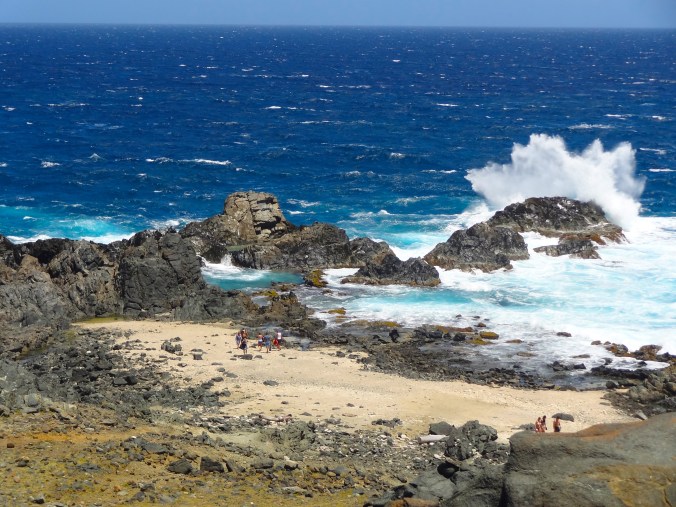
De Palm Island beach

Just off the coast of Aruba is a coral reef and sand island that’s been turned into a resort. Why would anyone ever want to leave paradise in Aruba for someplace else? Because this someplace has ziplining, all-inclusive drinks and food, fabulous snorkeling, banana boat rides, a water park, salsa lessons, and different underwater adventures like snuba, Sea Trek, and power snorkeling.

De Palm Island isn’t far off the coast – just a 10-minute boat ride. A bus picked us up at our resort, so my friend and I didn’t even need to worry about finding our way. After getting our tickets squared away on land and the short boat ride, we were there.

The first thing we did was the zipline. It isn’t one of those jungle treetop kind of ziplines, more like a straight shot zipline over the beach, but it was still fun. The most exciting part for me was wondering if the springs that were supposed to slow us down at the end of the line would actually work. I am alive to attest that they did indeed function properly.

Then we went snorkeling right off the steps of the snorkeling shack. I brought my own gear because I am a snorkeling snob, and my friend used the resort equipment (which worked just fine). She had never been snorkeling before and was a bit freaked out about the whole breathing underwater thing, but it didn’t take long for her to get the hang of it. And the fish were amazing. The island has great habitat for fish. All you need to do to find them is put your face in the water.

De Palm Island is known for its blue parrotfish, which we saw along with barracuda and a fish that looked similar to a cowfish. (Alas, if I had only finished my marine biology degree, I could tell you the name for sure.)

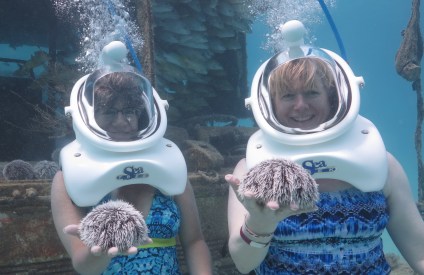
After hanging out on the beach for a while and socializing with people from a visiting cruise boat, it was time for our Sea Trek. This underwater adventure (available for an additional fee) involves having a seventy-pound helmet put over your head as you enter the water. The helmet quickly becomes lighter underwater and air is pumped into it from a hose above – kind of like a modern-day diving helmet. But the helmet is still heavy enough to allow you to walk on the bottom of the sea. And your hair won’t get wet. And you can wear your glasses.

After a short instruction period, we met the professional divers who would be helping us, and off we went into the water. I’m not sure how deep we ended up going – maybe about fifteen or twenty feet, but I would recommend renting one of the resort’s wet suits. It’s cold down there, even for hardy Minnesotans. We shivered the whole twenty minutes of the “dive.”

Along the route, the divers presented us with different forms of marine life to hold, like brittle stars, sea urchins and sea cucumbers. An underwater photographer/videographer recorded these explorations for posterity, and you can buy the photos/videos for an extra fee once you’re back up top. The diver also fed the fish to keep them swimming around for the photos, which made it look like we were in this huge school of fish.
IMG_6298

Sea urchin, anyone?

At one point, the divers had us all sitting in chairs at a table on the sea floor. One of my ears wouldn’t equalize and I thought I’d have to abort the dive, but the instructor just motioned for me to stand up. That took care of the pain and I was able to equalize and enjoy the rest of the experience.

The last thing they had us do was sit in an old Jeep and pretend like we were driving. Add some empty champagne bottles for props and you have the makings of underwater drunk driving photos.

The experience was unique and worth the price and the (minor) pain and chill. Still, we were glad to get out of the water and back into the warm sun.

Next up – the last entry about our trip: Aruba – Island of Sensual Delights . . .

Aruban Dreams (Part 3) – Beaches and Butterflies

DSC03881

Tourists ponder pelicans upon pilings, Druif Beach in Aruba.

My friend and I eventually came out of the caves in Aruba and into the sunlight. The first beach we saw was just outside our resort.

Used to the rootbeer-brown waters of northern Minnesota, my immediate reaction to Druif Beach/Divi Beach was to laugh at the impossibly white sugar sand and the turquoise water. I felt like I was walking through the living embodiment of a Caribbean travel magazine advertisement.

Druif/Divi Beach is in the low-rise resort part of the island, up the coast from Oranjestad, the capitol of Aruba. We spent a couple of afternoons and evenings on these beaches, which were a short walk from our resort condo.

Besides the ridiculously gorgeous scenery, the nice thing about this and the other beaches in this post is that you don’t have to fight for a spot under a cabana like you do at some resorts. No need to wake up at 6 a.m. and reserve beach chairs. We usually didn’t drag ourselves out of bed until 8 or 9 a.m., and often didn’t get to the beach until the early afternoon. We were always able to find either a cabana or a shady spot under a tree. Granted, the cabana might not have been the closest to the water, but it was nice not to have to strategize relaxation. This is a VACATION, after all.

Two drawbacks of Druif/Divi Beach are that it’s right near the roadway, and the scenery is marred by offshore oil platforms. Car motors compete with the sound of lapping waves. Baby Beach and Eagle Beach don’t have these problems.

DSC03976

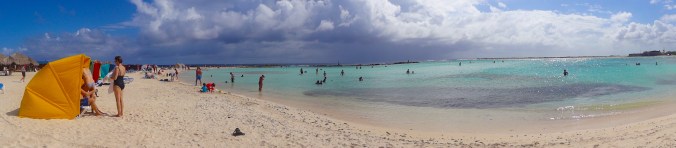
Baby Beach wide-angle view.

Baby Beach is in a large cove on the southeast end of the island. The shallow waters and protection of the cove make it perfect for young children for swimming. It’s also great for snorkeling, although you have to swim out a ways to the rocky cove walls to find the fish.

One word of caution: bring your wallet with you (not into the water, though!) If you need to use the restroom, it costs $1. You also might want to spend money at the bar/restaurant and the beach equipment rental place.

DSC04006

Eagle Beach

Our last morning on the island was spent at Eagle Beach, just up the coast from Druif/Divi Beach. We were not disappointed by this decision. Eagle Beach is rated consistently high in polls of beachgoers in the world and in the Caribbean.

The beach is wide and the road is far away. There are plenty of cabanas for shade. The water is so clear, it hurts the eyes. And there’s not a rock to be found. I suppose all that nice white sand is like an underwater desert for marine life, but at least humans NEVER have to worry about stubbing toes or stepping on a sea urchin.

Just like a tanning bed fan, the prevailing winds keep you cool and keep any bugs away. (No damn biting sand flies like in Minnesota). There are Zika mosquitoes in Aruba, but we never saw even one because of the wind.

Another activity for nature-lovers in Aruba is the Butterfly Farm — housed in a low-slung building across from the high-rise resort district. Lush greenery, flowers and butterflies will fill your senses. Knowledgeable guides give tours and can explain all the different butterfly types and life stages. I also went to a butterfly farm on the island of St. Martin, and the guides in Aruba were even better.

Bonus: your entrance fee is good for an entire week, so you can visit more than once if you want. The farm opens early in the morning sometimes for people who want to see the chrysalises hatch. The time was too early for me to rise during VACATION, but I was tempted. I bet it’s inspirational.

Up next in part 4: Getting personal with underwater sea life on DePalm Island Resort.

DSC03922

Aruban Dreams (Part 2) – Caves

DSC03902

Quadirikiri Cave

In the previous episode, my friend and I were returning from a trip to the Conchi Natural Pool in Arikok National Park in Aruba. After being spared a forced death march through the desert back to our car by some kind folks who had room in their Jeep, my friend and I were set to explore two of the park’s caves.

IMG_7433

What we could see of Fontein Cave through the locked gates. Photo by Karen Brehmer.

The caves are drivable via a paved road that devolves into a gravel road. But first we needed some lunch. Boca Prins Restaurant appeared before us, an oasis in the middle of nowhere – at the edge of a sea cliff where the paved road ends.

I had THE BEST pina colada and fish stew of my life there. The cold drink felt wondrous after our morning adventure and the fish stew was light, fishy, and limey – obviously made by someone who knew what they were doing.

We tarried over lunch so long that by the time we got to Fontein Cave, the gates to it were closed (it closes at 3:30 p.m.). If we had been able to enter it, we would have seen native pictographs dating back 1,000 years, along with drawings by colonialists. Guess I will have to visit it again on my next trip to Aruba.

DSC03910

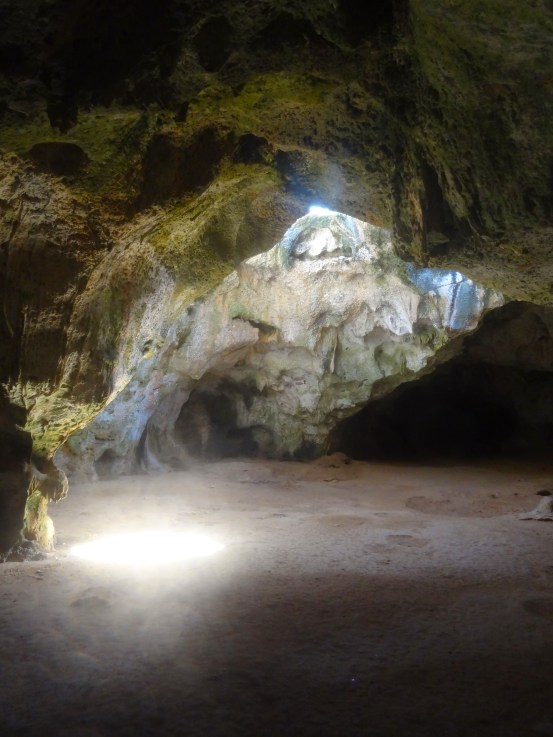
Quadirikiri Cave

Then we traveled to Quadirikiri Cave, which is known for its two large caverns and bats. The caverns are lit from holes in the ceiling. I could immediately see the appeal of the caves to ancient peoples. They provided shelter from the relentless and ever-present Arubian tradewinds and sun, and they were very roomy. I would totally have lived there 5,000 years ago.

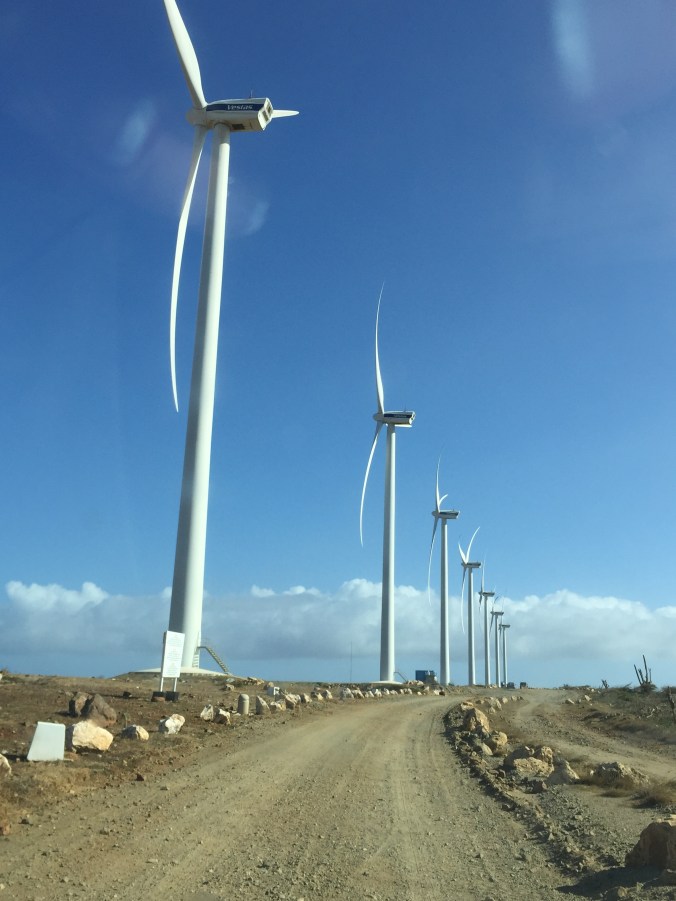
On our way out of the park, we drove past some prominent landmarks that took the form of wind turbines. Aruba gets a good percentage (15%) of its power from renewable sources, with a goal of 100% for the year 2020. The wind-farm we drove past is not part of the park, but it’s just as impressive as some of the natural landmarks.

Thus ends our time in the park. Next up: Beaches and Butterflies.

IMG_1443

Image by Karen Brehmer.

Aruban Dreams (Part 1)

DSC03897

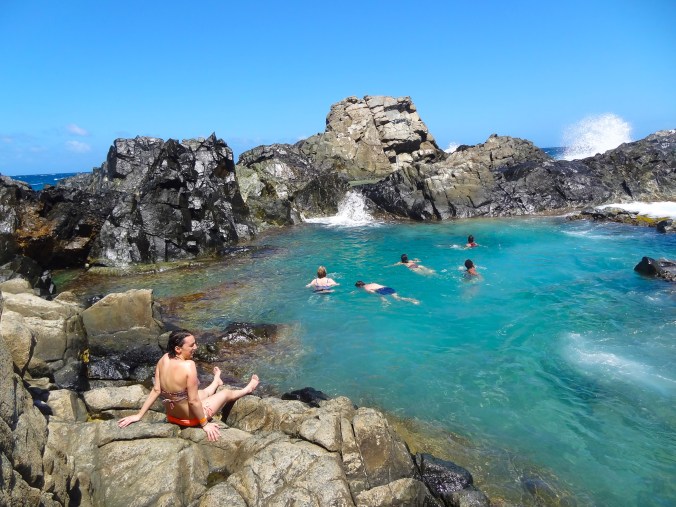
Conchi Natural Pool, Aruba.

A friend and I meandered down much closer to the equator last week to the Dutch isle of Aruba. The trip was my New Year’s Resolution and a chance to indulge my isle-o-philia. All I can say is that if every resolution was this amazing to fulfill, more people would make good on them instead of pooping out three weeks into the New Year. Enough of resolutions to lose weight or exercise more. Bah! People should make pleasurable and dreamy resolutions instead. Remember that for next year.

Our first island adventure was the most perilous undertaking of our week-long trip. We decided to visit the island’s one national park (Arikok National Park) to explore a natural ocean pool and then some caves.

The pool was our first destination. It’s located on the coastline, formed by a ring of high rocks that keep out the waves. Periodically, a wave overtops the rocks and fills the pool with more water. It’s known for good snorkeling, and an upper pool flows into the main pool via a small waterfall. Most people travel there by reserving a Jeep or 4×4 ATV. My friend and I? We decided to walk.

I had read somewhere that it only took a half-hour to hike from the park entrance to the pool. My friend and I didn’t need no stinkin’ 4×4 to get us there. That’s what feet are for. Besides, we wanted to get a feel for what the island is really like.

Heh heh. What the island is like is a desert. Hot. With no shade from the equatorial sun. And there are rattlesnakes. But I am getting ahead of myself.

At the park visitor center the attendant told us it actually takes an hour-and-a-half to hike to the pool. (I figured out later that the info I had read started from a different location – the Shete Entrance.) Plus, we would be walking up a 600-foot mountain on the way there.

My friend and I looked at each other, a bit taken aback. But we are healthy 50-something-year-olds from Minnesota. Above average, and all that. We decided we could do it. We were wearing athletic shoes and sunscreen. Our water bottles were full. We were ready to roll.

Then he told us the pool was closed due to high waves.

My friend and I looked at each other again. This was a more serious setback. But we decided we had come this far, we might as well go see the pool. I encouraged my friend to still bring her swimsuit, just in case conditions were really better at the pool than the attendant thought.

Off among the cacti we went. Unlike what the park map shows, there is no separate hiking trail from the Jeep trail, so we had to make way for all the lazy people who opted for motors. Almost all of them stopped and asked us if we were okay, subtly gloating that they were riding and we were walking. We assured them we were fine. We smiled and waved them on their way.

DSC03888

The “trail” to the pool.

Halfway up the mountain we met a family on their way down. The top of the mountain was as far as they got, and they decided that was enough. Especially after they saw the rattlesnakes (one was alive and rattling a warning four feet away from the family’s mom, the other was dead in the road).

I could feel my friend looking at me questioningly again, but I ignored her, determined not to let a few rattlesnakes deter us.

The view from the top of the mountain was great. It was easy to see how necessary the park is for preserving wild natural space on the 20-mile-long island – houses crowded everywhere but within the park’s borders.

The rest of the trail followed a sloping plateau and then made a steep drop to the ocean. Soon, we were able to see our destination, which made the rest of the hike easier — plus the fact that no rattlesnakes crossed our path.

As we neared the steps leading down to the pool, we could clearly see people swimming in it. Yes, waves were overtopping the protective rocks and washing into the pool, but it didn’t look like a life-threatening situation.

DSC03890My friend and I changed into our suits, thankful that we brought them and that we’d soon be going for a swim. We clambered over the rocks and slid down an algae-covered formation into the pool with half a dozen other people.

It was heaven, punctuated by anxious moments when a wave would wash into the pool. My friend got thrown around a bit by one wave, but I was luckier.

While we were swimming, my mind jumped ahead to the hike back out. I wasn’t looking forward to spending another hour-plus tromping through the desert. All my foot-powered bravado seemed to melt away into the sea. When one of our poolmates mentioned to us that he and his girlfriend had a Jeep with room for two more, I was the first to take him up on the offer.

My friend looked at me again, this time in thankful wonderment. I suspect she couldn’t believe that I changed my mind about the whole foot-powered thing. But heck, we were on vacation, not a forced death march.

So thank you, Bobbie and Samantha from New Jersey, for driving us back out to our car. Along the way, we saw another duo of women walking, and of course, we felt sorry for them. We joked that we should stop and ask them if they were okay.