
My Book Comes out this Week!

My collection of shorts stories, “The Path of Totality,” is being published this week by Cornerstone Press. It will still be on sale for a few more days for 20% off until the publication date, which is Feb. 11. You can order it from Cornerstone here.

I’m having a launch event Feb. 18th, 6:30 p.m., at one of my favorite cafes in Duluth—Wussow’s Concert Cafe. It’s being hosted by Zenith Bookstore. I’ll also be doing a reading/signing at Foxes and Fireflies Bookstore in Superior on March 1 from 1-3 p.m. If you’re in the area, please stop by!

Noted Superior, Wisconsin, author, Carol Dunbar is helping me with the Feb. 18th event. She is way more well-known than I am, having had two books published by a national publisher. She was nice enough to write a blurb for my book, which appears on its cover. She was also nice enough to volunteer for a question and answer discussion with me of our books and careers. We deal with many of the same themes in our writing, so it should be a cool event!

“Booklist,” which caters to libraries, recently reviewed “The Path of Totality.” Here’s what they said:

Love, in its numerous forms: romantic, parental, devotional, inspirational, and desperate, has a lingering presence in Zhuikov’s collection of tales. The title story describes a young couple’s emotional struggles after the devastating loss of a premature baby boy. While viewing the 2017 total solar eclipse, healing suddenly sprouts as something “flipped a reset switch” inside the wife. “Bog Boy” is a comically creepy tale illustrating that love truly has no limits. A teenage girl discovers the long-dead body of a young man entombed by peat in the woods, and the preserved corpse becomes her de facto boyfriend. “The Shower Singer” is a feel-good story about an aspiring musician who receives more than just a much-needed jolt of creativity when he hears a woman in the adjacent apartment singing lovely melodies in the shower. Other characters include a sleuthing widow obsessed with the strangeness of a house who ultimately pays a steep price for her curiosity, a hungry alien life form that stalks a college student in Biosphere 2, and a reference librarian with an extraordinary connection to sentient trees.
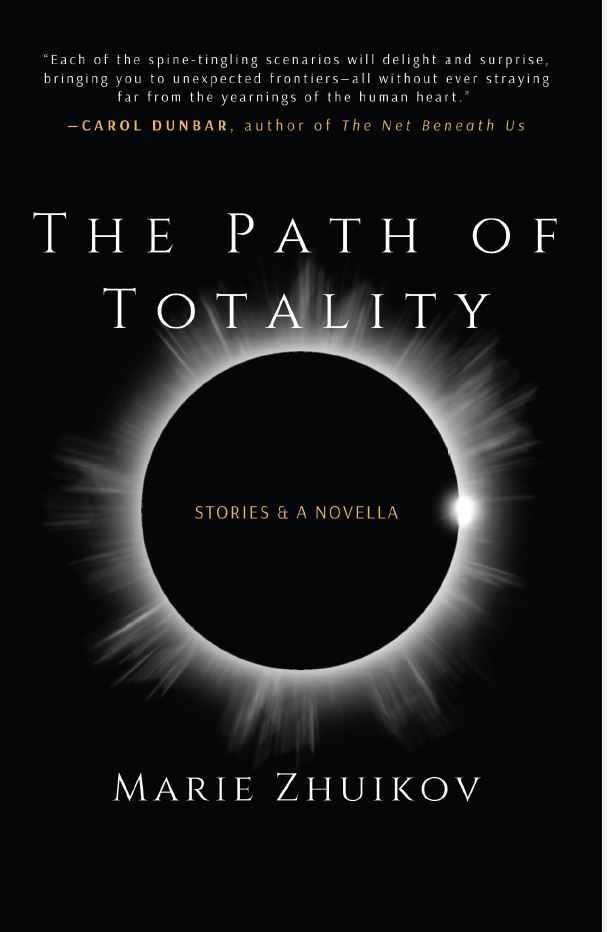
“The Path of Totality” is Coming!

A young man is mystified by why he can’t see an eclipse. A scammer falls for a woman he’s targeting. A nondescript gray house hides a secret from a curious woman walking her dog. A girl discovers a mummified Viking bog boy while on a birding tour. A college student gets trapped in a biosphere after hours. Hemingway’s stolen stories are found in New Jersey. Singing in the shower takes on a whole new meaning. And a librarian develops her own theories about the influence of trees. United by the power of appearances to deceive and captivate, these tales glisten with the magic and menace of everyday lives.

My next book is a collection of short stories and a novella. “The Path of Totality” is a meditation on the power of appearances to deceive and captivate. It’s being published by Cornerstone Press at the University of Wisconsin-Stevens Point and is now available for preorder at a 20% discount. The books will be distributed in February.

It’s already received some endorsements:

These stories concern everyday people discovering who they now are as opposed to who they once were. A grieving couple come to accept the death of their child. A woman pays too large a price for caring about a neighbor’s son. And in “Bog Boy: A Northern Minnesota Romance”—a gem of a story, a perfect story—a teen falls in love with someone suspended in time. Not all of Zhuikov’s characters find peace and harmony, for the damned soul and the broken heart and the heart’s longing are nothing to fool with. But the few who find love, for instance, Sheila and Peter in the long final story, enter paradise.

—Anthony Bukoski, author of The Blondes of Wisconsin

Richard Powers meets Gabriel Garcia Márquez in a collection that nonetheless could have been produced only by a singular sensibility— one firmly planted in a fully recognizable, verifiable natural world that’s also brimming over with mystery, wonder, and the fantastic. I love Marie Zhuikov’s brain. She’s both a scientist and a dreamer. These stories, rich in emotional metaphors that play out in magical ways, remind us to tread carefully and to always pay attention.

—Cheri Johnson, author of The Girl in Duluth (under the pen name of Sigurd Brown)

In settings strange yet familiar we meet characters who are sincere but possibly duplicitous in this new story collection spun by science writer Marie Zhuikov. Each of the seven, spine-tingling scenarios will delight and surprise, bringing you to unexpected frontiers—in a biodome, a graveyard, the husk of a living tree—all without ever straying far from the yearnings of the human heart. Reader, I defy you not to be curious.  

—Carol Dunbar, author of The Net Beneath Us

Marie Zhuikov’s The Path of Totality is a gem of a collection. These speculative stories explore a wide range of unusual situations with humor and insight, with empathy and heart. Readers will get carried away—just like these memorable characters get carried away—into imaginative worlds full of mystery and wonder. She delves into our longing for connections, how we respond in the face of strangeness and mystery beneath the ordinary.

—Jim Daniels, author of The Perp Walk

Please consider preordering while this discount is in place. You’ll be happily surprised come February. And thank you for your support!

Book Review: The Net Beneath Us

Debut novelist Carol Dunbar is living a dream. She’s been slogging along in the local writing trenches of the Duluth-Superior area for years. She gained some local notoriety and then hit it big, signing with an agent and getting a two-book deal with a national publisher.

But it almost didn’t happen. During a recent Wisconsin Writers Association (WWA) conference Dunbar said that ten years into her twelve-year journey writing her novel, a flood in her office made her want to quit. She printed out a draft of her manuscript and was about to begin querying agents. She had written notes in the margins and on the backs of pages – things she wanted to address before she sent out the document.

Carol Dunbar discusses her book at its launch in Duluth, Minnesota, earlier this year.

Dunbar’s writing office lies underneath two 250-gallon water tanks that serve her off-the-grid home in the woods. The tanks developed a leak. For twenty minutes, water poured into her 10 x 10-foot office and onto her manuscript.

“Water is death to all things writing,” Dunbar said. Her draft was illegible. The books lining her office were destroyed. She couldn’t see how to recover from this catastrophe, and she began to cry.

At some point in the devastation, the voice of one of her characters cut through to her. It was Ethan Arnasson, the father-in-law of Elsa, the novel’s main character. Dunbar said that Ethan told her, “Carol, just give it time.” She knew he was right and felt giddy that, “My fictional character was giving me personal life advice!”

Lucky for us, Dunbar persisted. “The Net Beneath Us,” is set in remote northern Wisconsin, where Elsa, a cossetted city girl turned country widow, must determine how to carry on with two her two children in the unfinished home her husband was building for them. To cope with the challenges she faces, Elsa forges a deeper relationship with the land, learning from the trees her husband loved.

As the book jacket says, the novel is a lyrical exploration of loss, marriage, parenthood, and self-reliance; a tale of how the natural world – without and within us – offers healing, if we can learn where to look. The story is written in a rotating third-person perspective and covers the course of a year.

As a writer with a nature bent, myself, I loved Dunbar’s descriptions of Elsa’s growing connection to the forest that surrounds her home. From a floating puffball that seems sentient, to the underground fungal connections that foster communication among trees, to a mysterious white stag, nature reigns supreme in the story.

However, be prepared. A slow grief lays heavy over it, also. Dunbar’s true account about her husband, which appeared this year in the New York Times Modern Love column, offers a huge hint about the source of her dark inspiration.

I gave the book five stars on Goodreads. The writing is so beautiful, I hesitate to nitpick. But it wouldn’t be a full review without some nits. I found that the middle section dragged just a bit. Through multiple examples, this part highlights all the various ways that Elsa feels out of place in her off-the-grid home. I felt like there were too many of these instances. I found myself thinking, “We get it, already!” The other nit occurs near the end where the symbolism of the unfinished second story of Elsa’s home is compared to an unfinished aspect of Else’s psyche. I felt like it would have been stronger and more “literary” not to spell this out for readers so clearly.

At the WWA conference, Dunbar said her book editor encouraged her to change the ending from one “where the dog dies,” (a no-no in literary fiction these days) to something else. After much thought and gnashing of teeth, Dunbar did this, opting instead for the drama of a lost child. This revision works, and it anchors the story even more strongly into the trees and to the white deer.

So, this local woman made good, and we are all the richer for it. I can’t wait to see what gifts her next book will hold for us.