I mentioned a few posts ago that during this trip to Scotland, I figured out that my ancestors were the Barons of Clackmannan and lived for many generations in a tower in the village of Clackmannan. Because we were the only ones who signed up for a group Outlander tour, Henry, our bekilted Tartan Viking Tour guide, had leeway to treat us to a side trip to this venerable ancestral tower.
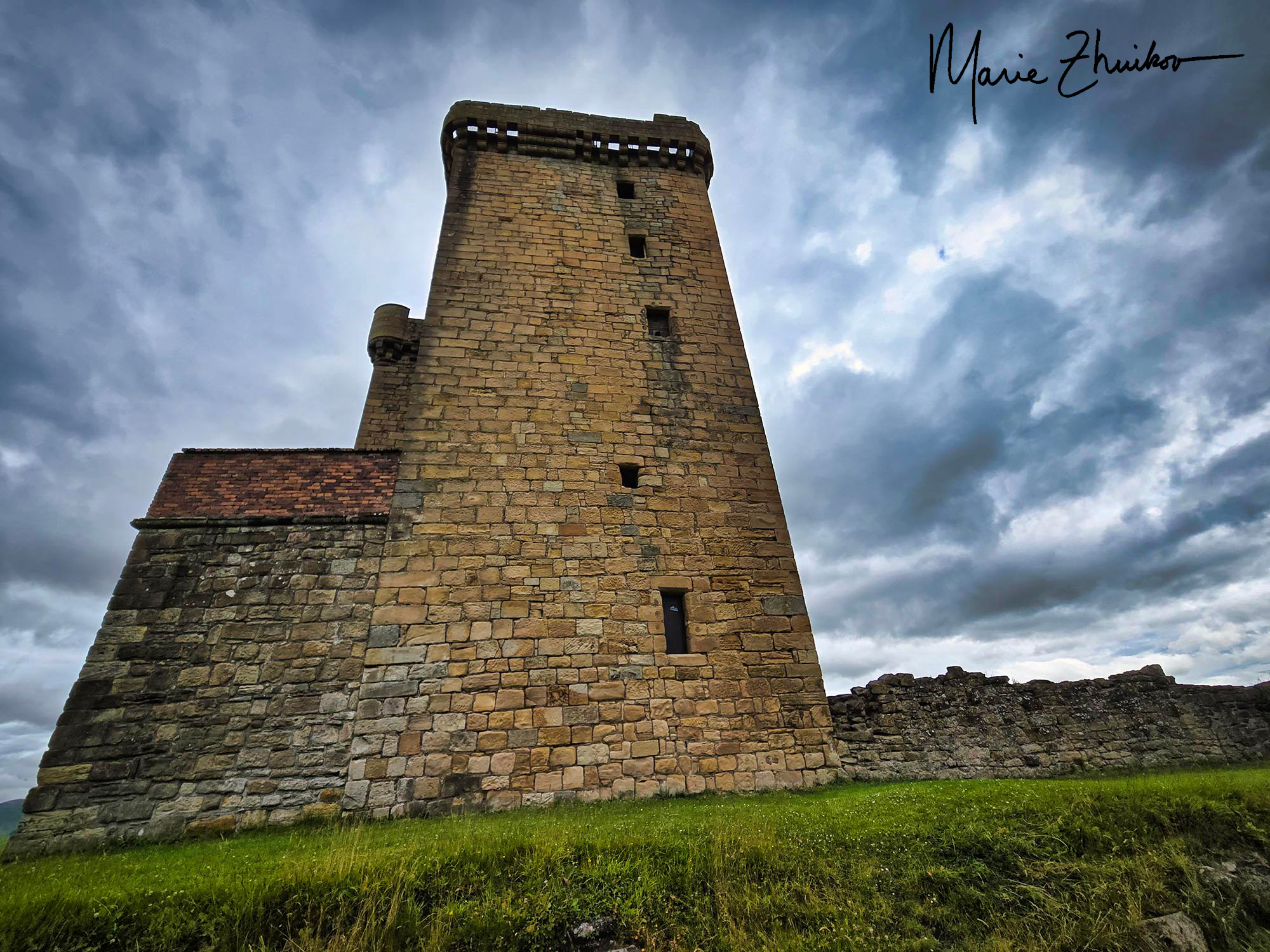
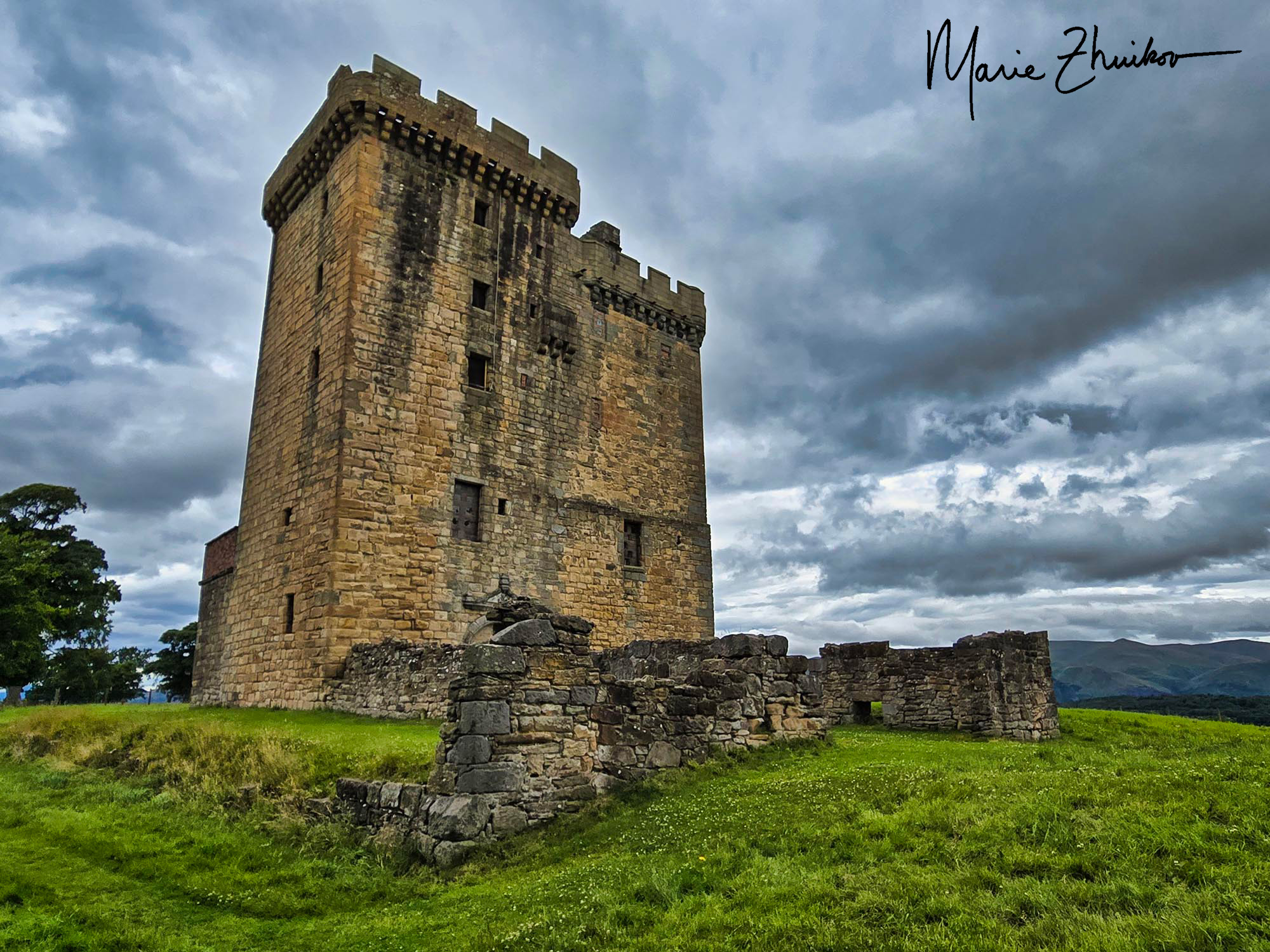
For me, our visit to Clackmannan Tower was truly an unexpected highlight of our trip (thank you, Henry!). King’s Seat Hill upon which the tower is built had long been a strategic outpost. Before the brick tower, the English had built a wooden tower upon it. It commands a view of the Ochil Hills, a 25-mile range that stretches between the Firth of Tay and Stirling.
I’m not exactly clear on this, but I think the tower was built by King David Bruce (Robert the Bruce’s son and second king of Scotland) and was given to his kinsman, Sir Robert Bruce, who is my ancestor. It was inherited by Sir Robert’s son Thomas, who was the 1st Baron of Clackmannan. My ancestors were part of the tower’s history until the 6th Baron of Clackmannan. After that, my ancestry diverges through the baron’s daughter, Lady Christina Bruce. The tower was passed from father to son, and since she was a daughter, she left once she got married.
A wonderful post with useful links about the tower is available through Wee Walking Tours, including embedded videos.
The tower had another tower built onto it, forming an L shape. Originally, a mansion was attached to the tower, but that has been long gone now. In the 1700s, the Bruces who were the current Barons of Clackmannan built a coal mine underneath the tower. Their venture into coal proved a downfall for both the family and the tower. They became bankrupt and the ground underneath the tower became unstable, causing it to lean. The family had to sell the tower to pay their debts. After that, it fell into neglect.
The tower has been rebuilt and refortified a couple of times due to this subsidence. It’s not usually open for tours and is now owned by Historic Scotland. During our tour of Broomhall, Charles Bruce told us that one of the stone archways in an upper level of the tower collapsed and broke through the floors below it. It’s not habitable but does have electricity and a well with water. Historic Scotland has plans to increase public access to the tower in the coming years. I wish them luck!
Near the tower is a modern stone timeline that describes the geologic and glacial history of the area. A nostalgic and primitive tree swing hangs from one of the large trees on the hillside.
If I ever return to Scotland, I think it would be fun to stay in Clackmannanshire and learn more about the area where my ancestors lived for so many generations, and spend more time with the leaning tower.
Next up: our final day in Scotland and a fancy dinner in a mansion that we won’t soon forget!
The Royal Scots Greys Monument with Edinburgh Castle in the background.
In my previous post, Russ and I returned to Edinburgh, mystified and a bit sad after a failed attempt to tour Broomhall House, current home of the Family of Bruce, which we’d been planning for months.
We spent the next day in Edinburgh, seeing the sights including the Scottish National Gallery, which offered several floors of exquisite Scottish and international art from the Renaissance to the beginning of the 20th century. The building looks like an ancient Greek temple and was meant as a “temple to the arts.”
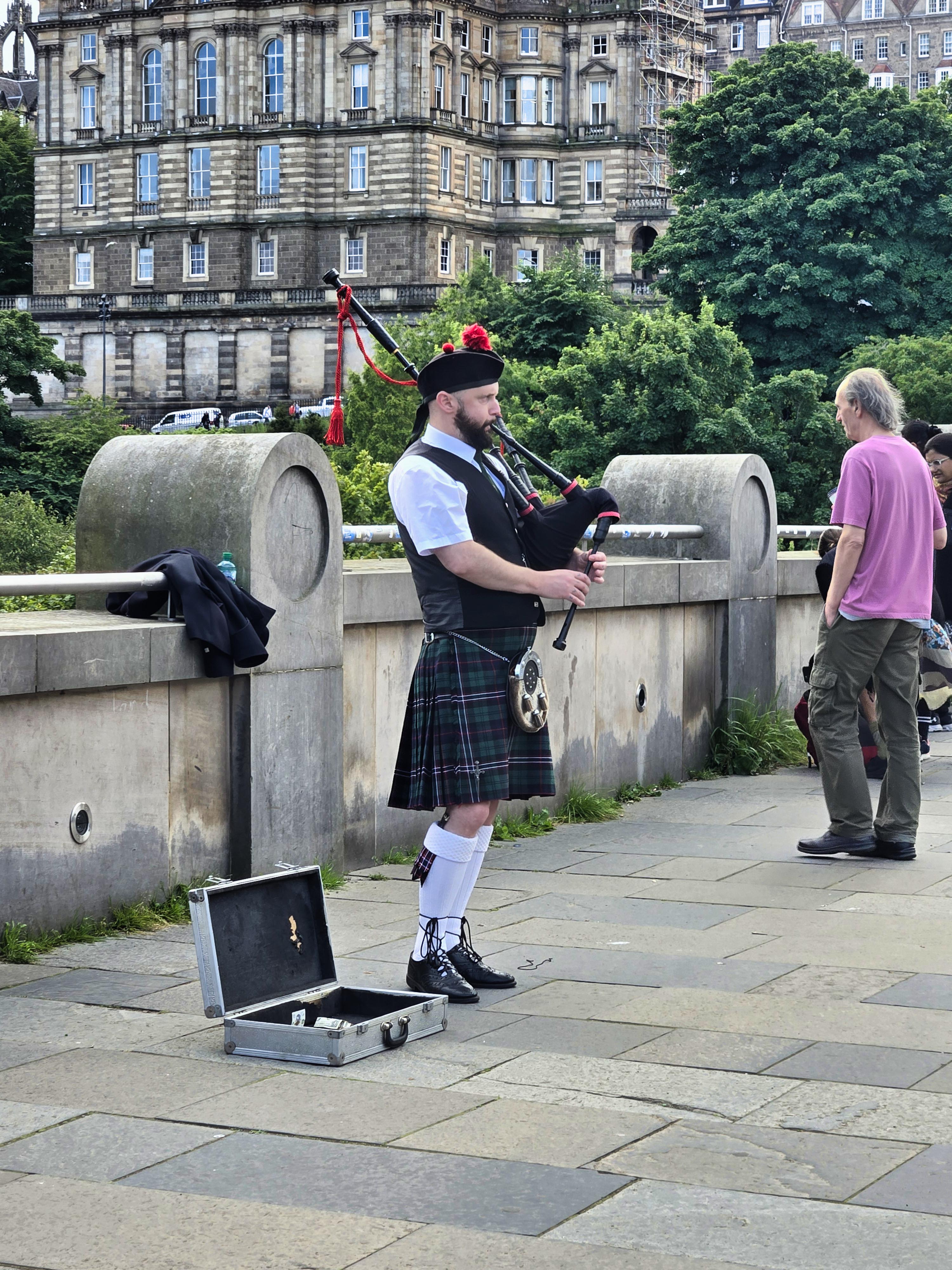
A street piper outside the Scottish National Gallery.
As we walked back to our hotel, we got a happy text from Tartan Viking Tours that our Broomhall tour was rescheduled for tomorrow! We ate lunch next door to our hotel, at Whighams Wine Cellars. I was excited to see they had Cullen skink soup on their menu. It was very good! We ended up eating two more meals there since the food was so good and the prices reasonable. In the afternoon, we meandered about a mile up the hill to Edinburgh Castle. We were an hour early for our reserved tour, so we wandered down the Royal Mile (along with thousands of other people) and shopped.
When it was finally tour time, great-grandfather to the 21st power, Robert the Bruce, greeted us in statue form as we crossed the drawbridge. (William Wallace is on the other side.) It’s crazy to think The Bruce strode some of the same walkways that we were now treading. Later, inside, we saw the ruins of a tower built by his son David. They were crumbling away underneath another building that had been constructed atop it. Stones may crumble, but the bloodline lives on in me and so many other people. I’ve seen estimates that 200 million people are related to Robert the Bruce. (BTW, I just sent off a DNA test kit so that I can confirm, or not, this relationship. The current info I have comes from some cousins.)
The Robert the Bruce statue at Edinburgh Castle.
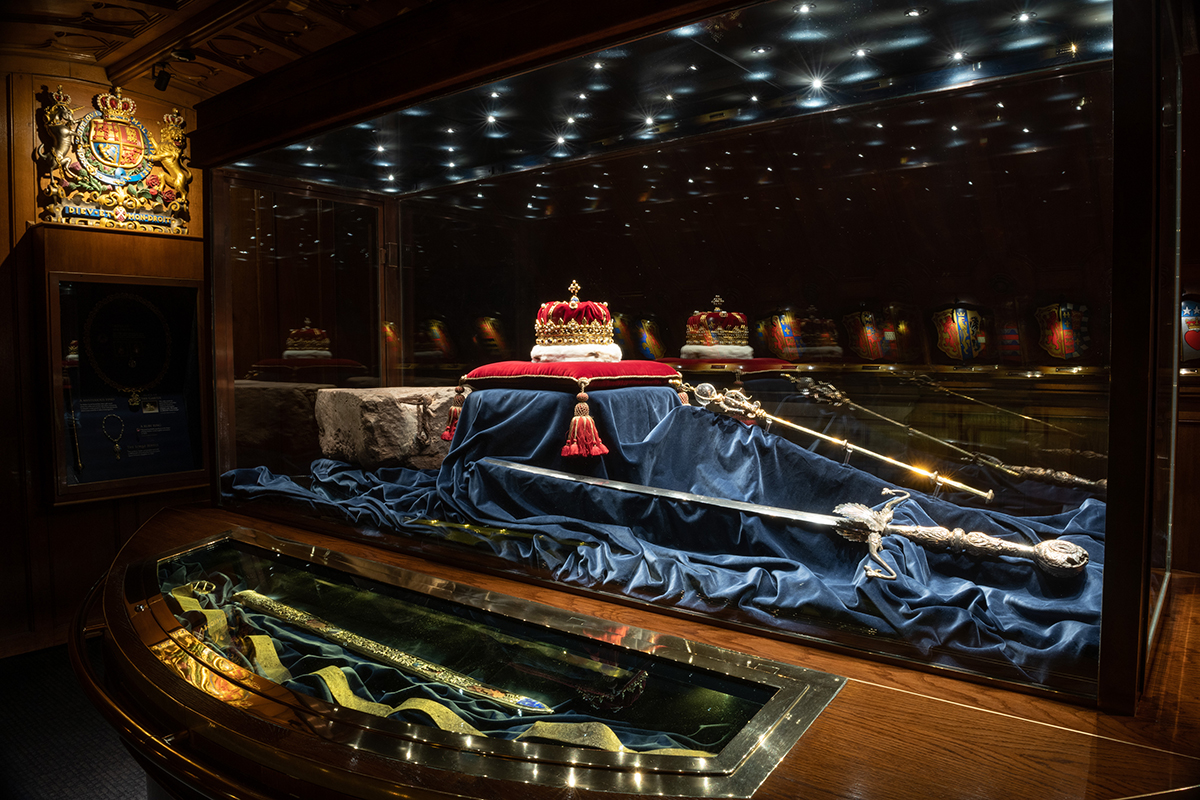
The castle is built on an impressive volcanic plug, but I found the castle itself – especially the royal quarters – not that impressive when compared to Stirling Castle. The Great Hall was cool, though, with its huge fireplace, oak paneling and suits of armor. I was also a bit let down by the crown jewels. From the long line of people waiting to see them, I guess I expected something more than just a crown, scepter, and sword. They wouldn’t let us take photos, but thanks to the castle’s blog, I have one to share with you.
Edinburgh Castle Crown Jewels Room. Image courtesy of Honours of Scotland.
I wondered if part of the reason the castle wasn’t “all that” was because it was yet another casualty of Robert the Bruce’s campaign to destroy castles so that the English couldn’t use them later. (Read more about that on the castle blog here.)
Tour over, we shopped some more on the Royal Mile and returned to our hotel. That was enough for me for the day. I had developed a bad cold or allergies was feeling under the weather. However, the actual weather this day was the best yet – no rain for once!
The beginning of the Royal Mile outside of Edinburgh Castle.
Day 8 in Scotland found Russ and I with our kilted tour guide Calum on the way to Broomhall House. Our tour was finally going to happen!!
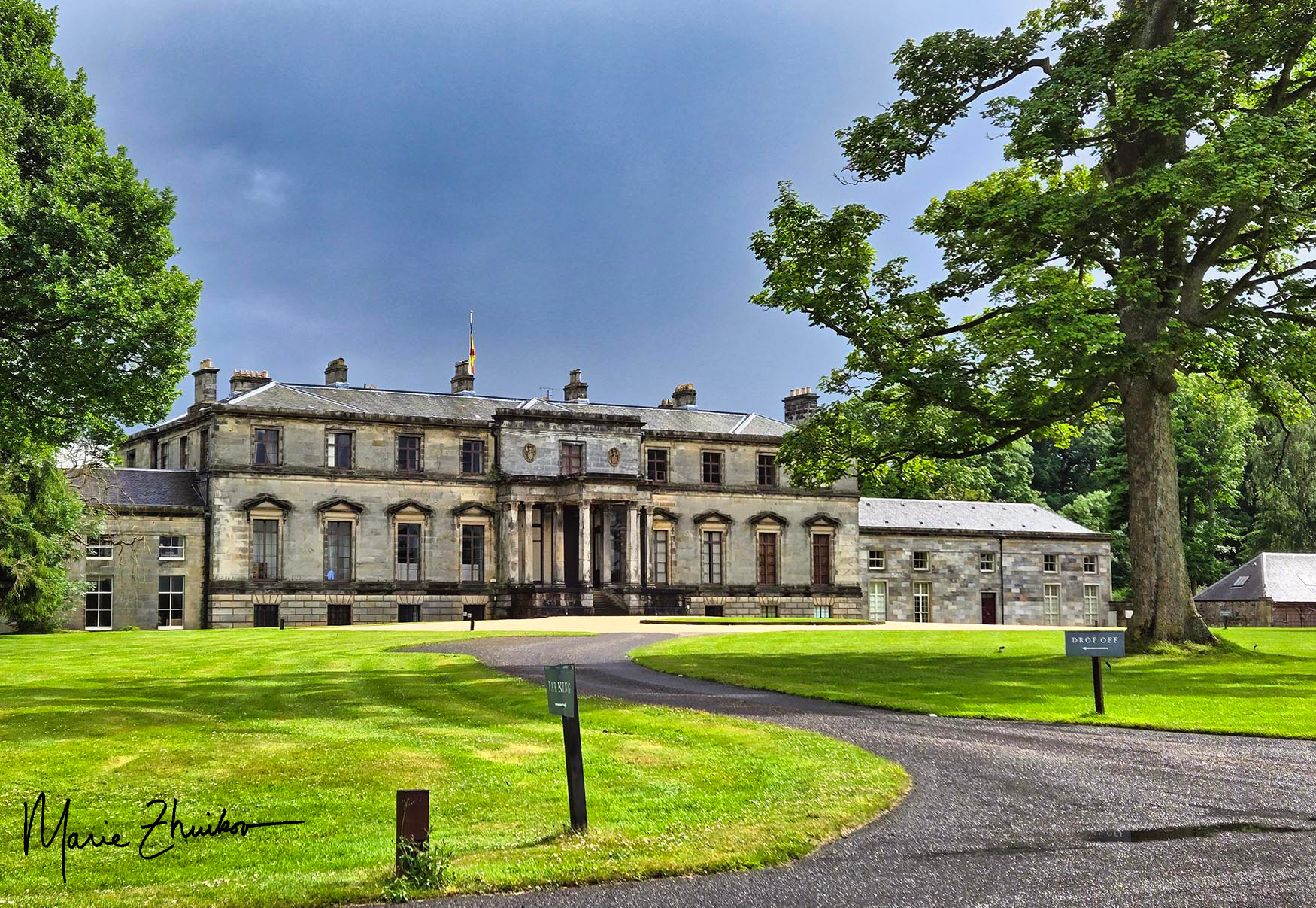
Broomhall House
Distant cousin Charles Bruce met us at the door. My first impression was that he must have an awesome skin care routine. His face positively glowed! After exchanging greetings, Calum said he was going to depart now. I looked at him, surprised. We had talked earlier about whether he’d be able to do the tour with us. He said he wanted to, as long as I was okay with it and Charles was okay with it. I was astute enough to notice that although Calum’s mouth was saying one thing, his eyes were pleading to let him stay. I said something like nonsense, we were fine with having Calum along for the tour as long as it was okay with Charles. Charles gave his permission and then led us through a room containing replicas of the “Elgin Marbles.” These are historic marble statues collected by a previous Lord Elgin (the 7th) from the Parthenon in Greece. In recent years, they caused quite a stir at being in the hands of the family, so they donated them to the British Museum in London.
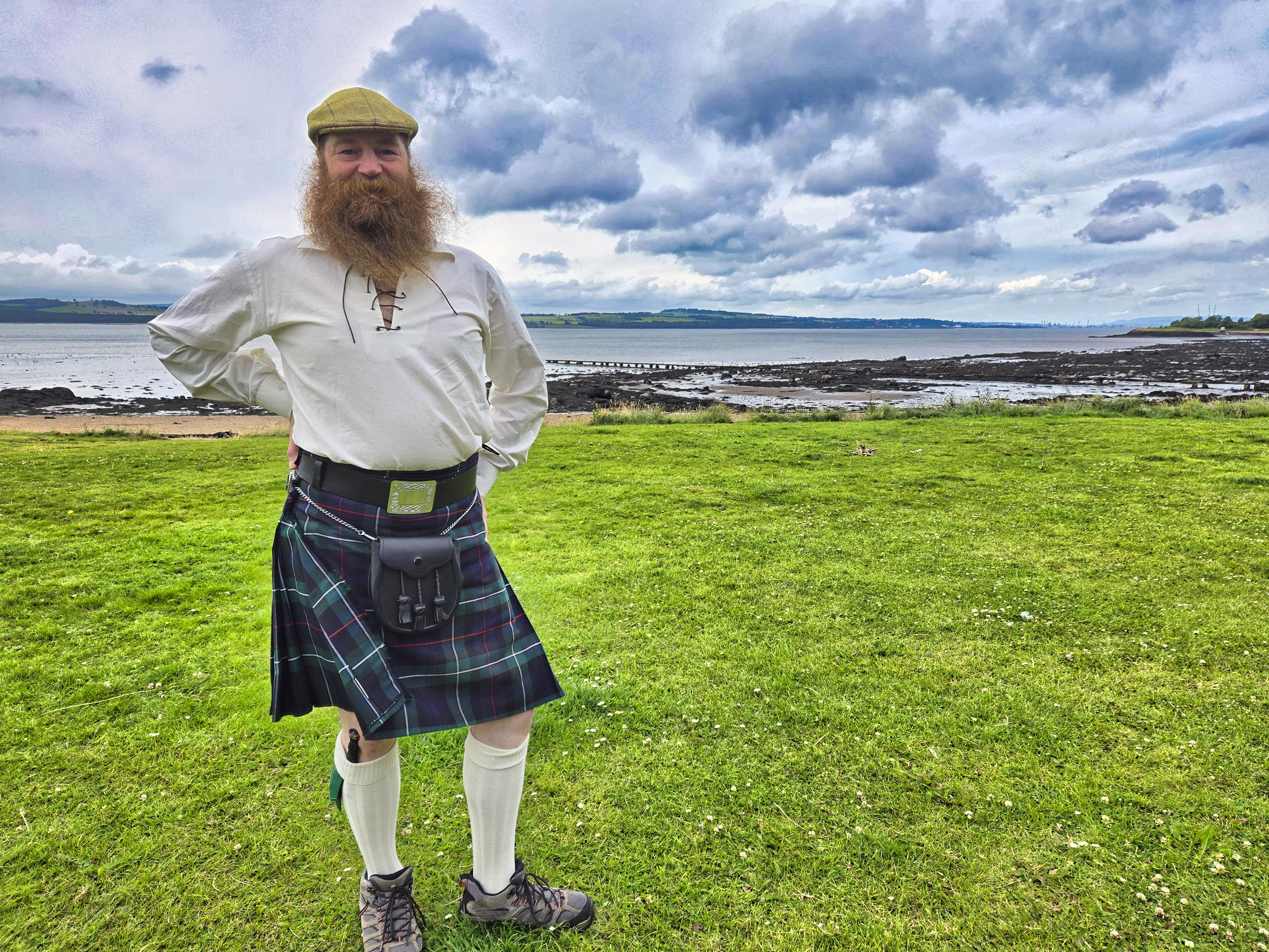
Calum, our Tartan Viking Tour guide, in Limekiln.
We settled in the library and Charles poured us some tea. He asked a bit about my ancestral background and then began a lecture about Andrew Carnegie, the Scottish-American industrialist and philanthropist who was born nearby in Dunfermline. He showed us a ledger book that contained an IOU to the Bruce Family from the Carnegie Family. It’s not known whether this debt was ever paid since the Carnegies moved to America later. But Charles was rather tickled to think that a family destined to become one of the richest in America had been in debt to his family.
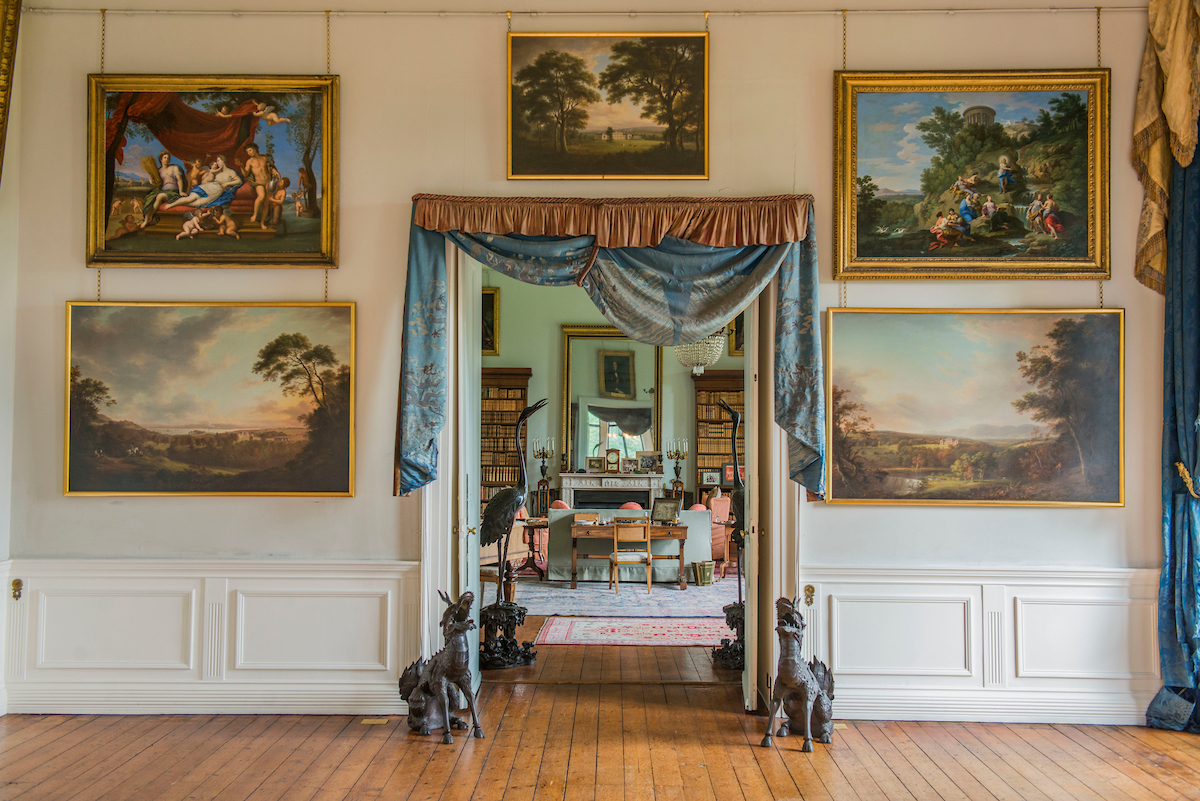
View from the Music Room into the Library. Image courtesy of Broomhall House.
As we discussed the books in the library, Charles off-handedly mentioned they had a first edition copy of “Waverly” by Sir Walter Scott. Later, I asked if I could see it. He couldn’t find it, but he did find a third edition of “Rob Roy.”
At one point, he opened a book that contained an old map. Me, with my cold and my dust allergies, immediately began a mortifying coughing fit. Charles, the dear man, ran out of the room to find me some water. In the meantime, I thought to pour myself more tea. By the time he returned, my fit had subsided, thankfully.
The Music Room in Broomhall. Image courtesy of Broomhall House.
Our next stop was the Music Room, which contained the original plans for Broomhall House. It was originally supposed to have marble columns on the front, but the family ran out of funds by that point. The columns, which were already cut, were added to a different building elsewhere. Charles also talked about the nearby town of Limekiln and how the citizens there made the best mortar (plaster) for building. It’s the same mortar that was used by the Scottish builders who worked on the White House in the U.S. Limekiln no longer has a lime works, but a nearby town does.
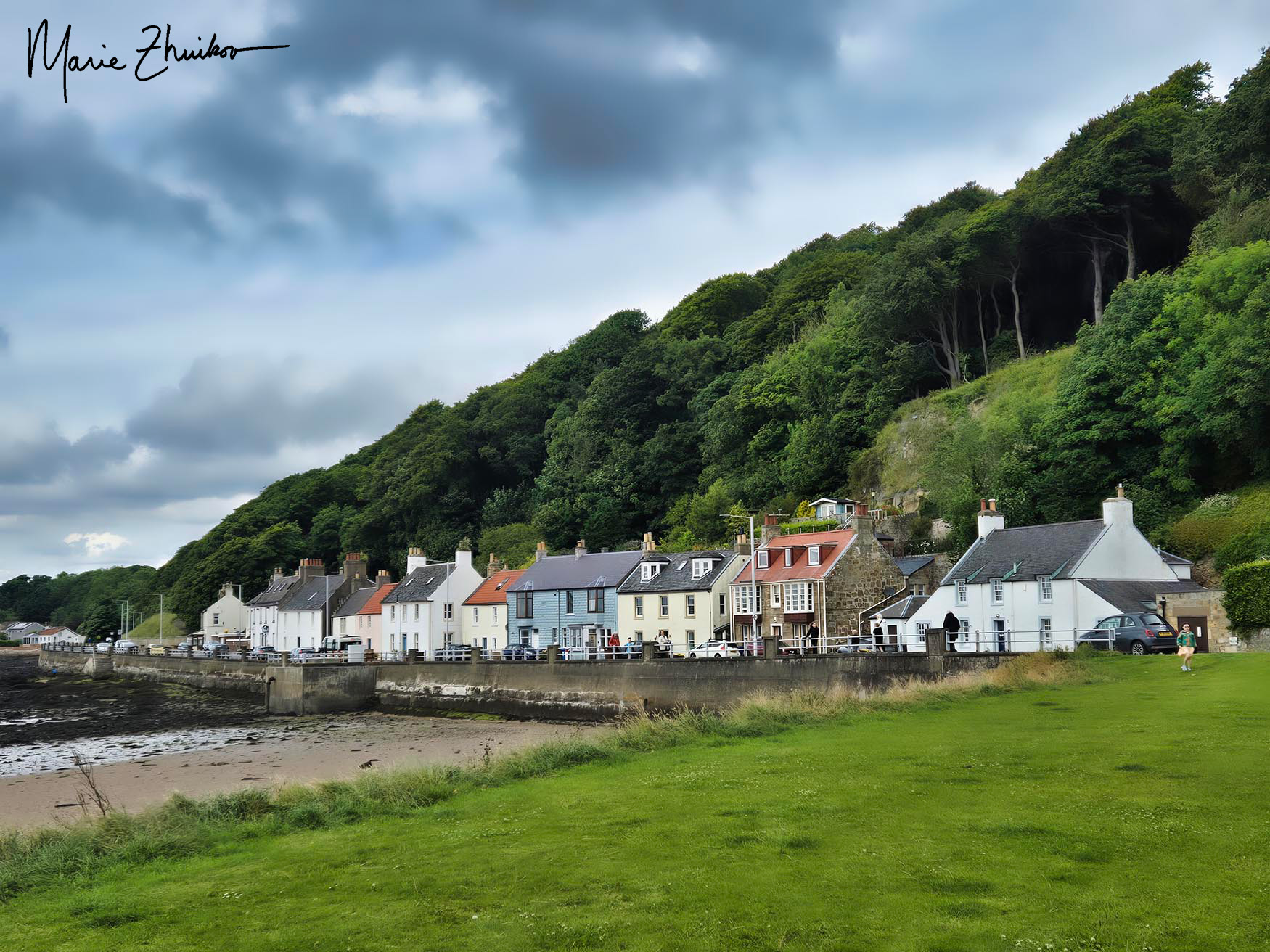
Limekiln, Scotland. Home of the mortar that holds the U.S. White House together!
On our way into the dining room, we passed a lighted cabinet that contained one of the plaster casts of Robert the Bruce’s skull and his claymore sword, which has been passed down in the family through the generations. I felt compelled to stand in front of it for a few moments and pay my respects.
The dining room sported a long table that Charles said was given as a wedding present. Family members each bought a chair that line the table, and he said they are very uncomfortable! There was also an impressive Delft tile fireplace with a mantle made from a bed that Queen Anne of Denmark slept in. Charles said his grandfather found the bed in pieces in an antique shop. There weren’t enough pieces to make it back into a bed, so he had them crafted into the mantle instead.
The Broomhall Dining Room and fireplace, decorated for the holidays. Image courtesy of Broomhall House.
On the table were many silver pieces, some oriental-looking. One of Charles’s ancestors was ambassador to Turkey and perhaps picked them up in his travels. The dining room also sported a painting of Catherine Bruce of Clackmannan. She was the last Bruce to live at the mansion and tower in Clackmannan and was a memorable character. She and her husband were Jacobites. She is known for unofficially knighting poet Robert Burns with the very sword I saw in the cabinet. She also has a contra dancing reel named after her.
Catherine Bruce of Clackmannan, the painting that hangs in Broomhall House. Image courtesy of Wikipedia.
Our last stop was a room that had a large, tattered Union Jack flag hanging from the ceiling. Charles said the flag had been flying at the house in the 1940s when three Nazi planes attacked. Charles’s father was ushered to the basement, but his grandfather grabbed a gun and went outside to shoot the planes! Later, at least one of the planes was shot down and it contained some bullet holes that might have been made by his grandfather. Charles showed us newspaper accounts of the adventure.
Our tour was only supposed to last for two hours but a fast 2-1/2 hours had gone past. As we began parting words, I thought to grab my genealogy list from my purse. I asked Charles if we could figure out where our lines diverged. He led me to a large book that contained a family chart. As near as I could tell with a quick look, our paths diverged after the 6th Baron of Clackmannan, David Bruce, in the late 1400s, which was about 15 generations ago.
Charles said he’d never had anyone come so prepared to discuss genealogy before. I was excited to see that the information Charles had gibed with what I had. I just laughed at his comment but inside I was thinking, “You have no idea!” I was glad for the time that my broken ankle gave me to bone up on the family tree. (Ha ha.) By now, my ankle had healed enough that I didn’t need to use hiking pole anymore. I was glad I didn’t have that thing clunking around in this fine home.
Charles gave me permission to blog about our visit; however, the Bruces don’t allow photos to be taken in the house. The ones accompanying this post are from the Broomhall website. We did take some shots of all of us on the steps of the house, thanks to Calum. I was tickled to notice that both Russ and Charles were wearing the same seersucker shirt.
Me, Charles and Russ after our tour.
I was so happy the tour came to pass. It truly was a once-in-a-lifetime thing. As Calum later commented, “That was posh!” And it was worth every penny and all the angst. In fact, the angst made me appreciate it even more.
Next up: An Outlander Tour.
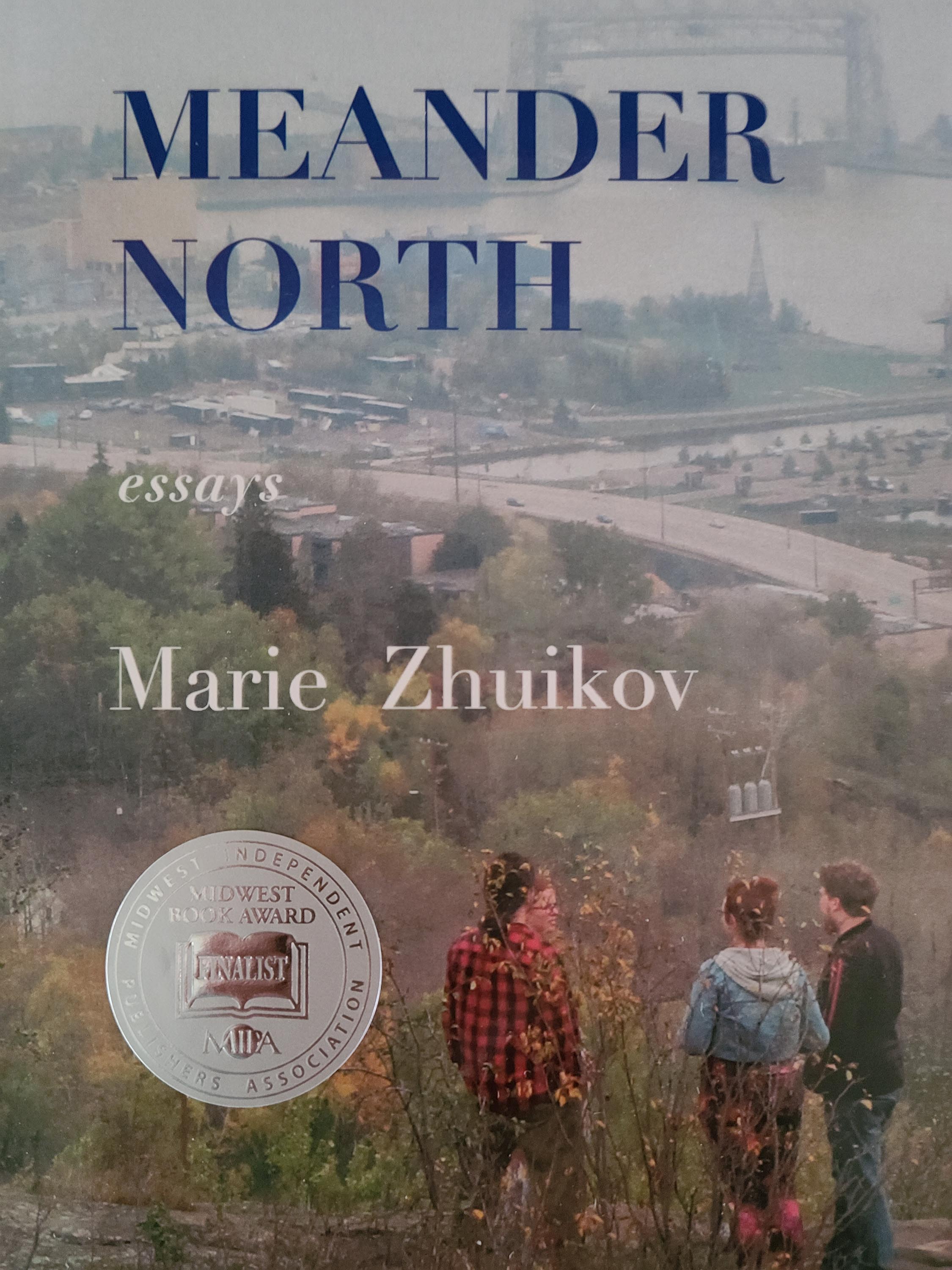
If you enjoy my blog, you’ll love my book! Meander North showcases 51 of the best stories from this blog about my quirky life in northern Minnesota and my writerly pursuits. It earned a silver Midwest Book Award for nature writing and was published by Nodin Press in Minneapolis. It is available for $19.95 through their distributor at this link.









 Marie's Meanderings