Russ and I went to one of those outdoor Christmas villages for this first time last weekend. It was in Knife River, which is about 20 miles north of us along the shore of Lake Superior. The village is called Julebyen (pronounced YOOL-eh-BE-en), which (appropriately) means Christmas village in Norwegian. The quaint former fishing village that it’s located in has Norwegian roots. Proceeds from the event support the community.
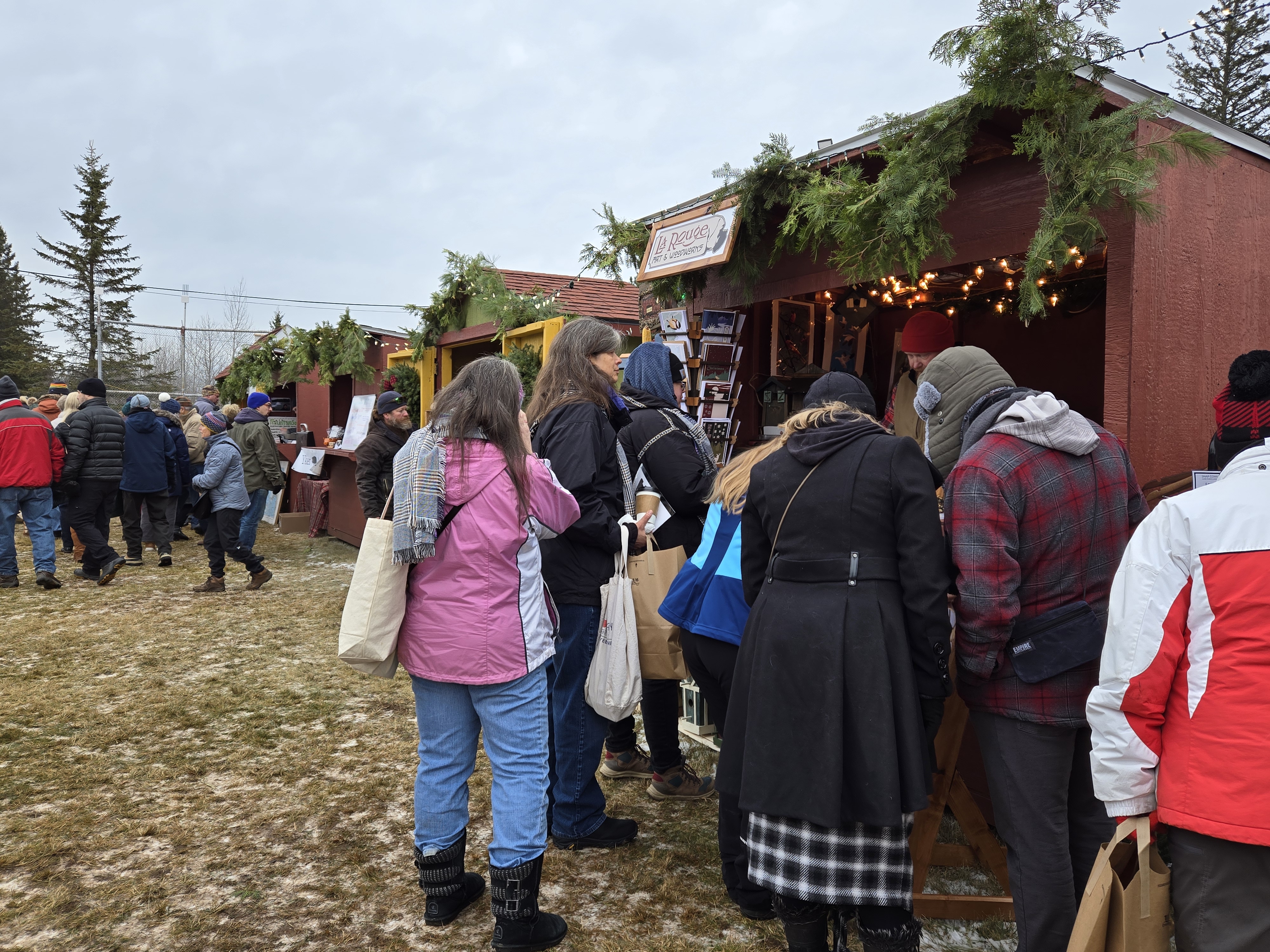
Outdoor stalls at Julebyen in Knife River, Minnesota.
Julebyen features ethnic foods (like lefse and krumkake), crafts, holiday decorations, and music. There are also food trucks from local eateries. A train brings visitors up from Duluth and Christmas-themed buses travel from the Twin Cities. We quickly learned that the event is HUGE. Lots of people and lots of fun. Shopping takes place in outdoor stalls and indoors under a couple of large tents. There are candles, pottery, clothing, teas, notecards, wooden sleds, fish, wreaths, honey, jewelry, mittens and honey.
My favorite thing, however, were the trolls. Two men in costume posed for photos and make troll-like comments and jokes with passersby. As you can see, I took advantage of the photo op. In Scandinavian folklore, trolls are supernatural creatures who are dangerous, evil, and hostile to humans. These ones weren’t, though. Trolls are thought to be able to transform themselves, offer prophesies, and steal human maidens. When exposed to sunlight, they explode or turn to stone. This is helpful to know if you ever meet one. Also helpful to know is that lightning kills them instantly.
I assume this is a Norwegian-style fishing boat, with a festive sail for the holidays.
The village also offered a sledding hill, but there wasn’t enough snow yet for that. I’m glad we got to enjoy Julebyen and get into the holiday spirit. I think it’s helping us through some hard times. I just learned by happenstance that my friend Yooper Duane died this year, on my birthday, no less. He was a special soul. We met on Isle Royale National Park in Lake Superior when I was in college and corresponded for years. I’d make a point of visiting him when I traveled across Michigan’s Upper Peninsula. The last time we touched base was by phone when I was on Isle Royale a couple of years ago. He was impressed by the phone call, since such contact was not technologically possible when we both worked on the island. Duane died at the ripe old age of 80. I’ll miss him!
The Knife River, which flows through the town.
Also, this week a family member was hospitalized. That’s all I’ll say about it to preserve this person’s privacy. But it’s a stressful situation that’s difficult for everyone.
Be sure to give your loved ones a hug this holiday season. You never know what the future holds.
Angelique and Charlie Mott. Image courtesy of “Abandoned: Angelique’s Isle”
We recently watched the movie “Abandoned: Angelique’s Isle,” which is a based on a true story set on Isle Royale in Lake Superior. I’d heard of the movie before but never had an easy way to view it until it turned up for free in my Redbox feed. Can’t get much easier than that!
Longtime readers are probably well-aware of my love for this wilderness island. I had a chance to revisit this national park this summer and fulfill longtime dreams. As wonderful as the Isle Royale is in the summer, I can’t imagine spending a winter out there.
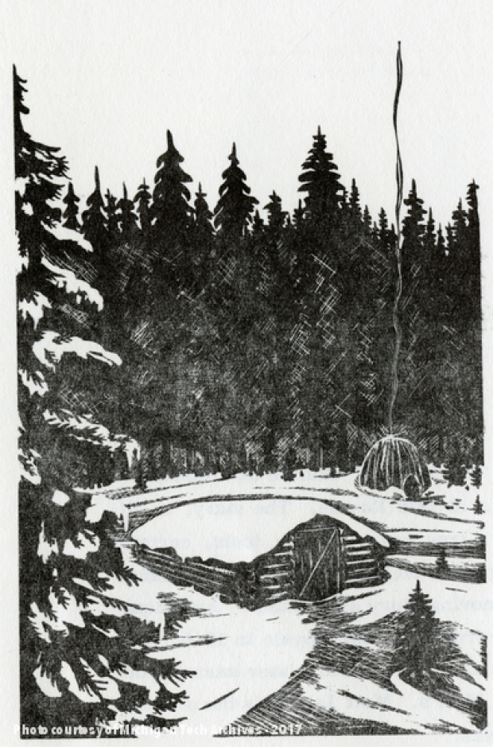
A sketch of the actual Angelique, courtesy of Michigan Technological University archives.
But that’s just what happened to a French voyageur and his Metis wife during 1845. Charlie Mott met 17-year-old Angelique and they lived at LaPointe on Madeline Island – although the movie makes it look like they were in Sault Ste Marie. Looking for work, Charlie is persuaded by some bigwigs from Detroit to visit Isle Royale on a mission to find copper.
Despite Angelique’s grandmother’s concerns, Angelique accompanies him and ends up being the one to discover copper – a huge mass. In the movie, the copper boulder is up on the shoreline but in reality, it was in the water. It’s summer and the Detroit men convince Charlie and Angelique to stay on the island for a few weeks so that the men have time to stake a claim. They said they’d send a supply boat and then they’d return for the copper and take them off the island before winter.
The couple agree and find shelter in an old fishing cabin on the island. They fix it up along with a birchbark canoe that’s there with it.
As you can guess from the movie title, the supply boat never comes, and the men don’t return before winter. What follows is a tale of perseverance, emotional strength, ingenuity and heartbreak. The themes revolve around being true to one’s roots and also (tongue in cheek), if your grandmother is having bad dreams about your impending trip, maybe you shouldn’t take it! I won’t give away any more of the plot in case you want to watch it.
An illustration from “Wolf’s Eye” Vol. 5, No. 4a. “Charlie and Angelique Mott: A tragic but true story of Isle Royale.” It depicts the living quarters of Charlie and Angelique Mott while they were staying on Mott island.
Isle Royale is not the easiest location to film a movie, so the film was shot in Terrace Bay (near Rossport) and Fort William in Ontario, Canada. The sand beaches are a dead giveaway – I don’t know of any sand beaches on Isle Royale. It’s all rock and cobble. I also don’t know of any rivers with huge rapids on the island like are in the lead photo for this post, but the stunted trees and rocky shoreline found in Canada are quite similar.
In all my time on Isle Royale, I never knew that Mott Island was named in their honor. It’s a small island where the National Park’s island headquarters are located off the main island. I was excited to see Native actress Tantoo Cardinal in the movie. She plays Angelique’s grandmother. I was in a movie with Tantoo and actually got to touch her arm in a scene! So, it was like seeing an old acting buddy, ha ha.
According to Mikel B. Classen’s blog, Angelique’s story was first written down as a footnote in the book, “The Honorable Peter White: A Biographical Sketch of the Lake Superior Iron Country.” That, combined with original research, inspired the book, “Angelique Abandoned” by James R. Stevens. His book was turned into a screenplay by Michelle Desrosier, an Indigenous woman from Canada.
Although some of the storytelling could have been smoother, I found the movie a meaningful tale of the power of women, the power of love, and belief in the forces of the universe.
The Isle Royale Lighthouse on Menagerie Island. Image courtesy of the National Park Service.
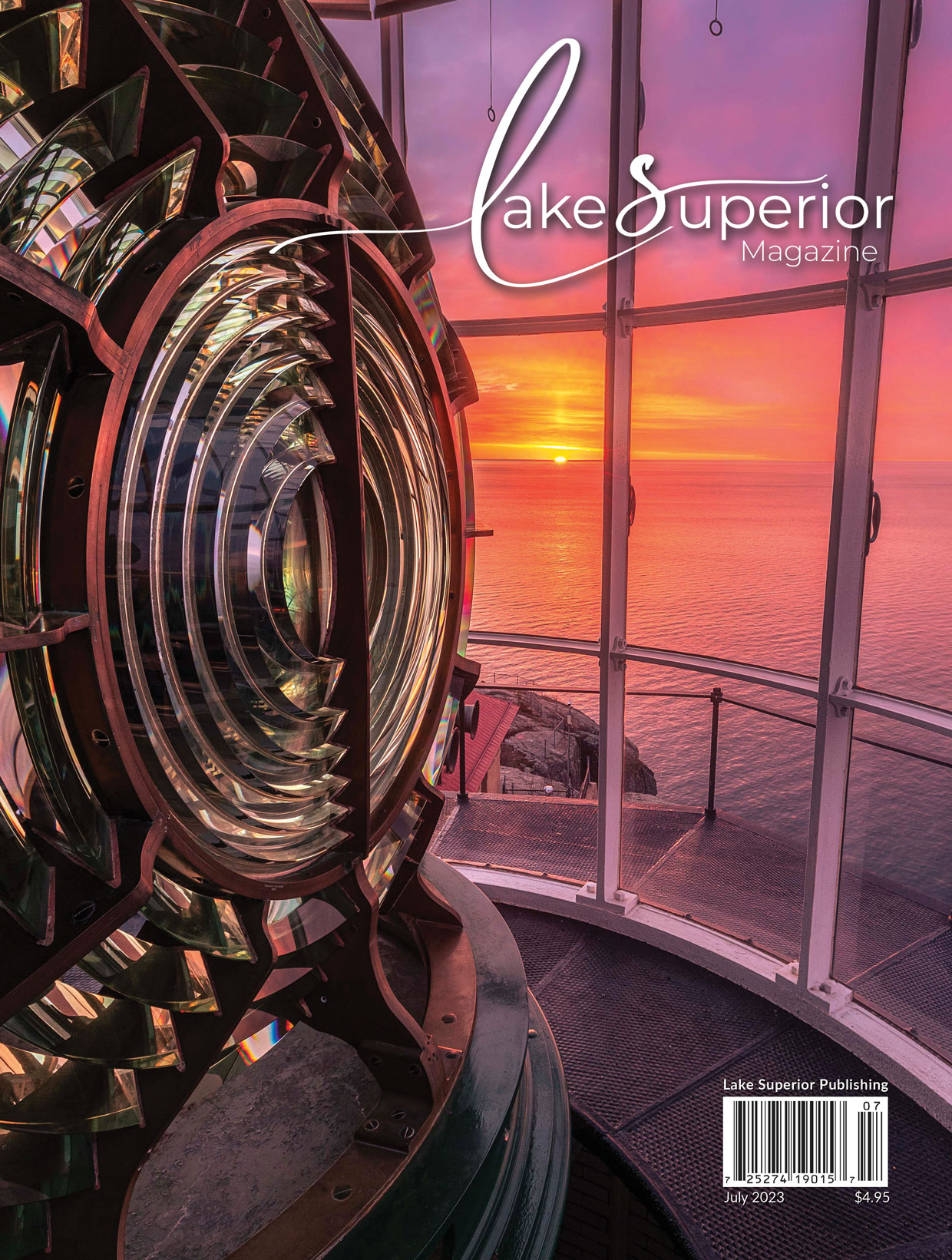
I recently had an article published in Lake Superior Magazine about a family of lighthouse keepers who spent their summers on a remote, rocky island that’s part of Isle Royale National Park. Here’s how the story (“Romancing the Stone”) came about.
Last December, I was hawking my books at a table at Fitger’s Bookstore in Duluth. Many holiday shoppers passed by, but one couple stopped to chat. Somehow, we got on the topic of Isle Royale, and I told them that my first novel was set on this island in Lake Superior.
The husband said something like, “Well, I’ve got a story for you. My ancestors were lighthouse keepers for two generations on Isle Royale.” The husband’s name was John Malone. His wife was LaRayne, and she mentioned they got engaged while on a trip to the “family’s lighthouse,” which was the Isle Royale Light on Menagerie Island. John mentioned that his lighthouse keeper great-grandfather had 11 children who lived out on the remote (and very small) island.
Although intrigued, I had plenty of story ideas in my head to keep me occupied for months. I told them I’d consider it but couldn’t promise anything.
But the more I thought about it afterward, the more interested I became in the story of the Malone Family. I checked with the Lake Superior Magazine editor to see if they’d ever featured a story about the Isle Royale Lighthouse and the Malone Family. She told me they hadn’t and that she would be interested in it.
I couldn’t find John Malone in the phonebook, but I was able to connect with him through social media. I reminded him who I was and told him I was interested in doing a story about his ancestors and family. On New Year’s Eve, he replied to me with his phone number. I called him to get more information so that I could pitch the story to the magazine.
Not long after, I pitched it, and the story was a go!
Then the work began. I was lucky that the Malones had a copy of a copy of the Isle Royale Lighthouse Keepers’ log, which they loaned me when I visited their home for an interview. Also, the National Park Service had done oral history interviews with two Malones a few decades ago. These Malones were now deceased, so those interviews were invaluable. I was able to combine those interviews with the ones I did with John.
After the last lighthouse keeper in the Malone Family quit his job on Isle Royale, he piloted yachts for the wealthy in Duluth. One of those families were the Congdons who built Glensheen Mansion, which is a tourist attraction now in the city. John Malone told me a tale about how his ancestor had been aboard the yacht when it sunk due to a fire. He had this great information (which is in my magazine story), but he didn’t think that the staff at Glensheen Mansion had heard the history.
It so happens that my daughter-in-law used to be a docent at the mansion and still has ties there. I consulted with her and she consulted with the staff at Glensheen to see what they knew about the sinking. It seemed as if a meeting between John and the mansion staff was in order, so I arranged it.
We met at the mansion and met with a Glensheen historian and the education manager. John got to tell his tale and I recorded it for my story. The mansion staff was excited to learn this new information. I hope they work it into the information that they provide to the public. And I think John was touched to have someone value the historic information he was privy to.
The Lake Superior Magazine editor only wanted a 1,200-word story, but I gave her more like a 2,000-word story. I apologized, saying the more I learned, the more there was to tell! But it paid off in the end because she dedicated much of that issue to maritime history.
Trying to sell books to people passing in a hallway can be depressing. I sometimes feel like one of those poor souls who stand on a street corner with a cardboard sign. My sign would say, “Will write for pay.” But this is one case where several good things came from putting myself out into the world.
Architectural drawings for the Isle Royale Lighthouse.This did not make it into my magazine story. Illustration courtesy of the National Park Service, U.S. Department of the Interior, Isle Royale Light Building Proposal, ISRO Archives, ACC#ISRO-00999, Cat#ISRO 20175.
Hidden Lake with a low fog, Isle Royale National Park.
When we last checked in, Russ and I were on Isle Royale, a wilderness national park in Lake Superior. It was our final day. Before we had to catch our boat back to the mainland in the afternoon, we had plans to canoe across Tobin Harbor to a rugged trail that leads to Hidden Lake, Monument Rock, and an overlook high on the backbone of the island with the prosaic name of Lookout Louise.
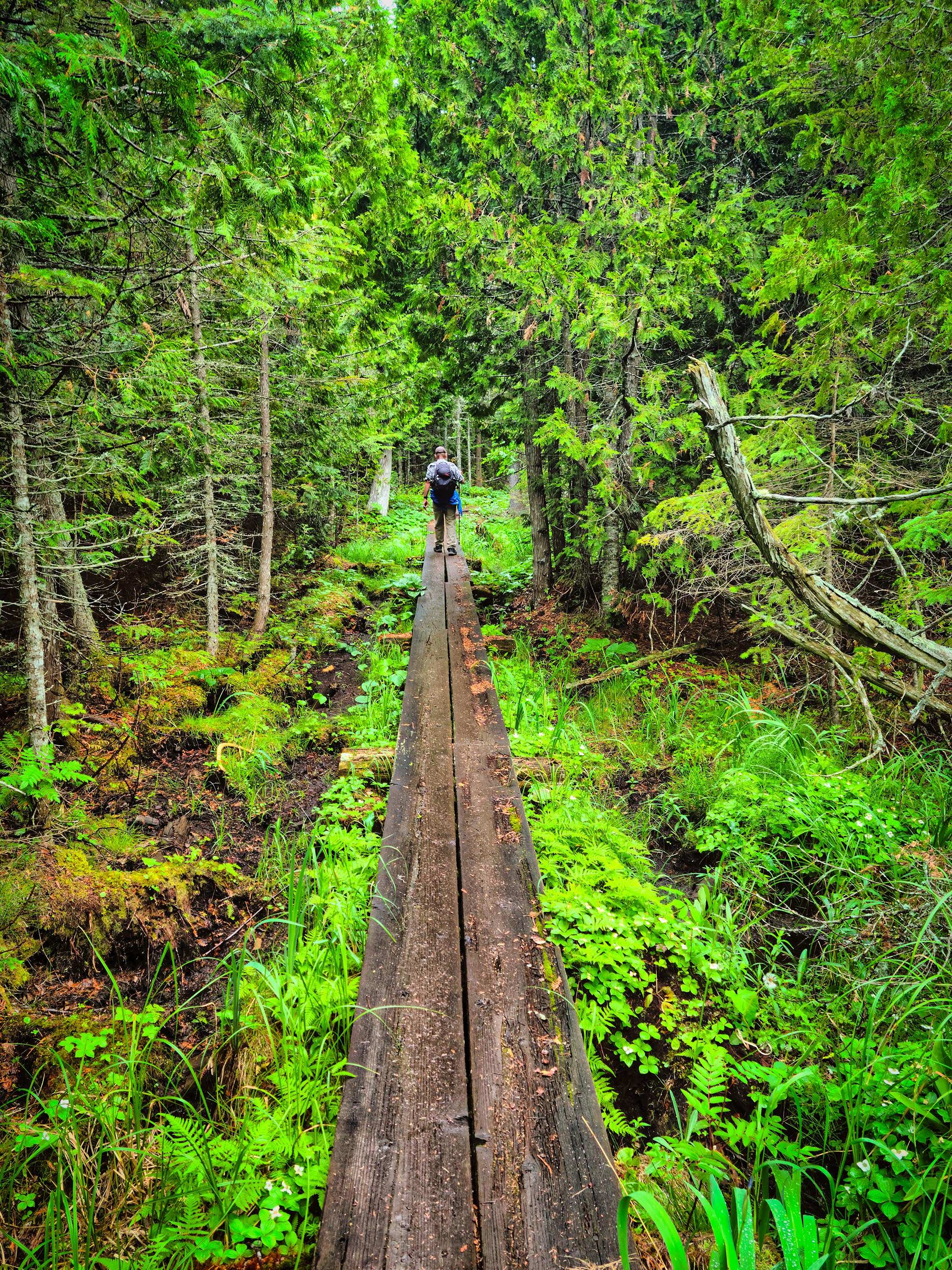
A boardwalk over a wetlands near Hidden Lake.
The weather had other ideas for us, however. A gray sky and drizzle greeted us as we carried our friends’ canoe down to the harbor. To me, it didn’t feel like we were in for a downpour, just a steady drip, so we decided not to let a little rain keep us from my old haunt and one of the most spectacular overlooks on the island. On a clear day, a person can see the other side of the island and all the way to Canada.
After about a half-hour paddle from the sea plane dock on the crystal-clear waters of Tobin Harbor, we reached the Hidden Lake dock. We hauled our canoe ashore and began the mile-long hike to the lookout. While the beginning part of the trail at Hidden Lake is flat, the grade gradually rises until it reaches a steep pitch on the way to Monument Rock and the lookout. Because of this, the difficulty is considered moderate to difficult.
Fog shrouded part of Hidden Lake, adding to its mystery. We found a pile of super-fresh wolf scat next to the trail along with lady slipper orchids.
For entertainment one evening earlier on our trip, we attended a park ranger talk at Rock Harbor. The topic was the fire that occurred on this part of the island last year (2021). Named the Horne Fire, it began as a lightning strike and ended up burning 335 acres and threatening cabins on Tobin Harbor. People were evacuated, tourism was disrupted, and a fire crew was brought in to fight the blaze.
Russ by Monument Rock, which was in the path of the Horne Fire in 2021.
From attending the talk, we knew that the Lookout Louise Trail would take us right through the burned area, so we were ready for the black chaos when we found it. Huge trees were uprooted, soil was blackened. Dead trees, denuded of branches, reached toward the gray sky like iron spikes. But some greenery was returning in scattered patches.
One unexpected benefit of the Horne Fire was that the view of Monument Rock – a large sea stack that sticks up from the hillside – was easily visible. Usually, it’s shrouded by trees. Reaching the landmark means you’re over halfway to the lookout. Once past the rock, the trail becomes a bit less steep.
We didn’t have much time to enjoy the view at the lookout for fear we would miss our boat home, but our gazes drank in what they could of Duncan Bay and Lake Superior. On a clear day, Pie Island, the Sibley Peninsula and Edward Island in Canada are visible.
I heard two days ago that Isle Royale is on fire again. Visitors were evacuated from Three Mile and Lane Cove campgrounds. Those campgrounds are currently closed as are some trails in that area. For more details, please see news article(s) about the fire. Of course, fires are natural on the island, but it is distressing to see the destruction they leave behind and how they impact the lives of the people who live and work on the island in summer.
The view from Lookout Louise.
According to the park service, the lookout was named for Louise Savage of St. Paul, Minnesota. Her family owned one of the cabins on Tobin Harbor before the area became a park.
As we hiked back to the dock, the drizzle grew into a light shower. But we didn’t mind. We had accomplished our goal and were feeling good. The fresh rain seeped into our jeans and into our bones, a reminder of our closeness to nature. We were able to return to Rock Harbor in plenty of time to catch our ride home.
Hidden Lake, Isle Royale. You can see evidence of the Horne Fire on the hillside in the upper right.
I left the island feeling peaceful. I was glad to see that lodge employees still gather on the sea plane dock to watch the sun set every evening like I used to back when I worked there decades ago. It’s obvious that the island still works its magic on employees and visitors alike.
I was taking sunset pictures on the dock during the final island evening of our trip. As oranges and pinks filled the sky, we could hear the rattling trumpet calls of distant sandhills cranes. These birds were not on the island when I worked there in the 1980s, but I guess they are more common now.
Then, right when the sun dipped behind the island’s Greenstone Ridge, a lone wolf howled somewhere near Lookout Louise (was it his/her scat we found the next day?) The small group gathered on the dock all looked at each other in wonderment, as if asking, was that a wolf we just heard? The wolf’s mournful, long howl was followed by a second. No other wolves replied.
As I stepped off the dock onto the land with my camera gear, a man sitting on a bench said, “I’ve been coming here for thirty years and that’s the first wolf I heard. That’s pretty special.”
Darn right it is! I told him the howls were also a first for me. That’s one of those mystical Isle Royale moments I won’t forget.
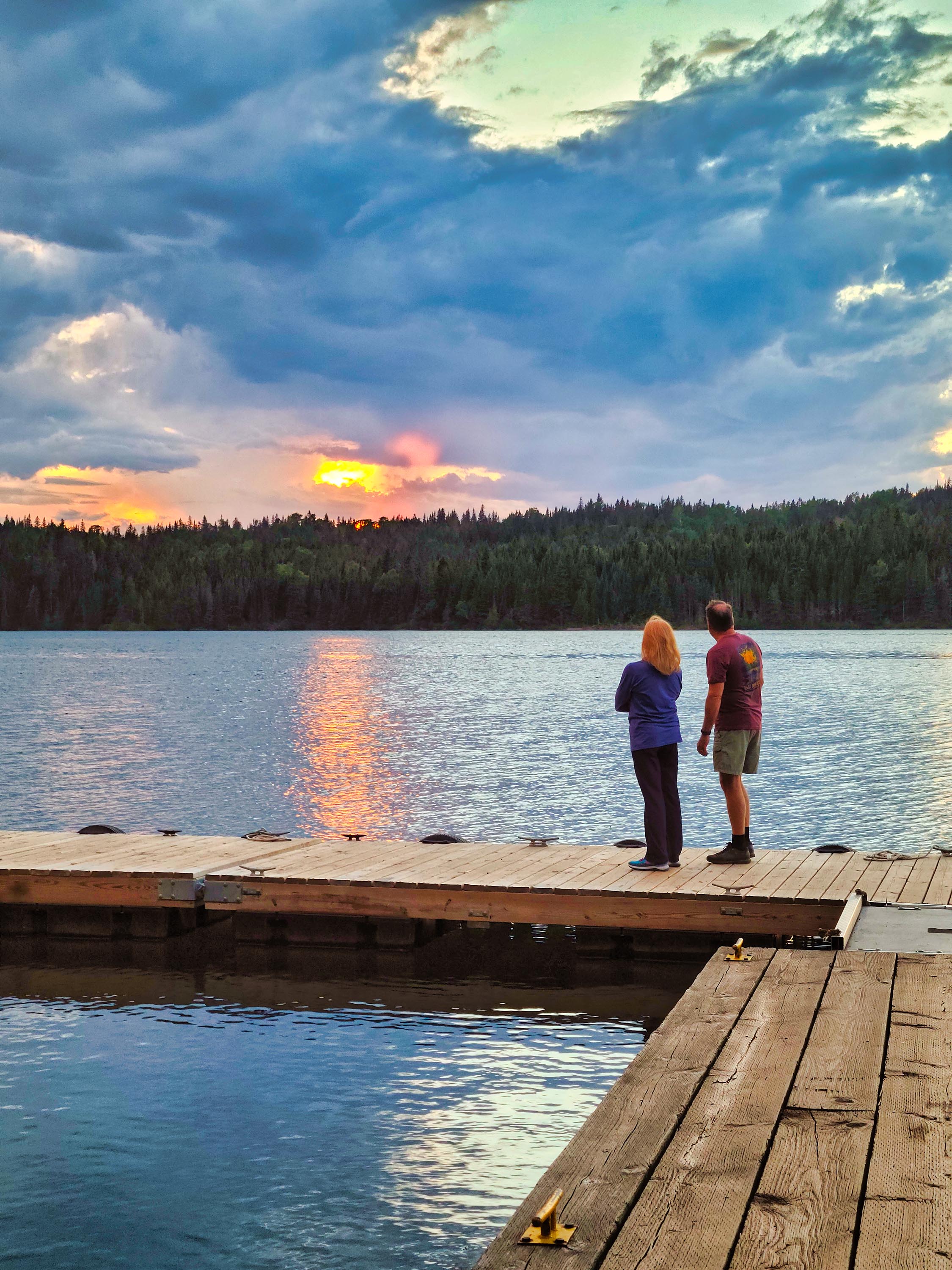
Isle Royale visitors take time to watch the sunset on the sea plane dock in Tobin Harbor.
This meander was two summers in the making. I tried to reserve a house keeping cabin at Rock Harbor Lodge on Isle Royale in early 2021, but they were booked already!
I longed to return to this national park in Lake Superior because I worked there as a waitress at the lodge for two summers in the 1980s. I hadn’t been back in over 25 years and decided it was time. I needed my Isle Royale wilderness fix.
I didn’t want to primitive camp, however. Been there, done that. During my college waitress days, I had dreamed of someday staying in one of the quaint cabins that line a protected harbor on the island – sleeping in a real bed, bringing my own food, and cooking in a kitchen complete with stovetop and mini-fridge. (Beats a camp stove and no fridge, any time.)
Now was that time. But the only openings were in the summer of 2022. I sighed and made the reservation for this distant date. I was also able to talk Russ and a couple of my friends into accompanying me.
I consider Isle Royale my spiritual home. I’ve had some of my most meaningful experiences there and it’s where I’ve met lifelong friends. My two novels are set on the island. I wasn’t sure how so much time passed off-island, but it probably had something to do with life, responsibilities, and distractions.
Lake Superior is cold this summer! Image courtesy of KBJR-TV, Duluth, MN.
As our departure date neared, my heart sank as I looked at the weather forecast for the four days we’d be spending in the park. The water temperature for Lake Superior has been at record lows this summer – its coldest in 25 years! (Lower-to-middle-40s.) It has to do with prevailing westerly winds, which caused colder waters to upwell from the depths.
As such, we were resigned to the yucky weather forecast for our stay, which predicted highs in the 60s and overcast skies. This magical and mercurial island had other things in mind for us, however; treating us to highs in the mid-70s, sunny skies, and sporadic fog.
One of my fellow travelers was prone to seasickness, so we took the shortest boat route possible, aboard the Queen from Copper Harbor in Michigan’s Upper Peninsula. The passage couldn’t have been better, and we spent our 3.75-hour unusually calm ride in pleasant conversation and card games.
Our house keeping cabin.
After we arrived at Rock Harbor, we had a few hours before our cabins were ready. We spent the time getting reacquainted with my old haunts: the snack bar (now named the Greenstone Grill after semi-precious stones only found on the island) and the America Dock – named after a ship that used to service the island but sunk. I was distressed to see the dock in ruins from ice damage. The employee dorm looked much the same, as did Tobin Harbor and the sea plane dock, next to where our lodgings would be.
The lodge is run by Kim Bob Alexander, who worked on the island when I did. He was a charter captain then and has been managing the lodge concession for many years. It was good to see a familiar face since all the rest are gone. He seemed to remember me, and we discovered that his daughter Marina would be our charter captain the next day for our lake trout fishing trip onto Lake Superior.
I was worried about how the loon population was doing on the island. I fondly remembered falling asleep to the mournful sound of their calls at night and hoped that hadn’t changed. I needn’t have worried. The moment Russ and I checked into our cabin, a pair of loons called from Tobin Harbor, as if in welcome.
The next morning, we rose early and headed to the docks for our charter fishing excursion. Marina and her co-captain Cole greeted us, giving us the rundown of where we would travel and how things would work. I had never been charter fishing before, so I was especially intrigued. (This was yet another former-Isle-Royale waitress’s dream experience.)
We headed out in the fog along the eastern side of the island toward Passage Island, which lies about three miles off its tip. We fished for a couple of hours, unsuccessfully. Or, I should say that Marina fished for us and we just lollygagged around, trying to stay out of her way.
Our lake trout catch.
As the fog began to lift, we hoped our luck would change. To hedge our bets, we decided to offer a little sacrifice to Lake Superior. My friend Sharon poured a little bit of leftover coffee into the lake, saying a few words.
Soon after, she was reeling in her line according to Marina’s instructions, with a four-pound lake trout on the end of it. Not long after, I caught a five-pounder. I was especially impressed by how cold my fish was when I held it, pulled from Lake Superior’s icy depths.
There was another lull during which Russ lost a fish or two. We decided it was time to offer another sacrifice. Sharon and I eyed our men, as if deciding which one to throw overboard, but then opted for a pinch of tobacco that one of them carried.
It worked again! Sharon’s partner Mike caught a trout and Russ finally did, too.
That night we dined on our trout, pan-seared by the lodge chef, along with all the fixings. We felt truly fortunate to eat these fresh gifts from the lake, much to the envy of our fellow diners, who also wanted fish, but it was not on the grill’s menu.
Our lake trout dinner.
Passage Island Lighthouse.
The next day, fog scuttled Russ’s and my plans to canoe in Tobin Harbor, so we opted to hike to Scoville Point instead. The point is about a four-mile round-trip from Rock Harbor. Along the way, we saw a snowshoe hare, which I had never seen before on the island, and an eagle’s nest, complete with eaglets. A mother merganser carried several of her brood on her back along the shore, followed by at least half a dozen other babies.
Our final full day on the island, Russ and I took a half-day trip aboard the lodge’s tour boat, the M.V. Sandy, to Passage Island. The weather cooperated. The park ranger who was supposed to interpret the rugged hike to the island’s lighthouse contracted COVID, so I ended up acting as an impromptu guide for part of the trip, pointing out plants not found on the main island (due to moose browsing) like the devil’s club and huge yew shrubs. We were also treated to views of peregrine falcons flying from their cliff face nest. The lighthouse has aged and decayed since I last saw it, but it still stood as a stalwart presence on the end of the island.
Our final morning dawned foggy and drizzly. Russ and I spent our time canoeing and hiking to Monument Rock and Lookout Louise. More on that in my next post…..
Mystical Scoville Point, Isle Royale National Park.
My meanderings last week took me Michigan’s Upper Peninsula, also known as “da UP.” Residents of the U.P. are affectionately known as Yoopers, and I visited a long-time Yooper friend, Duane.
Duane and I met thirty years ago on Isle Royale National Park (abbreviated in Park Service talk as ISRO). The island is one of the most isolated national parks in the country – only accessible by boat or sea plane. Duane was a carpenter for the park service and we became friends over coffee and doughnuts in the snack bar when I was a waitress on ISRO.
I’ve kept in touch with only a few people from my time on the island. Even Duane and I had long stretches where we lost track of each other. I managed to track him down a few years ago when I knew I’d be driving by his town for a book tour.
During my trip last week, we only had time for lunch. I wish our visit was longer, but I had to press home to a long list of responsibilities. But the time we were able to spend was vintage Yooper. Duane took me to Buck’s Café in downtown Ishpeming, and he wore the requisite Yooper regalia (see photo).
I expected to reach home by nightfall, but car issues forced an overnight stay at the edge of Yooperland (the MI/WI border). I found a mom and pop hotel complete with mouse droppings on the bedspread. But the mice stayed hidden, I slept well, and was able to successfully continue my journey home the next day.
Anyway, I just wanted to say thanks for the short taste of Yooper heaven, Duane!










 Marie's Meanderings