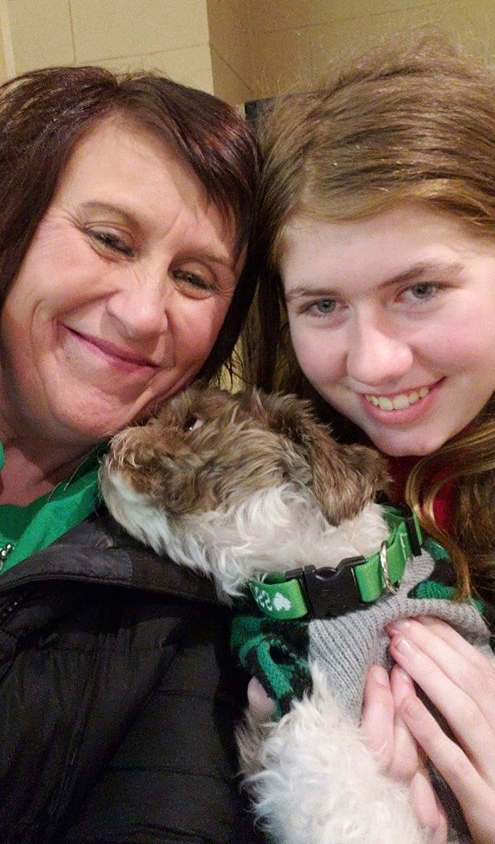
Jayme (right), her aunt, and doggie, safe at home. Credit: Jennifer Smith
I was in the bathroom, putting on my makeup with the door open when the television news story came on about Jayme Closs. She’s the 13-year-old girl who was kidnapped in northern Wisconsin. This was the morning after she was “found.”
The newscasters were going on about how she had been “found alive.” Of course, this was wonderful and superb. News of her kidnapping had filled newspapers and airwaves for weeks, and it seemed that, especially during the holidays, her photo and identifying information appeared often in an attempt to keep public awareness keen.
The reporter on the news show was interviewing Jayme’s aunt over the phone and was asking for details about how Jayme had been found. Since there had been such a major search effort put on for her in the area where she disappeared, I think most people assumed that volunteers or the authorities had found her. Part of the inherent definition of “found” is that it’s something that somebody else does.
Then Jayme’s aunt said that Jayme had escaped from the house where she was held. I popped my head out of the bathroom and walked over to the television. This was new information. This wasn’t just a damsel in distress being found. This was the damsel slaying the dragon and saving herself!
I watched the interview for a few more minutes, but then had to leave for work. During my drive, I heard a radio story about how Jayme had been “found.”
By the time I got to work, the writer in me and the MeToo woman-power feminist in me was dismayed by the passive and inaccurate role these newscasts were putting Jayme in. I wrote this quick post to my recent (personal) Twitter account:
I’m happy and relieved to hear that Jayme Closs is alive! However, it bugs me that the media keeps saying she was “found” alive. She freakin’ escaped her captor and saved herself. #JaymeCloss
I’ve only written a few tweets before then, and I’d never used a hashtag before. I didn’t expect much to come of it.
Holy moly, the thing went viral! As of this writing, my little tweet made 209,000 impressions. It had 4,400 engagements, 2,270 likes, 372 retweets and 78 replies. At one point as I sat watching the stats rise, 20 people per second were viewing it.
That was scarily overwhelming for a person whose most popular tweet to date only had six likes. Handling the comments was also overwhelming. Obviously, many people agreed with my sentiments and said they thought the same thing. Others were upset because they thought I was criticizing law enforcement personnel. I explained I was criticizing the news media, not law enforcement.
Others asked me what words would be better to use instead. I said, “Missing Girl Escapes.” Better yet is the headline I saw a few days ago that said, “She’s the Hero!”
Others jumped on my semantics bandwagon and criticized the use of the word “miracle” in connection with her escape. “It’s called self-preservation and bravery,” one tweeter said.
Then the authorities held their first news conference after her escape and commenters to my tweet started dissing them for the self-congratulatory tone of the event. Yes, these agencies did stellar work in trying to find her, and yes, they found her captor soon after Jayme escaped, but to many, it seemed as if the law enforcement agencies were taking all the credit and not giving enough to Jayme. This incensed one commenter so much that she said she called the sheriff’s office and complained about the way they handled the press conference.
Others criticized me for making a big deal out of word choice when this was such a joyous occasion. All I can say is that words matter. Accuracy matters. I have a journalism background and master’s degree in journalism. Words are part of who I am and I’m not going to apologize for that. And it’s obvious my words struck a chord because a heck of a lot of the commenters agreed with me.
This issue makes me wonder, if Jayme had been a boy, would the news media and the authorities have characterized her escape so passively at first? Comparing headlines (passive vs. active) for kidnap victims who escape would be a good PhD journalism research project to see if gender plays a role. PhD students feel free to steal this idea!
Lately, the news conversation has been about who should get the $50,000 reward in the case. Everyone – even the people who first saw Jayme – are saying the reward should go to Jayme because she saved herself. I think that’s very fitting. Jayme’s parents were both killed by her attacker/kidnapper. She’s going to need all the emotional and financial help she can get in the future. I hope that happens.
But I’m not going to tweet this opinion. 🙂
P.S. If you want to write or donate to Jayme, the address is: Light the Way Home for Jayme, PO Box 539, Rice Lake, WI, 54868.

 Marie's Meanderings