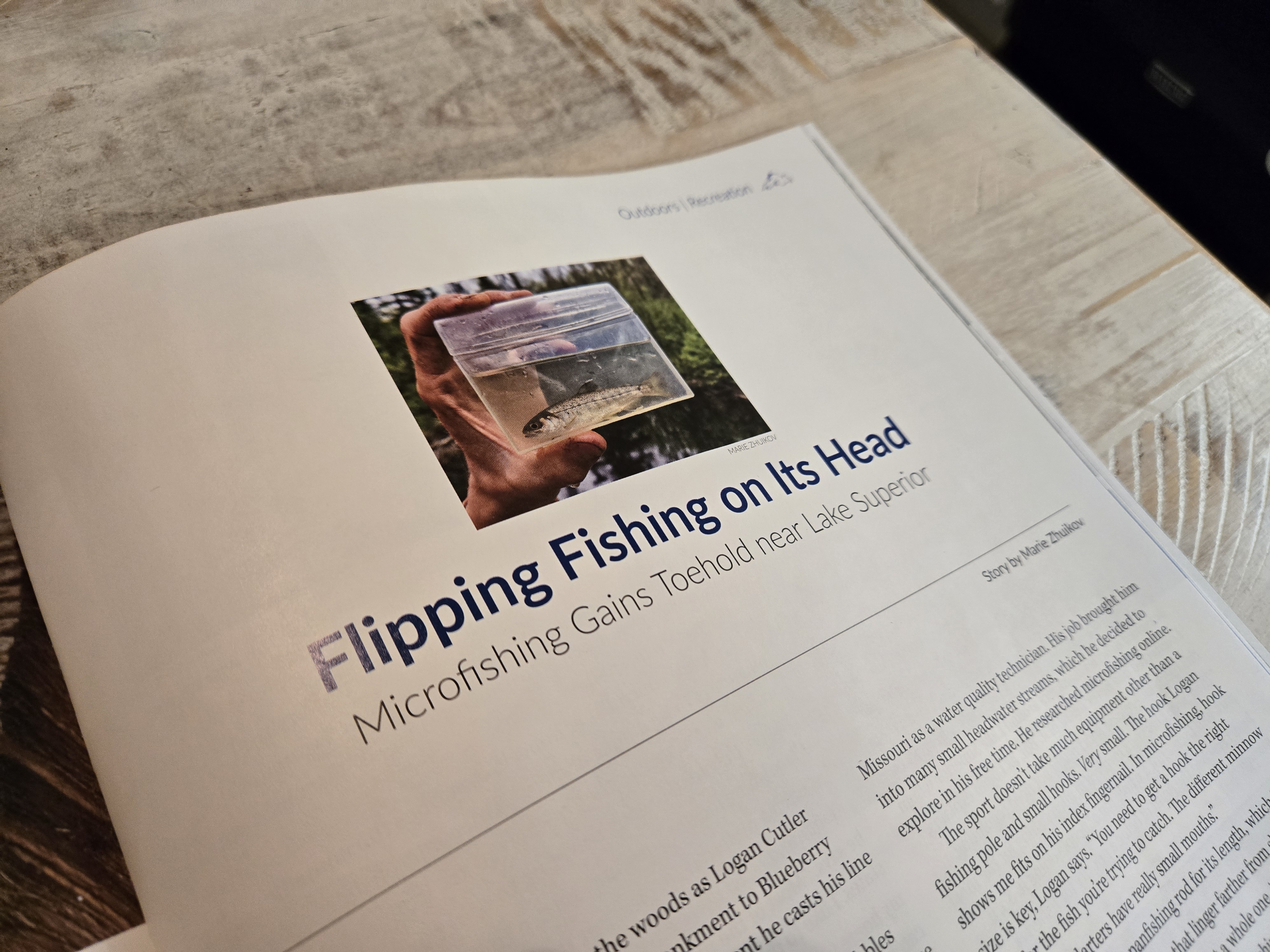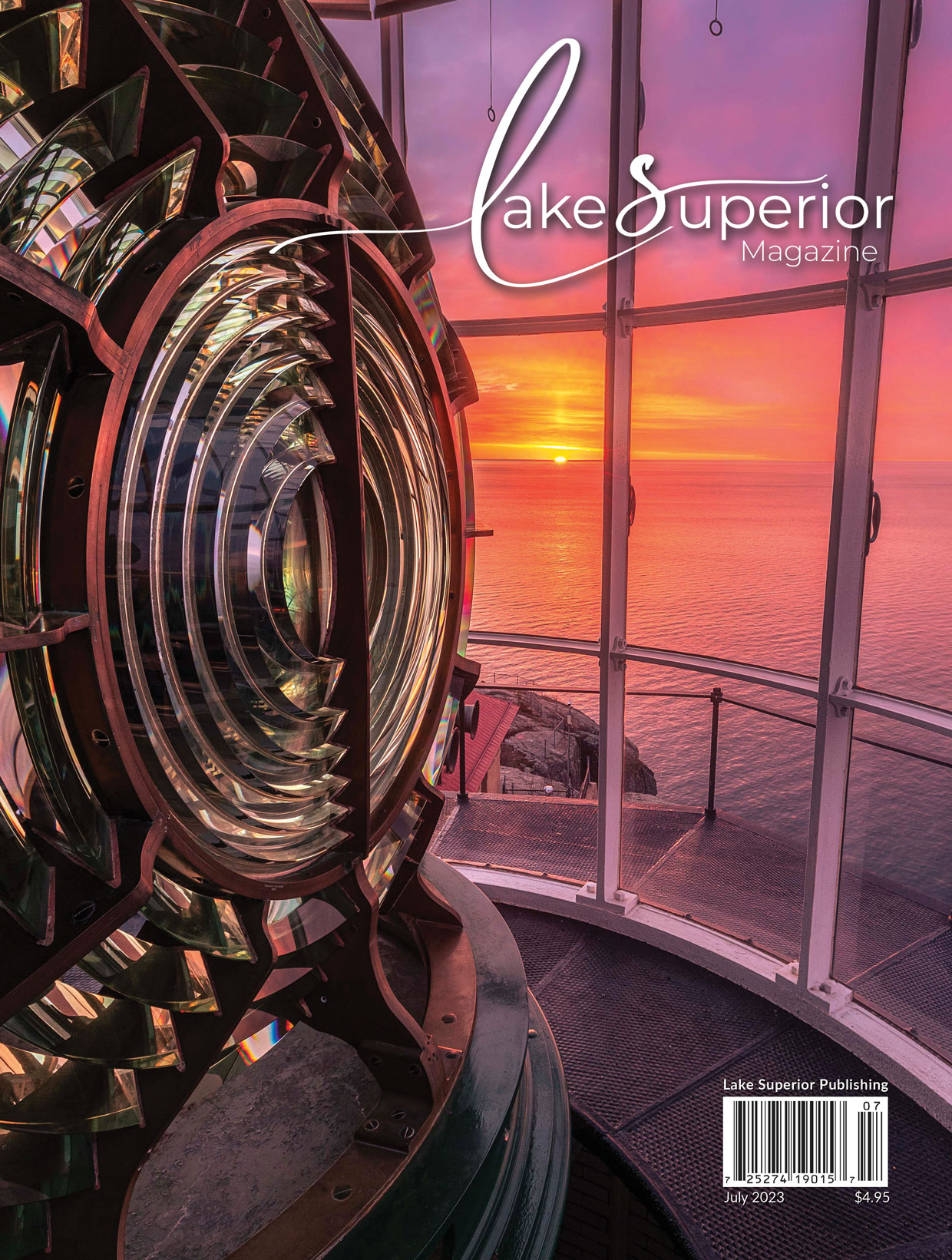
A new sport has reached the shores of Lake Superior. It’s called microfishing. Think birdwatching, but with tiny fish. Quite a change from trying to catch the largest possible fish!
You can read all about it if you’re a subscriber to Lake Superior Magazine. My story is in the October/November 2025 issue. I learned about this unique sport when I interviewed a local department of natural resources fisheries biologist for a different story. Once I retired, I had time to pursue a magazine story. The sport is practiced all over the world.
If you’re not a magazine subscriber and want to learn more, visit microfishing.com.
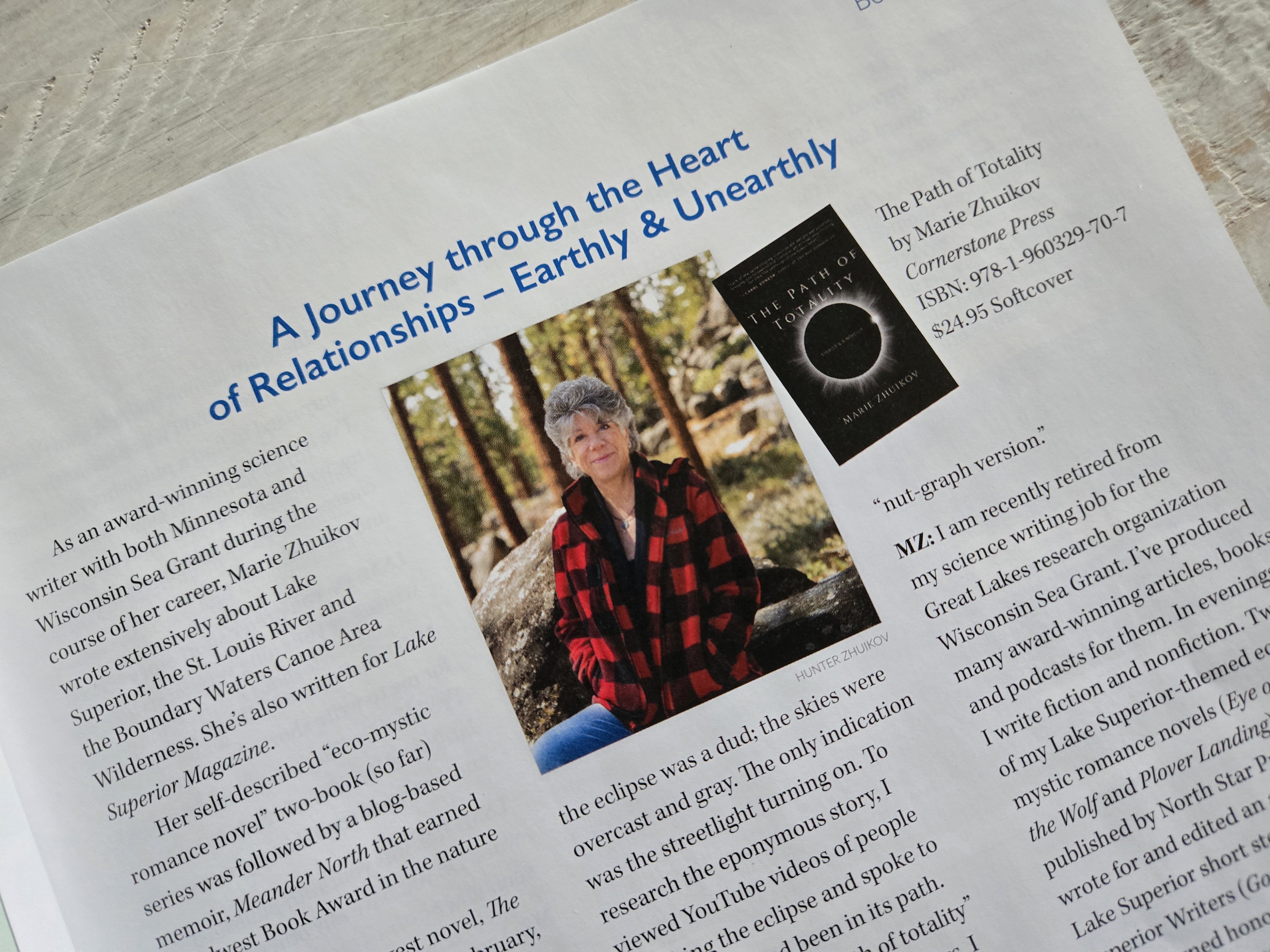
The April/May issue of Lake Superior Magazine offers an article about my magical realism short story collection, The Path of Totality. It takes the form of a Q&A, so I actually wrote much of it. 🙂 I was tickled to be able to use a word in the article that I recently learned: eponymous. (Thanks to blogger friend Vickie Smith.) It means a person or thing that gives their name to something. In my book’s case, it’s named after the first story. I was even more tickled that the editor kept the word in the article!
One question from the editor gave me pause. It was: What question have you always wished someone would ask you? I replied that I wished people would ask me if my book had a secret.
It does, and it involves the anchor story, “Invisible Connections.” A few other secrets are scattered here and there, but will only make sense to certain people. If you get a chance, check out the magazine to learn the secret! Better yet, read my book. It’s still offered at a discount at this link.
The Isle Royale Lighthouse on Menagerie Island. Image courtesy of the National Park Service.
I recently had an article published in Lake Superior Magazine about a family of lighthouse keepers who spent their summers on a remote, rocky island that’s part of Isle Royale National Park. Here’s how the story (“Romancing the Stone”) came about.
Last December, I was hawking my books at a table at Fitger’s Bookstore in Duluth. Many holiday shoppers passed by, but one couple stopped to chat. Somehow, we got on the topic of Isle Royale, and I told them that my first novel was set on this island in Lake Superior.
The husband said something like, “Well, I’ve got a story for you. My ancestors were lighthouse keepers for two generations on Isle Royale.” The husband’s name was John Malone. His wife was LaRayne, and she mentioned they got engaged while on a trip to the “family’s lighthouse,” which was the Isle Royale Light on Menagerie Island. John mentioned that his lighthouse keeper great-grandfather had 11 children who lived out on the remote (and very small) island.
Although intrigued, I had plenty of story ideas in my head to keep me occupied for months. I told them I’d consider it but couldn’t promise anything.
But the more I thought about it afterward, the more interested I became in the story of the Malone Family. I checked with the Lake Superior Magazine editor to see if they’d ever featured a story about the Isle Royale Lighthouse and the Malone Family. She told me they hadn’t and that she would be interested in it.
I couldn’t find John Malone in the phonebook, but I was able to connect with him through social media. I reminded him who I was and told him I was interested in doing a story about his ancestors and family. On New Year’s Eve, he replied to me with his phone number. I called him to get more information so that I could pitch the story to the magazine.
Not long after, I pitched it, and the story was a go!
Then the work began. I was lucky that the Malones had a copy of a copy of the Isle Royale Lighthouse Keepers’ log, which they loaned me when I visited their home for an interview. Also, the National Park Service had done oral history interviews with two Malones a few decades ago. These Malones were now deceased, so those interviews were invaluable. I was able to combine those interviews with the ones I did with John.
After the last lighthouse keeper in the Malone Family quit his job on Isle Royale, he piloted yachts for the wealthy in Duluth. One of those families were the Congdons who built Glensheen Mansion, which is a tourist attraction now in the city. John Malone told me a tale about how his ancestor had been aboard the yacht when it sunk due to a fire. He had this great information (which is in my magazine story), but he didn’t think that the staff at Glensheen Mansion had heard the history.
It so happens that my daughter-in-law used to be a docent at the mansion and still has ties there. I consulted with her and she consulted with the staff at Glensheen to see what they knew about the sinking. It seemed as if a meeting between John and the mansion staff was in order, so I arranged it.
We met at the mansion and met with a Glensheen historian and the education manager. John got to tell his tale and I recorded it for my story. The mansion staff was excited to learn this new information. I hope they work it into the information that they provide to the public. And I think John was touched to have someone value the historic information he was privy to.
The Lake Superior Magazine editor only wanted a 1,200-word story, but I gave her more like a 2,000-word story. I apologized, saying the more I learned, the more there was to tell! But it paid off in the end because she dedicated much of that issue to maritime history.
Trying to sell books to people passing in a hallway can be depressing. I sometimes feel like one of those poor souls who stand on a street corner with a cardboard sign. My sign would say, “Will write for pay.” But this is one case where several good things came from putting myself out into the world.
Architectural drawings for the Isle Royale Lighthouse.This did not make it into my magazine story. Illustration courtesy of the National Park Service, U.S. Department of the Interior, Isle Royale Light Building Proposal, ISRO Archives, ACC#ISRO-00999, Cat#ISRO 20175.
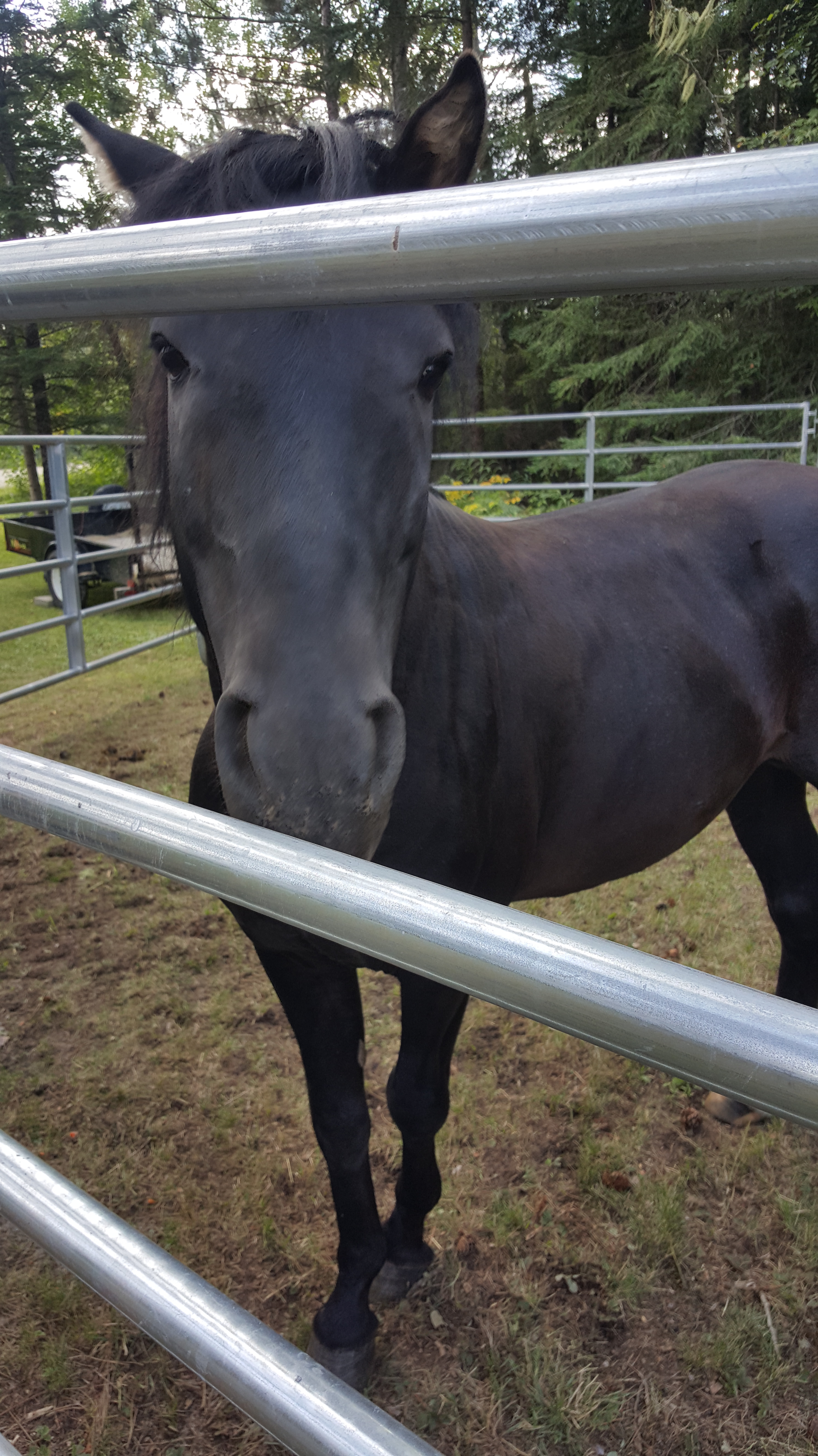
An Ojibwe horse makes friends with a girl at Dawson Trail Campground in Quetico Provincial Park, Canada.
When I was a girl, I was horse crazy. My best friend, Jody, lived in my neighborhood and we collected every different breed of plastic toy horse we could get our hands on. (Or that we could convince our parents to buy.)
I had galloping horses, standing horses, rearing horses, trotting horses; Palominos, greys, Morgans, Appaloosas, Paints, you name it.
Jody and I enjoyed many imaginary adventures with our steeds. Enraptured, we watched movies like “The Miracle of the White Stallions,” “Justin Morgan had a Horse,” “The Black Stallion,” and “National Velvet.” I must have read all the Beverly Cleary horse books and Walter Farley books. During winter, we didn’t build snowmen, we made snow horses (which are basically snowmen lying down).
The highlight of my year was summer YWCA camp where I could ride a horse, although at a plodding pace. (Spatz, I miss you!)
It didn’t help that my grandfather raised horses (and mules, donkeys, ponies) and had his own Western store. He had a mule named Hubert (after Hubert Humphrey, a Minnesota politician) and a dapple-grey pony named Daisy that he let me ride on my rare visits. My grandfather trained Palominos for show. The back of his store housed saddles, which were propped on rows of sawhorses. The heavenly aroma of leather filled that back room. I climbed up on the saddles, pretending I was riding.
Jody and I begged our parents for a horse, coming up with outlandish plans about how they could be kept in the garage of our city homes, promising we would take care of them and exercise them every day.
When we were in sixth grade, Jody’s parents caved. She got her own horse, a paint named Friskie. She kept it at a stable just outside of town. I spent many Saturdays there, joining her as she exercised Friskie around the indoor arena. I rode a different horse that needed a workout.
Sometimes, Jody would trailer her horse, once even bringing it to my back yard (see photo below). Her family had a cabin outside of town and I also I recall riding Friskie bareback on the gravel roads around Island Lake.
Having a girlfriend with a horse wasn’t quite as good as having my own horse, but it must have helped assuage my passion somewhat. I’m sure my parents breathed a sigh of relief. My horse love didn’t totally go away, though. At the end of junior high, I attended a horse camp in central Minnesota with another girlfriend. It was the kind of place where you were assigned your own horse for the week and were responsible for its care. We learned how to brush a horse properly, feed it, etc. We were assigned to different groups based on our riding proficiency. I was proud to be in one of the upper levels. The week culminated with a trail ride and campfire, where we had the thrill of galloping the horses.
These memories resurfaced because a magazine story I wrote (and photographed) about horses was published recently. Not just any ol’ horse, however. Quietly, over the centuries, the Ojibwe people developed their own breed, now known as the Lac La Croix Horse (or Lac La Croix Indian Pony). Once roaming in the thousands over northern Minnesota and Ontario, Canada, these horses were semi-feral and community owned. Tribal members only brought them into enclosures during the winter to ensure their safety and health.
In the late 1970s, the horses almost went extinct for a number of reasons, including systematic efforts by European settlers to destroy them, and the rise of motorized technology.
In my story for Lake Superior Magazine (“The Horses Nobody Knows”), I describe how the breed was saved from the brink of nonexistence and what they mean to the Ojibwe today. It’s the longest article I’ve ever written. I had to wait a year for it to get published, which was extremely hard, because, you know, horse mania.
Learning about an unknown part of my home state’s past was exciting. I thought I knew every breed. As it turns out, there was a unique breed almost in my back yard, so to speak, that needed help.
I was more than happy to resurrect my horse crazies and put my writing talents to use to help raise awareness about the Ojibwe horses’ plight. If you’d like to donate to Grey Raven Ranch to help these special horses, they have that option on their website.
Me, staffing the Water Bar. Have a drink! Image courtesy of the Natural Resources Research Institutue.
We made it through another year of blogging, dear readers! It felt like I didn’t blog quite as frequently as during the past six other years of this blog, but I have enough content that search engine-directed visits keep the stats steady.
In fact, during 2019, the number of people visiting my blog almost doubled, going from 7,100 to 13,300, with over 15,400 views.
Here are the four most popular stories from this year. Why four? Because it’s a nice even number.
#1 Bellying up to the Water Bar – This post was connected to my job for a water research organization. We hosted a water bar, where people could taste water from different parts of the state. The event was designed to celebrate the importance of clean water. People mentioned in it shared the post, which accounts for its popularity. But I’d also like to think it’s also because people care about water.
#2 The Jayme Closs Case and the Importance of News Headlines – This was my rant about a local kidnapping case and the headlines it generated when the young lady was “found.” I thought the headlines should have read that she escaped her captor, instead. I Tweeted this opinion, which blew up the Twitterverse and freaked me out good, because I had only just started a personal account on that platform. Jayme seems to be recovering well from her ordeal, thanks to the support of her family and community. And Jayme, if you are ever ready to tell your side of the story, remember, I am here to help! (And a gazillion other enterprising writers, I bet.)
#3 Five Things to do in Freeport, Bahamas – Russ and I traded in the white snows of Minnesota for the white sands of the Bahamas last February. I must have been in an odd-numbered frame of mind, sharing five popular locations and activities to do there — from creating your own perfume, to wave riding for miles on the ocean.
#4 In Which my Writing Inspires Theft – This post offered a peek into the glamorous life of a local author. A lady I met in my church bathroom told me she liked my story on American martens that was in Lake Superior Magazine so much, she stole it out of her doctor’s office so she could send it to her grandchildren in Japan. High praise, indeed!
Thank you again for meandering with me, and Happy New Year wherever you may be . . .
Here’s a peek into the glamorous life of a local author. I was at the mirror in my church bathroom today when a lady going into a stall stopped and said she enjoyed reading the cover story on American martens that I wrote for Lake Superior Magazine recently.
She saw the magazine in her doctor’s office and since she knew a new issue of the magazine was coming out soon, she thought it would be okay to take the magazine so she could send it to her grandchildren in Japan who love learning about northern wildlife.
I thanked her and told her that there are martens in Japan, too.
Afterward, the more I thought about it, the more tickled I became that she valued my story enough to steal it. Although, perhaps she needs to listen harder to the moral messages during the church service!