
When the stone
of the world
is upon you,
open it to ice;
release it
in stillness.

When the stone
of the world
is upon you,
open it to ice;
release it
in stillness.

Huge chunks of ice piled atop eachother off of Wisconsin Point, Superior WI in April.
No deep thoughts for this week; just wanted to show you some photos I’ve taken recently at and near my office on an island in the Duluth-Superior Harbor. I feel so fortunate to work in such a cool place and I never take it for granted. Ice can still be found in the bays and along the shore, but the spring break-up is finally here and it’s as if a bottleneck of birds has been unleashed upon the waters. I haven’t taken any bird photos, but I did manage to catch a fox kit out the office back door, an instant before it got scared away by someone approaching outside.

A fox kit investigates a stick as seen out the back door of my office last week.
Yesterday I accompanied some researchers out on the St. Louis River Estuary. They were taking water samples for an ongoing project about seasonal water quality variation in the river. Because it was a calm day, we went out on Lake Superior just for kicks, through the Superior Entry. I got a good shot of the lighthouse despite the chilling wind that stole my cap later on and dunked it into the river. The researchers were nice enough to turn the boat around so I could retrieve it. My cap is now christened in the estuary, so I guess I’ll have to wear it out there all the time now. Anyway, I love the reflection in this photo!
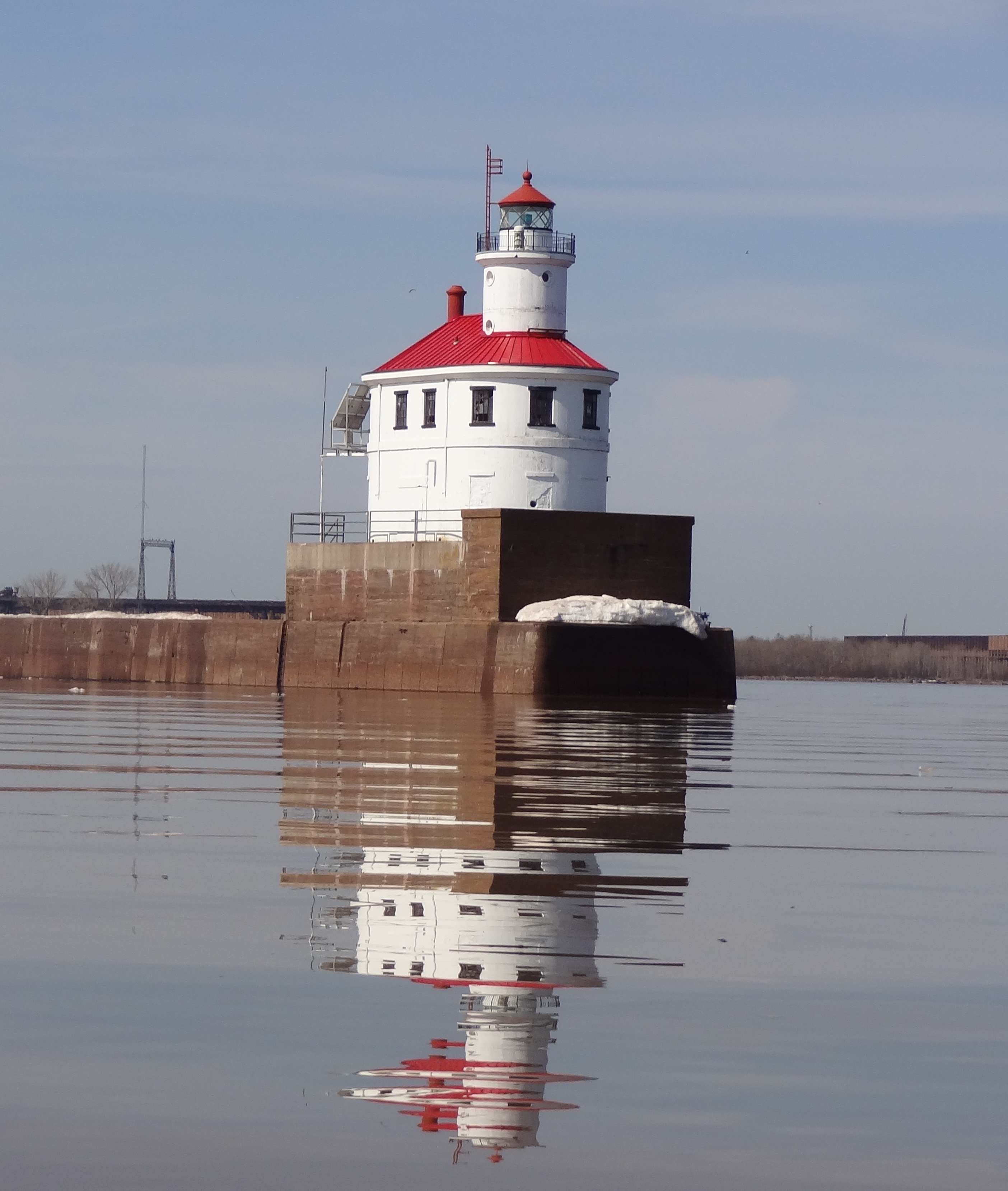
The lighthouse that guards the Superior Entry into Lake Superior.
On the other side of the breakwall was the U.S. Army Corps of Engineers dredger and some tugboats. The Army Corps dredges the harbor (digs out the muck) to ensure that the harbor is deep enough for the boats that ply its waters. The dredge is resting here. I thought this photo looks like a little mechanical family; papa dredge, mama tug and baby tug. Enjoy!

Dredge and tugs, Superior WI Entry to Lake Superior

Nature isn’t just what we see. It encompasses all our senses. Think of the vanilla essence of Ponderosa Pines, the rough grains of sandstone, and the sound of a dolphin’s exhale as it surfaces. We’re so used to the visual it’s challenging to remember other senses, especially in environmental and scientific work. I recently learned there’s a field that specializes in sound and the environment. It’s called acoustic ecology.
Acoustic ecology explores the relationship between living beings and the environment through sound. This can take many forms, from delving into what a forest sounded like 70 years ago when different species of birds lived there, to the affect of car alarms on the urban environment.
On a blustery day this past October I had the chance to talk with an acoustic ecologist. Chris Bocast is a talented musician who specializes in the field. He just finished producing a podcast about Lake Superior for our joint employer, Wisconsin Sea Grant. The series isn’t an example of acoustic ecology per se, but it does show how sound can illustrate environmental topics.
Because I’ve worked around Lake Superior for many years, Chris wanted to include me in the series. And of course, I couldn’t let him get away without covering the St. Louis River Estuary, too.
We met during a Sea Grant conference in downtown Duluth. For the interview we walked next door to the historic Greysolon Plaza Hotel. We sat in the hotel’s ornate and quiet mezzanine lounge.
In the middle of our conversation, Chris asked, “What’s the function of an estuary in an ideal ecosystem?” I replied that I happened to have written a poem about that, and darned if the poem didn’t make it into the series. It’s “Two Sisters” from my last entry.
Click here to listen to the Lake Superior podcast series. My poem can be found near the end of program #7 (Superior’s Sister).
The piano-based ambient music Chris created for the podcasts is unnamed. He told me it’s designed to evoke a sense of the pristine. I don’t know about you, but I could bliss out on his music all day.

I used to have a sister. She died years ago under unfortunate circumstances, and Lake Superior holds her ashes. If you’ve read my novel “Eye of the Wolf,” what happened to the main character’s sister (Melora’s sister) is similar to what happened to my sister.
People often ask me if parts of the novel are autobiographical. Of course, the story is drawn from my experiences, and I combined the traits of several friends to make up a character or two. (They know who they are!) But I wouldn’t go so far as to say it’s autobiographical, especially not the werewolf parts. (Grin) It’s the same with the poem below. It’s not about my sister but it contains her essence. I remember feeling like the ugly duckling compared to her more classical beauty.
Although I know that poems are supposed to speak for themselves, I would like to explain this one. The poem is about two things I love: Lake Superior and the St. Louis River Estuary. (The river in Minnesota, not Missouri.)
My love for the estuary came second and was harder won than my love for the lake. Lake Superior is what the tourists come to see. It’s picturesque and impressive; easy to love. The estuary is part of the less glamorous, roll-up-your-sleeves-and-let’s-work Duluth-Superior Harbor. It’s where taconite, coal and grain are unloaded from trains onto ships, where salt and cement dust sit in stockpiles, where polluted Superfund sites were left for us by our forebearers. But farther upstream, the river gets as wild as any federally designated wilderness. You just have to get out there and experience it to know.
I came to appreciate the estuary when I worked for Minnesota Sea Grant and the St. Louis River Alliance, both water-related organizations. Lake Superior is so huge, it’s hard to feel like you’re having an impact, whether one is a polluter or a restorer. The estuary is more manageable, and impacts can be seen more easily. I liked feeling that the work I did made a difference to the local environment.
The appreciation took a few years to grow, but it’s in me now and doesn’t diminish the respect I have for the lake. It’s like the parental cliché about adding another child to one’s home. Your capacity to love simply widens to encompass two instead of one.
Or it’s like having a sister. I hope you enjoy the poem.
Two Sisters
I am the quiet, hard-working one.
My sister gets all the attention.
She is larger than life, loud, showy.
I am slender, forgotten, kind to animals.
Her eyes are icy blue.
Mine are a warm brown.
My sister has a temper.
You know when she’s angry.
She’ll slap you and swallow you whole.
I am calmer, still dangerous, but
my hands are gentler.
These days, people are taking notice of me.
A team is giving me a make-over.
I may never be as popular as my sister, but
I have a lot to offer. It’s all a matter of
making the most of my assets,
repairing the neglect and over use,
restoring the smooth skin of my youth.
My sister, she might get jealous, but what can she do?
I’m protected by my friends who stand in a line between us.
Besides, what does she have to be mad about?
My life flows into hers.
What helps me, helps her.
©2013 Marie Zhuikov
 Marie's Meanderings