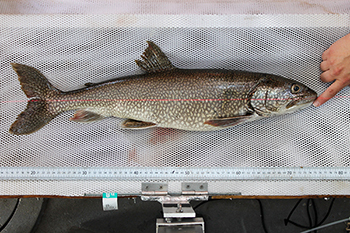
The oldest lake trout yet discovered in Lake Superior, also known as “Mary Catherine.”Image courtesy of the Michigan DNR.
The Michigan Department of Natural Resources (DNR) published a story a few days ago that made many people upset. As someone who has her feet in both natural resources management and public relations/science communication it offers an interesting case study. The DNR was trying to highlight an interesting fact about how fish can reach old ages, but some mistakes got in the way of this message.
The ear bone of one fish they caught in a special survey done in 2023 to study the different forms of lake trout and their reproductive biology was recently analyzed and the DNR discovered that the fish was as old as I am! (62 years) They caught the lake trout on a reef in the southeastern part of Lake Superior (40 miles north of Grand Marais, Michigan) and this lake trout is the oldest one currently on record.
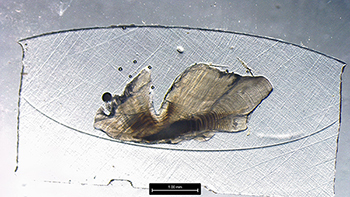
The ear bones of fish show annual rings much like a tree, and that’s how the DNR can tell the age of the fish. It’s the only way they can do this, and they have to kill the fish to extract the ear bone, also called an otolith
Mary Catherine’s otolith shows 62 years of growth.Michigan DNR image.
One mistake the technicians made was naming the fish. They picked the era-specific moniker of Mary Catherine because Mary was one of the most common names in 1961 when the fish was hatched. People who heard news reports were excited that such an old fish was found, and that it even had a name, only to be crushed when they learned later that the fish was killed in the process of discovering its age.
One Facebook commenter said, “Hey we just killed Mary Catherine, but the upside is we now know that she was 62 years young, much like many grandmothers and recently retirees. There’s one less on Social Security now, and that should help keep it solvent.”
Another said, “Sad that they killed a fish who is probably older than the combined ages of some of the researchers, but it is interesting information.” Another commented that the fish might have lived another 20 years if not sacrificed for science.
You might think that such an old fish would be very large, but she wasn’t. Mary Catherine weighed 2.1 kilograms (4.62 pounds) and was 627 millimeters (24.7 inches) long. That’s because Lake Superior doesn’t have much food in it and animals grow slowly. The typical lifespan for a lake trout is 25-30 years.
The story gained wide media coverage, so it was successful that way, but even some of the reporters were dismayed that Mary Catherine was a goner. People already love to hate the DNR, and this well-intentioned science story just gave them another reason.
I’d say the main lesson is not to name your research subjects in newsworthy stories, especially if they’re dead.
The researchers were mum about whether they were inspired by the Saturday Night Live character, Mary Katherine Gallagher.
This meander was two summers in the making. I tried to reserve a house keeping cabin at Rock Harbor Lodge on Isle Royale in early 2021, but they were booked already!
I longed to return to this national park in Lake Superior because I worked there as a waitress at the lodge for two summers in the 1980s. I hadn’t been back in over 25 years and decided it was time. I needed my Isle Royale wilderness fix.
I didn’t want to primitive camp, however. Been there, done that. During my college waitress days, I had dreamed of someday staying in one of the quaint cabins that line a protected harbor on the island – sleeping in a real bed, bringing my own food, and cooking in a kitchen complete with stovetop and mini-fridge. (Beats a camp stove and no fridge, any time.)
Now was that time. But the only openings were in the summer of 2022. I sighed and made the reservation for this distant date. I was also able to talk Russ and a couple of my friends into accompanying me.
I consider Isle Royale my spiritual home. I’ve had some of my most meaningful experiences there and it’s where I’ve met lifelong friends. My two novels are set on the island. I wasn’t sure how so much time passed off-island, but it probably had something to do with life, responsibilities, and distractions.
Lake Superior is cold this summer! Image courtesy of KBJR-TV, Duluth, MN.
As our departure date neared, my heart sank as I looked at the weather forecast for the four days we’d be spending in the park. The water temperature for Lake Superior has been at record lows this summer – its coldest in 25 years! (Lower-to-middle-40s.) It has to do with prevailing westerly winds, which caused colder waters to upwell from the depths.
As such, we were resigned to the yucky weather forecast for our stay, which predicted highs in the 60s and overcast skies. This magical and mercurial island had other things in mind for us, however; treating us to highs in the mid-70s, sunny skies, and sporadic fog.
One of my fellow travelers was prone to seasickness, so we took the shortest boat route possible, aboard the Queen from Copper Harbor in Michigan’s Upper Peninsula. The passage couldn’t have been better, and we spent our 3.75-hour unusually calm ride in pleasant conversation and card games.
Our house keeping cabin.
After we arrived at Rock Harbor, we had a few hours before our cabins were ready. We spent the time getting reacquainted with my old haunts: the snack bar (now named the Greenstone Grill after semi-precious stones only found on the island) and the America Dock – named after a ship that used to service the island but sunk. I was distressed to see the dock in ruins from ice damage. The employee dorm looked much the same, as did Tobin Harbor and the sea plane dock, next to where our lodgings would be.
The lodge is run by Kim Bob Alexander, who worked on the island when I did. He was a charter captain then and has been managing the lodge concession for many years. It was good to see a familiar face since all the rest are gone. He seemed to remember me, and we discovered that his daughter Marina would be our charter captain the next day for our lake trout fishing trip onto Lake Superior.
I was worried about how the loon population was doing on the island. I fondly remembered falling asleep to the mournful sound of their calls at night and hoped that hadn’t changed. I needn’t have worried. The moment Russ and I checked into our cabin, a pair of loons called from Tobin Harbor, as if in welcome.
The next morning, we rose early and headed to the docks for our charter fishing excursion. Marina and her co-captain Cole greeted us, giving us the rundown of where we would travel and how things would work. I had never been charter fishing before, so I was especially intrigued. (This was yet another former-Isle-Royale waitress’s dream experience.)
We headed out in the fog along the eastern side of the island toward Passage Island, which lies about three miles off its tip. We fished for a couple of hours, unsuccessfully. Or, I should say that Marina fished for us and we just lollygagged around, trying to stay out of her way.
Our lake trout catch.
As the fog began to lift, we hoped our luck would change. To hedge our bets, we decided to offer a little sacrifice to Lake Superior. My friend Sharon poured a little bit of leftover coffee into the lake, saying a few words.
Soon after, she was reeling in her line according to Marina’s instructions, with a four-pound lake trout on the end of it. Not long after, I caught a five-pounder. I was especially impressed by how cold my fish was when I held it, pulled from Lake Superior’s icy depths.
There was another lull during which Russ lost a fish or two. We decided it was time to offer another sacrifice. Sharon and I eyed our men, as if deciding which one to throw overboard, but then opted for a pinch of tobacco that one of them carried.
It worked again! Sharon’s partner Mike caught a trout and Russ finally did, too.
That night we dined on our trout, pan-seared by the lodge chef, along with all the fixings. We felt truly fortunate to eat these fresh gifts from the lake, much to the envy of our fellow diners, who also wanted fish, but it was not on the grill’s menu.
Our lake trout dinner.
Passage Island Lighthouse.
The next day, fog scuttled Russ’s and my plans to canoe in Tobin Harbor, so we opted to hike to Scoville Point instead. The point is about a four-mile round-trip from Rock Harbor. Along the way, we saw a snowshoe hare, which I had never seen before on the island, and an eagle’s nest, complete with eaglets. A mother merganser carried several of her brood on her back along the shore, followed by at least half a dozen other babies.
Our final full day on the island, Russ and I took a half-day trip aboard the lodge’s tour boat, the M.V. Sandy, to Passage Island. The weather cooperated. The park ranger who was supposed to interpret the rugged hike to the island’s lighthouse contracted COVID, so I ended up acting as an impromptu guide for part of the trip, pointing out plants not found on the main island (due to moose browsing) like the devil’s club and huge yew shrubs. We were also treated to views of peregrine falcons flying from their cliff face nest. The lighthouse has aged and decayed since I last saw it, but it still stood as a stalwart presence on the end of the island.
Our final morning dawned foggy and drizzly. Russ and I spent our time canoeing and hiking to Monument Rock and Lookout Louise. More on that in my next post…..
Mystical Scoville Point, Isle Royale National Park.



 Marie's Meanderings