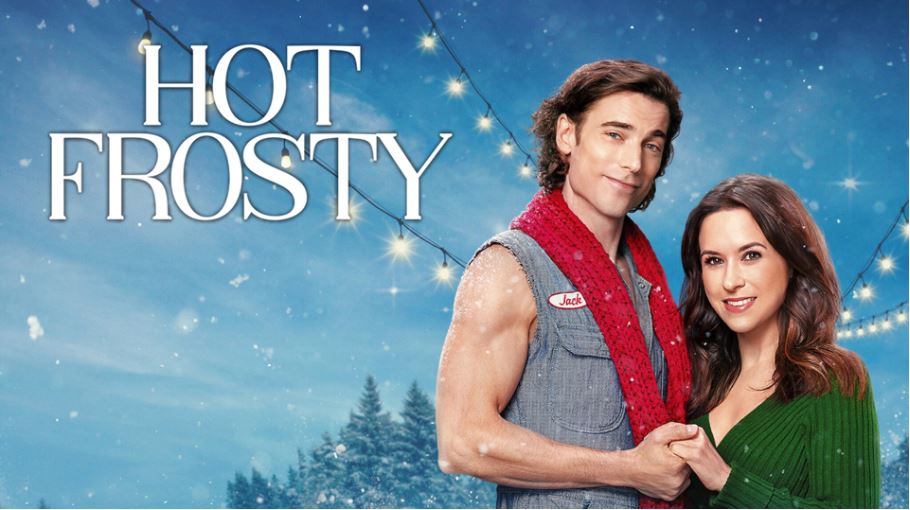
Russ and I are fans of National Public Radio’s “Wait, Wait, Don’t Tell Me” news quiz humor show. In a recent edition, host Peter Sagal mentioned that holiday movies are being produced with a decidedly sexy bent. He named one in particular: “Hot Frosty.” This Netflix production is about a muscular snowman who comes to life after a young widow drapes him with a scarf that has magical properties. Needless to say, he keeps his “hot” physique once he’s human, and romance ensues. But he also keeps some of his cold properties, too, such as a penchant for eating ice and a below-freezing body temperature.
We decided that “Hot Frosty” was a good candidate for a drinking game, even though it wasn’t an official Hallmark movie. We set a date with my friend Sharon, with whom we had a riotous time four years ago enacting and enhancing this drinking game list.
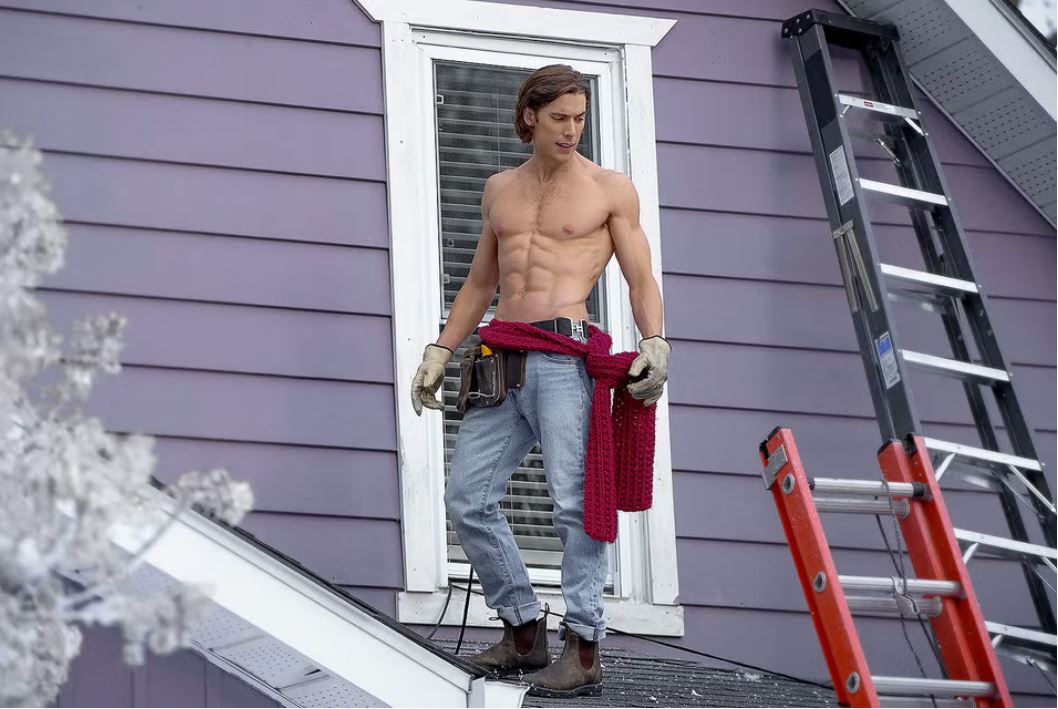
This living snowman causes quite a stir while fixing a roof.Image courtesy of Netflix.
Although “Hot Frosty” didn’t contain as many troupes as a Hallmark movie, we still had fun watching it. In fact, it inspired us to enlarge our game list with a few new rules. I’ll post the revised version below Sharon’s review of the movie. Please note: Sharon provided this review after drinking to drown her sorrows after the Packers lost to the Vikings, and after playing our movie drinking game.
“It’s part PG-rated but it doesn’t go too far in the sexy category. It’s not like “Magic Mike.” Netflix, could you ramp it up a notch? The snowman had an interesting body but no substance.
“Women are usually colder than men. I dunno if it’s from our estrogen or what. We don’t want to snuggle up to men who are colder than we are. We want hot men! If someone was as cold as this guy is, it would put a damper on things.”
So, there you have it. Maybe not all that sexy, and probably too cold, but it was a fun way to spend an evening.
Here’s our freshly revised list.
RULES
Take one drink whenever:
A reference is made to a dead relative The “Mayor” appears on screen The main character’s name is related to Christmas (Holly, Nick, etc.) Anytime someone disses fake Christmas trees A newcomer partakes in an old family or town tradition Hot chocolate, apple cider, or eggnog is on screen A big city person is transplanted to a small town Christmas caroling, a tree farm, baking cookies, or a snowman appears Mistletoe or a scarf is on screen A character makes a magic deal Any time you hear “Jingle Bells” The town is named something Christmas-y An interracial couple appears An angry, misdirected law enforcement officer appears
Take two drinks whenever:
Characters experience a ‘near-miss’ kiss An obvious product advertisement appears A snowball fight, ice skating, or dancing happens An ugly sweater or tie appears The characters are snowed in Someone gets a makeover A “Pride and Prejudice” reference is introduced (a character is named Darcy, a place named Pemberly) Someone refers to a metaphor or uses intelligent phrasing Someone refers to fishing or hunting Someone with slicked-back hair expresses their hate for Christmas
Finish your drink whenever:
The cynic is filled with the Christmas spirit It snows on Christmas Someone selects a Christmas tree The main characters bake/cook something together, or Christmas-themed food is mentioned Bad art appears or a literary reference is made Dissonant architecture appears (for instance, a lighthouse in Wyoming) Accordion music happens, especially if it’s playing Jingle Bells
Take a shot whenever:
The movie stars Candace Cameron-Bure, Lacey Chabert, or Andrew Walker appear The main characters fall in love The main characters kiss
Well, it wasn’t the series itself that broke the internet in my neighborhood, rather it was a virtual presentation about it by Netflix that seemed to break it.
About a month ago, I was invited to an exclusive virtual screening of a new television series that’s being made out of the book, “All the Light We Cannot See,” by Anthony Doerr. I was invited because I rated the book on Goodreads.
However, right when the screening was supposed to begin, the internet went down at my house. Luckily, I was able to access the event via my cell phone. I sure was glad I signed up for that new unlimited data plan!
The event began with an introduction of one of the series’ main characters (Aria/Marie). Then the first installment of the four-part series was shown. It was filmed in Budapest and is set to air November 2 on Netflix. This was followed by an enthusiastic conversation between Doerr and the series director, Shawn Levy. I recorded it so I could make this blog post, complete with quotes and everything.
If you’ve been living under a literary rock, you might not know that “All the Light We Cannot See” won the Pulitzer Prize for fiction in 2015. I attribute this to Marie being one of the main characters’ names. Ha ha.
Marie-Laure is a blind girl who crosses paths with a Werner Pfennig, a German soldier, in occupied France during World War II. After her uncle disappears, Marie takes over his nightly clandestine radio broadcasts from the attic. Werner’s job is to track down resistance operations, including radio broadcasts. His life and Marie’s collide in this book, which illuminates the ways people try to be good to one another against all odds.
I gave the novel five stars on Goodreads, saying, “This book has *almost* spoiled me for any other. The writing! The metaphors! The sensory descriptions! OMG. The flipping between time periods and character points of view were confusing at times, but it all works in the end. So, keep reading. You won’t be disappointed.”
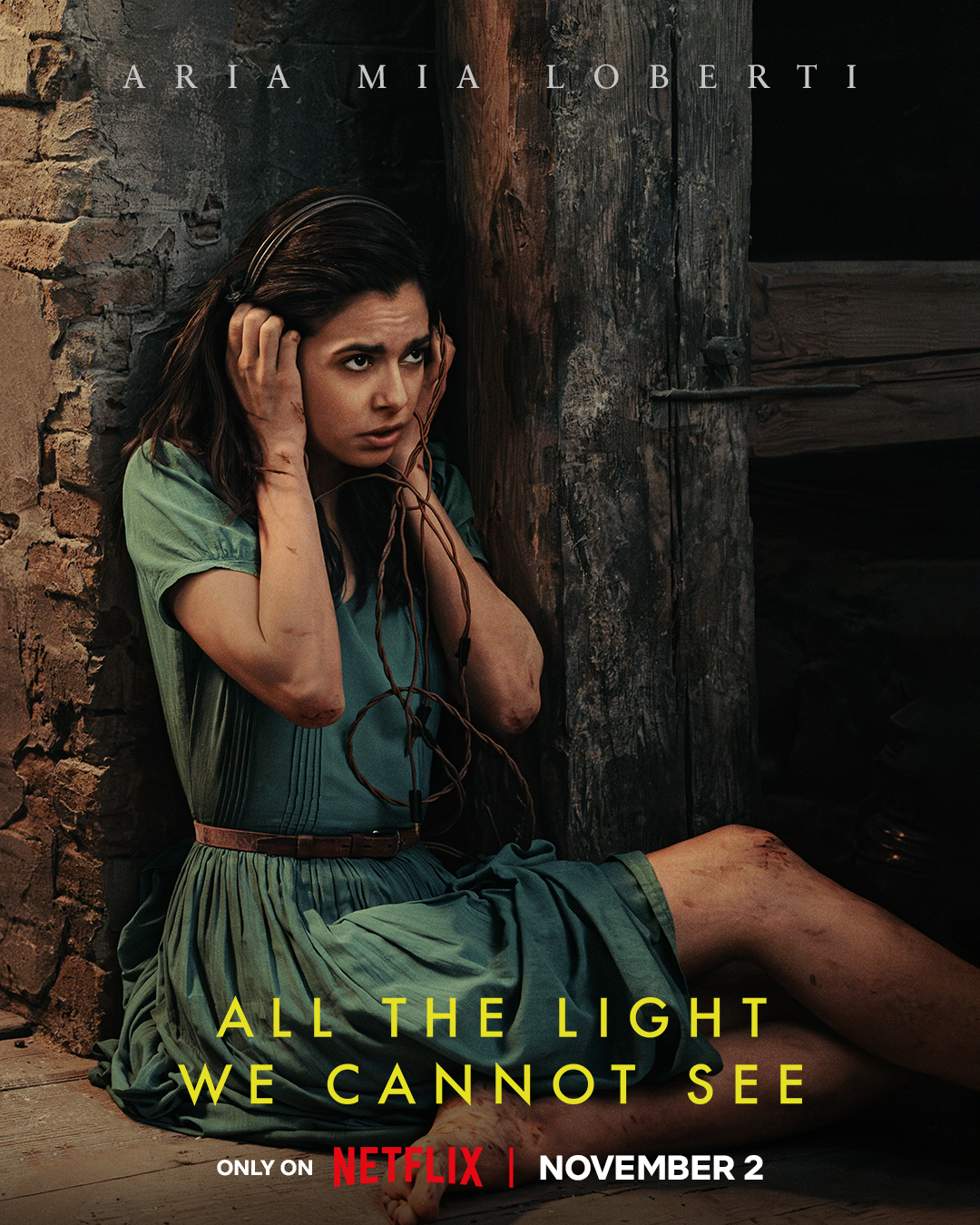
The character of Marie is played by a woman who is actually blind, “That’s valuable detail that impacts and informs every frame of this series,” Director Levy said. He conducted a global casting search for the part.
“We got thousands of videos. One of them is a unicorn of a discovery. She’s never auditioned, she’s never thought about being an actress, she’s an academic,” Levy explained.
He chose Aria Mia Loberti. She’s an American who was a graduate student in rhetoric. She learned about the audition from a former childhood teacher. Aria was a fan of the book and this is her first acting role.
Levy optioned the rights for the story after it was rejected by another firm, which decided it was too complicated to tell in a single movie.
Levy directs all four episodes, a task that Doerr called “herculean,” but Levy said this allows for aesthetic continuity between episodes.
Levy decided to direct all four out of selfishness because he loved the book. “By page 12 of episode 1 of the script . . . I said, ‘Oh no, no, I can’t share. I need to direct it and I need to direct all of it because I want live in this world and create this world in a way that feels uniform and unified across episodes.’”
Levy describes the work as one story that happens to have four episodic breaks. “I knew if I could make myself happy as a rabid fan of this book, likely I could make other fans happy. That was my whole strategy.”
Levy previously directed “Stranger Things,” a sci-fi horror series on Netflix. He also directed “The Night at the Museum” movies and “Deadpool 3.”
Doerr said that the general advice writers get is to write what they know. “I like to write into what I don’t know.” With “All the Light,” he said to Levy, “often, I’d get one-and-a-half sentences in and just like you guys, I’d have to go and build the set.” He had to research what it was like to be blind during the time period of World War II.
Levy asked Doerr how he combines lyrical storytelling with a taut narrative action. “Often, as a novelist, you’re toggling between the tiniest microscopic details, which can take a whole morning . . . and then other days, you’re trying to move totally structurally, and think, ‘where’s this tiny moment in the book falling in the larger scope of the narrative?’” Doerr said.
Levy finished Doerr’s thought with: “Because you always have to keep the narrative in your mind. Always. But you also have to be hyper-focused on this shot. It’s like zooming in and out from a macro to a micro lens.”
Many people think the book’s title comes from the blindness of the protagonist, but this was not Doerr’s intention. He thought of the title while on a train to NYC to see his editor about the cover of his current novel at the time.
“There was a guy in the seat in front of me and he was on his big 2004 cell phone. He was talking about the movie, ‘The Matrix.’ I remember that quite clearly. As we go underground as we near the city and Penn Station, his call drops, and he gets unreasonably angry. I remember thinking at the moment that what he’s doing is a miracle. He’s got this tiny set – a radio — a receiver and a transmitter no bigger than a deck of cards, and he’s expecting this conversation to work at 60 miles an hour, sending these little packets of light between radio towers at the speed of light. And who knows, the person’s he’s talking to could be in Madagascar or France. I remember thinking that what we’re all taking for granted is using this invisible light that can pass through walls. It’s a miracle and so many generations of humanity never had access to this kind of communication.
“I wrote down the title (usually titles come really late to me) but I wrote down “All the Light We Cannot See” in my little notebook that I carry in my pocket before I had anything. All I had was a girl reading a story to a boy, which is how episode 1 really begins, over the radio. I conceived of her being blind and him trapped in darkness, desperately needing this story. I just wanted to play with all the metaphorical meanings of where are we living and what our human perceptions involve.”
Levy asked Doerr whether it is surreal to have this population of people living in your head for years and then to see them burst into life on the screen. Doerr replied that he was blown away by seeing Aria’s audition video and also by the younger version of Marie, played by a child actress named Nell.
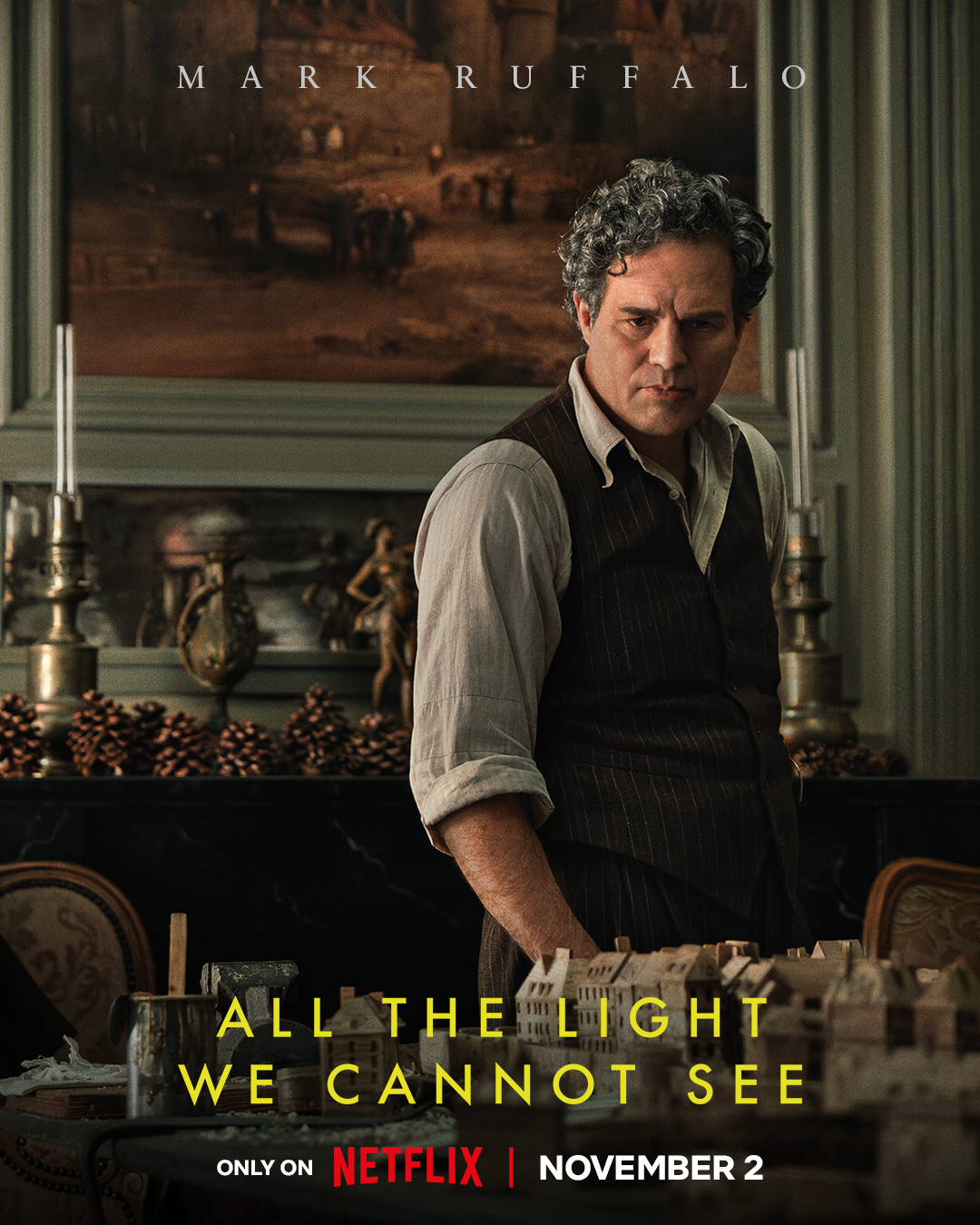
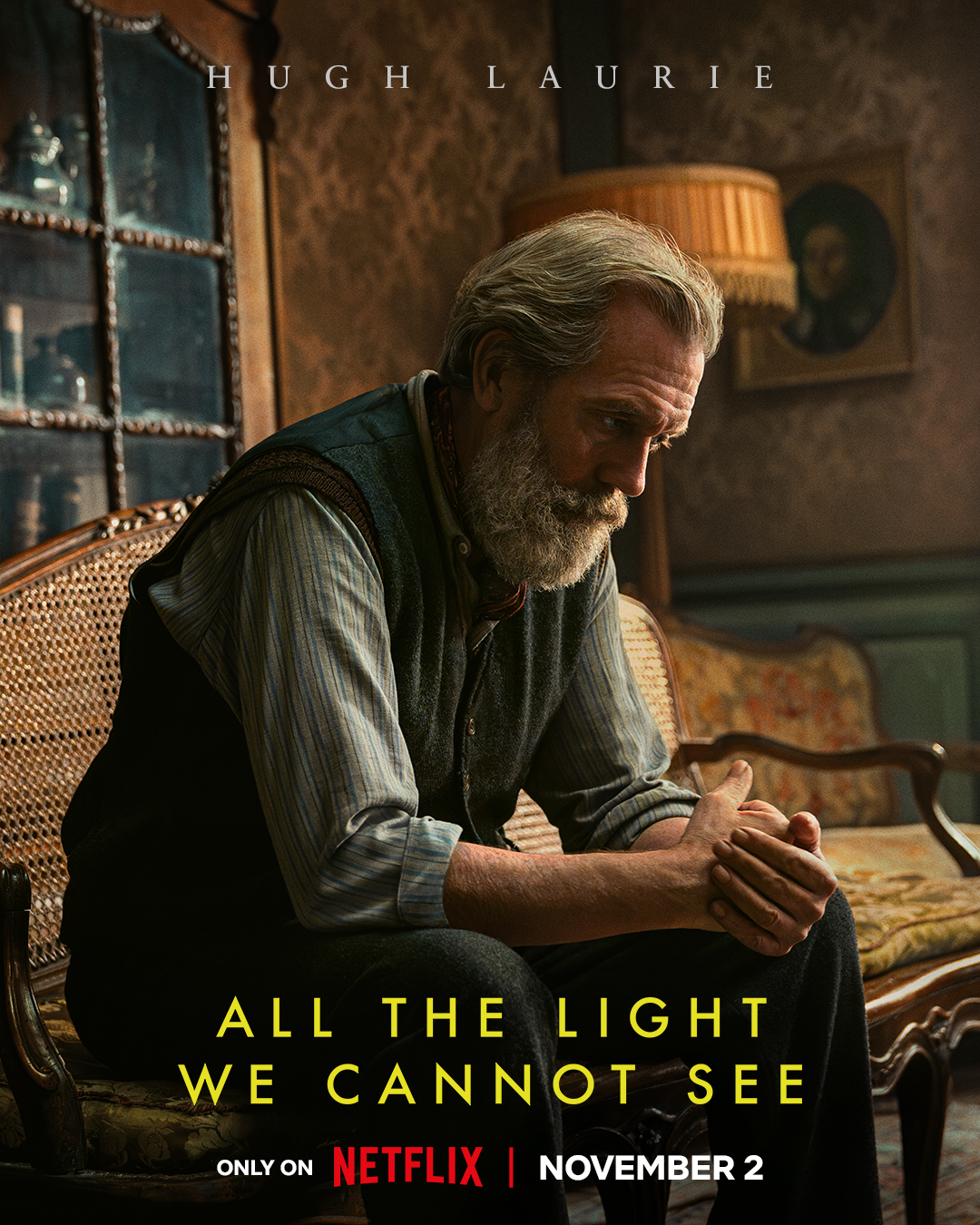
The movie stars other, more familiar actors, too. Wisconsinite Mark Ruffalo plays Daniel, Marie’s father. Hugh Laurie plays the reclusive uncle.
From being privy to episode 1, I can tell you that if you loved the book, you’ll love this series! I still can’t quite believe that I was invited to this preview.
Then the screening and conversation was over. Just as mysteriously, my internet reappeared at that instant. It made me wonder how many people got invited to this “exclusive” screening, anyway?
Unlike the man on Doerr’s train, I did not get unreasonably angry when my technology stopped working. I did get stressed out though, because I didn’t want to miss the screening. The irony does not escape me that my cell phone worked while the train man’s didn’t. And for that, we have to thank the miracle of invisible light that can pass through walls.
 Marie's Meanderings