…For the first time in my life I had failed to work for the joy of knowing the wilderness; had not given it a chance to become a part of me. –Sigurd Olson, “The Singing Wilderness”

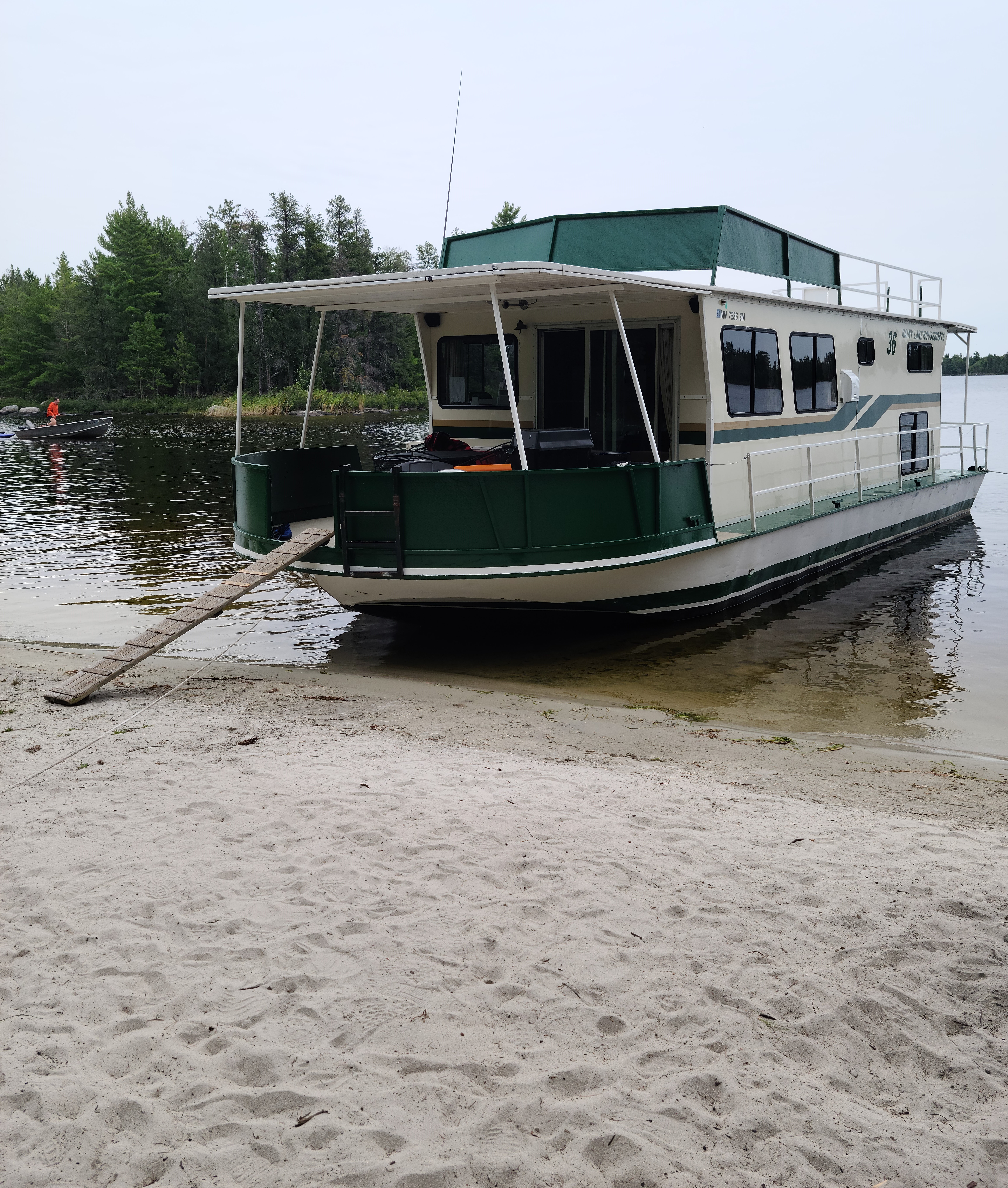
After our delightful stay on the Duckfoot Islands, we headed back toward the houseboat base. Our goal was Garretts Point, another sandy campsite in a protected cove. This was Garrett’s idea, for obvious reasons.
He successfully piloted us out into the lake. Then I decided to give houseboat driving another try. The first time I did it, my steering wasn’t so bad, despite the wind. There was less wind on this day, but my steering was much worse. I almost did a 180 with the boat! Luckily, we were in the middle of the lake, without any obstacles. That was one reason why I chose this stretch to try again.

As I zigzagged down our route, I figured out my problem. I’m used to steering a sailboat with a rudder. For that, you turn the rudder in the opposite direction you want the boat to go. Not so with a houseboat. To turn right, you turn the wheel to the right. I kept wanting to do the opposite. Also, you’re steering from near the front of the boat and the motor is in the back. That’s weird, too.
Despite all this, we successfully reached the Brule Narrows again and Garrett took over. The rest of our trip to Garretts Point in a light rain was uneventful. The site is sandy, but the beach is not as big as the one at the Duckfoot Islands. The fire ring is circled by nine stately red pines. We were greeted by a sparkly rubber duckie that someone had left on a rock by the fire ring.
Garrett was excited to arrive, and we took an obligatory picture of him standing behind the official campsite sign. Russ explored in the kayak and found a huge beaver house nearby. The beaver visited us that night as we sat around the fire.
I spent most of my time reading, but I also had a chance to explore my feelings. It didn’t seem right to be able to access these rustic locations without working very hard. Sure, driving the boat was stressful, but I wouldn’t call it physical labor. I’m used to canoeing for days and sleeping on the ground. This just seemed way too easy, like we didn’t earn it. It felt surreal to sit in my fluffy bathrobe next to a rocky campsite with scraggly jack pines and the chatter of a red squirrel.
Northwoods writer Sigurd Olson had these same feelings when he flew into Quetico National Park in Canada in a seaplane. In his book, “The Singing Wilderness,” he described the switch from civilization so quickly to the wilderness as “violent” and a psychological shock. While flying into the wilderness was what he had dreamed of doing, it didn’t allow him time to adjust and to soak in the wilderness ambiance.
He wrote, “Yes, I had been on a flight, had gone far into the lake country, had taken a few trout and enjoyed myself, but inside I was still a little out of breath and somewhat baffled by what I had done.”
We had another restful night and got up early in the morning so that we could drive the houseboat back to base by 9 a.m. so that somebody else could use it. In no time at all, we were back to the base. The houseboat guys came out to us when we were in the bay to pilot the boat into the dock.
As it turns out, we arrived in the nick of time. As we were clearing our gear out of the boat, we heard on the radio that the wind had switched and picked up speed. The base issued a no-travel advisory. We were glad we didn’t get stuck out there because Garrett had a plane to catch back to New York City. Whew!
I was glad to have had the houseboat experience, but I know that the next time I visit these northern border lakes it will be with a paddle and a pack so that like Olson, I can, “feel the rocks under my feet, breathe the scent of balsam and spruce under the sun, feel the wetness of spray and muskeg, be part of the wilderness itself.”

 Marie's Meanderings