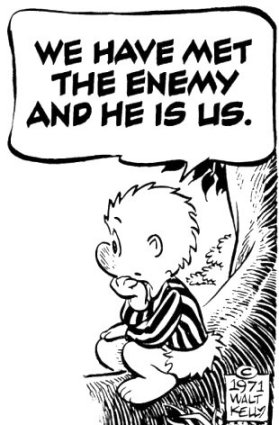
When my co-worker and I were debating whether to save the listless gull that appeared outside our office last week, she said something like, “Usually, I like to let nature take its course . . .” and I interjected, “But it’s often not nature that causes things like this, it’s humans.” I was remembering a gull I rescued many years ago that had been hit by a car.
As it turns out, although the gull at our office was put in distress by a natural process, the cause probably was us. As you may recall, when I brought the gull to the wildlife rehabilitation group, they said they thought the cause was a Vitamin B deficiency. (To be exact, a Vitamin B1 or thiamine deficiency.) They weren’t sure what was causing it, but suspected it had something to do with the gulls eating dead fish.
Back at the office, that got us thinking, especially after we learned the Wildwoods group had received three other gulls with the same problem that week, and after learning that two other co-workers had seen other gulls exhibiting the same symptoms: wing droop, loss of the ability to fly, and loss of the ability to “speak.”
Being of a scientific bent, we started researching the problem and came up with a paper published in 2009 about herring gulls and other birds in Europe that were dying of a thiamine deficiency. The researchers named the affliction “thiamine deficiency syndrome.”
In the paper, the researchers described the exact symptoms we were seeing: “The general course of this disease in full-grown individuals is difficulty in keeping the wings folded along the side of the body, inability to fly, inability to walk, and death. Other symptoms are tremor and seizures.” They said that the length of time between when a gull loses its ability to fly and death is 10-20 days. Turns out, this was the same paper that the Wildwoods people had discovered last year in an attempt to help more than a dozen gulls with the syndrome.
The researchers attributed the syndrome to “a causative agent(s) acting directly on the affected individual, and/or by insufficient transfer of thiamine between the trophic levels in the food web.” They cited an urgent need for investigation into the cause since bird populations in Europe were declining rapidly.
Putting together what we knew got us thinking: what kind of fish-related problem could cause a thiamine deficiency in gulls? I recalled Minnesota Sea Grant research from years ago about Great Lakes fish being low in Vitamin B1 due to a diet of smelt and alewives. Almost at the same time, my co-worker discovered similar research. Both smelt and alewives contain an enzyme that breaks down thiamine in the fish that eat them, which has caused documented problems in the lake trout, steelhead trout, brown trout, and salmon populations in the Great Lakes.
It makes sense that birds eating fish low in thiamine would become low in thiamine themselves. We didn’t find any research describing this problem in birds the U.S., but we didn’t do an exhaustive search. However, it sure seems like an interesting research project for some enterprising biologist.
It’s ironic that although the gulls are eating what they are supposed to (fish) versus an unhealthy diet of French fries, they are suffering. Remember the debate in the first paragraph about whether the cause is natural vs. human-made? Alewives and smelt are both non-native species introduced by humans into the Great Lakes. So the problem most likely is us, I hate to say.
A local reporter even did a story about the issue, which appeared on the front page of the Sunday Duluth News Tribune. (This story will be available for a week to non-subscribers.)
How is our office gull doing? The wildlife rehab folks report that it perked up after a thiamine shot. It had recovered enough for release the very next day. I am amazed that the solution was so simple, and amazed by what we learned in the process of saving what most folks around here consider as sky vermin.

 Marie's Meanderings