Scotland Day 10: The Last Day!

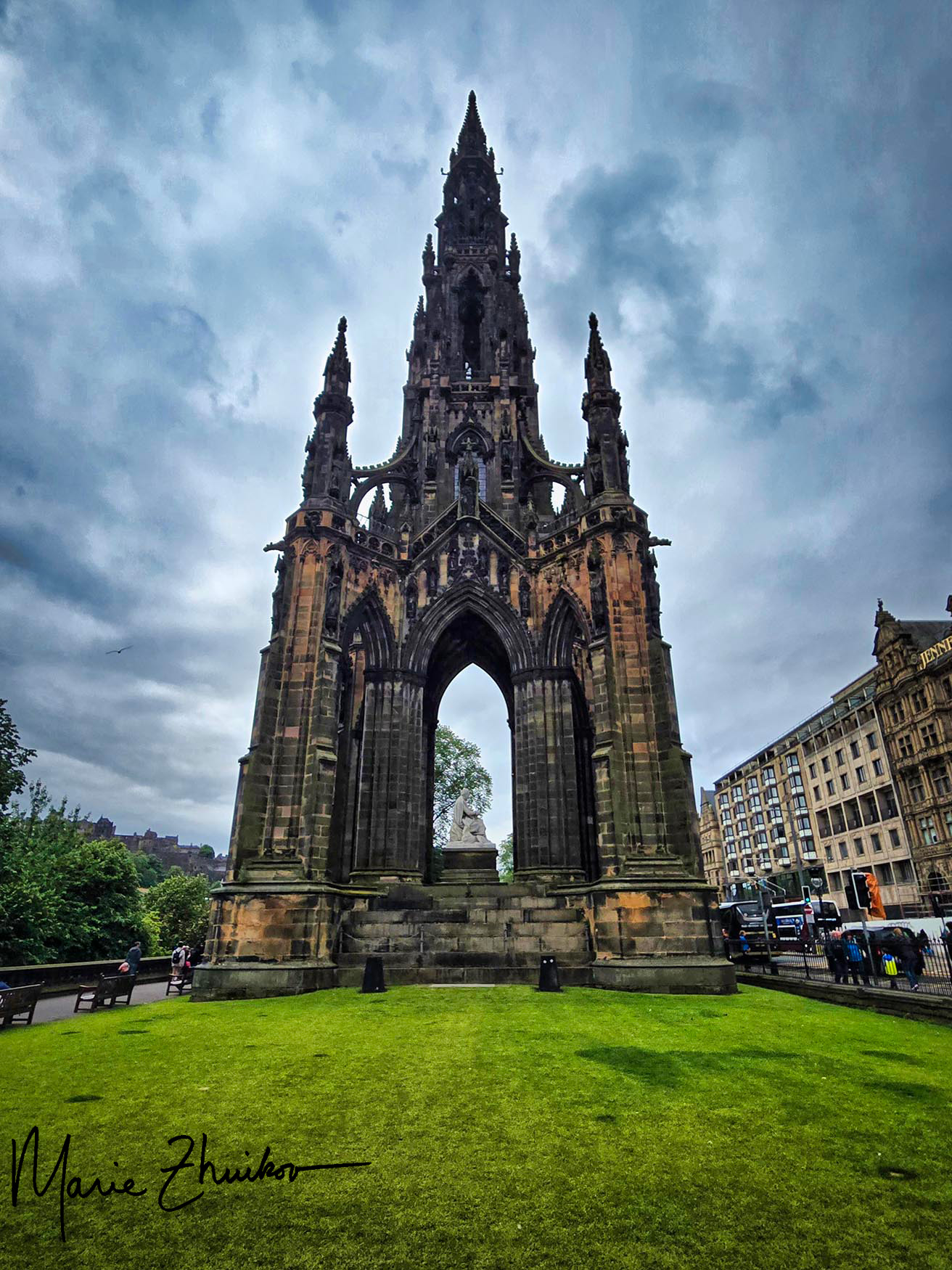
The Sir Walter Scott Monument, Edinburgh

After an awesome Outlander Tour and seeing the Tower of Clackmannan the previous day, we spent our final day in Scotland meandering some more around Edinburgh. We walked through the Princes Street Gardens, marveling at the fountain, statues, and quaint homes that can be viewed from it.
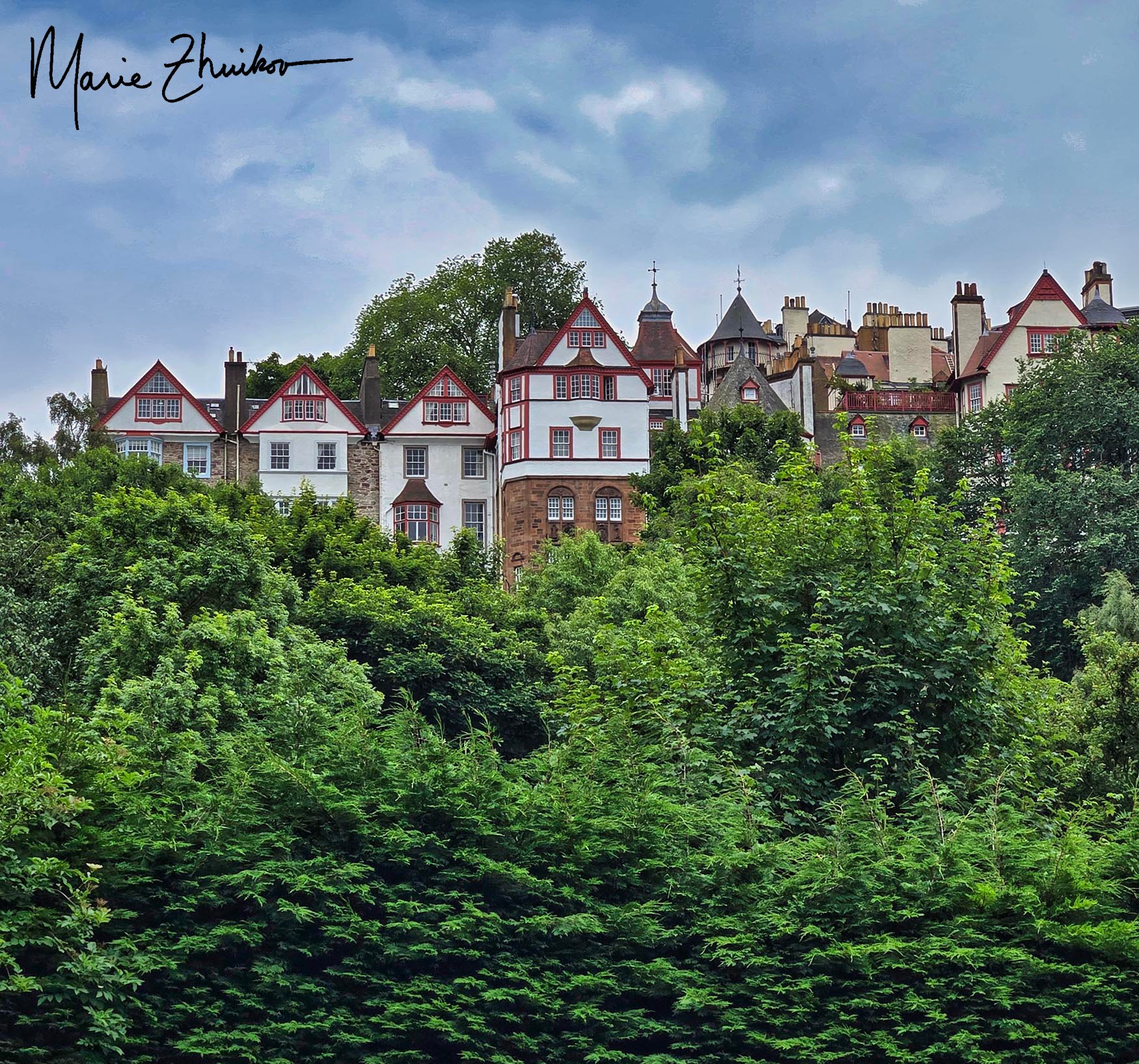
Homes seen from the Princes Street Gardens, Edinburgh

One unexpected sight was a statue memorializing Bum the Dog. Usually, everyone wants to see Greyfriars Bobby, the cute little statue of a terrier who slept on his master’s grave for years. I mean, the dog has even had a movie made about him! I don’t know. I much prefer the less popular landmark of Bum.
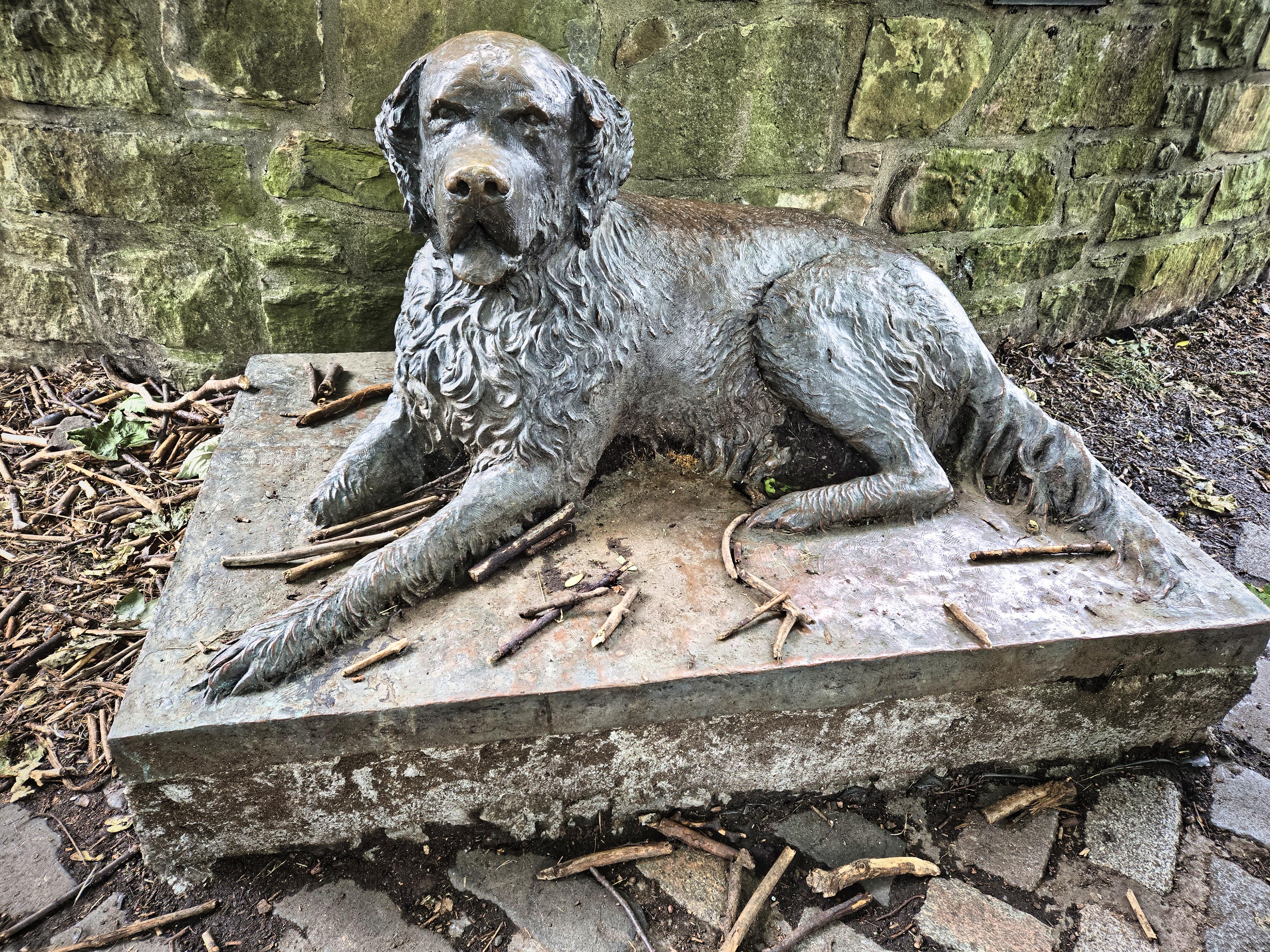
Bum, the San Diego dog, in Scotland

This remarkable dog disembarked from a ship in San Diego, where he won the hearts of the populace. The half-St. Bernard, half-Spaniel was owned by everyone and no one. Butchers fed him scraps and local doctors met his medical needs. He was so beloved that when San Diego issued its first dog license, Bum’s image adorned it.

His likeness sits in a small park in Edinburgh in tribute to San Diego, which is Edinburgh’s sister city. The Scots gifted San Diego with a statue of Bobby. The dogs represent the spirit of a twinning link friendship, loyalty, and shared experience. Bum died at age 12 in 1898. His memorial is one of five dog statues in Edinburgh.
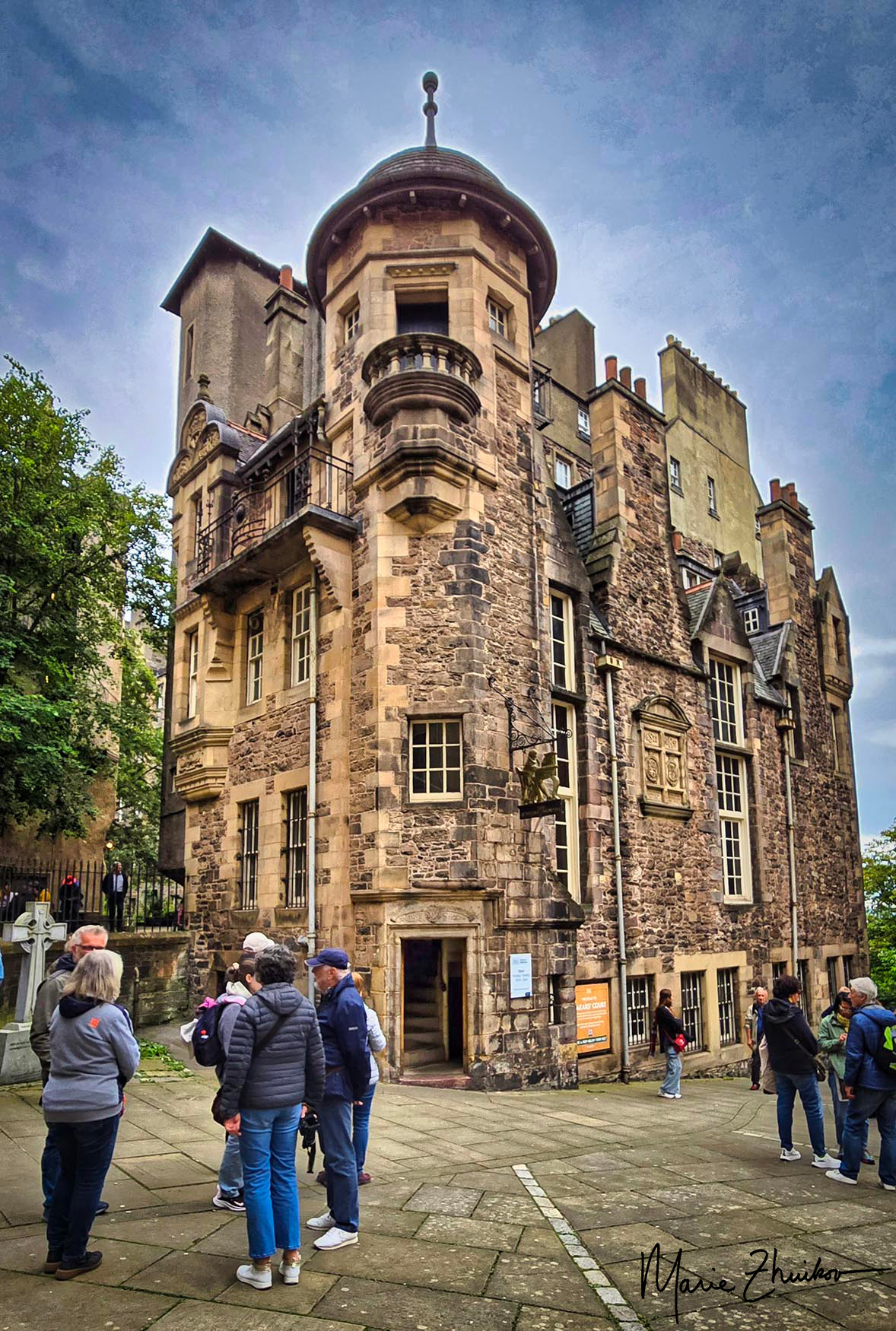
The Writers’ Museum, Edinburgh

On the other side of the gardens, we made our way to the Writers’ Museum. It’s in a narrow stone building, complete with more spiral staircases (my favorite!) The free museum is devoted to three Scottish writers: Robert Louis Stevenson, Sir Walter Scott, and Robert Burns. I never knew that Stevenson spent his later years in Samoa. One of the artifacts we saw was a tortoise shell ring given to him by a Samoan chief, engraved with the name ‘Tusitala,’ meaning ‘teller of tales.’ 
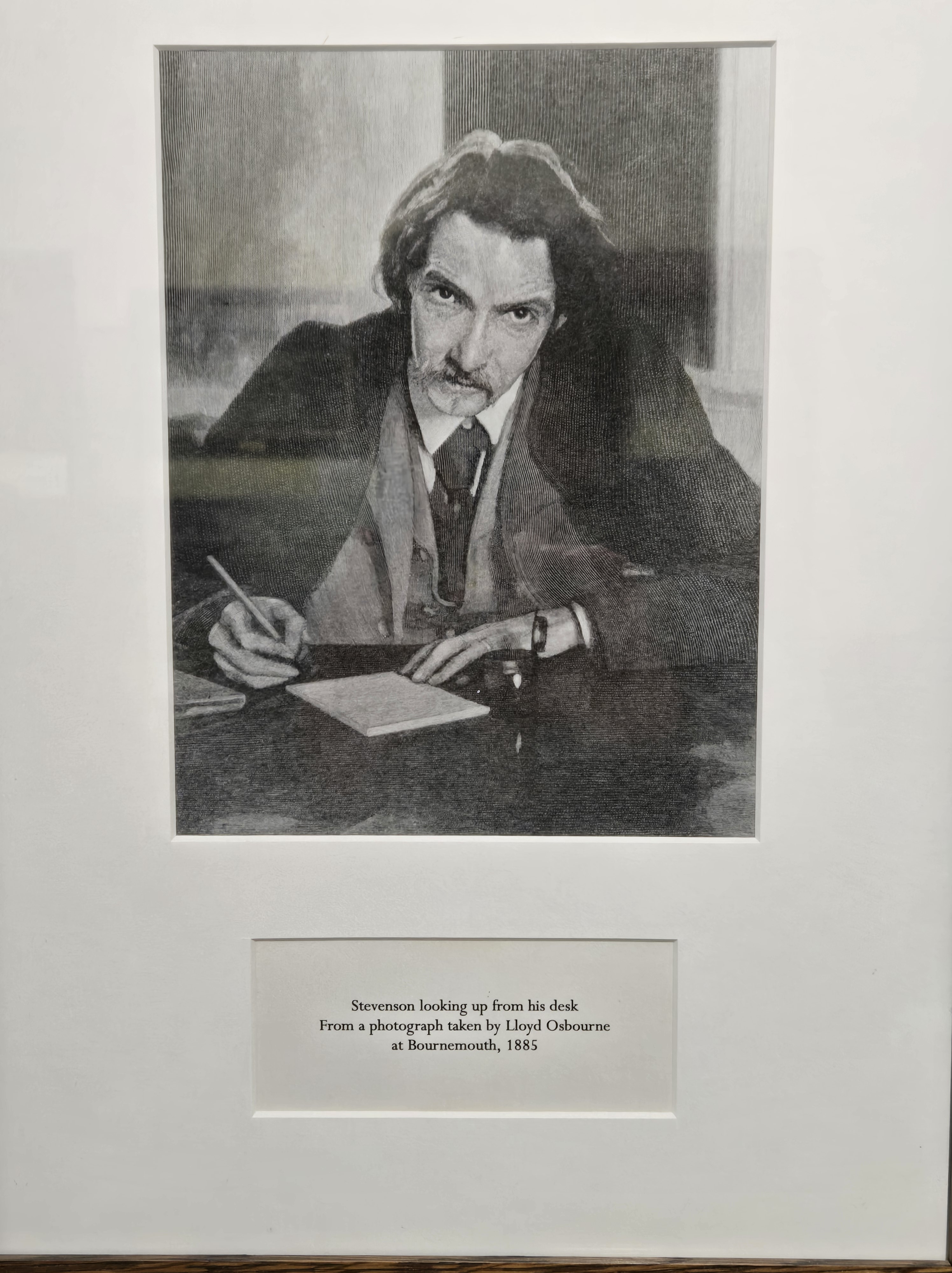
Author Robert Lewis Stevenson

The museum is near the Royal Mile, so we walked down that again, picking up last gifts for people back home. We also found the Witches’ Well, a memorial to all the women who were killed for practicing “witchcraft.” They were strangled and burnt on Edinburgh Castle’s Esplanade. It’s so small, we almost missed it! Surely, a memorial to the deaths hundreds of people should be a bit larger?
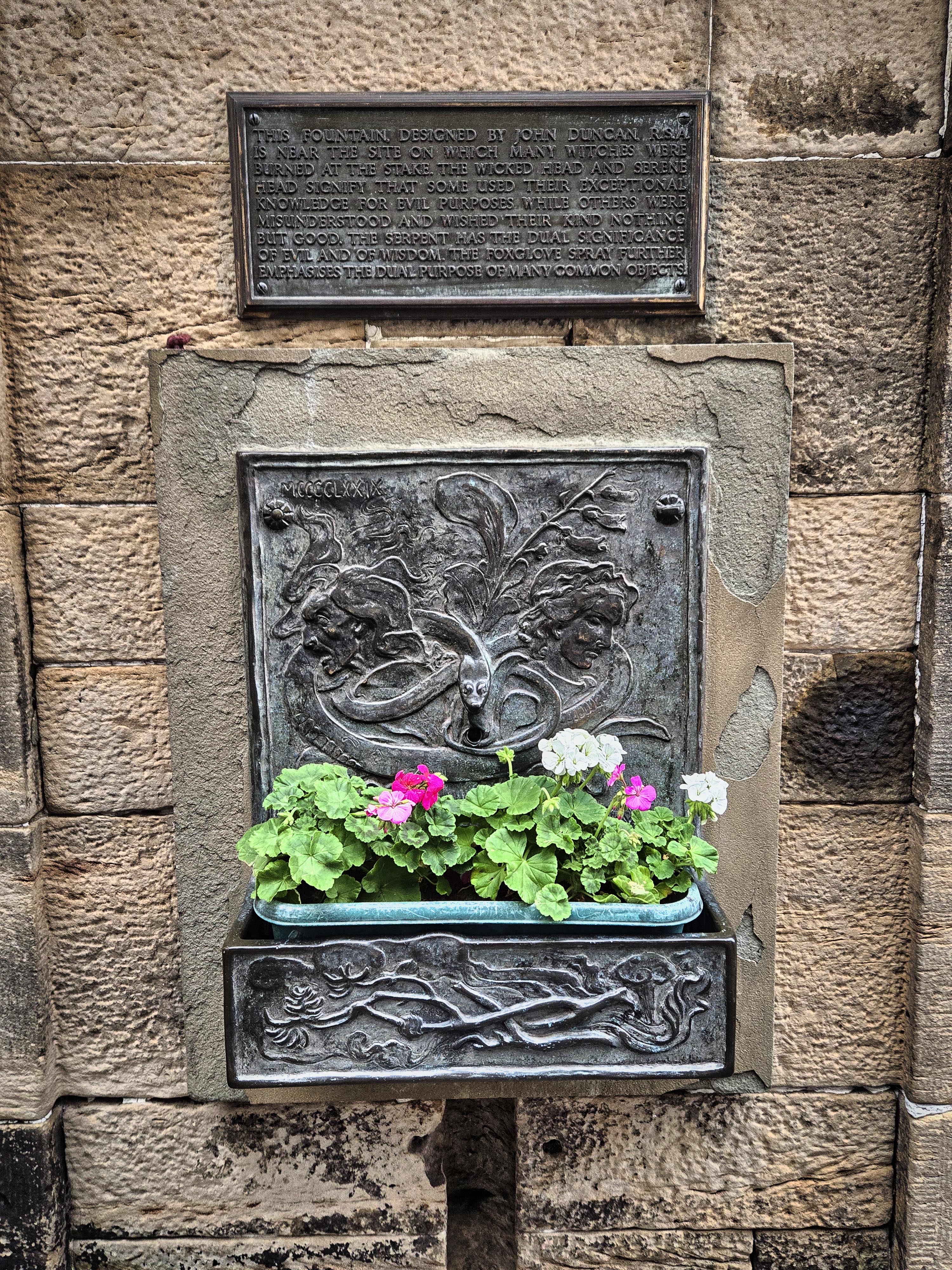
The Witches’ Well, Edinburgh

The plaque features a bronze relief of witches’ heads entangled by a snake. It uses dualism to highlight the balance between good and evil and to show that every story has two sides. The relief contains the image of a foxglove plant, from the center of which is a coiled snake intertwined around the head of Aesculapius, the god of medicine, and his daughter Hygeia, the goddess of health. Foxglove, though used medicinally, can also be poisonous depending on dosage, and the image of the serpent imbued with wisdom is also acknowledged as evil. 

As if to counterbalance the paganism, we popped into St. Giles Cathedral, another free tour opportunity. It’s quite the impressive structure! It was built in 1124 and has no doubt been rebuilt over time. I loved the ornate ceiling.
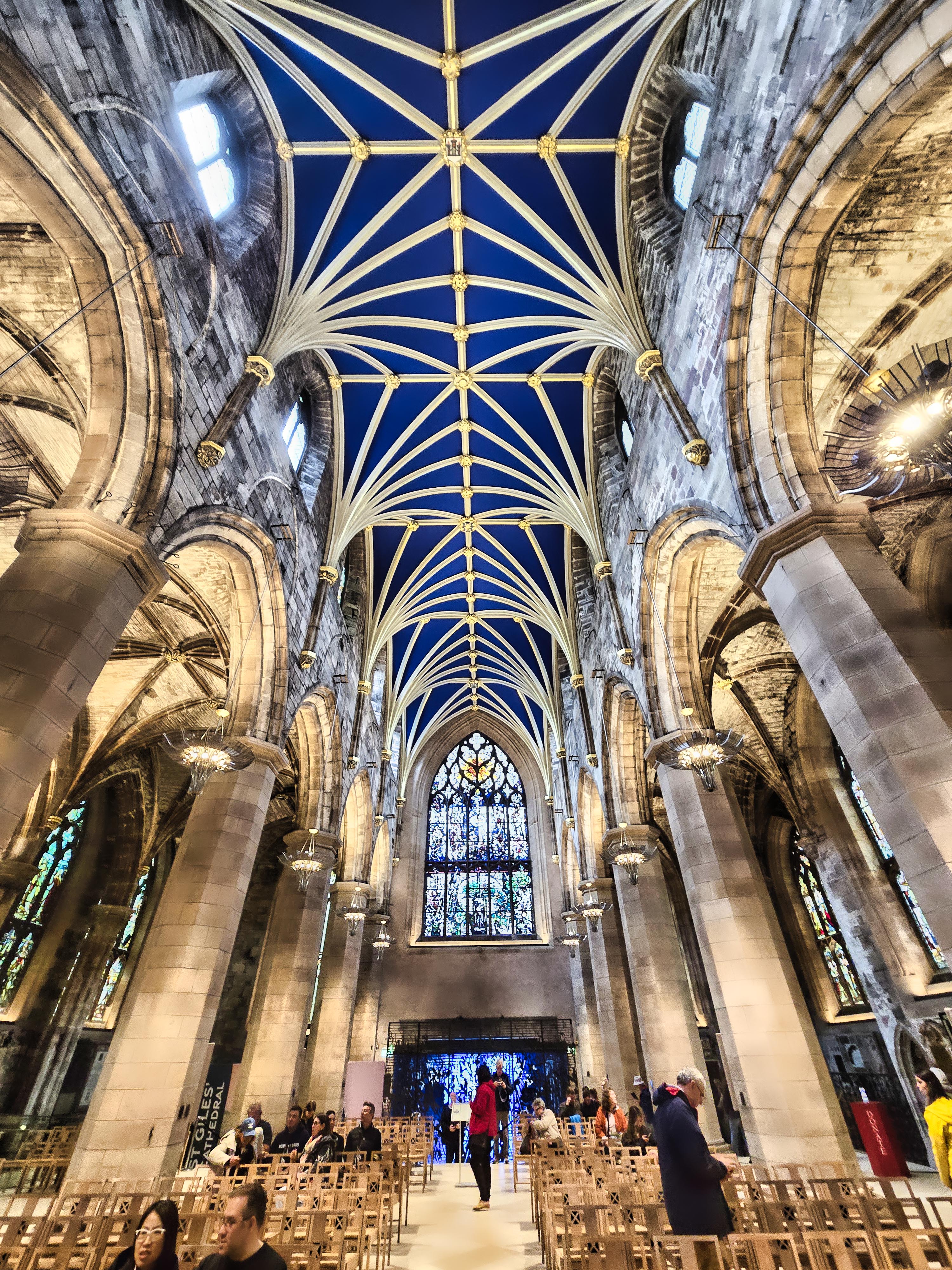
St. Giles Cathedral, Edinburgh

On our walk back to our hotel, we passed the Sir Walter Scott Monument, or the “gothic rocket ship” as our Outlander tour guide Henry dubbed it. I climbed the monument as a child and didn’t particularly feel the need to traverse more spiral staircases with my mending broken ankle now, so we appreciated it from the ground. Sir Walter’s statue in the middle of the tower sported another one of Edinburgh’s dogs, which sits by Sir Walter’s side. The dog, Maida, was a cross between a highland deerhound and a Pyrenean wolfdog.
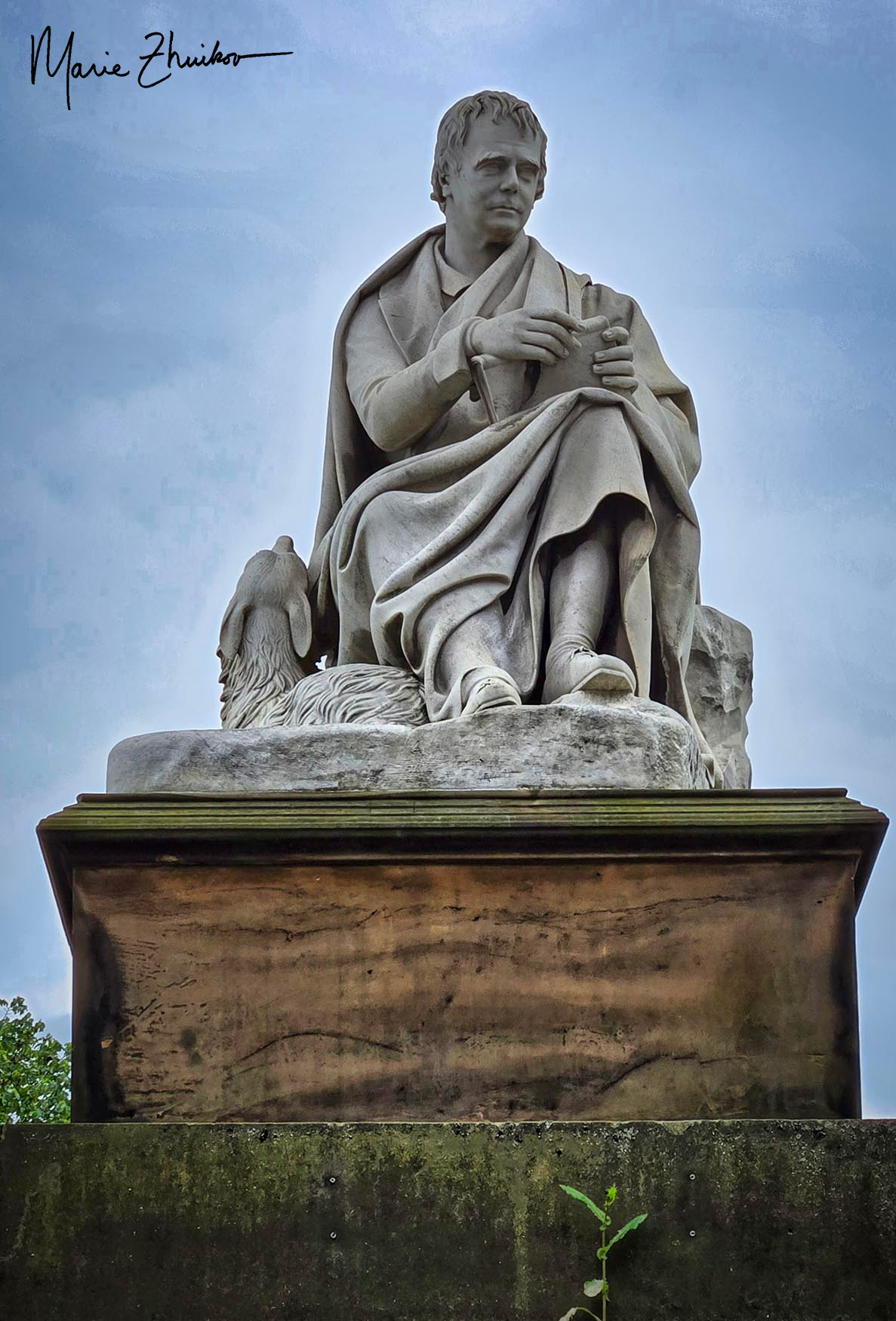
Sir Walter Scott and Maida

At the hotel, we got spiffed up for our final dinner in Scotland. We planned to go out in style! We had made reservations at The Rhubarb Restaurant, where rhubarb was first introduced to Scotland from Asia in the eighteenth century. Its garish yet fun interior reflects the plant: red velvet with green accents. So does its menu.
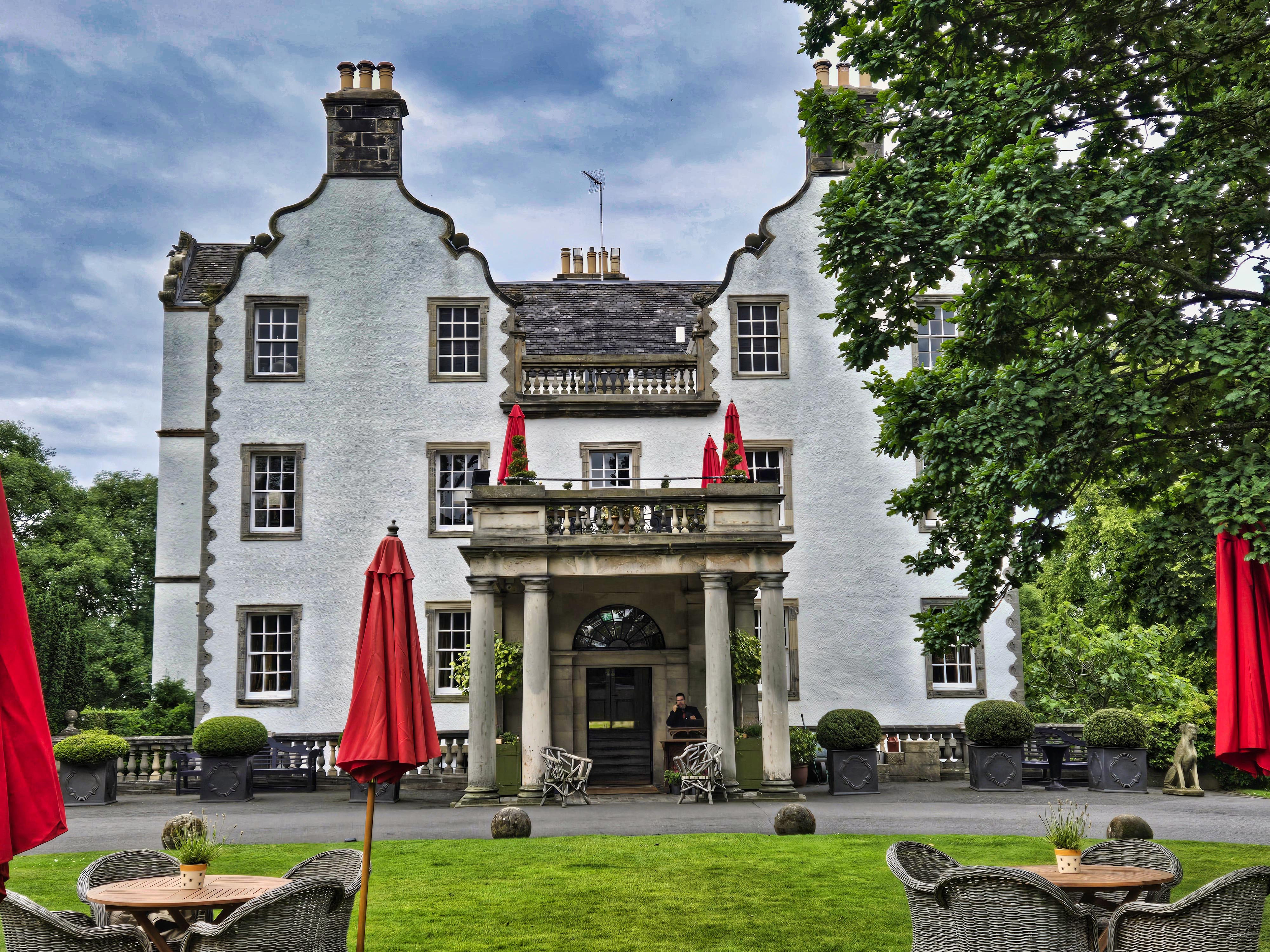
The Rhubarb Restaurant and Hotel

We caught a cab for a ride around the other side of Edinburgh Castle and Arthur’s Seat where the mansion and its large landholdings sit in the middle of the city. We had some time before our reservation and used it to explore the grounds and gardens. We were inordinately excited to see Highland cows (or coos) on the estate. We hadn’t seen any proper coos during our trip yet. There they were, lying underneath an impressive tree!
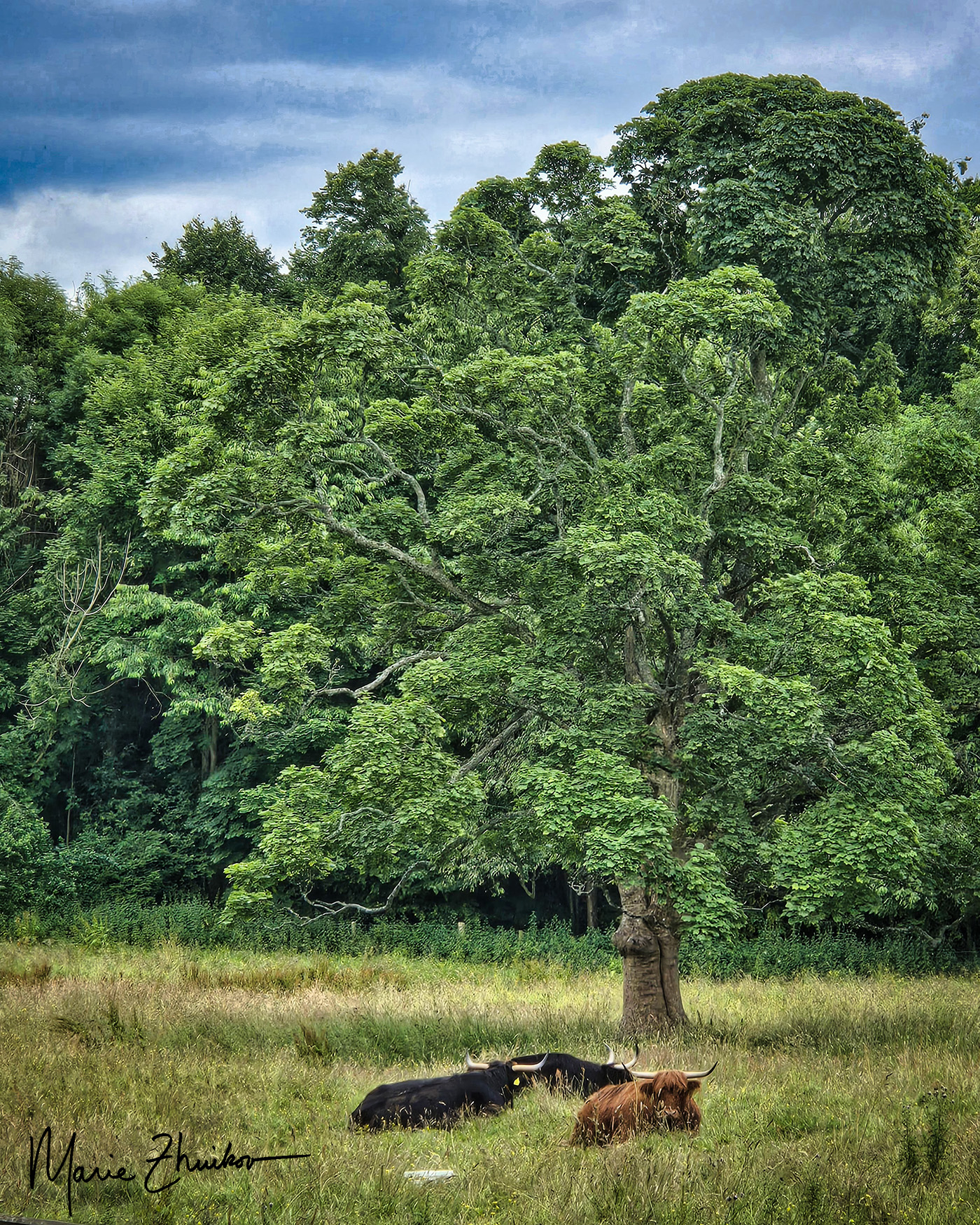
The coos! Rhubarb Restaurant Estate.

Inside, we were seated in a dining room (there are several) that offered a beautiful view of the grounds. I had a rhubarb-themed cocktail called the rhubarb patch. It had vermouth and rhubarb syrup — very good!
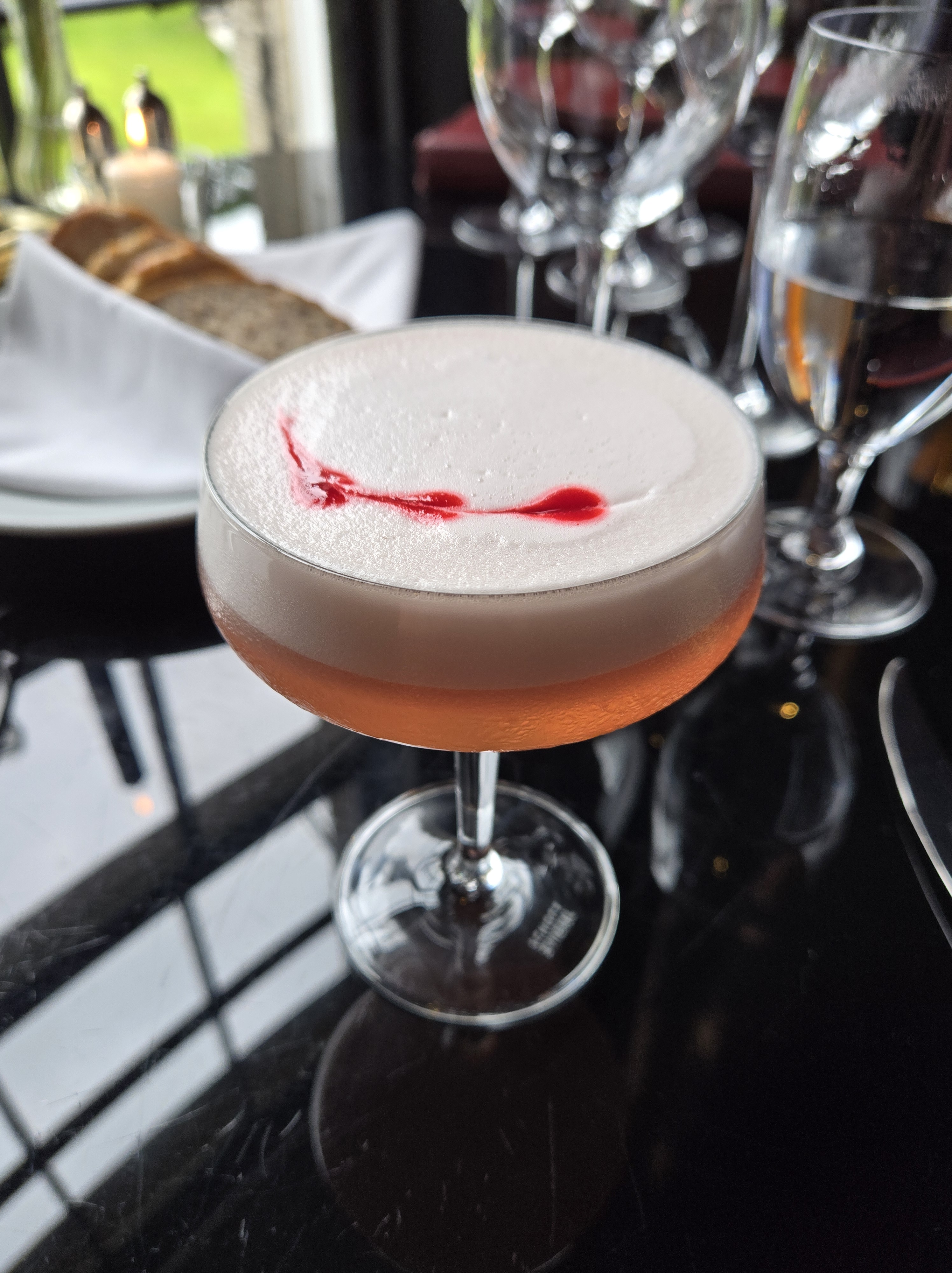
A rhubarb patch cocktail

For dinner, we shared a Châteaubriand Angus steak platter for two that was accompanied by potato purée, Lyonnaise potato with leek emulsion, crispy onions, braised red cabbage, honey-roasted pumpkin, beef dripping parsnips, a chicory and watercress salad, Béarnaise sauce, and Madeira jus. Oh man, the meat was so tender. As we ate, we watched a peacock strut outside and a cat scampering.

The view from our table. Note the peacock.

For dessert, Russ had a hazelnut banana ice cream concoction. I had tiramisu topped with a decorative chocolate square. Our dining experience was completed by a bagpiper who marched through the restaurant. I can’t think of a better way to top off our trip.
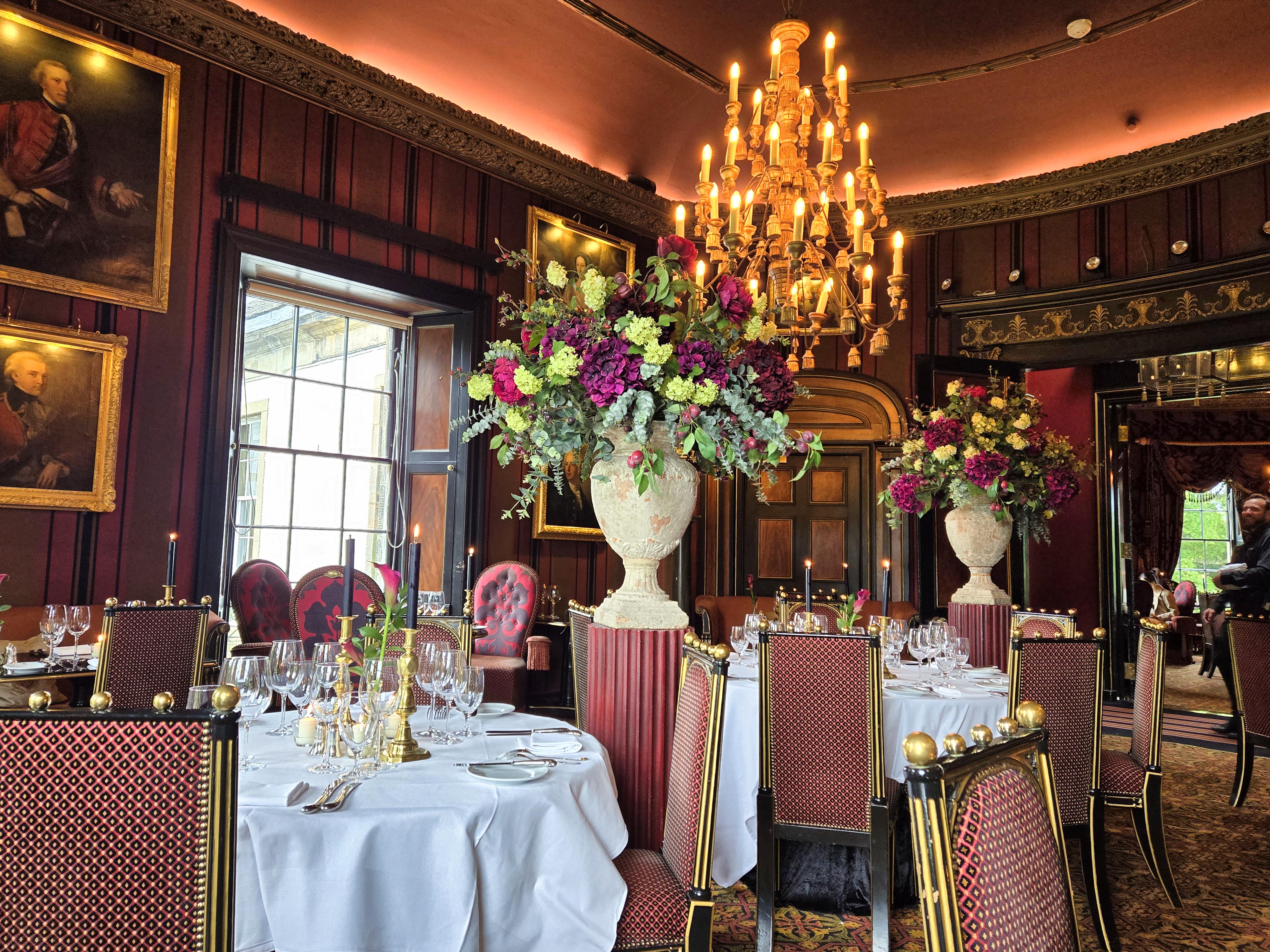
The Rhubarb Restaurant

The next day, however, we were slapped back into reality. Our plans were to fly to Dublin and then to Minneapolis. We made it to Dublin, but our plane arrived late from Edinburgh, and it took SO LONG to get through customs and security that we missed our flight to Minneapolis. When we arrived at the gate, they informed us we missed our flight by only two minutes! As it turned out, this was just as well because our baggage never even made it on the plane to Dublin because they didn’t have room for it.

Same as with our flights to Ireland at the beginning of this adventure, once again we were stranded without our baggage. But unlike that experience, this time the airline (Aer Lingus) put us up in a 4-star hotel and all our meals were paid for. It was a nice place, but it had a non-functioning toilet paper dispenser. How can a hotel get 4 stars with broken TP dispensers? I know, whine, whine. But we just wanted to get home! By now, we knew how to survive without a change of clothes or any toiletries. It really wasn’t that bad. What upset us was that due to this delay, we would miss our friends’ 50th wedding anniversary back home.
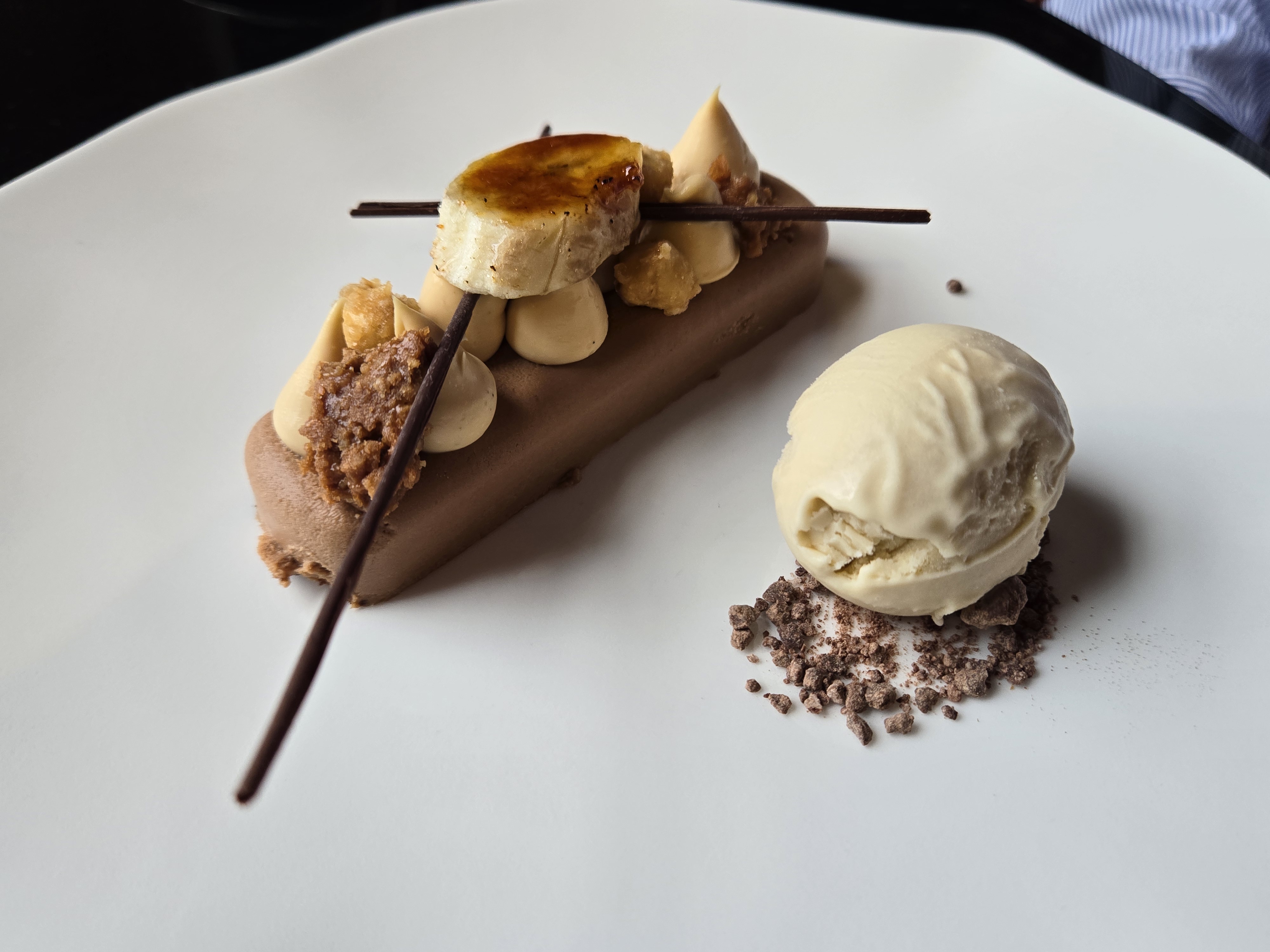
Russ’s hazelnut banana ice cream dessert, Rhubarb Restaurant

The next day at the airport, the lines for security and customs were EVEN LONGER (think hundreds of people) but we made it to our gate in time. Plus, once we landed in Minneapolis, our baggage was there, too!

So ends our nearly three-week excursion through Ireland and Scotland. Thanks for coming along on this epic ride. It’s taken me three months to write about everything. Reliving our adventures was so fun. Every time I wrote a post, I felt like I was right back in the experience. But my impatient mind already has ideas for six other topics I’d like to write posts about. I guess I’ll just have to keep blogging!

Despite setbacks, this trip opened our eyes to our pasts and gave Russ and I a stronger sense of where we come from. In Russ’s case, it’s a quaint hovel in the Irish countryside. In my case, it’s an imposing tower on a hill. It was truly a journey of discovery, and we feel so fortunate to have had these experiences.

I opened this series with a quote and I’m going to end with a favorite quote I discovered during our trip:

The world is full of magical things patiently waiting for our senses to become sharper. William Butler Yeats.

Keep your senses open, dear readers, and keep meandering!
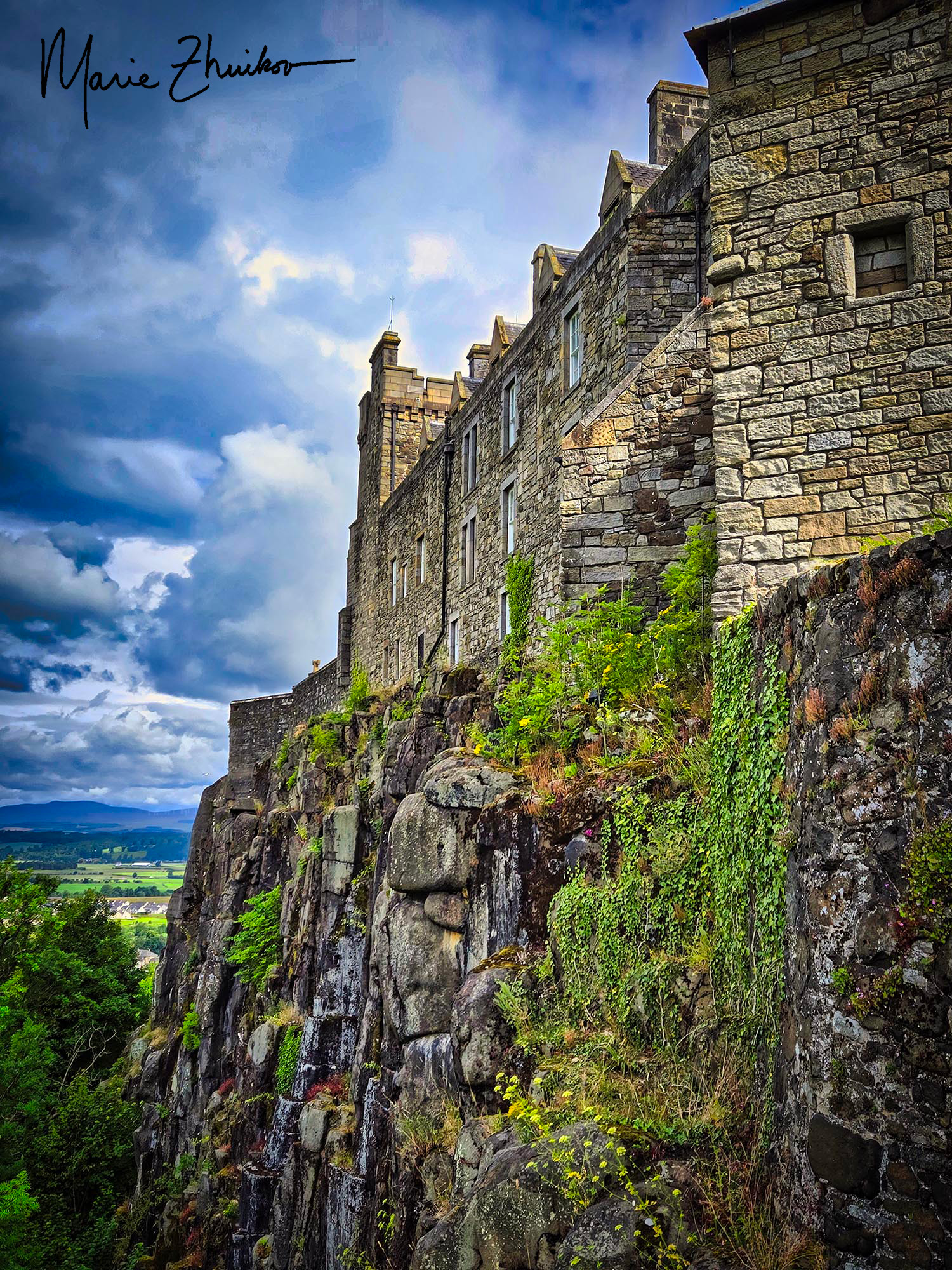
Stirling Castle, Scotland

Savannah, Georgia, and Sapelo Island

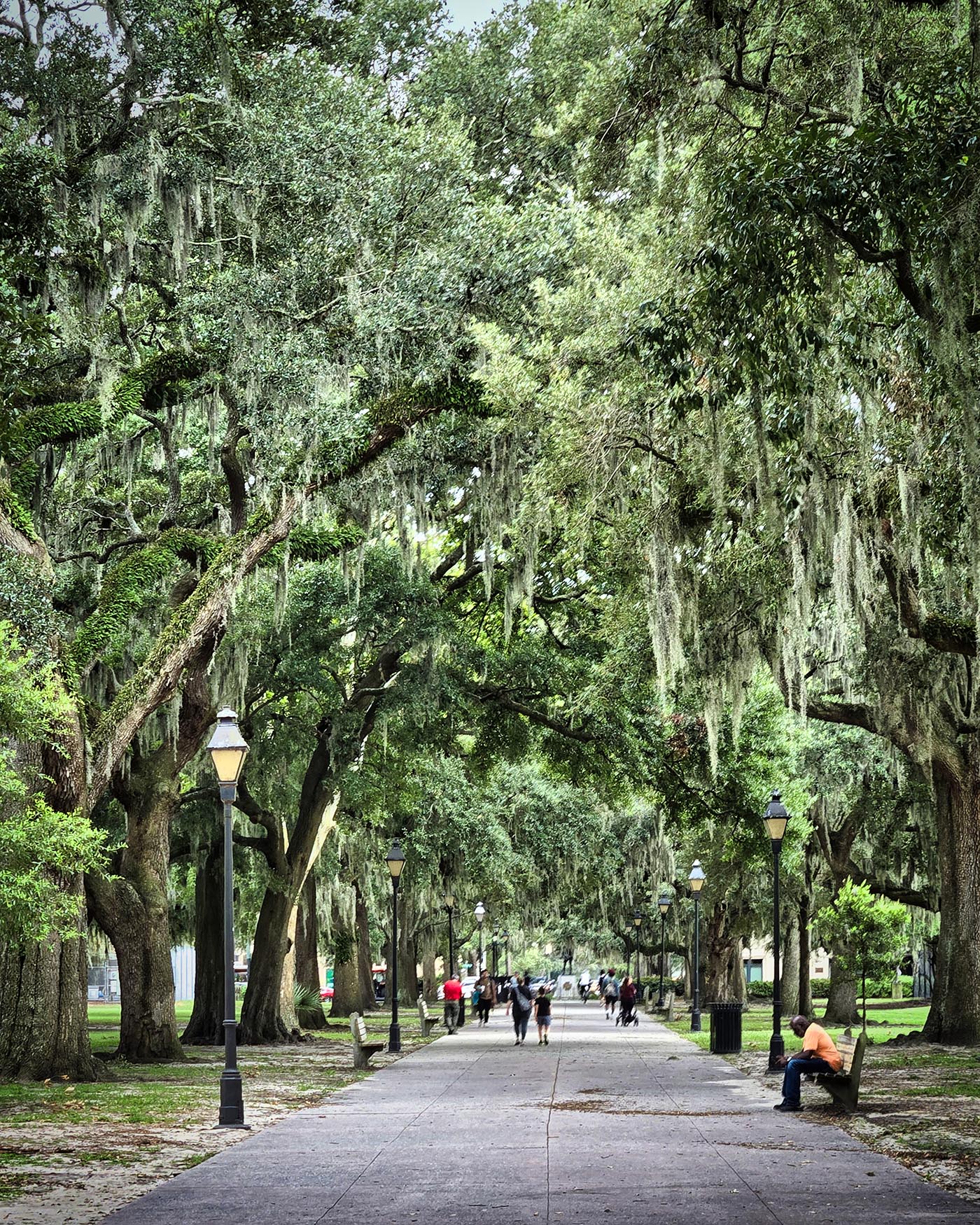
Forsyth Park, Savannah

I meandered down to Savannah for a work trip last month. I’d visited the city once before, but that was a long time ago, and I didn’t stay long. I must say I enjoyed spending four days in this southern gothic berg, even though most of the time I was in an air-conditioned hotel listening to presentations.

When I did get outdoors, I loved walking along the Savannah River down historic cobblestone streets. Live oaks draped with Spanish moss lined the route and historical sites seemed to emerge around every corner.

One morning, I managed to take a guided trolley tour around the city. It was one of those tours where you can hop on and off to explore the sights more closely. The trollies run every 20 minutes, which makes exploring very convenient. (Note: There are two trolley companies, so make sure you’re at the correct stop to board!)

I’d heard that Forsyth Park was picturesque, so I hopped off there and meandered around. The park offers wide sidewalks, those wonderful live oaks, and a large fountain. Near the fountain, a sidewalk trumpeter played a mellow tune. Even so, children walking by danced and hopped around to the music.

For the hungry, there’s a restaurant (Collins Quarter) in the park that offers takeout and sit-down dinners. People were lounging outside, dining under umbrellas on the patio of the Greek Revival building. I wasn’t hungry but didn’t want to pass up such a quaint place, so I ordered an iced spiced lavender mocha (decaf) from their takeout window. It was divine! The drink contained espresso, Condor chocolate, cinnamon, ginger, nutmeg, and lavender. I would rate it as one of the best mochas I’ve ever had. I sipped this purple cinnamon flower elixir as I walked to the trolley stop. It made the short wait more enjoyable.

The fountain in Forsyth Park.

Besides the mocha, another thing that impressed me about Savannah was the way they remember the different ethnic groups that helped found the city. About a tenth of the original settlers were Irish, so a Celtic cross stood in the park by my hotel. On the trolley ride, the driver pointed out a marker honoring Scottish Highlanders. Since I was just in Ireland and Scotland, this warmed the cockles of my heart and made me feel at home.

Once I was back near my hotel it was lunchtime. I decided to check out The Pirate’s House Restaurant. The building was first opened in 1753 as an inn for seafarers and then, as its website says, it “fast became a meeting place for pirates and sailors from the Seven Seas.” The building fell into disuse after World War II, but has been restored and is now considered a house museum.

I ordered the soup, salad, and sandwich, which featured she crab soup and a chicken salad croissant. Delish! As I ate, I realized that the building, with its uneven floors and clapboard siding, had a familiar feel – like I’d been there before. As I read about the restaurant’s history on my placemat, it struck me. I’d imagined this place while reading the book, “Treasure Island,” by Robert Louis Stevenson! Stevenson had visited Savannah and the house was thought to be his inspiration for the inn where Captain Flint died, uttering his last words: “Darby M’Graw, fetch aft the rum.”

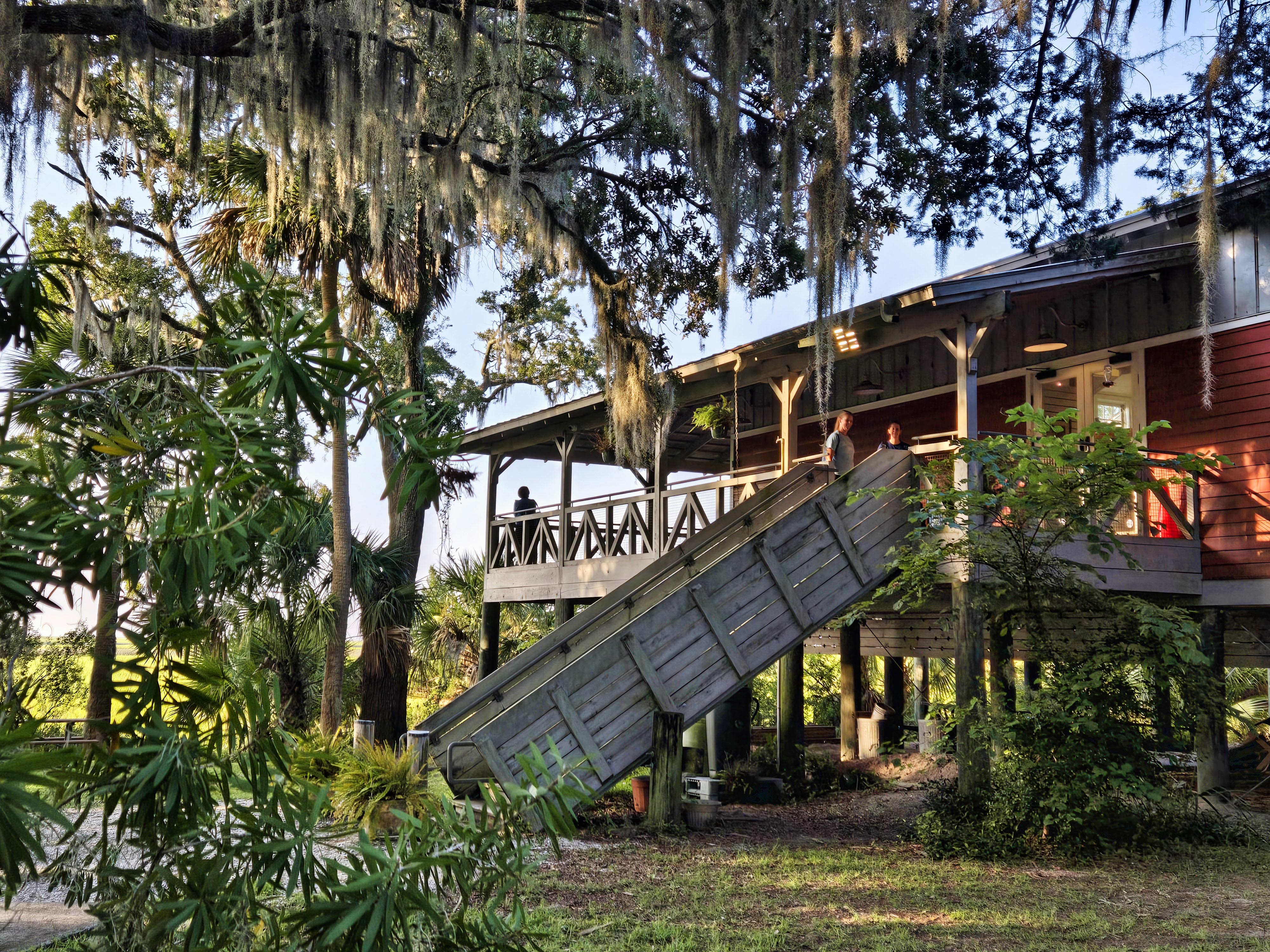
The Sapelo Island National Estuarine Research Reserve Visitor Center on the mainland.

The next day was field trip day for my conference. I had selected a trip to Sapelo Island off the Georgia coast. The island is a National Estuarine Research Reserve, part of the same national network dedicated to environmental research, education, and stewardship that the coworkers in my office back home work for. As you may recall, I’m an isleophile (I love islands!), so that, combined with the whole Reserve thing, is why I chose this particular field trip.

Not just anyone can visit the island. No roads lead to it—you have to take a ferry. Also, you need to be invited by the Reserve or one of the residents of the small island community of Hog Hammock. Many of the residents in Hog Hammock are Gullah—descendants of former slaves with their own unique culture.

Gullah ring shouters.

A few days earlier, our conference had kicked off with a stirring performance by Gullah ring shouters. They shuffled in a counterclockwise circle while singing, dancing, clapping, and stomping. Ring shouting is an African tradition that the slaves brought with them and is still part of the Gullah worship services. Hog Hammock is one of the last remaining Gullah communities in the U.S., and is under threat due to land development and zoning.

We boarded the ferry and traveled through the salt marshes to the island, where a flock of terns greeted us, sitting on the dock railings. Our first stop was the Reserve office where one of their naturalists oriented us to the island. Then we traipsed outdoors for a service project. The thirty of us weeded a native plant garden and transplanted live oaks into larger pots. The oaks were being grown to help rehab a former airstrip on the island. The island used to be owned by tobacco magnate, R. J. Reynolds. He built a mansion there (which sports a bowling alley and tennis courts and is now available for rent to large groups), a dairy barn and outbuildings. He wanted his compound on the island to be self-sufficient.

After the trees were all transplanted, we headed to the dock to collect some tiny salt marsh critters to bring back to the office lab and look at under microscopes. We found crabs, small fish, and barnacles.

A beach on Sapelo Island. I loved how natural it was.

After eating lunch under a shelter at the beach, our next stop was the University of Georgia Marine Research Institute. After Reynolds died, his widow donated the dairy barn compound to the university for that purpose. Students spend the summer on the island conducting research projects, and we saw several in progress.

The marine research institute on Sapelo Island.

A film screening studio is one surprising thing that Mr. Reynolds built into the dairy barn. Apparently, he had many friends in Hollywood who would fly out to the island to screen movies. He even had two extra-wide chairs built to accommodate his heftier movie mogul friends. We sat in the room and watched a movie about the research institute. But I must admit I was distracted by wondering if any famous movies were screened in that remote barn.

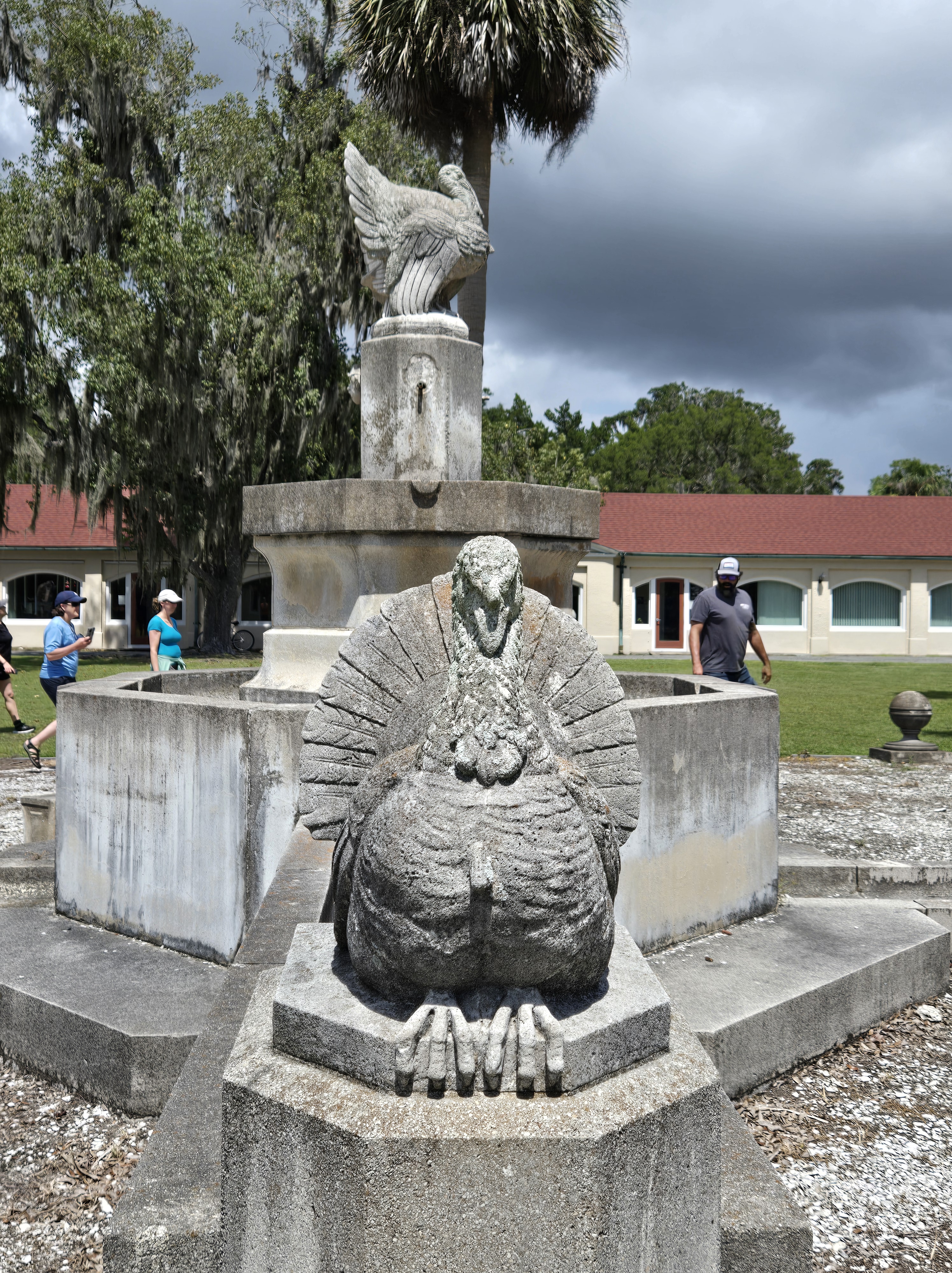
The turkey fountain on Sapelo Island.

Another surprising decorative feature at the institute was an outdoor fountain that features cement turkeys. Yes, you heard me, turkeys. Why? Conflicting stories abound. Some say it was R. J. Reynold’s idea. Others say it was his wife’s idea. It’s certainly not something you see every day, especially at a marine institute. When I first noticed the fountain from a distance, I assumed the turkeys, with their fanned-out tails, were large scallops or oysters. Huh.

Our last stop was the Sapelo Island Light Station. But on our way, we drove through Hog Hammock and were able to see where the ring shouter performers lived. The homes are very modest but some Gullah are selling their land to mainlanders who want to build larger homes, which would drive up property taxes.

The lighthouse is a red and white striped affair that rises 80 feet into the saltmarsh air. A tiny museum in a building alongside it offers bits of history and memorabilia. Others on our tour climbed the tower for the view from the top. I opted out. This northern lady was pretty sapped by the southern heat by then. Climbing a spiral staircase in a tower without air conditioning just didn’t appeal to me at that point.

Sapelo Island Light Station.

Then it was back to the ferry for us and a long bus ride back to Savannah. I felt privileged to have the opportunity for this special trip to the island and to learn more about Georgia’s environment and culture. It was fun to give back a bit, too, by transplanting those baby live oaks.

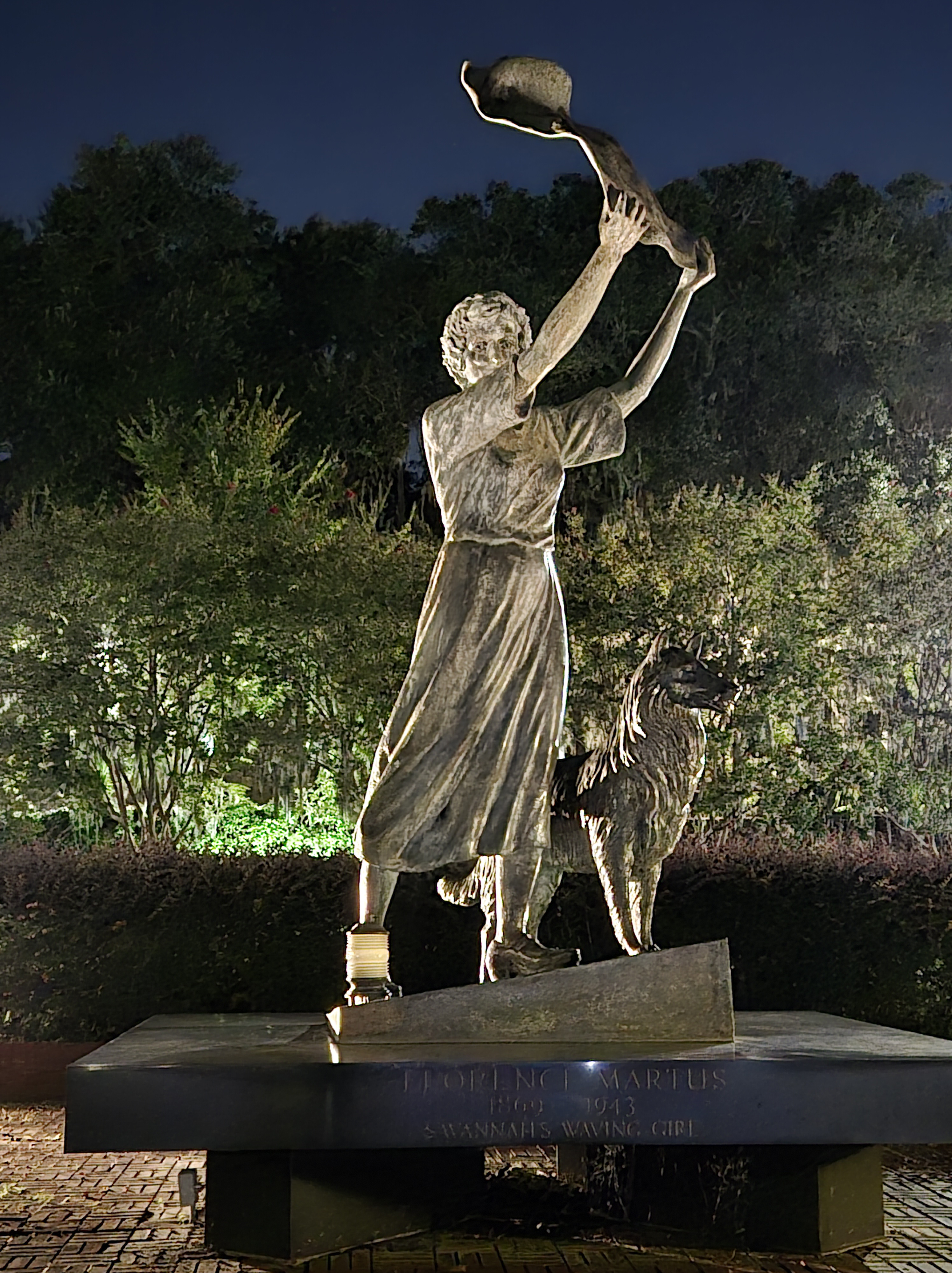
Savannah’s “Waving Girl” statue at night, waving hello (or is it goodbye?) to my blog readers and ships that pass on the Savannah River.