Scotland Days 7 & 8: Edinburgh Castle and Broomhall House

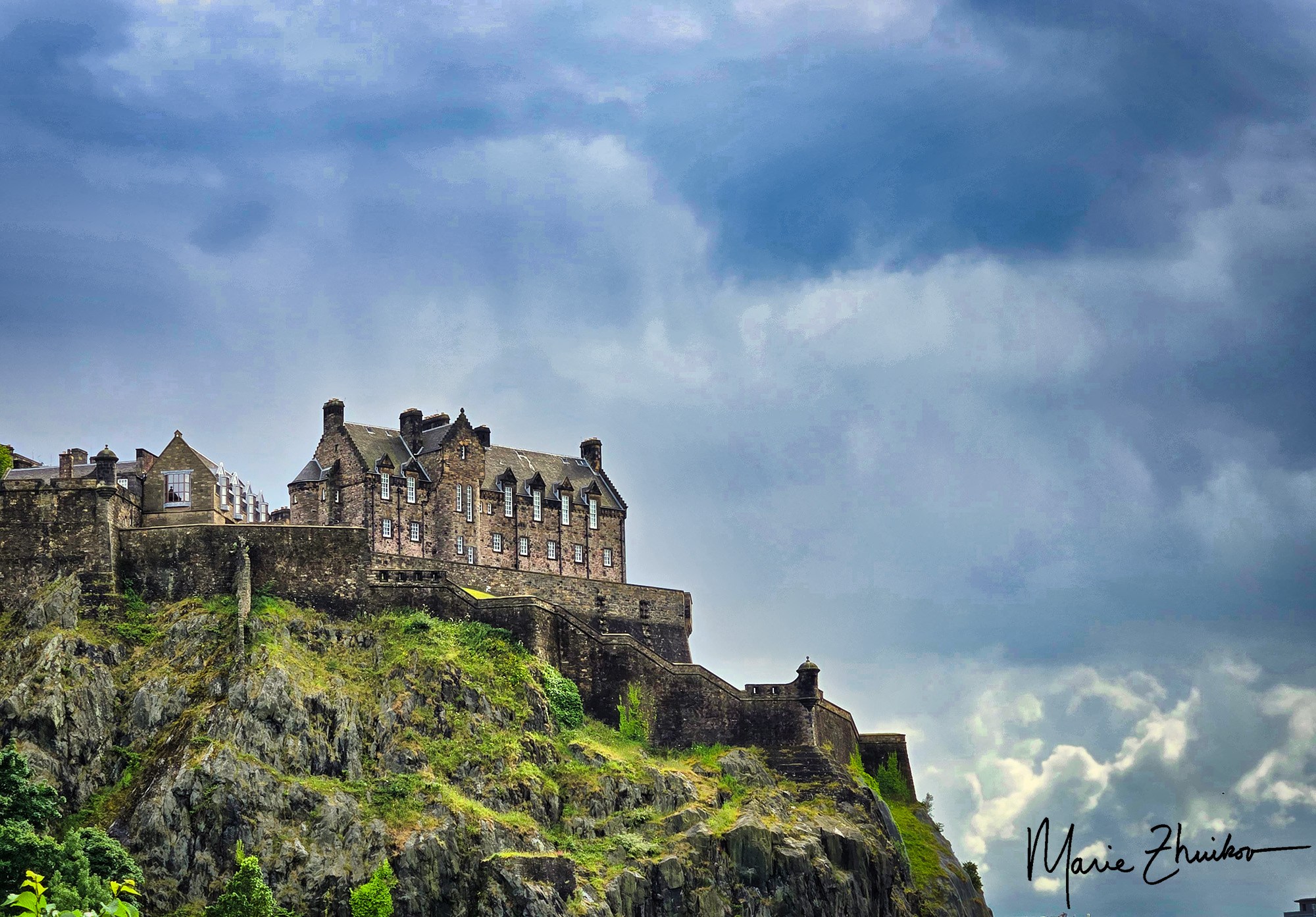
The Royal Scots Greys Monument with Edinburgh Castle in the background.

In my previous post, Russ and I returned to Edinburgh, mystified and a bit sad after a failed attempt to tour Broomhall House, current home of the Family of Bruce, which we’d been planning for months.

We spent the next day in Edinburgh, seeing the sights including the Scottish National Gallery, which offered several floors of exquisite Scottish and international art from the Renaissance to the beginning of the 20th century. The building looks like an ancient Greek temple and was meant as a “temple to the arts.”
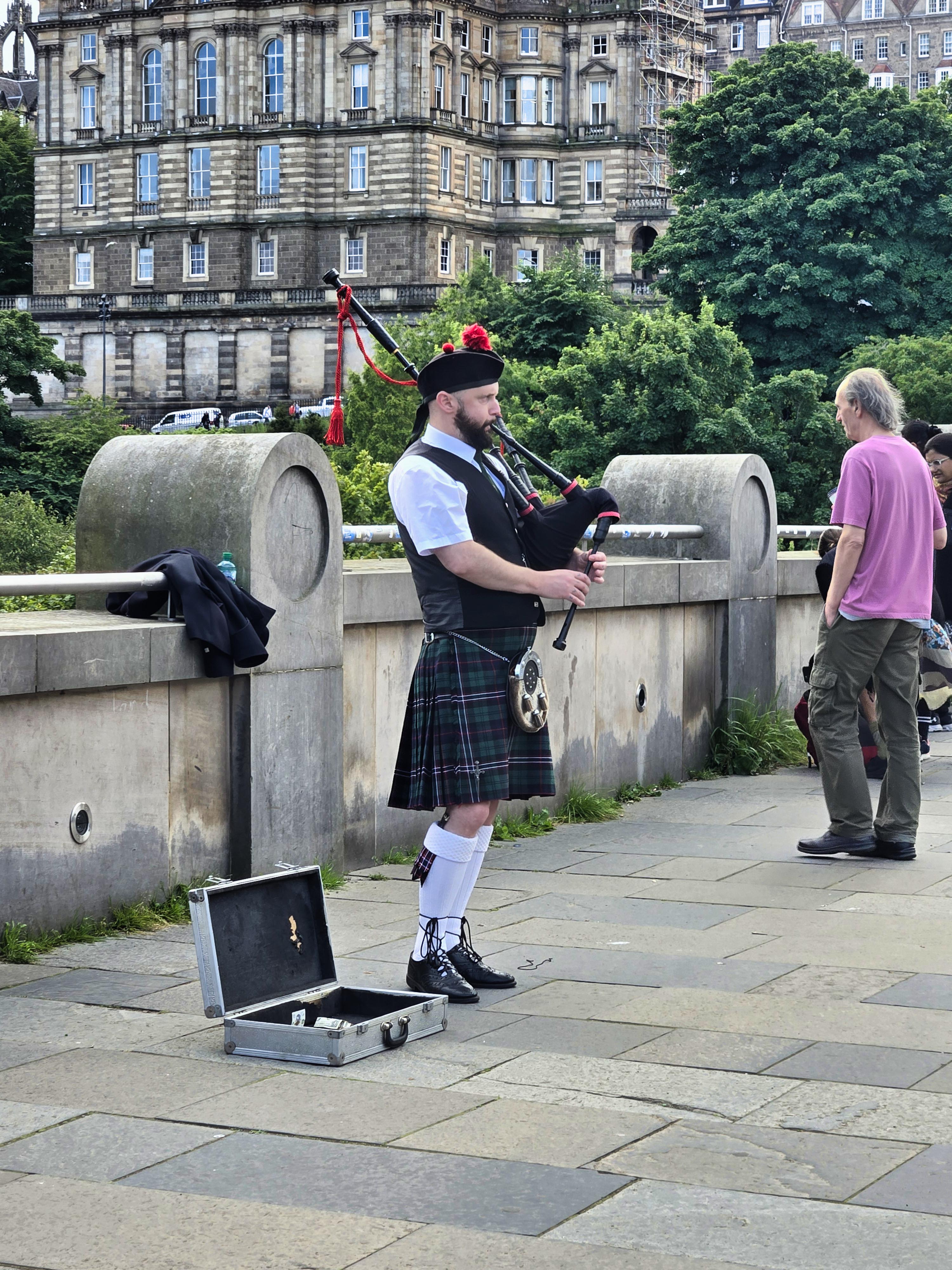
A street piper outside the Scottish National Gallery.

As we walked back to our hotel, we got a happy text from Tartan Viking Tours that our Broomhall tour was rescheduled for tomorrow! We ate lunch next door to our hotel, at Whighams Wine Cellars. I was excited to see they had Cullen skink soup on their menu. It was very good! We ended up eating two more meals there since the food was so good and the prices reasonable. In the afternoon, we meandered about a mile up the hill to Edinburgh Castle. We were an hour early for our reserved tour, so we wandered down the Royal Mile (along with thousands of other people) and shopped.

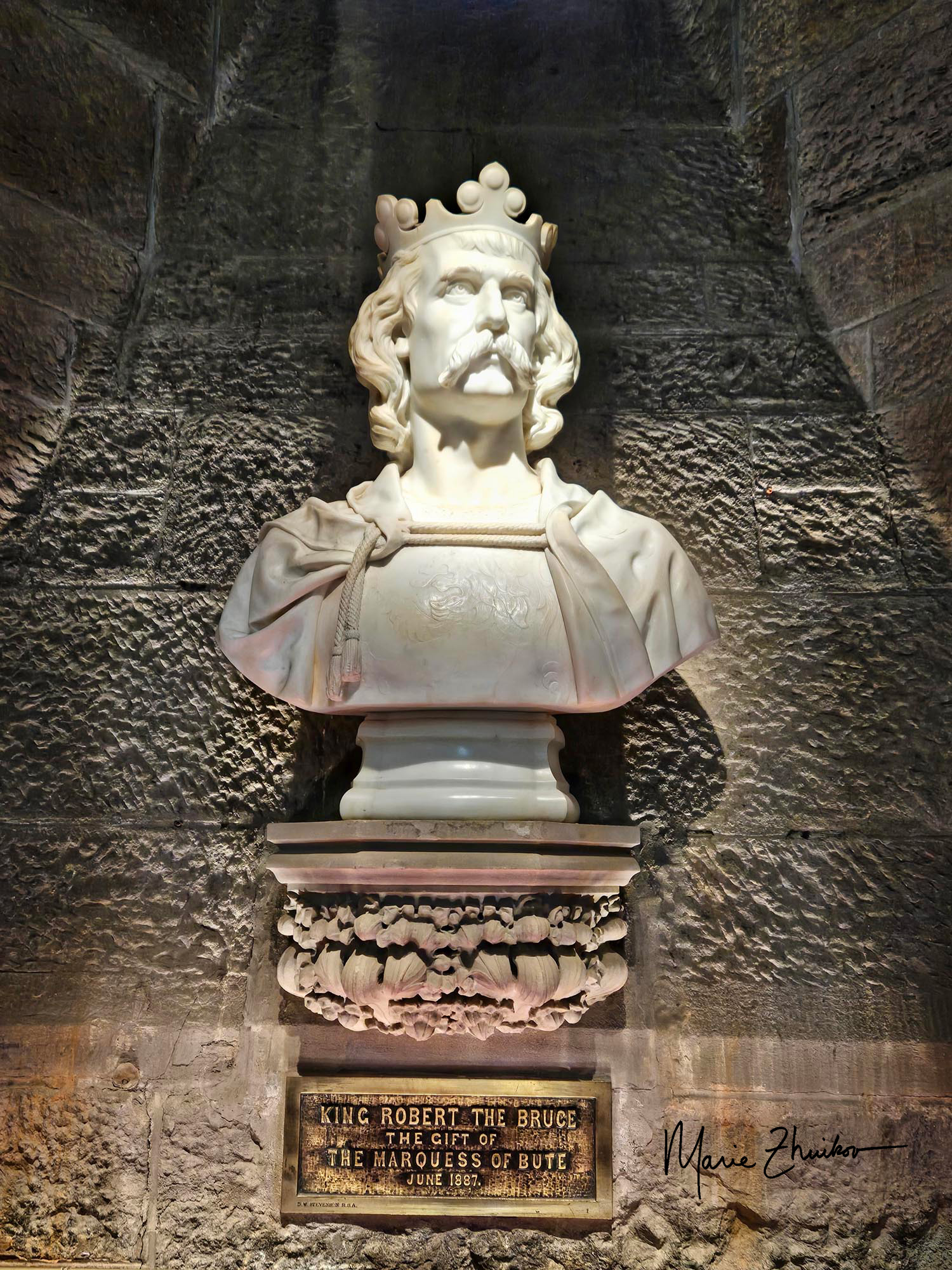
When it was finally tour time, great-grandfather to the 21st power, Robert the Bruce, greeted us in statue form as we crossed the drawbridge. (William Wallace is on the other side.) It’s crazy to think The Bruce strode some of the same walkways that we were now treading. Later, inside, we saw the ruins of a tower built by his son David. They were crumbling away underneath another building that had been constructed atop it. Stones may crumble, but the bloodline lives on in me and so many other people. I’ve seen estimates that 200 million people are related to Robert the Bruce. (BTW, I just sent off a DNA test kit so that I can confirm, or not, this relationship. The current info I have comes from some cousins.)

The Robert the Bruce statue at Edinburgh Castle.

The castle is built on an impressive volcanic plug, but I found the castle itself – especially the royal quarters – not that impressive when compared to Stirling Castle. The Great Hall was cool, though, with its huge fireplace, oak paneling and suits of armor. I was also a bit let down by the crown jewels. From the long line of people waiting to see them, I guess I expected something more than just a crown, scepter, and sword. They wouldn’t let us take photos, but thanks to the castle’s blog, I have one to share with you.
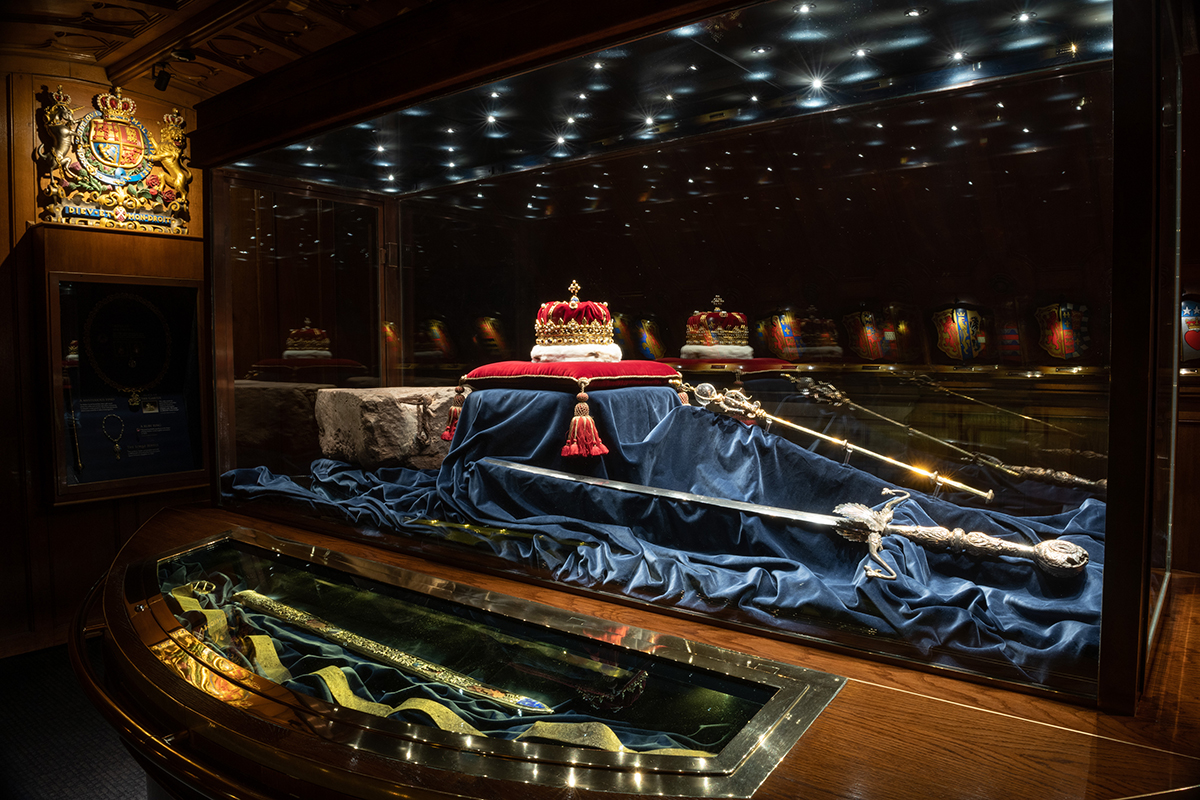
Edinburgh Castle Crown Jewels Room. Image courtesy of Honours of Scotland.

I wondered if part of the reason the castle wasn’t “all that” was because it was yet another casualty of Robert the Bruce’s campaign to destroy castles so that the English couldn’t use them later. (Read more about that on the castle blog here.)

Tour over, we shopped some more on the Royal Mile and returned to our hotel. That was enough for me for the day. I had developed a bad cold or allergies was feeling under the weather. However, the actual weather this day was the best yet – no rain for once!

The beginning of the Royal Mile outside of Edinburgh Castle.

Day 8 in Scotland found Russ and I with our kilted tour guide Calum on the way to Broomhall House. Our tour was finally going to happen!!
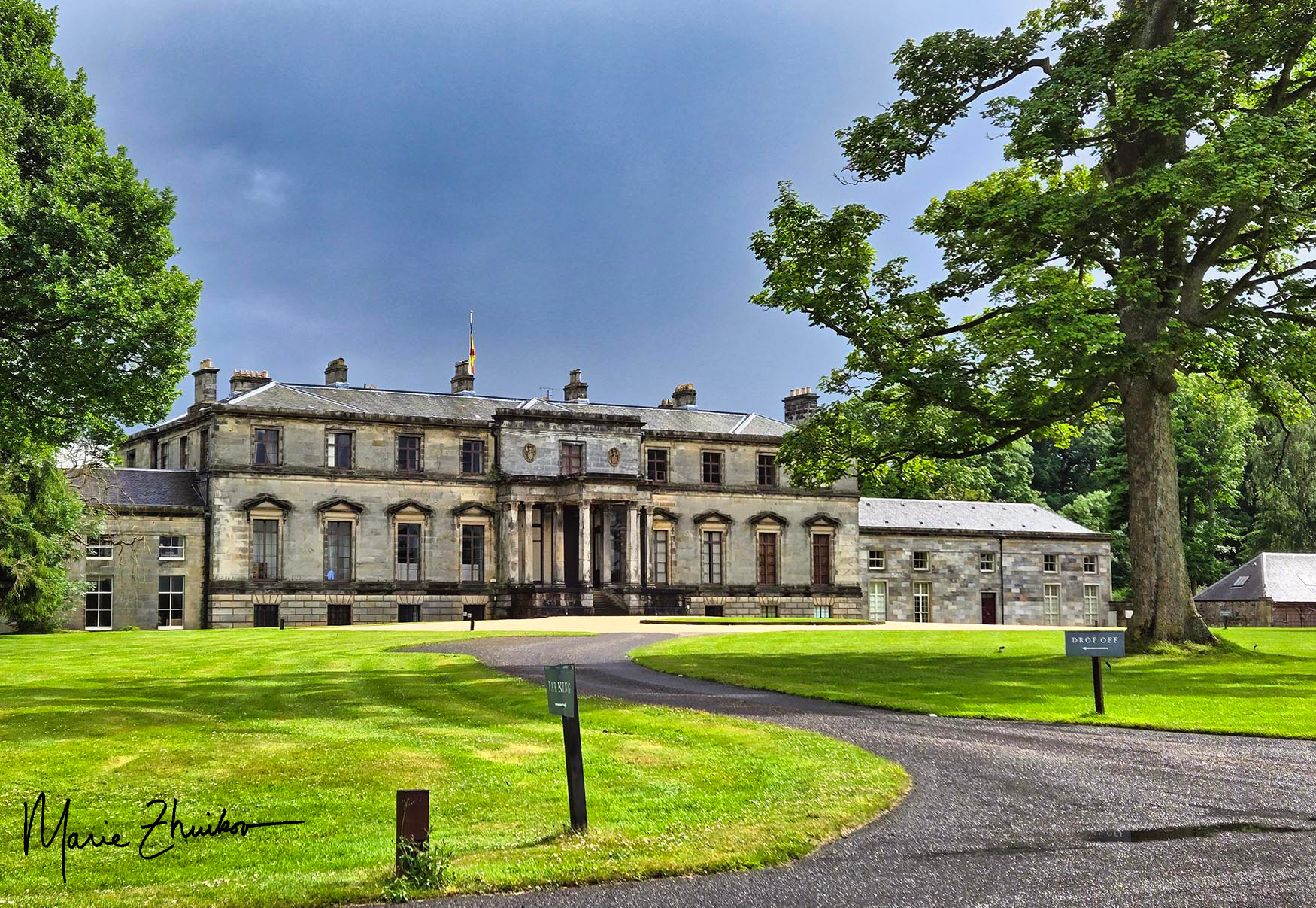
Broomhall House

Distant cousin Charles Bruce met us at the door. My first impression was that he must have an awesome skin care routine. His face positively glowed! After exchanging greetings, Calum said he was going to depart now. I looked at him, surprised. We had talked earlier about whether he’d be able to do the tour with us. He said he wanted to, as long as I was okay with it and Charles was okay with it. I was astute enough to notice that although Calum’s mouth was saying one thing, his eyes were pleading to let him stay. I said something like nonsense, we were fine with having Calum along for the tour as long as it was okay with Charles. Charles gave his permission and then led us through a room containing replicas of the “Elgin Marbles.” These are historic marble statues collected by a previous Lord Elgin (the 7th) from the Parthenon in Greece. In recent years, they caused quite a stir at being in the hands of the family, so they donated them to the British Museum in London.
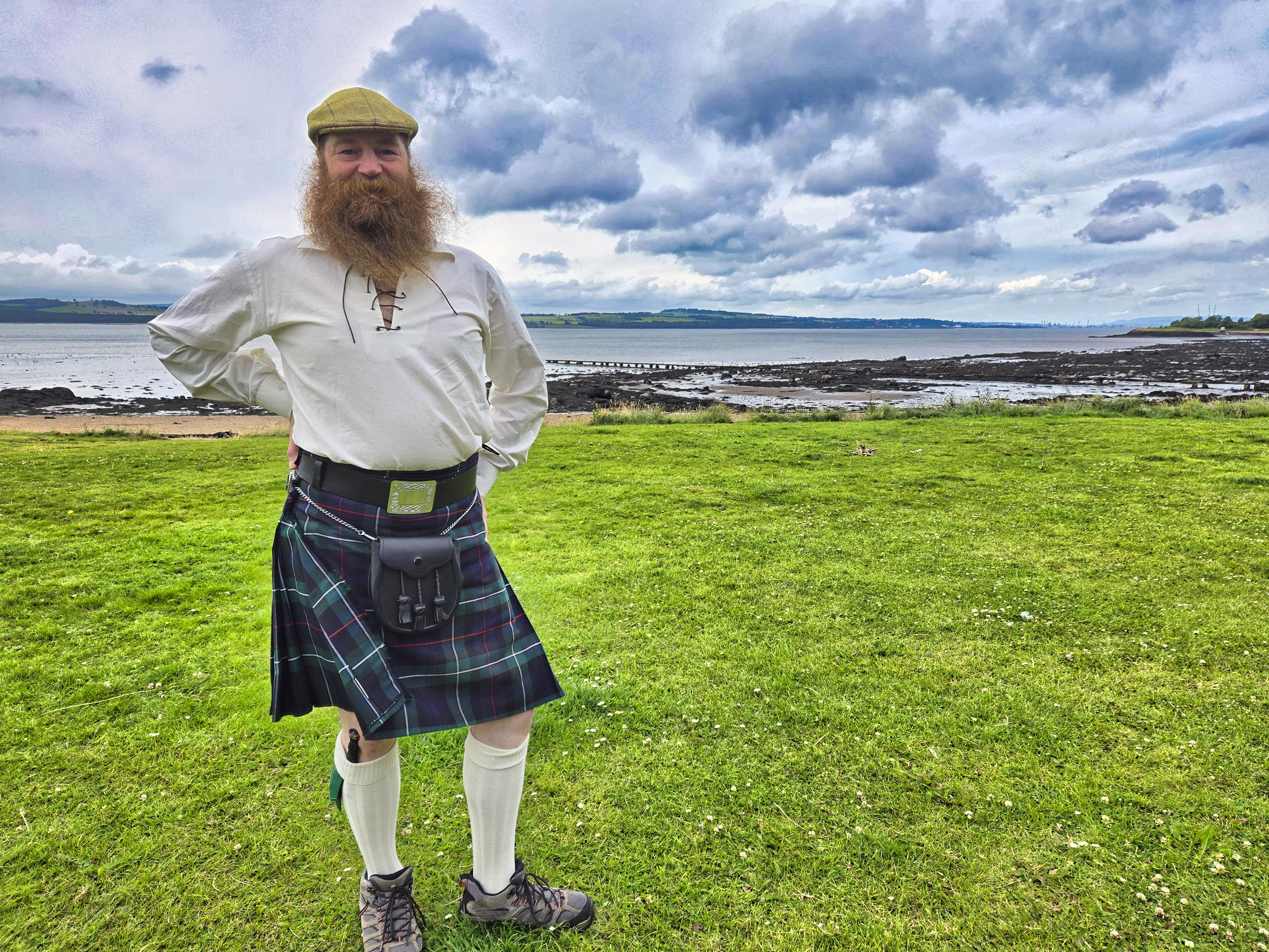
Calum, our Tartan Viking Tour guide, in Limekiln.

We settled in the library and Charles poured us some tea. He asked a bit about my ancestral background and then began a lecture about Andrew Carnegie, the Scottish-American industrialist and philanthropist who was born nearby in Dunfermline. He showed us a ledger book that contained an IOU to the Bruce Family from the Carnegie Family. It’s not known whether this debt was ever paid since the Carnegies moved to America later. But Charles was rather tickled to think that a family destined to become one of the richest in America had been in debt to his family.
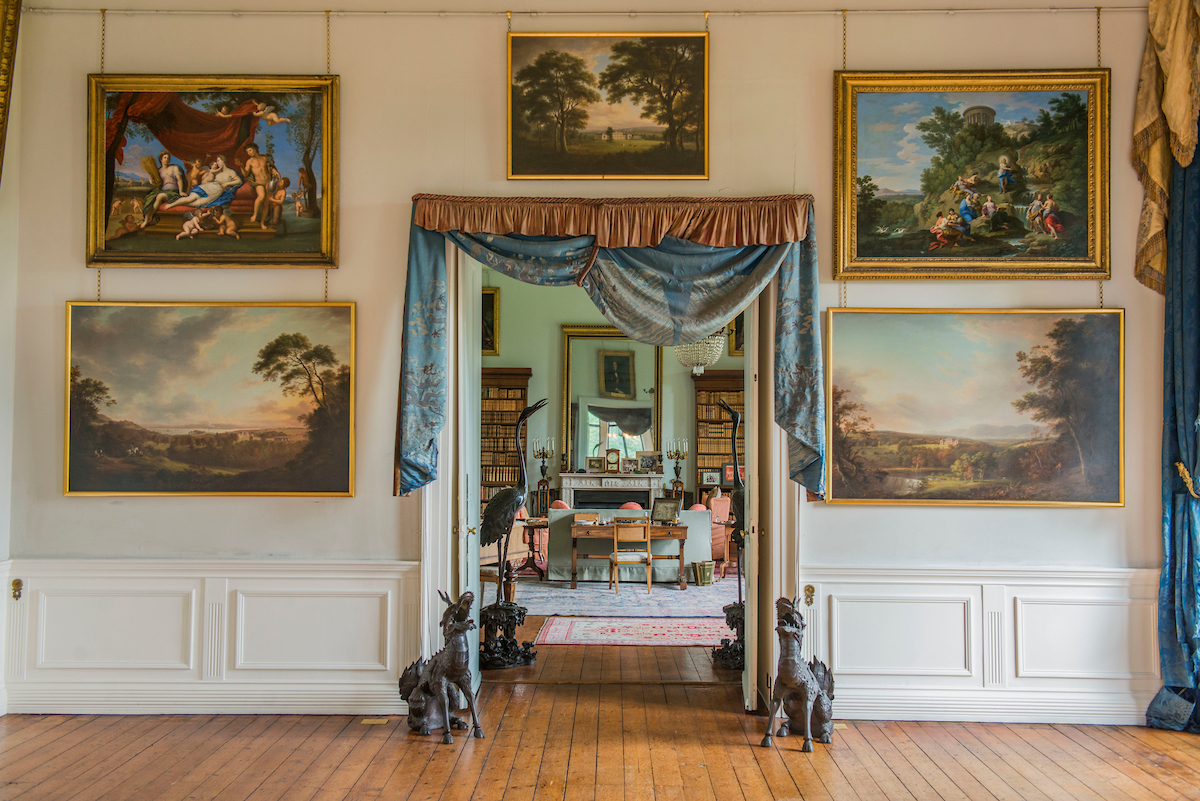
View from the Music Room into the Library. Image courtesy of Broomhall House.

As we discussed the books in the library, Charles off-handedly mentioned they had a first edition copy of “Waverly” by Sir Walter Scott. Later, I asked if I could see it. He couldn’t find it, but he did find a third edition of “Rob Roy.”

At one point, he opened a book that contained an old map. Me, with my cold and my dust allergies, immediately began a mortifying coughing fit. Charles, the dear man, ran out of the room to find me some water. In the meantime, I thought to pour myself more tea. By the time he returned, my fit had subsided, thankfully.

The Music Room in Broomhall. Image courtesy of Broomhall House.

Our next stop was the Music Room, which contained the original plans for Broomhall House. It was originally supposed to have marble columns on the front, but the family ran out of funds by that point. The columns, which were already cut, were added to a different building elsewhere. Charles also talked about the nearby town of Limekiln and how the citizens there made the best mortar (plaster) for building. It’s the same mortar that was used by the Scottish builders who worked on the White House in the U.S. Limekiln no longer has a lime works, but a nearby town does.
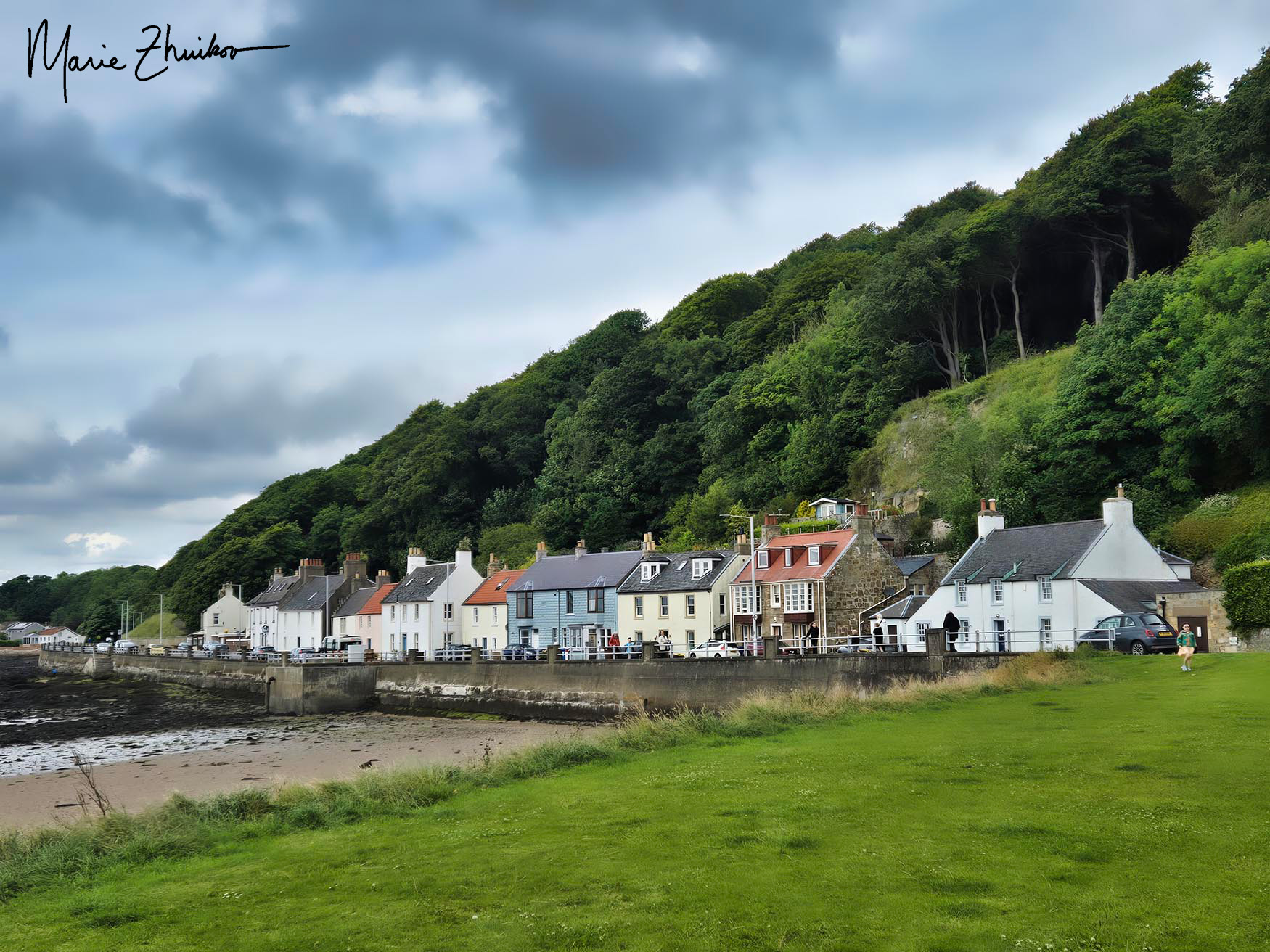
Limekiln, Scotland. Home of the mortar that holds the U.S. White House together!

On our way into the dining room, we passed a lighted cabinet that contained one of the plaster casts of Robert the Bruce’s skull and his claymore sword, which has been passed down in the family through the generations. I felt compelled to stand in front of it for a few moments and pay my respects.

The dining room sported a long table that Charles said was given as a wedding present. Family members each bought a chair that line the table, and he said they are very uncomfortable! There was also an impressive Delft tile fireplace with a mantle made from a bed that Queen Anne of Denmark slept in. Charles said his grandfather found the bed in pieces in an antique shop. There weren’t enough pieces to make it back into a bed, so he had them crafted into the mantle instead.

The Broomhall Dining Room and fireplace, decorated for the holidays. Image courtesy of Broomhall House.

On the table were many silver pieces, some oriental-looking. One of Charles’s ancestors was ambassador to Turkey and perhaps picked them up in his travels. The dining room also sported a painting of Catherine Bruce of Clackmannan. She was the last Bruce to live at the mansion and tower in Clackmannan and was a memorable character. She and her husband were Jacobites. She is known for unofficially knighting poet Robert Burns with the very sword I saw in the cabinet. She also has a contra dancing reel named after her.

Catherine Bruce of Clackmannan, the painting that hangs in Broomhall House. Image courtesy of Wikipedia.

Our last stop was a room that had a large, tattered Union Jack flag hanging from the ceiling. Charles said the flag had been flying at the house in the 1940s when three Nazi planes attacked. Charles’s father was ushered to the basement, but his grandfather grabbed a gun and went outside to shoot the planes! Later, at least one of the planes was shot down and it contained some bullet holes that might have been made by his grandfather. Charles showed us newspaper accounts of the adventure.

Our tour was only supposed to last for two hours but a fast 2-1/2 hours had gone past. As we began parting words, I thought to grab my genealogy list from my purse. I asked Charles if we could figure out where our lines diverged. He led me to a large book that contained a family chart. As near as I could tell with a quick look, our paths diverged after the 6th Baron of Clackmannan, David Bruce, in the late 1400s, which was about 15 generations ago.

Charles said he’d never had anyone come so prepared to discuss genealogy before. I was excited to see that the information Charles had gibed with what I had. I just laughed at his comment but inside I was thinking, “You have no idea!” I was glad for the time that my broken ankle gave me to bone up on the family tree. (Ha ha.) By now, my ankle had healed enough that I didn’t need to use hiking pole anymore. I was glad I didn’t have that thing clunking around in this fine home.

Charles gave me permission to blog about our visit; however, the Bruces don’t allow photos to be taken in the house. The ones accompanying this post are from the Broomhall website. We did take some shots of all of us on the steps of the house, thanks to Calum. I was tickled to notice that both Russ and Charles were wearing the same seersucker shirt.

Me, Charles and Russ after our tour.

I was so happy the tour came to pass. It truly was a once-in-a-lifetime thing. As Calum later commented, “That was posh!” And it was worth every penny and all the angst. In fact, the angst made me appreciate it even more.

Next up: An Outlander Tour.
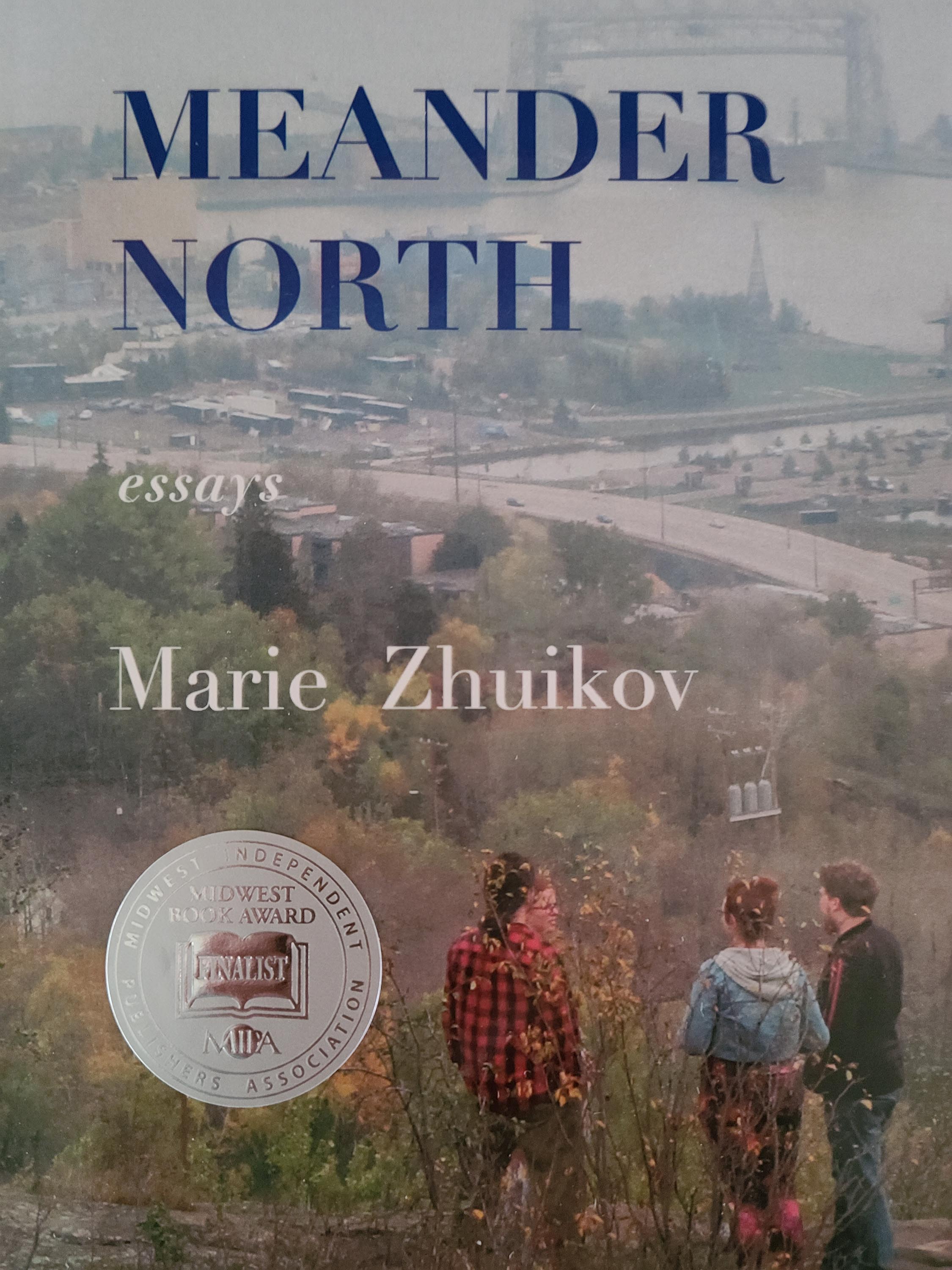
If you enjoy my blog, you’ll love my book! Meander North showcases 51 of the best stories from this blog about my quirky life in northern Minnesota and my writerly pursuits. It earned a silver Midwest Book Award for nature writing and was published by Nodin Press in Minneapolis. It is available for $19.95 through their distributor at this link.

Scotland Days 5 & 6: Edinburgh and Robert the Bruce

A cute train planter at the Huntly train station.

We departed the village of Gardenstown in a drizzle, boarding a bus for Banff with water squishing out of our shoes. In Banff, we caught a cab to the train station in Huntly. We had learned from our lesson the previous day and booked the cab in advance. The train arrived on time. We spent the relaxing ride reading and playing cards.

Schlepping my suitcase around while using a hiking pole for my broken ankle wasn’t easy, but my ankle, despite its deep purple, green, and sickly yellow hues, was no longer swollen and it felt pretty good. About five hours later, we arrived in Edinburgh.

The Angel’s Share Hotel, Edinburgh

Our destination for the next six nights was the Angel’s Share Hotel. I chose it because it was only six blocks away from the station (so we could walk there) and because I liked the name. If you’re a whisky drinker, you probably know that it’s named for the small amount of whisky that evaporates while it ages in a cask. It’s thought that the angels drink it, and thus get their share. The hotel’s bar and restaurant offer a wide range of whiskies and each room features large images of famous Scots. The singer Lulu Kennedy-Cairns graced our room. She’s best known for her song, “To Sir, With Love.” She looks like Olivia Newton-John.

After settling in our room, we popped down to the restaurant for a meal. The restaurant and bar are combined. The place was packed, and a soccer game was on (England vs. Sweden), plus a birthday or two were being celebrated. The decibel level was high! We assumed the crowd would be rooting for England, since it is geographically closer to Scotland, but they seemed to be cheering Sweden. I guess that even when it comes to sports, old grudges and rivalries die hard in Scotland.

Edinburgh Castle as seen during our walk from the train station.

Staying at the Angel’s Share ended up being a superb experience. It’s in a great location for walking to Edinburgh Castle, the Royale Mile, and many, many wonderful restaurants. We ate at a different place almost every day and never had a bad meal. Most were only a few blocks away. The rooms were quiet, and I loved the ambiance of the lobby with its dark wood paneling and fireplace.

We rose early the next day for a tour I’d been eagerly awaiting for months: sites connected with my great-grandfather to the 21st power and first king of Scotland, Robert the Bruce, including Broomhall House, the current home of the Bruce Family.

I was most excited about Broomhall House. It only recently opened for tours, which are led by Charles Bruce. I had contacted Broomhall directly through their website inquiring about a tour over six months before our trip but I never heard anything back from them. Then I contacted a tour company that listed Broomhall on its website as a tour option. I did not hear back from them, either. A few months before our trip, I tried the company again and they said they were all booked. By this time, I’d made arrangements for a different tour with Tartan Viking Tours (an Outlander tour. More on this in a later post) I contacted them and asked if I could “build a private tour” with them that included Broomhall. They said they could do it, which delighted me to no end. Later, they told me the private tour would cost $1,500. This gave us pause, but not for long. We figured this was a once-in-a-lifetime experience and that it would save us having to return some other time to do it, so we said “Yes!”

Calum was our guide. Sporting full Scottish regalia, he picked us up at our hotel in a van. Our first stop really didn’t have anything to do with “The Bruce,” but I had wanted to see it because I love Scottish myths and the images I’d seen of this attraction. Besides, The Kelpies were on the way to the other things we wanted to see.

The Kelpies

The Kelpies are two giant horse heads surrounded by a moat of water. In Scottish myth, kelpies are shape-shifting water spirits that lure humans to their deaths by drowning. They were built by Andy Scott and unveiled in 2014. The Kelpies have royal names: Duke and Baron. We saw more of Scott’s smaller sculptures in the middle of round abouts along the way. Also, Minnesota just got one of his giant sculptures in the form of a loon in St. Paul. It was just put in place last week!

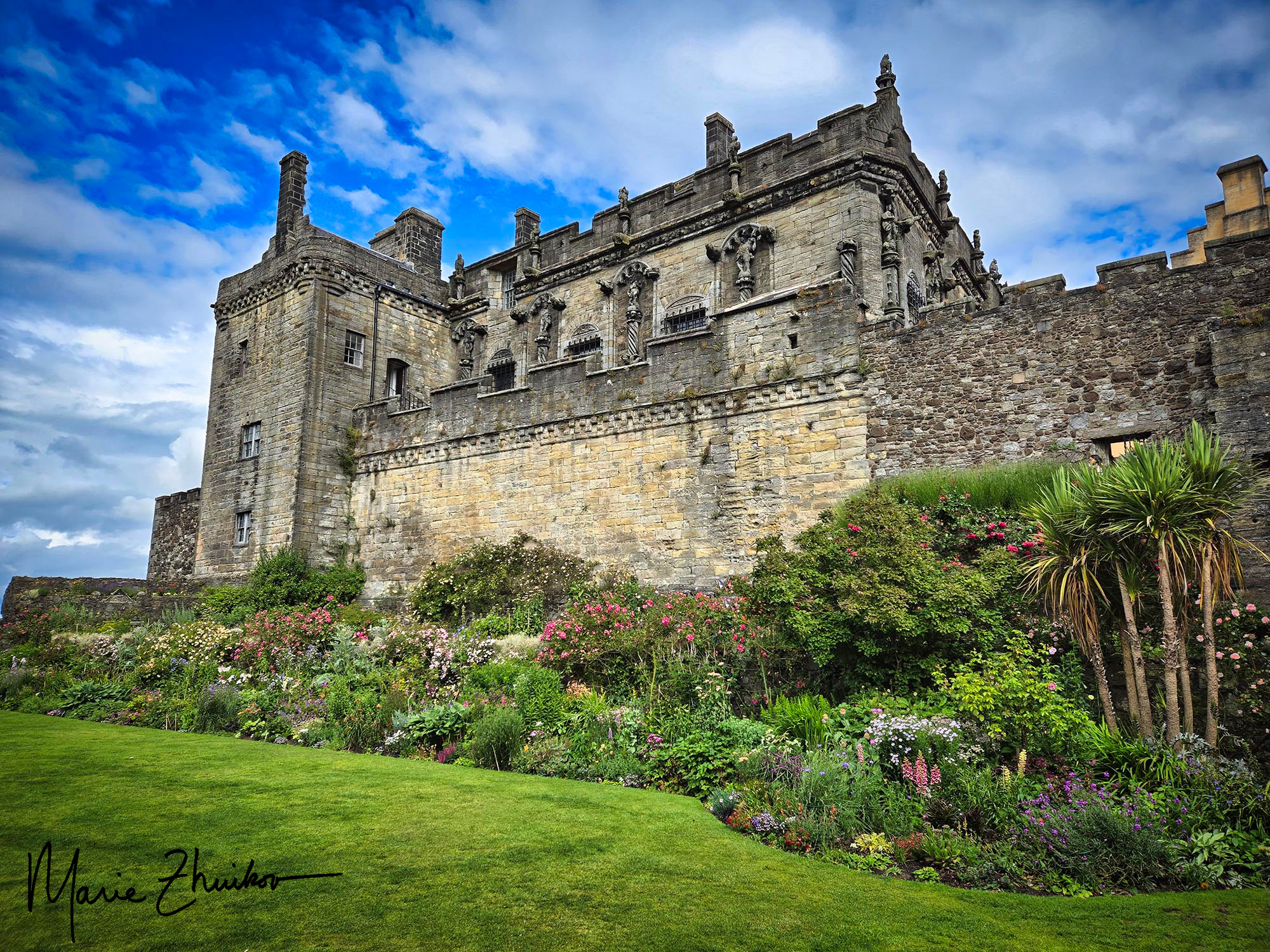
The gardens at Stirling Castle

Our next stop was Stirling Castle. If you only have time to visit one castle in Scotland, I suggest this one. We liked it because it just seemed like a castle should be. Built on a volcanic crag, the castle has a great hall, a palace with impressive bedrooms, a chapel, pretty gardens, and great views of the surrounding landscape including the Wallace Monument. Live actors worked in several of the rooms. One thing I learned was that the impressive bedrooms were mostly for show. Castle royalty actually slept in smaller, more modest rooms off the showy bedrooms.

The Robert the Bruce statue at Stirling Castle

Throughout his reign Robert the Bruce was known for destroying castles. He did this so that they couldn’t fall into the hands of the British. He also never settled in one place long himself to avoid being killed. Stirling Castle was one of The Bruce’s castle casualties, but it was rebuilt later. Even so, The Bruce is honored with a statue outside of it. While we were admiring the statue, Calum and his kilt created quite a stir among a group of Asian tourists. They were so excited, they were taking photos of his back! I mentioned this to Calum, who graciously posed for some full-frontal photos with the group. 😊

Calum being accommodating

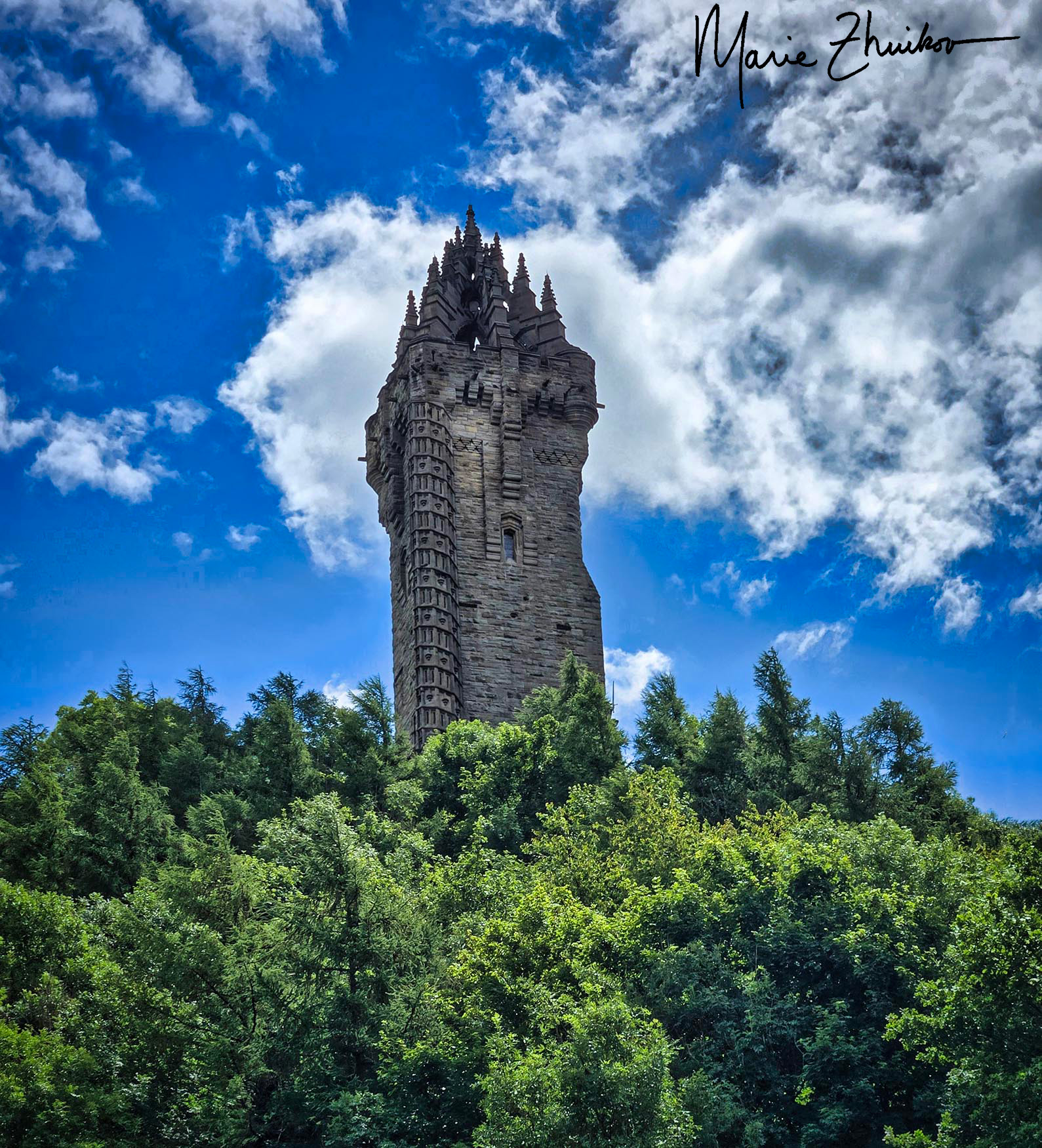
Next was the Wallace Monument. Although it was built to honor William Wallace, a heroic Scottish warrior, Robert the Bruce is honored in it, as well. A spiral staircase leads to the top of the monument. Several floors on the way up offer exhibits (and a rest from stair climbing). I learned that climbing spiral staircases with a hiking pole and a broken ankle is tricky. We encountered MANY spiral staircases during this tour and others, but in case you were worried, I’m happy to say, I emerged unscathed.

Our next site offered a much stronger connection to The Bruce. Dunfermline Abbey is where Robert the Bruce was buried. Actually, his alabaster tomb was destroyed during the reformation in the 1500s, but his body (along with alabaster fragments) was found in 1818 when the abbey was being renovated. His new tomb is done in the Scottish royal colors of red and yellow/gold. A wooden pulpit was built directly over it, so it’s as if the minister is channeling the king during his/her sermons! The abbey is still in use.

Robert the Bruce’s grave in Dunfermline Abbey.

The whole structure honors the former king. As we walked toward it, Russ noticed the words “King Robert The Bruce” are spelled out at the top of the abbey’s square spire. Before his body was reinterred, five plaster casts were taken of his skull. One was on display at the abbey. Another one is in Broomhall. For me, this was perhaps the most moving of all the places we visited. Something about the silence and the reverence impacted me.

Dunfermline Abbey

Then came the piece de resistance: Broomhall House! Calum had never been there, so he had to look it up on his mapping app. As we drove up to it, I noticed signs for a restaurant and hotel. The research I’d done on Broomhall had not mentioned anything like that. Curious.

We hopped out of the van and went to the reception desk. Calum said, “We’re here for the tour.” The receptionist looked at him blankly. Uh oh. As it turned out, we were at Broomhall Castle, not Broomhall House.

After discovering the error, we sped back in the proper direction. This time, the place we approached looked much more like what I was expecting. We stayed in the van while Calum knocked on the door. A woman came out from a different door, and they chatted. She looked worried and took up her phone. Uh oh. Eventually, both of them approached the van.

Broomhall House

The gist of it was that we were not expected. My heart bottomed out right there but I tried to keep it together. The woman who was speaking with us was Antonia Bruce, Charles’s sister. She had tried calling Charles, but he wasn’t picking up. She was willing to go into the house with us but she wasn’t really up on giving tours and besides, she was taking care of her parents, 100-year-old Lord Elgin (Andrew Bruce) and Victoria.

Antonia was verra verra nice. We apologized for interrupting her and said we’d try to come back another day. We had two days open on our itinerary and hoped that one of them would work. Somewhere there had been a communications breakdown. (Hint: it wasn’t on the tour company’s side.) I was hugely disappointed but realized that shit happens. I was just glad we were staying longer and might have time to for the situation to be rectified.

So, with fingers crossed, we drove away.

Did months of planning go down the drain? Did we just throw away a bunch of money? Did we ever get to tour Broomhall? Tune into the next exciting installment!

If you enjoy my blog, you’ll love my book! Meander North showcases 51 of the best stories from this blog about my quirky life in northern Minnesota and my writerly pursuits. It earned a silver Midwest Book Award for nature writing and was published by Nodin Press in Minneapolis. It is available for $19.95 through their distributor at this link.

Scotland: Days 3 & 4, Gardenstown and Banff

The town square in Banff, Scotland.

After breaking my ankle during a hike from Gardenstown, we laid low the next day. I sat in the window seat, watching boats and the tide come in and go out of the harbor with ankle iced and elevated. “Losing” a day of adventures was frustrating, especially after losing a day in Ireland due to our flight getting canceled. But I really had no choice but to be sensible. Sigh.

Gulls were nesting on the slate roofs in the nearby courtyard, squawking loudly and bringing food to their half-grown babies. With their calls in the background, I boned up on my Scottish genealogy in preparation for our meeting with a distant cousin at Broomhall House near Edinburgh. I mentioned in one of my posts about Ireland that, according to some less-distant cousins, I’m related to Robert the Bruce, the first king of Scotland. He was my great-grandfather to the 21st power. Someday I plan to get a genetics test to prove this, but I hadn’t had time or opportunity to do that just yet.

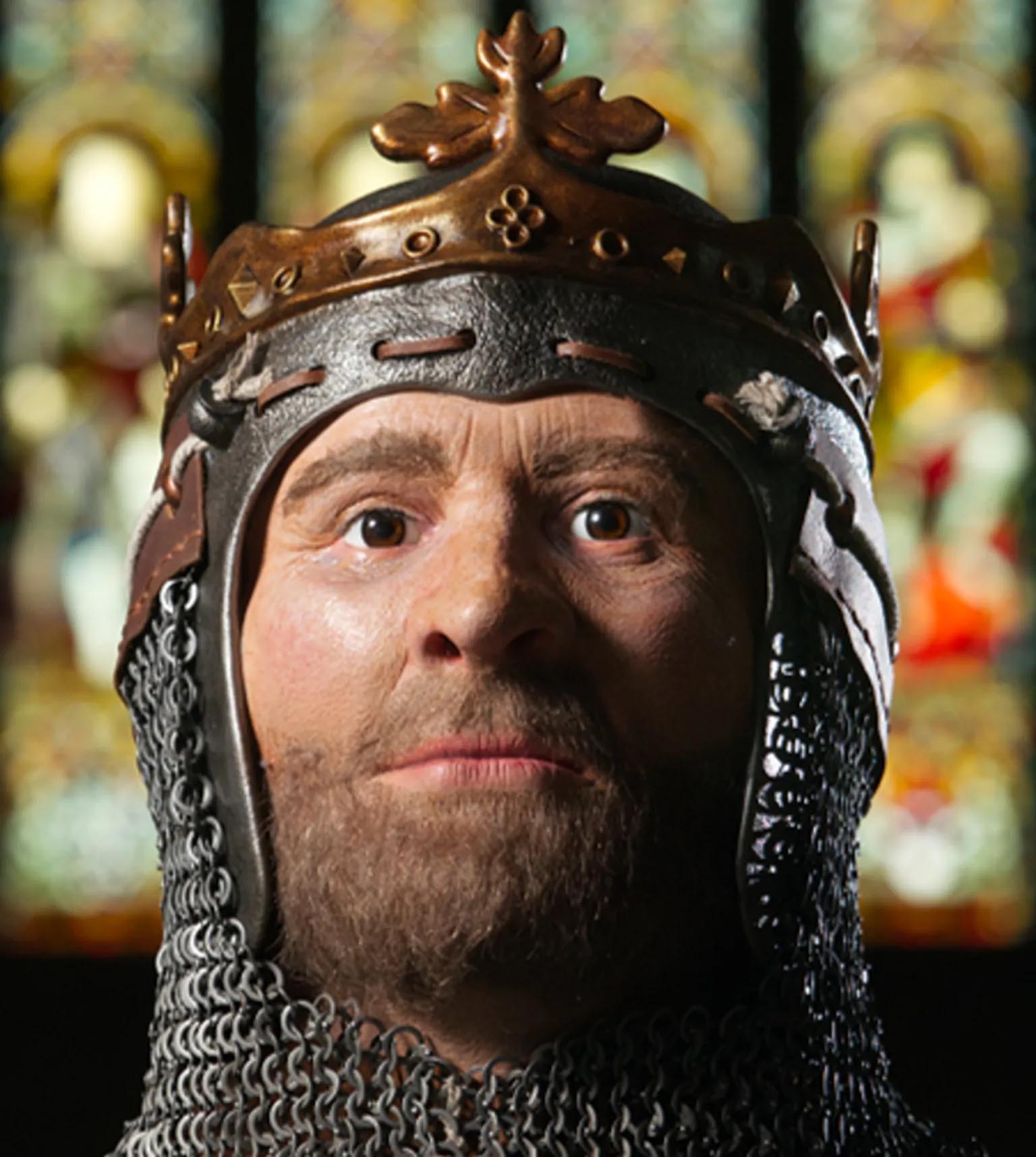
A reconstruction of Robert the Bruce’s face. Image courtesy of the BBC.

As I perused the genealogical chart, I was impressed by some of the sir names that popped up, including Stuart and Wallace. Apparently, our cab driver the other day might be a Stuart relative of mine! No wonder we became buddies so quickly. Also, there were six Barons of Clackmannan in my line. Thanks to some internet searches, I discovered that the barons lived in a tower and mansion in the town of Clackmannan and that the tower still stands. I thought it would be great to go there some day and filed that in the back of my mind. It wasn’t too far away from Broomhall House. Hmmmm.

The next day we decided to brave a bus trip to Banff, the nearest large town, to take in some of the sights. The bus stop was nearby, and it ran every hour or so, so it looked very convenient. And it was! Hobbling to the stop with my hiking pole, we caught the bus. Our goal was to wander around Banff for a while, then catch a taxi in the afternoon to Huntley and the Glendronach Distillery, one of our favorite brands of whisky.

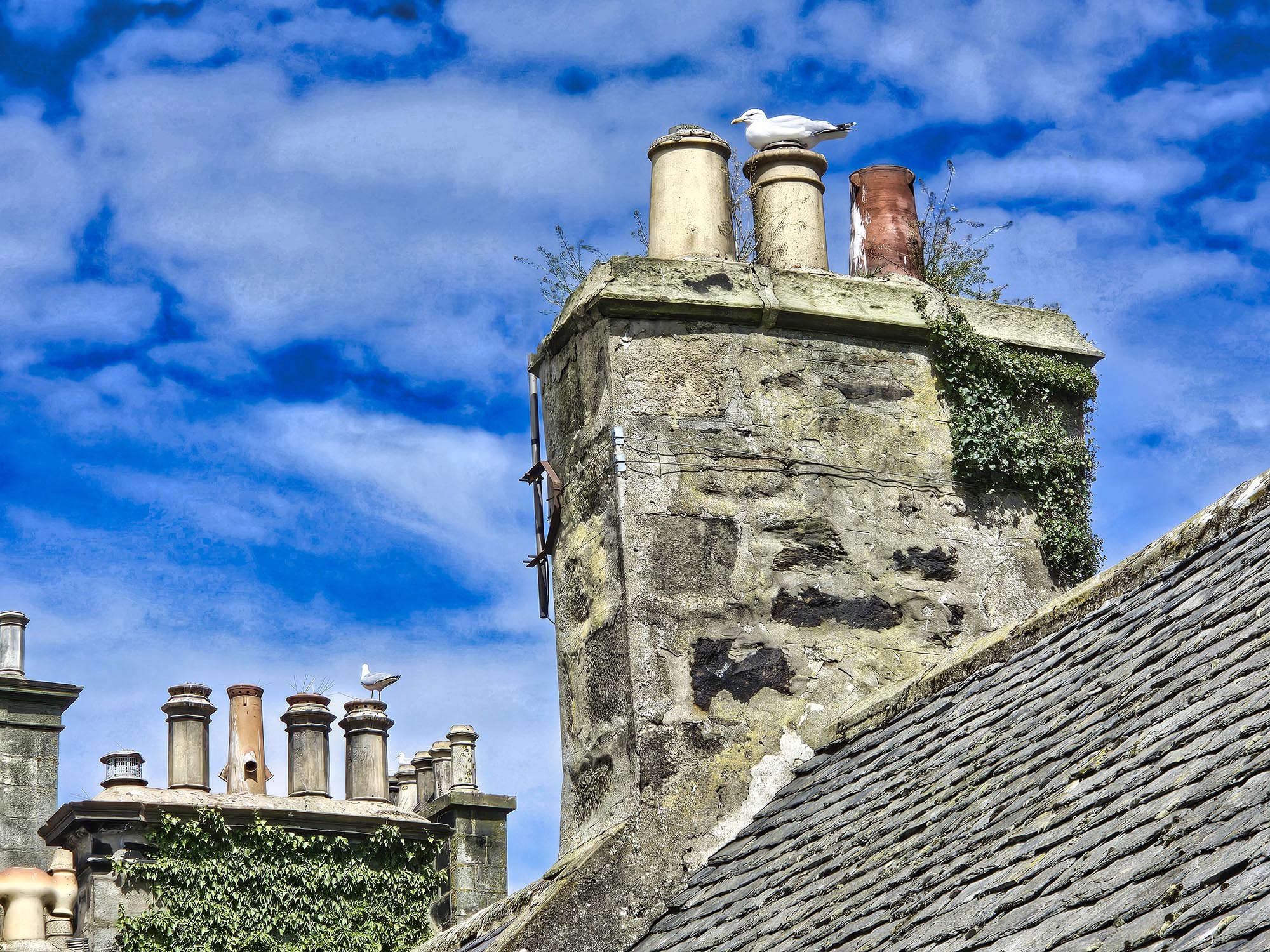
Chimney gulls in Banff.

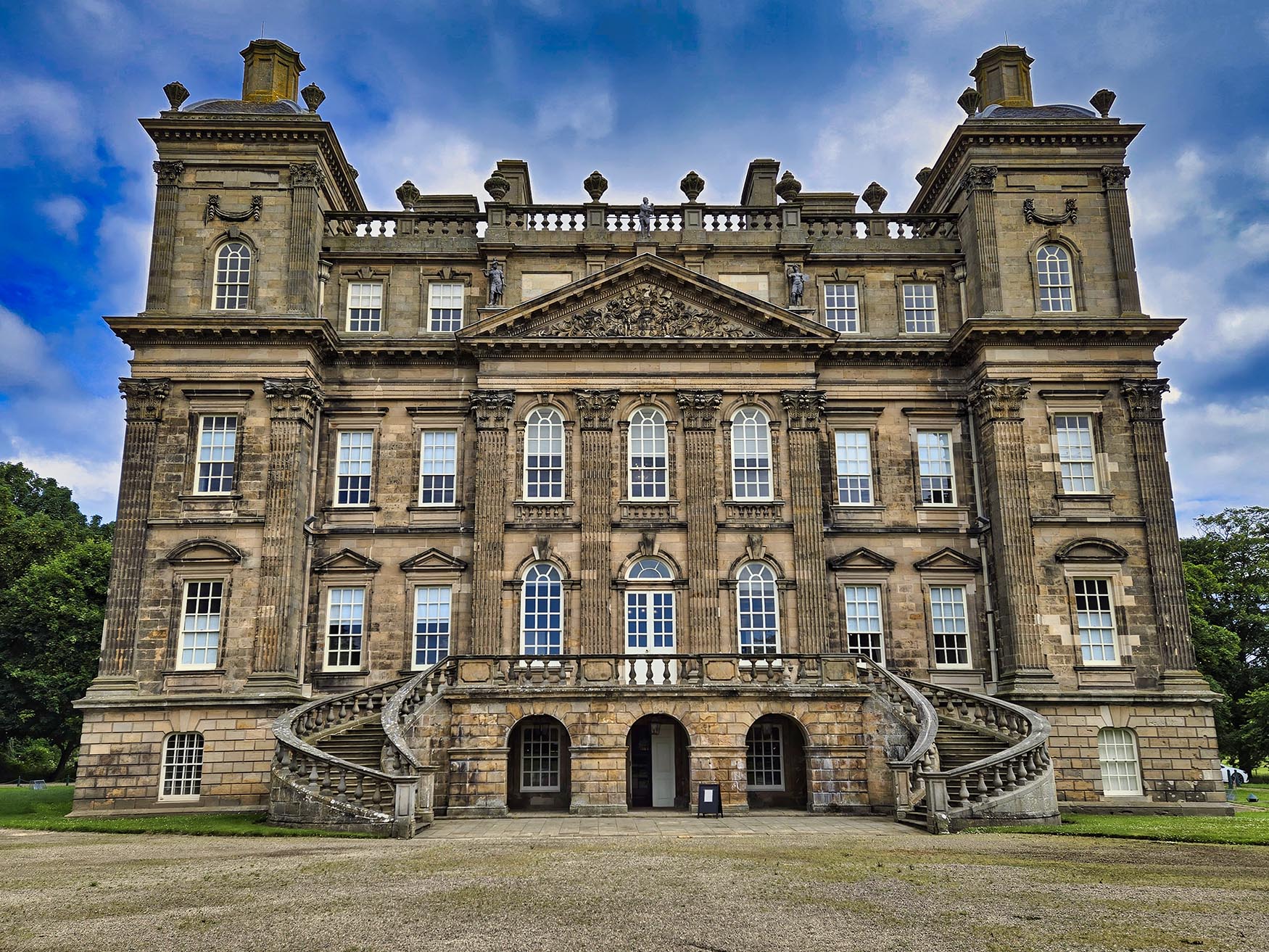
We were dropped off in the central town square of Banff. Mind you, this is the original Banff that Banff, Canada, is named for, or so the locals say. (I checked, and Banff Canada was named by the president of the Canadian Pacific Railway who grew up in Banff, Scotland.) An internet search told me that a local mansion called Duff House was open for tours. The walk wasn’t too far, so off we (I) hobbled.

Duff House in Banff.

The building was designed in the 18th century by Scottish architect William Adam for the local lord. However, before the interior was finished, work on the house stopped due to cost overruns. Apparently, the local lord’s (William Duff) plans were larger than his wallet. A court case ensued, which found in favor of the architect. Unfortunately, he died before the case was finished and never collected his payment. The lord was so disappointed by the whole thing, he never spent a night in the house and its completion was left to his heirs. During its life, the house has served many uses, including a hotel, sanatorium, and POW camp. If you’re interested in more history about the house, visit this site.

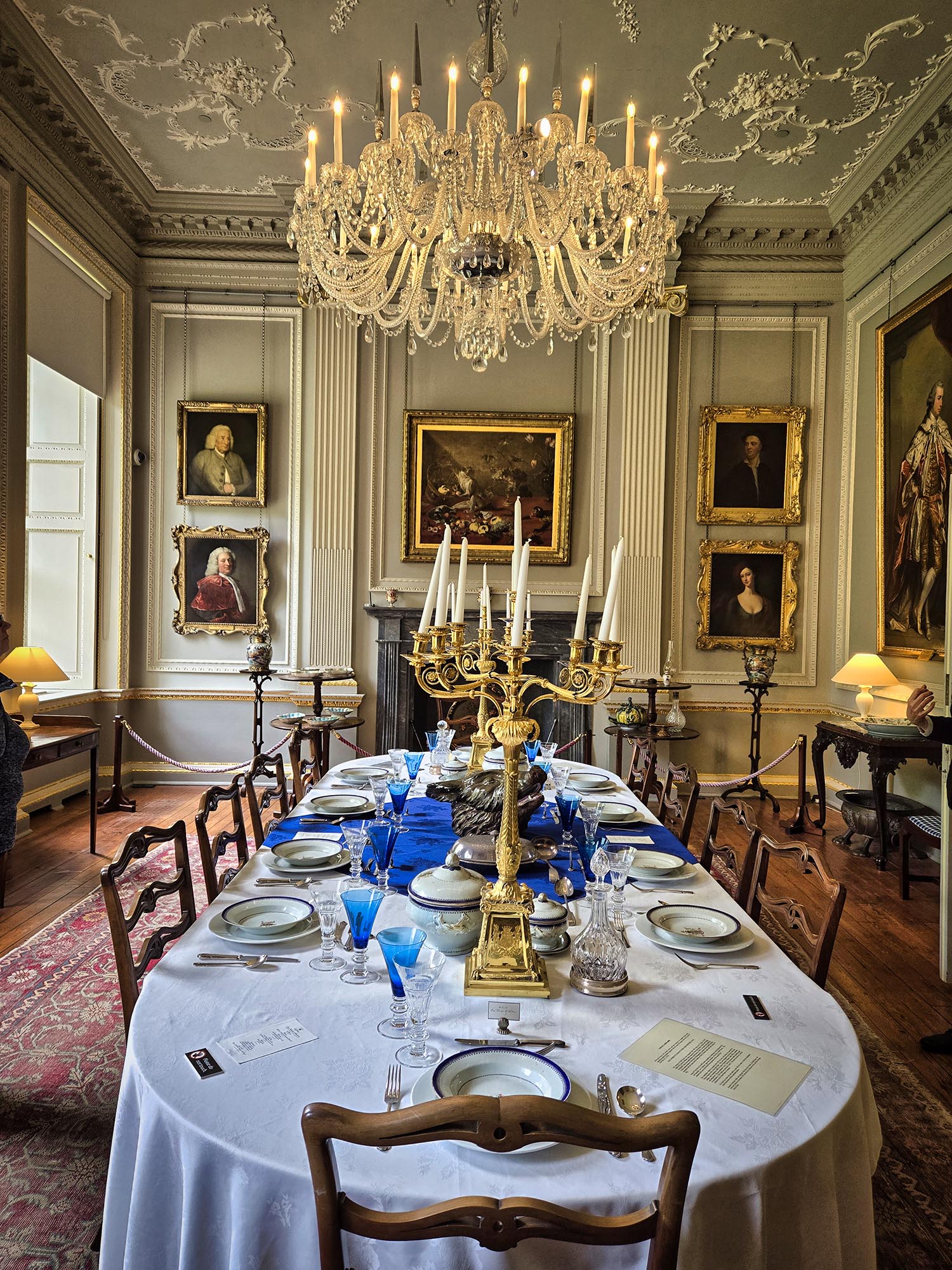
The dining room in Duff House, with a crooked candelabra.

The house is several stories tall. Rather than have a woman with a broken ankle hobble up and down stairways, the tour guides led me to elevators between floors, something I was thankful for! We enjoyed viewing the notable paintings and relics in the mansion.

By then, it was lunch time, so we walked back to the town square to a café we noticed earlier. Sated, we went back to the town square to see if we could connect with a cab. There are five cab companies serving Banff. Much to our dismay, we discovered that all of them were booked and there was no way we could make our distillery tour reservation time. We planned to leave for Edinburgh the next day, so we were out of luck for a tour later. We discovered the hard way that we should have made advance reservations with a cab. We learned that many school children in the area use cabs to get to and from school and that’s why none were available for us.

What was really lovely is that a woman who was walking by noted our plight and tried to help us. She even went across the street to a travel agent and asked his advice. Unfortunately, his advice was to spend time in the café where we had just had lunch and get a cab later. That wasn’t going to work for several reasons. So, we made the best of it and walked to the harbor to see more of the town.

Banff Harbor

We also stopped at The Market Arms Pub, which is rated the best in Banff. A bunch of guys were sitting at the bar. We grabbed a nearby table and had a pint while we waited for our bus ride back to Gardenstown. After about an hour, and older bespectacled gentleman turned to us and said, “Aye, do ye know who Mellors is then?”

It took me a beat to place the name, but I was soon able to tell him that Mellors was the gamekeeper in “Lady Chatterley’s Lover.” He said something about the other guys at the bar being too young to know who Mellors was. I told him it was one of my favorite books, and he agreed that it was beautifully written. That was the extent of our conversation. Where else in the world would a person in a bar ask you about a D. H. Lawrence book? I feel like something like this could have only happened in Scotland! This conversation made up for missing our distillery tour and is just one reason why I love this country.

A Gardenstown evening.

We caught the bus back to Gardenstown. Everyone on the bus was very friendly, both coming and going, and seemed to know each other. One man even tried to give us advice on where to sit. His advice would have separated me from Russ, however. I told him that just wasn’t happening. He huffed in a way that said, “Suit yourself. I tried!” As with my previous trip, I was so impressed by the community spirit of this area of Scotland and the helpfulness of the people. They’ve got their noses all up in your business, but they mean well by it.

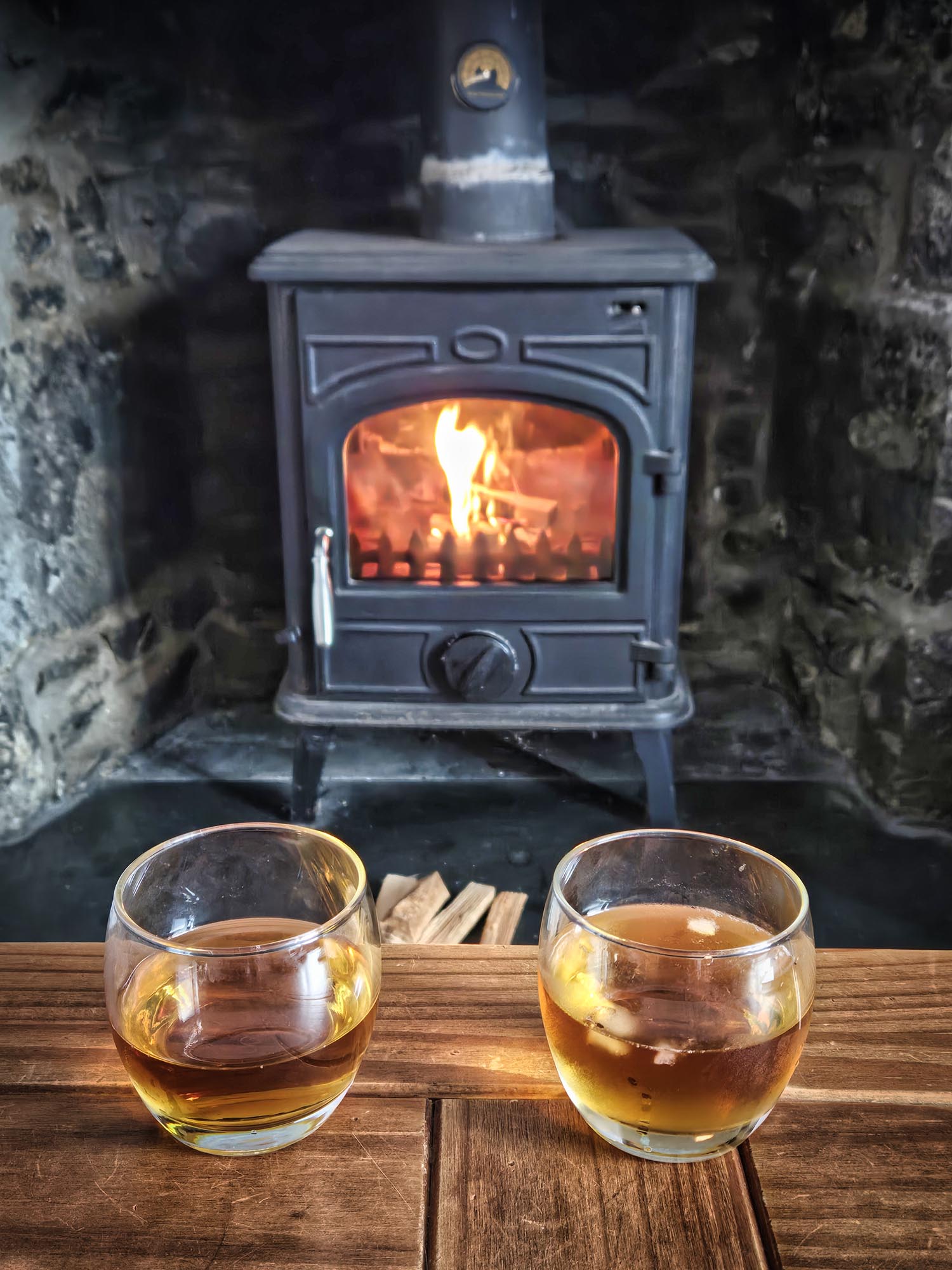
We capped off our night with another meal at the Garden Arms Hotel. I had langoustine nuggets (they’re a kind of shrimp also known as Norwegian lobster) and tiramisu for dessert. They were superb! We spent the rest of the evening at our AirBnB in front of the fire sipping scotch. The next day, our destination was Edinburgh, by train.

Scotland and the Moray Coast, More Taxi Driver Wisdom, and a Broken Ankle

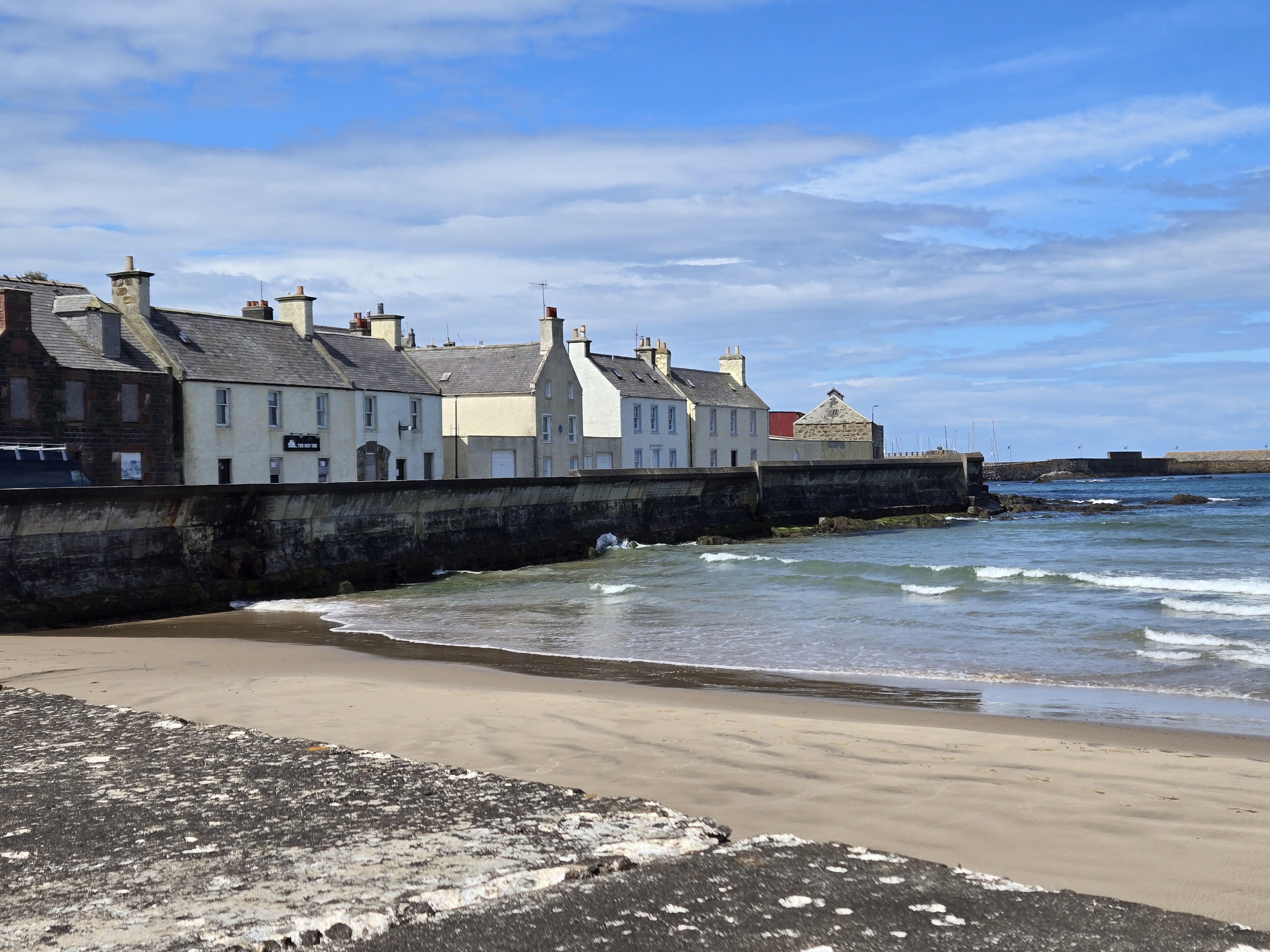
Gardenstown, Scotland, at low tide. To the left is Crovie.

Now, we’re continuing Russ’s and my epic trip to Ireland and Scotland. After spending a week in Ireland we flew to Aberdeen, Scotland. Our goal was Gardenstown, a coastal fishing village next door to where I stayed in Scotland eight years ago when I visited Crovie. I wanted to spend more time there and show it to Russ. I chose Gardenstown over Crovie because we weren’t renting a car this time and we wanted to be closer to a grocery store. Gardenstown sports a couple of convenience stores and “The Wee Shoppie,” a grocery store that offers a great selection of food despite being “wee.”

The cab ride from the Aberdeen Airport to Gardenstown was pricey (around $100) but to us it was worth it. By using cabs and public transport throughout our trip, we saved money versus renting a car. Our plans didn’t always work out due to unforeseen circumstances but overall, it went pretty slick. We also didn’t have the stress involved with navigating Ireland and Scotland’s narrow, winding roads where the locals drive very fast. Another reason was because the last time I was in Scotland, I had a car crash on my way to the airport in Edinburgh. (Read that saga here.) Gardenstown can also be reached by bus, but the ride is long, and we didn’t want to spend that much time getting to our destination.

Besides, if we rented a car or took a bus, we wouldn’t be privy to more taxi driver wisdom! On our ride we learned that Elvis is of Scottish descent. (Our driver had visited Graceland and brought the appropriate color tartan to lay at his grave.) We also learned that “You can always be sure of your mother, but not so much your father,” when it comes to ancestry. I suppose in many cases, that’s true! Our driver said he identified with his mother’s Stuart Clan for this reason.

The Robert the Bruce statue in Aberdeen. Photo credit: Duncan McDowall/Art UK.

This got us into a conversation about my link to Robert the Bruce, first king of Scotland. Our driver told us that there’s a statue of The Bruce in Aberdeen. It shows the king on a horse, holding papers in his outstretched, upraised hand. The charter is a declaration he signed in 1319 that gave the city his lands (Forest of Stocket) in appreciation for their support of him. This charter also resulted in the creation of the Aberdeen’s Common Good Fund, which is still used for community projects today. It stands outside the revamped Marischal College, the City Council’s headquarters. I’ve seen a lot of photos of Robert the Bruce statues, but this one was new to me. Our driver’s Stuart Clan supported Robert the Bruce, so we were like best buds after that conversation!

Our Gardenstown AirBnB was in the building on the left, the side with the white bay window.

He dropped us off at our Gardenstown AirBnB, which featured a full kitchen, fireplace, and views of the harbor. It was a little tricky to find, since it required a walk up a narrow set of stairs, but if you read the access instructions thoroughly, you should have an easier time than we did! We also had trouble accessing the lock box but a quick call to our gracious host fixed that problem.

The view out our bedroom window on a rainy Scottish day.

We dropped off our luggage and then made the short walk to the Wee Shoppie. We were famished from not having any lunch. While we shopped, fog rolled in from the North Sea and a drizzle began. It was perfect weather to cook a hearty pasta meal.

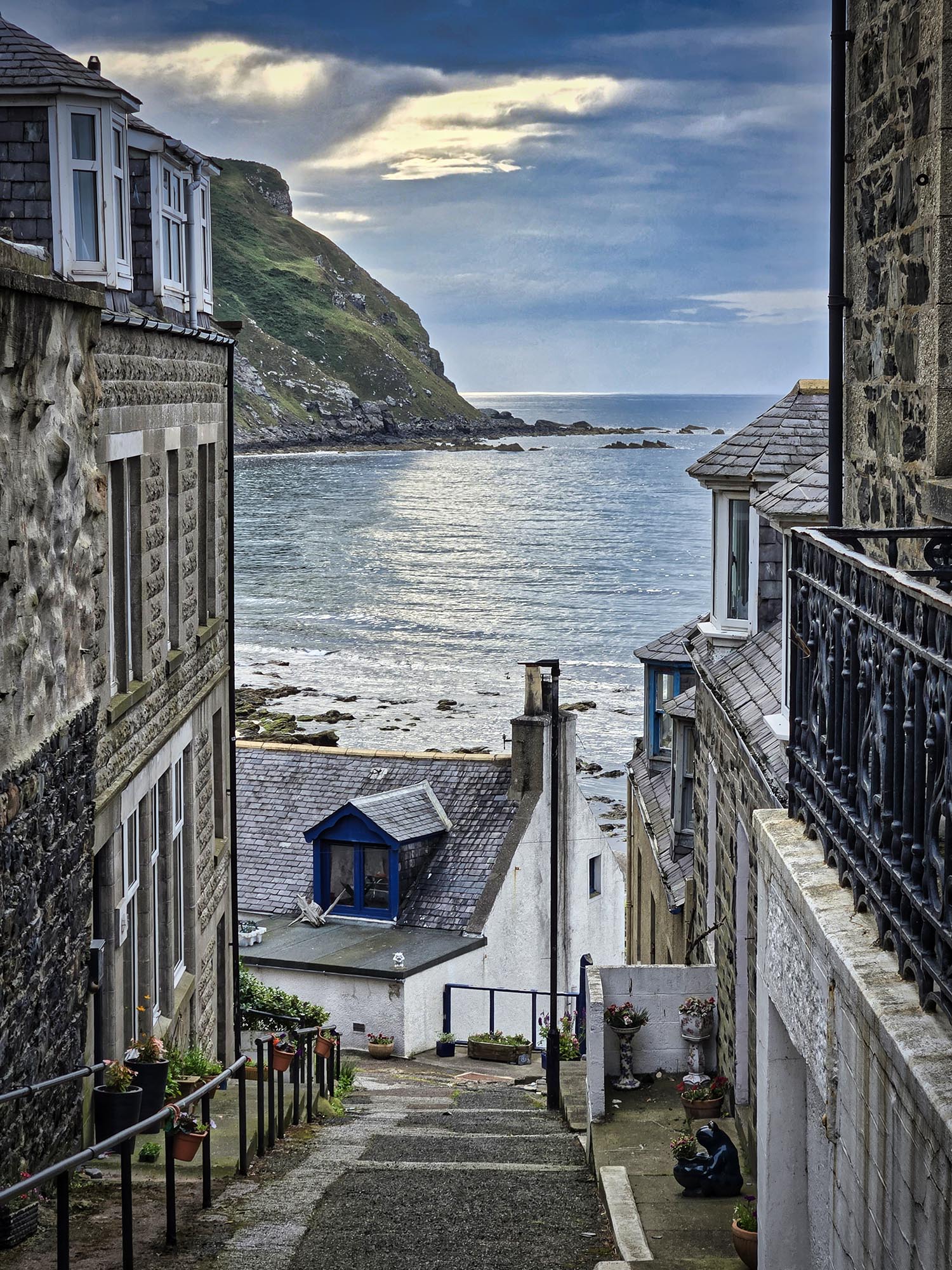
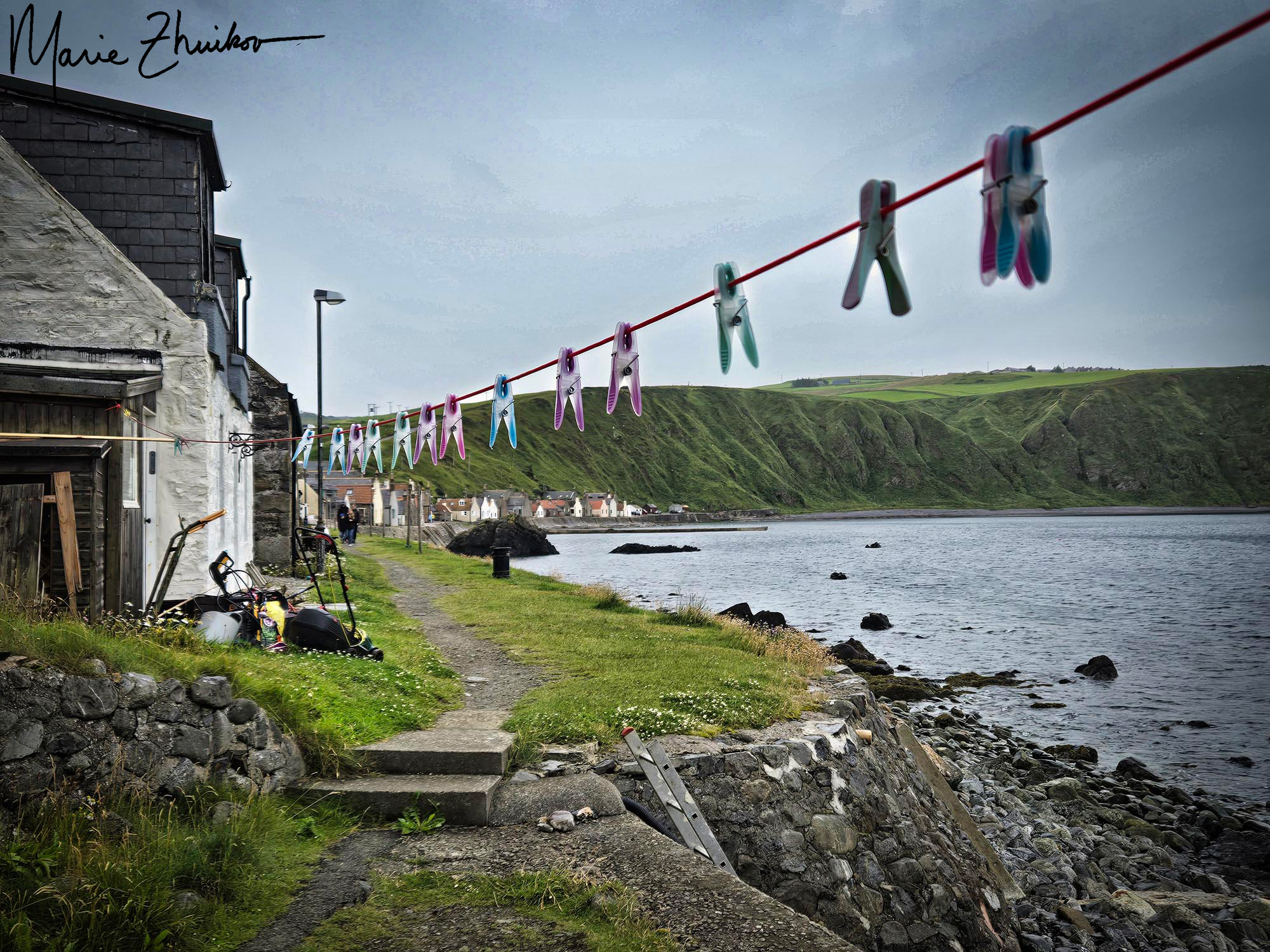
The next day, after the rain stopped, we hiked to Crovie. The rental cottage where I stayed before (Crovie #13) was still there. Crovie is also an historic fishing village, formed during the clearances when the British drove the Scots off their lands after the Battle of Culloden. It’s so picturesque, as you can no doubt tell from the images that go along with this post. Both Gardenstown and Crovie are on the Moray Coast, which is in northeast Scotland and spans from Fraserburgh to Inverness, a hundred miles along the coast.

We stopped back in Gardenstown for lunch and then hiked the opposite direction along the beach and up to the graveyard and ruins of an old church on a hill. The trail had suffered from some erosion since I was last on it, but we managed to get up the hill fine. Once we were atop it and nearing the church, however, I let down my guard. I rolled my right ankle, heard an ominous “snap,” and fell to the ground.

Two years ago, I broke that ankle (also hearing a snap) during a kickboxing workout. I have high arches, so am prone to this type of injury. Luckily, I just broke off the very tip of my tibia on the outside of my ankle bone that time and did not need surgery or a cast.

A scene from our hike to the church ruins.

When I heard the snap this time, I immediately knew I had rebroken the same spot. Thankfully, I was able to stand and walk. With the help of one of Russ’s hiking poles I hobbled to the church and sat on a bench while Russ explored. I kept my ankle elevated, but already it began to resemble a goose egg.

I pondered our predicament. We were on a hillside in the middle of nowhere. We didn’t know it then, but there were no clinics in Gardenstown. There was no way I was going back down the eroded trail. I knew there was a cart path out to the paved road that led back to Gardenstown. It would be a longer walk, but a smoother one. We could call for emergency help, but that seemed excessive since I could still walk, and the fracture probably wasn’t that bad.

Once Russ returned, we decided we would walk the road back to town. Of course, at that point, it began to rain. There’s nothing like hobbling through the rain with a broken ankle. Even walking on the smooth road was taking our lives in our hands, however. I’ve mentioned that the roads are narrow and winding. They also have blind curves, small shoulders, and are lined with hedges, which make it hard to get out of the way of vehicles. At one point, a farm tractor pulling a trailer roared around a corner, narrowly missing us. We thought we were goners! The driver probably pegged us as crazy.

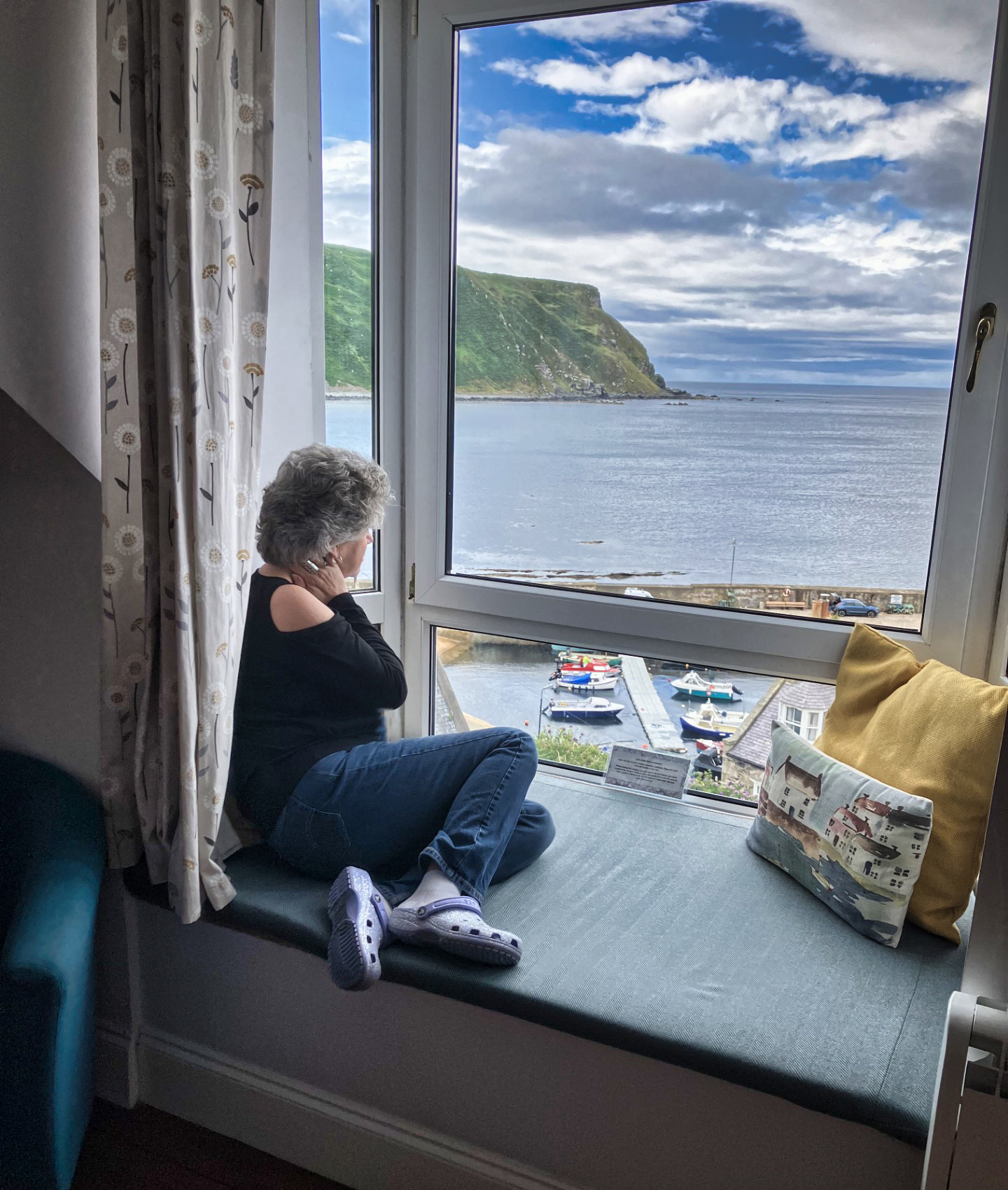
Me looking out the bay window the day before I broke my ankle.

After two soggy and slow miles, we began the steep descent into Gardenstown, which is built on a hillside. We stopped at a gas station along the way, hoping they’d have an ace bandage in stock, but no luck. Once we made it back to our AirBnB, bedraggled and cold, I sat on the couch while Russ went to the Wee Shoppie for a bag of frozen peas to place on my swelling.

During his trip, he noticed an ankle brace in a window of an osteopath’s shop. The shop was closed but had open hours the next day and a phone number for appointments. We called and left a message. The next day the lady osteopath called us back and was able to work me in between her other appointments.

Alas, the ankle brace box in her window was just for show. It was empty. But she had an expired ace bandage that she offered me for free. I never knew that ace bandages expired. Even so, it seemed to work just fine, and it made me feel much more supported when I walked. Thank you, osteopath lady!

Through internet searches, we learned there was a clinic in the nearby village of Banff, but I really didn’t want to spend hours of our vacation getting medical care, especially since I was getting around okay.

In need of pampering, Russ and I visited the Garden Arms hotel that night for supper. I had a haggis/black pudding burger with bacon. Nothing like a bit of suet and lamb heart to make things right!

Next: Laying low in Gardenstown and a visit to Banff

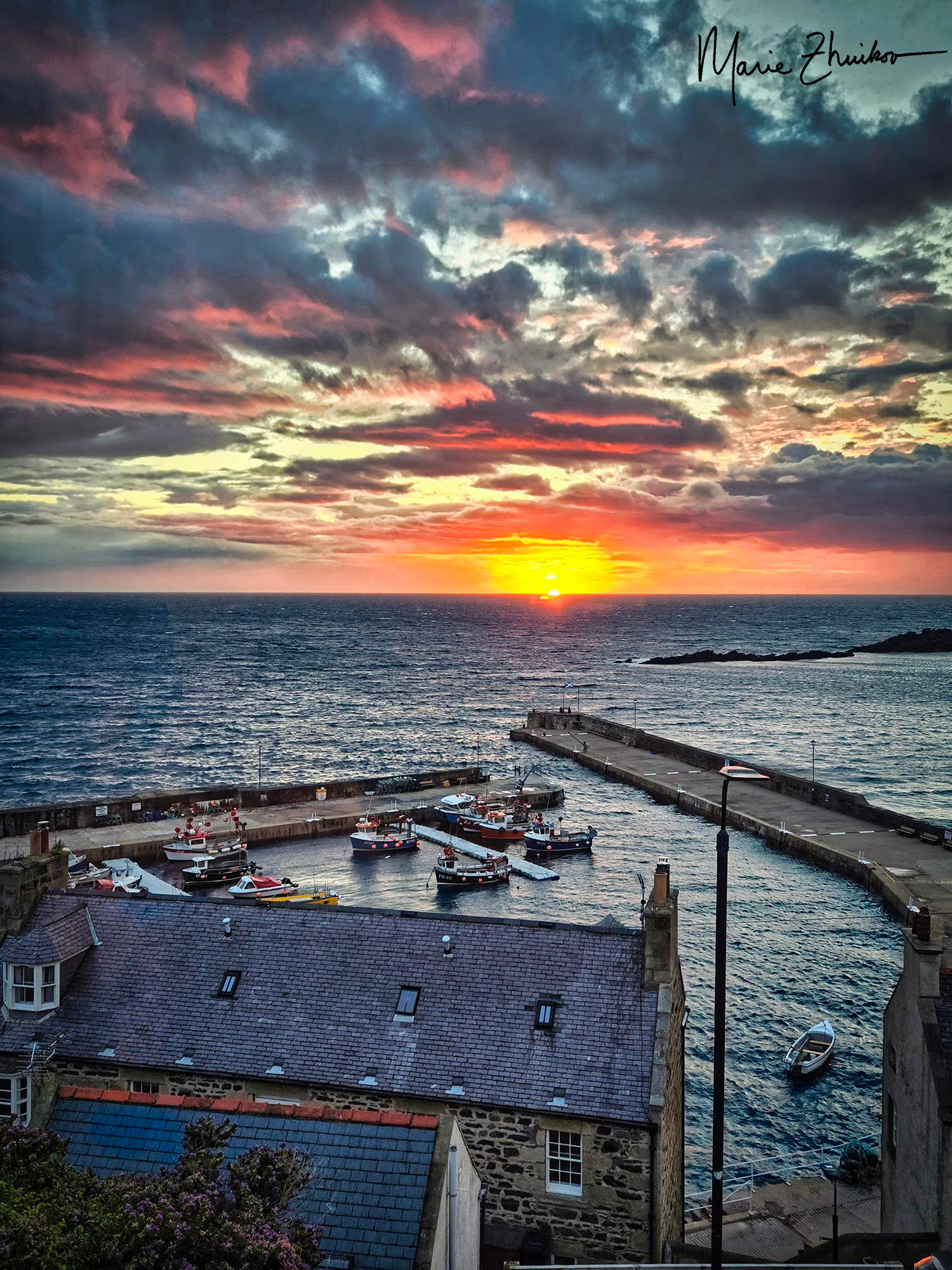
View of the Gardenstown Harbor from our AirBnB.