Another Winter, Another Ice Sculpture

Iceman 2016 008

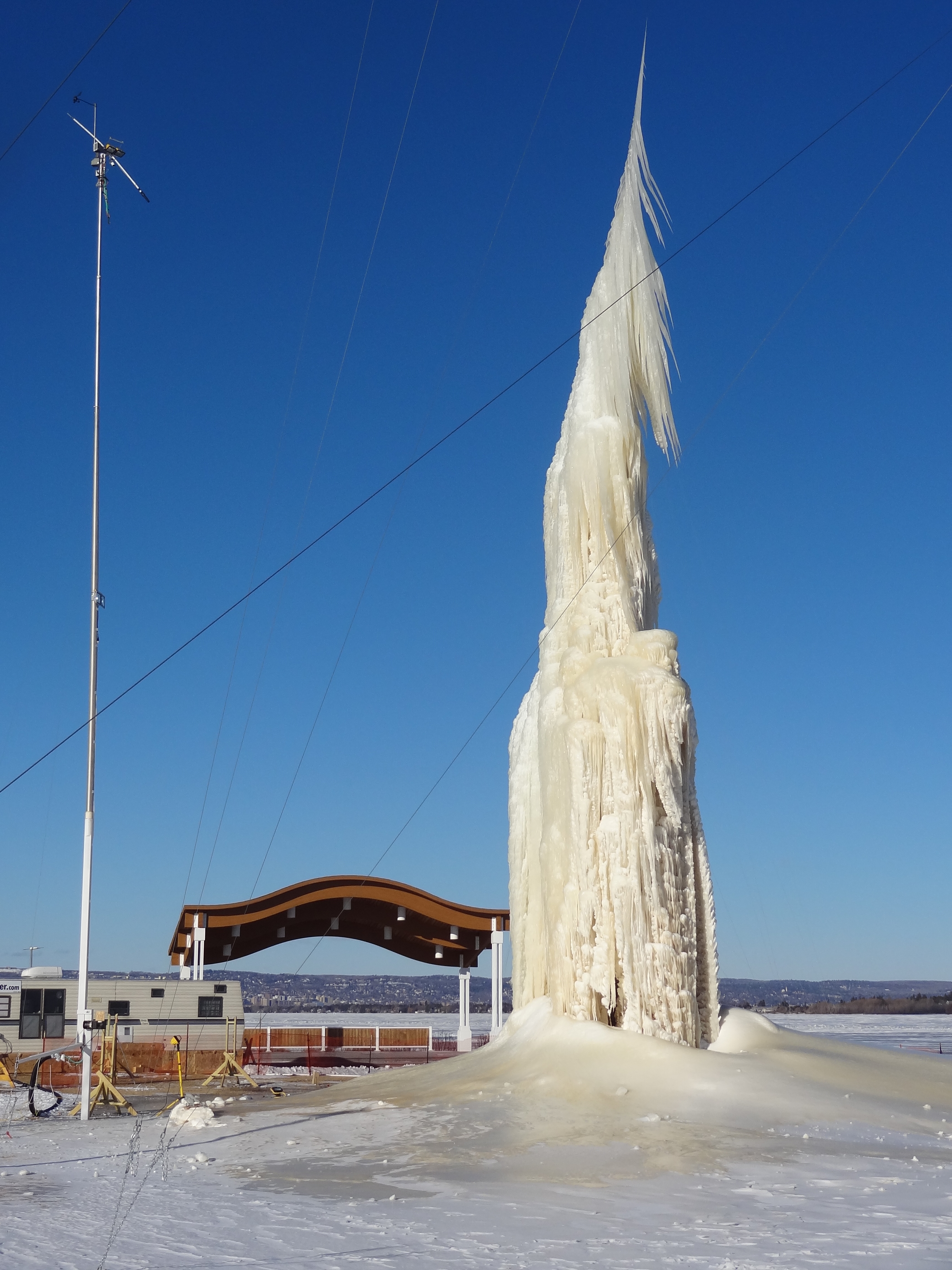
The ice formation, viewed from behind. Above it is one of the four towers that sprays water to create the structure.

A European-style castle is being built a few steps away from my office. The building materials? The reddish brown water from the Duluth-Superior Harbor.

From the four blog posts I wrote last winter, you may recall “Ice Man” Roger Hanson’s adventures trying to build a world-record ice sculpture on Barker’s Island in Superior, Wis. (To read the posts, type “Roger Hanson” into the search box on my blog.)

Let’s just say he learned a lot from that experience, and is at it again. Roger has a contract with the City of Superior to provide ice sculptures as a tourism attraction for three winters, and this is his second.

Last year, Roger was going for height, but a February thaw and shifting ground toppled his world-record attempt. This year, he’s going for width and mass. Plus he has a heckofa large supporting ice base on his formation that looks like it might not melt until July.

Roger builds his creations with the help of towers that periodically spray water he pumps from the harbor. He controls the actions of the towers through a computer set-up he has in the trailer he lives in near the sculpture.

He plans to spray a ninety-foot-wide, seventy-foot tall, eight million-pound structure, complete with castle turrets and a doorway in the middle.

He had one small set-back a few days ago when high winds blew apart part of the formation. Roger has since recovered, and the structure is now sturdy and thick enough that winds should not be an issue. But it’s an El Nino winter, which typically means warmer temperatures for this area. The weather has been cold enough lately for ice formation. Who knows what the rest of the winter may hold?


Oops!

The Lake Superior Ice Project came crashing down on Tues., Feb. 3 at 10:06 a.m.

The Lake Superior Ice Project came crashing down on Tues., Feb. 3 at 10:06 a.m.

An attempt at a world-record-tall ice sculpture came crashing down a few days ago on Barker’s Island in Superior, Wis. Of all times – it happened right when the “sculptor,” Roger Hanson, was being interviewed and photographed by the New York Times. In fact, because Roger is hard-of-hearing, the reporter had to alert him that something was amiss. Roger turned around from the interview just in time to see his creation fall in upon itself.

What his creation looked like before the collapse was a point of discussion between me and my office mates, who work in a nearby building. Before the crash, it rose 66 feet and had wing-like protrusions coming off either side (see my previous blog posting for photos). It struck me as vaguely menacing, so I called it the “ice wraith.” Others thought of it more benevolently and called it a “sentinel” – they thought it was guarding the estuary and harbor. Others called it a “blob.” Calling it a “sculpture” like the news stories do, just seems wrong. It is a creation, but it’s not like Roger is carving it. He’s squirting it.

Well, it’s clear that it is a pile now.

The crash is blamed on a thaw we had a while back. Although the temperatures dropped again enough for ice formation, I suppose the structure got brittle at that point. Roger started adding more water to the top of it instead of making it wider. Even to my unschooled ice sculpture eyes, it seemed precarious – like it needed more width instead of height. (But I speak from the benefit of hindsight.)

Although some are rejoicing at the crash of this hubristic endeavor, others in the community are upset. The project was drawing a crowd and even sported a gyros stand, and people seemed to enjoy watching the progress. Roger is such an earnest man, you can’t help but feel sorry for him. The city of Superior planned light and music shows, presentations, and even a fireworks display around the project for the next three weekends. (Feb 14, 21 and 28 at 6, 7, and 8 p.m.)

After the crash, the big questions were whether to build again and whether to hold the celebratory events. The answer? YES! Roger says he is going to rebuild, and has already started doing so upon the pile that was once his “sculpture.”

Poor Superior always seems the underdog next to the more populous and tourist-friendly Duluth across the bridge. This is yet another example of how the city just can’t win. But perhaps it’s also an example of perseverance and making lemonade out of lemons.

In my first blog entry about this project, I asked, “What could possibly go wrong?” Well, now we know! But at least nobody got hurt. And it makes for a good story. And looking at an ice pile IS sort of interesting. Especially when it’s lit up at night. (Grin.)

It’s Growing . . .

DSC019362The weather continues to cooperate for the Lake Superior Ice Project on Barker’s Island in Superior, Wis. “Ice Man” Roger Hanson from Big Lake, Minn., has added a third tier to the formation and it now stands about 52 feet tall and 20-something feet wide.

Roger had some troubles previously with the formation leaning due to the soft ground it’s built on and the prevailing winds, but he has since adjusted for that. Roger lives in that little trailer you can see in the side-view photo of formation. I don’t envy him. Barker’s Island is a desolate place in winter. No trees block the wind coming off frozen Lake Superior and the comforts of the mainland, although in view, might as well be miles away.

For more information, please see my two previous posts (1) (2) on this topic.

DSC01938

A side view of the formation, along with the spraying apparatus and Roger’s trailer home.

If You Build a Seventy-Foot-Tall Hunk of Ice, Will They Come?

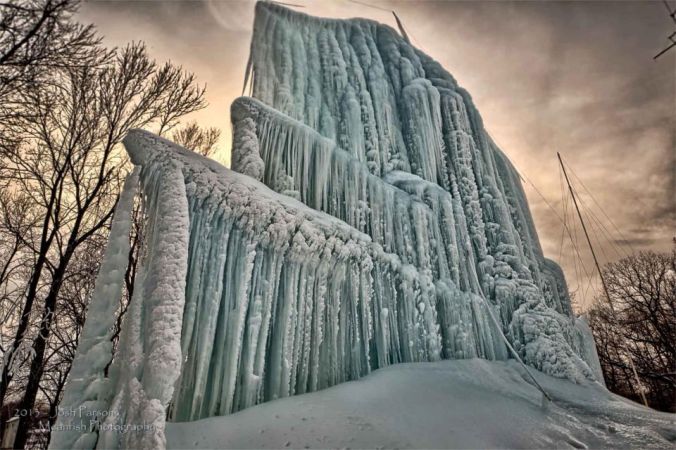
Photo by Josh Parsons

Photo by Josh Parsons

So this winter, as a tourist attraction, someone wants to create a seven-million-pound, seventy-foot-tall block of ice right near the building where I work. What could possibly go wrong?

Said person is Roger Hanson, a computer software developer who hails from Big Lake, Minn. He’s been forming huge hunks of ice in his back yard since 2007.

Perhaps hearing that we were nervous, Roger recently came to our office bearing donuts and information. He said he started his hobby because he’s a hoarder. He has a geothermal heating system at his house that creates wastewater. He didn’t want to just dump the water into the river that runs nearby, so he got the idea of using his computer and technical skills to build an ice formation with it. He’s built some impressive ones that have garnered local and national media attention.

He uses a computer-controlled robotic water sprayer and metal cables to create the structures. And like any good hoarder, his piles of ice keep getting bigger every year. I think he reached 64 feet last year.

This year, he’s moving outside of his back yard for the first time, onto Barker’s Island in Superior, Wis. The island is man-made, composed of sand and soil dredged from the harbor in the late 1800s. The City of Superior, inspired by the unprecedented popularity of the natural ice caves at the Apostle Islands in Lake Superior last year, thinks Roger’s artificial ice formation will make a good tourist attraction. Roger explained that he wasn’t the city’s first choice – they wanted an ice castle builder instead. But those folks had scheduling conflicts. The city has committed Roger to a three-year, $135,000 contract and is advertising for vendors to provide hot chocolate and the like for the masses it hopes the ice will draw.

One of Roger's previous creations by his house.

One of Roger’s previous creations by his house. Photo by Roger Hanson

Roger plans to build his largest formation yet at ninety feet wide and seventy feet tall. Already, he’s learning things and overcoming obstacles. For this endeavor, which he calls the Lake Superior Ice Project, Roger is pumping water out of the Superior Harbor. Although he thought he’d only have to lay one hundred fifty feet of tubing, he laid two hundred fifty feet out into the harbor in order to reach an eight-foot depth of water to be safe from a deep freeze. In the process, he ended up tripping on the tubing and got the cold shock of a dunk in the harbor.

He’s spent the past month setting up. Now the wind and the weather just need to cooperate. He explained that he designed the computer system for the prevailing wind direction for this area. Darn wind has been blowing from elsewhere, and the air temperatures have been too warm for him to begin spraying water for ice.

Roger also mentioned he dropped one of the seismic sensors he brought along that helps him predict when the structure will break up in the spring. He described how huge chunks of ice fall off the formation when it starts to melt. The stress on the structure can be measured with seismic sensors, and when the time between fractures starts getting too short (like labor contractions), Roger knows the thing’s going to blow – something very useful when there may be onlookers who need to be moved away for safety. But never fear, Roger was able to fix the sensor with some ingenuity and PVC pipe.

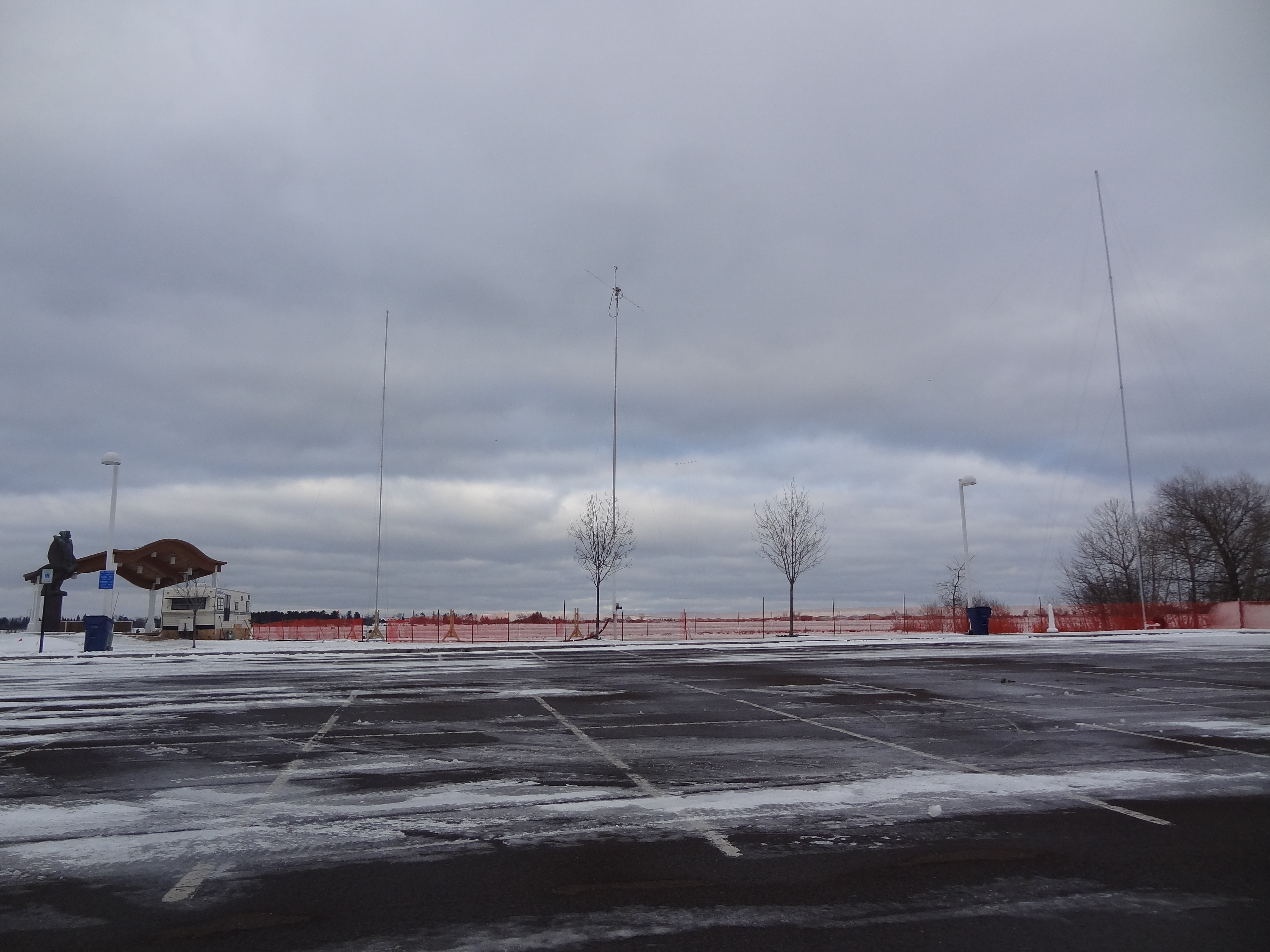
What the ice formation on Barker's Island looks like now (because the weather is not cooperating).

What the ice formation on Barker’s Island looks like now (because the weather is not cooperating).

If nature cooperates, he hopes to have the formation built by mid-February. He will light it up at night and give periodic tours. The city has a traffic flow plan in place. And although the city is spending thousands of dollars on this project, a city staffer who visited us admitted they have no advertising budget. As was the case with the Apostle Islands ice caves, the city hopes that social and news media will do the advertising for them. Also, the ice formation will be visible from a nearby highway and the city hopes that people driving by will see it and be drawn to it.

So we have a new location, finicky weather, seven million pounds of pressure atop a sandy island, no ad budget, huge blocks of ice calving off the formation, and massive amounts of meltwater come spring: what could possibly go wrong? Nothing, I hope, but stay tuned . . . .