Cullen Skink and Scones: Adventures in Scotland, Part 2

SCOTLAND! 037

The non-rocky part of the trail to Gardenstown.

We spent our first day at Crovie Cottage #13 on the Moray Coast exploring the small fishing village and hazarding the “Danger! Falling Rocks!” trail that leads along the sea to neighboring Gardenstown. Eventually, we stopped at a café for lunch.

The Tea Pot Cafe is the kind of place where everyone notices when somebody new walks in. Your table neighbors will advise you on menu choices, ask where you’re from, and if you’re lucky, will tell you the best places to visit.

SCOTLAND! 053

The rocky part of the trail.

We were advised to visit Delgatie Castle for the best scones and Cullen skink in the land. Scones need no explanation. Cullen skink, however, is a chowder made from smoked haddock. It was invented in the nearby town of Cullen, and is apparently all the rage. Certain restaurants along the coast even boast chefs who have won Cullen skink soup honors. The “Cullen” part of the name of this dish sounded okay to us. The “skink” part, not so much, but we were game to try it.

026

Delgatie Castle

So, the next day, after a visit to a nearby gannet colony at the Troup Head Nature Reserve, we were off to the castle. Delgatie Castle is no longer inhabited, but is run by an organization. As we approached on the dirt road and the pink tower loomed through the trees, we were stuck by the feeling we were in a fairytale.

Hungry again, we opted to visit the Laird’s Kitchen first and tour the castle later. We were not disappointed by either the scones or the soup, although as you can see from the photo below, the meal was a bit, er . . . white. The bread was homemade and the scones were meltingly hot.

The castle is primitive compared to others I’ve been in but it was interesting to see how the rooms were arranged around the large central tower staircase. There’s also a creepy story in one of the rooms about a monk being buried behind a wall.

So that was our introduction to local fare and Delgatie Castle. Next, it’s on to whisky!

SCOTLAND! 067

Cullen skink soup, homemade bread, and tea – of course.
Cruising in the Crawler Lane: Adventures in Scotland, Part 1

SCOTLAND! 014

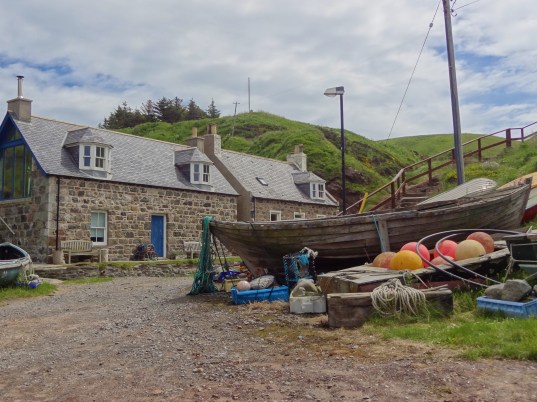
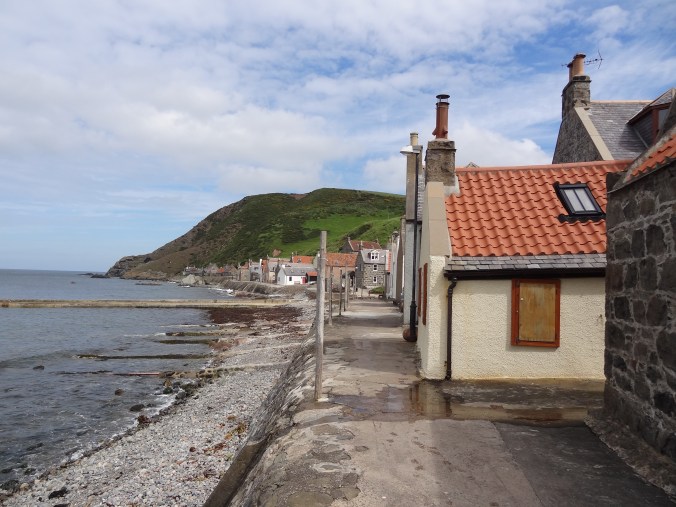
Crovie Village, Scotland. Where the sea is not only on your doorstep — it IS your doorstep!

At the time of this writing, I am almost done meandering around Scotland for ten days. I traveled with a friend and we spent most of our time in northeastern Scotland (the Moray Coast area near Banff). After that, I traveled by myself to the Borders area in the south to visit my ancestral hometown of Kelso.

First of all, I would like to apologize to all the drivers in Scotland. Yes, for the first several days at least, we were the ones stalling our manual transmission rental car while driving up hills and through round-abouts. We were the ones poking along in the far left lane (a.k.a. the crawler lane), afraid to drive over 65 m.p.h. It’s not easy driving on the left side of the road and shifting with your left hand. Just one of those things would be difficult, but add both of them together and it causes Driving Dread. It took me about four days before I could approach the car without wincing at the imagined bloody outcome.

SCOTLAND! 024

More Crovie.

Thank you Scottish drivers for not honking at us too often and for not crashing into us.

There, that’s out of the way.

We chose to stay in the historic fishing village of Crovie (pronounced “Crivvy” by the locals). It was settled by displaced Highlanders after the Battle of Culloden. Located at the bottom of a steep bluff right near the sea, I suppose it was land that nobody else had the guts or desperation to settle, and so it was theirs for the taking.

Crovie operated as a town and fishing center, home for up to 300 people at one time, until 1953, when a severe storm damaged many homes. Most of the people moved to Gardenstown, just a mile next door. Now the town functions mainly as a tourist attraction, hosting seasonal visitors and a few residents.

We met the last of the remaining full-time residents during our stay. His name is Billy. He’s lost some fingernails, and parts of fingers. He is also missing some of his upper teeth. But Billy is a rough-cut gem, and has obviously survived a hard life near the sea.

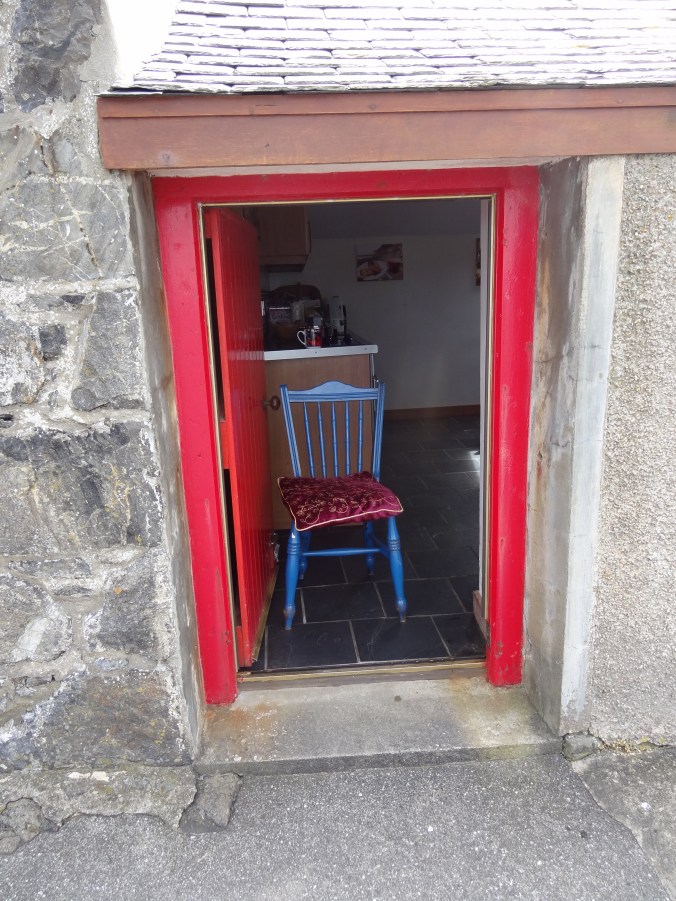
SCOTLAND! 027Our abode was Crovie Cottage Number 13. What could go wrong, right?

As the cottage ads say, abode number 13 is not suitable for triskaidekaphobics (those who fear the number 13). Fortunately, we do not suffer such a fear and found the place inspiring and charming. It took us a while to figure out which switches to flip for necessities like hot water and electricity, and how to operate the electric meter that required feeding with 1 pound coins for an uninterrupted flow of electricity, but after a day or two we had it down.

We also learned how to light a coal fire in the fireplace, and how to eat breakfast with the front door open to the sea (which is only three feet away).

Be forewarned – if you ever decide to visit or stay in Crovie, the descent into the village is extremely steep. You also can’t just park your car in front of your cottage and unload. There’s not enough room between the cottages and the sea for a road, so you have to park either at the lot above the steepest part of the road or the one at the bottom of the steepest part, and roll or wheelbarrow your supplies to your cottage.

My kind of place! More adventures to follow . . . .

SCOTLAND! 015

The Gaelic Soul

Duntrune-Castle-Skyfall-375x234

I drove 6 hours (one way) this weekend for a St. Patrick’s Day Party. What could possess an avowed introvert to do that?  I believe it was my Gaelic soul.

On my mother’s side, I’m English/Scottish/Irish (with a rumor of Native American). On my father’s side, I’m German. But it’s the Irish/Scottish soul that I identify with the most. I had 12 hours to think about this during my car ride.

Why doesn’t the English part of me resonate? I suspect it’s because England is too civilized. I visited the U.K. when I was 10 (left my appendix in London by accident). England impressed me with its royalty, cities, and groomed farmsteads: a landscaped tamed.

On the same trip, an ancestral tour of sorts, Germany impressed me with its order and the purposeful energy of its people. But neither England or Germany were for me. I recall thinking then (over 3 decades ago – I will not disclose exactly how many decades!), that if I returned, I would like most to revisit Ireland and Scotland.

I suspect this is because they have some wildness left in them, and that stirs my soul. This wildness causes people to depend more closely on each other than does a civilized landscape. It causes a certain kind of camaraderie not found in other places.

I’ve also noticed this interdependence in Newfoundland, Canada. Of course, the Irish brought their culture to Newfoundland, but it’s something more; a dependence of people on one another brought about by harsh conditions.

I recently watched the latest James Bond movie, “Skyfall.” The end of it is set in Scotland, in Mr. Bond’s childhood home – a stark grey stone mansion set in a remote moor. Although Mr. Bond claims to “never have liked the place,” I found myself inwardly cringing as it was shot up and set aflame. Its wild setting and stonework seemed ideal to me.

I suspect the Irish and Scottish in me overrules my other genetic makeup. Somehow, I inherited that soul more than the others. Who knows how this happens? All I know is that when I hear an Irish fiddle or bagpipes, there’s no force that can keep me from moving. I adore contra-dancing (like square dancing or line dancing but with a Gaelic bent) and ceili dancing.

And I would drive 6 hours when I had the opportunity to attend a bona-fide St. Patrick’s Day party with many friends and co-workers, complete with a blessing by a Catholic priest, bad jokes, and good music.

Slainte!