Natural History Gone Wild

An Ice Age exhibit at the Bell Museum of Natural History, including a mammoth, giant beaver and musk ox.

I recently had the chance to meander through two very different natural history museums. One was public and the other not so much. Both impacted my psyche.

The public one was the Bell Museum of Natural History. This was one of my favorite hangouts during my college days when I was minoring in biology. (I won’t divulge how many decades ago that was!) Besides the obvious appeal to the science-minded, my poetry professor once took us to the museum for inspiration purposes.

The new Bell Museum.

The Bell Museum used to be on the Minneapolis Campus of the University of Minnesota in Minneapolis. Now, it has a “new” facility on the St. Paul Campus.

Russ indulged me (smart man) and tagged along as we visited the Bell’s planetarium where we learned about astrobiology, or the search for life on other planets. The planetarium has a domed Imax theater roof. We saw a movie that was narrated by an actual museum staffer (in real life). This was unexpected, but cool, because we could ask questions. Many children in the audience did, and I was impressed by their interest in the planets.

One thing I learned was that we’ve had unmanned spacecrafts land on Venus. Somehow, I missed that news. It was so interesting to learn about the inhospitable conditions there – the landing crafts only lasted a few hours before they were incinerated by Venus’s hot temperatures.

Antlers on the wall, Bell Museum of Natural History.

In the natural history part of the Bell Museum, I was heartened to see that the painted dioramas I so loved in the old museum had been moved into the new museum. There was the wolf pack on the North Shore of Lake Superior. There were the sandhill cranes of the Platte River. I can’t imagine what it must have taken to move those overland to the St. Paul Campus intact!

Plus, the museum has many new exhibits that deal with the evolution of life on this planet. I don’t think they knew that stuff when I was a college student.

The not-so-public museum was the Zoology Museum on the University of Wisconsin-Madison Campus. I meandered into it for work. Every year, my boss at Sea Grant organizes a field trip for us science communicators and this year, our focus was Madison. This is where most Wisconsin Sea Grant staff are located, but there are many staffers from other areas in the state (including me), so all this was new to me.

The UW Zoology Museum is mainly for researchers and it was formed by researchers. Many of the specimens were collected during science expeditions or they came from nearby zoos. To give you an idea of its layout, there’s a bone room, where bones of animals are stored in boxes. There’s a skin room where animal skins are stored in drawers (think about an entire polar bear fitting into a small drawer). There’s also a taxidermy room that features various birds and mammals.

A soulful lion greeted us in the taxidermy room of the Univ. of Wisconsin-Madison Zoology Museum.

As we entered the facility, we had to carefully close doors behind us so that bugs and other contamination couldn’t follow us and destroy the samples.

In the lower level of the building is a fish room where various species of fish are stored in ethanol in jars and pails. This is in case the jars ever break – that way they won’t flood the other floors. The various jars are on shelves that are moveable. These are called compacter shelves. As opposed to stationary shelves, these can be easily moved so that more can fit in a room than otherwise possible.  Zooplankton are also preserved here. Various historic scientific instruments are scattered on nearby tables.

Another part of this basement room features preserved mammals, reptiles, and invertebrates in ethanol.

It was all kind of creepy and gave me some good ideas for a horror story. There were so many many samples! Something about all those dead animals in jars seemed wrong, even though it’s for the sake of science.

A polar bear in a drawer.

The piece de resistance, however, was a room we didn’t even get to see. It’s the room with the flesh-eating beetles. The museum staffer described the beetles as the best method to remove the “meat” from the bone samples that the museum staff wants. The beetles live up to their name, eating off the flesh from the bones. The dark room the beetles live in is down a concrete corridor that would give even Edgar Allan Poe pause. We did not get to see it, but our tour host’s description was good enough.

The beetles do a much better job of cleaning than any other method, so the university still uses them, even in the 21 Century.

Mice and bats in jars in the Zoology Museum.

I realize that science needs access to real animals for research purposes, but I must admit that this research museum creeped me out much more than the public museum. I guess that’s to be expected. I’m glad I was able to see both of them.

Look for the fruits of this field trip in my fiction some day! I just discovered that there’s a horror sub-genre called “dark academic.” The Harry Potter series fits into this – think gothic architecture, pleated skirts, melancholia, and leather satchels. This is opposed to “light academic.” “Pride and Prejudice” fits into this – think of the opening of the movie where Elizabeth Bennet Walks through a sunny field reading a book. It’s all about light and happiness. My story will be more along the dark academic vein.

My takeaway with this post? Visit a natural history museum near you sometime. It might spark something!
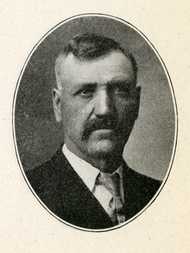
Laforest E. Potter, an Example of Early Minnesotan Grit and Determination

On a lark one day, I meandered around on the internet, searching for one of my great-grandfathers on my mother’s side. Imagine my surprise when I discovered he has his own Wikipedia entry, plus a YouTube video done by a stranger. Not bad for a man with humble beginnings who lived most of his life in the 1800s.

Why does he merit such acclaim in 2022? One reason is that he was a Minnesota state senator. Another is that he was a regent for the University of Minnesota. The final reason has to do with bricks. Yes, bricks. I’ll explain near the end of this post.

Laforest Potter

A cousin recently sent me recollections that Laforest, also known as “L. E.” (for Laforest Edgar), wrote later in life about his younger days. I’d like to share some of the highlights.

Laforest Potter was born in the same year that Minnesota became a state — 1858. But he was not born in the state where he spent most of his life. He was born in Ripon, Wisconsin. Both of his parents (John Potter and Olive Weymouth Potter) had moved there from Maine. His father was an orphan who farmed rented land and worked in the woods and on the water.

When Laforest was six, his father “rigged up a covered wagon and loaded in his belongings, which were mostly kids,” (he had ten!) “and started with others for Minnesota.” Laforest remembers crossing the Wisconsin and Mississippi rivers. It was on the Mississippi where he saw his first steamboat.

The family lived on the banks of the Watonwan River near Madelia, Minnesota, in the upper story of a log house owned by another family, who lived on the first floor. That family ended up spreading typhoid fever to Laforest and one of his brothers, who both survived.

Laforest remembers when he fell ill: “Father was working on a threshing machine to earn a living for us kids and one day in late fall, us boys were going to the woods to find wild grapes that had dried on the vines (and there were plenty). We got a short distance from the house when I became so sick, I had to turn back, and that was the last I remember until I was getting well.”

The next spring, they rented a log home across the river. That winter they were hard up for clothing and food. “At one time all we had was some small potatoes and not many of them. Father was away most of the time working at whatever he could get to do. Work was scarce, wages, low, and prices high.”

The family survived a deadly snowstorm that blocked roads and drifted through the cracks between the logs in their home until “our beds and the floor were covered when we got up in the morning . . . Father, knowing the condition we were in, started for home on foot with food. He made the trip where a less robust, determined man would have perished.”

When spring arrived, the family moved again to a farm near Mankato. They lived there for two years and Laforest got his first taste of farm work, made especially challenging after his father fell ill with appendicitis. “Us three boys, the oldest thirteen years old, did the fall work and husked the corn. We had no husking gloves then, and I remember the row I husked could be told by the blood on the husks where my fingers bled, but we stuck to the finish!”

It was near Mankato where Laforest first began to attend school when he was ten. In 1869 the family settled a land claim (I apologize to any Native Americans who may be reading this) fifty-five miles away near Springfield, Minnesota, the area where he was to live for the rest of his life.

He describes the area as “Fifty miles from a railroad, thirty miles from a doctor, and a day’s journey from a schoolhouse. This part of the state was one vast prairie with lakes and sloughs abounding with muskrats, mink, skunks, badgers, foxes, and some wolves, lots of buffalo bones, some Indian relics, all kinds of ducks, geese, sandhill cranes, prairie chickens, and jack rabbits.”

When they weren’t farming, the boys trapped. The family’s crops were destroyed for three years by grasshoppers. Laforest was able to receive about fifteen more months of schooling and survived more snowstorms.

Laforest writes about livestock and how he prized “the company and friendship of good animals more than that of some people I have met.”

He also recounted an incident that happened when he was a teenaged fur trapper one winter:

The ground and ice were covered with a clean layer of snow. There was a fox in one of my traps. He had lost a part of his tail and appeared as though he had been unfortunate at least. He was jumping and whirling around. I watched my chance and struck him on the head with my hatchet with sufficient force to kill him. As he lay there on the white snow with blood running from his mouth and nose, he sobbed and cried like a baby. I will never forget the effect this had on me, out there in the still morning, everything frozen and white, with death at my feet. I believe I have been more careful since in causing pain or death to animals unless necessary.

Wow – what an image! I can just see that fox. Perhaps this is where I get some of my interest and empathy for animals from.

Laforest worked his father’s farm until his father died in 1885. Less than two months later, Laforest married Ada May Redford and then purchased a farm not far from his father’s. His “Shady Lane Stock Farm” outside of Springfield was highly successful. He raised Hereford cattle, pigs, and sheep. His Herefords won numerous awards and are what probably got him an “in” with the University of Minnesota, leading to his appointment by the Minnesota governor as a regent (1920-22).

The “shady lane” on Shady Lane Farm in Springfield, Minnesota (2016)

He was also involved in many agricultural groups and became a sought-after speaker. My guess is that this is what led to his election to the state legislature.

According to the YouTube video I mentioned earlier, Laforest was also a proponent of home improvement, believing that farmers should improve their homes with conveniences “for the comfort of their wives.” He said that farm wives had “as much right to the benefits of labor-saving conveniences and a pleasant home in which to work, as the husband has to improved machinery and fine farm buildings.” Quite a progressive thought for the time, I’m sure. Or perhaps his wife Ada was the one who wrote his speeches?!

Laforest’s Shady Lane Farm was one of the first in the county to have electricity. His home still stands today, and I had a chance to see it a few years ago.

The Shady Lane Farmhouse that Laforest built (2016)

In 1911, Laforest built a silo on his farm from curved hollow clay blocks (rusty orange in color) purchased from the Ochs Brickyard across the road. This is what piqued the curiosity of Vince from Minnesota Bricks. He wondered about the silo’s history, since he has an abiding interest in bricks.

He did some research and discovered Laforest. He shared his knowledge in this impressive YouTube video. Laforest’s silo is no longer standing.

Laforest survived poverty, typhoid, killer snowstorms, child labor, grasshopper plagues, and a lack of formal education. He succeeded through grit and determination. He summed up his philosophy with these words:

First, believe you can do a thing, and then do it or bust a hame strap!

(A hame strap is one of the straps on a harness for horses. It sometimes broke when the horse pulled extra-heavy loads.)