
When the Rainy Lake Visitor Center was dedicated in Voyageurs National Park in northern Minnesota, I was there. That was maybe about thirty-five years ago. My mother wanted to attend, and she asked me to go with her. I’m not sure why she wanted to attend except that she liked national parks and perhaps this was her way of feeling connected to a local one.

The ceremony was interesting and came complete with a man dressed up as a French voyageur – one of the intrepid fur traders who plied the waters by birch bark canoe in the 16th to 19th centuries. I know I have photos of the ceremony – I’ll peruse my old albums to see if I can find any to include with this post.
This is just a long way of saying that, although I was part of the park’s beginnings, I had not visited it much, if any, since.
Russ and I had a desire for an overseas vacation this summer, but I, as the major trip planner, just couldn’t muster much enthusiasm for the effort it would require. I think I’m still recovering from all the travel we did last year in the “post-COVID” frenzy.
So, we thought of trips closer to home. Houseboating on Rainy Lake in Voyageurs popped into my head. There used to be billboards advertising the houseboat companies on a local major highway and I always thought it would be fun to try.
The idea appealed to us because it would be like being in the wilderness, except with comfortable beds, a refrigerator, and no need to paddle (except for fun) due to the houseboat’s motor. We have some experience driving boats. It sounded perfect! Plus, we’d get to know the park better.
With enthusiasm, we began planning and invited Russ’s grown son Garrett along on the four-night, five-plus-day trip.
After we arrived at the houseboat base just outside International Falls, Minnesota, we loaded our gear onto the watercraft, a 42-foot Minnitaki, which sleeps two to six people. From the dark paneled interior, it looked like the boat was built in the mid-1980s. Some of the houseboats feature hot tubs, but we did not feel the need for one of those. We were being decadent, but not THAT decadent.
We were required to rent a small motorboat to tow along behind us in case of emergencies. The motorboat is also useful for exploring or fishing. We also bought 3 bundles of firewood. We brought our own paddleboards and a kayak, which easily fit on the top level of the houseboat.
We were oriented to its somewhat complicated workings by one of the staff, who also piloted it out of the harbor and made sure we were comfortable driving it before he was picked up by another staff person in a motorboat and we were left alone.
It felt rather like when I was cast adrift on a paddleboard for the first time. However, this was a 42-foot, a much more expensive craft! I was glad we opted to pay the hull insurance the company offered.
The weather was sunny with a wind at about 6 mph. That might not seem like much wind, but in a boat shaped rather like a huge bathtub, it was a lot. We all took turns driving and were surprised by how hard it was to keep a straight course. The boat comes equipped with computer navigation and the lake comes equipped with red and green buoys. We just needed to keep the red buoys on our right and the green ones on our left so that we did not run aground. Easier said than done.
After zigzagging across the lake for about 8 miles, we were ready to moor for the night. Rainy Lake features designated houseboat sites on land where the boats need to be tied up for the night by 6 p.m. No driving boats in the dark is allowed, nor is anchoring.

The first designated site we wanted was already occupied so we chose a “traditional” site on a nearby island. We weren’t sure of the island’s name because it wasn’t listed on our chart, but we figured out later it was Oveson Island. Traditional sites don’t have houseboat signs and they are a bit more primitive than the designated sites.
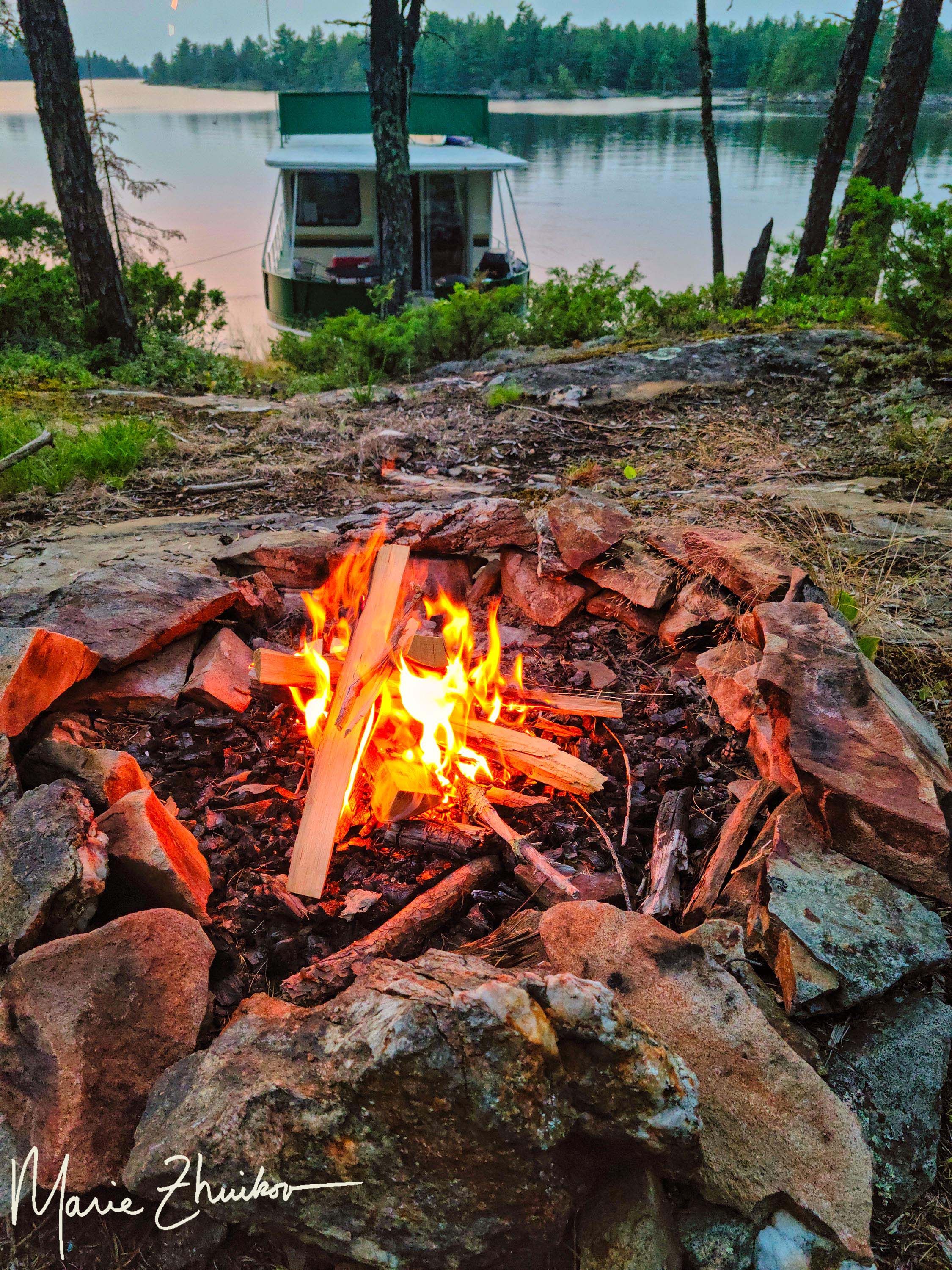
We tied the houseboat to three trees as instructed and walked down the skinny wooden gangplank to explore the small site, which came with a fire grate. It looked much like any wilderness campsite with rocks and pine trees.
After a scrumptious steak dinner thanks to the houseboat’s gas grill, I explored the island. A well-worn trail led away from our campsite. I was surprised when it ended at a well-built privy. I was like, “What the heck?!”
A trail from the privy led to a boardwalk and a small picnic area. Next to that were several buildings painted a light green. Interpretive signs along the way informed me this was the Oveson Fish Camp, built by Harry Oveson and occupied during summers from 1959 to 1985. Harry fished for whitefish and walleye.

An icehouse, a fish processing shed, and Harry’s house make up the camp. There’s also a large dock so boaters can visit.
Besides being a fisherman, Harry was a jack-of-all trades. He was an inventor, ham radio operator, mink farmer, home flipper, and an avid reader and bird watcher. I figured out later that I am acquainted with his nephew, Tony, who still lives near the park. Harry’s descendants operate a lodge on Pelican Lake, about an hour’s drive away.
Excited by my discovery, I scampered back to the houseboat. When I arrived, I told the guys that I found something, but I didn’t tell them what. They followed me down the trail, curiosity piqued.
I stopped proudly at the privy and said, “I found a privy!!”
They looked unimpressed until I laughed and pointed down the boardwalk where they could see the rest of the fish camp buildings. They were more impressed by this. (It’s the wilderness. Sometimes, you need to make your own entertainment.)
We spent the rest of the evening exploring the camp and later had a campfire at our site. At sunset, a single loon stationed itself off our stern in the small bay. It wailed a few times, making the wilderness ambiance complete.

We also heard noises nearby that sounded like people having a party. Garrett thought it might be geese. Later, it began to sound more like geese to me, but not Canada geese. I wasn’t sure what they were.
The night sky was filled with gobs of stars – Voyageurs National Park was just recently certified as an official Dark Sky Park, so it’s protected from light pollution.
Our sleep on the boat was restful except for the thumping of the motorboat against the stern. We hadn’t read the part in the boat manual yet about tying the motorboat up on shore for the night, but you can be sure we did that the following night. That turned out to be a very good thing!
In the morning, I enjoyed my mug of hot chocolate outdoors on the back porch of the boat while wearing my fluffy light blue bathrobe. I have never worn a bathrobe in the wilderness, and this felt especially luxurious.
The weather forecast called for sun, heat, and twice as much wind as the day before. Given the difficulty we had steering the boat, we decided to stay put. The wind was expected to die down the next day.
We spent our time paddling around the island in our kayak and paddleboards. Garrett and I saw a bald eagle, a single loon that I was pretty sure was the same one from the previous evening, and a regal pair of trumpeter swans. These must have been making the mysterious geese-like sounds we heard the night before.
The day was restful – full of reading, games, conversation, and eating. I watched a red squirrel drink from a puddle. I investigated the otter scat – full of crayfish parts – that littered the shoreline rocks. The sunsets both nights were beautiful – the sun made into an orange and then huge red ball in the sky from haze from wildfires in Canada. The loon parked itself off our stern again, giving its mournful wail. It sounded lonely. I called back to it a few times to give it some semblance of company.

However, the night was not restful. Around midnight, the wind switched so that it was directly behind us, causing our houseboat to bang into the shoreline rocks. Russ got up and retied our lines, but it was too late; our boat was wedged sideways on a rock ledge. After his effort, much of the bumping sounds stopped, but we had visions of a hull breach and our trip possibly being over. Once again, I was thankful we bought that hull insurance.
We’d have to radio the houseboat base the next morning and let them know the bad news. I mulled this over while listening to the loon, who had begun calling again.
Was our trip over? If not, how did we get out of this fix? Read the next installment, coming soon!
 Marie's Meanderings
I absolutely loved reading about your adventure on Rainy Lake! The description of the sunset and the peacefulness of the island campsite really drew me in. It sounds like a perfect getaway. I’m curious to know, did you eventually get your boat unstuck from the rock ledge? I can’t wait to read the next installment and find out! Such an engaging and well-written blog post! The sunset on Rainy Lake sounds absolutely breathtaking.
The sunset was breathtaking. You’ll have to read the next post to discover how we got off the ledge. It’s coming in a few days…. Thanks for stopping by!
You left us with a cliffhanger. Not fair!
Yeah, I’m so MEAN!
Can’t wait to read more. Sounds like the perfect northern lake adventure!
Oh, it was an adventure, all right! 🙂
It always pays to take the insurance! It seemed peaceful until you got stuck.
Yes, it was very lovely until the wind came up!
It sounds like you had a wonderful adventure–except for the wind issue. But no adventure is complete without a few “problems.” After all, that’s part of the adventure. I hope all turned out well. I guess I will have to read Part 2 to find out!
Hi Diana. So true about adventures having problems. We obviously survived or I wouldn’t be writing this, ha ha!
This sounds lovely. I sure hope that you didn’t have to cut your vacation short. Your pictures are so wonderful. To me this beats getting on an airplane and going to Europe.
Thanks, Vickie. In some ways, hopping on a plane would have been easier. At least we wouldn’t have had to fly it ourselves!