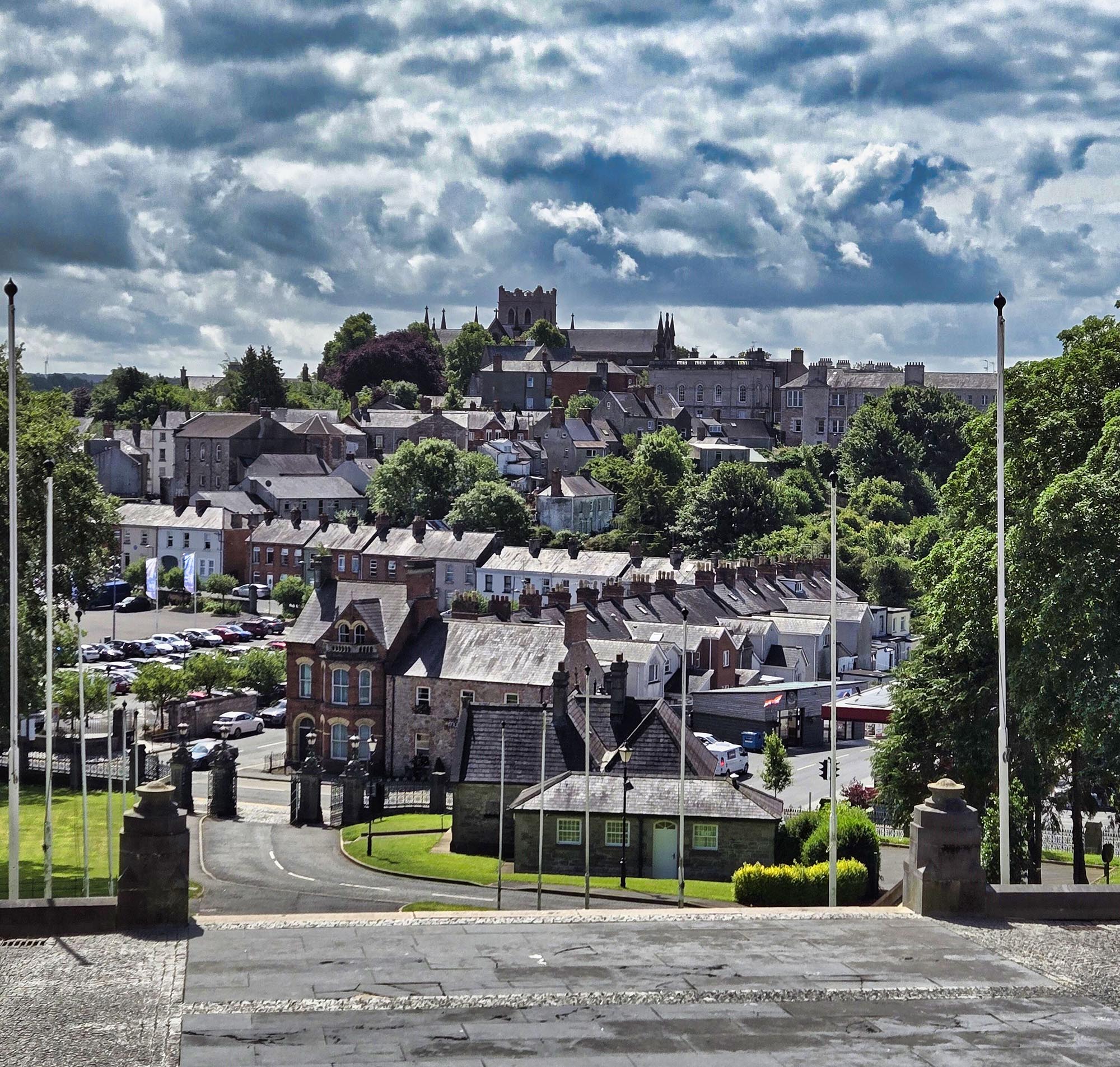
This day was a big deal for us. We’d been working for six months with My Ireland Family Heritage, a small, family-owned company that does genealogy research and tours. This was the day for our tour of the lands of Russ’s ancestors!
Our guide, Ian, picked us up from our hotel in Belfast. Our first stop was the small town of Armagh near where Russ’s ancestors lived. We had requested a visit to St. Patrick’s Cathedral there, but once we reached the town, we were surprised to learn that there are two of them! The oldest one (year 445) is Protestant and the more recent one (1840) is Catholic.
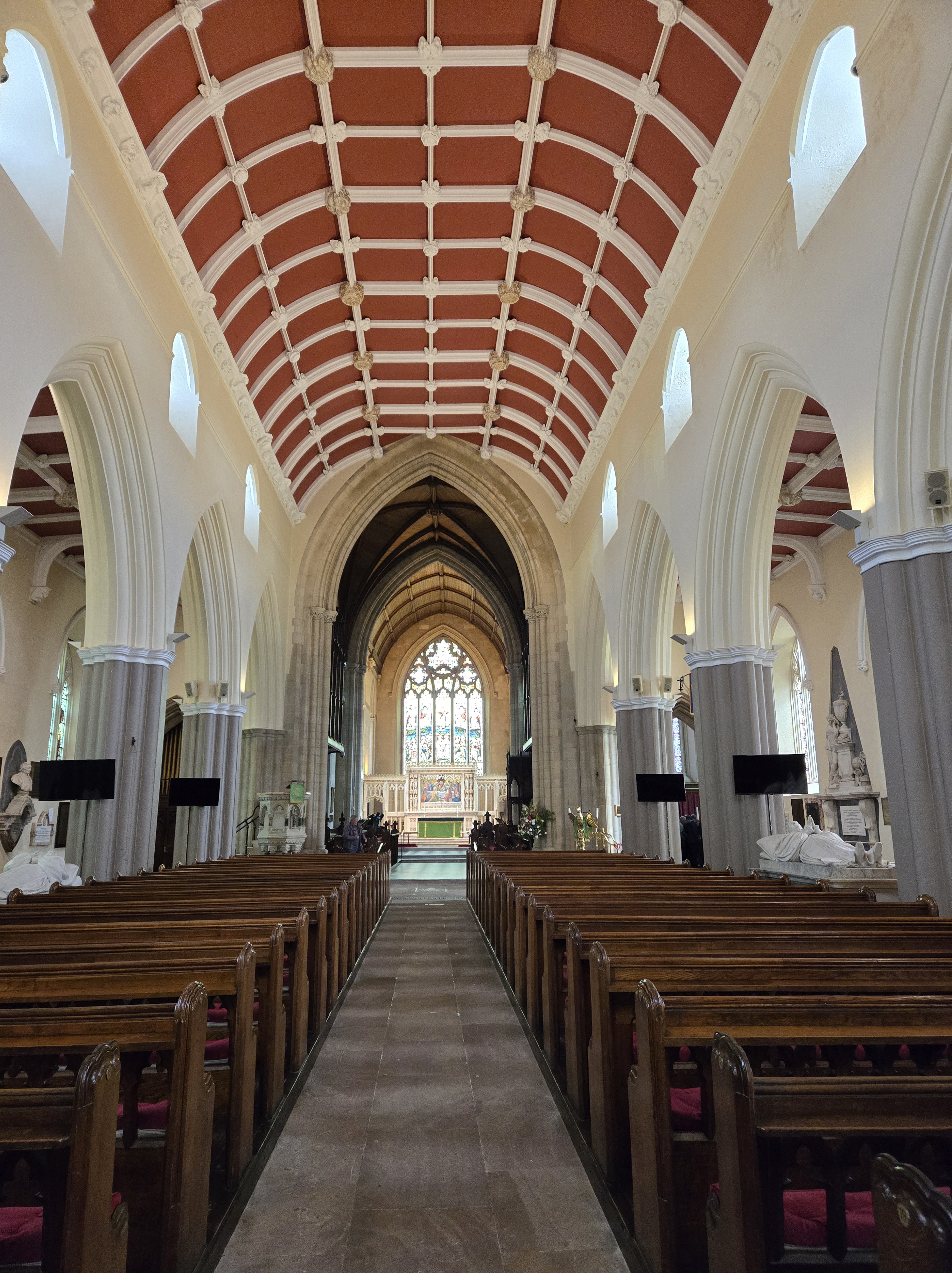
Armagh owes its association with St. Patrick to the old church, which is named St. Patrick’s Church of Ireland Cathedral. It stands on a hill overlooking the town. The hill (Ard Mhacha or Height of Macha) is where the city (Armagh) got its name. Before the church was built, it was a major ritual site and an ancient royal center. The Book of Armagh states that St. Patrick decreed that the Armagh church should have pre-eminence over all other churches and monasteries in Ireland, a position it holds to this day. The present structure was built in 1268 but it has been restored several times due to fires and worship needs.
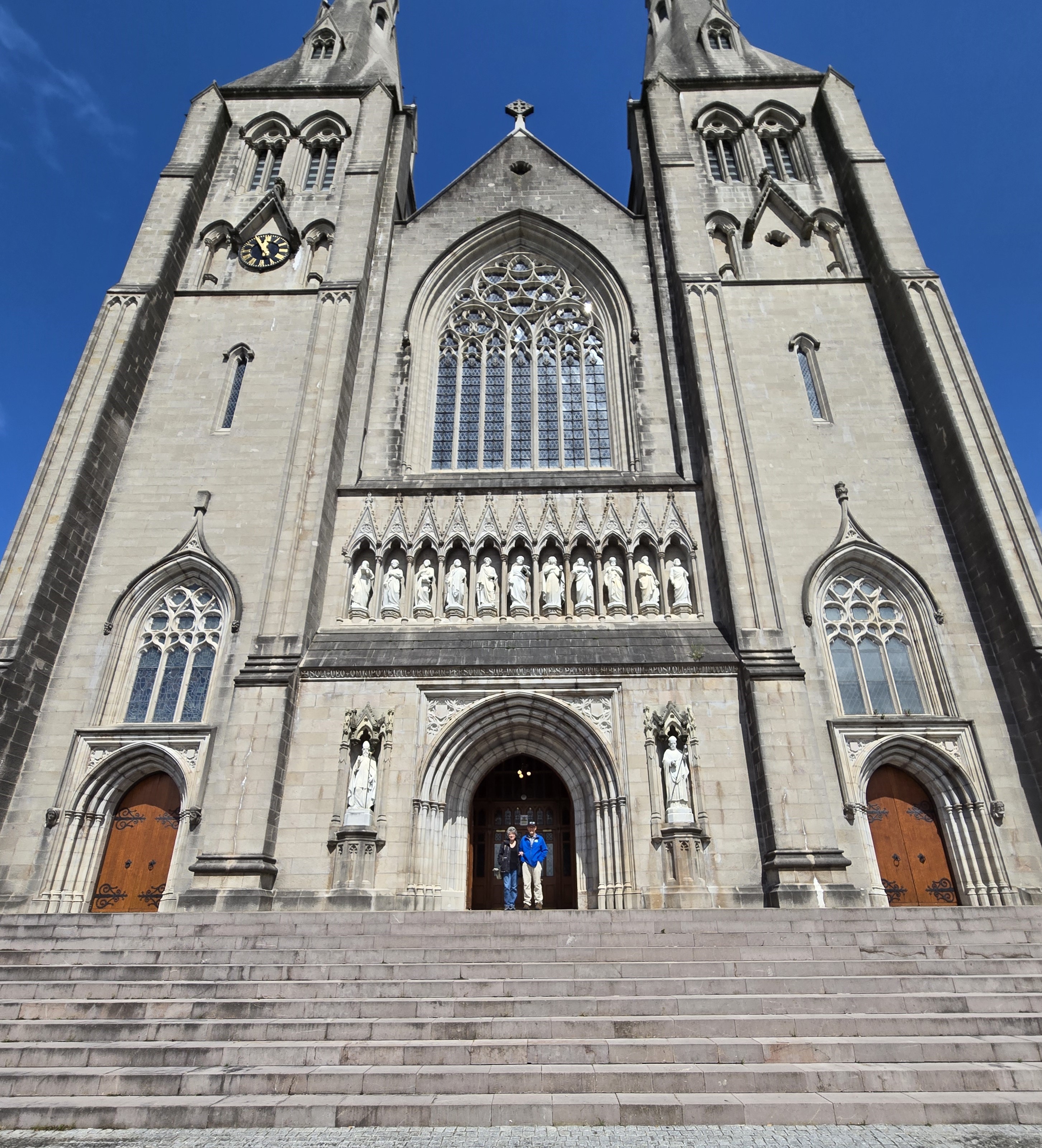
Across the way atop another hill is the other church, St. Patrick’s Roman Catholic Cathedral. It’s the seat of the Catholic Archbishop of Armagh. We could easily see it from the steps of the Protestant church. Of the two, the Catholic one is the fanciest, probably owing to its more modern construction.
Russ’s great-great-great grandfather James Henry Thornton lived just outside of Armagh in the small township of Foybeg. He came to Ireland from England with the unenviable job as a tax collector for Lord Lurgan (Charles Brownlow or Baron Lurgan), an Anglo-Irish politician who represented Armagh in the U.K. Parliament.
James Henry was married twice, but we didn’t know the names of either of his wives. James Henry had two sons, James and John, one with each wife. Besides being a tax collector, his occupation is recorded in church records as a farmer. Ian told us that Foybeg is known for the growth and weaving of flax into linen. It was the “cash crop” of the time, much like coffee is for Brazil today. So, he could have been a flax farmer.
His son James eventually moved to Australia. Russ is related to John, who was his great-great grandfather. He is described in family records as at least six feet tall. He loved horses, hunting and good whiskey, but hated work. He always carried a cane and had at least two dogs following him at all times. He was educated to teach school in Northern Ireland.
John married Jane Berry and they had eleven children. One of them was Russ’s great-grandfather, William John Thornton, who went by the name John Jr. After he emigrated to America, he married an Irish woman, Sarah J. Fox. She grew up near Foybeg.
After lunch, Ian took us to St. Paul’s Church, which was where Sarah’s family worshipped and were buried. We saw lots of graves with familiar family surnames (Fox, Johnston, Berry) but did not come across anything significant. Inside, there was a “new” baptismal font on display. The old one was shoved underneath a spiral staircase. Could that have been used for Sarah Fox or her family?

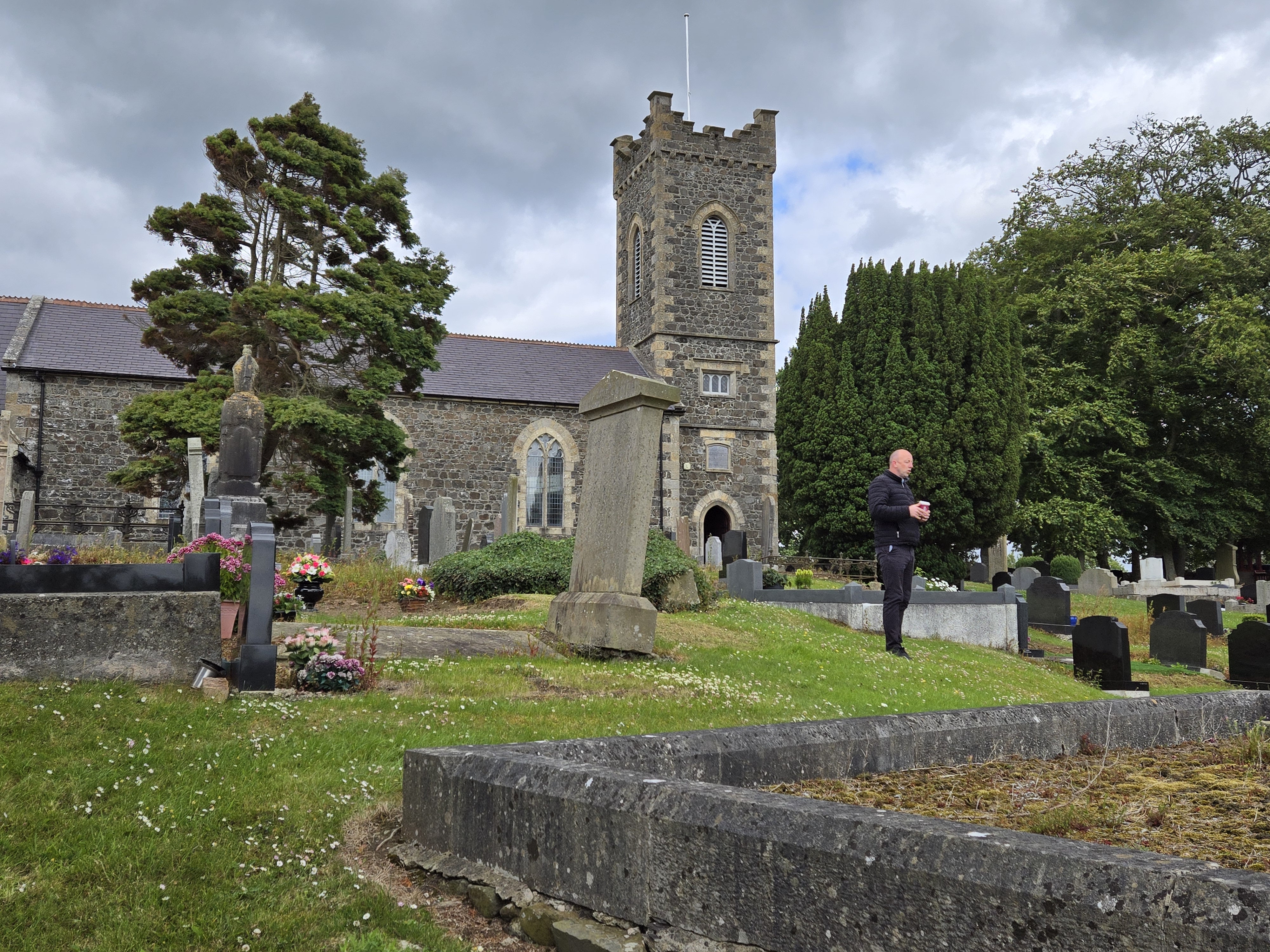
Our next stop was the Drumcree Church of the Ascension, where we hit the jackpot! This was the church (Church of Ireland denomination) where the Thorntons worshipped and were married/buried. The church is surrounded by cow pastures and apple orchards and even has an apple tree depicted in a stained-glass window.

Besides the ancestral connection, Drumcree Church was significant during Ireland’s “troubles.” For several years in the 1990s, this Protestant church drew international attention as the scene of the Drumcree standoffs. Each year, the Protestant Orange Order marched to-and-from a service at the church on the Sunday before the 12th of July. Residents in the nearby Catholic district prevented the march from continuing through their neighborhood. Thousands of Orangemen and British loyalists gathered at Drumcree and violently tried to force their way through, but were held back by security forces, who built large steel and barbed wire barricades. These yearly “sieges” of Drumcree ended in the early 2000s.

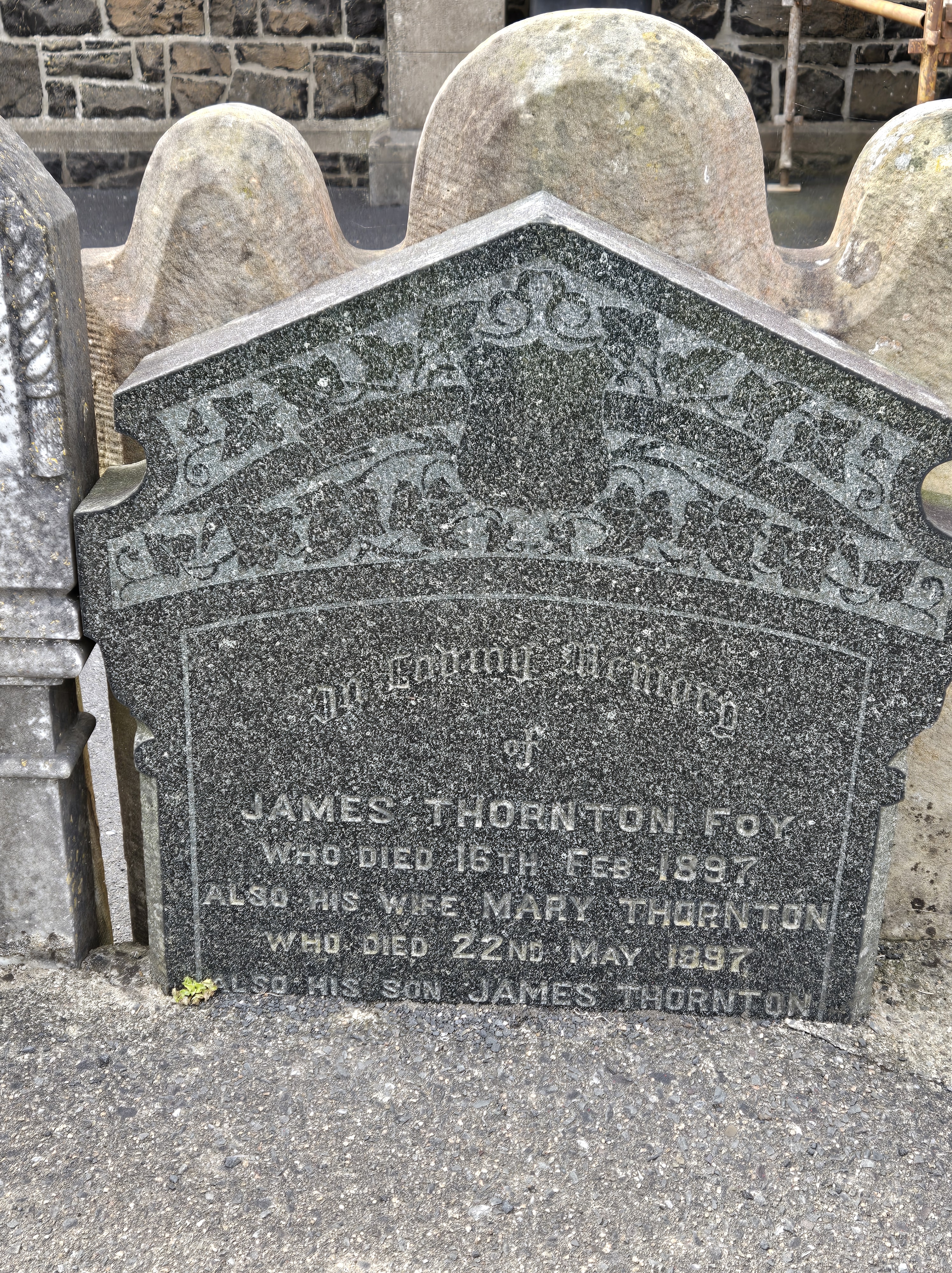
As we strolled around the graveyard, which smelled of manure from the cows nearby, we noticed a broken headstone propped up against the low stone wall that borders the yard. It was the headstone for James Henry Thornton and Mary. Mary must have been James Henry’s second wife! The last line on the tombstone says something about their son James Thornton, who was thought to have lived in Australia. Maybe he returned home to Ireland, eventually? The church member who let us into the building for a tour said that the stone must have been broken in the past, so that’s why it was leaning up against the wall and not over their gravesite. He said they do that instead of just getting rid of the broken ones.
As if discovering this significant gravestone wasn’t enough, our talkative guide Ian next took us to the homesites of Russ’s ancestors. Two out of three weren’t accessible or there was nothing to see but an orchard, but the Thornton homesite was different! We peered down a driveway that led to a modern house. Between the driveway and the house was an old white building with red doors and a rusting metal roof. This was where Russ’s Thornton ancestors lived! It looked more like a shed or a barn now than a home.
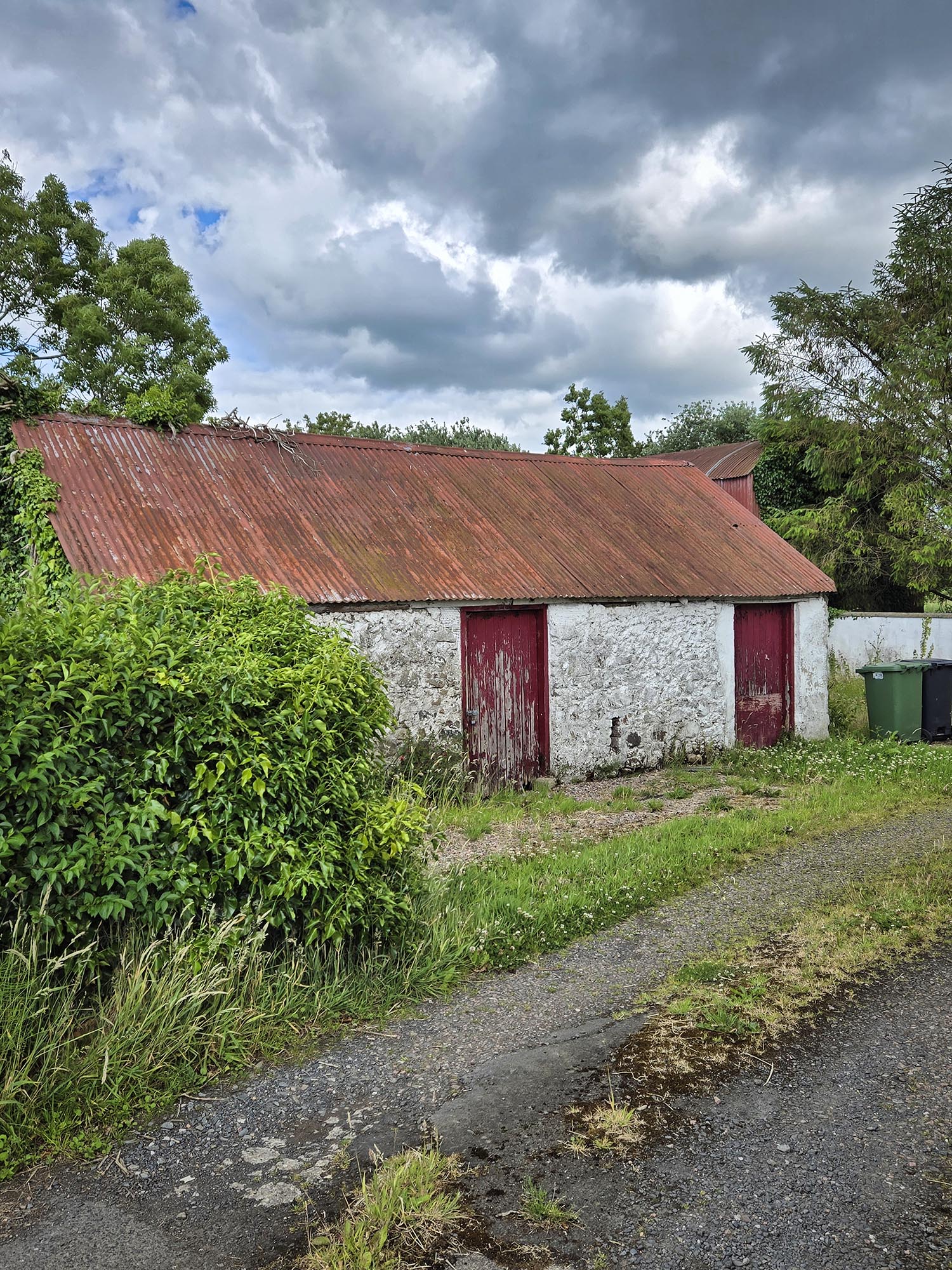
We only had time to take a few photos before Ian wanted to leave. You see, he is a Catholic from the Republic of Ireland to the south. We were in Northern Ireland, which is mostly Protestant. He did not feel comfortable hanging out in rural areas for fear of a confrontation. (People can tell where he’s from by the license plate on the van.)
Once we were back in the van driving away, Russ said a lady had been out in the yard. I would have loved to have had the chance to speak with her to see if she knew anything about the past inhabitants of her place, but I did not see her when I was taking pictures of it. Russ took the geographic coordinates of the location, so perhaps, if we ever return, we will have more time to explore and chat. Russ said that this was his favorite part of the tour.
As the ancestry book that the tour company put together for us says,
What was once a home where children played a hive of activities stands quiet now, a home for spiders and field mice. In the corner of the eves an owl hoots every evening . . . People lived and died in this cottage. Its walls could tell you stories, happy and sad. Children grew up here, some stayed near, and some traveled far and wide to the other side of the world. They packed their memories to start a new life, new beginnings, and new memories, leaving this little cottage to nature.
Russ’s great grandfather, William John Thornton emigrated to the U.S. He settled in Manchester Connecticut and married Sarah. They had four children. At the time of his marriage, William John was employed as a “velvet finisher.” He also worked as a coachman and a laborer later. Unfortunately, William John was an alcoholic. He died in 1917 from freezing to death in a drunken state in a roadside ditch. Sarah lived until a ripe old age, dying in 1964.
Tour over, Ian drove us to Dublin, the site of our next adventures!
 Marie's Meanderings
This story leaves me feeling strangely nostalgic for a past I never experienced.
With your red hair, you can be honorary Irish.
Aye 🙂
Quite a meaningful tour. Your husband “crossed paths” with ancestors.
Yes, he was feeling it!
What a wonderful trip. And how wonderful that Russ was able to see the places where his ancestors came from. Your pictures are stunning.
Thanks! It’s hard to take a bad photo in Ireland.
This brings such joy to my soul!! This and the previous two posts. Ireland was my first international trip, and has a very special place in my heart!! I am stoked you were able to explore both Ireland and Scotland!! Excited to see what else you were able to see.
Thanks for reading, Brittany! We were traveling for 3 weeks, so there’s much more to come.
What a wonderful treat for Russ to trod the home of his ancestors! I’m glad there are companies doing this. I hope to see more of my ancestral villages someday (Germany). The photos are a wonderful addition.
I hope you get to spend more time in the place of your ancestors, Eilene. It’s so meaningful! I was happy to have stumbled upon this tour company. They were so helpful!
Fascinating discoveries, Marie. I recently found out that a number of my paternal ancestors are from Armagh, including my father’s mother’s parents who came to the U.S. in 1886. It’s so lovely that you were able to share this adventure with Russ.
Wow, Carol, that’s amazing! Russ’s ancestors came to America around that same time – 1880s. I wonder if your ancestors knew his? Armagh is not a large county. Thank you for letting me know.