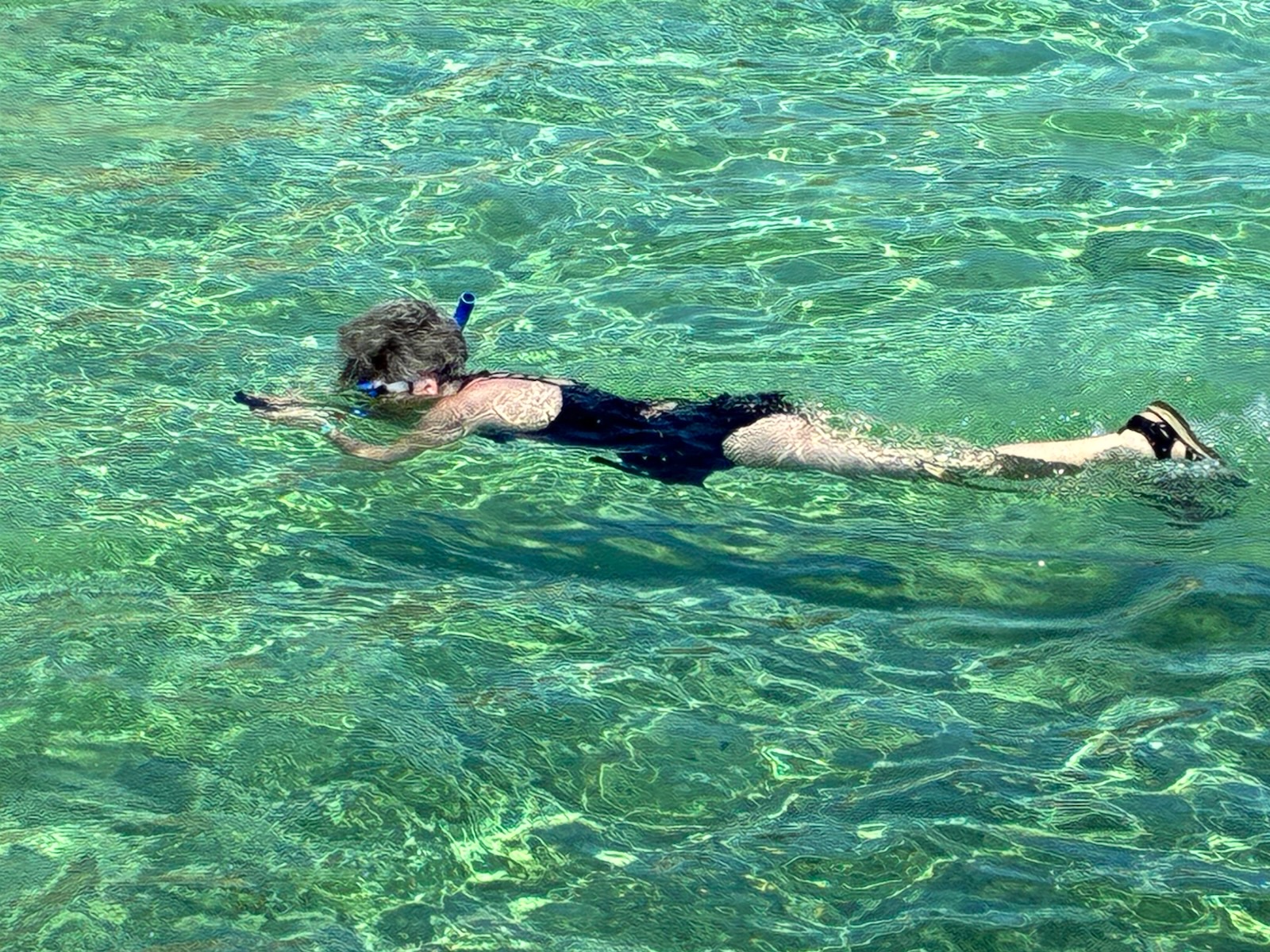
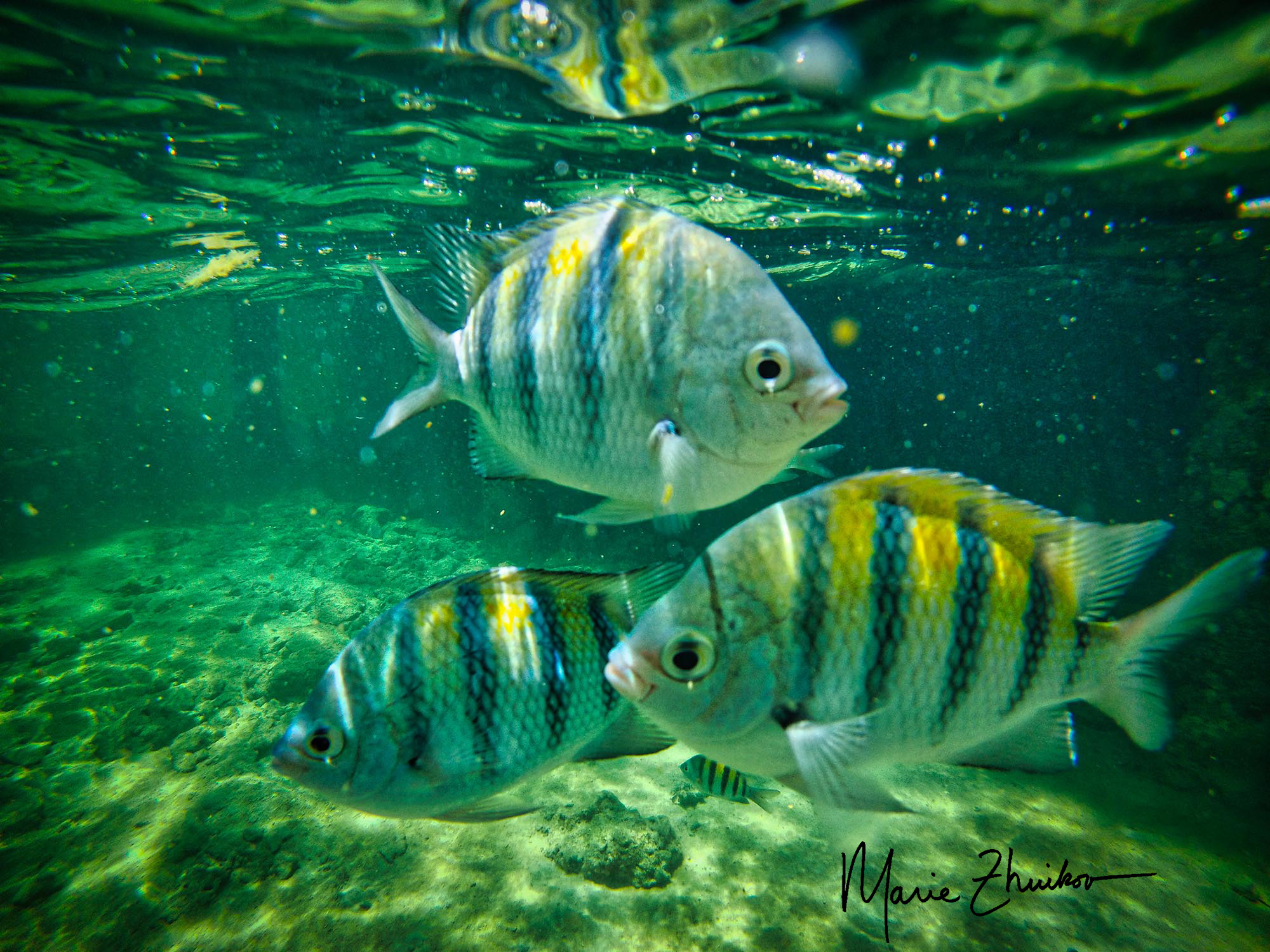
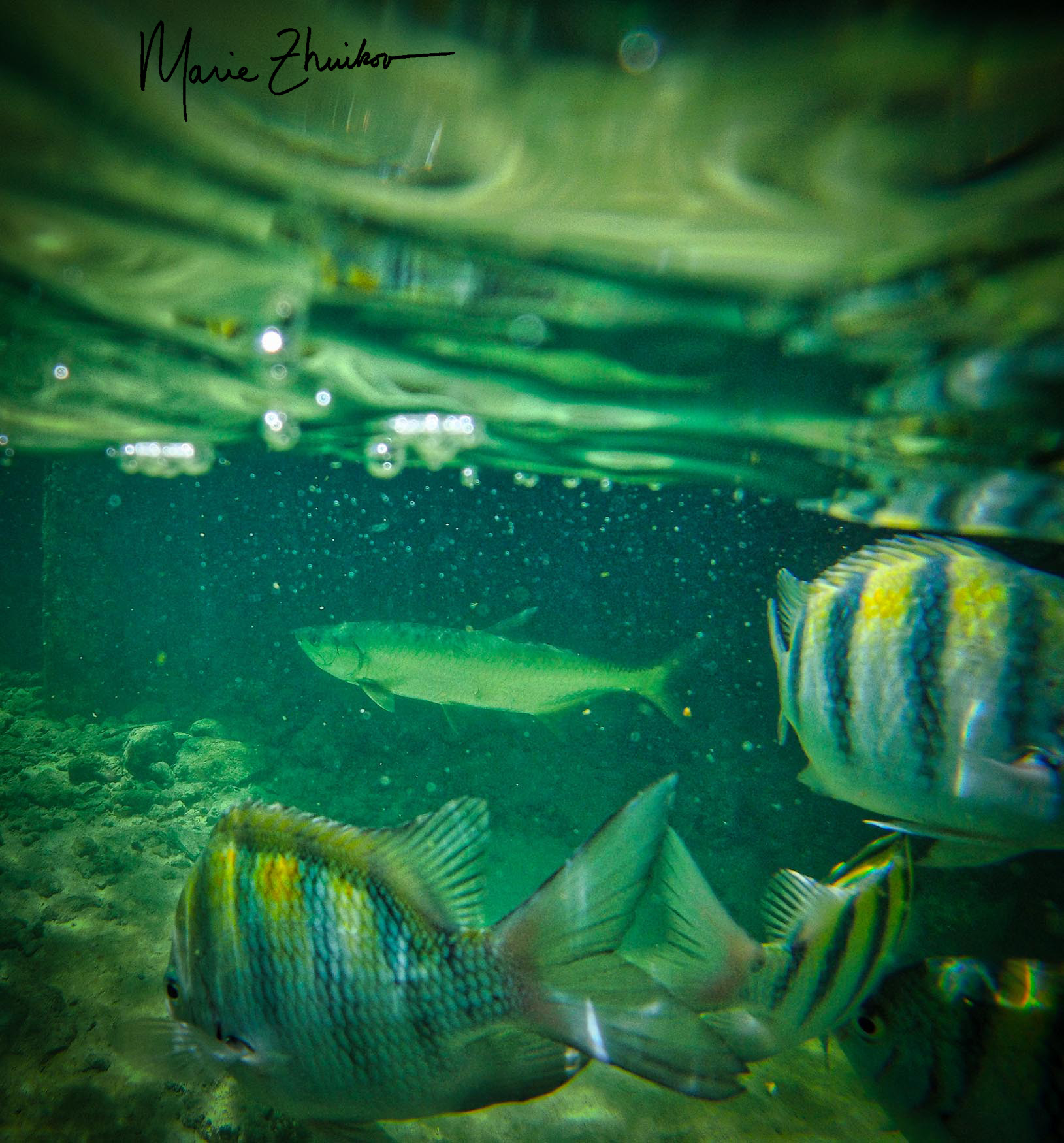
At dawn on our next day in paradise, I jumped into the water off the resort dock and cavorted with three-foot-long tarpons and other smaller tropical fish during the resort’s daily fish feeding time.
Why would I put myself in the middle of a feeding frenzy with tarpons, a prehistoric fish with sharp teeth? I’ve always wanted to try underwater photography. In preparation for this trip and as a retirement present, I bought a GoPro Hero camera. It’s on the lower end in terms of price and bells and whistles, but it looked easy to use for a beginner like me. Plus, it’s small and perfect for traveling. Fish feeding time seemed like a good test run for the camera before more serious underwater adventures.
One of my kickboxing trainers back home had experience with a GoPro and suggested I attach the camera to something that floats because, “Once you drop it, it sinks.” I immediately had visions of my camera, thirty feet below me on the bottom of the ocean – close enough to see but too far to reach with snorkel gear and ears that don’t equalize water pressure well. So, along with the camera, I purchased the Swim+Snorkel kit, which features a floating tube mount with a wrist strap and a small carrying case. On my morning outing, I was glad to discover that the camera did indeed float when attached to the tube mount.
The fish did not disappoint and neither did the camera. It was also helpful that on the dock, Russ was throwing fish food my way. Black and yellow sergeant major fish swarmed around me. Blue sea chubs darted past. Thankfully, the tarpons were shyer, keeping to the outskirts.
The GoPro has video and photo settings. Switching between them requires a swipe of the screen. I wanted to stay in photo mode but noticed that every time a wave washed over the screen, it would switch to video mode. After my outing, I discovered it’s possible to lock the screen so that this doesn’t happen.
This discovery made our next outing that day, a trip to Stingray City, much less frustrating! For decades (between four and eight depending on who you ask) southern stingrays have gathered at a sandbar off the island to eat leftover fish parts discarded by fisherman. Our guide, Jefferson, told us mosquitoes used to be so bad on the island that fisherman came out to the sandbar to clean their fish in peace.

Now that mosquito populations are more under control, the rays gather to eat squid offered by tour operators instead. The attraction is tightly controlled so that the rays and the sandbar don’t get overrun, and the rays have been microchipped by scientists so that they can monitor them and ensure they aren’t getting too stressed by the human interaction.
Yes, all these wild stingrays still have their stingers! I had to prod Russ a bit to go on this adventure. He was finally persuaded by reports of the safety of the outing and the friendliness of the rays. One description likened them to giant puppies of the sea! Most of the rays are female – they’re larger than the males and friendlier, apparently.

Entering the water with these soft, gentle giants was a bit freaky, but it was so cool! Russ impressed me. He was the first one off the boat and into the water with the rays. (I was second.) My GoPro worked great and I’m happy with the images I was able to capture. Russ even let a ray suck some squid off his hand and, with Jefferson’s help, he kissed a ray (and liked it)! I was too busy taking photos to partake in those activities, but I did pet a ray. The bottoms of the rays were smooth and soft, but the tops felt like sandpaper if you went against the grain. This experience was a highlight of our trip for both of us.

As part of our tour, Jefferson took us to a nearby coral reef, where we snorkeled for quite a while. Watching the fish was fun, but the poor condition of the reef was distressing. The coral was bleached and there were far fewer fish than there would be on a healthy reef.

We both had healthy appetites after these adventures. We satisfied them at Tukka Restaurant (East End), one of the other places on the island that serves lionfish (besides Eagle Ray’s Bar and Grill). We hadn’t made reservations, so the hostess walked us through the noisy, crowded main dining room to a lower room that sported plastic tables and chairs. However, the ocean view was just as stunning and, after the couple who were there when we arrived left, we ended up with the huge room all to ourselves! Tukka’s specializes in Australian/Caribbean fusion cuisine. I don’t recall what we ate, but it was very good. Every meal we had on the island couldn’t be beat.
Every evening at 5 p.m. restaurant staff and guests feed frigate birds off the dock. We arrived too late for that spectacle but were able to catch it by chance the next evening.
Next up: Blue iguanas, blowholes, a mansion, and frigate birds.
 Marie's Meanderings
What an adventure, Marie, and your photos are spectacular!
Thank you, Dave. We stayed on the island for a week, so there are 4 more days of adventures to come!
Looking forward to seeing more posts! 🙂
Georgeous photographs….whoever would have thought to ‘pet’ a stingray!
The rays seem almost to enjoy it!
Good job with your underwater camera!
Thanks! It was a learning curve, but I’m glad I figured it out.
Everything looks so gorgeous (except the bleached coral)! I’m sold.
Grand Cayman is truly a memorable, awesome experience.
The stingrays are so cool. I cannot imagine kissing one, though.
Me neither! I must admit I was not tempted by that particular experience.
Great photos!
Wow, what a beautiful place, and such gorgeous photos!
Thanks! We were glad we persevered to get to the island.
This looks like a wonderful experience and the fish are beautiful.
So true!
Looks amazing, but I don’t like that they feed the stingrays, especially to feed them squids, which are very intelligent. Maggie
I understand your concerns, Maggie. The ray feeding is a mutually beneficial relationship that’s been going on for over 70 years. During COVID when there was less human activity on the sandbar, our guide said that hammerhead sharks moved in and preyed on many of the rays. The rays are protected by the human activity and they have a food source. And, of course, the people get to interact with the rays. You’re right about squid being intelligent. I can’t do anything about that issue but at least the rays are getting fed something natural, not like French fries! 🙂
I guess after 70 years they have to continue, but there are so many that do it now just for the tourists. As COVID showed, it puts the fish at risk.
Pingback: Grand Cayman Day 4: Blue Iguanas, Blowholes, a Mansion, and Frigate Birds | Marie's Meanderings
Pingback: Grand Cayman Island Day 5: Art, Turtles, Hell, and Leaving our Mark | Marie's Meanderings
Pingback: Grand Cayman Day 6: Green Parrots and Starfish | Marie's Meanderings