Here’s yet another side detour from my New England travelog. Don’t worry, I’ll get back to it!
The other night Russ and I meandered around the backroads north of Duluth, joining many others who parked their cars in random spots and looked up to the spectacle happening in the sky.
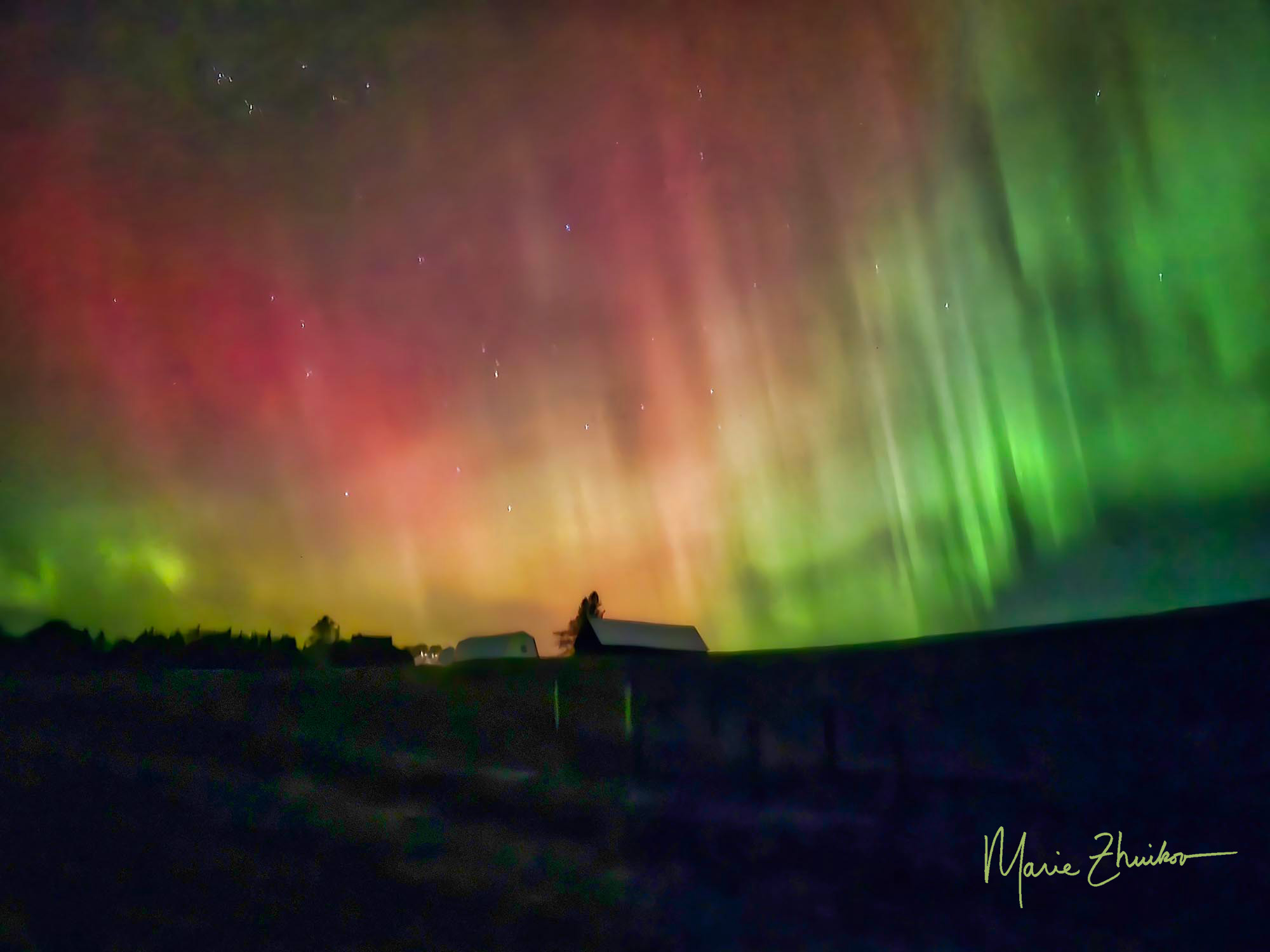
That spectacle was the northern lights. I took these photos the second night of the show at about 8:30 p.m. It was so kind of the aurora to happen before bedtime! We found a spot on a gravel road where we could see a whitish curtain of aurora on the horizon. We first stopped at a town hall but there were too many lights, so we went back down the road until we found a dark area. I took a few test shots with my phone camera and wowza! Jackpot.
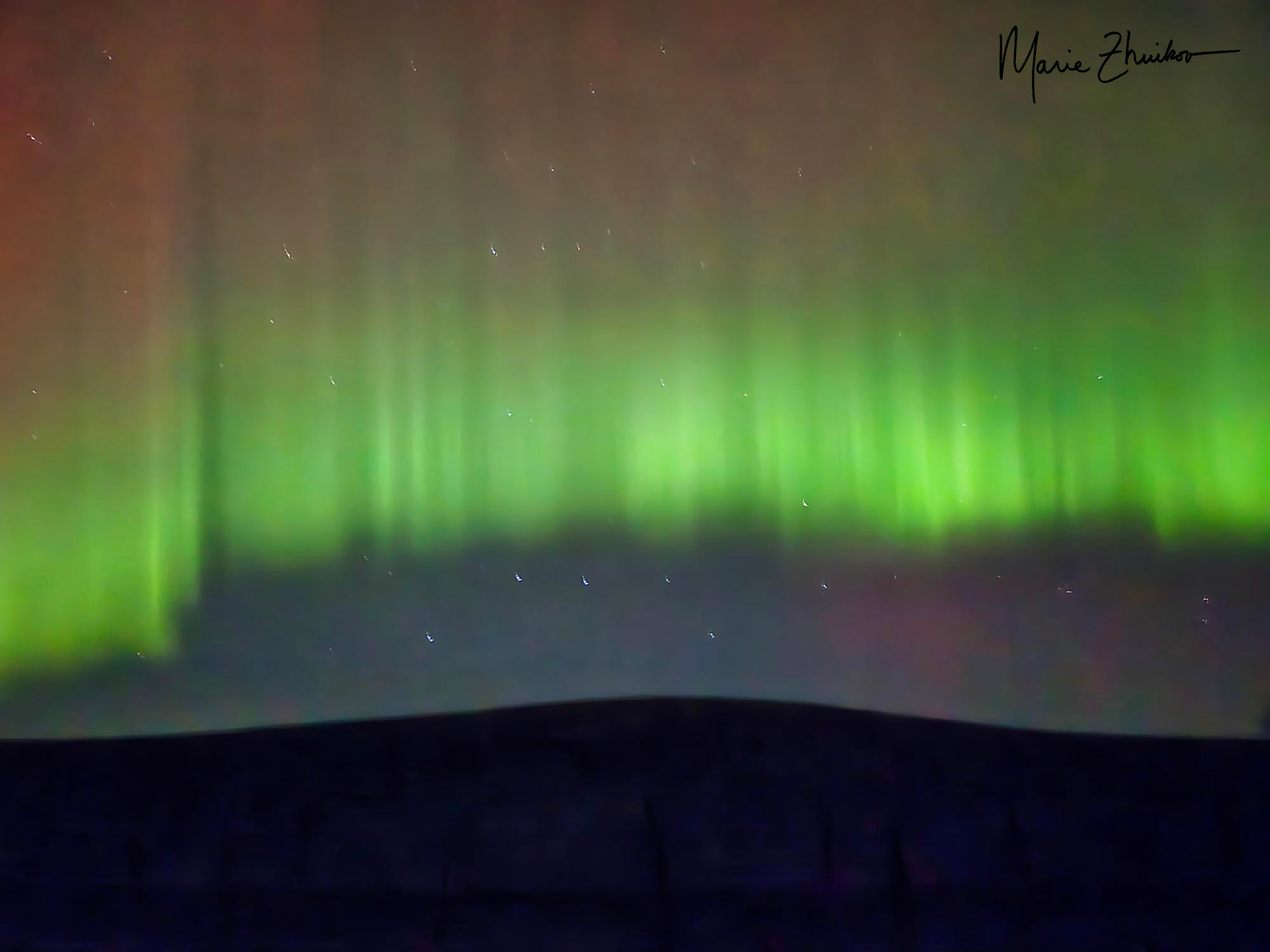
A green curtain filled the sky, with some red overtones. As the lights continued to dance, the red intensified. This color is rare in auroras.
Here’s an explanation from a local astronomer, Astro Bob (King). I don’t totally understand it, but here’s what he said about that storm:
Red aurora occurs high up in the atmosphere at an altitude of around 150-300 miles. Green emission happens at lower altitudes, around 75 miles. Both are produced when incoming charged particles strike and energize oxygen atoms. After the impacts, the atoms release that energy in the form of green and red light when they return to their original relaxed state.
At high altitude, the number of atoms drops sharply — it’s basically a hard vacuum up there. After it’s struck by a charged particle, an oxygen atom needs almost two minutes to release that energy. If a neighboring atom were to bump into it during the transition, it would short-circuit the process. But because there are so few atoms at that altitude, oxygen has time to release red light before a collision occurs.
There’s so little oxygen to begin with at high altitude, a strong storm is required to crank up enough oxygen atoms to produce the red aurora. Seeing red is a good sign that a significant storm is underway. Overall, the Nov. 11 storm reached the G4 (severe) level, with aurora reported in all 50 states (including Hawaii) and as far south as the tropics.

A farm house and barn stood off to the side and provided more visual interest to the shots. Eventually, the cold got the better of us and we crawled back into our car to return to our modest home filled with artificial light.
 Marie's Meanderings
Fabulous! You were fortunate to have the opportunity to see such an amazing display.
Yes, they seem to be more frequent lately.
Wowza is right! What a capture, Marie!
Thanks Jennifer. Did you see any displays up your way?
No such luck this time!
Sad face.
Absolutely beautiful photos and the sky was probably even more beautiful to the naked eye.
The display looked more whitish to the naked eye. The camera can catch more colors than our eyes, so you sort of shoot on blind faith to get these shots.
Thank you for sharing your photos. I was unable to view the auroras in my area due to haze and overcast those nights.
Oh, I am sorry to hear about the haze! We had clouds the first night but they cleared on the second night.
I suspected you’d be coming through with some excellent images of the solar aurora event—and you really delivered!
Here in Colorado, my images show entirely red, no green or blue. Some do show a bluish light, but I can’t be certain it’s not city glow from Durango.
Interesting about the all red photos you took. I wonder if it has to do with your elevation?
I must be the laziest aurora photographer ever. I only try to take photos if the skies are clear and it’s before 10 pm. I don’t even use a tripod (as evidenced by the blurry stars). But sometimes, I get lucky.
I suspect the elevation may be a factor. My photos were all done with handheld iPhone. Most came out pretty good, though I didn’t use any special settings.
Stunning photos, especially the (cropped & recentered?) shot near the end!
Thanks Liz! That’s actually a separate photo. I took it not long after the first one, however. It’s a bit sharper than the first one – no small feat without a tripod at night.
Gorgeous!
I love your pictures!
Thanks, Vickie. Chasing auroras was a fun way to spend an evening.
Wow!!!