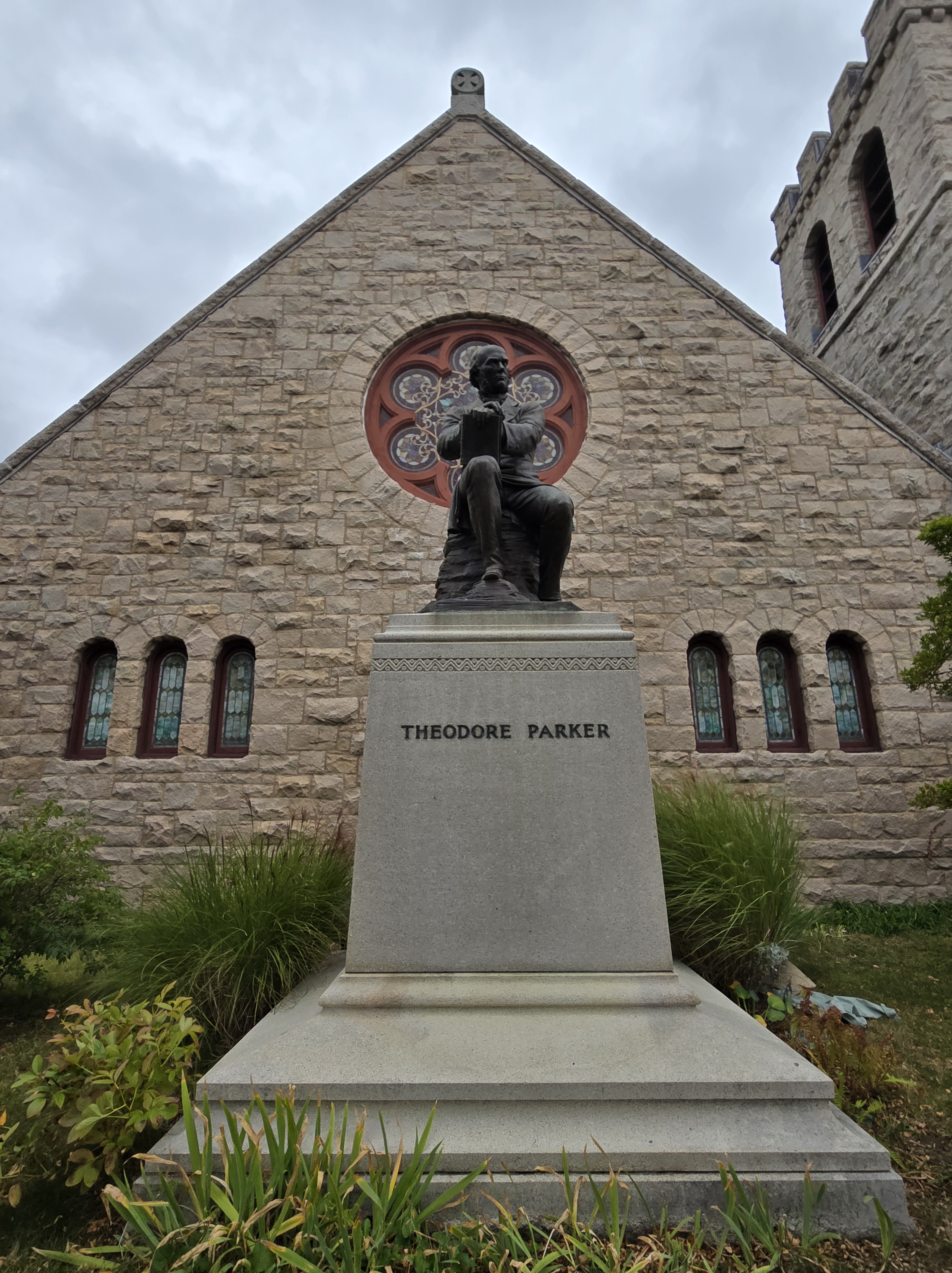
The morning before we visited the Parker Tavern in Massachusetts, we caught a church service at the Theodore Parker Unitarian Church in West Roxbury near Boston. This site was the second ancestral “treasure” I uncovered a few years ago (the tavern was the first) while looking for something else.
I discovered that noted Unitarian minister and abolitionist Theodore Parker (1810-1860) and I were related through Thomas Parker, a Congregational Church deacon who immigrated from England in 1635. Theodore’s first church assignment just out of Harvard Divinity School was this church in West Roxbury. But the actual building where he preached burned, so the church we attended was not the original.
After nine years, Theodore left the church after being kicked out of the Boston Unitarian Brotherhood for his “radical” views on abolishing slavery and other religious matters. He also believed outrageous things such as women should be allowed to vote, and to become doctors, lawyers, and (gasp!) even ministers.
Theodore spread his views not only through his sermons but via pamphlets. He is credited with famous quotes later shortened and used by President Lincoln and Martin Luther King. The phrases are, “a government of the people, by the people and for the people” and “the arc of the moral universe is long but it bends toward justice.” The former was used by Abraham Lincoln in the Gettysburg Address and the latter by Martin Luther King.
But as historical events played out, the moral arc of the universe must have brought him back into favor, because the church, designated a Boston Landmark, was named for him, and his statue was erected in front of it.
We arrived out a half-hour before the service began and had time to appreciate Theodore’s statue and wander around the outside of the church. Soon, a congregation member arrived, and we followed her to the old wooden front door. She took out a key to open it but had trouble. Russ and I looked at each other in dismay. We’d come all this way, and now we couldn’t get in!
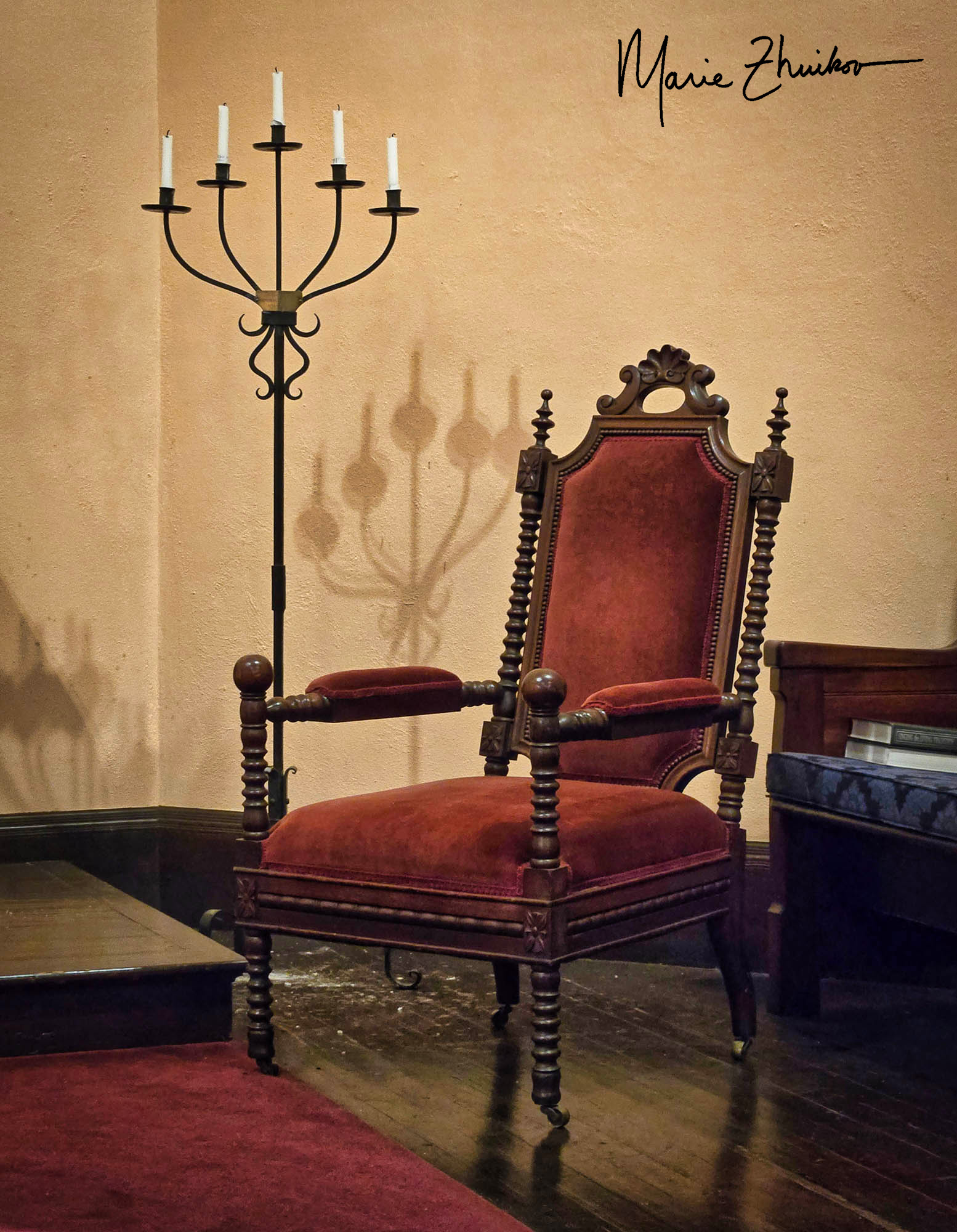
Russ soon stepped in to help, and with his key-handling expertise, he was able to open the door. Soon, more people arrived. In chatting with them about why we were there, they pointed out two Theodore Parker historians who were in attendance. We were able to speak with them both. They affectionately referred to him as “Teddy.” They reinforced what I already knew and pointed out some things I didn’t, including artifacts saved from the first church fire: a clock, Theodore’s pulpit, and his chair.
One of them also pointed out a trio of gorgeous 1927 Tiffany Studios stained glass windows that grace one wall. They feature irises and morning glories ringing a lake and mountain scene, with the words, “I will lift up mine eyes unto the hills from whence cometh my help.” According to a sign about the windows, a stained-glass consultant called the design one of the studio’s “greatest.” It incorporates several signature techniques: plating, where three layers of glass are used to achieve depth of color; mottling, which recreates intense sunlight as filtered through leaves; and acid etching, which involves removing a layer of colored glass to reveal a clear or palely tinted base glass. Intense leading is used on the windows to depict the organic lines of flowers and foliage.
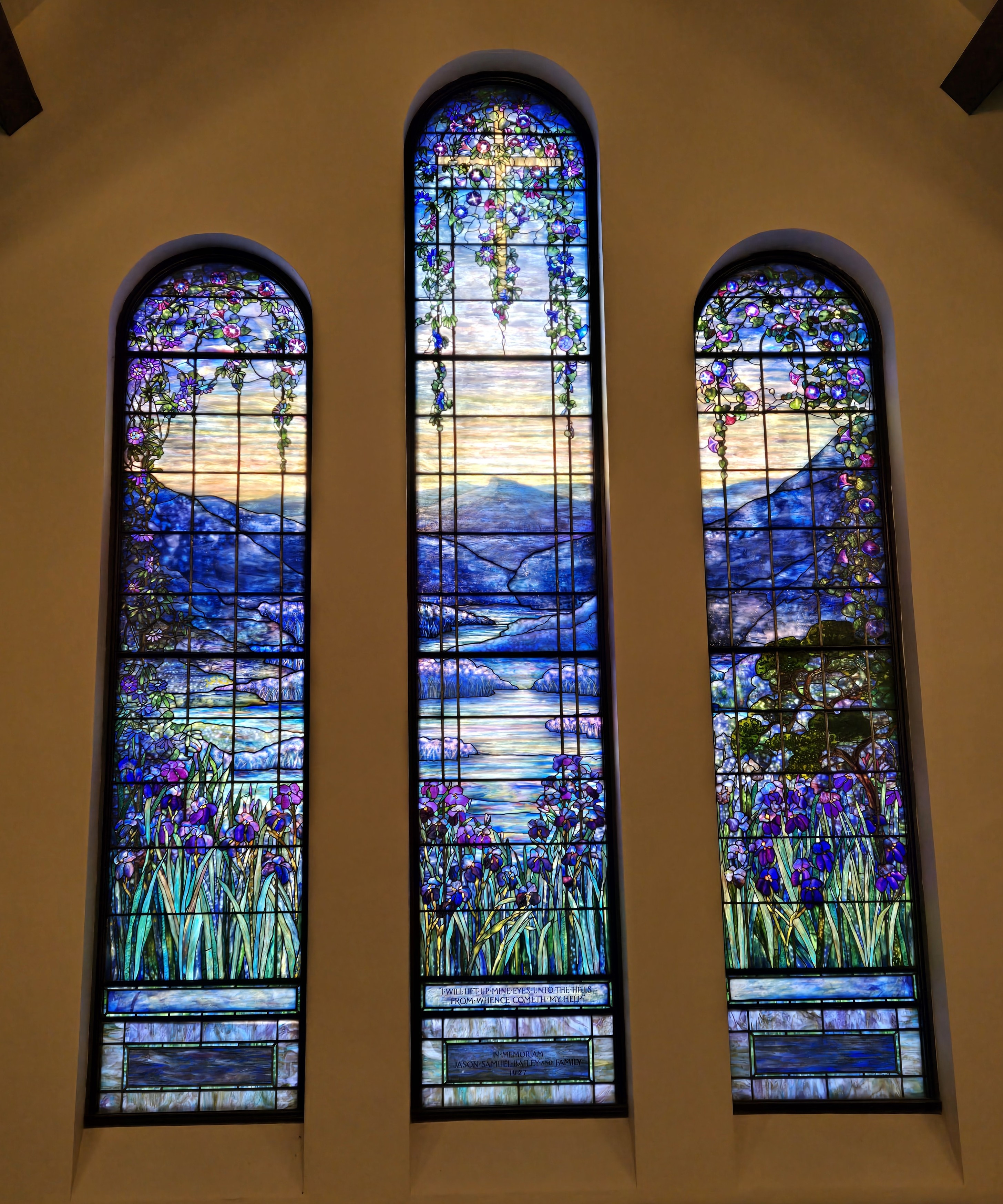
The outcome is dazzling. One church attendee told us she purposefully positions herself during services so that she can see both the windows and the pulpit for comfort and inspiration.
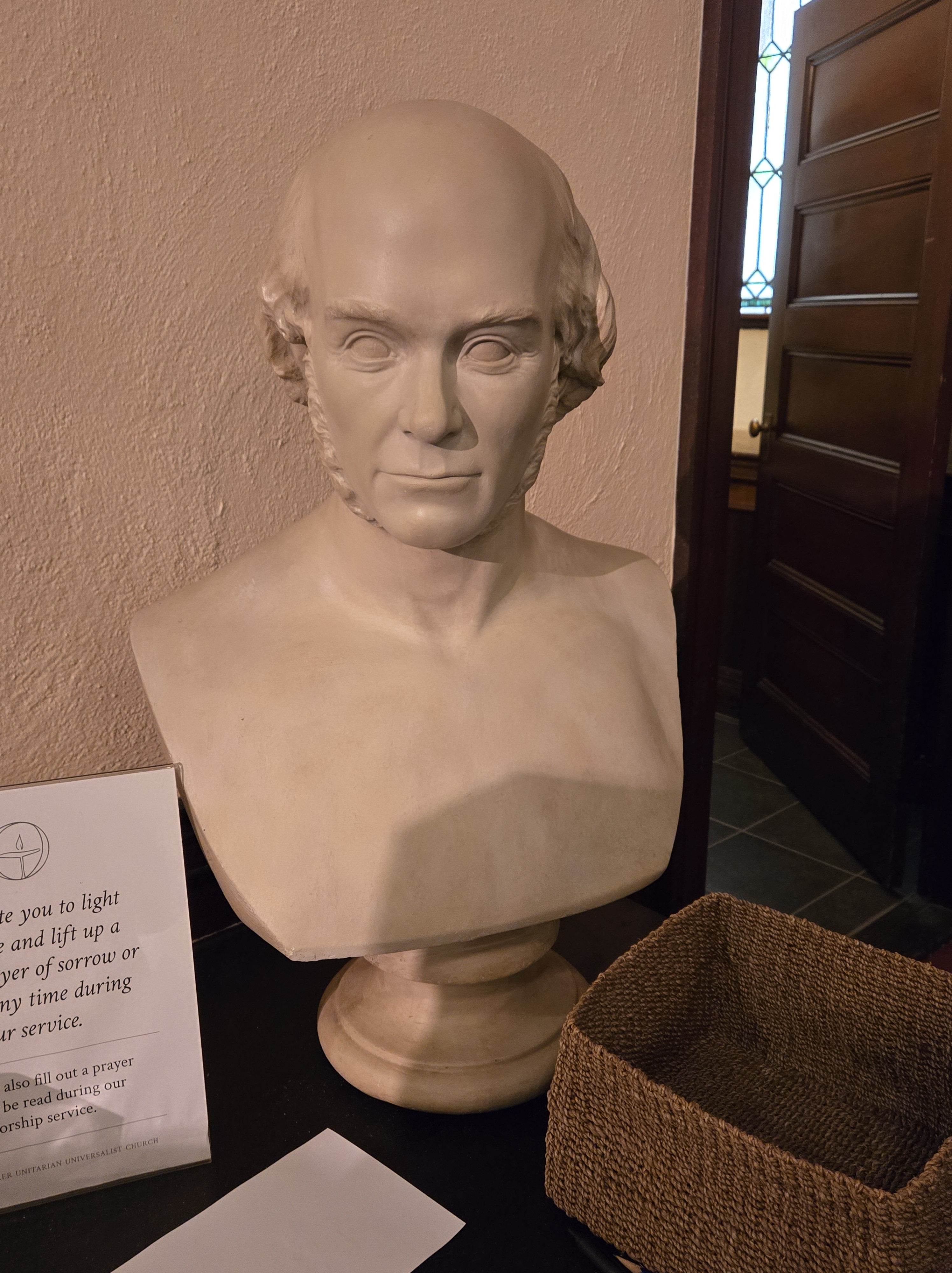
The service was conducted under the watchful eye of Theodore’s bust. We attend a Unitarian church in Duluth and were comforted by the similarities in the services. Everyone was super friendly, and we enjoyed hanging out with them afterward in the social hall.
Next up: Lexington, Massachusetts, and another illustrious Parker cousin who has his own statue.
 Marie's Meanderings
Funny how a locked old church door can feel like the universe testing its hinges—then one click later you’re inside, standing in the stained-glass glow where ancestors still whisper through light.
Oh man, that’s deep!
Wow, such beautiful stained-glass windows and fascinating family history. Thanks for sharing.
Thanks for continuing to read my stories, Diana!
Theodore sounds like a man with dangerous ideas.
I’m glad the moral arc of the universe turned toward his ideas instead of against them!
Someone we could use today. A wonderful family discovery.
So true that we could use Theodore’s wisdom today. While it would be helpful to have a live person to inspire us, at least we have the words of people with revolutionary ideas to inspire us. We just need to remember them!
The Tiffany windows in the church are magnificent.
Yes, if I lived near the church, I’d be tempted to go there every Sunday just to see the windows!
I’m in love with those windows!!!
What a fascinating relative you’ve uncovered. Such a progressive mind. Was he married to a progressive woman?
I’m not sure if his wife (Lydia Cabot) was progressive, but historical accounts say she was supportive. They couldn’t have children, which strained their marriage. After getting kicked out of the brotherhood, Parker and his wife traveled to Europe and that seemed to help their marriage. I read somewhere that he developed an emotional attachment to another woman but it never progressed farther than that, and he never left his wife. Wikipedia actually has a great account of his life and accomplishments, if you’re interested in reading more.
What a great guy to support abolition and women’s rights! The stained glass windows are stunning!
Yes, Teddy was truly ahead of his time.
Pingback: My Connection to the Battle of Lexington | Marie's Meanderings