Author: mariezhuikov
Two Nature Encounters

I usually take two walks every day. Recently, on one of my walks, I saw a painted turtle crossing the gravel road. It was headed in the direction of a small lake and had already made it across most of the road. But was now it had stopped. I worried it might get run over by an inattentive driver. I was tempted to pick it up and move it in the direction it was traveling, yet didn’t want to overly disturb it.
Luckily, as I stood behind the turtle, pondering, it began to move closer to the road’s edge. I slowly stepped forward and kept encouraging it to move in this way until I was sure it would be safe.
I wondered whether it was a late hibernator emerging from an inland pond or if it had laid its eggs somewhere and was now making its way back to the lake. I often see multiple painted turtles hanging out on a log at the end of the lake or swimming with their noses just above the water on quiet evenings.
After I walked a few more yards, a drizzle began. Then the drizzle became a shower. I wasn’t wearing a raincoat, so I cut my walk short and began quick-stepping my way back home. About a hundred yards past the first turtle, I saw another one that was almost the entire way across the road. It was moving quickly, so I didn’t worry about it like I had the first turtle.
Curious at seeing the two turtles crossing the road at nearly the same time, once back inside, I searched online for a possible explanation. Google said: “Every year, in mid to late spring, turtles start to move. The males are looking for partners and the females are looking for a good place to make a nest for their eggs. Unfortunately, for a lot of them, this means crossing busy roads and many don’t make it.”
In addition, Mississippi State University said that in the South, a legend says that rain is on the way any time you see a turtle cross the road. They continue, “There’s very little truth to this myth, even though it does seem like rain is in the forecast after we see one of these creatures slowly making its way across the street.”
Given my experience that day, I’m inclined to believe this legend!
Then I looked up the spiritual meaning of a turtle crossing your path. Google said it’s a sign of good fortune to come. Turtles are also omens of good health and symbolize a long, prosperous life.
If that ends up true, I’ll let you know in about thirty years.
My second wildlife encounter happened the next day. The moment I stepped out the door for another walk, I felt something land in my hair. I thought it was a bug and tried to brush it away. Out fell a five-inch black feather!
I looked around but whatever bird had lost the feather was long gone. However, a crow sat in a tree not far away. The feather certainly looked like it could be a crow feather.
While I’ve come across feathers on the ground before, I’ve never had one actually fall on me. The event was rather surprising and noteworthy (thus this blog post).
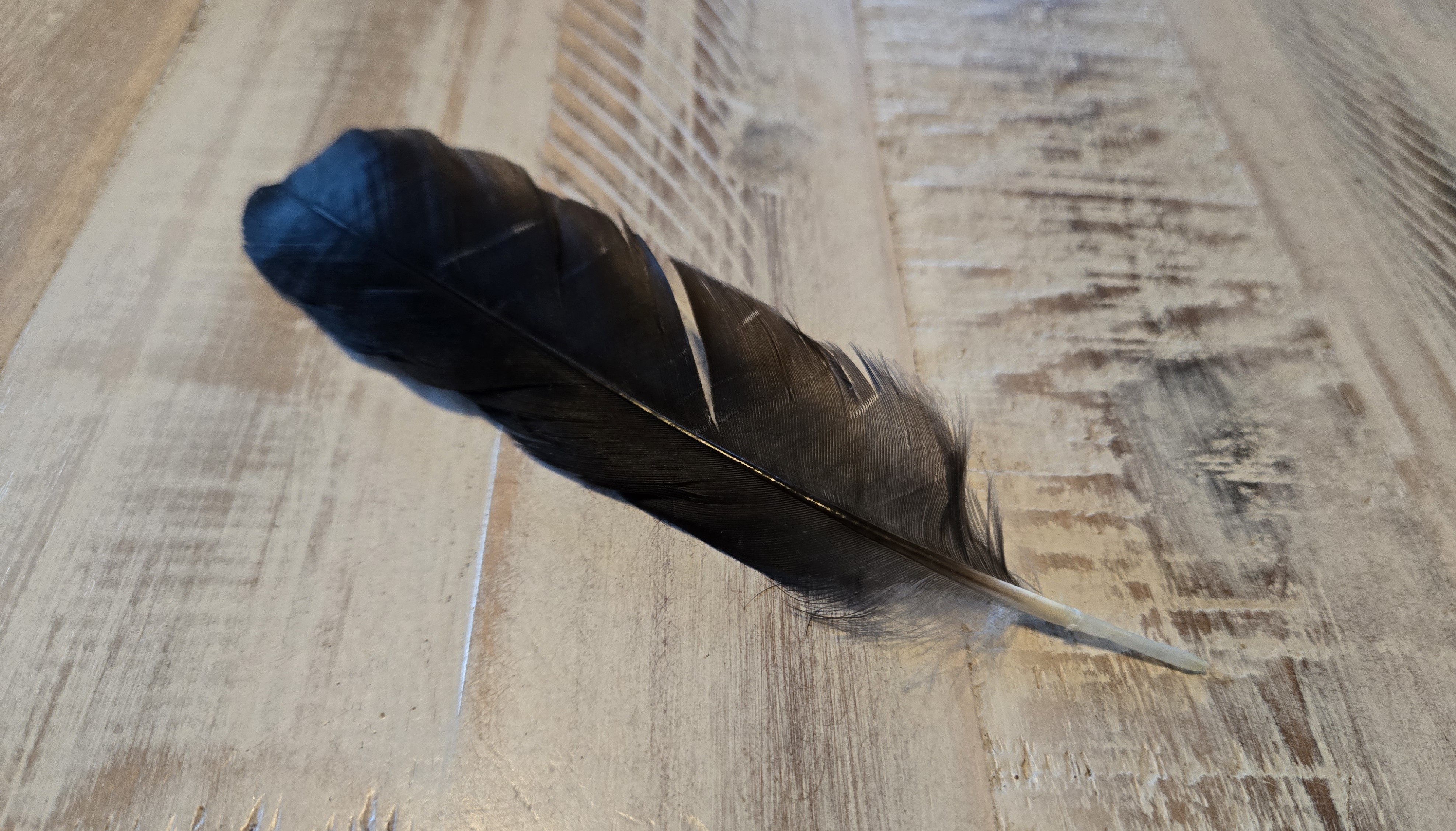
I seemed to be a roll with interesting animal encounters. Once again, I consulted the wise and wonderous internet for interpretation. I searched for “meaning of crow feather falling on your head.”
Nothing came up under that specific heading, but there were lots of entries about the “meaning of coming across a crow feather in your path.”
Apparently, like with the turtles, this is a good omen. A woo-woo yoga site said, “When a crow feather lands at your feet, it is a positive omen, meaning your calls have been heard and answered. If a feather comes to your path magically or surprisingly, it means a spirit is supporting or guiding you.”
Since the feather fell on my head, I must really be protected and supported!
Another site said it can also signify a visitation by a male loved one who has passed.
For several months, I have been working on a nonfiction story about a male relative. Although I was not born when he died (tragically and suddenly), I’ve found myself wondering if I haven’t conjured up his ghost with all my recent attention.
If he is watching over me, I’m okay with that. He was a good guy and I wish I would have had a chance to know him. Even if he’s not, these natural encounters have been interesting.
When I told Russ about the mysterious crow feather atop my head, he said, “At least it was a feather and not something else that birds usually let drop!” That’s my guy.
I think I’ll take another walk and see what happens next.
Newspaper Columnists Overdose Small Minnesota Community with Death
I don’t think I’ve mentioned this, but I write a monthly newspaper column for the “Cotton Chronicle,” a nonprofit newspaper in a small community in northern Minnesota, population 437. I got hooked up with it because that’s the community where our cabin is and it inspires some of the fodder for this blog.
My column began as a way to promote my blog-memoir, “Meander North.” I received a grant to publish it in several local media outlets, including the Chronicle. Once my grant ended, my column ended. Shortly after, I received an email from the editor. She’d heard good things from readers and asked if I would consider continuing my column.

I was like, “Well, would you pay me for it?” She was, like, “We’re not that kind of a newspaper.” We reached a compromise where I would write a column as long as I could mention of my book at the end of it.
Recently, I ran out of stories from my book that I thought would work for columns. I have plenty of blog posts that aren’t in the book that could substitute, but I’d recently read “Wild and Distant Seas,” a fiction book based around columns that Herman Melville used to write for a Boston newspaper. I recalled that Dickens did that, too.
Although I am no Melville or Dickens, the thought of doing a serial fiction column in the Chronicle intrigued me, and I had the perfect completed story in mind. I ran the idea and a few pages of it past the editor, and she said yes!
Now, instead of being titled, “Meander North,” my column is called “Through the East Door,” which is the name of my story. Well, it’s more like a novella. The piece is over 20,000 words long. My columns are only supposed to be around 1,200 words. This is going to be a long serial!!
The tale centers on a young woman reeling from the death of her husband. She retreats to her cabin (in the Cotton area) to heal. Along the way, she comes across a wounded animal. Caring for it takes her mind off her troubles. But is the animal real or is it imaginary? Readers will have to make up their minds themselves.
The first installment was published earlier this month. Except for some cute husky puppies, the plot is dark – focusing on sudden death. The Chronicle also has another columnist named Tom. I’ve never met him. Don’t know who he is or what his background is. But I was chagrined to see that his column also dealt mainly with death.
In it, he mentioned his wife said he’s stuck in a “groove” about writing about dying. He ignored her criticisms for several months until he read some of his recent past columns and realized she had a point. He’d rather think of his writing as being more of a “senior groove” than a death groove and said that it would be disingenuous to write about being a senior (elder) without including some element of death. He continued, relaying several stories about people dying or talking about dying and ended by saying he’s working on his tendency to write about death. However, he left readers with the final image of a male dragonfly being eaten by its mate.
Other than for community committee, town board, and fire department reports, the “Cotton Chronicle” this month was sure a downer! I felt sorry for its readers, overdosing on death. I want them to know that my story gets less depressing as it progresses (until the very end). And it sounds as if Tom is trying to get less depressing, too. I am interested to see how it all goes.
This post probably isn’t the best marketing technique, but if you want to follow my story and see if Tom can jump into a different groove, or just learn about small-town Minnesota life, you can subscribe to the newsprint version of the Cotton Chronicle for a year for a mere $12. It’s not available online. (P.O. Box 126 – 9087 Hwy 53, Cotton, MN, 55724-0126)
Garden Gnome
Inspired by mishearing the song “Cardinal” by Kacey Musgraves. Thought it was funny. Hope I don’t get sued.

I saw a sign or an omen
In the garden, in the morning
Right after I
Lost a friend without warning
Words unsaid
Nose of red
Garden gnome
Are you bringing me a message from the other side?
Garden gnome
Are you tellin’ me I’m on somebody’s mind?
Don’t leave me behind
I took a walk in the ‘hood
To clear my head
Turned my collar to the wind
On the street, it was blowin’
And there he was
By the shed
Garden gnome
Are you bringing me a message from the other side?
Garden gnome
Are you tellin’ me I’m on somebody’s mind?
Don’t leave me behind
Are you just watching and waiting for spring?
Do you have some kind of magic to bring?
Are you just watching and waiting for spring?
Do you have some kind of magic to bring?
Are you just watching and waiting for spring?
Do you have some kind of magic?
Garden gnome
Are you bringing me a message from the other side?
Garden gnome
Are you tellin’ me I’m on somebody’s mind?
Garden gnome
Are you bringing me a message from the other side?
Garden gnome
The Mesabi Bike Trail from Mt. Iron to Kinney, MN
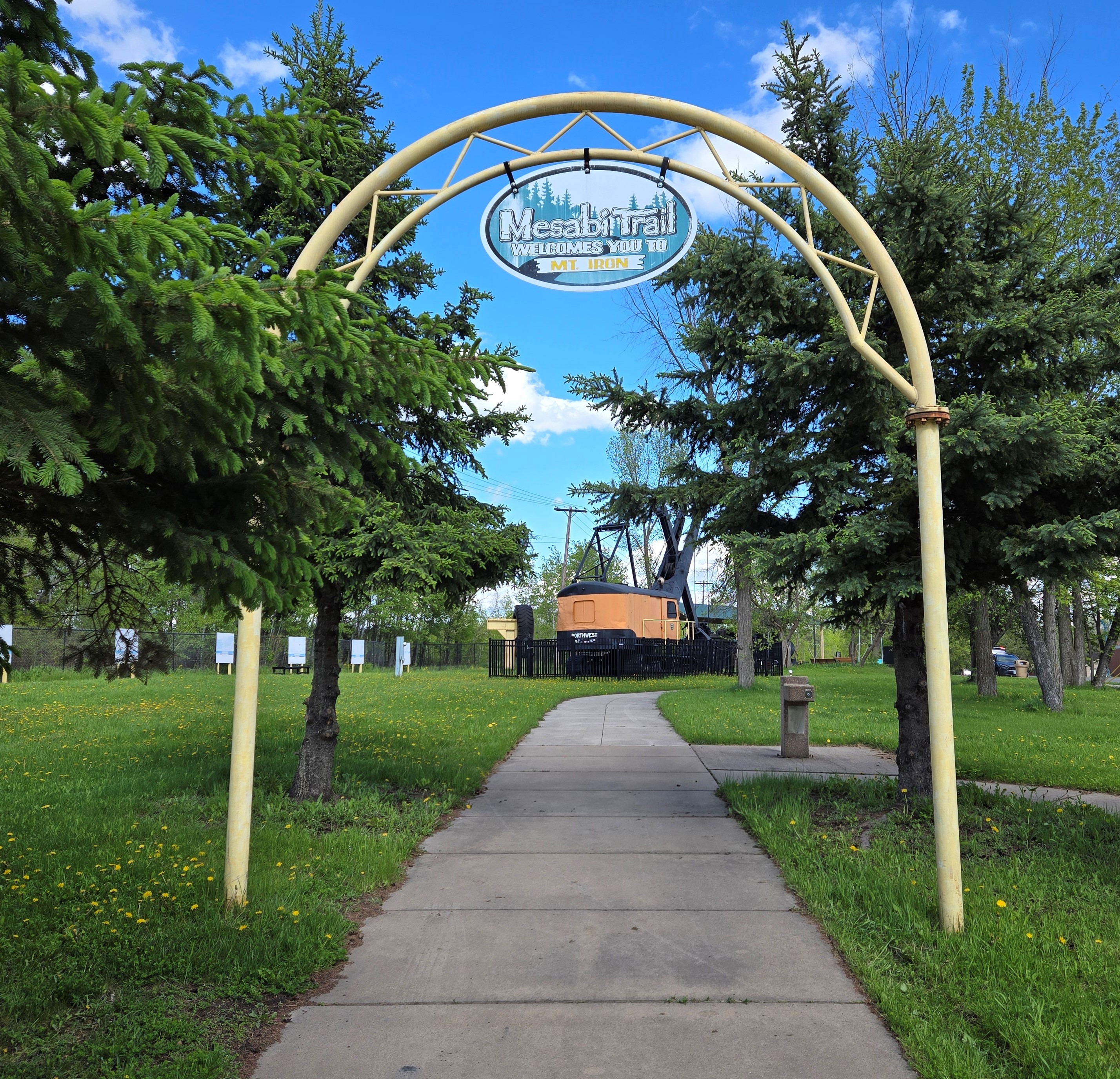
In our continuing quest to bike different sections of the Mesabi Trail in northern Minnesota, Russ and I meandered over to the small mining town of Mountain Iron last weekend. We planned to pedal a 6.5-mile stretch between there and the neighboring town of Kinney. (Round-trip, the distance is a little over 13 miles.)
Mountain Iron is known as “The Taconite Capitol of the World.” It’s the site where iron ore was first discovered on Minnesota’s Iron Range. The mine is no longer in operation, but during the 30 years it was open, 52 million tons of iron ore were shipped to various steel mills in places like Michigan and Illinois.
The landscape and town bear the scars of this industry. A huge mine pit filled with turquoise water is visible from the small city park where the trail begins. As we biked toward Kinney, we passed ghostly remnants of homes and businesses that had been moved to make room for mining operations. Cement house pads and neglected lilacs provided testament to the abandoned homesteads.
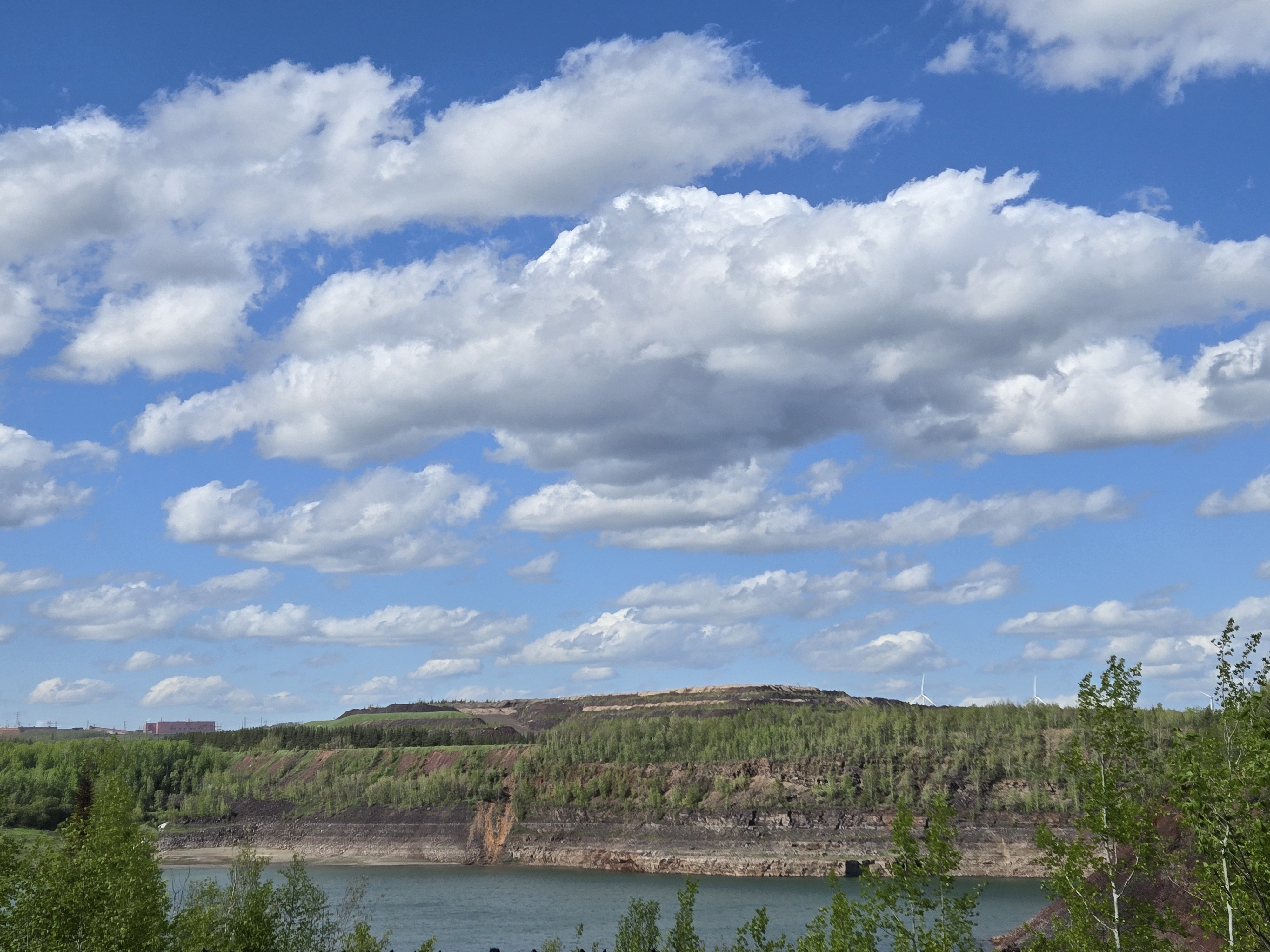
These days, instead of iron ore, Mountain Iron is known for wind energy. Several turbines spin on far hills. They are part of the Taconite Ridge Wind Energy Center – the first commercial wind center in northeastern Minnesota. An interpretive sign in the park says, “In ideal wind conditions, 10 turbines can collectively capture the wind and convert it into 25 megawatts of electricity – enough to power 8,000 homes on an annual basis.”
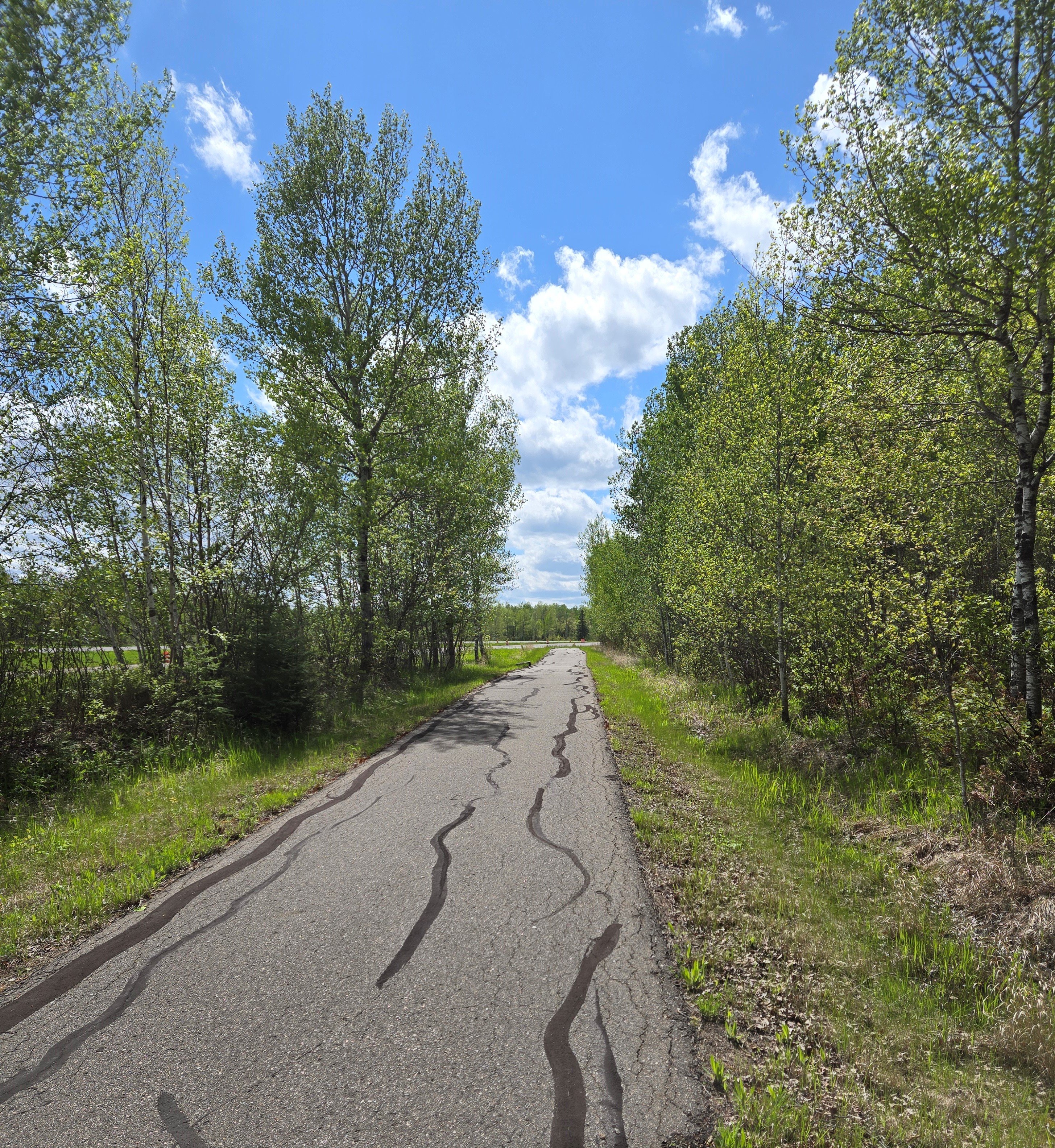
Compared to other sections of the trail we’ve biked, this was more civilized. Once we passed the abandoned neighborhood, a few occupied homes lay along the trail. Huge grassy piles of mining tailings lined the horizon. Although a sign along the way says that tailings are not a health hazard, I don’t believe it! We saw a lined basin where it seemed like water was being pumped from the base of the piles. I couldn’t find any info about that online, but I am hoping it’s so the water can be collected and treated before being released into the environment. For much of the way, the trail parallels a highway, although it’s often hidden from view by trees.
A couple of hills dot this section of trail, but nothing too onerous. When you first near the highway, there is a hill with a curve at the bottom. Bikers coming the other way also have a downhill before the curve, so beware of that. Two downhills lead over small bridges with culverts underneath them. The culverts each form a bump. I almost caught air on one of them!
We saw one bicycling family and a few other small groups. When we reached the turn off to Kinney, we did not feel the need to explore. But now, after reading more about the town, I wish we would have. Kinney once voted to secede from the United States and become a foreign country. This bold yet tongue-in-cheek action was taken to draw attention to the small city’s dire water system situation.
According to an account on the Mesabi Trail website (linked above via “Kinney”), the system was “failing so badly that the fire department had to watch buildings burn to the ground due to lack of water pressure. That year the term ‘The Kinney Brown Shirts’ was coined because all clothing washed with detergent that included bleach turned brown because of mineral deposits in the water.
“Replacing the water system far exceeded the budget of the small town, so the city exhaustively searched locally and nationally for assistance. The resulting volume of paperwork led to the city’s motto of ‘File in Triplicate.’ The city attorney commented that it would be easier to get money if the city seceded, waged war with the union, quickly lost, and then asked for foreign aid. The joke took root, and the council voted unanimously to secede on July 13, 1977, and a certified letter was sent to U.S. Secretary of State Cyrus Vance.”
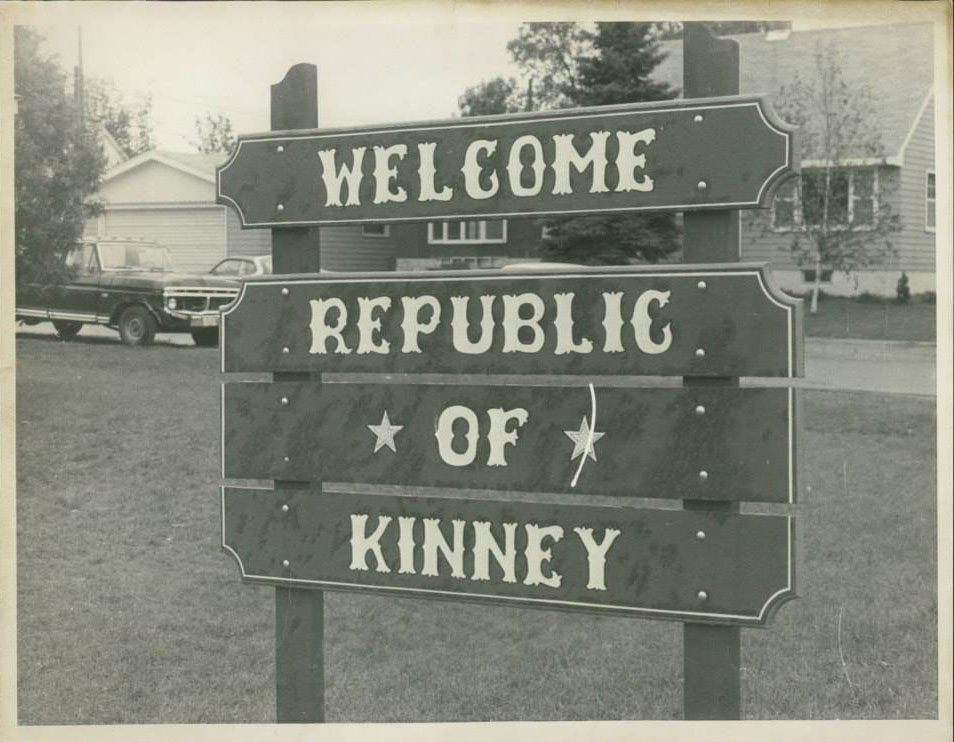
The secession gained international publicity and from that, the city eventually received grants to replace their water system.
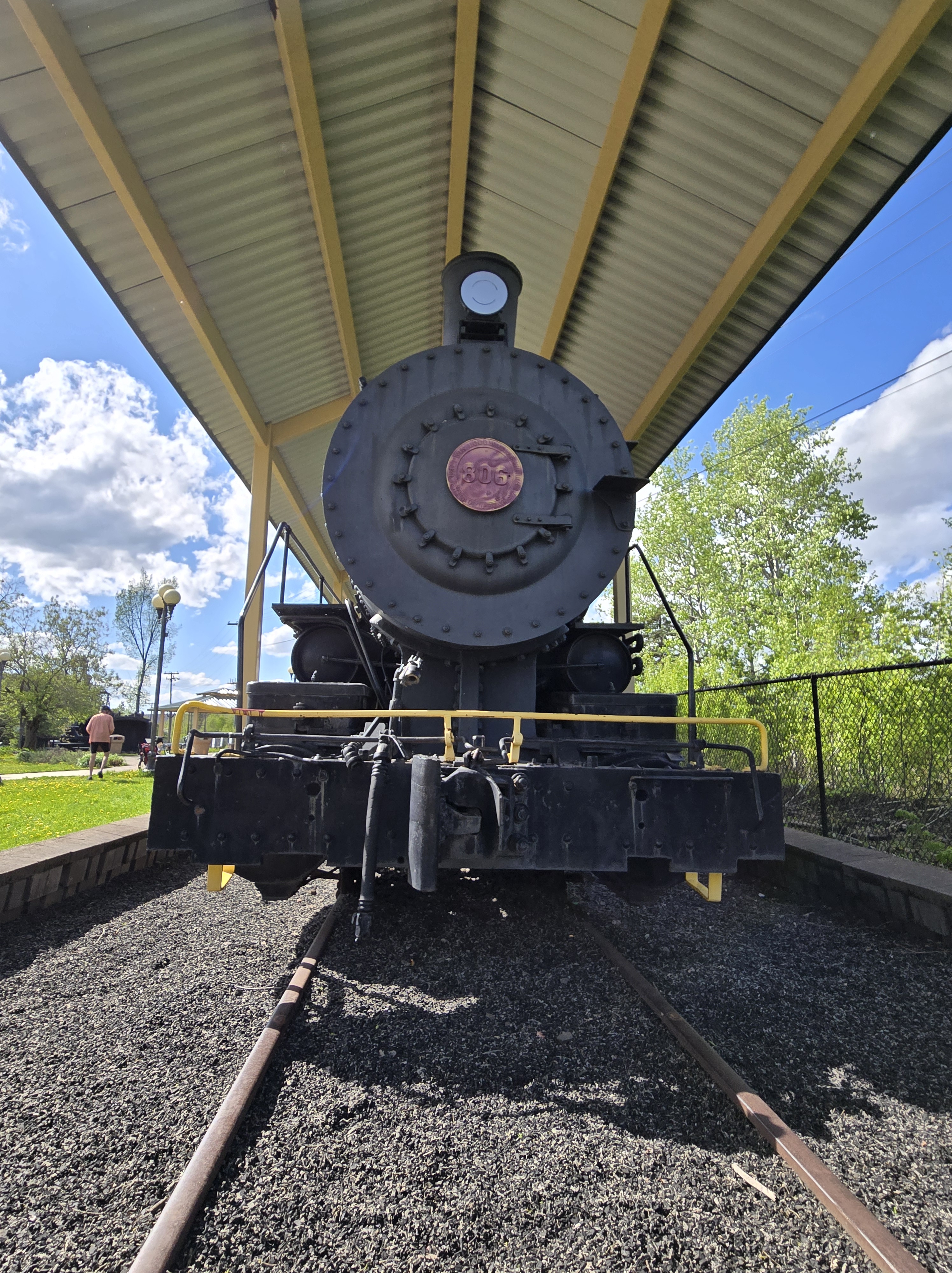
Our way back to Mountain Iron seemed easier than the ride out. I’m not sure if that was from the tailwind or the topography, but biking back was a breeze. Ride over, we spent time exploring the various pieces of mining equipment in the park. This included an old locomotive, which, no doubt, used to haul taconite to ships waiting for it on Lake Superior’s shore. Another group of bikers that we passed on the trail arrived and we chatted a bit. They were from St. Paul and were biking the entire trail, staying in hotels overnight.
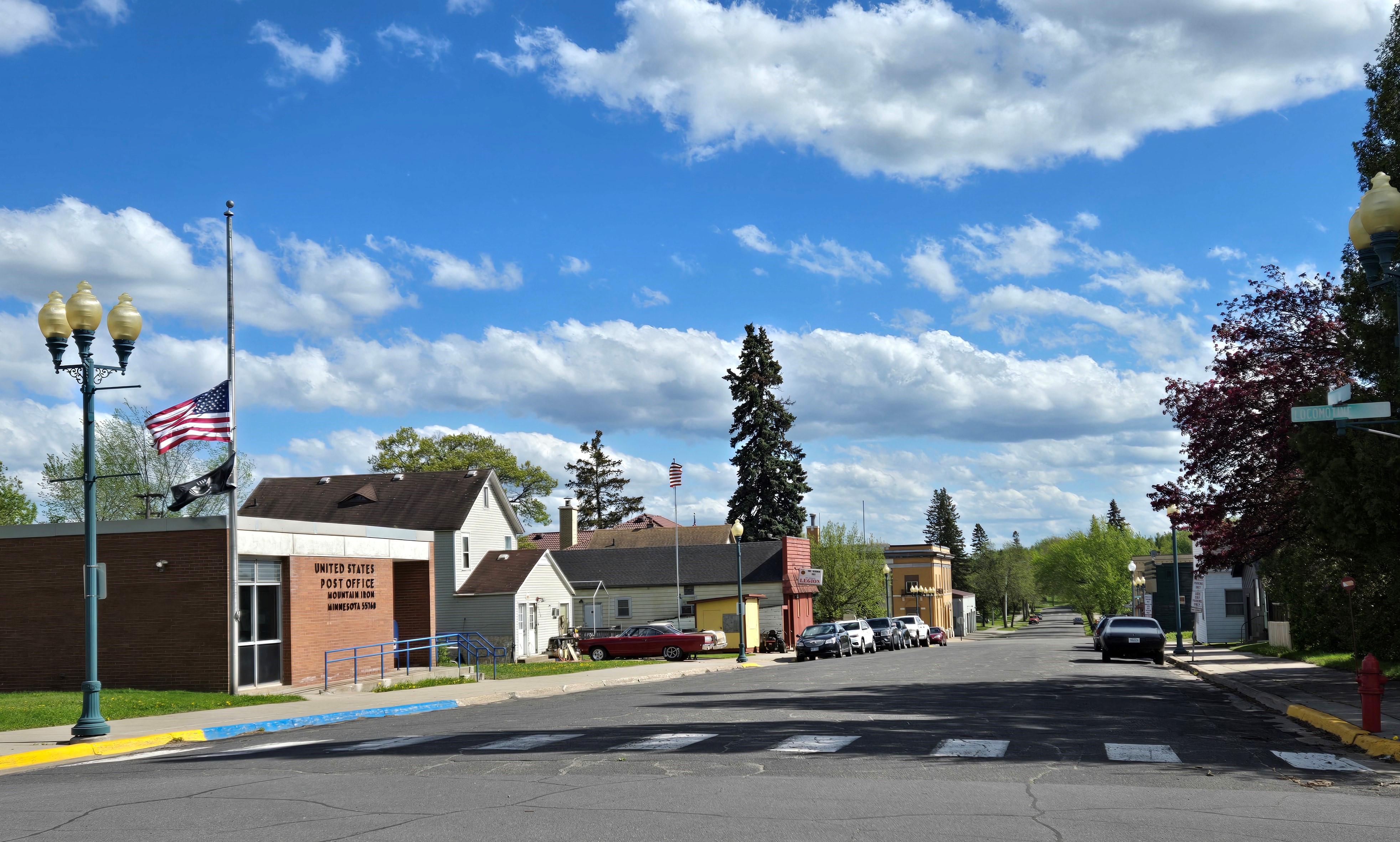
That’s it for our experience with this section of the Mesabi Trail. Maybe next time, we’ll start from Kinney to experience this plucky little burg.
Update: 8/31/25
Well, it took a while, but we did start cycling from Kinney. This hardscrabble town is composed mostly of trailer homes. Not that there’s anything wrong with trailer homes. I’m just not used to seeing so many of them near the center of town.
We biked from Kinney to Buhl, which is only 4K. From there we rode toward Chisholm, a section we’ve ridden in the past, but I don’t think I blogged about it. The most scenic spot was the Stubler Mine Pit Beach, which looked like a good spot for swimming. A bunch of folks were doing just that during our Labor Day Weekend ride.
The beginning of the trail was wooded, but then much of it follows an abandoned roadway. The most scenic part of the section past Buhl was the City of Chisholm sewage plant. Thus, this addendum and not an entire blog post.
Two Island River and Taconite Harbor: Off the Beaten Path
We’ve been driving up and down Highway 61 on Lake Superior’s North Shore more than usual lately to deliver and retrieve my photos that were on display in Grand Marais. On one trip, I noticed a river that flowed underneath the highway. No sign sported the river’s name. Looking landward as we whizzed past, I spotted a double culvert bridge about a hundred yards away that the river flowed through. Was that a waterfall behind one of the culverts? The scene was intriguing and not one I’d ever seen photographed by established North Shore photographers. I made note of the location and vowed to stop on our next trip.
That “next trip” was last weekend. On our way back to Duluth from Grand Marais, we stopped near the mystery river, which is near Taconite Harbor. The harbor’s a place where mining companies used to load taconite (iron-ore pellets mined and made on Minnesota’s Iron Range) from rail cars into ships bound for steel-making plants in Michigan and Illinois.
We parked our car in a driveway entrance that was blocked by a gate overgrown by saplings. Although the driveway had a fire number on it, that gate obviously hadn’t been opened in years, so we weren’t too worried about blocking access.
We walked across the highway and, as cars rushed past, took a short jaunt to the river. We hopped the guardrail in a likely looking spot and soon found a faint game trail. The trail also could have been made by anglers. We found out later that part of the river is considered an “Aquatic Management Area” allowing angler access by the Minnesota Department of Natural Resources.
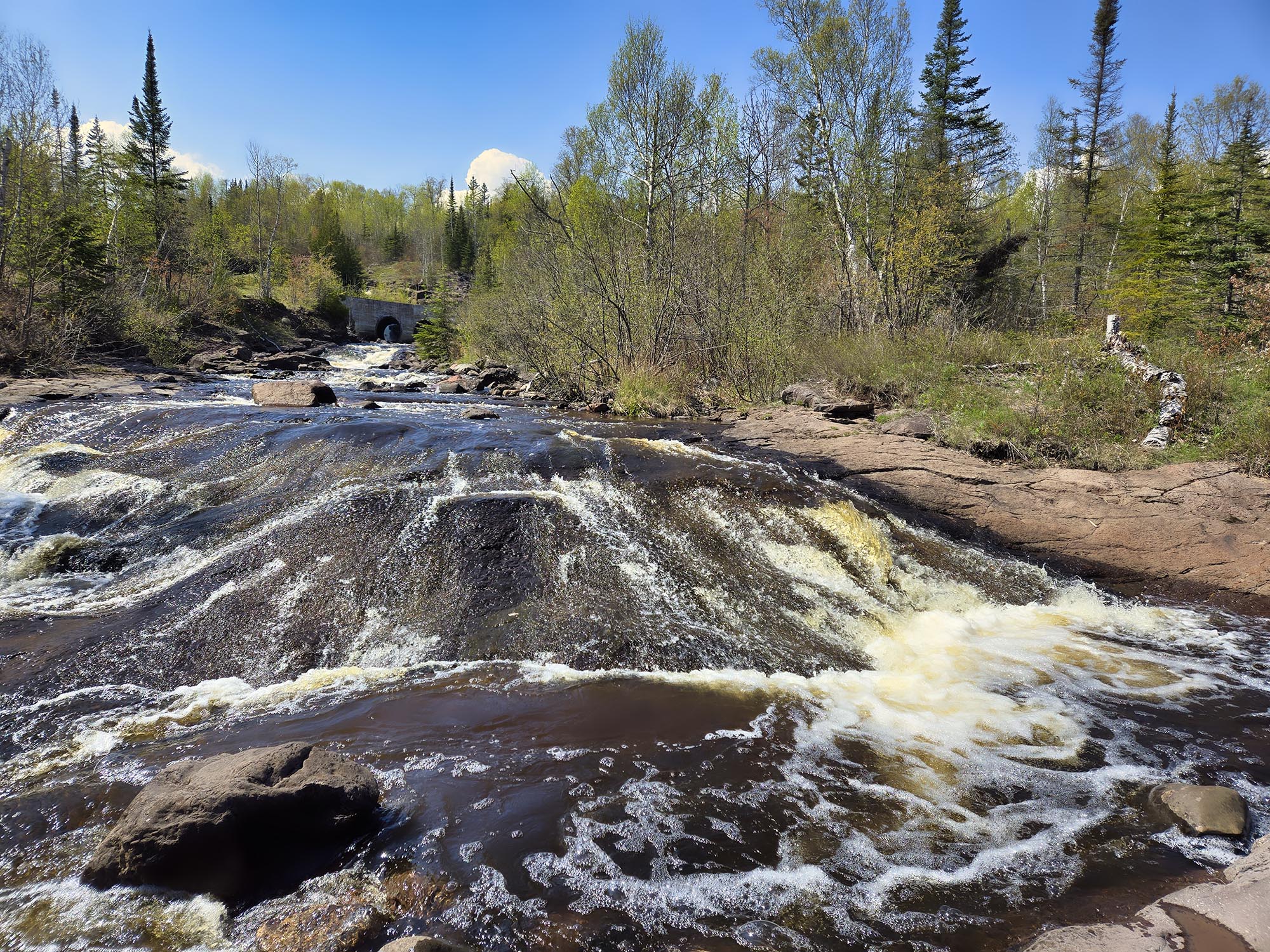
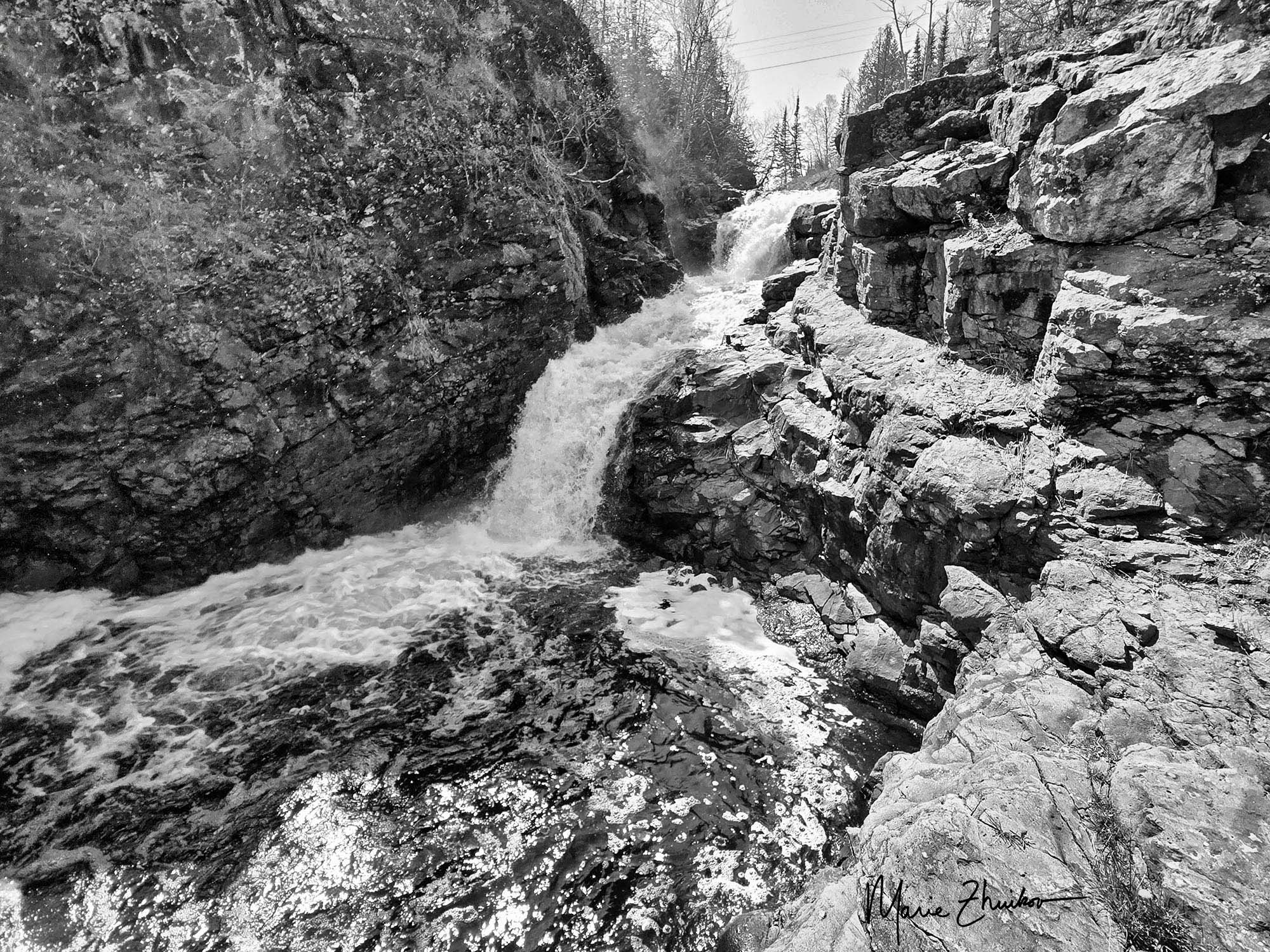
It’s spring and we’d had a heavy rain recently, so the shallow river splashed with gusto over reddish-gray rocks. I clambered along the banks, camera in hand, taking photos at spots that offered a good vantage. But I was impatient to get to my goal: the double culvert up the hill, and that waterfall behind it.
Russ went ahead while I took photos. When I caught up to him at the railroad bridge with the culverts, he’d had time to look up the name of the river on his phone. We were looking at Two Island River, a 15-mile waterway. There’s not much info out there about it, but Wikipedia says the river is named for two lake islands near its mouth.
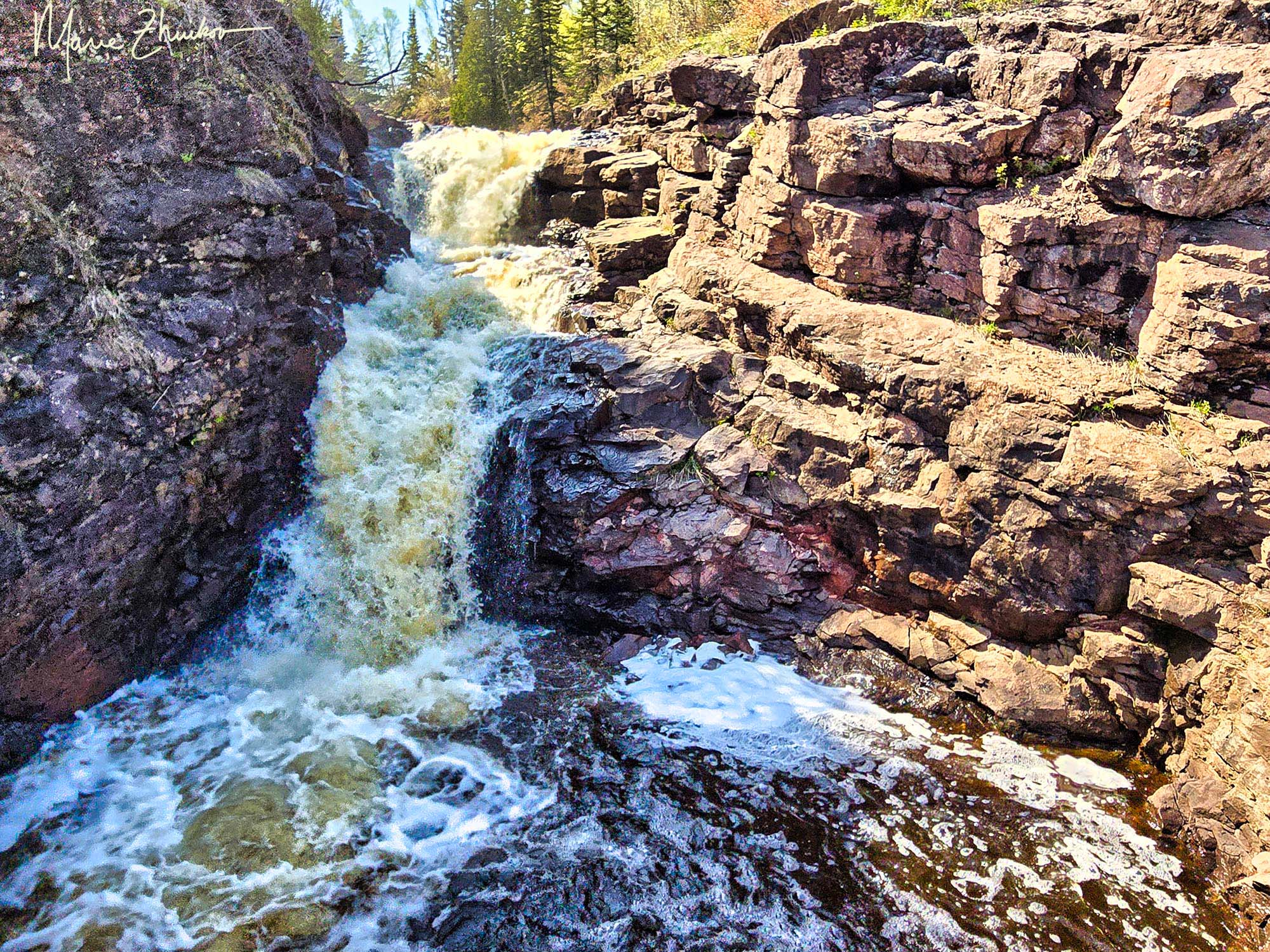
As you can probably tell, there was a waterfall behind the culverts. A very nice one, too. The steep angle of the sun and rising mist from the falls made for some blurry spots in my photos, but I managed to get a few images without amorphous blobs floating around in them.
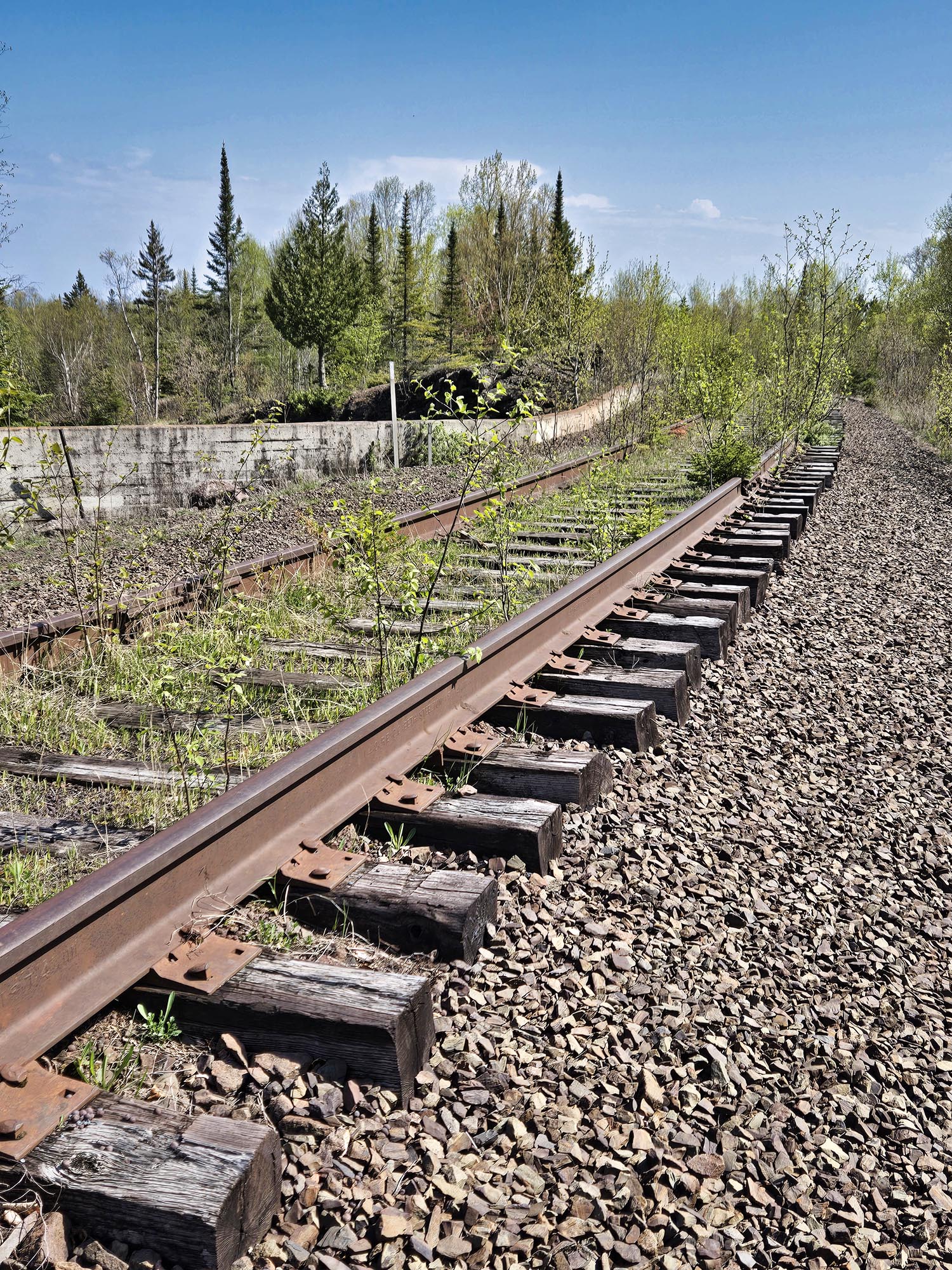
Waterfall appreciation over, we investigated the railway bridge. Like the driveway gate, the railroad was overgrown with saplings and obviously hadn’t been used in years. Research I did while writing this post uncovered the facts that the railway was named the Cliffs Erie Railroad. The last train operated in 2001, but after that, cleanup trains, which collected leftover chips and pellets from the mines, operated until 2008.
A bustling little town was situated near the Two Island River, probably accessed through that overgrown driveway where we parked. Taconite Harbor, Minnesota, was a mining town built by the Erie Mining Company. In 1957, twenty-two prefabbed homes were trucked into a several block area near the lake. The little community even had a fire hall, community center, playground, and baseball/tennis courts.
It seemed like a 1950s ideal community. Seventy-five children grew up there and probably played along the river’s banks. In the 1970s, families were driven away by noise pollution and health concerns about the taconite dust that blew off the rail cars and from local stockpiles.
The steel industry lull added another blow in the 1980s and by 1988, the last resident had left the little Taconite Harbor town. In 1990, the remaining homes and buildings were packed up and transported away by trucks. Driving past the site, I recall seeing only empty asphalt streets, home foundations and streetlights. Nature has reclaimed much of the area, but town remnants remain. It’s truly a North Shore ghost town.
Russ and I didn’t have time to investigate the town site ourselves, but there are many good images of it on the internet. “Forgotten Minnesota” has some good ones.
The history of this area also includes an event that I narrowly escaped. It’s an involved tale so I’ll start from the beginning. In 1957 when the little town of Taconite Harbor was being formed, the mining company also began dumping ash from its nearby coal-fired power plant near the river and the town. I’m not sure it was illegal at the time, but it probably was as time went on. The dumping continued until 1982 and the pile covered 27 acres.
On the morning of July 28, 1993, I drove up the highway in a pale green government car through a heavy rain on my way up to Grand Marais for my job with the Forest Service. Later that day, thanks to the rain and the fact that the mining company had been dumping excess water from a coal stockpile onto the ash heap, the pile became saturated and it liquified in a rare phenomenon called “static liquefaction.”
The heap collapsed and flowed downhill, covering the highway and contaminating the river and Lake Superior. It knocked out an electric substation and buried someone in their car who was traveling on the highway. I can’t find any news reports about the incident now, but as I recall, the person was rescued. I believe another car was partially buried.
All I could think of at the time is that could have been me! Luckily, it wasn’t. And luckily, I already had been planning to stay overnight in Grand Marais because the highway was unpassable and closed until the ash was cleared later the next day when I traveled home.
Russ also recalls hearing about a truck that hit the top of one of the railroad bridges that span the highway at that site. As a result, the bridge spans that cross the highway have been removed, leaving just the tracks and growing saplings on either side.
In short, this is a picturesque area that has had a lot happen to it! Its history of abuse and neglect is probably why the site is not sought-after by more photographers or tourists. That’s too bad. I suppose the mining company still owns the area and they obviously just want to forget about it. The river and the old town site could use some love. The nearby harbor has had some public funds put into it. It’d be nice to see the same for the Two Island River.
Marie’s (Fish) Cheeks

Did you know that fish have cheeks? And did you know you can eat them?
Well they do and you can. Several species of fish, both saltwater and freshwater have cheeks that are large enough to harvest. These include halibut, grouper, cod, walleye, whitefish and lake trout. About the size of a scallop, fish cheeks are prized for their firm texture and tenderness.
They’re usually not available in supermarkets, but if you’re near a commercial fisherman, you might be in luck. For work, I recently meandered along Lake Superior to the Bayfield Peninsula in Wisconsin. I stopped by Halvorson Fisheries in Cornucopia where they had frozen lake trout fish cheeks for sale. I’d never had them before, so was intrigued. I bought a half pound and took them home in my cooler.
To find out what happened and get a free recipe, please visit a blog post I wrote for work. You can visit it here.
A Lake Superior Apocalypse Novel Review

Duluth author Leif Enger’s latest novel, “I Cheerfully Refuse,” is set in the near future in small towns along Lake Superior and on the wide water itself. The apocalypse that’s occurred isn’t some cataclysmic event, rather the novel investigates what could happen if current conditions exaggerate. Citizens are increasingly desperate and illiterate, a billionaire ruling class referred to as “astronauts” (think Elon Musk and Jeff Bezos) employ indentured servants and conduct “compliance” experiments on people in medical ships that roam the seas. Lake Superior is subject to rogue storms and increasing temperatures. The warming waters finally give up the bodies that have lain preserved in icy slumber in its depths. School children have so many behavior problems from toxic chemicals they’d been exposed to in utero, they’re rated on a Feral Comportment Continuum.
Rainy, the narrator, is a bereaved bear of a man and a musician from the small mythical town of Icebridge on Minnesota’s North Shore. (If you read Enger’s previous novel, “Virgil Wander,” Icebridge is right next to Greenstone, the mythical town where that book is set.)

Through a series of unfortunate events, Rainy ends up fleeing Icebridge on a sailboat named “Flower.” Most of the novel follows his Gulliver-like travels to the Slate Islands and Michigan’s Upper Peninsula where he encounters fog, hunger, storms, and lawless townspeople. But there’s also poetic beauty in gulls that settle on his sailboat when he plays his bass, magisterial island rocks, and unexpected kindnesses from strangers. I don’t want to give away too much more of the plot.
Things I loved: The novel’s focus on the importance of music, books and literacy. The sailboat setting, and Enger obviously knows his nautical terms, having had a boat himself in Bayfield, Wisconsin. I also appreciated the hopefulness amidst the horror.
Things I didn’t like so much: The book’s ending. Although it’s beautiful and literary, I expected more after the epic events that led up to it. Once Rainy reaches his ultimate destination, readers are only given a few vague lines about Rainy feeling a slight warm weight against his back, “a pressure like a palm between my shoulder blades.” A few dream-like images round it out and that’s it. But I still think I’ll give it a 5 on Goodreads because the writing is so gorgeous, and we Duluthians need to support each other. The world out there is already cruel enough.
I attended Enger’s Duluth launch last April and noted a contrast to his “Virgil Wander” launch six years earlier. That event was held at a local independent bookstore shortly after Enger had moved here. About 45 people attended and ate brownies and bars made by Enger’s wife, Robin.
His latest launch was held at a local brewery where people’s food order buzzers interrupted Enger’s presentation as their pizzas arrived. I’d say the audience tripled, which is a testament to the connections Enger has developed in the community during his time here. True to the musical emphasis in “I Cheerfully Refuse,” a guitarist accompanied Enger, playing through breaks in his reading.
Enger said he wasn’t sure if he could call himself an actual Duluthian yet or not. As he lies in bed at night, he still thrills at the sound of the lift bridge and ore boats in the canal communicating with each other with their horns. He thinks if he were a real Duluthian, that would all be passé.
I would answer: the trick is holding onto that wonder even after hearing the horns a thousand times. Then Enger will be a real Duluthian.
Northern Nights and Lights

Thanks to a gargantuan sunspot group 15 times the size of Earth, we on Earth in northern climes were treated to a spectacular aurora borealis display last night.

The evening began with a thunder shower, which led to a picturesque sunset, which was capped off by the northern lights display.

I ran around with my camera, documenting everything at our cabin in northern Minnesota. I had tried before to photograph the sky at night with little luck. But this time, it worked! My camera captured even more colors than were visible to the “naked” eye.

As I wandered on gravel roads in the middle of nowhere with eyes raised to the eternal mystery of the dancing sky, our resident loons began to call. Spring peepers croaked and a distant train whistle blew. We are so fortunate to live in these times, in this place.
Spring and Newton’s Apple Tree
I traveled to Madison, Wisconsin, this week for a water symposium on the university campus. As I walked back to my hotel from the event, I passed the university’s botany garden. On a whim, I meandered off course a few steps and entered.
Although it was too early in the season for everything to be blooming, enough flowers were showing to keep me moving through. Sculptures with botany themes were scattered throughout the small but pretty garden.
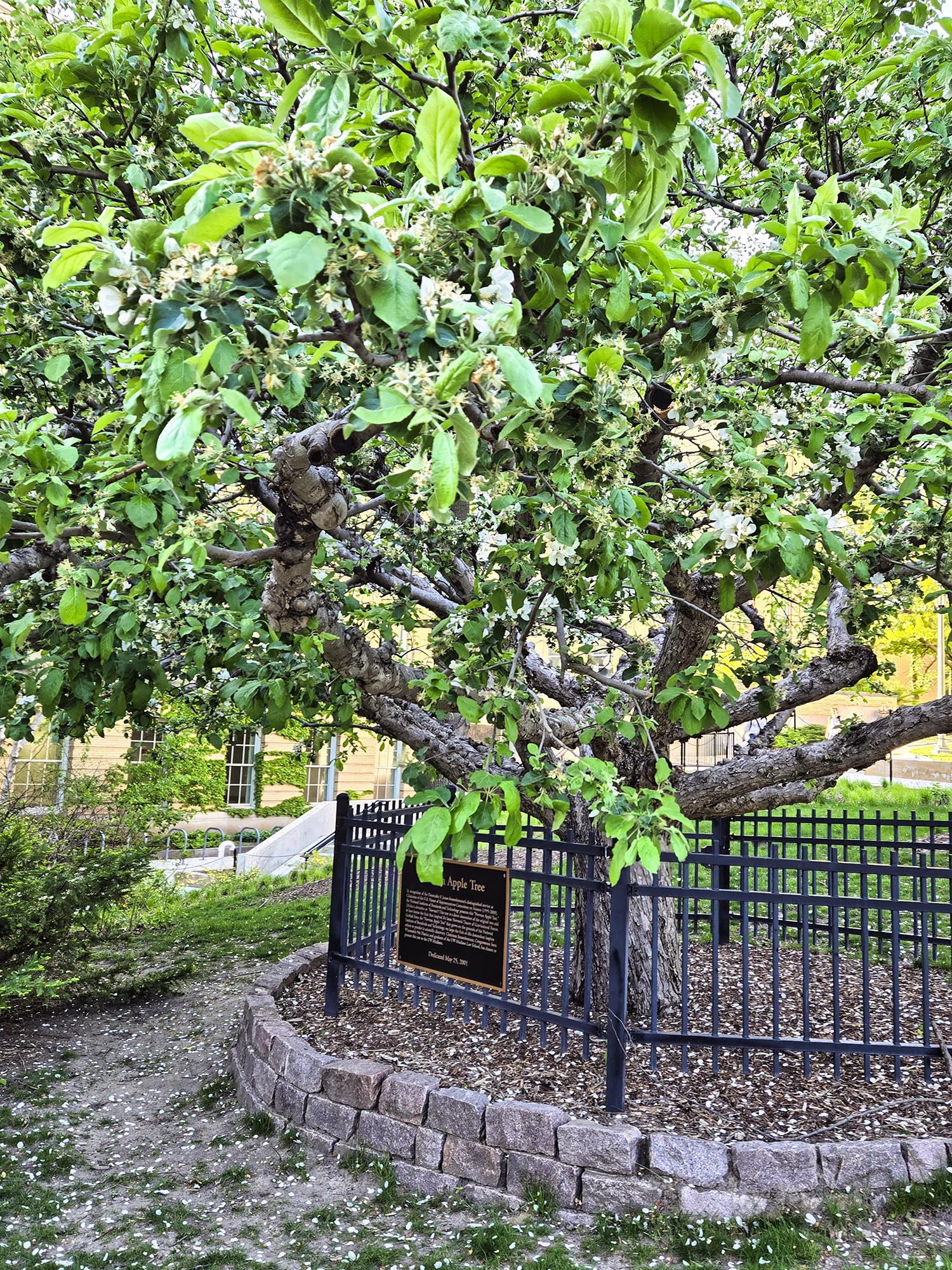
One plant and plaque stopped me in my tracks: a picturesque apple tree surrounded by a fence. The tree sported white blossoms and looked older than its 23 Years. Reading the sign, I learned that the tree, planted in 2001, is a direct descendant of the original tree that bore the fruit which inspired Sir Isaac Newton’s Theory of Gravitational Forces.
Huh. I always assumed that the whole apple falling on Newton’s head thing was a myth. But now here was living proof that the tree from which said apple fell not only could be identified, but its offspring was living in Madison!
The plaque said the original “Newton Apple Tree” grows on the grounds of the National Institute of Standards and Technology. But that institute is in the United States (in Maryland). I thought Newton made his discovery in England.
So, in writing this post, I did some digging. The institute tree the Madison tree is grafted from was a clone. Alas, the clone fell over and died about a year ago “due to unknown reasons” according to Wikipedia.

The actual original Newton tree grew in the 1600s on the grounds of the English manor where Newton was raised. The Woolsthrope Manor tree has died, but its descendants and clones live on at the manor and many other places around the world.
The story of the apple inspiring Newton’s theory gained public visibility when Newton’s niece related it to Voltaire, who included it in an essay. The apple, however, did not fall on Newton’s head. That is a silly myth.
The Madison tree was planted in honor of F. James Sensenbrenner, chair of the U.S. House of Representatives Committee on Science (1995-2000). Sensenbrenner was a Republican congressman from Wisconsin and a graduate of UW-Madison. From the plaque text, it sounds like Sensenbrenner presented the tree to the university himself in hopes that “the fruit of this descendant inspires others to partake in scientific discovery.” This strikes me as rather self-aggrandizing, but it was a nice gesture, no doubt accompanied by some additional funds.
As if having a copy of the Newton tree isn’t enough, the UW-Madison Botany Garden was the first in the world to be based on the new Angiosperm Phylogeny Group system of molecular classification of plants. I don’t really know what that means but if you visit the garden’s webpage, there’s a chart about that.
As I continued my walk through the garden, I envied the Madisonians their warm breezes and blooms. In northern Minnesota, our daffodils are just beginning to show. It will take us about three weeks to catch up to the plants in Madison. Sigh. But this way, lucky me experiences two blooming seasons and that’s just fine.
I exited the garden, glad for my little educational and botanical detour and that I’d have something to share with you. And now you know more than you probably ever wanted about Newton’s apple tree!
 Marie's Meanderings