The Top 4 Marie’s Meanderings Posts of 2019

NRRI image

Me, staffing the Water Bar. Have a drink! Image courtesy of the Natural Resources Research Institutue.

We made it through another year of blogging, dear readers! It felt like I didn’t blog quite as frequently as during the past six other years of this blog, but I have enough content that search engine-directed visits keep the stats steady.

In fact, during 2019, the number of people visiting my blog almost doubled, going from 7,100 to 13,300, with over 15,400 views.

Here are the four most popular stories from this year. Why four? Because it’s a nice even number.

#1 Bellying up to the Water Bar – This post was connected to my job for a water research organization. We hosted a water bar, where people could taste water from different parts of the state. The event was designed to celebrate the importance of clean water. People mentioned in it shared the post, which accounts for its popularity. But I’d also like to think it’s also because people care about water.

#2 The Jayme Closs Case and the Importance of News Headlines – This was my rant about a local kidnapping case and the headlines it generated when the young lady was “found.” I thought the headlines should have read that she escaped her captor, instead. I Tweeted this opinion, which blew up the Twitterverse and freaked me out good, because I had only just started a personal account on that platform. Jayme seems to be recovering well from her ordeal, thanks to the support of her family and community. And Jayme, if you are ever ready to tell your side of the story, remember, I am here to help! (And a gazillion other enterprising writers, I bet.)

#3 Five Things to do in Freeport, Bahamas – Russ and I traded in the white snows of Minnesota for the white sands of the Bahamas last February. I must have been in an odd-numbered frame of mind, sharing five popular locations and activities to do there — from creating your own perfume, to wave riding for miles on the ocean.

#4 In Which my Writing Inspires Theft – This post offered a peek into the glamorous life of a local author. A lady I met in my church bathroom told me she liked my story on American martens that was in Lake Superior Magazine so much, she stole it out of her doctor’s office so she could send it to her grandchildren in Japan. High praise, indeed!

Thank you again for meandering with me, and Happy New Year wherever you may be . . .

Mountie Art Memories

Russ and I meandered over to the Tweed Museum of Art on the University of Minnesota Duluth Campus last week. Russ had never been there, so we figured it was time for him to get some “cultcha,” even if it is only a Duluthy version of culture.

The museum currently features an exhibit of Russian art (Art in Conflict), which was interesting. You don’t often see Lenin in artwork displayed in America.

D81.x333

Image courtesy of the Tweed Museum of Art.

My favorite collection in the Tweed, however, is the Canadian Mountie illustrations. My father used to get calendars from a local paper company that showed red-suited Mounties in all sorts of exciting and helpful situations, fueling my childhood imagination. There were Mounties petting sled dogs, Mounties building a snowman with native children, Mounties tracking bad guys – you get the drift.

Something I didn’t realize back then was that more than one artist drew the illustrations. The most prolific was Arnold Friberg, noted for his religious and patriotic art. But fifteen others tried their hand at it, as well.

The Mountie art came about during the Depression when the Minnesota Paper Company chose it as their advertising theme because it evoked a strong and dependable product. It was an instant success and continues until this day, although the company’s name has changed several times over the years.

D81.x348

Image courtesy of the Tweed Museum of Art.

While I suspect that real Mounties have committed their fair share of atrocities like any arm of law enforcement, I don’t want to know about it. As a child, I was totally sold on their Dudley Do-Right goodness, and, as I looked at the paintings in the Tweed, I realized I want to keep my childlike innocence where Mountie art is concerned.

If you’re ever in Duluth and want some culture, try the Tweed! Admission is free, although donations are appreciated, and there’s a box for that by the door.

The Cat Who Liked to Swim

Canoe Cat_Page_1

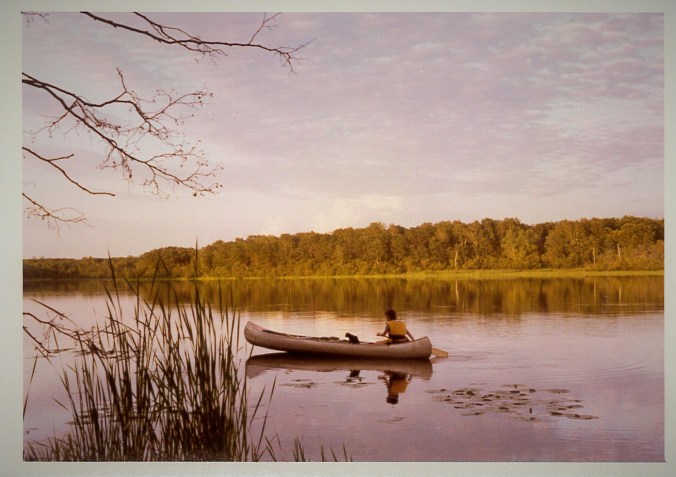
Inky and me, Star Lake, Minn., July 1977. Image by Dorothy Pramann.

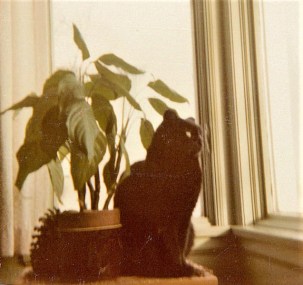
I grew up with a black cat named Inky. She was a stray a neighbor boy brought to us because he knew we recently lost a cat. That previous cat was a calico we named Muffin. Alas, Muffin ran away when we were on a camping trip while she was under the care of a neighbor. Perhaps because of that, we took Inky along on all our camping trips.

She did not enjoy car rides – she would disappear under the driver’s seat and not emerge until we’d reached our destination – but she liked being outdoors in the campgrounds where we stayed. We’d leash her to a picnic table so we wouldn’t lose her.

One place we liked to stay for extended periods was Star Lake, a Methodist Church Campground in northern Minnesota. Because we’d stayed there several times and we didn’t need to travel the next day, we’d let Inky off her leash to come and go as she pleased, like she did at home.

We owned an old Grumman aluminum canoe that I used to paddle around the lake. One day, I got the idea of bringing Inky along.

Canoe Cat_Page_2

Inky at home, 1975.

She seemed to like the canoe ride better than a car ride. She perched on the gunwale a few feet in front of me, leaning out over the water.

With each canoe outing, she’d lean farther and farther over the side. It seemed like she wanted to go into the water. One day, I tipped the canoe slightly, giving her some “help.”

Plop! Into the water she went.

We weren’t far from the shore of our campsite – only about 30 feet — and she swam in that direction. I can’t recall if she meowed as she swam, or if she swam silently. (My memory has fuzzed during the four decades since this occurred.) She made it to shore just fine and seemed no worse for wear.

The next time I took Inky out for a canoe, as we neared our site again, she jumped out of the canoe by herself!

Could it be, she liked to swim? I’d never heard of a cat who liked to swim, but apparently, I had one. By the end of our stay, her swims from the canoe to our campsite were a regular thing.

Inky the swimming black cat lived to a ripe old age, despite getting hit by a car once, breaking her leg. I’ve had other cats since then, but none who liked to swim like she did.

I just researched swimming cats. Although most cats would rather avoid water, some do like it. (Read stories here.)

My youngest son is allergic to cats, so I have since switched to dogs. But in my home, I keep this photo my mother took of Inky and me canoeing. I think of my swimming cat whenever I pass it.

Star Lake was the only place I ever took her canoeing. I wonder what she would have thought of the Boundary Waters Canoe Area Wilderness? I bet Inky would have liked it.

Another Random Act of Decorating Kindness

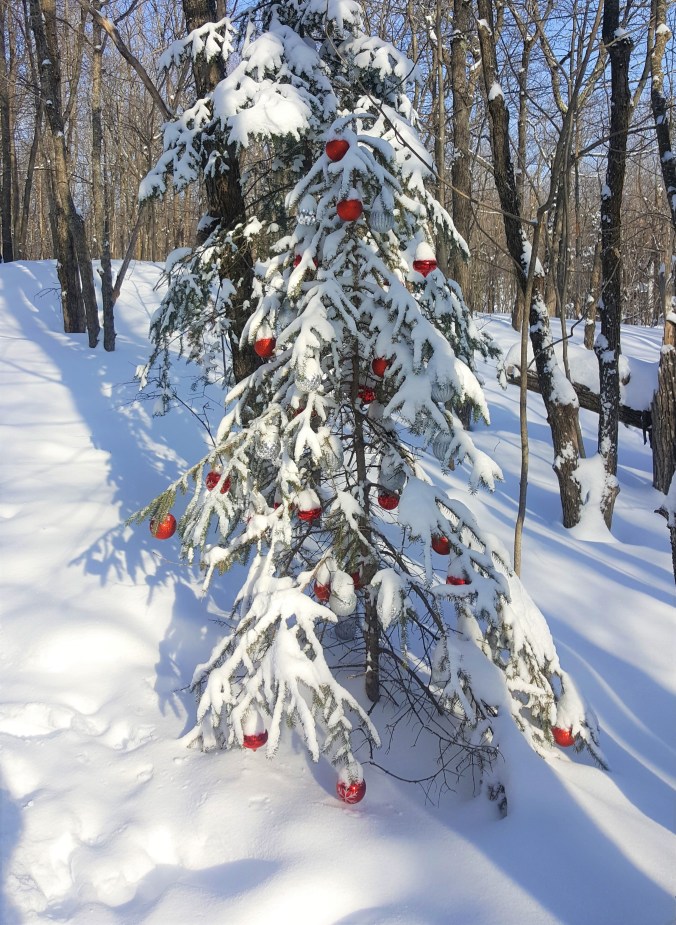
20191210_121551Someone is decorating outdoor trees in my neighborhood. If you have an excellent memory, you may recall that in 2015, I came across a small tree decorated on a trail where Buddy and I habitually walk. This unexpected act of decorating kindness lifted our spirits, and no doubt, the spirits of others who walk the trail.
The problem was, nobody undecorated the tree. As the winter wore on, some of the ornaments broke. Eventually, I ended up freeing the tree of the clutter at winter’s end. The next two years, no mysterious decorations appeared. I missed them, so last year, I ended up decorating the same small tree with several old ornaments that I no longer had room for on my personal indoor Christmas tree.

Well, somebody beat me to it this year. Red and silver ornaments magically appeared on a larger tree. And these weren’t just a few cast-off decorations like el-cheapo me used. They are numerous and new-looking. Plus, Buddy and I noticed another tree sporting similar decorations on a roadside in our neighborhood.

Could the same little elves have decorated both trees? Perhaps.

I don’t want to think about it too hard. I just want to enjoy the gesture. And I would like to wish a Merry Ho Ho to all and to all a good night.

Book Review: Hawks on High

20190915_141115_001

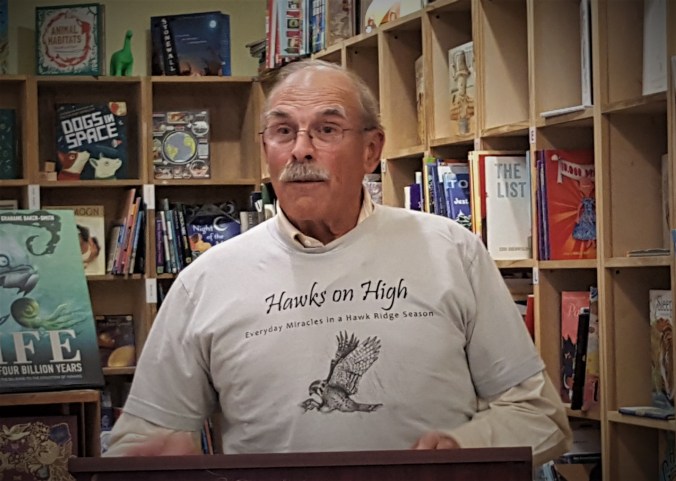
Phil Fitzpatrick talks about his book “Hawks on High” recently at Zenith Bookstore in Duluth, Minn.

It’s about time someone wrote a book of poems about Hawk Ridge in Duluth. And it took a newcomer to do it. Author Phil Fitzpatrick (Hawks on High: Everyday Miracles in a Hawk Ridge Season) has only been coming to the popular bird migration counting station on the ridge for two years. However, with his “new eyes,” that was long enough for him to amass enough poems for this book. His poems are combined with pen and ink drawings by artist Penny Perry.

My favorite poem is “Pringles Prize.” It describes how the hawk ridge workers use Pringles potato chip cans to contain the hawks they catch in mist nets on the ridge. Once the hawks are slipped into the cans, their legs can be easily banded for later identification. Before a hawk is released, the birder eases it “from its cardboard confines” for a short show-and-tell to the gathered bird-watchers. Then it “lifts above wide-eyed kids who now love hawks even more than Pringles.”

Love the wonder and subtle humor of that ending! I gave “Hawks on High” five out of five stars on Goodreads.

The Secret Bank Account

Woman's hand holding US banknotes

Image from time.com.

One of my first jobs out of college was as secretary for a local factory that made bakery machinery. As part of my job, I was in charge of handling credit union transactions for the workers. (This was way before the days of online banking and at the dawn of the age of computers.)

One day, a worker was absent and he received a payment from the credit union. I believe he must have been on vacation. As plant secretary, I had access to index cards containing personal information for all the workers, including their home phone numbers.

I thought I would be super helpful and let the man — let’s call him Butch — know his payment was waiting. If he was home, maybe he’d want to pop over to the office and pick up the check.  I phoned his home. Nobody answered, so I left a message.

A few days later, I got called into the plant manager’s office. He told me Butch was upset I had left the message about his credit union payment. You see, his wife didn’t know about this account and she heard the message. You can guess what happened at home!

Anyway, the plant manager chewed me out and told me not to call workers at home about their credit union payments. I was officially reprimanded.

As I was on a walk the other day, I remembered this event and started musing about the chutzpah, or perhaps it’s male privilege, that allowed the worker to complain to his boss that I had outed his secret bank account. And then for the manager to blame me for the problem.

It made me wonder whether it was common practice at this factory for workers to have secret bank accounts – to hold money back from their families. How would the families know? The deposits were automatically deducted from their paychecks. The transactions all occurred at work.

Instead of meekly agreeing to the reprimand, I wish I had laughed at the absurdity of the plant manager chewing me out for innocently not keeping a worker’s dirty little secret. But that probably would have gotten me fired on the spot.

I can’t recall if I was actively seeking employment elsewhere at the time, but I knew I wasn’t happy in that work environment and didn’t plan to stay long. I ended up working there for two years before resigning and finding a job better-suited to my career goals.

I am so glad I didn’t let the security of a paycheck keep me tied to a place and a job that didn’t suit me.

Unicorns in New York City!

20191103_123900

The unicorn in captivity tapestry.

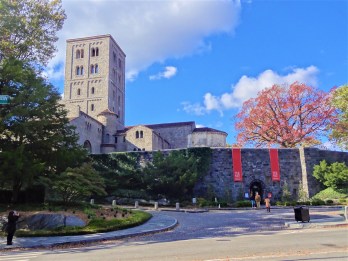
On our recent trip to NYC, Russ and I discovered there are unicorns in the city. Specifically, unicorns adorn tapestries in The Cloisters, a branch of The Metropolitan Museum of Art devoted to medieval European art.

DSC05648

The Met Cloisters

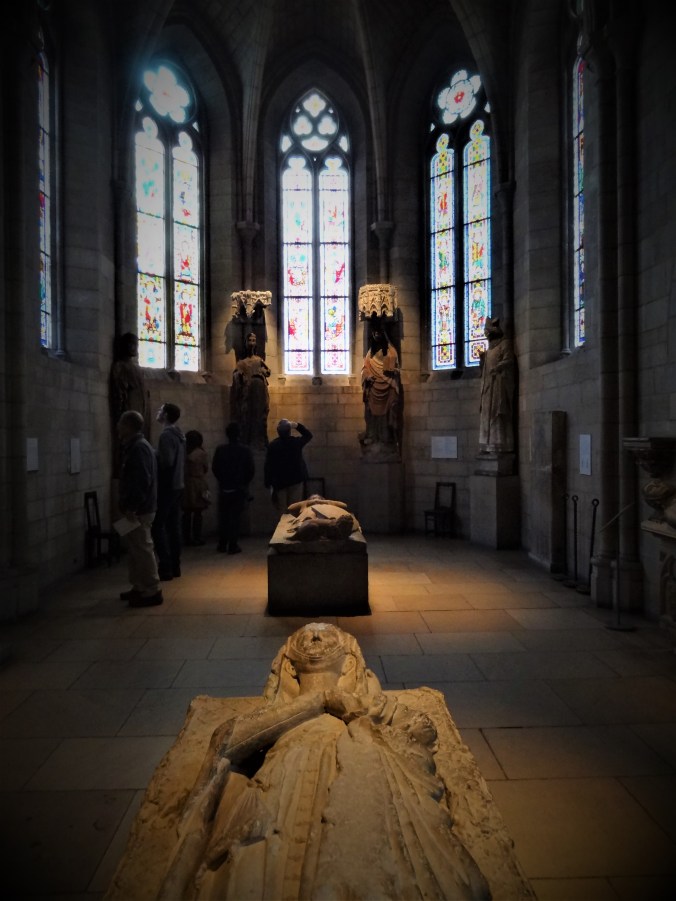
Atop its hill overlooking the Hudson River, The Cloisters takes visitors back to another era. Many of the buildings and chapels were transported over from Europe. They house sculptures, paintings, sarcophagi, stained glass and other master works from the 12th century to the 15th century. The halls are separated by courtyard gardens and outdoor gardens that will make you feel like you’re on the set of Romeo and Juliet or something.

One of our favorite rooms held the unicorn tapestries. These seven wall hangings were thought to be woven in the 1500s in Brussels. They depict the hunt and capture of a unicorn. The unicorn does not fare well with its encounter with humans. It’s held captive and killed. Or is it killed? Artistic scholars debate this, but what’s not debatable in the renderings is that people attack it. But I’m not going to show those tapestries here. They are just too mean! I will show a different one, instead.

20191103_124142

The unicorn purifies water and is discovered by the hunters.

Enjoy this mini tour of The Cloisters.

DSC05666

DSC05669

DSC05671

Oh, and this is a unicorn thing that does something. I don’t know what, but it looks cool.

Aspects of 9-11

DSC05595

The slurry wall inside the 9-11 Museum.

Russ and I meandered over to New York City last week. We didn’t plan it, but our trip ended up being 9-11 themed. Our first experience was a visit to the 9-11 Memorial and Museum.

The dim lights and the quiet struck me as we entered the museum. This was hallowed ground. Visitors treaded lightly and spoke softly. We met our tour guide in the lobby and she took us down, down, down into the excavation pit of the World Trade Center buildings.

DSC05587The heavy ghost of all the rubble that had filled the space and piled above it was an emotional and physical weight. Our guide showed us the slurry wall that held back the river from flooding the space, the square-edged outlines of the waterfalls that flowed in the memorial outside, the wreckage of the fire trucks, and the last cement column that survived the building collapse, festooned with first-responder graffiti.

The most awe-full artifact for me was the impact steel from the North Tower, which was the one hit first. Mounted on the wall like a crucifix with a stark light upon it, the mangled steel beams hung as a testament to the power of the plane that crashed into the building and began the nightmare.

People showed different emotions to these sights. Some were crying, some were dazed. Everyone was somber.

20191102_111834

The impact steel from the North Tower.

Our tour guide explained that her brother worked in the World Trade Buildings. He only escaped death that day because, at the last moment, he decided to go to the optometrist to get his glasses fixed instead of heading up the tower.

Tour over, we were free to wander among the artifact exhibits on our own. I was drawn to the information about the plane that crashed in Pennsylvania, because I was in Pennsylvania when 9-11 happened. A timeline of those events was on display along with text of the plane cockpit recordings.

Also powerful and haunting were the voicemail messages left for loved ones from those who worked in the tower after the plane(s) crashed into them.

After all that heaviness, I was glad to get outside into the memorial area. But even the memorial is heavy, with all the names of the dead inscribed around the waterfalls that flow into the building pits. We found the name of a man who had been in a relative’s wedding party.

DSC05674The other 9-11-themed thing we did was attend the Broadway show, “Come From Away.” Although poignant at times, this experience was much more enjoyable than the museum. The musical tells the story of the townspeople of Gander, Newfoundland. This village of 10,000 people hosted 7,000 airplane travelers who got grounded on 9-11 for several days.
The Newfies welcome the confused travelers like only Newfies could – with generosity, caring, music, and whisky. The show offered 100 minutes of humanity and hopefulness.  The audience gave it a standing ovation at the end. If you have a chance to see “Come From Away,” by all means, do so!

Adventures in Acupuncture

Oliver dixon jpeg

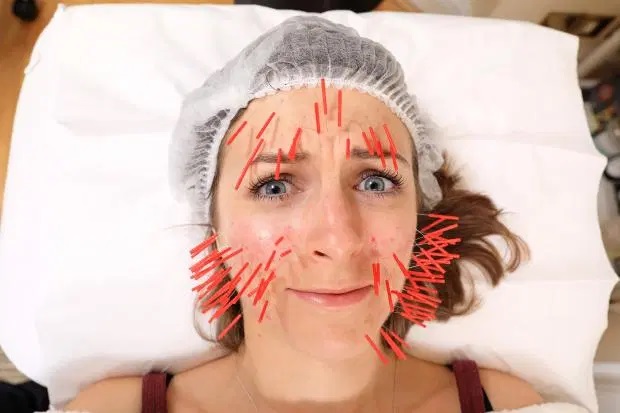
This is not me, but this is how I felt! Image by Oliver Dixon.

I realized I haven’t updated you all on my “Fun with Acupuncture.” Dear readers, as you may recall, I decided to visit a local acupuncturist for help with my hot flashes. That was in July. Now it is over two months later. What’s the verdict?

During the first week or so, I thought the treatment wasn’t working. It involved an acupuncture session and herbal supplements to take later. Then I realized I wasn’t taking the proper dose of the supplements. When I fixed that, things seemed to improve.

I’ve done well avoiding chocolate, as the acupuncturist suggested. Not so well avoiding wine, but I have cut back quite a bit.

I went back for a follow-up session a few weeks ago. This time, she wanted to stick her needles a few new places to help my allergies and my stuffy sinuses. She asked me if she could stick some needles in my face.

Let me say that again: MY FACE. Stupidly, I said yes.

I LET HER STICK NEEDLES IN MY FACE. Specifically, I let her stick two needles in that space between my upper lip and my nose. (Also known as the philtrum.)

I felt nothing with the first needle. I felt the second needle go in, plus she twisted it a bit. She also stuck a needle in the TOP OF MY HEAD. That one started to sting.

I asked her if it was normal for it to sting. She said she thought it would calm down after a while.

Happily, the pain did lessen, but it was rather disconcerting for a few minutes. Lying on the table for 20 minutes was a bit easier this second time. I think it helped that I couldn’t see the needles she stuck in my face. They were so close to my eyes that they were blurry. She also gave me an additional herbal supplement for my allergies.

For the first day or two, I had no hot flashes. Then they started returning at night, but only a few times a night. I’ve also had them during the day, but not as often as before I started treatment.

The supplement she gave me for my allergies worked like a charm.

Overall, I’d say that my hot flashes have improved by about 65%. And the flashes I get are not as extreme. They are more like warm flashes than hot flashes. I am sleeping better and plan to continue taking the supplements until I feel like I don’t need them any more (or I get sick of them, whichever comes first.)

If you are thinking of trying acupuncture for help with hot flashes, I say go for it.

Personally, I feel like I’ve had enough sessions with the needle for now. I fear a continuing escalation of where she’ll want to stick needles next, and I’d rather not go there.