Book Review: Babbitt by Sinclair Lewis

ilewish001p1

Sinclair Lewis. Image courtesy of the Encyclopaedia Brittanica.

I was motivated to read “Babbitt” because the author lived in my hometown in the 1940s for a time. I periodically drive by the house Sinclair Lewis used to own and it made me curious to read his works.

Also, my mother had a brush with Lewis. As a home economics major at the University of Minnesota, to gain experience she worked as a cook for a professor who had Lewis over for dinner one night. As I recall, my mother was not impressed with the author, saying that his face was pock-marked, he seemed unhappy, and was inordinately self-absorbed.

Although the book and its slang are dated, I found the tale eerily relevant, given the current political climate. It’s not so much a story as it is an extended character study of George Babbitt, a real estate broker in the mythical town of Zenith (which is patterned after Sauk Centre, MN). And if you ever wondered how white male privilege came about, this story reads like a propaganda packet for it and it will enlighten you.

During Babbitt’s time, cigar lighters in cars were a big deal. Ads were written in flowery language with fountain pens, and protracted descriptions of electrical outlet covers could make their way into novels. “Boosterism” was big. Prominent community members were expected to extol the virtues of their small towns far and wide to encourage business and prosperity.

Babbitt is a 48-year-old economic booster who faces a mid-life crisis – kind of like if Donald Trump ever got a conscience or sought spiritual enlightenment. The story follows him from his rise to the ultimate booster, to his decline after his friend is jailed for a shooting. Babbitt begins to question the social culture of his town and he rebels to the point of drinking heavily, having an affair, and consorting with **gasp** liberals and men deemed as socialists.

Babbitt is brought back to the fold of social respectability after his wife contracts appendicitis and the community rallies around his family. However, after his wife’s recovery, the old rebellion starts in on him again. He feels powerless to act on it because he’s finally back in the good graces of the town’s powerful men.

It is at this time [spoiler alert!] when his son elopes with the neighbor girl. After they come back home and announce their news, the shocked families start expressing their disapproval, except for Babbitt, who takes his son aside into another room. Babbitt praises him for having the guts to buck society and do the things that Babbitt was never strong enough to do. Thus, he passes the torch of social rebellion onto his son to carry.

My favorite scene in the book involves the subtle satirical humor at a dinner party where all the men complain about small town hicks who repeat the same things over and over again during their dinner parties because they are so uncultured. Each big city cultured Zenith man at the table expresses this same complaint, just in different words.

Although Lewis is an astute observer of human nature and his story is meant to be a cutting social commentary, the language makes it rather quaint today. It’s full of words like “zip” and “pep,” and such shocking swear words as “golly,” and “rats.”

But I liked the story. I gave it three out of five stars on Goodreads. I feel I’ve done my duty in reading a local author. Next time I drive by his former house, I’ll utter a couple of “gollies” in his honor.

Bellying up to the Water Bar

20190418_161340

Friends Pat and Tari visit my Water Bar.

Last week, I had the chance to watertend for my job. What’s that? It’s like being a bartender, but without the alcohol.

I learned my new trade at an open house hosted by the Natural Resources Research Institute (NRRI) in Duluth, Minnesota. The “Tapping into Science” event was the brainchild of June Breneman, a friend of mine and fellow science communicator, with the intent of celebrating the importance of clean water by offering the public a chance to taste regional water at a Water Bar and local craft beer brewed with Lake Superior water. It’s also an opportunity to put water professionals and educators in contact with the public in an approachable setting.

Unlike a real bartender, my preparation was minimal. All I needed to do was read a one-pager on how to tend water and watch a short video. Plus, I had help. I worked with fellow watertender Steve Berger, who serves as chief of staff for NRRI.

Steve and I served three varieties of water from growler jugs. Varietal #1 was from Minneapolis, which gets its water from the Mississippi River. Varietal #2 was from Duluth, which gets its water from Lake Superior. Varietal #3 was from Buhl, a small town on the Iron Range, which gets its water from an aquifer.

NRRI image

Me, watertending. Image courtesy of the Natural Resources Research Institute.

Like a real bar, the atmosphere is intentionally casual, with convivial and open-ended interactions. As the one-pager says, there’s no wrong or right way to do it, so that takes the pressure off right away!

We wore aprons with big blue water drops on them and served the water in compostable plastic cups on a flight board featuring three circles with numbers for the different types of water.

I arrived thirsty, so before the event began, I did my own tasting. #1 had a chemical tang to it with a hint of algae. #2 didn’t taste like anything to me, probably because I live in Duluth and am so used to it. #3 tasted much like #2. I found it interesting how many subtle differences I could taste between the Minneapolis water and the other samples when drinking them sequentially.

Most of our patrons at the water bar wanted to guess which samples came from which locations. It was interesting to see their different interpretations of the tastes. The experience sparked many discussions about the kind of drinking water people grew up with and the sources of the drinking water they now use.

After finishing their flights, patrons walked down the hallway to visit water research displays and to sample beer from three local breweries.

This is a unique way to encourage thought and discussion about water. If you work for a water organization, keep this in mind as a public outreach method. The Water Bar and Public Studio provided materials for the bar. It’s a nonprofit arts organization connected to the Freshwater Society in Minnesota. According to June, the amount organizations pay for the bar materials is negotiable.

Now I have a new skill to list on my resume.

And I have a whole new definition for what constitutes a “dive” bar. 🙂

20190418_170208

A flight of water.

Dining in the Dark

20190418_190920

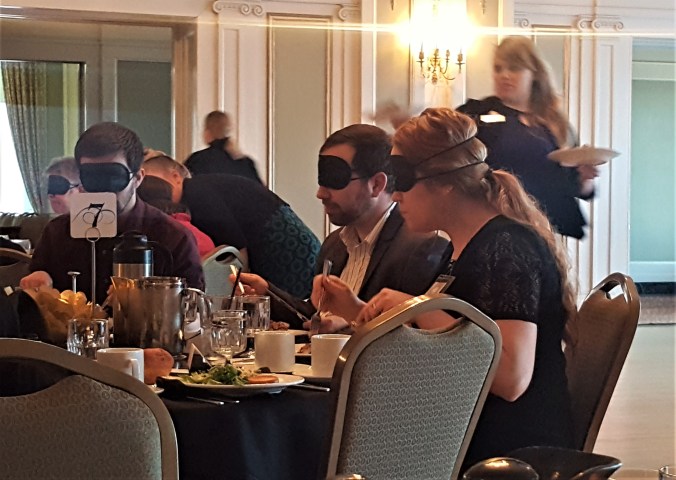
Yesterday, Russ and I paid good money to eat food we couldn’t see. The dinner was a fundraiser for the Lighthouse Center for Vision Loss, a local group that helps people with vision problems. (You may recall that I volunteer for this group by reading the Sunday newspaper aloud over the airwaves once a month.)

The event was hosted by a local TV news personality and the keynote speaker was a man who lost his vision due to retinitis pigmentosa. From him, I learned that blind people make jokes just like the rest of us (imagine that!) and that 66% of visually impaired adults are unemployed.

Another speaker before the dinner was a woman who lost her vision to diabetes. Her best joke was that this was one night when she didn’t have to worry about how awful she eats. (Because everyone else will be blindfolded. Get it? Maybe you had to be there.)

Then two speakers instructed us on how to go about eating when blindfolded. The main tips were: to sit close to the table; put a napkin in your lap or tuck it into your shirt; feel slowly with your hands where your silverware and drinks are first; think of your plate as a clock face and have someone tell you where your food is in relationship to that; use the edge of your fork to circle your meat and determine what size it is; and keep the sharp side of your knife down when cutting meat.

Before the food was brought out, we were instructed to don black blindfolds that were provided near our place settings. Once our plates arrived, I cheated and took mine off so I could tell Russ where his food was on his plate.

I found that cutting meat was the hardest part. I attempted several cuts, but couldn’t tell if my knife was  sharp-side-down or not. I ended up just stabbing a large piece of pork and tearing off pieces with my teeth — not exactly fancy dinner behavior, but hey, it worked. I appreciated the advice about reaching slowly for water glasses and silverware. I am proud to report no spillage or droppage.

Once I mostly emptied my plate, finding the remaining food became more difficult. I can’t imagine having to eat that way all the time. The experience gave me a greater appreciation for the challenges that visually impaired people face and the important work that organizations like the Lighthouse Center do.

Careful! People Might Take you at Your Word

Cake by Chriss

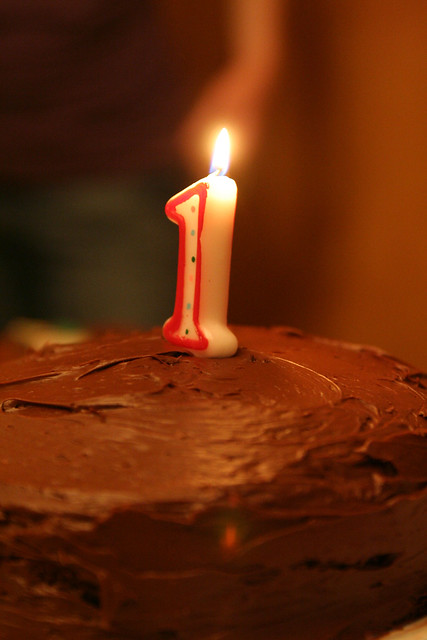
Image by Chriss from Flickr.

An incident is arising in my mind from the mists of time, perhaps because I’ve been planning several events recently. My husband and I had purchased our first house in a Duluth neighborhood. Our son was one, so we decided to hold a combination birthday party and open house for our friends and the neighbors.

On the afternoon of the party, many people showed up. Things were in full swing when a couple from down the street rang the doorbell. We hadn’t met them yet and were happy to see them at our door.

After introductions, the woman said something like, “I’m sorry, we don’t have time to stay, but we just wanted to say hello.” My husband and I expressed our disappointment at this. We chatted a few moments more and then they went on their way.

I was surprised some months later to learn from my mother (who lived in our same city) who in turn learned from one of her friends who was acquainted with the couple, that they were incensed and highly affronted that we didn’t insist they come into the party.

I stared at my mother in disbelief at this news, then started to laugh. Oh the social games people play! I had never run into that behavior before. And I’m sorry, I’m not the type of person to beg people to come to parties if they’ve said they can’t. Imagine that — the couple was angry because we believed what they said.

We lived in the neighborhood for a few years more and never did run into the couple, so we had no chance to smooth things over.

I suppose they had expected us to say, “Nonsense, please come in. We’d love for you to stay!”

Instead, they got, “Oh, sorry to hear that,” and eventually, a goodbye.

In our defense, we were new homeowners, new parents, and unschooled in social mores. But I do hope the experience made those neighbors think twice before they tried this tactic on others. I’m sure there are other people in the world who think people actually mean what they say.

Marriage Advice Learned in a Bar

I attended a bachelorette party recently in a local pub. Two patrons near our table were asked for their advice for the bride. Bernie (a woman) and John had these sage words of wisdom to impart from their 40 years of marriage:

When you wake up each morning, ask yourself what you can do for your spouse today instead of what they can do for you. 

Going on a Tongue Adventure at Duluth Cider

20190406_202549The wave of hard cideries that has swept the coasts has finally made its way inland to the shores of my fair burg. So far, one has opened in Duluth (Duluth Cider) and another is planning to open later this month (Wild State Cider).
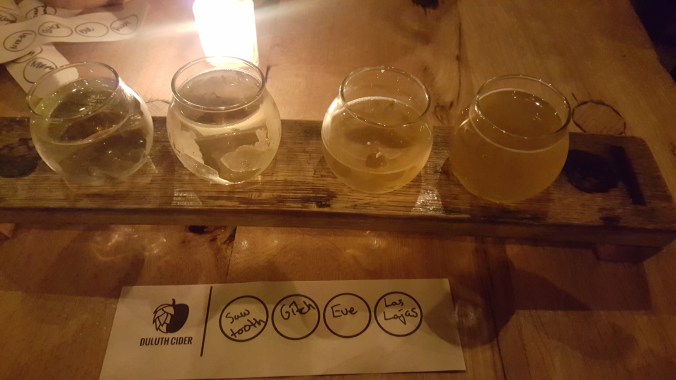
I had a chance to go to Duluth Cider this weekend and have a taste. I ordered a flight of ciders — yes, just like you can at a winery or distillery. I asked the bartender to pick out two sweet ciders and two semi-sweet ones since that mirrors my preferences in wine.

On the sweet side, he poured me Eve and Las Lajas. I have to admit, of all the varieties I tried that night, Eve was my favorite. It tastes like one of the crisp fall apples you’d eat at Bayfield’s Apple Fest. The finish had a lovely little bite.

20190406_202947Las Lajas is flavored with coffee from Duluth Coffee Company. I tried this one first, and didn’t like it because it didn’t have the traditional apple taste I was expecting. But after I tasted the other three and came back to it, my palate had gained a new appreciation. Besides the coffee, it carries hints of caramel and vanilla – rather like a crème brulee of ciders. I joked with my friend that this would make a good breakfast cider.
I did not enjoy the semi-sweet ciders as much. Those were Sawtooth and Gitch. I can’t think of any description for Sawtooth. It just did not inspire my tongue. Gitch was a bit better, but like its namesake lake, was watery compared to the more robust flavors of the sweet ciders.

Instead of ordering a flight, my friend had a full glass of the Palisade — a dry cider that he found “quite pleasing.”

Many in the crowd were drinking a reddish cider called Ruby, which is a sweet one made with cranberries. I’d like to try that next time we go back. We were there on a night that featured a jazz band. The cidery has many events planned in the coming weeks that look intriguing.

The crowd was a mix of ages, but featured a preponderance of men with dark beards, glasses and plaid shirts. So if you’re a hipster, you’ll fit right in. If you’re an oldster hipster like us, even better!

The types of ciders available vary, so you might not find these same ones when you go. Don’t let that stop you from giving your tongue an adventure and trying what sounds good.

I’m glad this wave of ciders has reached the shores of Lake Superior.

Break Open This File in Case of Depression Emergency

20190330_122431

Last night on the radio I heard the deejays talking about the value of writing yourself a ‘love letter’ to read when your mood needs lifting up. It reminded me of a blog post I had been saving for times when I ran low of bloggy ideas. Since I seem to be in that state (running low of ideas, not feeling bad), I thought this was a good time to share it.

*

New Years is a hard holiday for me for several reasons. None of which I will go into over the Internet. To cope, I found myself breaking out my “fan mail” folder for the first time ever. It’s a folder about three inches thick where I’ve stored cards and letters over the years from my children, friends, colleagues, ex-husbands (when times were good!), and ex-lovers.

I had never broken it open before. I got half-way into the stack of papers before I had to stop. I was filled to overflowing with the love given me by the people I love.

I highly recommend it – a fan mail folder. Use only in case of emergency…. It works.

Free Poetry Project

free poetry dnt

Image by the Duluth News Tribune. That’s my poem that’s pictured!

The city of Duluth has a poet laureate. The current laureate’s name is Gary Boelhower. One of the ideas he put forth during his nomination process was to organize a free poetry project in our community. He made it happen, and now people can pick up poetry printed on cards at a dozen locations around town, including bookstores, coffee shops, and cafes.

Eleven local poets offered poems, including me! I offered several poems that haven’t been published yet. I chose fun ones that I thought would have popular appeal. One of them, titled “My Facebook Identity,” happened to be featured in a newspaper photo that accompanied a story about the project. To learn more, read the story.

I’m honored to take part in this sprinkling of poetry across our city!

Solastalgia: The Psychological Impact of Environmental Change

DSC05208

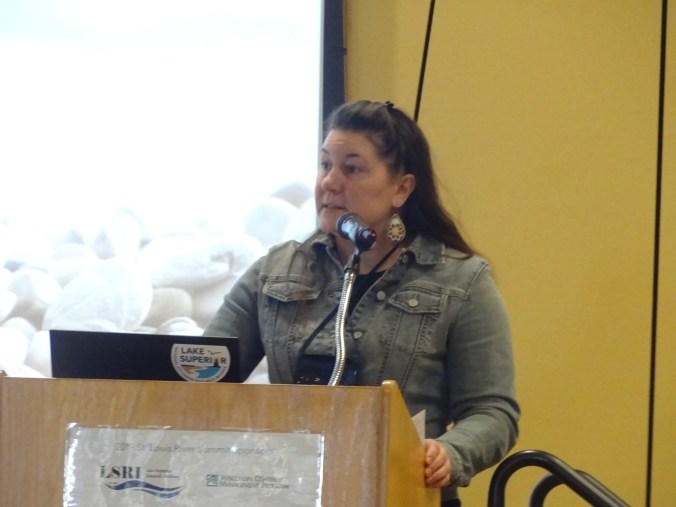
Leah Prussia, College of St. Scholastica.

Earlier this month, I attended the St. Louis River Summit. This science conference about the largest river that empties into Lake Superior (on the U.S. side) has gradually been incorporating more presentations that aren’t as “sciencey” as usual.

One of them caught my interest. Presented by Leah Prussia with the College of St. Scholastica, it was called “Solstalgia: An Intersection of Shared Knowledge.”

“What is solastalgia?” you may ask. Solastalgia is an English term for the mental or emotional distress that people feel from harmful environmental changes. It’s made up of “solace” and “nostalgia.” People feeling solastalgia no longer receive solace from their environment. Due to changes, they feel nostalgia for the way the place used to be. It’s a relatively new word, coined in 2003.

The changes can be from environmental catastrophes, such as volcanoes or floods, or from human-made changes like development or climate change.

DSC05209

St. Scholastica students gathering stories about people’s experiences with solastalgia.

Prussia, a social work professor, had her students at the Summit to collect people’s stories during lunch. I told them the story of a grove of trees near my home where I used to play with other neighborhood kids. I was devastated when the grove was cleared for a new house.

I remember complaining to the neighbor boy about it while we were on the swing set in my back yard. He said I’d get over it. That was almost fifty years ago!

I’m obviously still not over it if I can remember the pain I felt at the change. Have you ever felt solastalgia?


What it’s like to have Cataract Surgery

As the anesthetist wheeled my hospital bed down the hall, I looked up at the rectangles of passing florescent lights overhead, stereotypical of every television hospital scene ever filmed. Maybe it was a side effect of the sedative he gave me, but the thought that I was in a bad TV movie amused me.

I was going into surgery to have my old dirty cloudy eye lens plucked out from my right eye and replaced with an UltraSert lens, corrected for my nearsightedness and with UV and blue light filters! Years of squinting into the sun and just plain living had caught up with me. I’d been seeing haloes around the headlights of oncoming cars for years. Things had gotten so bad recently that I started avoiding driving at night.

This surgery was going to give me a new lease on seeing. My friends who had undergone the procedure told me it was a piece of cake, but I was skeptical about staying awake and having someone rummaging around in my eye innards. It didn’t help that the day before my surgery, news reports came out about a woman who committed suicide because her Lasik surgery went wrong.

At least I was having a different procedure done, but it still gave me pause.

Well, I am still here to say that I’m looking forward to having my other lens replaced later this week. Although I didn’t feel that sedated, I was apparently relaxed enough that they didn’t need to strap my head down to keep it from moving.

The doctor opened my eye with a speculum. They irrigated my eye with a saline solution and that’s about the only thing I felt. The main thing I had to remind myself was not to try to blink or struggle against the speculum.

What did I see? The white light that the doctor used to look into my eye. I saw the light the whole time through the 20-minute procedure. I couldn’t really tell when my old lens was gone and the new one was put in – I always saw light, although I guess from stories I’ve heard, other people see a red light or blackness. There was one point when my sight seemed to take a more internal turn, and I got impressions of things floating around inside my eye. Perhaps that’s when I was lensless.

From the time I got to the outpatient clinic to the time I went home took about 4 hours. You’ll need a friend to drive you home and back later the same day to the clinic for a follow-up exam by your doctor where s/he will check the pressure of your eye and make sure everything’s okay.

DSC05225

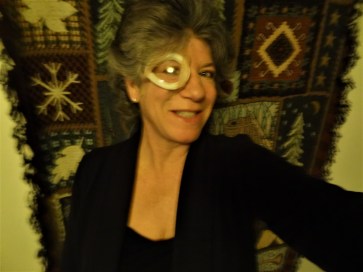
A blurry photo of my fashionable night eye guard that I wore for a week.

Be prepared for a lot of different drops put in your eye. Post-surgery you’ll be on an eye drop regimen that consists of a steroid to keep the swelling down and an antibiotic to prevent infection. At night, you’ll need to wear an eye guard for the first week.

The worst part of the procedure was only having one good eye to work with for two weeks. Although I got a clear lens placed in my eyeglasses over my good eye, I found I couldn’t tolerate wearing my glasses because of the lack of depth perception. So I’ve just been going around with one clear eye and one fuzzy eye. So if you notice any spelling errors in this post, that is why! But I’ve been making due the best I can in the meantime, and I’ve been able to drive all right (20/30 vision in my surgeried eye makes me legal to drive).

I also went out and bought a brand new pair of nonprescription sunglasses — first time I’ve been able to do that in years! The surgery seems to have made my eyes more sensitive to light, and the sunglasses are helpful.

A creepy side effect of the surgery is that, in the right conditions, I can see reflections from the artificial lens in my eye. I can tell that it’s not natural – kind of like having a robot eye. I wasn’t expecting that. But I guess it’s worth it to have better vision.

Anyway, wish me luck on my next surgery, and if you are scheduled to have it – I’m here to attest that it really isn’t so bad. It may even free you from glasses. And no, my doctor is not paying me to say any of this!