Fun with Acupuncture

acupuncture-on-wristAs you may know, I am in my elder years. As you may not know, I have been experiencing hot flashes for several of those elder years. If you don’t want to know that information, you can stop reading now. But if this revelation holds any interest to you, and you want to know what it’s like to have acupuncture, read on!

At first, my hot flashes weren’t so bad – just a minor inconvenience. After a few months, they went away. I thought they were over and that the whole hot flash thing wasn’t so bad. WRONG. They returned and were a bit peskier than before – interrupting my sleep, arriving at inopportune times during the day, eliciting knowing looks from other older women in airports and grocery stores as I fanned myself.

My doctor offered the idea of estrogen therapy or some anti-depressants, but I shied away from those. Reports of problems with those drugs made me skittish, besides, I figure there’s a good reason our bodies are no longer making estrogen. Why prolong this with adding it back in?

As my hot flashes became more severe over the past year, I tried a few different herbal supplements, but they just made things worse. On the advice of several friends, I decided to try a local acupuncturist.

The first step in my appointment was filling out about a 15-page health history. Wow! I dropped it off at the practitioner’s office a week beforehand so she would have time to look at it before my appointment.

When I arrived for my session, we went over the document and she asked for details on a few things. She quickly zeroed in on several habits I have that can worsen hot flashes, those being drinking WINE and eating CHOCOLATE. She suggested I give those up for a month or so to see if that helps.

WINE and CHOCOLATE. These are the only things that make my life bearable. Because I’m intolerant to wheat and corn, I can’t have pastries, pies, cookies, doughnuts, etc., unless I go to great (and rare) lengths to make them myself from alternative ingredients.

I have often said that I am so glad I can still eat chocolate. If I ever become allergic, someone should just shoot me.

This woman might as well have had a gun to my head. Granted, she wasn’t saying I had to give up these two elixirs forever, just for a month. But still. The only good part of that conversation is that hard liquor (spirits) might still be okay to drink instead of wine. I grasped desperately at the idea that scotch could get me through this deprivation.

As we spoke, the practitioner took notes for my treatment plan. Then she asked if I was open to the idea of acupuncture. I agreed, so she laid me down on a table. She made me stick out my tongue so she could see the color of it, etc. Then she took my pulse in both wrists. Then came the needles.

I didn’t want to watch. I also don’t watch when I get shots. I’d rather not see sharp things approaching my skin. During television news stories about the importance of flu shots, I cannot watch as other people get shots, either.

As I looked up at the ceiling tiles, she inserted seven thin, stainless steel needles into my wrists, lower legs, and feet. It hurt a little bit, but not as much as I was expecting. On a scale of ten, they were about a three. She flicked the needles as she inserted them.

She said she was going to leave to write up my treatment plan. She asked if I would like some music while I waited. When I asked how long it would take, she said fifteen minutes. “Yes, music, please!”

The practitioner exited, leaving me alone with seven long needles sticking out of my body. Well, not having the courage to look at them, I didn’t know they were so long at first. Eventually, I lifted my head and looked at my wrist. A needle stuck about three inches out of it!

I put my head back down, fighting the urge to rise up, tear out all the needles, and get the heck outta there.

“Breathe,” I told myself. “Relax. This is supposed to help you.”

I tried to concentrate on the music (Carlos Nakai flute music, BTW.) That worked for a while, but then I just had to look at my legs. Mistake! The urge to flee came back.

I laid back down and fought it. I tried to meditate, with limited success. I tried to write this blog post in my head, but that made me concentrate on the feeling of the needles and how to describe it.

My right wrist was developing a deep ache. A nerve in my calf twitched. Was this normal? I began to wish the practitioner was in the room so I could ask her. What if my leg cramped up? If I called for help, would she hear me?

I did not like the being left alone part.

After a long fifteen minutes, she came back and took the needles out. I expected her to ask how I felt, but she didn’t. When I sat up and she noticed me rubbing my wrist, she asked if it hurt. I told her it was a deep ache. She said that meant there was a blockage, and suggested I rub the pain out through my hand, not back toward my body.

I could hardly tell where the needles had been. There was no blood, just some tiny discolorations that disappeared quickly. I felt fairly normal and was able to walk down the hall to her office just fine.

There she gave me a different herbal supplement than the one I’d had before. We talked about a follow-up visit. I paid and was on my way.

Once I was back home, I had a hot flash, but it wasn’t as powerful as before. That night, I had another, but it was at a different time than usual and didn’t last as long. I felt more rested than before when I awoke.

Today is the next day. I just read a research study that says acupuncture has been scientifically proven effective to help menopausal sleep disturbances, which is reassuring.

It’s too soon to say definitively if it is helping me. That will take time. I’ll let you know if it does!

In the meantime, I’m glad I resisted my urges to flee the acupuncture table. That would definitely not have been helpful. Time for some scotch.

* * *

UPDATE: Two months later, what’s the verdict?

During the first week or so, I thought the treatment wasn’t working. It involved an acupuncture session and herbal supplements to take later. Then I realized I wasn’t taking the proper dose of the supplements. When I fixed that, things seemed to improve.

I’ve done well avoiding chocolate, as the acupuncturist suggested. Not so well avoiding wine, but I have cut back quite a bit.

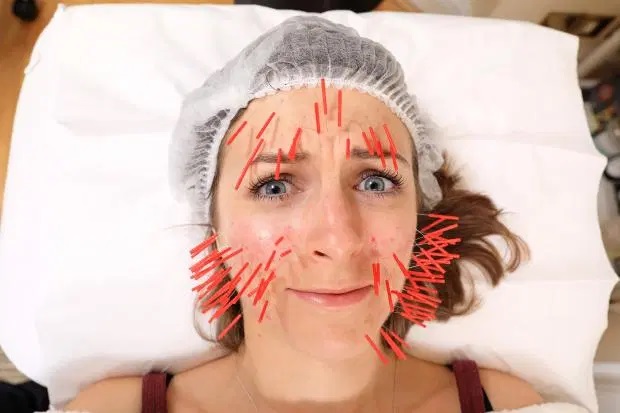
I went back for a follow-up session a few weeks ago. This time, she wanted to stick her needles a few new places to help my allergies and my stuffy sinuses. She asked me if she could stick some needles in my face.

Let me say that again: MY FACE. Stupidly, I said yes. I LET HER STICK NEEDLES IN MY FACE. Specifically, I let her stick two needles in that space between my upper lip and my nose. (Also known as the philtrum.)

I felt nothing with the first needle. I felt the second needle go in, plus she twisted it a bit. She also stuck a needle in the TOP OF MY HEAD. That one started to sting.

I asked her if it was normal for it to sting. She said she thought it would calm down after a while.

Happily, the pain did lessen, but it was rather disconcerting for a few minutes. Lying on the table for 20 minutes was a bit easier this second time. She also gave me an additional herbal supplement for my allergies.

For the first day or two, I had no hot flashes. Then they started returning at night, but only a few times a night. I’ve also had them during the day, but not as often as before I started treatment.

The supplement she gave me for my allergies worked like a charm.

Overall, I’d say that my hot flashes have improved by about 65%. And the flashes I get are not as extreme. They are more like warm flashes than hot flashes. I am sleeping better and plan to continue taking the supplements until I feel like I don’t need them any more (or I get sick of them, whichever comes first.)

If you are thinking of trying acupuncture for help with hot flashes, I say go for it.

Personally, I feel like I’ve had enough sessions with the needle now. I fear a continuing escalation of where she’ll want to stick needles next, and I’d rather not go there.

Two of the Coolest Spots on Madeline Island

IMG_6082

The bridge across Big Bay Town Park lagoon. Look at that beautiful water!

My friend Sharon and I meandered onto this island in Lake Superior a couple of weeks ago. We’d both been there before, but found two cool new places to explore this time. And I mean “cool” as in awesome and interesting.

20190713_141046

The lagoon.

The first was Big Bay Town Park, which friend recommended to us. Unlike with the state park on the island, the town park has a free-will donation fee. A short walk down a stairway from the parking lot leads you to a bridge across a stunning lagoon that enters Lake Superior. On the other side of the lagoon is a public beach studded with white pines. The water is crystal clear and inviting, although as always with Lake Superior, temperatures may be a bit cool.

Canoes are available to rent via self-service onsite, or you can rent watercraft, including paddleboards from a place in town. The kayaks, canoes, and paddleboard are all onsite, and the businesses will give you a key to unlock them.

I brought my own blow-up paddleboard and Sharon rented one for two hours. We cruised the lagoon, watching painted turtles walk across the sandy bottom and startling a fish here and there. The water is so clear, it felt like we were flying through it.

IMG_6099The second place is Tom’s Burned Down Café. I’d seen it from afar before and heard about its, shall we say, counterculture reputation. Maybe it once was a café (before it burned down?) but now it is a bar. No food is available.

The place is a hodgepodge of homegrown-construction seating areas held together with signs with sayings like “It’s not premaritial sex if you don’t plan on getting married,” and “Be the rainbow in a world full of rain.” The top is covered by several tents.

20190714_132120Filter

Tom’s Burned-Down Cafe

Sharon and I sat down, thirsty after our paddleboard, and ordered margaritas. The friendly bartender asked us if we’d like to try beet-infused tequila in our margaritas, pointing to a large glass container of mysterious red liquid behind him.

20190714_133432

My beet-infused margarita with the hand-written menu behind it.

We hesitated for a few beats, and then agreed. We were already brave enough to come into the bar, why not be even braver and try something new? The beet margarita was definitely drinkable, but it didn’t have as much lime in it as we were craving.

Also of note is that the place is cash-only. If you don’t have any, an ATM is available (under its own small tent) in the bar.

Tom’s was named the Number 2 Best Beach Bar in America in 2013 by Maxim Magazine, no doubt, for its unusual ambiance. If you go there with a sense of adventure, you won’t be disappointed!

Book Review: How to Talk Minnesotan, Revised for the 21st Century

9780143122692_p0_v3_s550x406The first version of this book, published in 1987 and later made into a video, helped me understand my own culture. Before reading it, I never understood that the “long good-bye” was something unique to my state of Minnesota. (The long good-bye is where it takes at least three tries to leave a friend’s home before they will actually let you go.)

Also helpful was the “angle rule,” which describes how many Minnesotans talk to each other without actually looking at each other. Instead, they stand at 90-degree angles, looking off at some mysterious distant point while conversing. I had seen that many times and just thought that’s how everyone did it. I was not conscious that these were Minnesota “things.”

I watched the “How to Talk Minnesotan” video so many times, I had the lines memorized. So when I heard the book had been updated (in 2013), I put it on my list to read.

In reading the recent edition, it didn’t seem like a whole lot had changed. Although it now contains sections on Tweets, Facebook, and smart phones, the same lines from the video are there on the page.

However, in reading this new version, I realized something that nagged me with the first version, which is that this is not a book that encompasses the whole of my dear state. The traits described in it are more common in farm country. I’d say that’s about from Hinkley, Minnesota, and south. With token mentions of smelt and lutefisk, this book has a bit of relevance to northern Minnesota, BUT, there’s not one mention of a sauna etiquette, iron ore mining, Lake Superior, Ole and Lena jokes, or wilderness camping. It lacks northern nuances.

A more accurate title for this book would be “How to talk Mid- to Southern-Minnesotan.” If you live north of Hinkley, reading it will be helpful, but it won’t get you the whole way. If a third version is ever done, the author should come on up here and talk to us northerners for some new material, don’t cha know.

Exploring Prophyry Island Lighthouse

DSC05399

Porphyry Island Lighthouse

Porphyry is a wilderness island in Lake Superior on the east side of the Black Bay Peninsula near Thunder Bay in Ontario, Canada. Most arrive by motorboat, sailboat, kayak or canoe, docking in a secluded cove about a mile away from the lighthouse. Some arrive by helicopter, alighting on the helipad adjacent to the lighthouse.

Us? We arrived by dinghy, rowing from our anchorage farther down the island. When we landed, we were met by a native Canadian lad – a volunteer for the Canadian Lighthouses of Lake Superior organization.

DSC05388

Did you know there’s a universal symbol for taking a sauna? We didn’t until now, either!

When he asked where we traveled from, Captain Dave told him we rowed from Isle Royale — a preposterous 29 miles away. The lad did not take the bait, and instead, graciously offered us a tour of new structures in the cove. A boathouse features a mini-gift shop, and the sauna offers promises of warmth to be dashed by a splash in Lake Superior afterward.

Although bikes were available, we chose to stretch our sailboat- and dinghy-cramped legs by walking the flat trail to the lighthouse. Lined with Canada dogwoods, forget-me-nots, and the mysterious devil’s club plant (readers of my novel “Eye of the Wolf’ will know what this is!), the trail passed two points of interest along the way.

One was a small graveyard. Four white crosses mark where members of a former lighthouse keeper’s family are buried. The second is an area where a couple of junker cars lie moldering, relics from when the trail used to be a road.

DSC05393Upon reaching the lighthouse, we were greeted by several more volunteers, plus Eve, a former assistant lighthouse keeper. Her husband, Graham, was the last to keep the light before it became automated. He died a couple of years ago, and a photo gallery has been set up near the lighthouse to showcase his award-winning photos.

DSC05398Volunteer Kaitlyn showed us the gallery and a small museum. She was walking us toward the lighthouse for a tour when the door of the structure groaned and burst open. A man ran out, cell phone plastered to his ear, talking intently.

After all the wilderness silence we’d experienced, this was shocking. Not only for the noise but for the technology. (We hadn’t had cell phone service in a while.) We all put our hands on our hearts, and stopped on our tracks.

The man continued walking away from us, talking on his phone. After recovering, Kaitlyn and Eve told us the man was Paul, who ran the place. Once he got off his phone, we were able to meet him. He explained his office is in a room in the base of the lighthouse. He did not explain why he had to suddenly run out of it, but one would assume it was because he was in an important conversation and needed better reception. It made me wonder if his heart-attack-inducing bursting forth happened often, and also made us feel a bit sorry that running the place has him so stressed that he can’t meld into the peacefulness of it.

DSC05401

The helipad at the lighthouse.

As we were speaking with Paul, an older woman laden with painting supplies walked by. She was the latest artist-in-residence at the lighthouse, a painter from Jerusalem. The lighthouse organization sponsors several artists each summer. There’s also a guest house that people can rent, which used to be the lighthouse keeper’s quarters.

After we promised to donate to the lighthouse organization, Paul deemed us worthy of a tour of the lighthouse. Eve and Kaitlyn guided us up the six steep sets of stairs, which were more like ladders. Once at the top, we admired the view of Thunder Bay’s Sleeping Giant through the windows.

After a bit, Eve asked us if we’d like to go outside on the railing. Without hesitation, we said yes. We ducked through a small opening, out into the freedom of the summer breeze. The view was stunning. Eve pointed out the other islands we could see where she had worked with her husband, and where her sons were born. She told us that when they worked at Prophyry, her sons used to enjoy dropping water balloons down the inner corridor. I could totally see how that would appeal to them.

DSC05404

The view looking down from the top of the lighthouse.

After drinking in the view, we carefully descended the steps back to the ground. Eve, at 70, navigated them like a much younger woman. Then again, she must have had a lot of practice when she worked here.

We walked back to the cove and socialized with a Canadian sailor who was anchored there. As we rowed back to our boat, a fog started to roll in, relegating the lighthouse and its inhabitants back into the mists of time.

DSC05403

Eve and Kaitlyn

Wilderness Sailing in Canada, Eh?

DSC05356Russ and I had the privilege of crewing on the sailboat Neverland on a Lake Superior cruise during the 4th of July week. We sailed from Grand Marais, Minnesota, to Red Rock, Canada, which is as far north as you can go on the lake.

I learned more, not only about sailing, but about my feelings for my country. Before we left Duluth for Grand Marais, we happened to see a beat-up pickup truck driving around town with two American flags stuck behind its cab. Instead of inspiring feelings of patriotism, the sight of the flags struck me as aggressive, pugnacious, and a little redneck.

I have never felt that way before about the flag, and suspect it has something to do with our current president and the political/cultural climate in which we find ourselves. Suddenly, missing Independence Day fireworks because we’d be in Canada didn’t seem so bad. But I brought along several old packages of sparklers I had just so we’d be able to celebrate a little bit on the boat.

The Neverland left Grand Marais on a calm, cool morning. Although the air temperature was in the 60s, the Lake Superior water temperature was around 40 degrees. Brrr! Plunk yourself down in a boat in the middle of it, and it feels like fall in July.

Calm weather means poor sailing, so we motored for most of the day across the Canadian Border. You may be wondering how one can cross the border if there are no customs stations in the lake. Well, you need to fill out a remote border crossing permit beforehand. The permits cost around $30 and you have to provide copies of your passport along with it. Allow a month for processing.

If all goes well, your permit will arrive in the mail a few days before your trip. You need to bring the permit along with you just in case your craft gets stopped once you’re over the border. Thankfully, we never got stopped, but it was good to know we had the proper permissions with us, just in case.

Our first anchorage was at Spar Island, near the entrance to Thunder Bay. This craggy, piney island has a protected cove, which provided for tranquil waters all night. In the morning, we rowed Tinkerbell, the dinghy, to a campsite on shore and found a trail that leads to the “top of the world,” which is a tall bluff that offers stunning views of the lake and nearby islands.

DSC05366

View from the “top of the world” on Spar Island.

Ever observant, Russ found a metal mailbox nestled in a pine tree. It held a logbook and we added our names to it. After enjoying the view, we hiked back down.

DSC05369

Looking down from the top of the world.

After another cold, calm crossing (we could see our breath!), we anchored at Porphyry Island. We began the Fourth of July with a breakfast of luscious banana walnut pancakes courtesy of Captain Dave. Then we rowed Tinkerbell over to Prophyry Island Cove. We were met by a volunteer who gave us a tour of the new sauna and boat house at the cove. The island also features a lighthouse. I’ll describe our tour of that in a separate posting later.

Our afternoon sail took us to Chapleau Island, which is off the Black Bay Peninsula. Cell phone service is nonexistent here, and would be until the end of our trip. We shared our cove with a bunch of kayaker boys who were using the campsite and sauna opposite our anchorage. It was fun to see them whooping and hollering as they ran from the sauna and jumped into the frigid waters.

We celebrated our successful arrival with gin and tonics below decks, enjoying the music of hermit thrushes, winter wrens, white-throated sparrows and loons from the surrounding forest.

DSC05428

Fourth of July sunset.

Russ cooked us THE BEST maple butter chicken I have had in memory. Maybe it was so good because of the holiday, but maybe it was because we were so hungry from a long day of activity.

DSC05435After dinner, Russ and I went on deck and took out the sparklers. We were heartened to see they still worked. We had our own little private fourth of July celebration as the sparklers quietly hissed and threw their light into the Canadian evening.

The next morning, I practiced rowing Tinkerbell by myself in the quiet cove. I will admit I did it perfectly backwards, but was soon corrected by my sail mates and got myself turned around in the right direction.

We rowed quite far to explore an unnamed island that Russ and Capn Dave had seen on their last trip here. The island was half rock and half trees, sloping down into the lake gently on one side, with a steep cliff on the other. Pools of fresh water collected in depressions on the shore, featuring tadpoles and mysterious shrimp-like creatures. On the way back to the boat, I even rowed. I can’t say that I am proficient, but at least nobody drowned.

In the afternoon, we finally had good sailing weather. We reached 6 knots on the way to Moss Island, which is at the beginning of the Nipigon Straits. However, good wind means a lot of cold – I had to wear four layers on top and two on the bottom, but at least I didn’t need to use hand and feet warmers like last year. The air was beginning to smell like wildfire smoke and the sky was getting hazy.

A flock of half a dozen white pelicans greeted us and flew by several times during our stay. The weather warmed enough that I could wear shorts, finally – as one should during July!

The next morning, we motored up the straits to Nipigon Bay. In the bay, the wind picked up enough to sail. We made it to Red Rock Marina, our final destination, in time for supper and most-welcome showers.

This is my third trip aboard the Neverland. I am finally getting the hang of what “port” and “starboard” mean. I can steer the boat well while it’s motoring, but not so well with sails. That will take more practice. I am learning the boat’s quirks and how everything works. I would not call myself a sailor, though. I still have a long way to go before that happens.

As we drove home the next day, we saw plenty of Canadian flags, since Canada Day was July 1. I marveled at the different emotions that flag elicited within me: happiness, friendliness, and peace – similar to the feelings the wilderness islands and lake stirred within.

Now, I realize that Canada is not perfect (for instance, their treatment of native peoples is deplorable) but on the whole, their displays of the flag seemed glaringly different compared to the displays in my home town.

I can hear the haters now: If you hate America so much, just move to Canada! I don’t hate America. I’m just pointing out that the 4th of July doesn’t feel the same as it used to, but it took time away on a sailboat for me to realize that.

I hope this time next year our culture will have changed enough that I can be proud of our flag again.

DSC05448

Tinkerbell on the unnamed island near Chapleau Island.

Forest Bathing: A Secret to Better Health

20190622_135935A recent New York Times article described results from a study that quantified how much exposure to nature people need to impact their health in a positive way.

The researchers found that people who spent about 120 minutes per week in nature (like a park or a forest) were less stressed and healthier than people who didn’t get outside at all. Spending less time (60-90 minutes) did not have as significant an effect. Even spending more time (5 hours) offered no additional benefits.

From this post’s title, perhaps you thought I was going to describe how to get nekkid and take a bath in the forest. Sorry, “forest bathing” just means immersing yourself in nature.

The study’s results made sense to me. As a species, we evolved in the outdoors. It’s what we’re made for. Spending time by water is also beneficial.

20190622_133733I am happy to report that I spend at least 140 minutes in nature per week. I am lucky to have a huge city park by my home where Buddy the Wonderdog and I walk every day.

I took some photos from my last walk through the park. At 640 acres, the park is large enough that you’d never know you were in the middle of a city while walking its trails. Signs of civilization are few, even from the rocky knob that features a view of Lake Superior.

My photo walk was longer than usual – over an hour. I returned home feeling serene, indeed. Have you had your dose of nature today?

20190622_132014

Calendar Girl

WI DNR Calendar

I am happy to announce that two of my poems will be featured in the Wisconsin Department of Natural Resource’s 2019-2020 Calendar. The DNR holds an annual contest for photos and takes writing submissions for their 16-month Great Waters calendar, which is designed to show the ways that people connect with the state’s lakes and rivers.

My poem, “Stockton Island” graces the month of August 2020. I wrote the piece decades ago after my first stay at Quarry Bay on the island for a summer science program. My second poem, “Lake Superior Auntie” made the December 2020 page. This poem looks back on my career with organizations that are working to understand and preserve lakes Superior and Michigan.

The calendar will be distributed for free beginning August 1 at the Wisconsin State Fair, Wisconsin DNR offices, state and national park visitor centers, and through partner organizations.

The DNR has just posted the calendar on their website, too. If you’re interested in checking out information about the submission process, take a look here. Your work could be in their next one!

St. Martin Island Princess Cocktail

20190622_173936

This is a drink I spontaneously created while on vacation on the island of St. Martin with ingredients we had on hand. It’s a perfect summer cocktail when you can’t decide whether you’d like a margarita or wine.

I named the drink for the island and for the name the zipline instruction guys called me when I was getting ready to throw myself off the zipline platform. Yes, I am a fifty-year-old “princess!” It became my trip nickname. This is a perfect summer drink.

Ingredients:

White zinfandel wine
Key lime juice (not just any old lime juice, it must be Key lime!)
Simple syrup (a 1:1 cooled mixture of water and sugar that has been heated so the sugar dissolves)
Ice

Pour the wine in a glass until it’s ½ to 2/3 full. Add lime juice (1+ tablespoon, to taste). Add enough simple syrup to sweeten. Add a couple of ice cubes. Enjoy!

How we almost saw Biosphere2

20190619_091811I meandered down to Tucson, Arizona, with one of my sons last week. On the last day of our trip, before we caught our plane back home, we had a few extra hours. We decided to go see Biosphere2, the world-renowned self-enclosed science station run by the University of Arizona that’s about a 45-minute drive outside of town.

Because we would be time-limited, I checked the station’s website to see when their tours run. The text said tours were offered throughout the day on a first-come, first-served basis. Great! We would have time for a tour if we arrived right when their doors opened at 9 a.m.

However, when we got there, the docent said the tours wouldn’t be starting until 10 a.m., which was when we needed to leave to catch our flight. We were disappointed, but decided to pay the entry fee anyway and take a self-guided tour of the grounds.

I remembered hearing about the facility while I was growing up when a team of “terranauts” closed themselves into this giant terrarium for two years to see if humans could live in a man-made environment, with the thought that something similar could be done on some other planet, like mars.

What I didn’t realize from the news stories about the experiment is that Biosphere2 has different enclosures for different environments. There’s a rainforest, an ocean, a desert, and a coastal fog desert. To ensure adequate air exchange, there are event two “lung” buildings that control air volume.

On our self-guided tour, we were able to see the outside of the rainforest building, which is covered in glass panels. Leaves were plastered against the windows, making it look like the plants were just about to burst out of their man-made enclosure.

We were also able to go into the living area that the team used when they were enclosed in the facility. Unfortunately, construction was going on, so we really weren’t able to see much of anything. But there was a cool globe where we could see graphic representations of world populations, Facebook friend links and the like.

The last place we visited was the ocean building. We were able to go inside it and see the exhibits. Unfortunately, the ocean itself is experiencing an algae overgrowth. The water was green, which made it hard to see any fish.

Although we hardly got to see anything, it was still cool. I would like to go back there again under better circumstances and try to get the official tour.

20190619_091800

The huge rainforest pavilion, with plants plastered against the glass.

The Love of Their Life

couple_2648415b

I have developed a fascination with obituaries lately. Most likely, this is because I read them out loud every month from the local newspaper for my volunteer stint with the Lighthouse Center for Vision Loss.

Despite my history as a romance writer, the cynic in me always gets a kick out of obituaries that state the departed met or married someone who was the “love of their life.”

I have noticed that the “love of their life” phrase is usually used when the “love of their life” survives the person for whom the obituary is written. Could it be that the survivors are the ones who wrote the obituaries? If so, are they including the phrase because it’s true, or as an ego boost for themselves and a way to assert their important status in the departed person’s life?

The romance writer in me would like to think the phrase is true. But I have done an informal survey and have noticed that almost every time, the “love” is the one who is the survivor.

If the couple had a long relationship, I’d be inclined to believe that the phrase is true, but length of a relationship does not always indicate a happy, loving relationship.

I often wonder if the departed person would have included the phrase in their obituary if they had been the one to write it. Since they are dead and I cannot ask them this, I guess this is one of those unanswerable burning questions that will plague me for the rest of my days during the wee hours of the morning.

What do you think about this phrase? Is it overused? Is it just a way for survivors to feel better? Am I entirely too cynical? Should I try to solve world hunger instead?