Tips from Outdoors Writer Sam Cook

20181116_152952CropI meandered up the North Shore of Lake Superior last month for a writing workshop offered by Sam Cook, noted book author and outdoors writer for the Duluth News Tribune. The workshop was offered by North House Folk School in Grand Marais, Minnesota.

As he stood in front of us in the classroom, Sam’s eyes grew misty as he read this passage from Aldo Leopold’s “A Sand County Almanac:”

A dawn wind stirs on the great marsh. With almost imperceptible slowness it rolls a bank of fog across the wide morass. Like the white ghost of a glacier the mists advance, riding over phalanxes of tamarack, sliding across bogmeadows heavy with dew. A single silence hangs on the horizon.

Out of some far recess of the sky a tinkling of little bells falls soft upon the listening land. Then again silence. Now comes a baying of some sweet-throated hound, soon the clamor of a responding pack. Then a far clear blast of hunting horns, out of the sky into the fog.

High horns, low horns, silence, and finally a pandemonium of trumpets, rattles, croaks, and cries that almost shakes the bog with its nearness, but without yet disclosing whence it comes. At last a glint of sun reveals the approach of a great echelon of birds. On motionless wing they emerge from the lifting mists, sweep a final arc of sky, and settle in clangorous descending spirals to their feeding grounds. A new day has begun on the crane marsh.

“Sometimes it makes you depressed to read really good writing,” Sam said. However, I suspect he was moved by Leopold’s writing, and just wanted to hide how sentimental he truly is.

Sam was talking to us about the power of details in writing and how they can draw a reader into your story. Other writers he quoted from included Leif Enger, Barry Lopez, John McPhee and Dennis Olson.

I won’t give away all of Sam’s secrets, but I would like to share a few bullet points from his class that you might find useful.

  • Good writing makes people feel like they’re in the experience with the author. Incorporate all the senses into your writing (taste, touch, smell, etc.) Be a sponge, soak it all in when you’re gathering information.
  • Read your story aloud during the editing process to smooth out awkward wording.
  • In bad weather, pencils work better outdoors on paper than pens (or electronics!)

Sam passed around a stack of his reporter’s notebooks to show us how he processes information for his stories. He also read from some of his own works, notably, a story about how he – a Kanas native – became a true northerner by sticking his tongue on metal in the middle of winter.

I learned new ideas for writing story openings from Sam. If you ever get a chance to take a class from him, don’t miss it!


Psycho Dads: A Comparative Book Review of “My Absolute Darling” and “The Marsh King’s Daughter”

Warner bros the shining

One of the scariest psycho dads of all time: Jack from “The Shining.” My post is not about him, but it is about psycho dads. Image by Warner Bros.

Fathers. They can have a profound impact on their daughters’ lives. Unfortunately, the two daughters in these books hit the jackpot when it comes to living in a family headed by psycho dads. Both books make for compelling, disturbing reads.

I read them back-to-back by happenstance. I was lured into “My Absolute Darling” by an intriguing and glowing New York Times book review. Alas, judging from all the complaints on Goodreads, I wasn’t the only one misled by the review, which glosses over the nasty bits about incest and the fact that THE DOG DIES in it. (I hate books where the dog dies, especially when scavengers pull its intestines out of its anus afterward.)

Instead, the review focused on positive comments by other writers, including Stephen King, and the author Gabriel Tallent’s background (this is his first novel).

The unfortunate daughter in “Absolute” is Turtle, a young teen living in the woods of northern California with her dad. Her mother died when she was young, leaving her at the mercy of her father who has an inordinate fondness for guns, and a paranoia about societal collapse. Turtle eats raw eggs for breakfast and wears combat boots to school. Her only friends are her grandfather, who lives in a trailer home next door, and a teacher who sees the signs of abuse and tries to help.

Later, Turtle befriends Jacob and Brett, two boys near her age who are lost in the woods. These well-read surfer dudes provide a foil for Turtle’s dark story, and are the catalyst for her father’s abuse to escalate.

The story of Turtle’s escape from her father is often profane, violent, heartbreaking, frustrating, stark and sometimes funny. On Goodreads, I rated the book 3/5 stars, mainly because some of the violence felt unnecessarily exploitive.

I read “The Marsh King’s Daughter” at the recommendation of my book group and because it’s set in Michigan’s Upper Peninsula – not far from my stomping grounds. The unfortunate daughter in this story is Helena. Her father kidnapped her mother when she was young and brought her into a remote marsh in the wilds of the U.P. Born in the marsh, Helena grows up in blissful ignorance of her true situation because her family is so isolated from the outside world.

Like Turtle, Helena is at home in the woods. Her father has taught her well how to survive and track animals. These descriptions are especially vivid and believable, as are the scenes of Helena’s eventual escape from the marsh.

The abuse in “Marsh King” is tamer than that in “Absolute.” Another thing that puts readers at more of a distance is that the story is told in retrospective. Helena is grown and out of the marsh, with a family of her own when she begins relating the tale. Even when the action is in the present, Helena is prone to bouts of rumination and repetition that slow down the action. There was so much of this in the climax scene where she has a death match with her father that I could hardly tell it was taking place in the present. But the story hooked me enough that I kept reading.

Another scene that stuck in my reader’s craw, however, was the one where Helena’s father tries to drown her mother in punishment for what he thinks is an escape attempt. Helena’s mother is canoeing alone across a lake (to search for strawberries on the other side) – something she is apparently forbidden to do. The father comes home and asks Helena where her mother is. Helena points to her mother who is out in the canoe. Somehow (I don’t recall exactly and no longer have the book to refer to), the father reaches the mother in the canoe and manhandles her out of it. To punish her, he almost drowns her. But does he do it in the lake where there’s plenty of available water? No. He drags her up to the porch, gets a bucket full of water and does it there. That just seems inefficient and weird to me, even for a psycho dad.

I gave “Marsh King” a higher rating on Goodreads (4/5 stars) than “Absolute” because the violence seemed less exploitive. I would have given it an even higher rating but for the rumination/repetition issues and the near-drowning scene.

Neither book dwells on how the fathers became psycho. They just deal with how the fathers’ actions impact their families.

In both books [spoiler alert!] the daughters triumph over their fathers both physically and emotionally. So if you want to read a book about “girl power” these are for you.

Marten Mania

DSC05086Edited

A marten carving graces the post of a Keweenaw Bay Indian Community pow wow shelter in Michigan’s Upper Peninsula. The marten is one of the Ojibwe clan symbols.

I’m in the planning stages for my third eco-mystic-romance novel. In my previous novels I’ve focused on endangered animals from the Lake Superior region, like the wolves of Isle Royale or piping plover shorebirds.

During a trip I took to the Apostle Islands a few years ago, the American marten (also referred to as the pine marten) came to my attention. It’s the only endangered mammal in Wisconsin and has mysteriously started showing up on Lake Superior islands where it was once thought extinct.

Sounds like a good topic for an eco-mystic-romance novel, right? To beef up my knowledge about martens (Martes americana), I attended the 7th International Martes Symposium in Bayfield, Wisconsin, this past fall. I was able to speak with marten researchers from all over the world and to interview ones who are doing local projects. I also took a field trip out to the Apostle Islands with the Wisconsin researchers and learned more about their methods.

45400919_10155548206416386_4915007419303591936_nTo cover the cost of the symposium and field trip, I wrote two magazine articles about martens. They are both out on newsstands now. The first ended up as the cover story for the December/January issue of Lake Superior Magazine. It focuses on the Apostle Islands martens and other populations found around the lake.

The second is in the “Around the Shore” section of the November Northern Wilds Magazine (on page 6). It focuses on the Isle Royale martens.

Take a read about these magical and mysterious animals of the north!

thumbnail_IMG_0294Cat Is

A marten climbs a tree on Cat Island of the Apostle Islands National Lakeshore. Trail cam image courtesy of Northland College, the University of Wisconsin-Madison, and the National Park Service.

When Classical Music Goes Bad

switched-on-bach

Image courtesy of Syracuse New Times.

Look what I found in the classical record collection that I inherited from my father.

During the two years since he died, I’ve been listening to my dad’s records whenever I exercise on my elliptical strider at home. It’s a way of getting healthier, figuring out which records I’d like to keep, and remembering him.

I’m about halfway through the stack and probably have another two years to go, unless I start exercising a whole lot more.

As a child, I used to hang out in my dad’s “radio room” when he played music after supper. I remember some of the albums vividly, others not so much.

I don’t recall this album (“Switched-on Bach” played on Moog synthesizers) and somehow don’t think it’s going to make my cut! Although all classical music is retro, this is just a little too retro-techno for me.

I wonder what possessed my father to purchase it? Maybe he thought it was cutting-edge at the time.

According to an article this spring in the Syracuse New Times, “Switched-on Bach” was released in 1968.  It “dropped like a bunker buster on the world of classical music, fostering incredulity and pushback from classical music purists, who considered such treatment to be blasphemous.”

Apparently, those objections were quickly quashed by enthusiasm from younger listeners who were otherwise not interested in classical music. The album vaulted to the top of the classical charts where it remained for 49 weeks. It was honored with three Grammies in 1970: Classical Album of the Year, Best Classical Performance by an Instrument Soloist, and Best Engineered Classical Album.

It even sold one million copies (!) – the first classical album to achieve that status.

*   *    *

Okay, I just listened to it. My judgement hereby is that the music does not stand the test of time despite all the awards it won.

Sorry dad, this one’s going in the rummage sale pile.

My Neighborhood Rezoning War is OVER!

20181113_174853

One of my neighborhood warriors testifies at a planning commission meeting.

We’re having a party in Marie’s Meanderings Blog world tonight. I just returned from a Duluth Planning Commission meeting where the motion to rezone my residential neighborhood for development was denied.

If you’ve been following this issue on my blog and in the news, you know that this is GOOD NEWS for my neighbors and myself.  (See Part 1 and Part 2.)

It’s been a long five-month haul. I went into this latest planning commission meeting feeling downtrodden and doomed because the planning department had changed their original plans to include even more of my neighborhood in the rezoning. They went from impacting only eight or nine houses to over thirty homes!

I was like, WTH? And one of the new homes included in the rezoning was mine. Before, I was just a few houses away from the proposed rezoning area. Back then, I was protesting on behalf of my neighbors who were directly affected. Now, as if in payback for my squawking, my house was included, too.

So I did my due diligence and wrote another letter urging the commission to deny the rezoning plan. One of the arguments I used was that there is already a shortage of affordable single-family homes in our city. Why potentially remove so many of them? I also repeated my previous argument that the neighborhood is a strong, well-functioning community.

When I arrived at the commission chambers, I was heartened to see it full of my neighbors again. Several spoke well-reasoned and impassioned arguments against the plan. I was so proud of them!

Only one person spoke in favor of the plan, and he is a developer who owns property in the neighborhood.

After some strategic moves and hemming and hawing, which made me wonder if the commission really knew what it is doing, the vote was taken. All but one commission member was opposed to the rezoning plan, so it was denied. Everyone applauded, just like we were in a freakin’ movie. (One with a happy ending.)

The reasons the commissioners gave for the denial were that when the plan was developed that recommended rezoning of my neighborhood, it was in a time before many of the current apartment buildings and business existed. They heard us that “enough development is enough.” The commission didn’t feel the neighborhood could sustain more development without even more traffic problems and other issues occurring.

Another reason given was that my neighborhood is a socially strong, well-functioning place. Why fix what isn’t broken? They also were impressed by the numbers of us who turned out to protest the plans and they wanted us to feel like they were listening.

I am so proud of our planning commissioners! I raise a toast to everyone.

I’m glad this is over and sure hope it doesn’t rear its ugly head in another form.

Can a Writer Learn How to Paint?

My creative horizons expanded recently when I used a gift certificate for painting lessons at a local gallery.  “Learn how to paint” is on my list of things to do when I retire, but thanks to this gift, why not get an early start?

My certificate was for the Art on the Rocks Studio, which is located in Duluth’s Canal Park business district. They offer group painting lessons, where everyone paints the same image, or you can arrange for personal lessons.

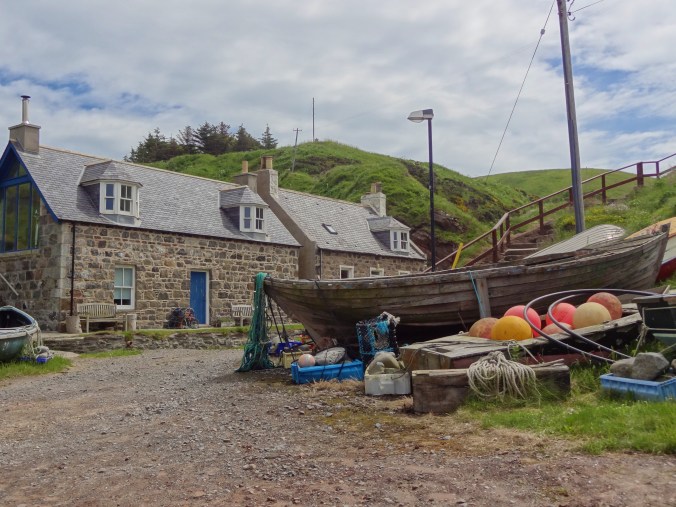
The idea of a group lesson did not appeal to me. As you all know, I enjoy photography, and have found myself wanting to paint a few of my recent photos. So I arranged for a private lesson. The image I decided to start with is this one I took from my 2016 trip to Scotland. We stayed in an historic fishing village called Crovie. I immediately fell in love with the place and its quaint cottages on a ledge by the sea.

SCOTLAND! 024

I brought a print out of the image with me to the studio. As instructor Chelsey and I sat at our easels and were about to start, she asked when I last sketched. “High school?” I answered.

Chelsey said that was okay. She just wanted to know what she was dealing with.

What she was dealing with is someone who has only used her fingers for typing for many many decades. And the last thing I ever painted was a watercolor scene in high school.

Before I could psyche myself out in an artsy panic, Chelsey started to show me how to organize my canvas and print out into quadrants to figure out what goes where. Easy peasy, right? Yes, actually, it wasn’t that hard. Then we picked up our pencils and drew in the scene.

I had to keep reminding myself that the sketch didn’t need to be elaborate. I’d be covering it up with paint eventually. I just needed a general guide to work with.

That done, we started painting. Chelsey squirted a bunch of acrylic colors onto a paper plate, which served as my fancy palette. She showed me how to mix colors and explained which brush to use to create different effects on the canvas.

We started with the background first, coloring in the sky and the grassy hills. By this time, a group class had arrived and Chelsey needed to flit between them and me. By now, I had mustered some artistic bravado and did not panic at her absence.

After two hours, I needed to leave for another appointment. Chelsey graciously said I could leave my painting there and come back again, which I did the next week.

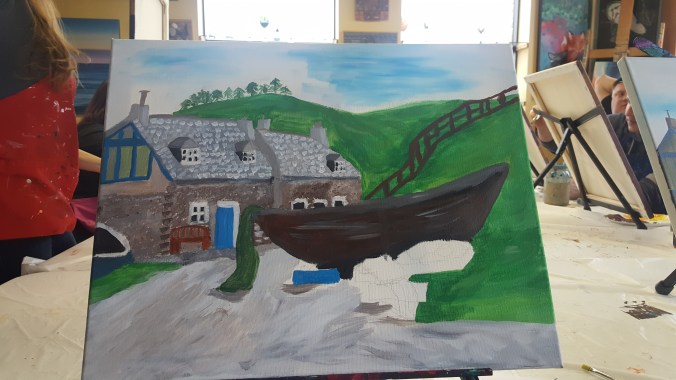
At the next lesson, she gave me tips for painting the houses and the boat. I finished almost everything during that session except for some nets and flotsam that are next to the boat. This time, I took my painting home to finish.

I just need to find some time to buy some brushes and paint and I’ll finish it up and fine-tune the details. Here’s what my painting looks like at this point. It’s painfully elementary, but I’d like to think it’s not too terrible. Who knows, maybe it’s the start of something?!

20181110_144831

Wolf Reintroduction on Isle Royale

ISRO wolves MI tech

The last two resident wolves on Isle Royale National Park. Image courtesy of Michigan Technological University.

People keep asking me what I think about the latest efforts to reintroduce wolves on Isle Royale National Park. I suspect their questioning has something to do with the novel I wrote about the topic. (Do ya think?!)

Well, my novel “Eye of the Wolf” was more about the wolves saving themselves than human efforts to save them. But I wrote it because of my interest in the wolves’ real-life plight: the packs on the island were dying out due to long-term inbreeding and disease. This continued until only two wolves, a male and a female father/daughter combo were left.

My past blog posts about the wolves may have also spurred peoples’ questions. So I suppose I should share my thoughts.

I haven’t done so sooner because my interests have moved on to other endangered animals in the region. Nevertheless, I have been following the wolf reintroduction effort just for old time’s sake, and to see how the real story plays out.

Okay, enough caveats. Here we go.

I wish the National Park Service had waited to reintroduce new wolves until the two resident wolves lived out their lives. My fear is that the new, younger wolves will rip apart the old ones. It just seems disrespectful, and it could look bad for the park service. I can see the headlines now: Resident Isle Royale Wolves Slaughtered by New Wolves.

This fall the park service released four wolves on the island that were captured nearby in Minnesota. Their genetic rescue plan is to release at least 15 (and up to 25) more in the next three years. I just don’t think the old wolves stand a chance.

When this concern was voiced at one of the public meetings I attended about the reintroduction, the park biologist dismissed it, saying the resident wolves know the best hiding places because they’ve lived on the island longer than the newcomers. Somehow, that answer wasn’t comforting.

My other concern is that the new wolves, which are from the Grand Portage Ojibwe Reservation, will leave the island this winter if an ice bridge forms, thus wasting all the effort and taxpayer expense of transporting them there. Research has shown that transplanted wolves do try to find their way back home once they’re released.

I understand that the park service wanted to restock the island with wolves that are used to hunting moose, but I question whether having the first ones come from an area so close to the island is a good idea. It might have been better to get wolves from farther away, especially for these initial efforts. I fear another headline that reads something like: Reintroduced Wolves Leave Island for Home on Ice Bridge.

I also feel bad for the transplanted wolves. They are basically kidnapped from their packs and home territories, and dropped someplace strange on an island in the middle of Lake Superior. Is keeping wolves on Isle Royale worth that kind of disruption? I don’t know. It just seems kind of extreme.

Drugging wolves is also dangerous – one wolf slated for the reintroduction died in the process. [Update on November 13: one of the transplanted wolves was reported dead, cause unknown.] Is keeping wolves on Isle Royale worth that risk? The park service and the wolf researchers obviously think so.

Let me just say that although I’m supportive of reintroducing wolves to the island, I’m not optimistic things will work out as planned. Life and Mother Nature seem to find ways to mess up the best-laid human plans.

The story continues….

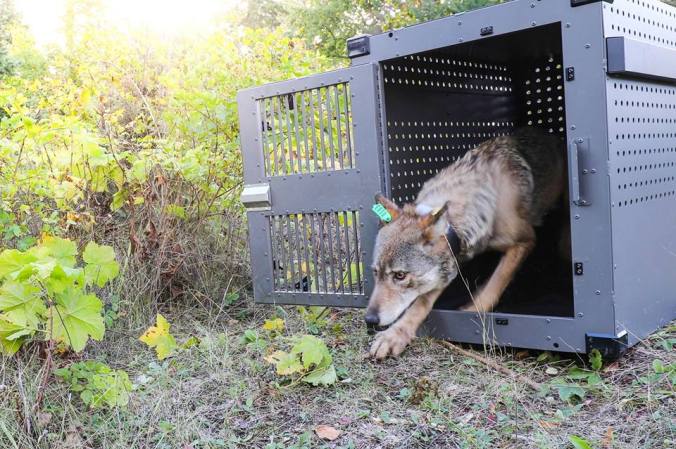
Isro female wolf 9-26

A female wolf — one of the first reintroduced to the island this fall. National Park Service image.

* * *

Update: In early February 2019, one of the wolves reintroduced to the island (the female pictured above) walked back home to Grand Portage, Minn., on an ice bridge that formed on Lake Superior during cold weather. I hate to say it, but one of the headlines I feared happening has come true!

The Perfect Duluthy Fall Hike

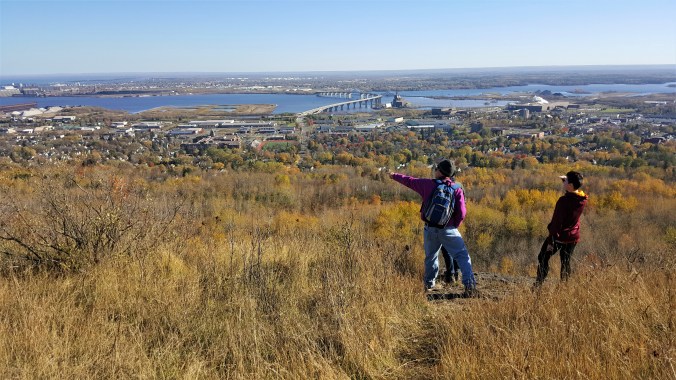
20181021_145814

The panoramic view from the Brewer’s Park Loop on the Superior Hiking Trail.

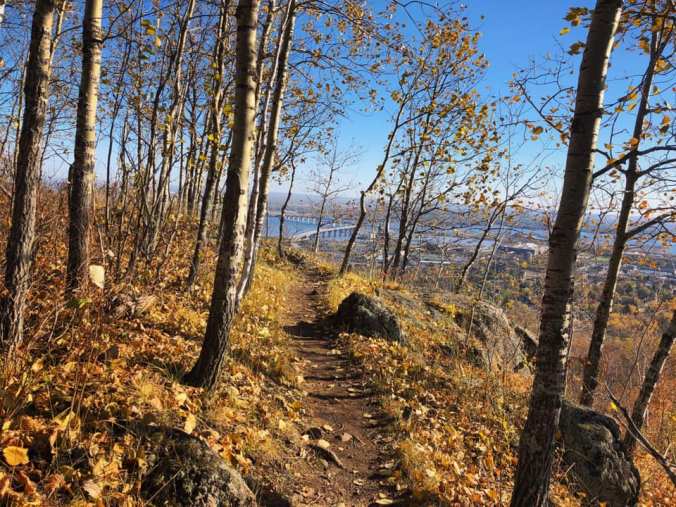
I meandered onto a newish section of the Superior Hiking Trail in Duluth recently. My friends and I hiked the Brewer’s Park Loop, which was completed in 2016. The trail takes walkers through an oak/maple forest and offers unparalleled views of the western part of the city and the St. Louis River – making it a perfect hike for fall.

Amanda image2

Photo by Amanda Jo Dahl-Sales

Some web pages rate the hike as moderate, others as easy. I would say both are true. Some of the climbs are rather steep and would rate a “moderate” in my book, but the majority of the hike is on an unobstructed path that’s fairly level, which rates an “easy.”

It took us 1-1/2 hours to go about 3-1/2 miles, but we were gawking and talking most of the way so I’m sure other people could do it more quickly. Access to the trail off Haines Road (see map).

Bring some water and your dog. For a near-perfect Duluth experience, visit Bent Paddle Brewery afterward for a drink. Urban hiking doesn’t get much better than this!

Brewer Park loop trail

Duluth News Tribune map

20181021_145751Enhanced

Amanda image

Image by Amanda Jo Dahl-Sales

Foraging for Wild Pizza

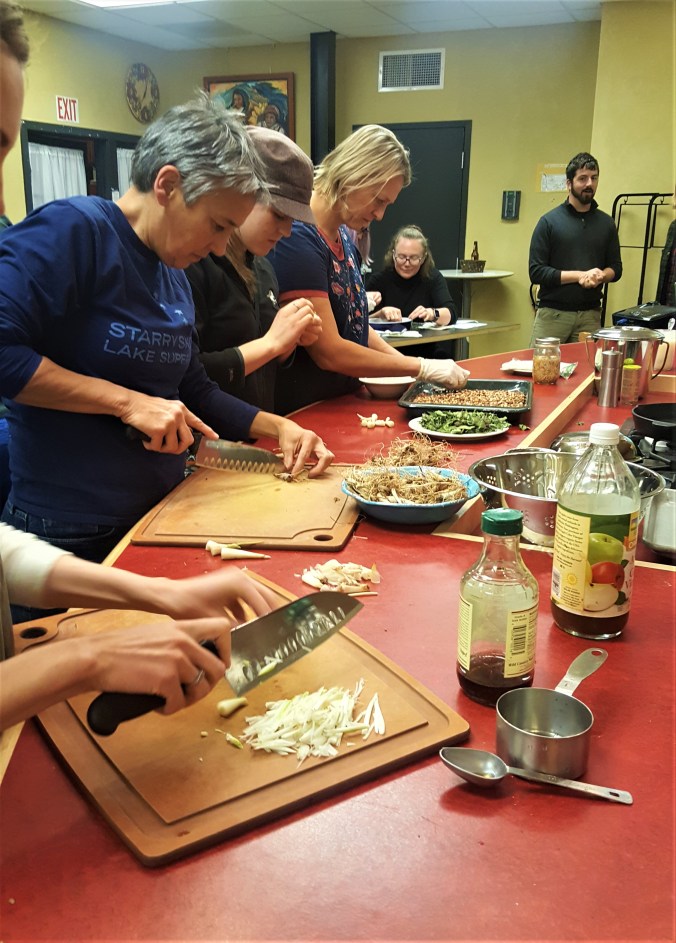
20181023_190519I took a class this week at my local Whole Foods Coop to learn how to make a pizza from foraged ingredients. The crust ingredients included wild rice flour, which is relatively easy to find and make, and acorn flour, which takes more work because you need to soak the nuts to remove the tannins.

Earlier, when I signed up for the class, I was psyched by the idea of making some acorn flour myself. However, the oak trees in my neighborhood do not seem to be cooperating this year. Last year, gobs of acorns were everywhere – so many littered the ground that walking on my neighborhood trail was hazardous — like walking on a bunch of marbles.

Our instructor, Gil Schwartz from Seasonally Sourced Foods in Washburn, Wisconsin, explained that oaks go through boom and bust cycles when it comes to producing acorns. Apparently, in my neighborhood, this year is a bust cycle, and all the trees are busting at the same time. Perhaps next fall I can indulge in my acorn-flour-making fantasy.

Anyway, I digress. While the crust cooked in the oven, we worked on the sauce and processed the other ingredients for toppings. I don’t want to hurt Gil’s business, so I’m not going to divulge his recipe. But I will say that the sauce involved simmering black nightshade berries (which are edible and taste tomatoey), sliced wild leek blubs (also known as ramps), and apple cider vinegar, with salt and dried bergamot (which tastes like oregano) for spices.

The toppings included wintercress (a spinachy-mustardy tasting plant also known as yellow rocket), cooked black trumpet and hen of the woods mushrooms, “cheese” made from the insides of young milkweed pods (boiled), and ground roasted hazelnuts.

After the crust and sauce were cooked, we assembled everything onto the pizza and cooked that for about ten minutes.

Although I only got to eat a small piece of the pizza (we had to divide the pan into twenty pieces since twenty of us were in the class), it was tasty and filling. It made me glad to know that if our society collapses and Domino’s Pizza disappears, a pizza of sorts could still be had.

My classmates joked that with all the work that went into finding and prepping the gourmet ingredients for this pizza, it would cost at least $150 to order off a menu. It made me realize that spending $20 for a class and only getting a small piece of pizza to eat wasn’t such a bad deal, after all!

20181023_194504

End of Season Sail

DSC05076

Basswood Island dock, Apostle Islands National Lakeshore in Wisconsin.

I had the privilege of another sailing trip on Lake Superior this year. The season is ending — the wind cold, the sky gray, and the leaves turning.

We sailed from a marina outside of Bayfield, Wisconsin, and went to Oak Island in the Apostle Islands National Lakeshore. We anchored off its shore and hiked a long loop on the island among giant hemlocks and oaks, and then spent the night offshore. The next day we traveled to Basswood Island for a hike to the quarry there before sailing back to the mainland.

The sailing season is short, but oh so worth it!

DSC05070

Oak Island sandspit, Apostle Islands National Lakeshore

DSC05063

Guess which island we found these on?

DSC05081

Basswood Island brownstone quarry pond.