I’m an Isle-ophile. Are You?

St. Martin Island, West Indies.

St. Martin Island, West Indies.

An island doesn’t have to be very far away from shore or very big to accomplish its true work: to surround you with imminent water, and to unhitch you from the grappling hooks of your own life for a while. – Minnesota Author Bill Holm, Eccentric Islands

I love islands. I’ve known of this affliction for quite a while, even before I heard the term for it: isle-ophile. Some of my most intense experiences have happened on islands. I like how islands make me feel and how they make other people behave (unless they are deserted islands, then it’s not so pretty.)

I first got a feel for islands when my parents took us camping. I have hazy young memories of Mackinac Island in Lake Huron; Prince Edward Island in Canada; the U.K.; and Madeline Island, Stockton Island, and Isle Royale in Lake Superior.

My exposure to Isle Royale led me to work there during college for two summers at the rustic resort. Then there was Grand Manan Island off New Brunswick, Newfoundland, Gero Island in Maine, Cumberland Island Georgia, Key Largo Florida (and eventually all the keys), Puerto Rico, Catalina Island in California, Ludlow’s Island in Minnesota, Orcas Island of the San Juan chain in Washington, St. Martin in the West Indies, and Brigantine in New Jersey.

Each place has provided intense experiences — unlike those a person can have on the mainland. Islands have offered: opportunities to form and intensify friendships, crazy experiences with animals, cold refuge from storms, hot refuge from heartbreak, family vacations, work conferences, romantic vacations, and immersions in local culture.

Islands force people to depend on one another more than they do when on the mainland. Usually, you’re more at the whims of nature because you’re in the middle of a body of water. Communication with the outside world is sporadic and takes more effort (although it’s a lot easier now, with computers). You’re living on the edge, but that edge is defined and it’s hard to get lost.

I’m irresistibly drawn to islands. Are you?

Here’s another reason to ponder about why islands draw people, offered by Mr. Holm:

In one way, all islands are female, surrounded by female water. John Fowles, in his book, “Islands,” says, “The domain of the siren had been where sea and land meet; and it is even less for nothing that the siren is female, not male.” Islands are secret places where the unconscious grows conscious, where possibilities mushroom, where imagination never rests. “All isolation . . . is erotic.”

Writing at Dream Speed

The Northeastern Minnesota Book Awards ceremony was held a few days ago in Duluth. I attended in because my novel, Plover Landing, was nominated in the fiction category, and because it’s fun to hob nob with other writers. Although any hope of an award was futile (sniff, small sob), the event always has inspiring speakers (see last year’s blog story), and poet Barton Sutter provides entertaining emceeing.Layout 1

This year’s speaker was Duluth Poet Laureate Jim Johnson, who offered a tongue-in-cheek look at the writing process. Regarding the importance of writing rituals: “The muse can only find you at the same place and same time every day. The first step in writing is to be there . . . . While you are waiting for the muse to appear, you might as well write.”

Is the writing process about hard work or inspiration? “Yes,” is Johnson’s answer. “You can’t write if your ritual doesn’t work right. Don’t skip over the details!” Then he went into a long explanation of the importance of exact paper and pen placement on the desk, having all your pencils sharpened, your computer programs updated, etc.

Is all this preparation and procrastination worth it? “Trust me,” Johnson said. “Something will happen. When it does, it’s magical. The words will come out at dream speed . . . . This is its own reward. Writing isn’t about money, awards, or publication. Sometimes we’re rewarded, sometimes not. The odds are not good.”

DSC02240

The crowd gathers for the Northeastern Minnesota Book Awards presentation.

Basically, he was saying that writers need to trust in whatever process they’ve developed, and that the key is to persevere despite rejections from publishers or awards judges. There’s nothing better than when the words seem to come of their own accord and you get into that “flow.”

Keep flowing, my friends. Keep writing at dream speed.

Author Reading from “Plover Landing”

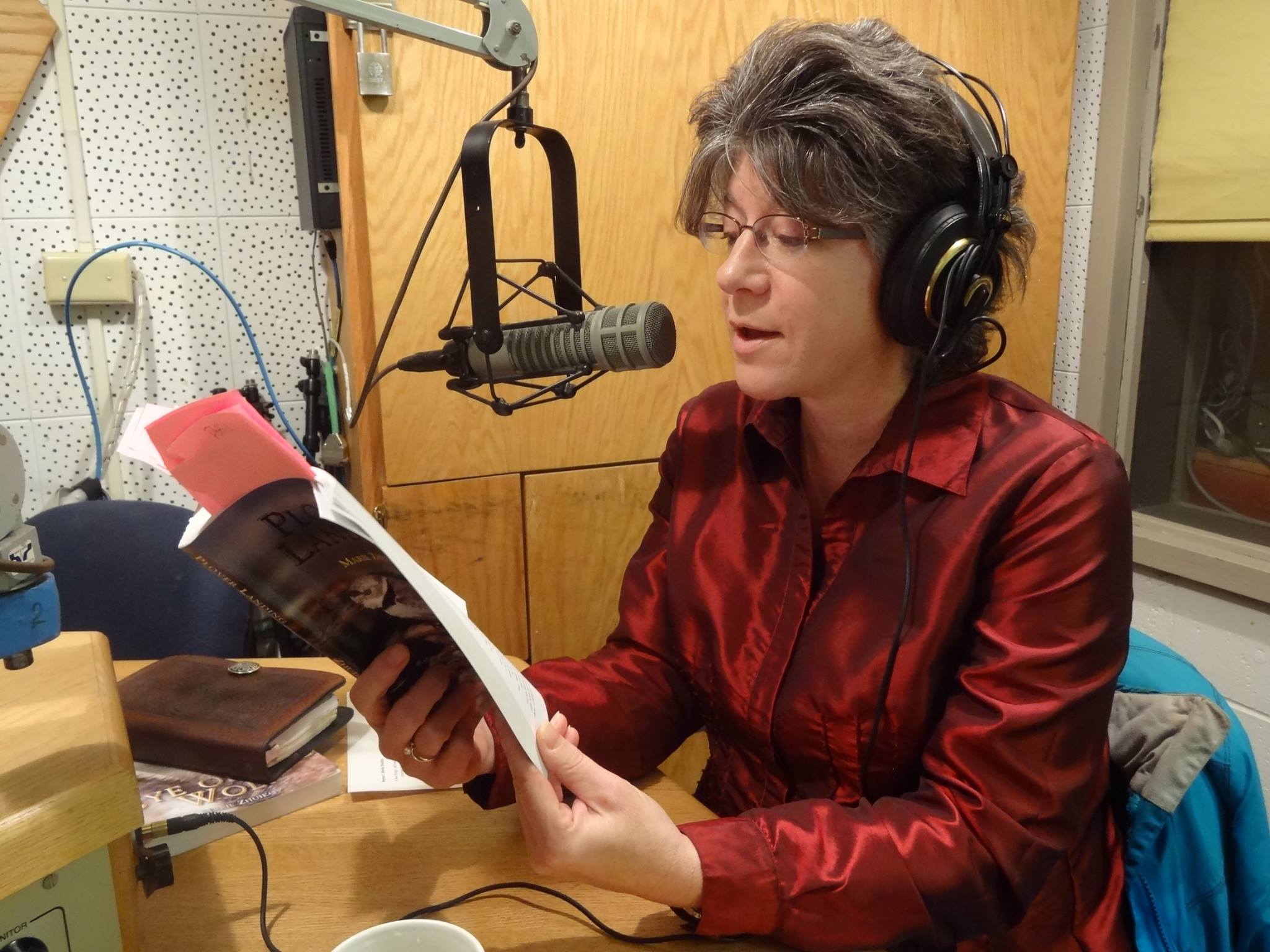
Layout 1A community radio station, KUMD, featured my most recent novel on their “Women’s Words” show last weekend. My novel is called “Plover Landing” and it’s an eco-mystic romance set in Duluth, Minn., that highlights the plight of an endangered shorebird, the piping plover.

You can listen to the six-something minute show here. My novel is available for sale in the usual places (Amazon, Barnes and Noble, etc.) or you can contact me through my website to receive an autographed copy. My online store isn’t working at the moment, but if you send me a message from my site, we can work something out!

Author Reading from “Eye of the Wolf”

In the sound studio at KUMD Radio.

In the sound studio at KUMD Radio.

I took advantage of the opportunity to be part of a local radio station’s weekly program that features Minnesota women authors. I read excerpts from both of my eco-mystic romance novels, so they’ll be doing two shows about them. The first one featuring “Eye of the Wolf” aired this week on KUMD Radio in Duluth. You can access the six-minute audio file here.

My trip to the station in the basement of the local college was nostalgic. I used to have my own radio show for work called “Listening to the Lake.” I produced the show at that station with the help of their staff. They still have the same sound board I used for my show. These community stations are a great and unique news resource, so if you have one in your town, be sure to support it however you can!

How NOT to Deal With a Bad Relationship: Lessons from “Gone Girl” and “Anna Karenina”

Amy Dunne from "Gone Girl."

Amy Dunne from “Gone Girl.”

Anna Karenina

Anna Karenina


I had the serendipitously synchronistic experience of reading Gillian Flynn’s “Gone Girl” and Leo Tolstoy’s “Anna Karenina” at the same time. Although the stories take place in different eras, I was amazed by the similarity of some parts — especially if you just ignore most of Tolstoy’s ramblings about farming and equality for the peasant class. (I know, how dare I say that. Insert gasp from literary community here.) Both are about bad relationships and various ill-advised ways to deal with them.

In Gone Girl, Amy (the wronged wife) decides to deal with her husband’s infidelity by faking her death and framing him for it. But she still really loves him in her twisted way, so they patch things up (sort of) and resume living together, trying to recapture the magic of their early years. But their situation is not sustainable because it’s based on manipulation and power struggles. And Amy’s husband Nick only buys into it because she leaves him no choice. Especially after she announces she’s pregnant with his child.

(I hope there’s a sequel because something’s going to blow, and it’s going to blow big! Maybe their child will be the instrument of the familial explosion. I can’t imagine a baby raised in such a twisted environment would come out unscathed.)

Anyway, in Anna Karenina, Anna is the one who has an affair, and it’s her husband Karenin who thinks that remaining together in the same house is a good idea. As long as her lover stays away and she keeps things discreet, he’s all right with Anna continuing the affair, but he wants to keep up appearances for the sake of his career and social status. Like Amy, Anna also becomes pregnant. But it’s with her lover’s child, not Karenin’s.

Of course, it’s not a sustainable situation, either, and Anna keeps looking for a solution. She thinks she’s found one when she has a premonition that she will die during childbirth. Yes – that’s the answer – don’t deal with the situation, just die and get out of it! Although she comes close to death, she survives. Then it’s her lover’s turn to think about death, but he botches his suicide and survives also.

In Gone Girl, Amy’s original plan was to commit suicide as a final act of vindictiveness after successfully framing her husband for her death. But ever the narcissist, she decides he’s not worth killing herself over.

In Anna Karenina, Anna does eventually commit suicide as the solution, even though she and her lover Vronsky are at last free of Karenin and living the high life together with their daughter. Why does she do it? Out of vindictiveness and fear. She feels the romantic love between her and Vronsky slipping. He’s actually asserting some independence and (gasp!) doing some manly things without her. She can’t handle it and throws herself under a train – mimicking an incident that happened when they first met. Thus, despite overcoming many societal struggles, their relationship implodes from within.

As mentioned parenthetically already, I expect the relationship in Gone Girl will also implode. But only if the author gets on it and writes a sequel! Does anyone know if a sequel is planned?

I suspect that a creative writing graduate student could make a good thesis topic out of comparing these two novels. And that they could do it much more thoroughly than I. Feel free to use my blog story as an outline and go for it! I just thought it was amazing that these two authors spanning so many years were essentially writing about the same thing: human nature. It apparently hasn’t changed much, although if Gone Girl is any indication, human nature may have gotten even worse.

The Book Signing and the Viola Player

This weekend I had my first book-signing events in the metropolises of Minneapolis and Maple Grove, Minn. One was a reading at a small indie bookstore; the other was a signing event with a bunch of other authors at a big box chain bookstore.

Moon Palace Books in south Minneapolis.

Moon Palace Books in south Minneapolis.

I did the indie bookstore reading first, at Moon Palace Books in south Minneapolis. The audience was intimate and mostly genetically related to myself. (Grin.) But it was fun and I sold a few books. The owner was wonderful and, with thirty bookcases that were only two years old, the place smelled good — like freshly cut lumber.

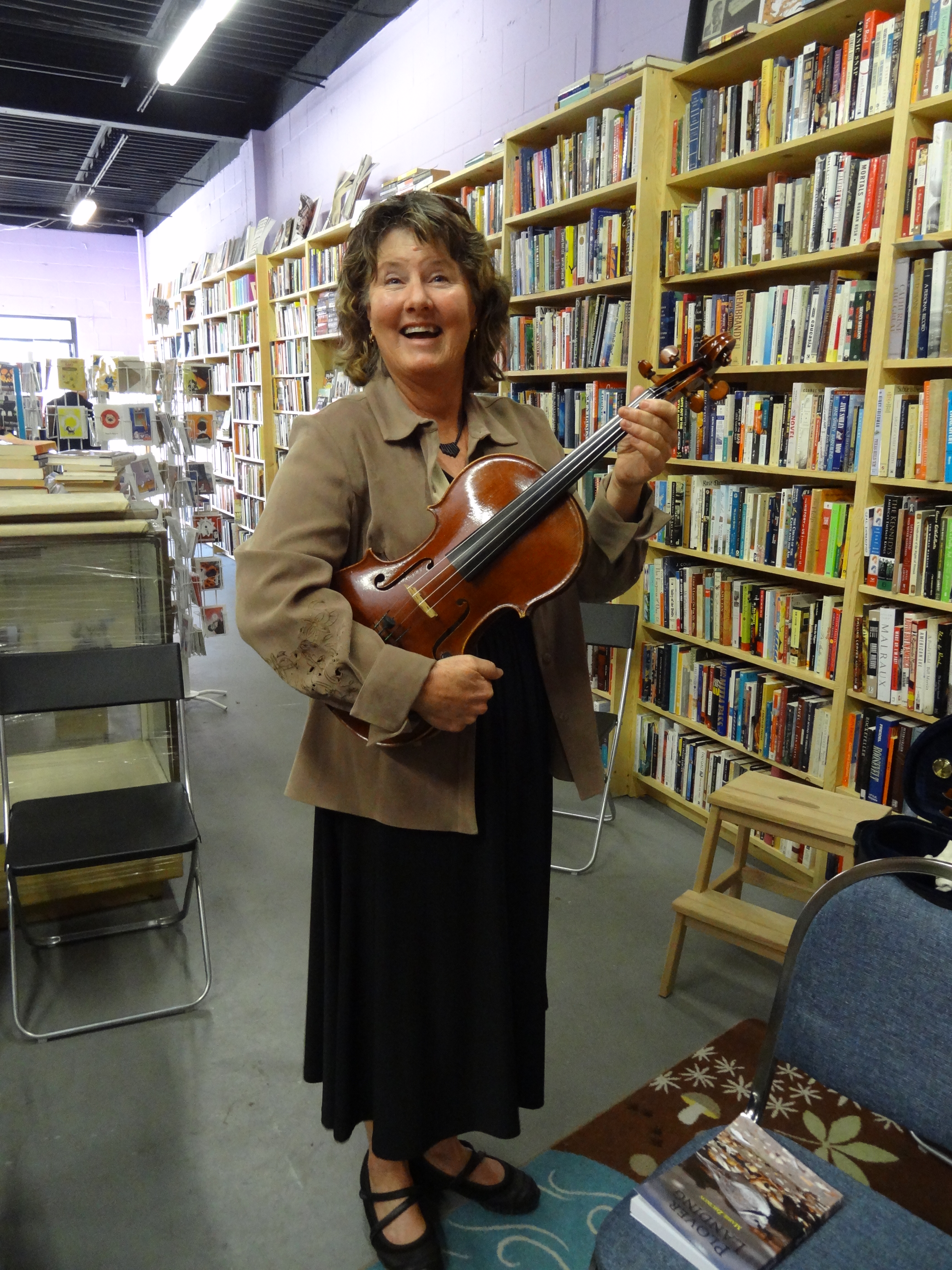
We were just wrapping up when the Viola Player arrived. Or rather, she swooped in. Judy with the Duluth-Superior Symphony Orchestra (DSSO), is not the type to enter any other way. I experienced her vivaciousness first-hand when I had lunch with her as research for my novel “Plover Landing.” A viola player figures prominently in the story, but I needed to learn more about the life of this type of musician. I brought my plight to the DSSO and they hooked me up with Judy.

I chose the instrument because it’s the one I would have wanted to play if I hadn’t already been a French horn player in the high school band. I just love how it sounds, and the introvert in me loves how it’s a background instrument. From Judy, I learned about the underdog, scrappy culture of violists.

Judy, the vivacious violist.

Judy, the vivacious violist.

I didn’t know she was planning on attending my reading, so her swooping entrance was a surprise. A nice one, however! She even had her viola strapped to her back, and with little coaxing, treated us to several tunes. That’s one reading I won’t soon forget, and I’m sure the bookstore owners will remember it, too.

The big box chain bookstore event was a bust. Hardly anyone attended. If it had been my only event, I would have driven home in the dark of night feeling like the five-hour round trip was not worth it. I learned two lessons from this experience that I would like to share, especially with new authors who are responsible for their own marketing:

  1. If you’re traveling more than an hour or two from home, try to have more than one signing event scheduled to hedge your bets on feeling successful. In other words: Don’t put your book signing eggs all in one basket.
  2. The book signing ain’t over until the viola lady plays!

“Zenith City” Offers a Broader Understanding of Duluth

Zenith_City-210“Zenith City” is a collection of stories by former Duluthian Michael Fedo (cousin of former Duluth Mayor John Fedo). The memoir chronicles his time growing up in Duluth, Minn., in the 1950s and 60s.

I enjoyed reading the book. I recognized Fedo’s references to the city’s inferiority complex (which is turning around, now, thank you, with Duluth being named things like Best Outdoors City, etc.), and Fedo’s references to Duluthians’ relationship with their hills, KDAL Radio, dear old Denfeld High, the Flame Restaurant, and the Pickwick.

However, in many instances, Fedo writes about a Duluth with which I am unfamiliar — one where relatives live next door (my parents were the northernmost transplants of their central- and southern-Minnesota families), where the vices and haunts of downtown were nearby (I grew up in more distant Piedmont Heights), and where folk music was popular (I was born about 15 years too late for that).

But that’s all right. The descriptions gave me a better understanding of the place where I live. I especially enjoyed his reminiscences about Don LaFontaine, the famous movie trailer voiceover actor (think, “In a world where….”), his encounter with Louis Armstrong, and with Bob Dylan’s mother. And because of my exposure to this book, I now intend to read “Babbitt” by Sinclair Lewis, who lived in Duluth for a time. (Also because my home economics-major mother once made and served him dinner when she was working in college for a family who entertained him.)

I noticed two punctuation errors: one where closing quotation marks are missing, another where a sentence ends with both a period and a comma. This surprised me since I’ve come to expect better from the University of Minnesota Press. I don’t know if it’s a sign of their quality slipping or of my editorial eye getting sharper with experience.

The only other thing that gave me pause was the repetition among the stories. For instance, we hear that Fedo worked at the local college radio station at least four times throughout, but I suppose this is an artifact of the book being a compilation of stories that were written for other publications. Just be aware it’s not a seamless memoir written in a singular effort.

Earlier this year, I went to an event by Fedo at Duluth Public Library. He read from many of the stories, and afterwards, he and his wife were generous with their time for a discussion with me, a newbie novelist. They were a class act. I highly recommend this book, even to non-Duluthians.

A Photo From This Morning

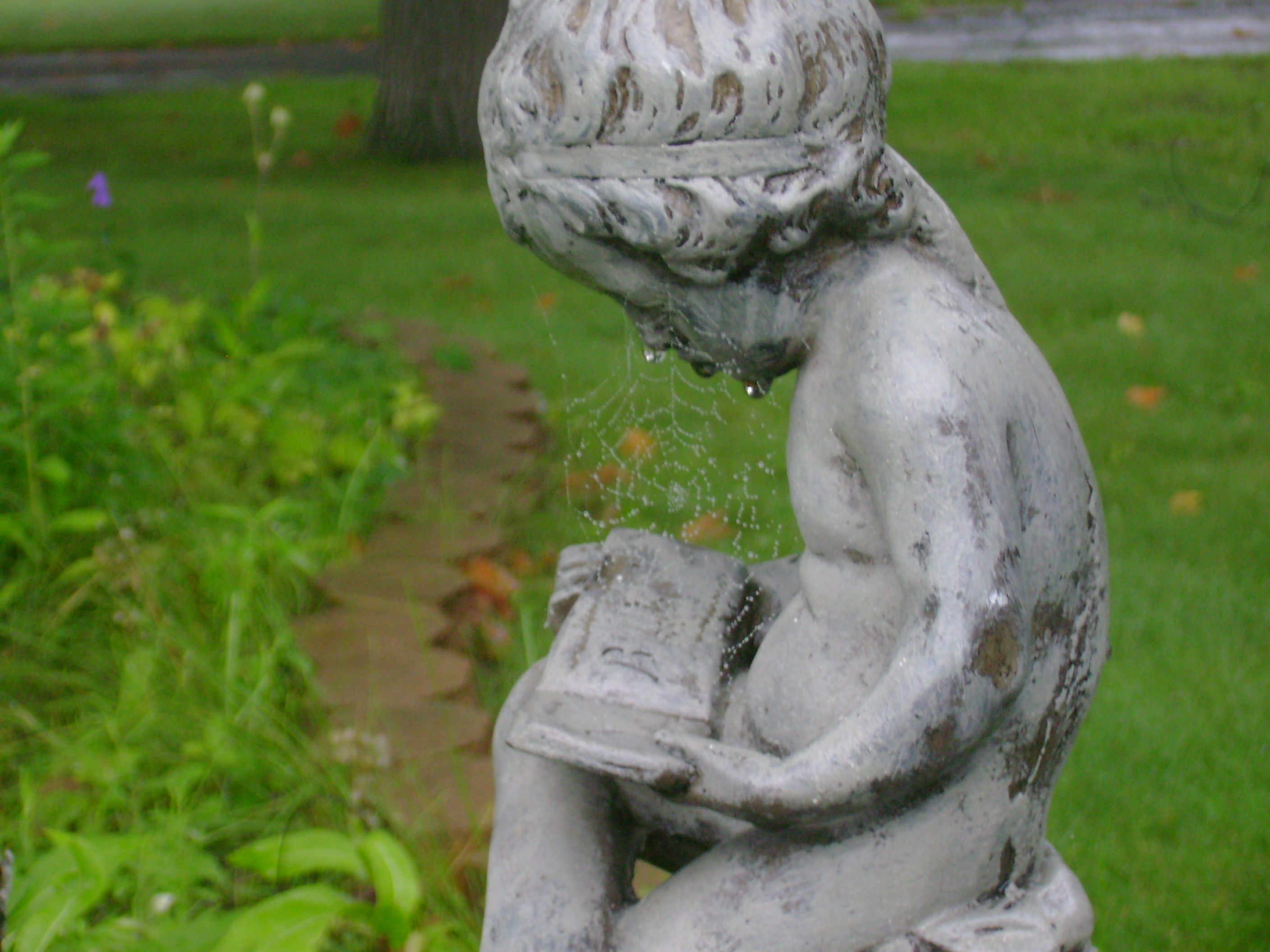
My garden statue has been reading for a long time!

My garden statue has been reading for a long time!

This sight greeted me this morning on the way to the mailbox. The only camera I had on hand to capture it is my crappy old Sony DSC-S500 Cyber Shot. I was glad it was able to show the detail of the spider web. Please have a wonderful day, even if it’s rainy!

Making Mosses Sexy (The Signature of All Things – Book Review)

SigofAllThings

I picked up this book because I like Elizabeth Gilbert’s nonfiction (I’ve read “The Last American Man,” “Eat, Pray, Love,” and “Committed”). I haven’t read any of her novels, so I wanted to see what she could do with fiction. Also, I wanted to see how/whether she could make botany interesting. Caution: this review contains spoilers, so if you don’t want to know how the novel ends, it’s best to stop reading now.

The story follows the life of Alma Whittaker, a scientifically inclined child born into a wealthy American family in the 1800s. Alma’s life is so lonely and sterile in the first part of the novel that I began to wonder why I was continuing to read. Finally, when she meets a botanical artist, Ambrose, things look up for her. Gilbert does an admirable job taking readers along with Alma’s joy and hopes/fears at this point, so that when they come crashing down, so do readers’ hearts. I liked how Alma dealt with life’s disappointments by grinding them under her boot heel. That’s a philosophy worth emulating.

Midway through the novel, when Alma is casting about for things to occupy her time, I found myself asking – why doesn’t she try to help someone else for a change? That thought doesn’t come to her at that point and she turns instead to a solitary life of studying mosses. I was thankful to see altruistic motivation finally come to her after her father dies.

So how does Gilbert make botany interesting? She combines it with a life story, sex, and spiritualism. Gilbert uses Alma’s situation to explore the dichotomies between science and the soul, and how a woman can endure a lifetime of sexual frustration, yet still function in the everyday household and business duties required of her.

I want to share a quote from the story that particularly resonated with me: “These are two things I have always observed to be in singular accord: super-celestial thoughts and subterranean conduct.” I have found this to be true, as well. Think of all the televangelists and others in positions of authority who have been brought down by sexual scandals. But I am meandering…

One thing that bothered me is that when Alma was in Tahiti, she did not even think of showing a drawing of the mysterious Tahitian boy to someone. She did mention there were some facial drawings of him that weren’t lewd. Showing one to someone she trusted, like the reverend or the ‘wild boys,’ would have saved her a lot of time trekking around the island. She could have said she found it in Ambrose’s things and was wondering who his friend was. Gilbert didn’t even have Alma consider showing someone a drawing, which bothered me and seemed unrealistic (even for fiction!)

Another thing that bothered me that one of Alma’s major goals in life was to give a man a blowjob. I mean, seriously?! The feminist in me is just so affronted by that. Alma’s character is already so intelligent, capable and self-sacrificing. I would have been much more comfortable if her goal in life was to have a man give HER oral sex. (Smirk.)

The dust jacket description says that events take place at a galloping pace. I wouldn’t say this is true. The pace is more like that of a pachyderm than a horse. Both Alma and her father are so deliberate in their speech and actions that all sides of an issue are explored before action is taken. This is hardly galloping. But the good side of this is that you come to know the characters intimately.

I ended up wanting SOMETHING good to happen for Alma – better than performing a blowjob on a lovely male Tahitian in a cave (which is not bad, but still….) Near the end, there’s another glimmer of hope when she develops her own theory of natural selection. But does she publish it? No. Like the aforementioned slow-moving pachyderm, she has to investigate all sides of her theory, which takes time. She’s not satisfied that it provides the answer to everything everyone would ever want to know about how the world works, so she lets the document sit in a valise under her couch, until it’s too late and Darwin beats her to the punch.

In a Hollywood ending, Alma would have published her theory to great fame and finally be recognized. But since this is not a Hollywood book, it ends with Alma being satisfied that just one person recognizes her for what she is. This was a good ending for the circumstances, and refreshing in some ways, but it’s much too realistic. If I wanted to realism, I would just plod along in my own daily fight for survival and grinding of life’s disappointments under my boot heels. I read to escape or to see characters overcome obstacles and succeed. However, Gilbert did manage to make mosses interesting.

Overall, I give it a mixed review. There’s no question that Gilbert knows her mosses and how the scientific mind works. Her character development is outstanding as is her insight into the human condition. I just had problems with certain aspects of the story that didn’t fit my personal escapist needs.