“Zenith City” Offers a Broader Understanding of Duluth

Zenith_City-210“Zenith City” is a collection of stories by former Duluthian Michael Fedo (cousin of former Duluth Mayor John Fedo). The memoir chronicles his time growing up in Duluth, Minn., in the 1950s and 60s.

I enjoyed reading the book. I recognized Fedo’s references to the city’s inferiority complex (which is turning around, now, thank you, with Duluth being named things like Best Outdoors City, etc.), and Fedo’s references to Duluthians’ relationship with their hills, KDAL Radio, dear old Denfeld High, the Flame Restaurant, and the Pickwick.

However, in many instances, Fedo writes about a Duluth with which I am unfamiliar — one where relatives live next door (my parents were the northernmost transplants of their central- and southern-Minnesota families), where the vices and haunts of downtown were nearby (I grew up in more distant Piedmont Heights), and where folk music was popular (I was born about 15 years too late for that).

But that’s all right. The descriptions gave me a better understanding of the place where I live. I especially enjoyed his reminiscences about Don LaFontaine, the famous movie trailer voiceover actor (think, “In a world where….”), his encounter with Louis Armstrong, and with Bob Dylan’s mother. And because of my exposure to this book, I now intend to read “Babbitt” by Sinclair Lewis, who lived in Duluth for a time. (Also because my home economics-major mother once made and served him dinner when she was working in college for a family who entertained him.)

I noticed two punctuation errors: one where closing quotation marks are missing, another where a sentence ends with both a period and a comma. This surprised me since I’ve come to expect better from the University of Minnesota Press. I don’t know if it’s a sign of their quality slipping or of my editorial eye getting sharper with experience.

The only other thing that gave me pause was the repetition among the stories. For instance, we hear that Fedo worked at the local college radio station at least four times throughout, but I suppose this is an artifact of the book being a compilation of stories that were written for other publications. Just be aware it’s not a seamless memoir written in a singular effort.

Earlier this year, I went to an event by Fedo at Duluth Public Library. He read from many of the stories, and afterwards, he and his wife were generous with their time for a discussion with me, a newbie novelist. They were a class act. I highly recommend this book, even to non-Duluthians.

A Photo From This Morning

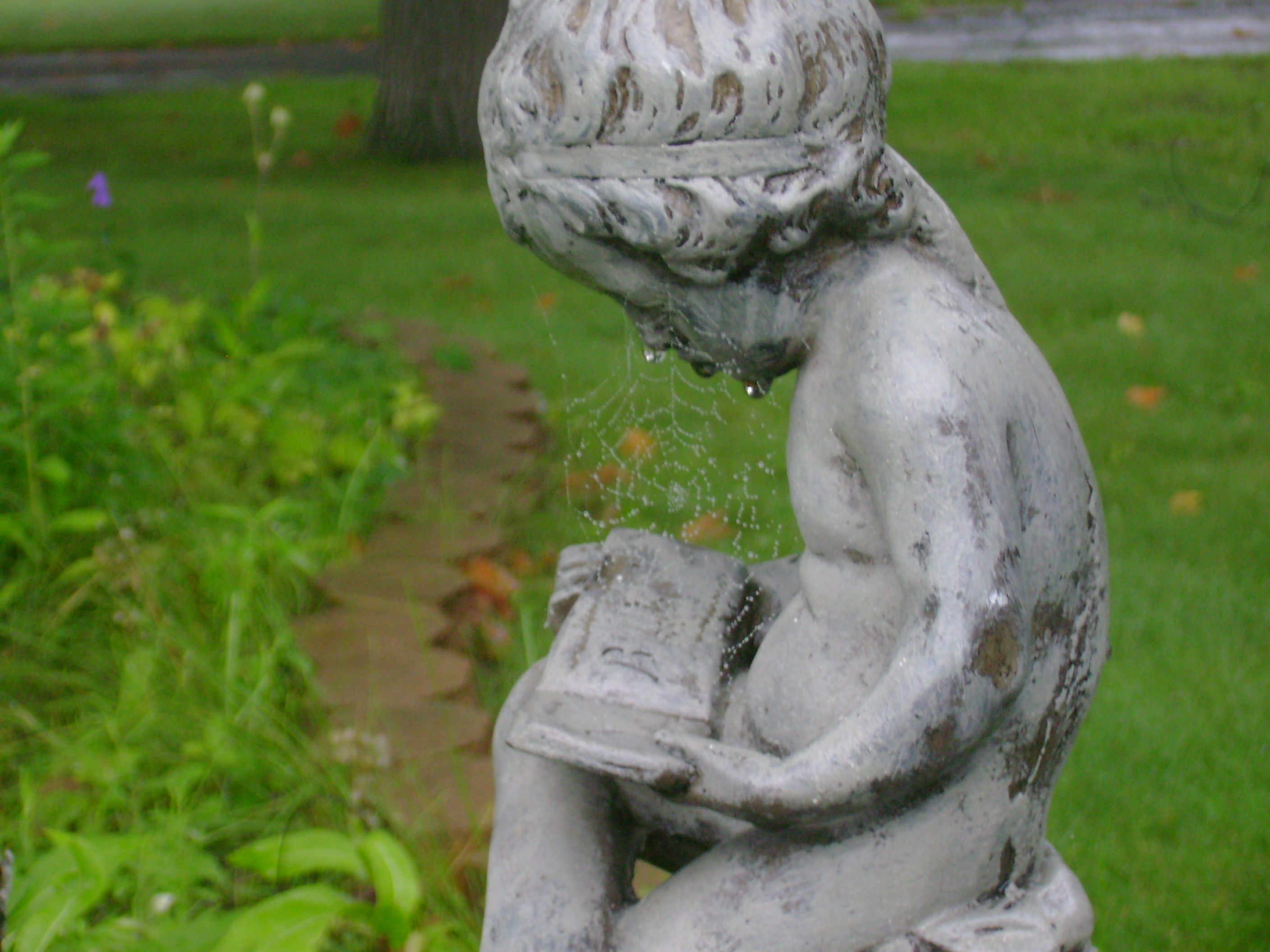
My garden statue has been reading for a long time!

My garden statue has been reading for a long time!

This sight greeted me this morning on the way to the mailbox. The only camera I had on hand to capture it is my crappy old Sony DSC-S500 Cyber Shot. I was glad it was able to show the detail of the spider web. Please have a wonderful day, even if it’s rainy!

Making Mosses Sexy (The Signature of All Things – Book Review)

SigofAllThings

I picked up this book because I like Elizabeth Gilbert’s nonfiction (I’ve read “The Last American Man,” “Eat, Pray, Love,” and “Committed”). I haven’t read any of her novels, so I wanted to see what she could do with fiction. Also, I wanted to see how/whether she could make botany interesting. Caution: this review contains spoilers, so if you don’t want to know how the novel ends, it’s best to stop reading now.

The story follows the life of Alma Whittaker, a scientifically inclined child born into a wealthy American family in the 1800s. Alma’s life is so lonely and sterile in the first part of the novel that I began to wonder why I was continuing to read. Finally, when she meets a botanical artist, Ambrose, things look up for her. Gilbert does an admirable job taking readers along with Alma’s joy and hopes/fears at this point, so that when they come crashing down, so do readers’ hearts. I liked how Alma dealt with life’s disappointments by grinding them under her boot heel. That’s a philosophy worth emulating.

Midway through the novel, when Alma is casting about for things to occupy her time, I found myself asking – why doesn’t she try to help someone else for a change? That thought doesn’t come to her at that point and she turns instead to a solitary life of studying mosses. I was thankful to see altruistic motivation finally come to her after her father dies.

So how does Gilbert make botany interesting? She combines it with a life story, sex, and spiritualism. Gilbert uses Alma’s situation to explore the dichotomies between science and the soul, and how a woman can endure a lifetime of sexual frustration, yet still function in the everyday household and business duties required of her.

I want to share a quote from the story that particularly resonated with me: “These are two things I have always observed to be in singular accord: super-celestial thoughts and subterranean conduct.” I have found this to be true, as well. Think of all the televangelists and others in positions of authority who have been brought down by sexual scandals. But I am meandering…

One thing that bothered me is that when Alma was in Tahiti, she did not even think of showing a drawing of the mysterious Tahitian boy to someone. She did mention there were some facial drawings of him that weren’t lewd. Showing one to someone she trusted, like the reverend or the ‘wild boys,’ would have saved her a lot of time trekking around the island. She could have said she found it in Ambrose’s things and was wondering who his friend was. Gilbert didn’t even have Alma consider showing someone a drawing, which bothered me and seemed unrealistic (even for fiction!)

Another thing that bothered me that one of Alma’s major goals in life was to give a man a blowjob. I mean, seriously?! The feminist in me is just so affronted by that. Alma’s character is already so intelligent, capable and self-sacrificing. I would have been much more comfortable if her goal in life was to have a man give HER oral sex. (Smirk.)

The dust jacket description says that events take place at a galloping pace. I wouldn’t say this is true. The pace is more like that of a pachyderm than a horse. Both Alma and her father are so deliberate in their speech and actions that all sides of an issue are explored before action is taken. This is hardly galloping. But the good side of this is that you come to know the characters intimately.

I ended up wanting SOMETHING good to happen for Alma – better than performing a blowjob on a lovely male Tahitian in a cave (which is not bad, but still….) Near the end, there’s another glimmer of hope when she develops her own theory of natural selection. But does she publish it? No. Like the aforementioned slow-moving pachyderm, she has to investigate all sides of her theory, which takes time. She’s not satisfied that it provides the answer to everything everyone would ever want to know about how the world works, so she lets the document sit in a valise under her couch, until it’s too late and Darwin beats her to the punch.

In a Hollywood ending, Alma would have published her theory to great fame and finally be recognized. But since this is not a Hollywood book, it ends with Alma being satisfied that just one person recognizes her for what she is. This was a good ending for the circumstances, and refreshing in some ways, but it’s much too realistic. If I wanted to realism, I would just plod along in my own daily fight for survival and grinding of life’s disappointments under my boot heels. I read to escape or to see characters overcome obstacles and succeed. However, Gilbert did manage to make mosses interesting.

Overall, I give it a mixed review. There’s no question that Gilbert knows her mosses and how the scientific mind works. Her character development is outstanding as is her insight into the human condition. I just had problems with certain aspects of the story that didn’t fit my personal escapist needs.

A Cross Between Christmas and Childbirth

Plover Landing Novels
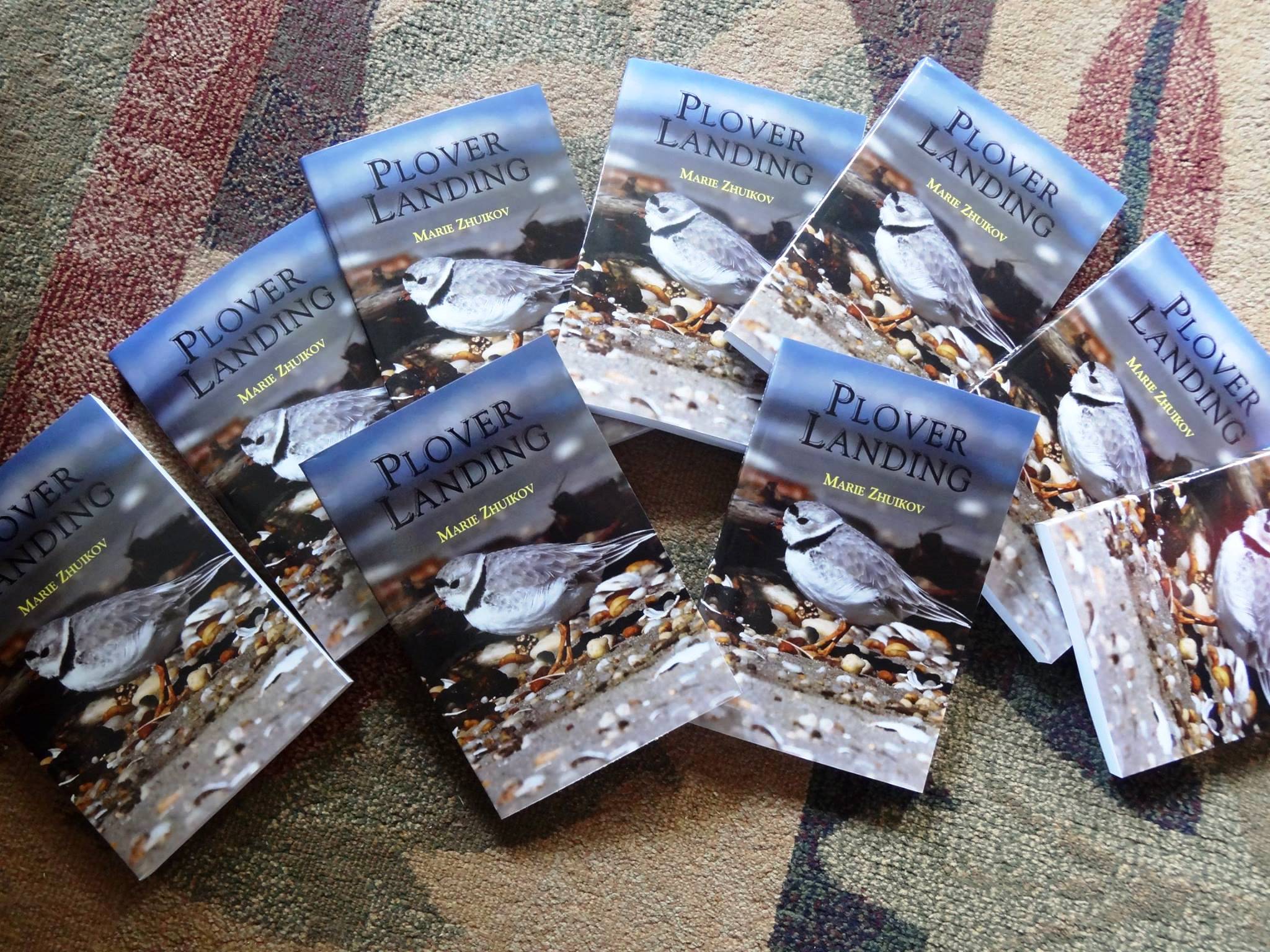
My books are here! My books are here! It’s so fun to open those boxes and see what’s inside – kind of like a cross between Christmas and childbirth. I don’t think they’ve been distributed to Amazon or Barnes and Noble, etc., yet. So if you can’t wait and you’d like an autographed copy, by all means, feel free to order one from me!

I have copies of both “Plover Landing” and “Eye of the Wolf” available. You can find out more and order them here. I ship them via media mail, which is fairly cheap. Slow, but cheap.

So I’m gearing up for my book launch party tomorrow night and a reading at a local bookstore this weekend. I can’t wait to see everybody and introduce them to “Plover Landing” and the characters within.

Received some great press in a local paper . They called it a “breezy beach read.” Start your summer right and pick one up!

Making Piping Plovers Sexy

My second novel is coming out later this month. I’m happy to unveil the cover for you:

Layout 1

Plover Landing is an ecological-mystical-romance that I wrote for college-age readers and older. What’s an ecological-mystical-romance, you ask? It’s a genre I’d like to think that I created, which deals with endangered species, Native American mythology, and human-human, human-animal romance and connections.

Plover Landing is set in my hometown of Duluth, Minn., in 1995, and it’s a sequel to Eye of the Wolf. Novelists who haven’t been published yet might hate me for what I’m about to admit, but when my publisher suggested a sequel, I wasn’t that enthused. That’s because, between life’s distractions, the first novel took me seventeen years to write, then another couple years to publish.

The thought of doing that all over again was exhausting, although at least I wouldn’t have to spend time looking for a publisher. I was also exhausted from seventeen years of thinking about wolves, which are the animals I focus on in Eye of the Wolf. If I was going to survive a sequel, I needed to focus on a different endangered animal and environmental topic.

It just so happens I was working on a project to restore habitat along the shores of Lake Superior in hopes of encouraging an endangered shorebird to nest. Through that process, I had already learned a lot about piping plovers, so that became the focus of my sequel. Granted, plovers are not as sexy as wolves and they don’t have a handy supernatural being associated with them (like the wolves have werewolves), so I had to ponder how to work the mysticism into it. (But never fear, wolf aficionados, the wolves come into the story at the end.)

My writer’s group joked that I should write about plover zombies, but I did not take them up on that idea. (Smirk) Instead, I researched myths about plovers. While I couldn’t find any local myths, I did find an interesting and sexy Hawaiian myth about plovers, and I discovered a way to use it as the foundation of the story.

Even so, that wasn’t quite supernatural enough, so in addition to the heroine and hero from Eye of the Wolf (Melora St. James and Drew Tamsen), I introduced a new character, a boy named Demetri, who both helps the plovers and focuses readers’ attention on the issue of climate change. I feel strongly that the more integrated that issue is into mainstream media, especially through the use of storytelling, the more people will come to accept it as real.

Because I’d learned ways to encourage myself to write with my first novel, even though I had just as many distractions, Plover Landing only took two-and-a-half years to write. My publisher thinks it’s an even better story than the first and has hinted about the desire for another in the series. I created the ending of Plover Landing with openings for another story or so that it works as a finale. I don’t know. I’ll have to think about that one.

In any case, let the marketing begin! Speaking of which, if any of you are active on Goodreads, I have a giveaway for Plover Landing that’s active until July 15.

I am Finally Killing a Mockingbird

MockingbirdI may be one of the only semi-literate people who have not read “To Kill a Mockingbird.” I can’t even use the excuse that it’s because I live at the end of the world in Duluth, because the book was promoted as a community read a few years ago.

I’m in the process of rectifying this oversight. I like to listen to books on CD from the local library during my commute to work, and “To Kill a Mockingbird” is my most recent choice. Before reading the description on the back cover of the CD case, I knew vaguely that the novel was about a white southern lawyer who defends a black man; that it was written by the no-speech-giving and friend-to-Truman-Capote Harper Lee; that it was turned into a movie starring Gregory Peck; and that Bruce Willis and Demi Moore named one of their daughters after a character in it.

What finally attracted me to listen to the CD is that the story is told through the eyes of a child, and a precociously literate girl child at that. I am a sucker for unusual narrators. I’ve listened to about half of it by now, and I am coming to understand its classic appeal. Although the beginning is rather murky — you don’t really know why you’re reading (listening to) it because it doesn’t spoon feed the themes like authors do for readers now — if you give it a chance, you’ll notice it addresses all sorts of social issues.

Instead of being praised for her skills and sent on to a higher grade, the precociously literate girl (Scout) is made to feel bad that she can read by her insecure teacher. There’s sexual role modeling: Scout is under pressure to act more like a “lady” even though she’s only in early elementary school. There’s discrimination in the form of gender and color. A creepy neighborhood house and family stands testament to the damage that being overly religious can cause. And I haven’t even gotten to the trial part of the book yet.

If I were to dare to criticize the story (and I dare, for I am about as ladylike as Scout), I would say that sometimes the words used by Scout are too advanced for her age, even given that she’s literate. But the tone is spot-on as are the topics. The story also unintentionally provides a scathing commentary on the status of our communities today, where neighbors barely know each other or their histories.

It’s a great story. Go kill a mockingbird if you haven’t already.

I’m Somebody Now!

Web ImageI just finished creating my author web site. I’m so excited – I feel like Steve Martin’s character Navin in the movie “The Jerk,” when he finds his name in the phone book for the first time:

Navin R. Johnson: The new phone book’s here! The new phone book’s here!

Harry Hartounian: Boy, I wish I could get that excited about nothing.

Navin R. Johnson: Nothing? Are you kidding? Page 73 – Johnson, Navin R.! I’m somebody now! Millions of people look at this book everyday! This is the kind of spontaneous publicity – your name in print – that makes people. I’m in print! Things are going to start happening to me now.

I have my own web site! I’m somebody! Whether or not things start happening because of it depends, I guess, on my efforts to make it visible (hence this blog posting, heh heh).

I’ve been my own Realtor, divorce lawyer, tax preparer, and now web designer. Of these, I am most proud of the web designer title. Creating the site was my New Year’s resolution, and it took this long for me to decide what to say and to work through all the technical difficulties associated with it.

But it’s up, it’s out in the world, even better than the phone book! If you’d like to know more about me and my writing, please take a look at http://www.marieZwrites.com. You can even pre-order my new eco-mystic romance novel, “Plover Landing,” due out this summer.

Good Enough for Jazz

I sent the text for my second novel off to the publisher last week, a few days earlier than the January 1 deadline they had given me. Why early? I just couldn’t look at it any more. There comes a point where editing fatigue sets in and no additional amount is going to make a difference.

Line art drawing by Pearson Scott Foresman, Wikimedia

Line art drawing by Pearson Scott Foresman, Wikimedia

After reworking it with the input of my writer’s group during the two-and-a-half years it took to create, incorporating comments from several reader friends, and then a two-month concentrated bout of editing once the story was finished, I had reached the editing-point-of-no-return.

In high school, my best friend was a saxophone player. I played French horn, and we sat next to each other in band. My friend was also in the jazz band, and when we were out gallivanting on the town or at home without our instruments, she used to sing the jazz songs to me that she was learning. That’s how I gained an appreciation for Count Basie, Woody Herman, and the like. She also shared a phrase that the conductor used to say when the musicians were tuning their instruments: “It’s good enough for jazz.”

So maybe the instruments weren’t perfectly in tune. For jazz — home of individuality and improvisation — perfect technique is eclipsed by style and feeling. Have an instrument not perfectly in tune? That’s cool, that’s all right. It’s good enough for jazz.

Of course, that would never fly in concert band. And the phrase struck the young me – who was ever striving for perfection and straight “A” grades. Not aiming for perfection went against everything I had been taught up until that point. It instilled in me the idea that sometimes, things are as perfect as they are going to get. Any additional amount of effort isn’t going to make a difference, and, in fact, it can detract from whatever you’re trying to do.

That’s what it’s like with my novel. I’ve made it as perfect as I can at this point. I am happy with it, but not overjoyed. Some parts of it I read and love, but other parts I’m not so keen about. Don’t get me wrong, I’m sure it’s better than a lot of published writing out there, but if I waited until I had the text in a form I was totally, outrageously happy with, I’d never get it off my computer and onto my publisher’s.

So it’s off. It’s gone. Another eco-mystic romance will be unleashed upon the world in June. It was so much fun to write, and I got to include some of my favorite topics, like music (although a more symphonic sort). The setting is in my home town, which I saw through new eyes during the writing, and it deals with issues dear to my heart, like climate change and endangered species recovery.

I’ll still have opportunities to tweak it (not to be confused with twerking it) before publication. But for now, it’s good enough for jazz.

Pride & Prejudice & Snickering

empty chair

An empty chair awaits readers of the Duluth, Minn., public rendition of Pride and Prejudice.

Last weekend, I took part in a marathon public reading of “Pride and Prejudice,” by Jane Austen. The event, hosted by a local writers group, was a celebration of the novel’s publication two-hundred years ago. The reading began on a Friday evening, stopped for the night, and spanned the next day from 9 a.m. to 9 p.m.

The sanctuary of a local church provided a great venue for the event.

The sanctuary of a local church provided a great venue for the event.

You might think that the atmosphere would have been staid, literary, and slightly pompous, but there was actually a lot of snickering – at least when I read. While that could have been the result of my poor attempts at voicing characters with English accents, I’d like to think it was from the subtle humor employed by Austen two centuries ago, which still resonates today.

The sanctuary of a quaint stone church served as an atmospheric venue. For those requiring refreshment, tea and cucumber sandwiches were served in the basement. About twenty-five readers each took turns reading aloud for twenty-five to thirty-five minutes. They were a diverse group — ranging from the Mayor of Duluth, actresses, poets, English teachers, Jane Austen-lovers, and me – who had never read the book, but I’d seen the movie.

I hadn’t read aloud from someone else’s writing in many years – since reading bedtime stories to my sons. And I was amazed at just how funny Austen’s writing is. It didn’t strike me that way when I read my section silently. But when I practiced it aloud at home, the irony of the passages was clear. It made me wonder if Austen wrote the book to be read aloud as entertainment on long evenings before the invention of television.

A respectable crowd gathered for the reading.

A respectable crowd gathered for the reading.

The section I read featured a clergyman who had originally wanted to marry Elizabeth — the narrator of the story (played by Winona Ryder in the movie version). Elizabeth visits him and his new wife, who was Elizabeth’s best friend, and who won the minister by “default” after Elizabeth turned him down. The scenes are set in their home and then move to the mansion where the minister’s patroness, the condescending and imposing (to everyone but Elizabeth), Lady Catherine de Bourgh (played by Judith Dench).

I was heartened that the irony of Austen’s portrayal of the clergyman and Lady de Bourgh was not lost on the small audience gathered to listen. My reading was punctuated by quiet laughter in several appropriate places. It just goes to show that although many years have passed and our lives are very different from those who lived when the story was written, human nature is similar enough that we can still relate.

Me reading (amid snickers).

Me reading (amid snickers).