Good Enough for Jazz

I sent the text for my second novel off to the publisher last week, a few days earlier than the January 1 deadline they had given me. Why early? I just couldn’t look at it any more. There comes a point where editing fatigue sets in and no additional amount is going to make a difference.

Line art drawing by Pearson Scott Foresman, Wikimedia

Line art drawing by Pearson Scott Foresman, Wikimedia

After reworking it with the input of my writer’s group during the two-and-a-half years it took to create, incorporating comments from several reader friends, and then a two-month concentrated bout of editing once the story was finished, I had reached the editing-point-of-no-return.

In high school, my best friend was a saxophone player. I played French horn, and we sat next to each other in band. My friend was also in the jazz band, and when we were out gallivanting on the town or at home without our instruments, she used to sing the jazz songs to me that she was learning. That’s how I gained an appreciation for Count Basie, Woody Herman, and the like. She also shared a phrase that the conductor used to say when the musicians were tuning their instruments: “It’s good enough for jazz.”

So maybe the instruments weren’t perfectly in tune. For jazz — home of individuality and improvisation — perfect technique is eclipsed by style and feeling. Have an instrument not perfectly in tune? That’s cool, that’s all right. It’s good enough for jazz.

Of course, that would never fly in concert band. And the phrase struck the young me – who was ever striving for perfection and straight “A” grades. Not aiming for perfection went against everything I had been taught up until that point. It instilled in me the idea that sometimes, things are as perfect as they are going to get. Any additional amount of effort isn’t going to make a difference, and, in fact, it can detract from whatever you’re trying to do.

That’s what it’s like with my novel. I’ve made it as perfect as I can at this point. I am happy with it, but not overjoyed. Some parts of it I read and love, but other parts I’m not so keen about. Don’t get me wrong, I’m sure it’s better than a lot of published writing out there, but if I waited until I had the text in a form I was totally, outrageously happy with, I’d never get it off my computer and onto my publisher’s.

So it’s off. It’s gone. Another eco-mystic romance will be unleashed upon the world in June. It was so much fun to write, and I got to include some of my favorite topics, like music (although a more symphonic sort). The setting is in my home town, which I saw through new eyes during the writing, and it deals with issues dear to my heart, like climate change and endangered species recovery.

I’ll still have opportunities to tweak it (not to be confused with twerking it) before publication. But for now, it’s good enough for jazz.

Pride & Prejudice & Snickering

empty chair

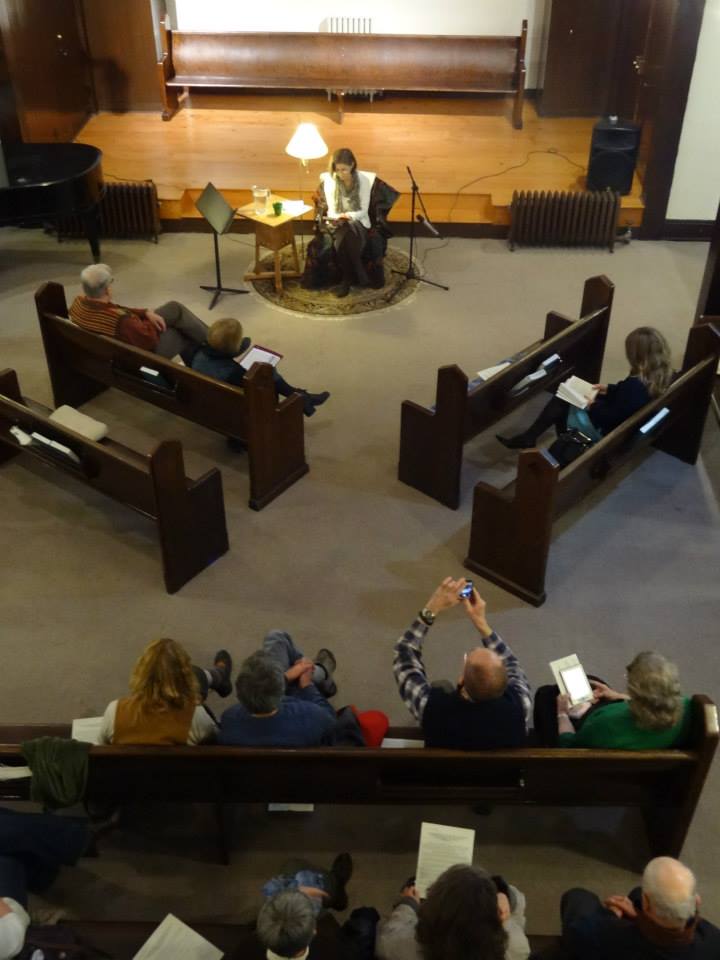
An empty chair awaits readers of the Duluth, Minn., public rendition of Pride and Prejudice.

Last weekend, I took part in a marathon public reading of “Pride and Prejudice,” by Jane Austen. The event, hosted by a local writers group, was a celebration of the novel’s publication two-hundred years ago. The reading began on a Friday evening, stopped for the night, and spanned the next day from 9 a.m. to 9 p.m.

The sanctuary of a local church provided a great venue for the event.

The sanctuary of a local church provided a great venue for the event.

You might think that the atmosphere would have been staid, literary, and slightly pompous, but there was actually a lot of snickering – at least when I read. While that could have been the result of my poor attempts at voicing characters with English accents, I’d like to think it was from the subtle humor employed by Austen two centuries ago, which still resonates today.

The sanctuary of a quaint stone church served as an atmospheric venue. For those requiring refreshment, tea and cucumber sandwiches were served in the basement. About twenty-five readers each took turns reading aloud for twenty-five to thirty-five minutes. They were a diverse group — ranging from the Mayor of Duluth, actresses, poets, English teachers, Jane Austen-lovers, and me – who had never read the book, but I’d seen the movie.

I hadn’t read aloud from someone else’s writing in many years – since reading bedtime stories to my sons. And I was amazed at just how funny Austen’s writing is. It didn’t strike me that way when I read my section silently. But when I practiced it aloud at home, the irony of the passages was clear. It made me wonder if Austen wrote the book to be read aloud as entertainment on long evenings before the invention of television.

A respectable crowd gathered for the reading.

A respectable crowd gathered for the reading.

The section I read featured a clergyman who had originally wanted to marry Elizabeth — the narrator of the story (played by Winona Ryder in the movie version). Elizabeth visits him and his new wife, who was Elizabeth’s best friend, and who won the minister by “default” after Elizabeth turned him down. The scenes are set in their home and then move to the mansion where the minister’s patroness, the condescending and imposing (to everyone but Elizabeth), Lady Catherine de Bourgh (played by Judith Dench).

I was heartened that the irony of Austen’s portrayal of the clergyman and Lady de Bourgh was not lost on the small audience gathered to listen. My reading was punctuated by quiet laughter in several appropriate places. It just goes to show that although many years have passed and our lives are very different from those who lived when the story was written, human nature is similar enough that we can still relate.

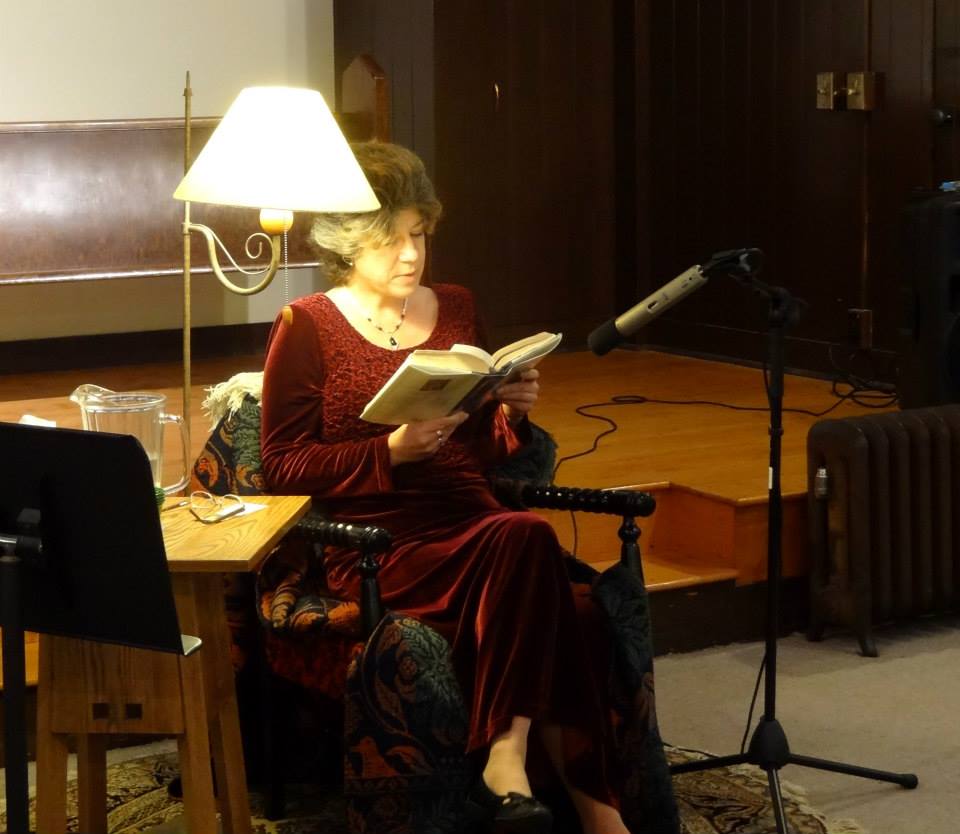
Me reading (amid snickers).

Me reading (amid snickers).

A Book Signing with Heart

Eye of the Wolf, Marie ZhuikovIn contrast to my previous rant about book signings, I’d like to share the story of an unusual thing that happened at my first public signing for “Eye of the Wolf.”

My eco-mystic romance novel deals with the plight of the dwindling wolf population on Isle Royale National Park in Lake Superior. About two years ago, I had just begun sitting outside the Bookstore at Fitger’s Mall in Duluth, trying to hawk my wares to the holiday shopping crowd when a tall, thin, bearded man approached.

It soon became apparent that he was deaf and could not speak. Through a combination of gestures and lip movements, he managed to convey that he didn’t have any money to buy a book but that he liked the topic. Then he pointed to the part of the description on the back of my novel about the wolves on the island being in trouble. He put his hands over his heart and made a breaking motion. Clearly, it broke his heart that the wolves were dying out. He shook my hand twice, thanking me for writing about the issue, and left.

Thinking about the short encounter during the rest of my signing caused mixed feelings. The cynical part of me wondered if he was just trying to get a free book. The innocent part berated myself for not giving him a free book. In the end, my heart fell out of my chest and writhed around on the hallway floor in a fit of sentimentality, but it was too late to do anything about it.

I’m hoping the sequel to “Eye of the Wolf” will be published in about a year. If I see that guy again, I’m giving him a free book. Maybe one of each.