The Dolphin Who Ate Fish at my Feet

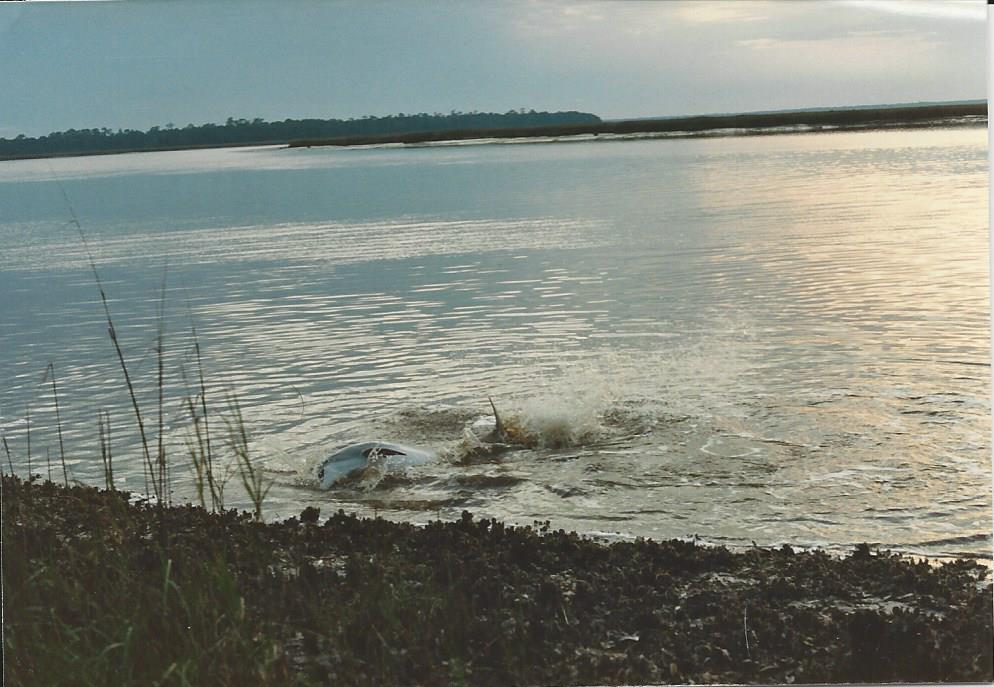
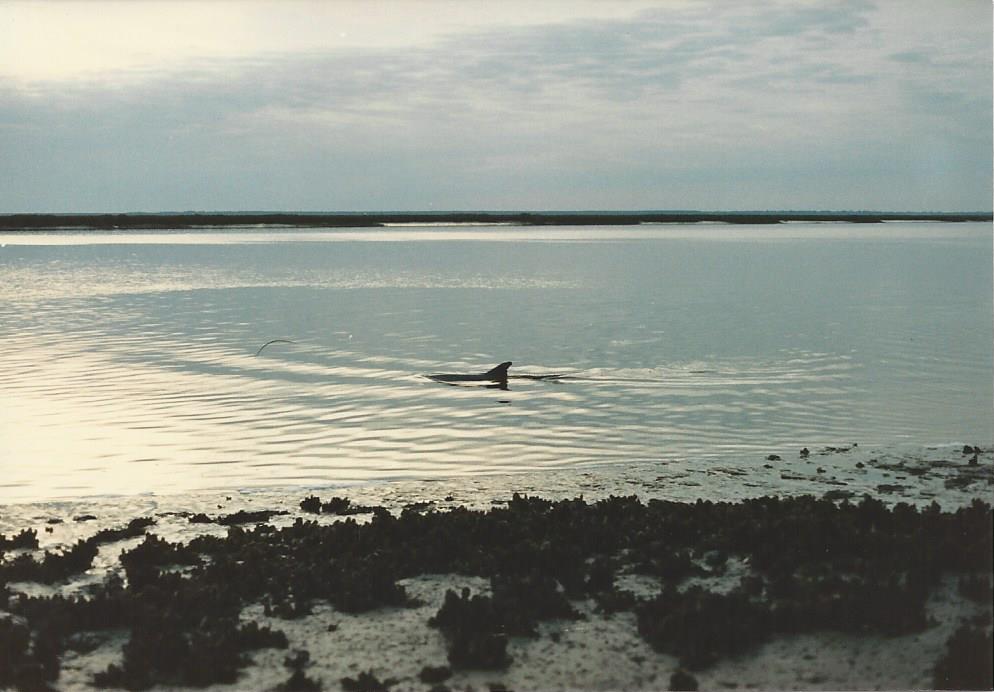
A dolphin beaching itself to catch fish it has pushed ashore. Cumberland Island, Georgia.

A dolphin beaching itself to catch fish it has pushed ashore. Cumberland Island, Georgia.

I once lived outside for nine months (September – May), traveling North America. The experience was through the Audubon Expedition Institute and I was working toward a graduate degree in environmental education.

While on the trip I learned I was not there for the academics but for the adventure. And there certainly was a lot of adventure. It was 1986-87 and we travelled from New York City up the East Coast to Maine and Nova Scotia, Canada. Then we took the ferry to Newfoundland. We went all the way to the northern tip (you can see Labrador and icebergs from there) and then headed back south, eventually reaching all the way to Key Largo, Fla. From there we headed West, making it to Canyonlands Utah before the yellow school bus that was our home had a fatal break down.

Along the way we tented and cooked our meals over campstoves. We sometimes lived for a week in a fishing village, or among Buddhist monks or uranium miners. We visited with local experts, learning about environmental issues and how the locals thought about the land and sea. We took hikes, canoe trips, and snorkeling excursions; swam with manatees; danced contra dances; joined pow wows and local organic fairs; and were privy to Native American ceremonies.
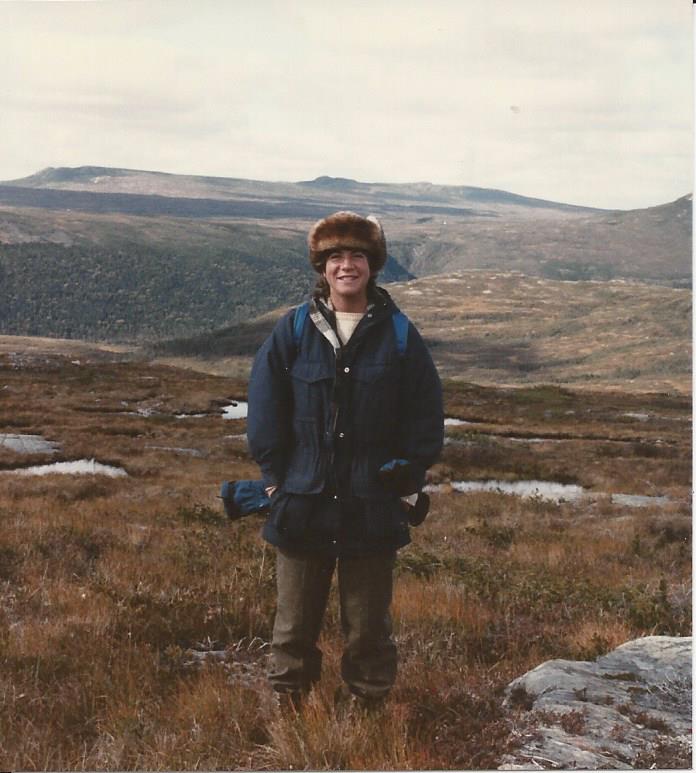
Me on the moors in Newfoundland, looking for caribou, circa 1986.

Me on the moors in Newfoundland, looking for caribou, circa 1986.

I got so acclimated to living outdoors that when I came home to my parents for breaks, I slept in the backyard, even when it was twenty below. My body was so used to revving up with heat at night, that I got too hot sleeping indoors. I also remember when we visited a medicine man in Boston (Slow Turtle). Twenty of us crowded into a skyscraper conference room to speak with him. That, combined with being in a heated space, made me feel faint. I had to go outside to cool off for a while.

The experience was like a combination of “Survivor” and one of those bachelor/bachelorette reality TV shows. We began with twenty-four people, but through a process of mostly self-elimination, ended up with twenty.

All this is a long preamble to what I really want to write about, which is an experience I had during the expedition with a dolphin on Cumberland Island National Seashore in Georgia. We spent several days on the island among wild horses and armadillos, hiking from one end to the other, mostly along the beach on the Atlantic side. On the other side of the island, a salt marsh and river separate it from the mainland. One evening, we camped on the mainland side. We had eaten dinner and several of us were hanging out by the water as the sun started to set.

Then the dolphins came. Two of them swam alongside the muddy banks of the river, peeling off into circles. We didn’t realize it until later, but the dolphins were corralling fish with their bodies. When enough were captured in their water circle, they rushed toward the bank. The fish were stranded on the bank, easy pickings for a dolphin who doesn’t mind a little air time itself. . I learned later that this behavior is indeed called strand feeding. Here’s what I wrote in my journal:

We run down to the Brickhill River like lunatics, insatiable for a rare glimpse into the workings of nature. We try not to get too close and scare the dolphin away, but it’s hard. We follow the dolphin as it swims along the shore, the deep mud sucking at our shoes.

The mammal tips on its side and looks at us with a dark gray eye – two, three times. It corrals the fish and rushes the bank, its whole body breaching again. We go mad. Paul jumps up and down, saying he’s seen God. I click photos like I’ve got a roll of thirty-six instead of only four photos left. Our oohs and ahhs echo across the sunset.

The dolphin wriggles its body back into the water comfortably. It swims back upriver and down. Its companion across the way breathes five times in quick succession, and with that signal, they depart.

Despite the shortage of film in my old-fashioned 35mm Olympus, I managed to snap a good picture of the dolphin doing its work. And it was just a few feet away from me – close enough for us to see eye-to-eye. It’s an experience I’ll never forget. It filled us with wonder and awe, and we felt a connection beyond time, beyond words to the place and each other.
Bye bye dolphin!
Bye bye dolphin!

How I got Jane Goodall to Stick her Head in a Potted Palm Tree

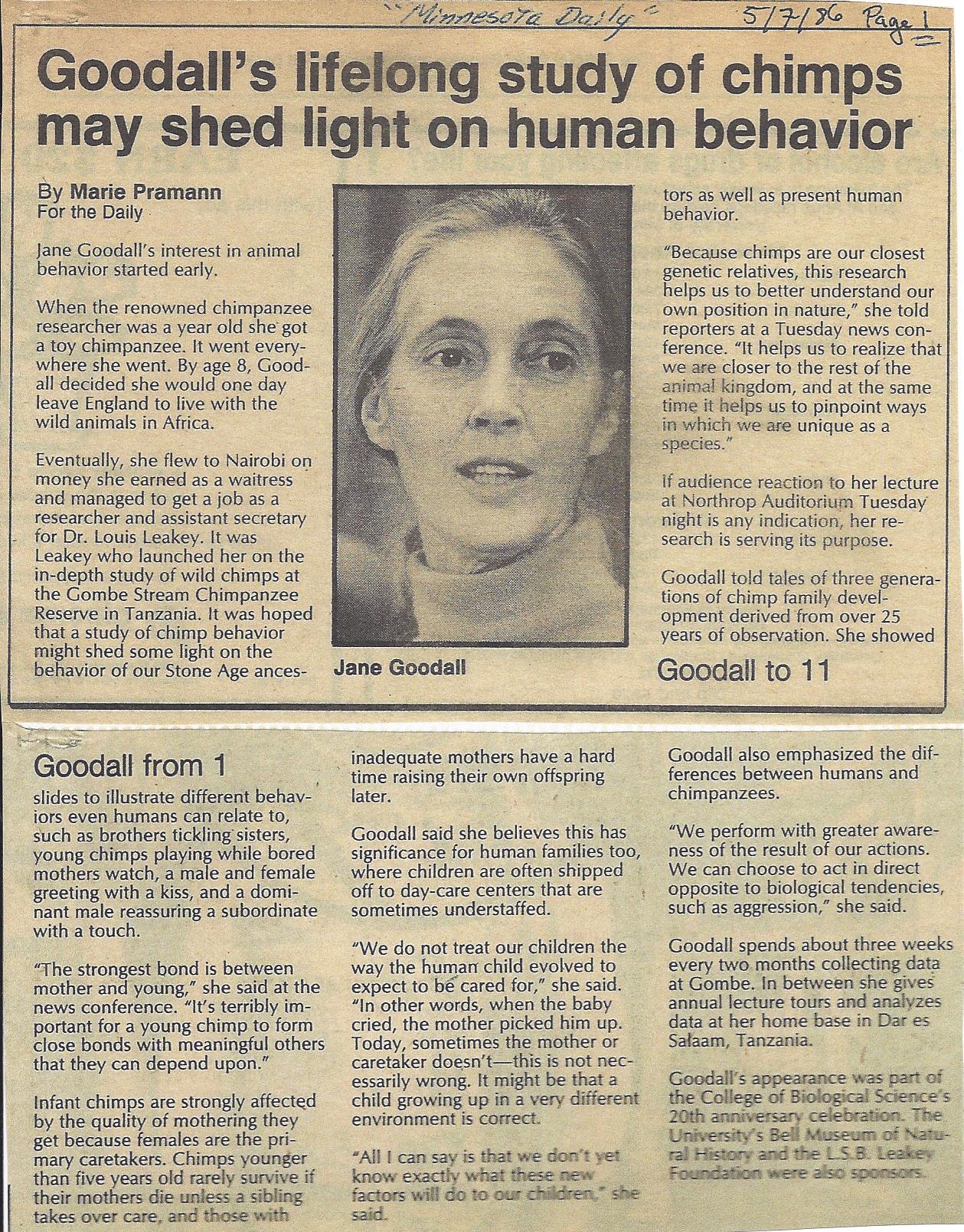
Jane Goodall

My story from the Minnesota Daily, May 7, 1986, page 1.

A recent news story about chimpanzee researcher Jane Goodall reminded me why she’s one of my favorites of the scientific glitterati. Here’s a link to the Huffington Post video story. Basically, she’s saying that researchers need to have empathy with their subjects in order to conduct ethical and meaningful science. I agree!

I had the chance to meet Jane (I don’t think she’d mind if I call her by her first name – she’s that kind of a person) back in my glory days as the environmental reporter for my college newspaper, the venerable “Minnesota Daily” (best college newspaper in the country!) Jane came to town to give a talk on chimpanzee behavior and DNA, and how similar they are to our own.

She presented to a packed auditorium and afterwards, hosted a news conference. I sat in the front row along with a photographer for the paper. I don’t remember what questions I asked, but I do recall being impressed by Jane’s seeming kindness and approachability.

During the news conference, the photographer and I surreptitiously discussed good locations in the room to take her photo afterwards, both agreeing (with the logic of college students) that the potted palm next to her podium would be ideal. She did work in the “jungle,” after all! However, the thought of asking Jane Goodall to stick her head among palm fronds filled me with anxiety. Would she be insulted? Have us thrown out of the room? Turn around and walk off in a huff?

Once the news conference was over, no other reporters seemed to want to talk to Jane, so I approached – probably gushed about what a big fan I was – and put forth to her the photographer’s plight of getting her photo against an interesting background. I couldn’t believe our luck when she pointed to the palm and said, “Well, why not here?”

Amazed and relieved, I agreed. Unfortunately, the palm tree photo did not run with the story — the photo editors ran a boring head-shot instead. But I will always remember how gracious and accommodating Jane was, and how willing she was to stick her head in a potted palm for a college reporter.

Dinner on Lake Michigan

My boss commissioned me to write a poem about Lake Michigan for our biennial report. I hesitated a moment before saying yes, not because I have any qualms about getting paid to write poetry (grin), but because I have mixed feelings about Lake Michigan. I know Lake Superior much better — having lived there most of my life. Lake Michigan I’ve only visited about a dozen times. I am sad to say that the pollution and development around that lake depress me.

I agreed to write the poem. I tried to let my feelings come through but have some fun, too. It’s much easier to accept sorrowful topics if there’s humor mixed in. But enough explaining!

Dinner on Lake Michigan

Sitting at a table at the end of the world,
or the end of Door County,
whichever comes first,
I bite into the tender white flesh of the lake.

Before the net,
this fish swam in the shallows
over Petosky stones,
through waving green hair of algae,
above sharp striped shells of zebra mussels;
eating its fill of midges, minnows, shiners, snails,
fingernail clams.

Perhaps it fought rip currents,
avoided dead zones,
dodged ore boats,
resisted shiny lures,
mouthed and spat out cherry pits from across the lake
where you sit
at the end of the world,
or the end of the Old Mission Peninsula,
whichever comes first.

In the sunset, you watch gulls,
the souls of lost sailors, or sky rats — take your pick —
as they skim over lawns cropped like emerald felt to the shore’s edge
where wetlands used to grow in spiky abundance.

You listen to the whistle of the lighthouse,
cutting through the sooty tangerine sky,
across the lake,
over the ferries,
above the lakers,
past the power plant chimneys,
through the dunes,
into the restaurant,
to the table
where I sit
alone
at the end of the world.

©2014 Marie Zhuikov and the University of Wisconsin Sea Grant Institute

Making Piping Plovers Sexy

My second novel is coming out later this month. I’m happy to unveil the cover for you:

Layout 1

Plover Landing is an ecological-mystical-romance that I wrote for college-age readers and older. What’s an ecological-mystical-romance, you ask? It’s a genre I’d like to think that I created, which deals with endangered species, Native American mythology, and human-human, human-animal romance and connections.

Plover Landing is set in my hometown of Duluth, Minn., in 1995, and it’s a sequel to Eye of the Wolf. Novelists who haven’t been published yet might hate me for what I’m about to admit, but when my publisher suggested a sequel, I wasn’t that enthused. That’s because, between life’s distractions, the first novel took me seventeen years to write, then another couple years to publish.

The thought of doing that all over again was exhausting, although at least I wouldn’t have to spend time looking for a publisher. I was also exhausted from seventeen years of thinking about wolves, which are the animals I focus on in Eye of the Wolf. If I was going to survive a sequel, I needed to focus on a different endangered animal and environmental topic.

It just so happens I was working on a project to restore habitat along the shores of Lake Superior in hopes of encouraging an endangered shorebird to nest. Through that process, I had already learned a lot about piping plovers, so that became the focus of my sequel. Granted, plovers are not as sexy as wolves and they don’t have a handy supernatural being associated with them (like the wolves have werewolves), so I had to ponder how to work the mysticism into it. (But never fear, wolf aficionados, the wolves come into the story at the end.)

My writer’s group joked that I should write about plover zombies, but I did not take them up on that idea. (Smirk) Instead, I researched myths about plovers. While I couldn’t find any local myths, I did find an interesting and sexy Hawaiian myth about plovers, and I discovered a way to use it as the foundation of the story.

Even so, that wasn’t quite supernatural enough, so in addition to the heroine and hero from Eye of the Wolf (Melora St. James and Drew Tamsen), I introduced a new character, a boy named Demetri, who both helps the plovers and focuses readers’ attention on the issue of climate change. I feel strongly that the more integrated that issue is into mainstream media, especially through the use of storytelling, the more people will come to accept it as real.

Because I’d learned ways to encourage myself to write with my first novel, even though I had just as many distractions, Plover Landing only took two-and-a-half years to write. My publisher thinks it’s an even better story than the first and has hinted about the desire for another in the series. I created the ending of Plover Landing with openings for another story or so that it works as a finale. I don’t know. I’ll have to think about that one.

In any case, let the marketing begin! Speaking of which, if any of you are active on Goodreads, I have a giveaway for Plover Landing that’s active until July 15.

Happy International Migratory Bird Day from a Recovering Birder

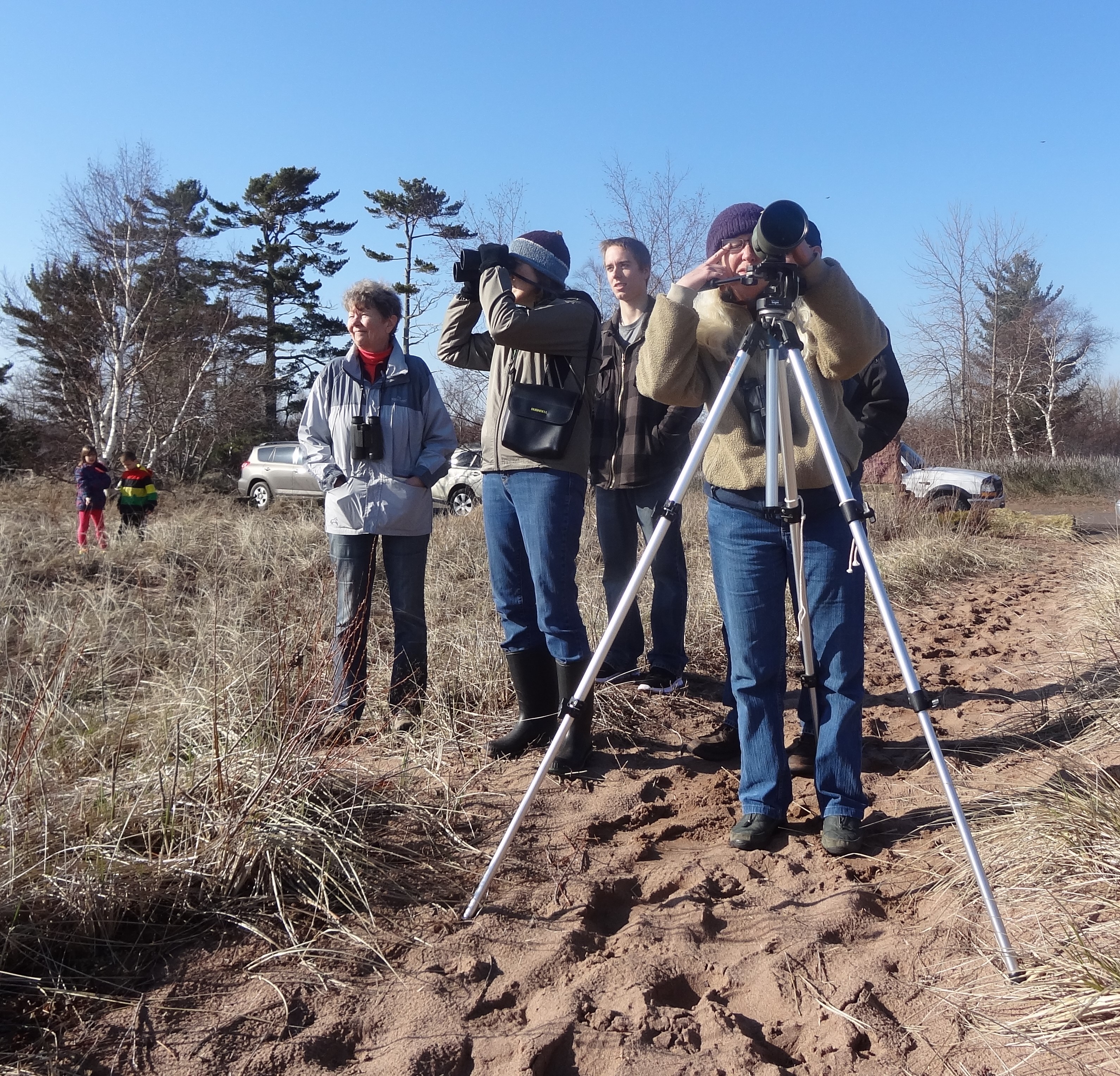
Birders on the shore of Lake Superior, Wisconsin Point.

Birders on the shore of Lake Superior, Wisconsin Point.

No, I’m not writing about Mother’s Day, but about a lesser known and newer commemorative event that celebrates birds. Yesterday, I participated in the second annual International Migratory Bird Day, held in Superior, Wis.

White pines on Wisconsin Point.

White pines on Wisconsin Point.

I haven’t been to a birding event in years, partly on purpose and partly due to other demands in my life. I like to think of myself as a recovering birder. I took up bird watching in seventh grade and was active in the birding community through my twenties – even participating for a year on the Audubon Expedition Institute, where I travelled across the country in a yellow school bus for a year with 24 other people interested in birding and the environment for master’s degree studies.

It was during that experience that I overdosed on birding. I came to realize that people stopped looking at birds once they had identified them. I rebelled against the obsession to name everything with feathers that I saw or heard. I rebelled against using eyesight aids like spotting scopes and binoculars – wanting to view the birds instead as part of their surroundings.

But I still feel an affinity with birds. My upcoming novel is about them, after all, and this event seemed a good excuse to get outside on a rare warm spring day. We met at Wisconsin Point, a long sandbar just outside the city. A small group of us spent three hours birding. We didn’t see very many birds but there were bald eagles, chickadees, scaups, red headed ducks, lots of blue jays passing through, and the requisite ring-billed gulls. I do admit to looking through a spotting scope (and the world did not end!), but I tried to keep it to a minimum to allow others the opportunity. After birding, we went to a local inn to listen to some presentations about migration.

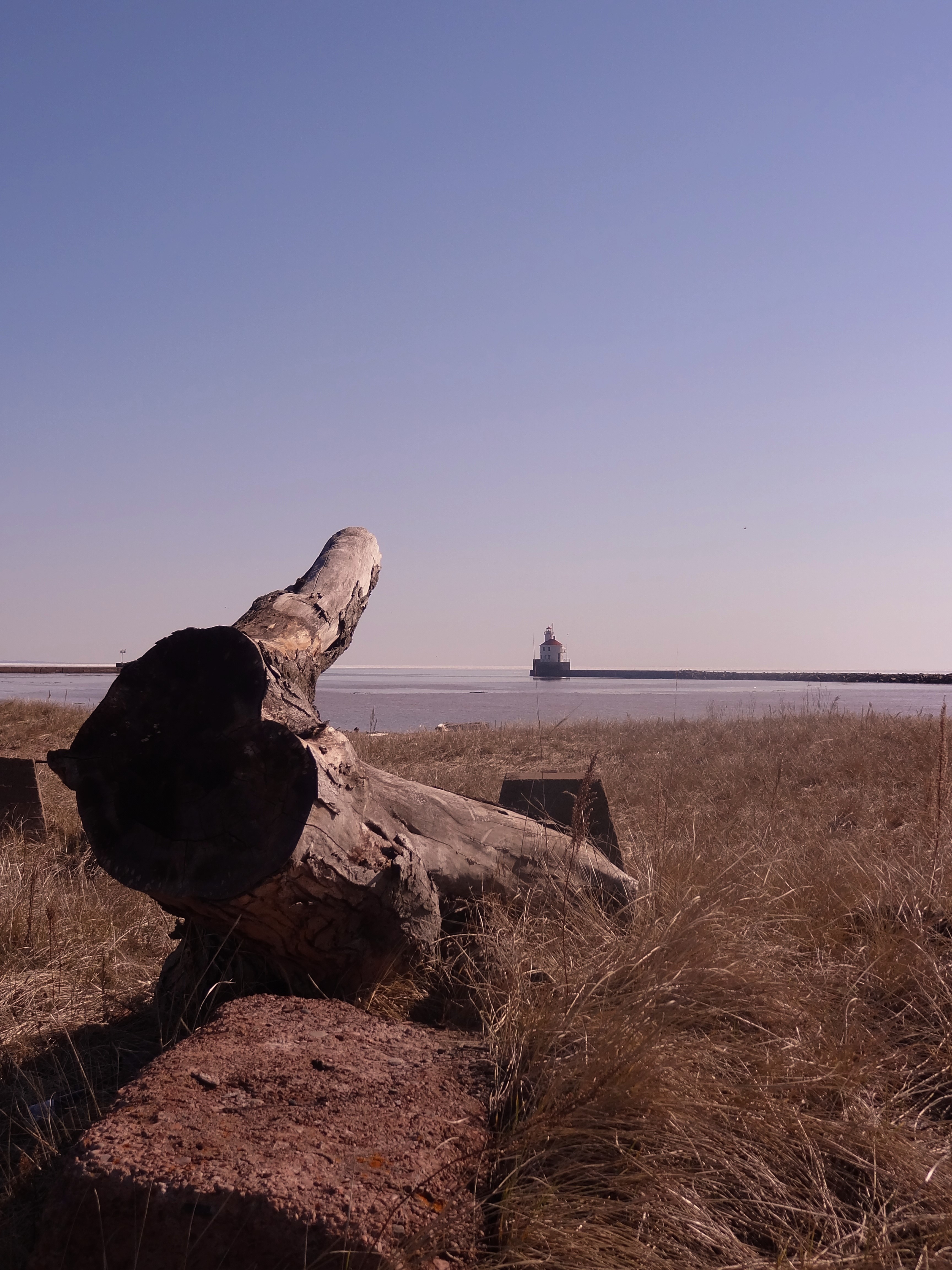
My camera isn’t built for bird pictures, but I do love the lighthouse and the white pines on the point, so I thought I’d share photos of them with you.

Wisconsin Point Lighthouse

The Wisconsin Point Lighthouse.

Wisconsin Point Lighthouse and log

The Smelt Parade That Wasn’t

Duluth Smelt Parade

A party of one: the 2014 Duluth Smelt Parade.

An annual Smelt Parade is held in Duluth to welcome the spring run of this tasty silvery little fish. Although the runs are much smaller than they used to be (which is a good thing because smelt are non-native) the fish still serves as a unique celebration of abundance and a cultural reminder that spring is on its way. For the past two years, the parade has been spearheaded by a local puppet troupe. Citizens make costumes and participate in the procession along the shores of Lake Superior, complete with a brass band.

I’ve never attended the parade, so today I committed to going. Wouldn’t you know it, this year the wind, rain and 35-degree-temperatures made it “the parade that wasn’t.” I was hoping to get a lot of fun images to share, but all I got was this single photo of a “parade of one” that happened outside a local arts café where the rag-tag group of parade-goers gathered indoors instead of walking along the shores of Lake Superior.

Oh well. Better luck next year. If you’d like to learn more about smelt, Minnesota Sea Grant offers a great fact sheet.

To Mine or Not to Mine?

Native copper. Image by Jonathan Zander, Wikimedia.

Native copper. Image by Jonathan Zander, Wikimedia.

That was the question I pondered along with about 1,500 other people and lots of rent-a-cops at a public meeting in Duluth last week. The project up for comments is an open-pit copper-nickel mine (a.k.a. sulfide mine) farther north near Ely, Minn., on the border of the Boundary Waters Canoe Area Wilderness. I have followed the development of this Polymet Corp. project for several (five?) years, trying to learn as much as I can to make informed comments as a concerned member of the community.

True to my blog’s name, this post is going to meander quite a bit as I try to gather my thoughts, so please bear with me. The problem is that copper sulfide mining has never been done successfully (from an environmental standpoint) in the U.S. These mines have a bad track record of long-lasting pollution. Even with all the new technologies the mining company proposes using with it, this mine will require 200-500 years of water treatment once its 20 years of life is over.

I was heartened to see so many people involved in the public meeting. It was well-organized and moderated. As is typical for public meetings about contentious issues, the open house portion of the meeting was designed to divide up the audience. The organizers provided tables staffed by people conversant in different specialties such as air quality, water quality, mercury, and wetlands. I had questions about how the acid-rain producing gasses from the waste rock were going to be handled, and ended up having conversations at four tables. I spoke with a consultant at the water quality table, who referred me for more information to the air quality table. They couldn’t answer my question, so referred me to the Polymet table. I also stopped at the “cultural resources” table (which was really the tribal table) just because I knew the people staffing it.

The public comment period followed, with everyone filling up a huge ballroom of the conference center. Guidelines for giving verbal comments were clearly spelled out in the meeting packet, and speakers (whose names were drawn at random) were given three minutes to say their piece. Groups of mining supporters in the audience sported royal blue round stickers (curiously, the same color as the Polymet staffers’ polo shirts), and environmental supporters wore round green stickers.

The thoughtfulness and thoroughness of people’s comments impressed me, as did the polite applause following each talk, no matter what viewpoint the speaker espoused. I heard that the applause got rowdier as the hours-long comment period progressed, but I had a dog to let out back at home, so I didn’t stay for the whole thing.

This is the mining company’s second try at an Environmental Impact Statement (EIS). The Draft EIS they released in 2009 was deemed inadequate by the state and federal agencies involved, so they issued a Supplemental Draft EIS. This version addresses some water quality concerns and waste tailings disposal issues. It also adds a necessary land exchange with the Superior National Forest, since the mine will impact National Forest lands.

If this EIS gets shot down, I’m not sure if the Polymet Corp. will get another do-over or not. What would that be called, I wonder – an Additional Supplemental Draft EIS? (Grin.)

But I have a feeling that even if the mining companies are required to add more details before the project can begin, they will complain, but they will do it. There’s a lot of money and profit riding on this project. And it’s not just this one mine – several others are in line behind it. The corporations are salivating over this copper-nickel vein, which is one of the richest untapped sources around.

As the Polymet project stands now, the mining company wants to use northern Minnesota as a guinea pig for some new techniques. Call me selfish, but I’d rather they practiced their techniques somewhere else first and proved them effective before using them here. The natural environment in that part of Minnesota is the most precious thing we have. It’s what gives the BWCA Wilderness the status of the most-visited wilderness in the lower 48 states. And this is not your grandpa’s iron ore mine — the type of pollution sulfide mines can produce is orders of magnitude different than the types an iron ore mine can produce, and this mine would be right near the wilderness.

I think that 500 years of maintenance for 20 years of jobs is too steep a price to pay for some copper. I thought it when I first heard about the project, and even with all the research and listening I’ve done that remains unchanged. Yes, I know that copper is vital for the functioning of society. Heck, I’m writing this on a computer, which I assume must have copper in it somewhere. But if we can’t extract copper without having to clean up the pollution from the operation for five centuries afterwards, maybe now is not the right time to be doing it. Maybe we should wait until mining methods improve enough that a legacy of pollution is not what’s left once the project is done.

Although the people I spoke with at the open house tables were all respectful and knowledgeable, I must admit, I trusted the folks at the tribal table the most. They are the ones that have the land and the environment as their number one priority. They are not pulled in as many competing directions as are the agency and corporate staffers.

The tribal comments are contained in Chapter 8 of the Supplemental EIS in a section reserved for “major differences of opinion.” One (of several) issues they raise is that an underground mining operation was not adequately considered. If the operation was kept totally underground, it would eliminate the impact to wetlands and surface waters, and it could limit the sulfide gas (acid-rain-producing) emissions from the site. The tribes argue that underground mining is technically feasible, “leaving only the lack of economic feasibility as the rationale used by the co-lead agencies to eliminate the alternative.”

I found the response by the co-lead agencies about underground mining arrogantly dismissive, and it backs up the tribal complaint: “The co-lead agencies believe that adequate consideration was given to the Underground Mining Alternative prior to eliminating it from further consideration . . . . “ Although they concede that an underground mine would offer “certain environmental benefits,” they contend that the “tonnage/volume and grade (amount of metals) of rock would not generate enough revenue to pay for all the costs associated with underground mining. Therefore, underground mining would not be economically feasible.”

But they offer no numbers. If I was grading this response on a school test paper, I would give it a “D” for “not showing your work.” I guess we’re just supposed to trust them on this. NOT. They also did not do a good job of “showing their work” on the details for the perpetual water treatment system that would need to be put into place.

Would Polymet find a way to make an underground mine feasible if that was the only alternative? I suspect so. If this copper mine is going to happen now with the technologies we have, this is the only alternative I would support, but this EIS gives no adequate justification for not taking that route other than “it costs too much.” I fear it will cost society and the environment too much if we don’t pursue an underground mine. Please, Minnesota Dept. of Natural Resources, send Polymet back to the drawing board!

It’s Climate Change, Stupid!

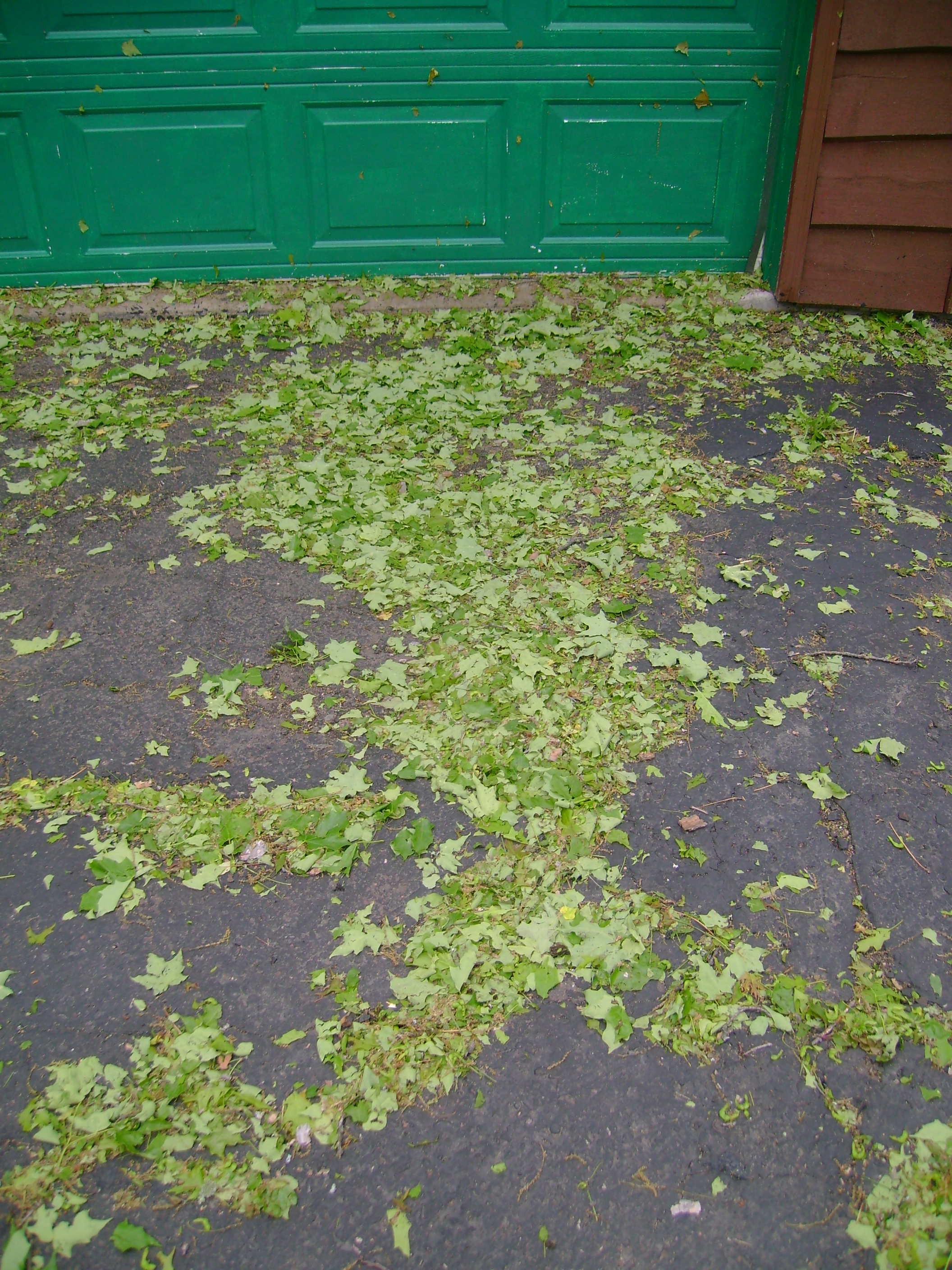
Shredded leaves from a hail storm litter my driveway.

Shredded leaves from a hail storm litter my driveway.

Even though it only lasted a few minutes, the hail squall that passed through my neighborhood earlier this week did a respectable amount of damage. Winds up to 70 mph toppled stately trees, people lost power – some for up to 22 hours (I lost power for about 12), and hail shredded the leaves that had finally popped out on the trees, creating a green carpet over people’s driveways and the roads.

Loss of power and loss of my routine reminded me of just how vulnerable we are to even the littlest whims of nature. I would have had to eat a cold supper but for the propane-fueled camp stove tucked away in my basement. With all our experience with snowstorms, perhaps northerners are more used to weathering weather disruptions than those in lower regions of the country, but we are far from immune. With no televisions and computers for distraction, my neighbors all took to the street to compare notes and make sure everyone was okay.

Unfortunately, violent storms like this are only likely to increase in the future. A few days after the storm, I attended a public forum called “A Flood of Options – Adapting to Climate Change,” which was hosted by the St. Louis River Alliance and the Izaak Walton League, and sponsored by the Minnesota Coastal Program and Freshwater Future. Speaker Mark Seely, the Minnesota State Climatologist, said that one of the things we can expect with climate change (and it’s happening now) is an increased amount of moisture from violent storms. There’s already been a 31 percent increase in this type of precipitation for the Great Lakes.

Higher temperatures are another thing that are happening, especially in the northern latitudes. The number of warm nights is increasing and so it goes that the number of cold nights is decreasing. Other lovely things to ponder are that mean monthly temperatures across the U.S. in 2012 were the highest since 1895 (I am guessing this is when stable record-keeping started). Not just by a little bit. Seely said they, “Obliterated all other year’s” temps. The same was true for Canada last year. Also, the value of economic losses due to weather/climate disasters has increased since 1980 due to hurricanes, floods, drought, etc. Seely said this is a motivator for communities to talk about climate adaptation. “Our climate vulnerability is becoming more and more clear to us.”

Other consequences include a longer mold and allergy season, increased frequency of freeze/thaw cycles, shorter time of ice cover on lakes (which leads to an increase in winter evaporation), and a longer growing season (which might not be all bad for northern Minnesota). The goal of the workshop was to inform participants about the impacts of climate change and provide ideas about how communities can adapt to it. It is a precursor to later workshops that will get more into advocacy and more specific adaptation measures.

During the question and answer session after his talk, Seely said, “Doing nothing is not an option. We’re obligated to think about this and to do something in our roles as citizens.” Chris Kleist, stormwater manager for the City of Duluth, also spoke, outlining the impacts of last year’s “500-year-flood” on the city. He estimates that long-term restoration will cost $12.6 million and the city has received about $2 million so far.

A look around the audience of 25 made it clear to me the presenters were preaching to the choir. Most of the others are already active in the environmental community. The guy seated next to me was so into the topic, he quoted from notes he wrote on a napkin. The type of approach used in the presentations wasn’t going to change anyone’s mind who wasn’t a climate-change believer. I know enough about behavior change theory to understand that.

Please forgive my Bill Clinton-esque title to this piece. I hope use of the word “stupid” does not offend, but I could not resist! It gets frustrating sometimes reading/hearing some of the refutations to climate change produced by nay-sayers. One of the problems is that those involved in climate change research and education do not employ effective communication techniques to get their messages across.

Spouting facts does not spur people to action. What does spur action and advocacy is storytelling, emotion, and spontaneity combined with some key message pre-testing and removing barriers to action. One of my favorite proponents to this approach is Randy Olson, a marine biologist-turned-filmmaker. He produced a movie about climate change (“Sizzle: A Global Warming Comedy), and wrote a book that tries to help scientists get their message across more effectively to the public (“Don’t Be Such a Scientist”). Seely did introduce a bit of emotion, but it wasn’t until the end of his talk, in the question and answer session. By then, an hour after his presentation began, it was too late.

It’s my sincere hope that the later climate workshops in this series integrate more effective communication techniques. And if you have a scientific message to get out to the public, please, consult with a trained communicator. It can only help! I’ll get down off my soapbox now.

A River Runs Through My Bucket List (or Learning How to Fly Fish Before It’s Too Late)

English: Green Highlander salmon fly. The hook...

English: Green Highlander salmon fly. (Photo credit: Wikipedia)

I have to admit, I like creating lists. They help me remember things and when I cross something off one, it gives me a straight-lined sense of accomplishment. A few years back I started a “Things to Do When I Retire” list; not really a bucket list (things to do before I die), but a similar concept. The list contains things like volunteering for the Red Cross, taking painting lessons, taking classes at a local folk arts school, and doing more photography.

I was content to delay the activities on the list until I had time during retirement, which was probably about 15 years away. That was, until one of my friends died unexpectedly in his early 40s. A sense of mortality smacked me in the forehead and I realized how much I’d been putting off really living and making the most of the present. In my friend’s honor, I decided to stop PLANNING and start DOING.

One of the activities on my retirement list is fly fishing. I suspect the inspiration for that came from watching the 1992 movie “A River Runs Through It.” Directed by Robert Redford and featuring Brad Pitt, the movie centers around fly fishing scenes in Montana. It was also around that time that I visited Montana and helped fight a wildfire on the White River National Forest in Colorado. I saw people fly fishing on rivers in these places and it looked so idyllic, I knew I had to try it someday. Plus, the biological aspect of the sport appeals to me. You have to know how to think like a fish and be aware of what’s going on with the local bugs to be successful.

Well, “someday” came last week. Rogue, non-retired list-breaker that I am, I took a fly fishing class with a group of women along the banks of a river on the outskirts of town. The opportunity was organized by one of my women friends and taught by Katherine Lansing, a local fly casting instructor certified by the International Federation of Fly Fishers.  

Katherine Lansing

Katherine Lansing

Lansing became an instructor by accident. She had been fly fishing for a few years, then she signed up for a class she thought was about how to learn to cast better. Turned out it was about how to learn to teach other people to cast better. Although hesitant, she took the class, which led her on the path to becoming one of only 80 female certified fly fishing instructors in the U.S. at the time.

We met under a picnic shelter at a local city park on a 40-degree evening. As the five other women described how they became interested in fly fishing, I realized I was the only one there not introduced to the sport by a man. Everyone else had been introduced by a boyfriend, husband, brother or father. Not sure what that says about me. I do admit I had been hoping “some man” would take me fly fishing, but it just never happened.

Lansing started the class by giving us an overview of the various fly fishing equipment and showing us how things worked. Then she introduced us to knot tying. We learned two knots, practicing first on chunks of nylon rope, and then on the more challenging fishing line. Tying the knots became more difficult as the cold temperature took its toll on our fingers. But it wasn’t long before we were up and moving, practicing our casts on the lawn beside the river, which was roaring with melt from spring runoff.

Casting was fun, and people kept remarking that I’m a natural at it (preen, preen). If I am a natural it’s from a lot of practice casting regular fishing lures and maybe from throwing an atlatl (a prehistoric throwing spear), which is a story I’ll perhaps tell another time. As we casted, Lansing went around and gave us tips in her no-nonsense and helpful manner.

After about 2-1/2 hours outdoors, I could no longer feel my toes, so I decided it was time to head home. But I enjoyed the experience and I’m looking forward to actually getting out on the water to fly fish next time. Then I’ll be able to officially cross that one off my list, and I’ll have a new hobby NOW instead of waiting for my retirement or until I’m dead, whichever comes first. (Smile.)

Vinny with a Y not an IE

grey wolf

grey wolf (Photo credit: Wikipedia)

I was walking my dog through the local forest the other day when I met a 12-year-old neighbor boy for the first time. His name is Vinny; spelled with a Y on the end, not an IE. “People mix that up all the time,” he said. He was walking a chocolate lab who was also 12 years old. His lab got along well with my goldendoodle so we let them off their leashes to romp.

Vinny was the talkative sort. I’m always amazed at how much kids unknowingly reveal about their lives and their parents’ lives to strangers. While on the one hand, I’m glad children are still trusting, on the other hand, I shudder to think what could happen if the information made it into the wrong ears.

During our short walk, and with hardly any prompting from me, I learned about all of Vinny’s former and current pets, that Vinny’s parents are hiring a nanny for the summer to drive him to his soccer games, that he has a sore knee but his mom said that some exercise walking the dog would probably be good for it (I had to smile at that one), and that Vinny’s dad shot a wolf.

Of course, as a wolf novelist, this last bit of news gave me pause. I can’t even remember how the topic came up, but suddenly, there it was, as unexpected and pungent as blood on leaves. I do remember that Vinny was explaining how he likes to deer hunt. He was in his deer stand when he was 7 and a wolf appeared and scared him. From questioning and further conversation, I got the impression he was in the stand alone, but that his dad was nearby, possibly in a different stand. Vinny ended up meeting up with his dad and telling him about the wolf. That’s when he told me his dad shot the wolf.

Oh, there were so many things I could have said and so many routes our conversation could have taken. My first instinct was to trot out the fact that wolves have not been documented to kill a human in the U.S. but once in recent history; that they are shy and normally do not approach humans. But I didn’t. I wasn’t there in the forest in a deer stand with a scared young boy. Obviously, something the wolf was doing scared him and concerned his dad enough that he decided to kill it. And during my book signings in northern Minnesota and Michigan, I’ve heard many stories from people about wolves. I understand that they are capable of all sorts of behaviors, many of which are seen as threatening by humans.

Instead, I said something about wolves usually being curious more than anything else. I wanted to ask him if his dad reported the shooting, because I’m sure at that point in history (5 years ago) the wolf was still considered an endangered species and thus illegal to kill. But I really didn’t want to know.

Vinny then went on to describe a plan he and his dad made in case Vinny ever felt threatened by a wolf again. He told me the special kind of ammunition they would use, which would hurt/scare the wolf but not kill it. This gave me a bit of consolation. At least they knew that killing the wolf was wrong and either got the special ammunition idea from a conservation officer or his dad had thought about it enough to figure it out. I doubt that shooting a wolf with anything is a good idea because the wolf could die of an infection, but I kept my mouth shut about this, also. I didn’t want to criticize Vinny’s dad because that could shut Vinny off for future conversations about wolves.

Our conversation ended with Vinny asking me if my youngest son likes to hunt. I told him we weren’t hunting people, but that my son enjoys fishing. By that time, we were at a crossroads and we separated, each to our own homes. I hope I meet Vinny again. Maybe I’ll have another chance to educate him more about wolves. I sure hope so.