An Ancestral Trip to Afton, Minnesota

afton-trip-020

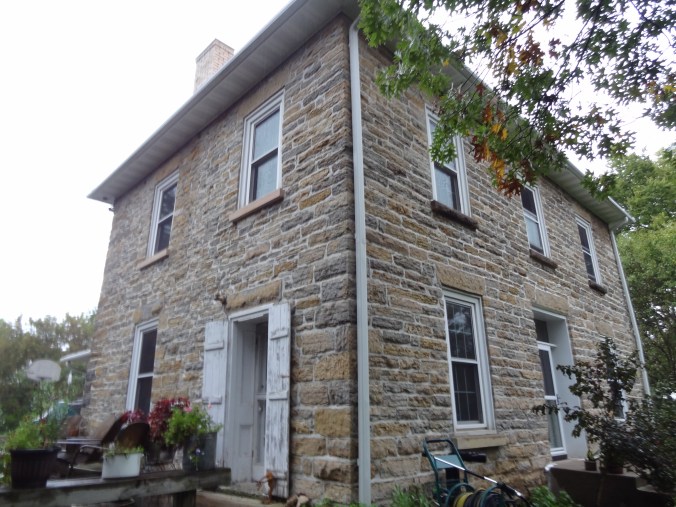
Stone Oak Farm, built by my great-grandfather.

Last weekend, I meandered to the charming river town of Afton, Minn. My reasons were double: to sell my books at a local fair and to visit the home my Scottish great-grandfather built when he immigrated there.

You may recall my trip to Scotland this summer and all the fun I had finding ancestral homes and castles. After I returned to the U.S., I realized there was at least one ancestral home here that I had never seen. I knew it was in Afton, so when an opportunity arose to sell my novels at Afton Art in the Park with another author, I jumped on it.

afton-trip-019I never met my great-grandfather. He was long gone from this Earth by the time I was born. I barely even remember his daughter, who was my grandmother. Even so, I feel a kinship for that side of the family and for that part of my genetic makeup.

Before I left on my trip, I contacted the home’s current owner. She was more than willing to meet with me, and was enthused about learning more family history about the man who built her home.

Afton is located in eastern Minnesota along the St. Croix River. The nearest town of note is Stillwater, a popular tourist destination. As I turned off the freeway and onto the country roads, the clean smell of the air was the first thing that struck me. It smelled . . . well, green.

afton-trip-008Nearing Afton, the rolling green hills and pastures reminded me of the land around Kelso, where my great-grandfather was from. Combine that with the river (which Kelso also has), and it makes perfect sense why he chose to settle in a place that must have reminded him of his homeland.

I found the house down a long driveway, set atop a small hill and surrounded by oak trees and cornfields. The house is built of locally quarried stone, with walls over two feet thick. The owner said it used to be called Echo Valley, but she renamed it Stone Oak Farm because she thought that fit better.

The original home, an imposing square two-story structure, is still intact. But subsequent owners have enhanced and modernized it by adding a garage, entry room, and a back addition that has a laundry room, office, bathroom, rec room and a massage room. The original ice house sits off to one side in the yard.

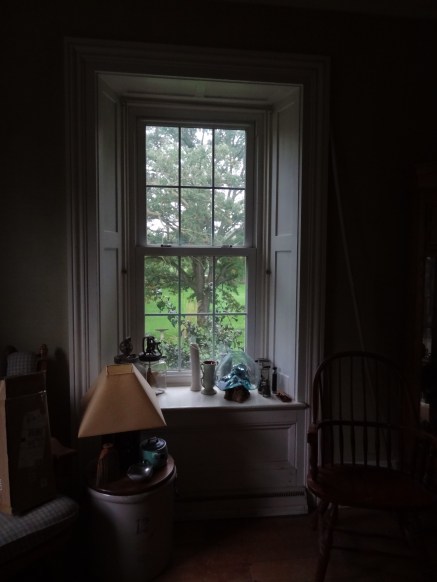
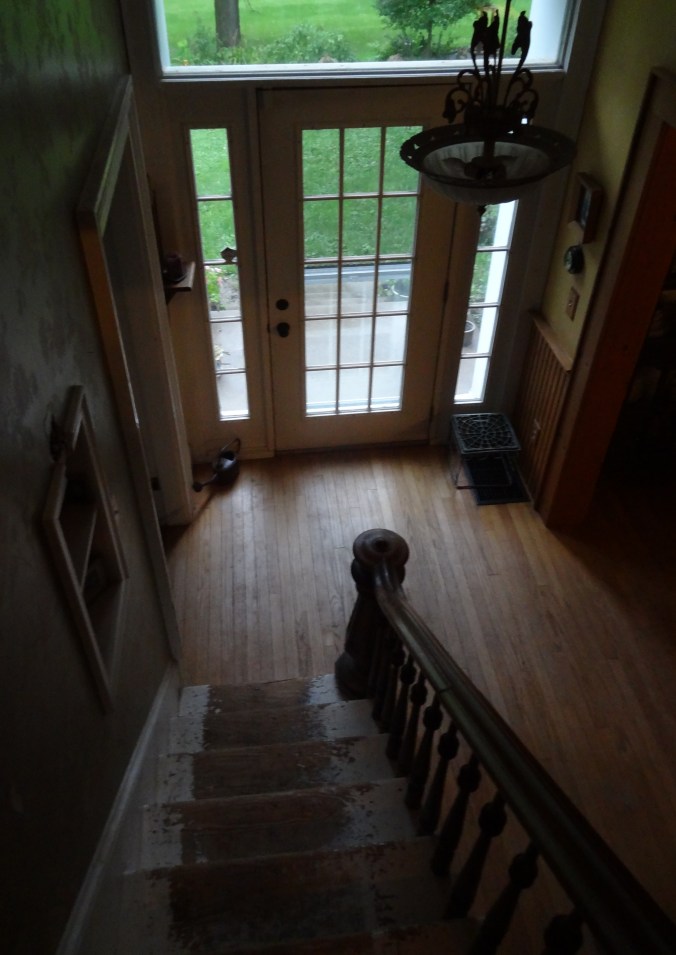
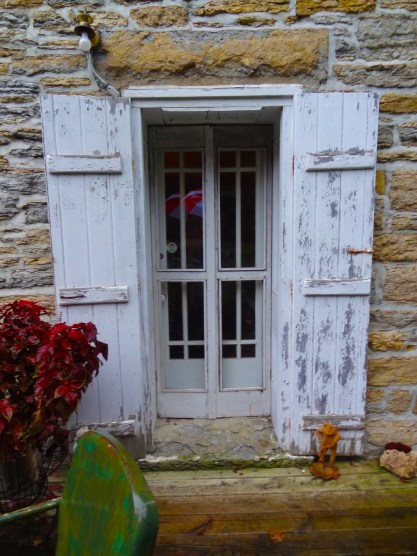
The deep window wells and original wooden floors speak of another era. The transom door provides an imposing entrance, that’s more just for show now since the owners use the door to the new entry room instead.

afton-trip-013I walked through the home with reverence, feeling the weight of history and time in the stones, the scuffed stairway, and the huge trees outside the windows. It was obvious the current owner loves the house and has treated it very well.

I asked her if there are any ghosts in the home. She described some mysterious pranks that involved clothes being strewn about, an exercise ball rolling down a hall and around a coffee table of its own accord, and a weeping bouquet of dried flowers. However, the owner thinks it’s one of her relatives haunting the place, not mine.

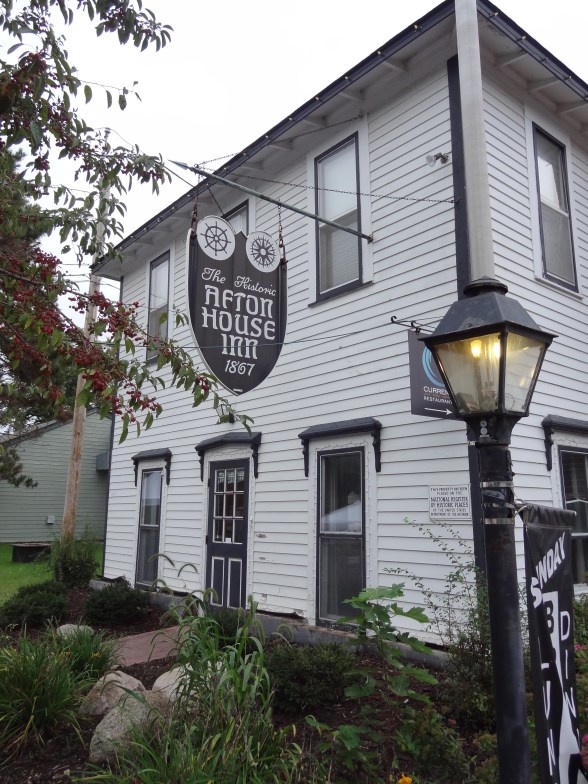
I left feeling like my family’s ancestral home was in good hands. After spending a night in the quaint and historical Afton House Inn, my book sale the next day went very well. I’m glad I made the trip! If you ever get the chance, you should check out Afton.

afton-trip-033

Mary Queen of Scots and Kelso Luck: Adventures in Scotland, Part 10

002

Mary Queen of Scots’ death mask.

Just to forewarn you – this is a long entry. I made the most of my last full day in Scotland. Have a cup of tea and enjoy the read! I’ve highlighted important names to remember for this story to make sense.

My last day in Kelso began with a short drive to the Mary Queen of Scots Visitor Centre in Jedburgh – on the advice of one of my blogging acquaintances. (Thank you James of “Walking with a Smacked Pentax!”)

The approach to the center is through a narrow alleyway, so the building doesn’t look all that impressive (especially for a former queen to have stayed there) until you walk around to the front, where you can see its stately tower. Having watched a public television series on the queen when I was young, I was interested to learn more and to refresh my memory.

001

The Mary Queen of Scots Visitor Centre

Entrance to the center is free, although the written guide costs a few pence. Mary (whose French name is Marie) stayed there for about a year. She almost died there, too, after a trip to visit her secret lover, and encountering bad weather and falling into a bog on her way back to Jedburgh. It was the last place in Scotland she was to live before becoming Queen Elizabeth’s prisoner in England for eighteen years.

Her sad and devious story is laid out clearly in the various rooms. Walking among the artifacts – a buckle, a shoe with a broken heel, a lock of her strawberry blonde hair – I couldn’t help but feel sympathetic toward this woman whose life started out with so much promise, only to disintegrate after marrying the wrong man and trusting people she shouldn’t have.

By the time I reached the room that features her final letter, addressed to her brother-in-law King Henry III, my heart was heavy and quiet. Mean old Queen Elizabeth wouldn’t even allow Mary the comfort of her own chaplain in her final hours. And then I came upon her death mask on display. It was common practice to take a cast of the face of beheaded prisoners. Mary really was beautiful.

*

The drive back to Kelso allowed me enough time to shake off the sadness. After all, I had a mission to fulfill: I was going to try and find two homes associated with my great-great-great grandmother. Her name was Margaret Gray. She was the mother of Susan Gray, who married William Dick (my great-great grandfather) who worked at Floors Castle.

My mother and/or aunts had requested a report on Margaret from the Scots Ancestry Research Society in the early 1990s. They found that she was listed in the 1841 census as being widowed, 75 years old, and living in a house with her son-in-law and his young daughter. There is no wife listed in the report. One could assume that perhaps the wife died and that Margaret was helping with the child.

The house had a name and location, which, to protect the privacy of the people currently living there, I am not going to divulge. Let’s just call it Pinnacle Cottage. When I was still at home in the U.S. before my trip, I had wondered if a house important enough to have its own name might still be there. I did some Google searches and found a house in the right location.

Graham, the super-helpful host at my B&B, the Bellevue Guest House, also took a look at the name of the house and pointed me in the same direction.

In that same census, another Margaret Gray is listed as being younger (60 years old) and working as a servant in another named house not far from Pinnacle Cottage. Let’s call it Forest Lodge. Could it be that Margaret lived in Pinnacle Cottage and worked in Forest Lodge? (Maybe the lodge owners didn’t know her real age or didn’t want to admit to making a seventy-five-year-old work for them.) Or maybe Margaret lived in Pinnacle Cottage and one of her daughters named Margaret (who she must have had when she was 15 years old!) worked at the lodge. In any event, it seems likely there was some kind of connection.

I was also able to find the lodge with Google, and Graham again pointed me in the same direction. Forest Lodge was within easy walking distance from Pinnacle Cottage.

As I drove back into Kelso, I did so from the Pinnacle Hill direction and parked across a bridge from the hill. I figured I could find the cottage more easily by walking than driving. I crossed the bridge into a neighborhood full of houses, which soon thinned as the area became more wooded. I came to a house with a driveway gate and a sign that had the owner’s last name and “Pinnacle Hill” on it. Not exactly “Pinnacle Cottage,” but close. I walked down the road a bit farther to see if there were any other houses. As I did, I passed another gate where I caught a glimpse of the Pinnacle Hill house through the trees. It was low-slung and covered in white stucco with blue and yellow trim around its many windows.

No other houses stood beyond it – just a natural area with a trail. So I walked back. As I stood near the gate and took a photo of what I could see of the house, I heard the clip of hedge trimmers. I called out a “hullo” and was met by the gardener. (How lucky was that?)

I told him my quest and asked him if he thought this house had been around since 1841. He said he’d ask the owner – an elderly gentleman who was a retired doctor. He went inside to ask and came out with the explanation that the doctor was in his nineties and wasn’t open to having company (actually, he said the doctor liked to hang out naked most of the time, and I laughed and said I wanted to do that when I got old, too) BUT he thought this could be the right house.

Cool. I asked the gardener if it would be all right if I came into the yard to take photos of the house. He said that would be fine, and opened the gate to let me in. The house and yard were well-kept and it looked like another small house was attached behind it. A mother-in-law’s cottage, perhaps??

As I was raising my camera for a shot, I glimpsed a figure that looked like an old man in one of the far windows . When he saw that I saw him, he scuttled from view. (He had clothes on!)

The gardener and I chatted a while longer, then I was off to find Forest Lodge. I continued down the road, past the nature trail and to a sign for the town of “Forest.” I followed the sign and eventually came to a house with an impressive gate and a gatehouse. The name on the gate was “Forest House.” Not exactly Forest Lodge, but it would do.

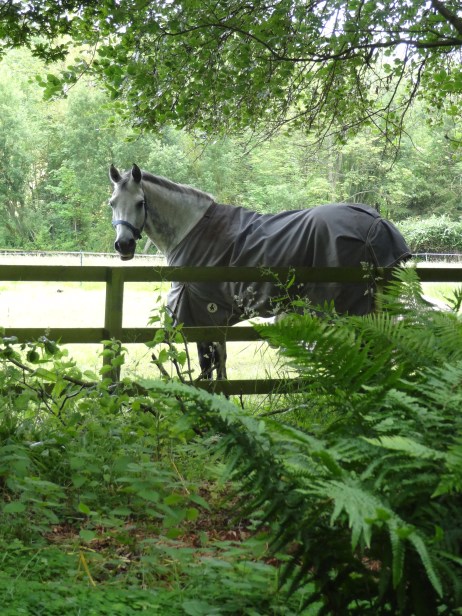
016Another sign on the gate said PRIVATE in big letters. Hmmm. How brave was I? Apparently, I was medium-brave. I knocked on the gatehouse, but nobody answered. I decided to walk down the long driveway to at least see if I could view the house from a distance and take a photo. But as I walked upon the smooth blacktop, past the immaculately groomed flowers and towering trees, I started to lose my nerve. My nerve fled farther upon seeing a beautiful dapple grey horse gazing at me placidly from over a fence. These people were equestrians. Just how much money did they have? I stopped behind a trimmed tree for a moment and the rest of my nerve fled.

I turned and walked back down the driveway toward the road. As I approached the gatehouse, I saw a car parked by it. But nerveless me couldn’t bring myself to knock on the door again. I reached the road and started back toward my car. As I walked, the sky darkened and rain threatened, matching my mood.
026It wasn’t long before I noticed a woman walking a dog in a field. I could see her through the thin hedgerow and it looked like she came from the gatehouse. I gave my bravery a kick in the pants and told myself I HAD to talk to her. So I did. The sun came out and the sky brightened. She said she was the mother of the woman who lived in the gatehouse. She just happened to visit to walk her daughter’s dog. (How lucky was that?)

I told her of my quest and hesitancy to invade privacy, and she encouraged me to ignore the PRIVATE sign and walk to the house. She said the owner was really nice and wouldn’t mind. It did seem silly to come so far and not try harder to see the house, so I followed her advice.

As I walked down the fancy driveway, more horses came into view and yet more spectacular shrubbery. Then I saw a gardener at work across the yard. He didn’t seem to notice me, so I continued on to the house. What a house! It was a big grey castle-like structure with green climbing vines and roses covering the front. I walked past the two marble dogs guarding the door and rang the bell.

018

Nobody answered. However, a side door opened and a youngish blonde lady stepped out. I thought she looked too young to be the owner, but I gave her my spiel and asked her if she thought this could be the right place. She did. As we talked further and I showed her the census report, I discovered she was indeed the mistress of the house. And yes, she was very nice. I asked her if I could take some photos and she readily agreed. However, she stayed outside with the gardener the whole time. I don’t blame her.

Mission accomplished and copious thanks given, I walked back to the road, ready for my next quest, which was finding the gravestone of William Dick. I happened upon the gatehouse lady’s mother coming up the road, returning from her dog walk. She asked how my visit to the house went and I relayed the happy news.

Then I told her of my next quest and she showed me on my map exactly where the cemetery was. In fact, it was right near where I parked my car. (How lucky was that?)

Purpose clear, I walked down the road and across the bridge. The cemetery gate was open. I had a crude map my mother had drawn of the grave’s location. After a bit of looking, and concluding my mother must have been drunk when she drew the map, I found my great-great grandfather’s gravestone.

I was so happy, I took a selfie at the grave. The stone was in good shape, although moss was growing over the top and beginning to cover the words. I scraped it off and as I did so, the stone vibrated beneath my hands. It sort of freaked me out until I discovered the stone was a bit loose in its setting. That’s just how the gravestones were. I touched some others and the same sensation ensued. Nothing supernatural. Darn.

Feeling fortunate and lucky, I hoofed it back to my car and to Bellevue Guest House.
049

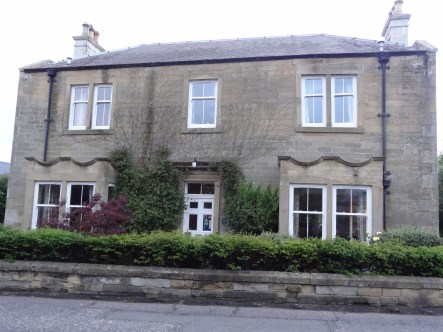
Bellevue Guest House, Kelso.

I would be remiss if I didn’t put in a plug for the guest house – Graham and his wife were super nice and helpful to me, the food was great (you can even order haggis for breakfast!) and the beds are comfortable. If you’re ever in Kelso, give it a try.

My luck was short-lived, however. My next post will detail the adventure I had catching my flight home the next day.


Floors Castle and Crying During Movies: Adventures in Scotland, Part 9

061

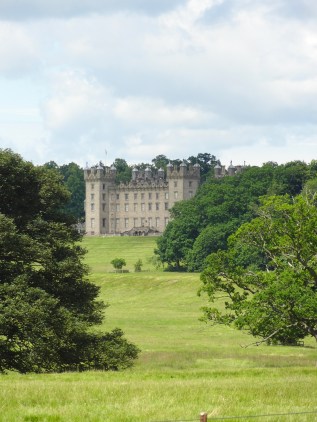
Floors Castle, Kelso, Scotland

My story about Floors Castle starts, not in Kelso, but a few months ago back on my couch in the U.S. (Yes, I’m doing it again – starting a story about Kelso someplace else.) This was before I knew about the newspaper story detailing my ancestor Isabella’s childhood in the castle and before I was convinced of my family’s ties to the castle.

I knew of rumors of the ties, so I was digging through the castle’s website when I noticed a movie had been filmed at Floors Castle, called “Greystoke: The Legend of Tarzan, Lord of the Apes” (1983).

I actually saw this movie when it came out since I am something of a Tarzan fan. (I watched way too many Johnny Weismuller Tarzan shows after school while growing up.) Plus, if you’ve read my novels, you know I have a thing for animal/human communication. But the movie was rather fuzzy in my brain since I saw it so long ago.

I decided to buy the movie for a look at the castle in preparation for my trip. When I eventually watched it (sitting on my couch), I recalled why it got panned orginally. Much of the first part of the movie features Tarzan (Christopher Lambert) grunting at apes. The critics didn’t like the lack of dialog, but hey, what are you going to do? It’s a movie about apes! Nonetheless, the movie did end up receiving three Academy Award nominations. It didn’t win any, though.

The last half of the movie is set in Scotland at Floors. My dear blogging audience, because I have no pride left, I will share my reaction to the movie with you. In short, I bawled like a baby. When the castle first appears in the opening credits and the duke and his doomed son (Tarzan’s father) race toward it on horseback, tears were coursing down my face and I didn’t know why. It’s not usual for me to burst into spontaneous copious tears at movies. I’m more of a leaky-tear-wipe-away person. And the castle scenes weren’t particularly emotional, either.

But once the movie was over, I realized the tears were from an overwhelming feeling that my ancestors loved the place and their time there.

A few months later, I found the newspaper story about how my great-great grandfather worked at the castle for over fifty years, and I decided that maybe I wasn’t so crazy after all. I mean, why would he work somewhere so long if he didn’t at least like the place and the people in it?

057

The castle gate.

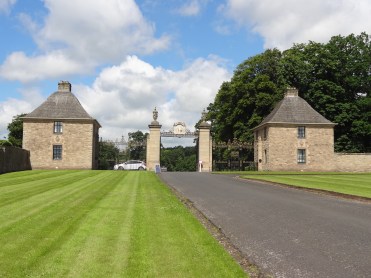
My Bed and Breakfast was close enough that I could walk to Floors Castle. When I reached the gate, I asked the attendant if walkers got a reduced entrance fee, but she wasn’t buying it. 🙂

I meandered up the castle driveway with some trepidation. After all, if a movie could affect me so strongly, I wasn’t sure how I would react to seeing the real thing. This was after a search for my great-great grandfather’s gravestone at the Kelso Abbey that morning, which proved unfruitful. But I was told of another cemetery in town that I hoped to check on my next, and last day in Kelso.

058The driveway was long and lined with tall trees and rhododendrons. It wound through fields and afforded views of the castle and the River Tweed in the distance. Set on a hill above the river, the castle appears to grow directly out of the lawn. I knew from my research that, in addition to the castle tour, Floors features a gift shop and two cafes (one with an outdoor terrace), plus a walled garden. It was still early in the day and I wasn’t hungry, so I planned to tour the castle first and eat later.
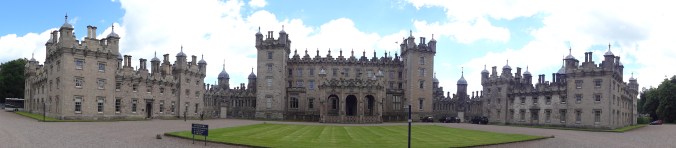
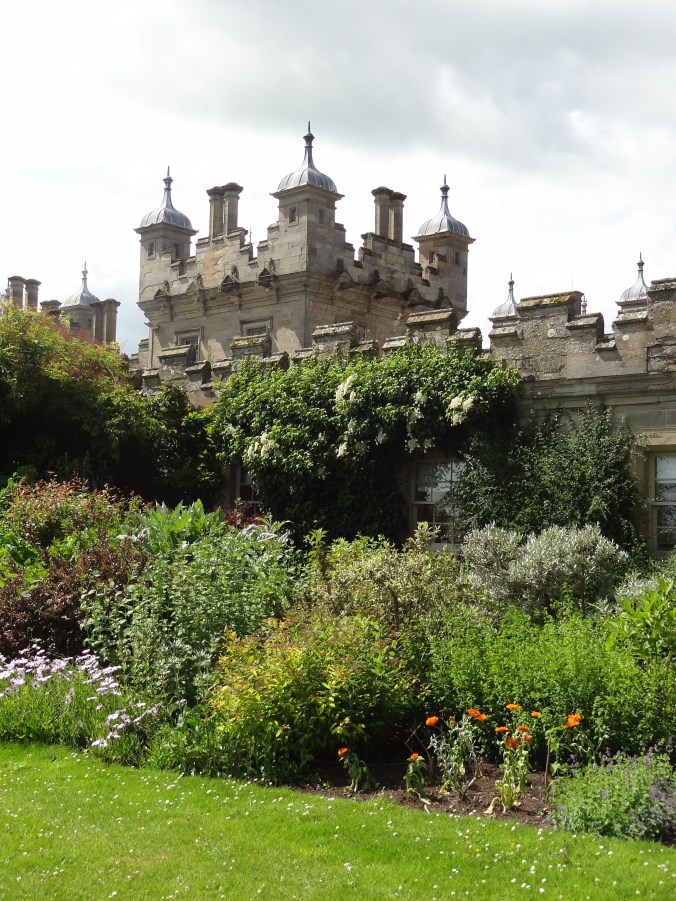
Built in 1721 for the First Duke of Roxburghe, Floors Castle is still home to the Roxburghe family and the Tenth Duke of Roxburghe. It is the largest inhabited castle in Scotland but parts of it are open to the public.

As I approached, I became confused about where to enter for the castle tour. It seemed as if the signs were pointing to the castle’s front door. Surely that couldn’t be right. Tourists entering through the impressive massive intimidatingly wealthy front door? What if I was mistaken and I walked in the front door and everyone turned to look at me in horror?

065

The front door. Intimidating, much?

I decided it was safer to enter the gift shop around the side of the castle first. I browsed the Floors Castle Christmas ornaments, Floors Castle honey, and Floors Castle dish towels, then asked the clerk where the entrance for the castle tours was. “The front door,” she said.

When I explained I couldn’t believe they’d let tourists in the front door she just laughed and said, “Of course, why not?”

Buoyed by newfound certainty, I walked to the front door. I did not get yelled at as I entered. Instead, the docent gave introductory remarks to the small group of us gathered in the entry, then he set us loose upon the castle. The tour is self-guided, although docents are in some of the rooms to answer questions and to ensure that nobody walks off with a priceless vase.

I wandered amid the tapestries, paintings and porcelain. There was even a room full of stuffed birds. Apparently one or two of the dukes were ornithologically inclined. One of the duchesses collected a few Matisse paintings. When I got to the dining room (which was originally a billiards room) I encountered a particularly friendly and knowledgeable docent named David.

slide4

The dining room where David and I talked. Image courtesy of Floors Castle.

I told him about my ancestral connections to the castle, and he was intrigued. He had a list of dates when the various dukes reigned, and we figured out my great-great grandfather must have worked for the sixth and seventh dukes of Roxburghe. David said a lot of building was going on during the reign of the sixth duke and that perhaps my grandfather was instrumental in it. The castle isn’t the only business on the estate, there’s also forests, fields, horses, wind farms and the like. It’s a huge operation.

086We also got to talking about the Tarzan movie. He told me he was in the movie – he played a cleric. He said the rainy scenes at the castle were shot with the help of the local fire department up on the roof, spraying “rain” with their hoses. He also mentioned that the film directors were sticklers for historical accuracy. All the television antennas on the roof had to be hidden during the day, and were put back out in the evening so the residents could watch TV.

David promised to look into some things for me. I gave him my card. As yet, I haven’t heard anything from him, but who knows? So, although I didn’t get to totally “vindicate” my ancestors’ role with the castle estate office, at least David knows about him, and my family, and all of you!

072

My bird friend.

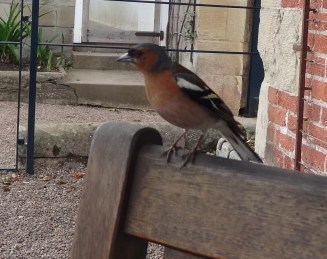
By now I was hungry. Thankful that I didn’t burst into tears during my castle tour, I made my way to the terrace café. I sat outside and indulged my sweet tooth in chocolate eclairs and meringues. A friendly (and hungry) bird kept me company – reminiscent of the Kelso Welcome Swan.

Sated and peaceful, I toured the walled gardens. But I must confess the flowers that truly impressed me were rhododendrons growing in the forest on the trail to the gardens (see photo below). After another visit to the gift shop to buy mementos, it was time to go.

069

As I left and walked down the drive, I couldn’t help but stop and turn back to look longingly at the castle several times. It was like the ancestors inside me didn’t want to leave just yet. I indulged them for a while, but then it was time for the next adventure.

Kelso Ancestor Quest: Adventures in Scotland, Part 7

Springfield Ancestor Quest 013

“Main Street,” Springfield, MN

My trip to Kelso starts, not in Scotland, but in the small southwestern Minnesota town of Springfield. That’s where my mother (from whom I get my Scottish blood) was born, and the museum there is home to a set of family scrapbooks she put together.

A few weeks before my Scottish trip, I visited the Springfield Museum on a quest. You see, one of my ancestors — my great-great grandfather William Dick — was rumored to have worked for Floors Castle in Kelso. He was the lead carpenter (or “joiner”). But when my parents and aunt visited Kelso in the late 1970s, they were told by the castle estate office that they had no record he worked there.

Dicks2

My Scottish great-great grandparents, Susan and William Dick.

As a journalist, I know that could mean a lot of things. It could mean the records were lost. It could mean no records were kept so far back (the mid-1800s) or it could mean nobody looked very hard for the records.

While tooling through the family genealogy book one day (months before my trip), I noticed mention of a newspaper article about William Dick working at the castle. The note said the article was in the family scrapbooks.

The castle, on its website, says it is interested in historical information about the people who worked there, so I thought a visit to the museum was in order to find records to prove that my great-great-grandfather worked there.

I also noticed in the genealogy and census records that at least one of their ten children, Isabella, was born on the castle property in 1842. Why would she be born there if my ancestors had no connections to the castle?

Since it’s a good chunk of a drive from Duluth to Springfield, my oldest son kindly offered to join me in the quest. This was also a good chance for him to learn more about his family history since he had never been to Springfield.

We took off one afternoon with tents in tow — planning to camp in the Springfield City Campground overnight so that we could get to the museum in the morning. The museum wasn’t actually open on the day we planned to visit, but I had made prior arrangements with the museum director to meet us there.

Springfield Ancestor Quest 017

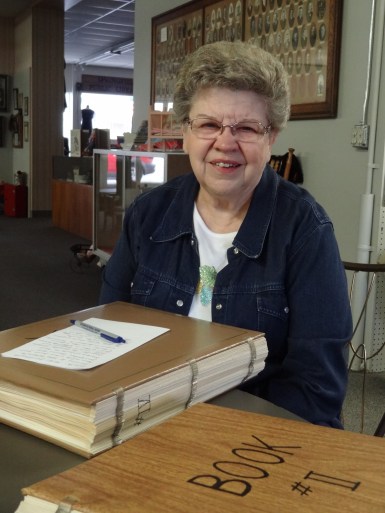
Very helpful Springfield Museum Director Carole Young with some of my family’s scrapbooks.

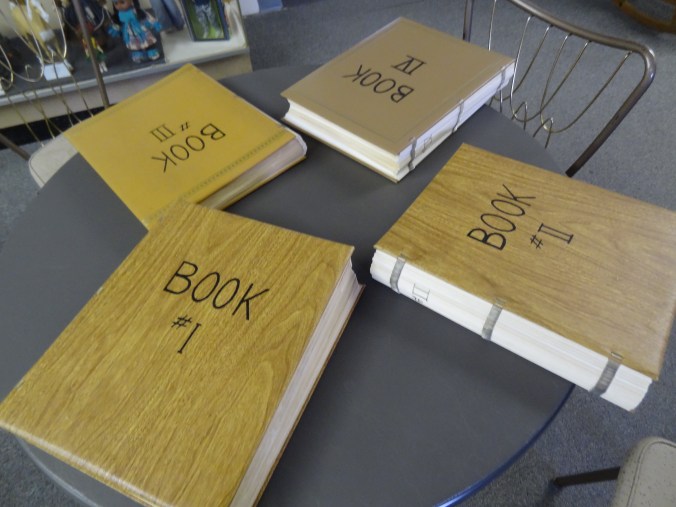
We met the director, Carole Young, as planned. She had the scrapbooks waiting for us, spread out on a table. It didn’t take us long to find the newspaper article in question since my dear organized mother had indexed the scrapbooks by family name.

There it was, a story from the Spirit Lake Beacon, a newspaper in Iowa. It was dated 1913 and had the title, “Scenes and Reminiscences of a Spirit Lake Lady Reared Among the Royalty of England and Scotland.” It was an interview with Isabella (the one born at the castle) and the story featured her memories of life growing up in a grand house on the castle grounds. Her father was the head state carpenter at the castle, holding the position for “upwards of fifty years” until he retired.

Their house was apparently near a cricket field and castle visitors, such as Queen Victoria and the Prince and Princess of Wales would drive down from the castle to their house to watch the games. The article says “rooms were prepared especially for them” by Isabella’s mother and the children. During these visits, Isabella said, “We children were always on our best behavior and willing to do little things to make it pleasant for the visitors,” who often stayed three or four days at a time. Isabella also met famous composers and pastors. She and her siblings were sometimes called on to “make up the required number” for a cricket game, and Isabella was proud that they could play the game well.

Eventually, Isabella, a widow with children, left the U.K. and came to America to marry a childhood neighbor who lived in Illinois. They later settled in Minnesota and then Iowa. Her brother, Francis, came to America also, settling in Minnesota. He was my great-grandfather.

Viola! Proof that William Dick worked at the castle! Unfortunately, there was no way to photocopy the article from the scrapbook, so my son and I took scans and photos with our cell phones. However, they didn’t turn out so well. Once I returned home, I searched for a digital copy of the story. I couldn’t find it in the Spirit Lake newspaper database, but I was able to find the same story in The Des Moines Register, which had published it a week later. Score!

I sent the story and a photo of William Dick and his wife to the castle. I had also emailed the castle previously, but did not receive a reply to either attempt.

Harrummph. Whatever. It was proof enough for me. And the quest was a good bonding experience for me and my son. I realize there’s almost nothing more boring than reading about someone else’s ancestors, but I hope this story wasn’t too painful.

Next posting: Kelso — for real this time!

Springfield Ancestor Quest 015

My Dad & Barnacle Bill

TruckRepair1951

My dad repairing a vehicle in our driveway, 1951.

One of my fondest memories of my father — who is ninety-seven and has been having a rough go of it lately — involves the ballad of Barnacle Bill, a song popular in the 1930s.

Picture me as a child of five, knocking on the bathroom door. My father is inside, shaving or whatever. He answers my knock, singing in falsetto:

“Who’s that knocking at my door? Who’s that knocking at my door? Who’s that knocking at my door? (Cried the fair young maiden).”

Of course, I’d tell him it was me and that I had to go to the bathroom . . . BAD. Like all children who would rather play than go pee, I’d leave it until the last moment.

He’d answer by continuing to sing, this time in a gravelly male voice:

“It’s only me from over the sea
(Said Barnacle Bill the Sailor).
I’m all lit up like a Christmas tree
(Said Barnacle Bill the Sailor).
I’ll sail the seas until I croak.
I’ll fight and swear and drink and smoke,
But I can’t swim a bloody stroke
(Said Barnacle Bill the Sailor).”

By this time, I’d plead again for him to let me in, and he’d reply in falsetto:

“I’ll come down and let you in,
I’ll come down and let you in,
(Cried the fair young maiden).”

Sometimes he’d let me in. But if he needed more time to finish, he’d draw out the torture by singing the last verse:

Fancy Pants

My dad in his knickers (right) with his father outside their home in central Minnesota. I call this photo “fancy pants.” It must have been taken in the 1930s, during the time the Barnacle Bill song was on the radio.

“Well hurry before I bust in the door
(Said Barnacle Bill the Sailor).
I’ll rare and tear and rant and roar
(Said Barnacle Bill the Sailor).
I’ll spin you yarns and tell you lies
I’ll drink your wine and eat your pies
I’ll kiss your cheeks and black your eyes
(Said Barnacle Bill the Sailor).”

Finally, he’d open the door to find me doing the ‘I have to go pee’ dance in the hallway.

Even though this ritual was rather cruel, hearing my father imitate the male and female voices was fascinating. It was sort of scary, too, like there was a stranger (or two) in the bathroom. And some of the words were rather violent. But I was the youngest of four, so no doubt, my father needed some type of delay or coping mechanism for these interruptions from his children.

In looking up the lyrics for this song on the Internet, I learned my father was singing the tame version. His rendition was made popular by Hoagy Carmichael and his orchestra on the radio (including Benny Goodman on clarinet and Tommy Dorsey on trombone). Other adaptations are much “saucier,” and longer.

All I can say is thank goodness my dad sang the short and sweet version to me or there would have been a puddle in the hallway.

Duluth Does the Day of the Dead

All Souls Night 2015 007
At the risk of having you all think I’m extremely morbid, (since I just wrote about obituaries) I am going to write about All Souls Night in Duluth, also known as the Day of the Dead. It’s a community event that, although somber, is an expression of joy and remembrance for our ancestors.

I’ve wanted to attend All Souls Night for a year or two, but it never worked out until this week. Part of the event is held indoors and part outdoors on a chilly northern November evening. After applying colorful skull makeup at home, my friends and I arrived for the indoors part in time to hear a local singer and choir perform. Then there was a ceremony to honor the dead. Most touching was when audience members called out the names of the departed. Their offerings were recognized with the ring of a bell.

Tribal belly dancers came next, honoring the dead with their sinuous and graceful movements. Then it was time to head outdoors for the Funeral March for Bad Ideas. A jazz brass band led the hundred-plus people around the block along with stilt walkers, and several huge puppets that depicted death and rebirth: fish and moose skeletons combined with a monarch caterpillar and butterfly.

We gathered in a pavilion and held a ceremony to burn pieces of paper upon which the audience had written their bad ideas from the past year. Some were funny (like “Donald Trump”) and others were more personal. My friends and I were getting cold, so we left after the spiral dance, missing the music that continued indoors.

I was impressed by the range of ages of the crowd. There were more children than I was expecting for an event that deals with death. But I suppose it is good to have the next generation learn about honoring ancestors.

I was also surprised to learn this has been going on for eight years here. Candlelight and singing amid the clutter of our lives. . . .

My Obituary

I was digging through an old grocery bag of papers and artwork from my school days when I found a news story that detailed my death. I must have written it for English class. Here it is:

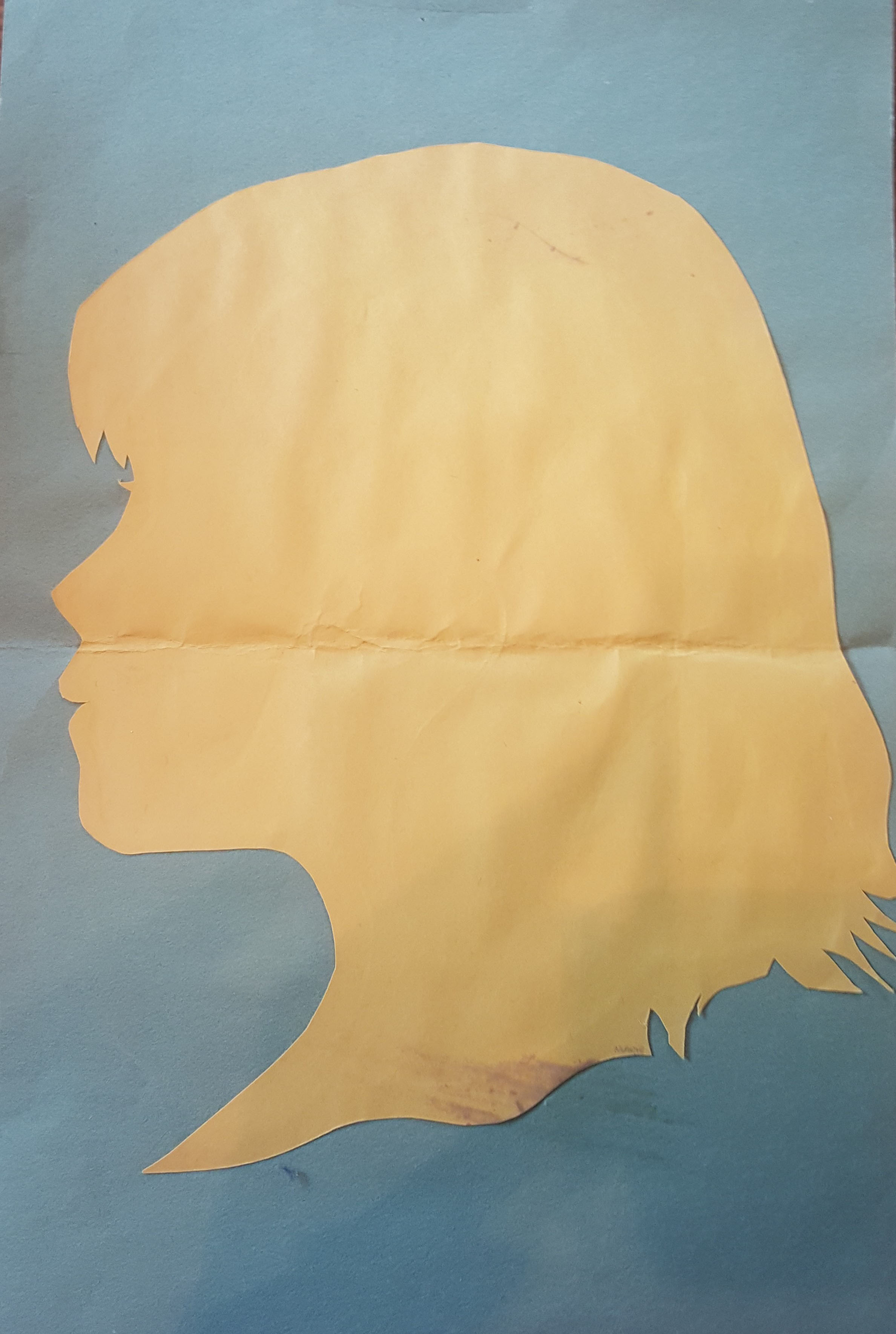
Another schoolwork bag find: my shadow portrait from sixth grade.

Another schoolwork bag find: my shadow portrait from sixth grade.

Marie, 16, died today after saving five girls from drowning. She was lifeguarding at the YWCA girl’s camp, Camp Wanakiwin. The girls were having trouble swimming to shore from an airplane that crashed in the lake near the camp.

Said one of the rescued girls, “She was going back to the plane to get a sixth girl when the plane blew up.”

Marie had completed her sophomore year at (specific school name deleted to protect the innocent). Her anatomy teacher said that she was witty and smart. “I used to give her a hard time,” he said. “Her presence will be sorely missed in school.”

Marie was one of the top swimmers and cross-country skiers at (school name), holding the city titles for 100-yard breaststroke and girl’s senior high cross-country skiing.

The funeral will be held at First United Methodist Church, 10 a.m., this Wednesday.

I’m sure I wrote the story tongue-in-cheek (delusions of grandeur, much?!), but it gives a glimpse into the things that were important to me at the time: mainly, my lifeguarding class and athletics. My anatomy teacher was my favorite because he was always cracking jokes and made learning fun. And what better way to leave this world than in an effort to help others, combined with a big explosion!

Later, after I became a mother and wrote a relative’s obituary, I wrote a serious obituary about myself. Motherhood and my relative’s death reminded me of my mortality, and the journalist in me wanted to know that the last words written about me would be somewhat accurate. That obituary has been lost to the winds of time, but I recall it focused on my career and role as a mother.

Lately I’ve been considering taking a stab at another one. Not to be morbid, but because I’m not sure that my kids or relatives know enough to do it justice. I mean, think about it. Good obituary writing is an art. And for some people, it’s the only time they’ll ever get in the newspaper other than their birth announcement. I’d really rather have my obituary say more than I liked knitting and was a good speller.

I’ve saved a couple of friends’ obituaries I thought were well written. But I suppose that even after I rewrite mine, I’ll have to update it — sort of like a resume or a will. Things change the longer you live. Accomplishments that were important to you in high school no longer matter as much when you’re in your fifties.

From my past efforts I know that writing your own obituary causes you to take stock of life. It makes you ask: Is what I’m doing really important? (To yourself or to society.) Is this how I want to be remembered? Do I need to change something?

Who will write your obituary after you die? Do you think they’ll get it right? Does it matter or is it all vanity? It’s something to consider.

Afternoon in the Museum – Finger Weaving with Dennis White

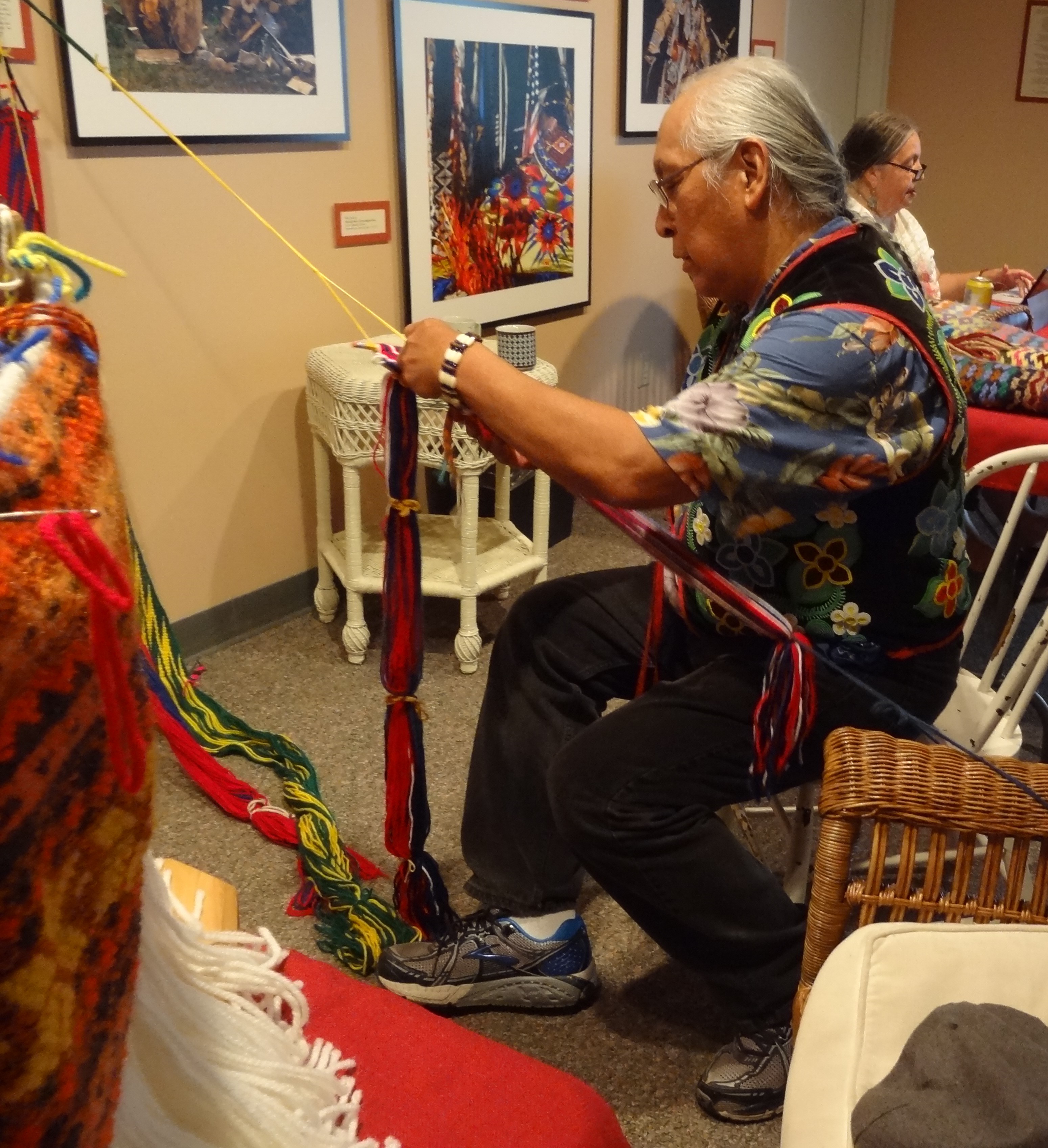
Dennis White demonstrates finger weaving in the LaPointe Museum.

Dennis White demonstrates finger weaving in the La Pointe Museum.

Last weekend I had the chance to revisit Madeline Island in Lake Superior – my latest island love. This time I brought my family along and was able to spend more than an hour on the island – more like five hours – but it still wasn’t enough!

The most noteworthy experience was a visit to the museum in La Pointe, the town on the island. The museum is a compendium of historic and modern buildings. Although the dusty artifacts were interesting, the coolest thing was an actual live human being named Dennis White. He was demonstrating finger weaving, a Native American craft.

Finger weaving is new to me. Dennis explained it’s like weaving without a loom. He described two methods to us, one that uses a single stick as a frame for the weaving and another that uses the doubly complicated equipment of two sticks. For the two-stick method, Dennis had some custom-made wooden frames, but explained that a person could just as easily poke two sticks into the ground for the same effect. I loved that the technique was so primitive and portable.

He weaves sashes for ceremonial purposes, bags, and small pouches that people are now commandeering to carry their cell phones. To allay the boredom that can come from working on a single design, Dennis usually works on multiple weaving projects at a time (eight or more). It takes him about 10 hours to weave a sash. The longest amount of time he spent on a project was 100 hours.

Dennis is an Ojibway from Hayward in northern Wisconsin. He’s so accomplished at his craft that he was invited to do an artist’s residency at the Smithsonian Institute. One of his weavings is featured in the Tweed Museum of Art in Duluth. Dennis also has a master’s degree in mathematics and is a retired math teacher.

We got into a philosophical conversation about the links between math and art, and how people with a talent for one of these things often possess a talent for the other. I wish I could better remember his words. In any event, they were deep and true. Just from our short exchange I could tell he was kind, wise, patient, and proud of his heritage. His sense of humor was delightful, too.

An elementary school art teacher happened to be standing next to me during our conversation and told me she hopes to invite Dennis to her class someday. I get warm fuzzies knowing that this chance encounter could lead to young minds being instructed and inspired in an ancient craft.

For more information about Dennis, read this story from “On Wisconsin” magazine.

The Neanderthal in Me

Neanderthal image from Wellcome Images, a website operated by Wellcome Trust, a global charitable foundation based in the United Kingdom.

Neanderthal image from Wellcome Images, a website operated by Wellcome Trust, a global charitable foundation based in the United Kingdom.

I figure a birthday is a perfect excuse to discover more about myself, so I sent my spit in the mail to 23andMe, a company that tests DNA. Each person’s DNA contains 23 pairs of chromosomes, thus the company’s name. And if you order one DNA test kit, you can get additional kits at a discount, so I requested one for my son, too.

Although several companies provide personal DNA testing, I’ve been watching this company for a while. They first came to my attention when I worked for a major medical center and one of the founders gave a presentation there. Back then, their DNA test cost too much for me: $500. But now the price is only around $100.

The doctors at this major medical center (which shall remain nameless) expressed concern that 23andMe was providing medical genetics results but no genetics counseling. They thought it was irresponsible to give people possibly alarming information without giving them a means to interpret it.

Turns out, the U.S. Food and Drug Administration thought the same thing in 2013, prompting the company to no longer provide medical results. Instead, they have limited their offerings to ancestry DNA and, as an exciting added bonus, you can discover if you have any Neanderthal DNA lurking in your family tree. If you wish to share your information with others who have used the service, there’s also the chance you could find relatives you didn’t know you had. And you can participate in research surveys.

So my son and I sent our saliva samples off. The company said it could take six weeks for results, but we started receiving ours in about two weeks. I’m still waiting for the final round of info, but here’s what I’ve learned so far:

  • I have more Neanderthal DNA in me than 66% of the population. Most people of European descent have a smidgeon of Neanderthal DNA, a relic of when our ancestors migrated out of Africa and mixed with the Neanderthals living on what eventually became the European Continent. My son has more caveman DNA than 98% of the rest of the population. Hmmm, what does that say about my ex? (Smirk.) And if you’re really enthused about your inner Neanderthal, you can buy a T-shirt on the company’s website proclaiming your Neanderthal DNA percentage.
  • There were rumors of Native American blood on my mom’s side of the family, and this test confirmed it. There’s not as much Native American DNA in my genes as we thought, but it’s fun to know that its there. There’s even a tinier bit of Middle Eastern DNA in me.
  • The biggest chunk of my ancestry is from English/Irish/Scottish stock. This must be why I feel I have a Gaelic soul (see previous blog post about this). The next largest chunk is German/French. A tiny bit of Scandinavian rounds it out.
  • Singer/author Jimmy Buffet (who is Wastin’ Away Again in Margaritaville) is a distant relative on my mom’s side. I hear he has a thing for islands. I am an isle-o-phile, too. Maybe it’s in our genes. (I also like margaritas!)

As I am a bit of a science nerd, this was all very fun to learn.  I hope that someday the company will be able to provide medical DNA results again. I gave them permission to store my sample in hopes that they can test it later for this purpose.

Yes, it is rather scary that this company now has genetic information on gobs of people, and although customers can sign off on how much of that info they are willing to share, in the end, the company has it and could do whatever they wanted, I guess. In my case, curiosity won out over paranoia.

Mother’s Day is coming up. Maybe dear old mom would like to embrace her inner Neanderthal?

Yo, Dorcas!

Some of my female ancestors.

Some of my female ancestors.

My ancestors had weird names. I was looking through a genealogy book for my mom’s side of the family recently, and came upon gems like “Experience.” Actually, there are several “Experience”s, and they were women who lived in the 1700s. Tell me, how can you make a nickname out of “Experience?” Spiery? Expy? It just doesn’t work. Maybe they didn’t use nicknames in the 1700s.

I know that names of virtuous traits were popular then – such as Prudence, Virtue, Hope, but Experience? Maybe it meant the opposite of Chastity? (Smirk)

Then there was Dorcas. And there are several of those poor women in my tree from the 1600s and 1700s. The name connotes whiffs of Dork and Doofus. I was so curious and disturbed by this name that I had to look up its meaning on several baby name websites.

One said: Dorcas — Derived from the Greek dorkas (gazelle). The name was borne by a Christian woman of Joppa who devoted herself to works of charity. She was raised from the dead by the Apostle Peter and converted many to Christianity.

Another said the name was used in America. The Aramaic version is “Tabitha” and that it means gazelle. In the bible, Dorcas was called Tabitha by the Jews.

Personally, I like Tabitha better, too.

With names like Ephraim, Menzies and Ruben, my male ancestors didn’t fare much better. There’s even an Ebenezer.

I suppose in the far future, should I be so lucky to still have descendants, they can laugh at my name, Marie. The urban dictionary (my favorite dictionary!) says it’s the French version of Mary. It’s a universal middle name. Also that it’s “the name for that irresistibly mysterious girl whom you see around often, yet know nothing about. An outrageously cute spontaneous person. Lovable, extremely intelligent, and slightly eccentric. Often resembling a nymph of sorts. Beautiful and trustworthy.”

Yeah, a nymph. That’s me! Actually, my mother told me I was named after a Catholic nun who took care of her when she was in the hospital having me. Sister Marie later left the order. Maybe because she was such a nymph.