My husband’s nickname is Russell Brussel. He has a fondness, some might call it an obsession, with Brussels sprouts. We were cooking supper the other night: caramelized Brussels sprouts pasta with toasted chickpeas – a great vegetarian meal that we’ve cooked before – and I noticed a curious thing. The day was warm, so we had the kitchen windows open. Gradually, gobs of large black flies collected on the screens. They not only collected, they swarmed. In a spontaneous, miniature airshow, they divebombed the screens, as if trying to get inside.
Curious about whether this was happening elsewhere around the house, I checked other windows. No. The phenomenon was only happening at the kitchen windows. Thank god for the screens or we would have had an invasion on our hands!
We were busy cooking and then eating, so I didn’t think much more about it, although I noticed that the flies dispersed once the cooking was done.
The next morning, I did an internet search about whether flies are attracted to the smell of cooking Brussels sprouts. As you can probably guess, YES, they are!
Here’s why:
Odor Amplification:
Cooking can intensify the smells of food, making them more noticeable to flies, which have a highly developed sense of smell.
Volatile Compounds:
When heated, Brussels sprouts release various volatile organic compounds, some of which might be similar to those produced during decomposition, a known fly attractant.
Opportunistic Feeders:
Flies are attracted to a variety of food sources, including those that are decaying or decomposing.
The process of cooking, especially when done with heat, can amplify the odors of food and make them more appealing to flies. Brussels sprouts, like other vegetables, can release volatile compounds when cooked that are similar to those found in decaying organic matter, which is a common attractant for flies. This is due to the presence of methyl eugenol, which is also found in other fruits and vegetables such as cherries, raspberries, and basil. When this compound is present in high concentrations, it can be intoxicating to flies and other insects.
Now you know! Plus the next time we have Brussels sprouts I can joke to Russ that he’s cooking carrion again.
My home on the shores of Lake Superior in Duluth, Minnesota, lies next to a large and wild city park. We’re often blessed by visits from local wildlife. While I was on a walk earlier this week, I learned a new bear story from one of my neighbors, and it reminded me of two other stories about neighborhood bears.
The story my neighbor told me happened years ago at the house next to mine. The incident involved honey, a black bear, and guns. Warning: things do not end well for the bear.
My neighbor said that the event even got written up in the newspaper, so when I returned home, I began a search. I found it! The headline from the Sept. 25, 1958, Duluth News Tribune reads: “Honey-Loving Bear Killed. Elaborate Trap Ends Bee Hive [sic] Raids.”
Ole Martinson used to live in the house next door. He was a beekeeper and had several hives. Oak trees also grace the yard, and bears are drawn to the acorns. That fall, a 250-pound bear was bulking up for winter and raided the hives. Martinson complained to his neighbors, who decided to help him with his plight. The article says that the residents, “had fired about 15 shots at the bear in three days, but never were successful in hitting the animal.”
Can you image people discharging firearms within city limits like that now? (Currently in Minnesota, it’s illegal to discharge a firearm within 500 feet of a dwelling or occupied building unless you have written permission from the owner or occupant.)
After the unsuccessful hunt, a policeman who lived at the end of the road (Royce Hanna), and another neighbor concocted a plan with Martinson. They strung a line of light bulbs from a garage to a field and a lookout was posted to whistle when the bear approached in the night. The whistle was the signal for the lights to be switched on.
According to my neighbor, who witnessed the event, the first night they tried this scheme, the lookout mistook moonlight glinting off the lightbulbs for the bear’s eyes and Hanna shot out a lightbulb instead of a bear. (Apparently, they didn’t turn the lights on before Hanna shot!)
The second night, the bear walked into the trap “with 35 to 40 spectators hidden nearby. . . Someone whistled at the right time, the lights flashed on and Hanna opened fire. The policeman’s first shot wounded the bear. His second killed the animal.”
My neighbor told me that Hanna almost lost his job because he had called in sick that day and then his boss read about it in the newspaper. I guess the lesson is, don’t give interviews to newspaper reporters when you’re supposed to be sick! He also said that someone else in the neighborhood had skinned the bear and kept the hide.
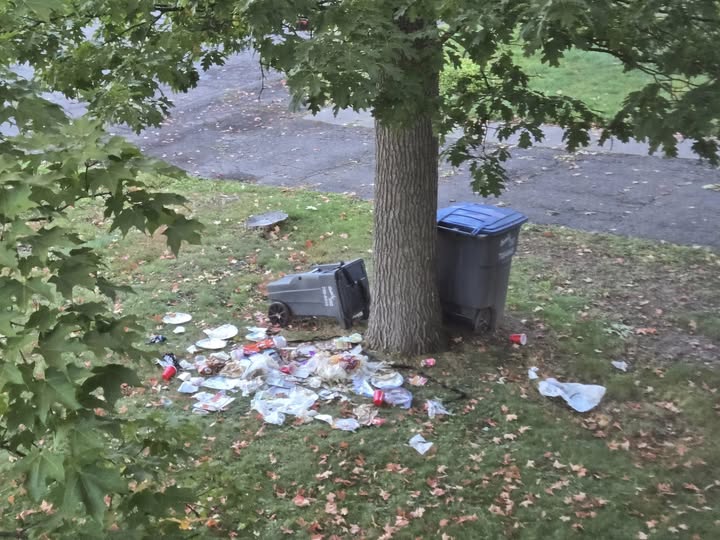
The second story happened last fall. The people who now live in Martinson’s house had multiple bear raids on their garbage can, which they unwisely left outside all the time. I could tell the culprit was a bear by the scat left behind. Have you ever seen bear scat? It can look like a pile of chocolate soft serve ice cream in a pile as large as a dinner plate, depending on the size of the bear.
To deter the animal, they rigged the garbage can lid with straps to hold it down, plus tied the container to a tree in their yard. I just laughed when I saw this. Like a few little straps would deter a huge bear! Here’s a photo of what their container looked like the next morning.
Score one for the bear! After this, my neighbors cleaned out their garage enough that they could fit their garbage and recycling containers in it. I’m not sure why they didn’t do that in the first place. Must be slow learners. Or maybe they thought it was only a racoon.
Anyway, knowing that the house next door has been a bear target for years is sort of fun. At least this time, the bear got away with its life.
The third story happened in my own back yard about fifteen years ago. We were eating breakfast when we noticed the bear. My former husband was so excited, he burst out of the house clutching some doughnuts AND RAN TOWARD THE BEAR. I ran after him, asking what he was doing. “I want to feed the bear!” he said. I must mention that my former husband was from Russia. I guess that’s just what they do.
The bear took one look at this crazy Russian running toward him and promptly turned tail. He climbed a tree in a yard a few houses away. Disappointed, my husband left the doughnuts at the base of the tree for the bear once he climbed down.
I don’t recall if the bear ever ate the doughnuts, but this story was forever cemented in the annals of family history. Remember that time your dad chased a bear?
I ordered my son a Lego “toy” for Christmas last year. At 25, he’s not a kid anymore, but he has fond memories of putting Legos together in Christmases past. The Lego was a design of the universe with a “you are here” pointer.
That must be how I got back on the Lego mailing list. I received their catalog in the mail last month and noticed it featured some Christmas decorations that could be made from Legos. Russ and I like to put together puzzles in winter. This would be like a three-dimensional puzzle.
How fun! I thought. What a cool holiday activity that we could do. Plus, the grandkids will love seeing it.
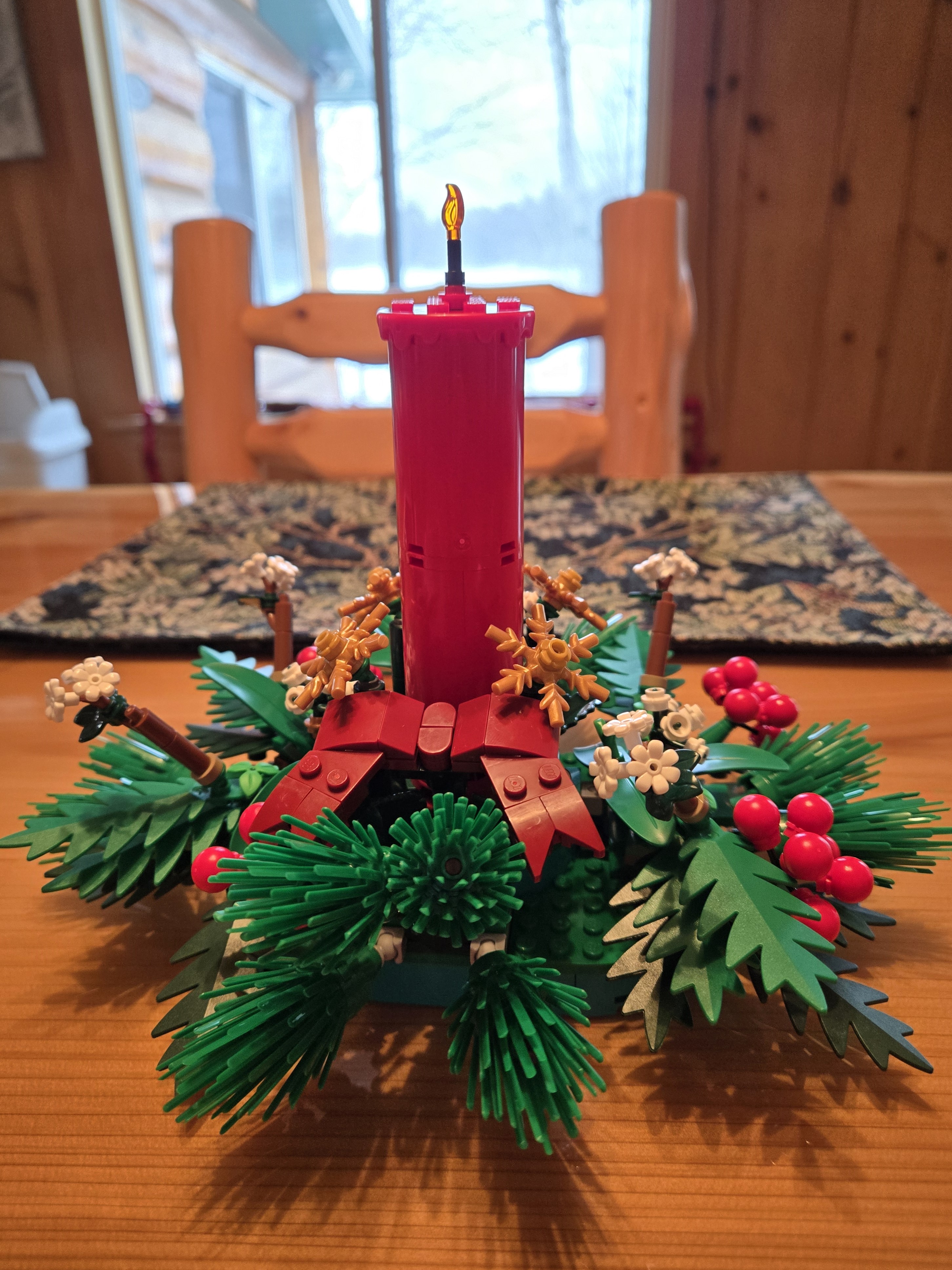
I ordered a table decoration that looks like a red candle with a pine wreath around it. It arrived just fine. Russ and I waited until the weekend after Thanksgiving to begin working on it. (I’m one of those people who rails against the encroachment of Christmas on Thanksgiving, so there’s no way we would have done it sooner.)
We started it late one evening when we were already tired, so only made it a few pages into the instructions before we stopped. It was fun. As we built it, I marveled at this engineering feat that would soon turn into a Christmas decoration. We decided to save the rest for the next day when we had more time and energy.
This was where the going got tough.
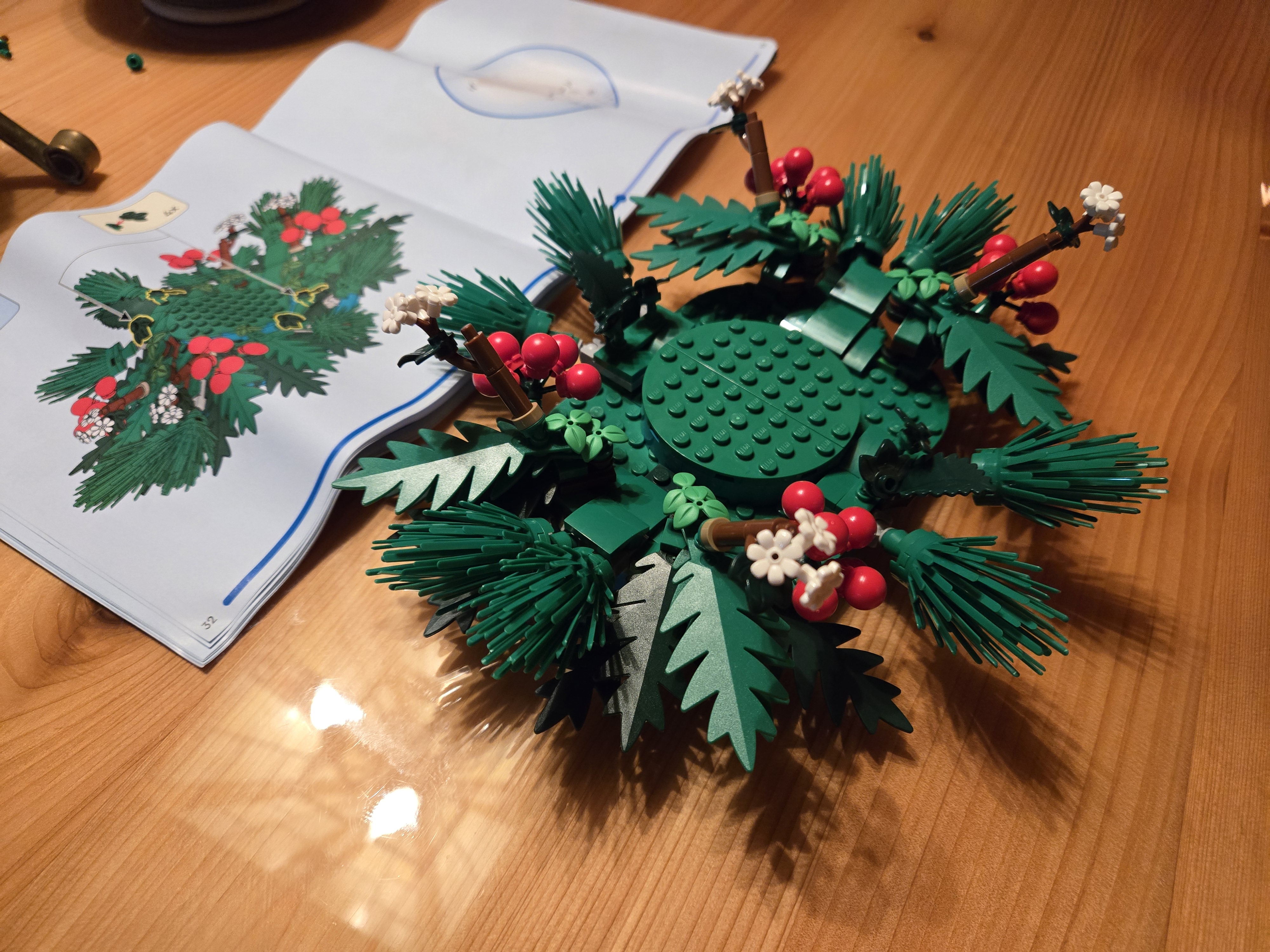
The next day, building the Lego was fun up until we realized it was built for people with smaller fingers and better eyes than we have. There came one point when every time we added a new element, another one (or two, or three) would fall off. Before long, much festive swearing ensued as our frustration mounted. Oh, and did I tell you the Lego was rated for ages twelve and up? We had to stop working on it to avoid violence. (To the Lego, not to each other.)
The next day, we carefully and slowly approached the Lego decoration again. It was looking nice, but we dared not touch it for fear something would fall off. We did have more mishaps of that sort, but not as many as the day before. Still, at one point I had to excuse myself because I was getting too frustrated. Russ worked on it by himself (he’s much more patient than I) and made good progress. By the time I dared return, we were working mostly on the candle, which was much easier than the foliage and the berries. We ended up needing to make some modifications to the parts so that the candle would fit properly but finally, after three days, we finished!
Much rejoicing ensued, but we were careful not to touch the decoration for fear it would collapse in a heap. I’m thinking we might need to cover it with a glass case so that the grandkids don’t touch it when they visit. 😊
Russ brought up the idea of taking it all apart once the holidays are over so that we could try to build it “properly” next year. I told him there’s no way I’m building that thing again. Besides, I’m pretty sure we followed the directions correctly. Maybe we should just coat it in superglue so that it will last for a few years . . ?
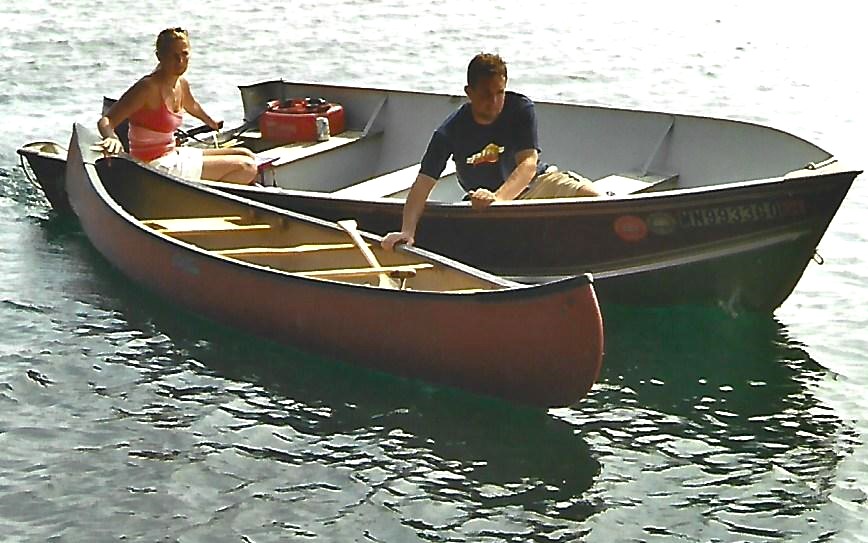
Me and my boys in our Old Town canoe, Clearwater Lake. Photo by Sharon Moen.
It was August 2003 and my friend Sharon and I decided it would be fun to do a mother/children canoe trip in Minnesota’s Boundary Waters Canoe Area Wilderness. At the time, my boys Hunter (4 yrs) and Logan (11 yrs) had been camping but I don’t think they’d been in the wilderness yet.
We planned to stay on Clearwater Lake, which I became familiar with years ago when I was a volunteer wilderness trail crew member for the Forest Service. I had fond memories of the clear water and impressive rock ledges on the campsites there. I used to work for the Forest Service and had been in the wilderness many times, so I was quite comfortable taking my children there in our red Old Town canoe without their dad.
Marie, Hunter, and Logan. Photo by Sharon Moen
Sharon brought along her two girls, Sierra and Savannah, and their dog. I can’t recall exactly how many days we camped – maybe two or three. The weather was great, and the water was warm enough for swimming. A submerged log lay not far offshore from our campsite and provided endless hours of entertainment for our children as they swam. They could stand and bounce on it, which made it seem like a wilderness theme park ride. A downed tree near our campsite also fascinated them.
Marie camp cooking. Photo by Sharon Moen
We spent evenings around the fire regaling each other with tales of our wilderness exploits and prowess. One afternoon, we decided to canoe to a campsite farther down the lake that I recalled was a good fishing spot. A large rock ledge with a deep drop off was also the perfect place for a picnic lunch. We beached our canoes on the small sandy beach at the empty campsite and the festivities commenced.
Sharon about to help Logan unhook his fish.
Later, Logan caught a fish. As Sharon was trying to unhook it for him, the hook went into her finger. I performed minor surgery to get the hook out and all was well. That was, until I noticed a red canoe floating across the lake.
“Huh, that canoe looks the same as mine,” I said to Sharon.
She looked at the beach where her canoe sat all by itself. “That IS your canoe!” she said.
What I, Miss Wilderness Expert, didn’t count on was the wind switching. Part of my canoe had still been in the water, enough so that it floated away.
I panicked. Losing a canoe in the wilderness is like losing your car in the city; maybe worse than losing your car because there’s no public transportation in the wilderness. I was ready to swim out and grab it. I’m not sure why I didn’t think of paddling to it in Sharon’s canoe with one of my children and having them hold onto the canoe so we could tow it back. Anyway, swimming was what made sense at the time. And time was of the essence before the canoe drifted farther away.
I was ready to jump into the lake when a couple in a motorboat happened by. Although motors are not allowed in most of the wilderness, there are a few lakes like Clearwater where they are allowed. I think it’s because there’s a resort on this lake.
“That your canoe?” One of them asked. When we responded in the affirmative, they followed up with: “Want us to get it?”
That earned an enthusiastic “Yes, please!”
Helpful motorboaters return my canoe. Photo by Sharon Moen
They grabbed the canoe, no problem, and brought it back to us. We thanked them profusely and I made sure that sucker was totally out of the water when I beached it this time.
Over the years, Sharon has made sure I don’t forget this incident. We trotted it out just last week when having lunch with a new coworker who wanted to know how long we’d been friends.
Although it was incredibly embarrassing at the time, losing my canoe was a good lesson about not getting too complacent in the wilderness or in life. You never know when the wind might switch.
Northern pike illustration by Virgil Beck, courtesy of the Wisconsin Dept. of Natural Resources.
If you’ve watched Disney’s “Finding Nemo” movie, you probably recall the scene where Bruce, the ravenous great white shark pledges to curb his natural impulses as a way to improve the reputation of sharks. “Fish are friends, not food,” he says during a mock Alcoholics Anonymous meeting undersea.
That line runs through my head whenever anyone asks me if I fish in the lake at my cabin.
I tried fishing there once, a couple of years ago. I dug out my angling gear, which hadn’t been used in years. As a child, I enjoyed fishing, once I got over my squeamishness at impaling angleworms on hooks and handling the sunfish I caught. I thought it might be fun to resurrect this pastime.
I asked Russ if he wanted to fish. His answer was short and definitive: “No.” Then he added, “And don’t come running to me if you can’t get the hook out of the fish’s mouth.”
Oh well, more fish for me! I bought a fishing license online. Then I set up a chair at the end of the dock, tied on a rubbery lure impregnated with fish scent, and began casting.
Not long afterward, I caught a long, skinny northern pike. These fish have a lot of teeth. They’re voracious eaters and are considered an undesirable invasive species in the western U.S. Since this one was too small to eat (and pike are supposedly full of bones, as well) I gingerly picked the fish up to unhook it, intending to throw it back.
I’d hooked it well. I couldn’t get it out though just using my hands. Now, most experienced anglers have a pliers in their fishing tackle box. I was just getting re-started, so I hadn’t quite got that far in my preparations.
I carefully laid the fish on the dock planks and scurried into the boat house, looking for a pliers. I couldn’t find one, so I went back to the dock and put the fish back into the water, securing my pole so the pike couldn’t swim away.
I ran into the cabin and asked Russ if he had a pliers in his toolbox. Grumbling a bit, perhaps shaking his head, he retrieved the tool for me. I ran back to the dock, fishing the fish out of the water. I began to work on the hook again. It was stuck into the fish’s mouth at such a weird angle, I couldn’t get a good grip.
At this point, I was getting stressed out. I felt urgency to release the fish back into the water so that it could survive being hooked, and I knew that messing with it so ineffectually was probably stressing out the fish, too.
I worked on the pike a few more minutes and then put it back into the water. I realized I was going to have to break my promise to Russ. The life of this watery being depended upon it.
I ran back into the cabin. “Russ, please, you’ve gotta come help. I caught a pike and I can’t get the hook out. It’s stuck in this weird angle and I just can’t do it.”
Bless his reluctant heart, Russ took pity on me, or perhaps he took pity on the fish. He sauntered down to the dock, picked up the fish, and with a single flick of his wrist, dislodged the hook.
I stared, dumbfounded, as the fish swam away into the murky depths.
To this day, I don’t understand how Russ unhooked the fish so easily. It must be a Man Thing.
My return to fishing was not fun. I decided it was too stressful to continue. I tell this story about Russ and the hook whenever anyone asks me whether I fish.
I’ve realized I’d rather be like another Minnesota woman I saw on the television news. She feeds the sunfish that gather underneath her dock, even forming a five-year friendship with one of them. The fish follows her when she swims. She dislodged a hook from its mouth once after someone tried unsuccessfully to catch it.
That’s more in my nature. I want to be like her. The television woman digs up worms, which she no doubt cuts up for the fish. I don’t think I can do that, but I can buy some commercial fish food pellets and see if those will work. I used to take care of a tank of sunfish in a Forest Service reception office where I worked, and they ate pellets just fine.
That’s going to be my project come ice-out this spring.
I received a text from my trash and recycling company the other day, telling me their schedule had changed for the week due to the New Year holiday. From nowhere, a motto popped into my head: “We’re at your disposal.”
If you own a trash company and need a motto, please feel free to use this one. 😊
This does not look like a dead butt to me. Photo by Oleg Melevych on Pexels.com
I recently learned there’s such a thing as “gluteal amnesia.” Have you ever heard of that? I hadn’t.
It’s a condition caused by our society’s sedentary lifestyle – literally by sitting on your butt too much. Also known as “dead butt syndrome,” gluteal amnesia happens when your gluteus maximus muscles (the major muscles that make up your butt) lose their ability to contract naturally. There are different theories about why being sedentary causes this to happen, but it does seem to happen to some unfortunate individuals.
Having a dead butt can cause lower back problems and sometimes pain that resembles sciatica. Also, it can give you a saggy butt. Oh no!
To compensate, a person can do exercises, among them squats, hip thrusts, and bridges. Experts say that with proper treatment and exercise, there is hope for resurrecting dead butts.
According to Self Magazine and Healthline, the condition can even impact people who exercise regularly if they sit a lot when they don’t exercise. Suggestions for preventing it include breaking up time sitting with walks and stair climbing.
Rest assured, my butt is just fine, thank you, especially since I began kick boxing workouts. But now you can say you learned something today.
The Wisconsin State Capitol as seen from Lake Mendota.
May seemed the month for me to meander around Wisconsin. My communications group at Wisconsin Sea Grant goes on an annual field trip to familiarize ourselves with projects that our water research program works on and the researchers who we fund.
Although most of our staff is in Madison, Wisconsin, this year, we chose that locale for our field trip because we have several new staff members. This was especially useful to me, who works far away in northern Wisconsin.
One of our activities during the two days in late May was a pontoon boat ride on Lake Mendota. This is the lake where the University of Wisconsin-Madison is located, and Sea Grant has funded many research projects in and upon it. I had never been on the lake before, so I was looking forward to the ride. I know, I have such a tough job if I get paid to go on a boat tour!
Our videographer, Bonnie, arranged for the rental. She thought she would be able to drive the pontoon. But when we arrived, the staff said she was too young and that she had not taken a required boater safety course, so someone else who was older needed to drive the craft.
Captain Sarah at the wheel!
In stepped Sarah, our graphic designer. She had never piloted a pontoon boat before, but she had experience sailing, so we figured she was the next best thing. I could have possibly done it, too, but was happy not to have the responsibility since I am unfamiliar with the lake.
After Sarah’s short orientation to the pontoon’s operation, we motored off around the lake on a two-hour tour. Viewing how homeowners dealt with erosion in contrast to more natural areas around the lake led to interesting conversations among us.
When we were about a quarter of the way around the lake, a siren sounded. Everyone else on the boat seemed to know that this meant “get off the water!” We were near the university docks, so Sarah headed there. The problem is, she had never docked a pontoon boat before. She recalled from reading the orientation instructions that docking was the most dangerous part of operating the craft.
Understandably, she was wary. She thought maybe we could circle near the docks until the “all-clear” siren was sounded. In the meantime, the wind picked up and rain began to fall. Then came lightning. Sarah and Bonnie checked their phones. Both had received calls from the rental agency, telling them to get the pontoon off the lake.
After her third circle near the docks, Sarah gained enough confidence (or perhaps she was just worried enough) to try and dock the pontoon. She told us which side she planned to dock on, so we deployed the fenders and I organized everyone regarding who would throw ropes and who would jump onto the dock to catch them.
The only problem was that the wind was blowing with gusto by this time. Sarah’s plan to dock us on the left side quickly turned into a plan to dock us on the right side as the wind blew us in that direction. We adjusted on the fly and jumped out onto the right dock.
Stormwater gushes out into Lake Mendota underneath the college’s mascot, Bucky Badger. Note the mallard headed into the stream.
We secured the pontoon and stayed docked for at least a half hour. Rain poured down as the five of us huddled under its canvas roof. A brown plume of stormwater erupted from a nearby storm drain, carrying with it a red baseball batter’s helmet and assorted flotsam that the local mallard ducks surged toward, finding it irresistible. Gross!
Shortly, we discovered that rain leaked through the roof’s zipper, but that was easy enough to avoid. We thought of running through the rain into the shelter of the student union, but the surety of getting wet outweighed the danger of being on the water in a metal structure. Perhaps not so bright, but there were two other pontoons of people who had docked near us, and they were also waiting out the storm on their boats.
While rain poured down and thunder roared on our side of the lake, the pontoon rental people called Sarah and told her it was all clear and that we could go back on the lake. We were like, no way! We waited out the storm another half-hour.
Our unscheduled team-building exercise wasn‘t all terror. We saw this picturesque sail boat before the storm. Note the gathering clouds.
When it seemed like the storm was over, we hightailed it back to the rental place because we were overdue. Bonnie and our boss, Moira, were sitting in the front of the boat and the rest of us were under the canopy. Bonnie had a cap on. Moira didn’t, and she noted with some amusement that her long hair was standing on end.
I wasn’t sure if this phenomenon was due to the wind or some less friendly element, but it’s obvious there must have been electricity in the air. Bonnie didn’t notice it happening to herself because of her cap.
Capn Sarah quietly checked her weather app and gunned the motor. Eventually, Moira’s hair deflated, and we made it back to the rental center intact. Our two-hour tour had turned into a three-hour tour due to weather, but we weren’t charged any extra due to this “act of God.”
Later, at dinner, I looked on the internet to see what it means “when your hair stands on end when you’re in a boat on water.” The entry stated, simply and plainly: You will be struck by lightning!
When I shared this with my colleagues, we all felt lucky to have survived the tour unscathed. Sarah admitted that when she had checked her weather app while Moira’s hair stood on end, it had shown lightning in our vicinity.
After more conversation, it slowly dawned on me that, although I had no hand in organizing the pontoon ride or piloting the craft, my coworkers unanimously blamed me for our misadventure.
Why? Because, as we were about to board the pontoon, I was singing the theme song to Gilligan’s Island. And I MAY have mentioned something about a three-hour tour.
I’m reading “David Copperfield” by Charles Dickens in preparation for reading this year’s Pulitzer Prize-winning novel, “Demon Copperhead” by Barbara Kingsolver. Although it’s not a requirement to be familiar with Copperfield before reading Copperhead, the latter is based on former so I figure it can’t hurt.
Given my blog’s name, imagine my delight when, in the opening of Copperfield, I found a short treatise on meandering. David Copperfield was born with a caul (amniotic sack) around him. Back in the day, cauls were thought to have mystical properties, one of which was to protect whoever possessed it from death by drowning. They had value. David’s family sold the caul in a raffle. It was won by an old lady who died triumphantly in her bed years later at the age of 92. She was triumphant because she did not drown. But drowning would have been difficult for her even without a caul since she never went in or near the water except to cross a bridge.
Copperfield says, “Over her tea, to which she was extremely partial, she, to the last, expressed her indignation at the impiety of mariners and others who had the presumption to go ‘meandering’ about the world. It was in vain to represent to her that some conveniences, tea perhaps included, resulted from this objectionable practice. She always returned with greater emphasis and with and an instinctive knowledge of the strength of her objection: ‘Let us have no meandering!’”
That made me laugh. Good thing the dear departed lady is not alive to read my blog. She would surely find it objectionable.
I have been doing my share of meandering lately, thus my absence from this blog. I hope to write more soon about my adventures traveling around the state and culture of Wisconsin.
Characters from the series “Sanditon.” Image courtesy of PBS.
In my household, we’ve been watching the Public Broadcasting Service series, “Sanditon.” It’s based on an unfinished novel by Jane Austin – the last of her writings before she died. It’s set in England, of course, with strong and conflicted heroines.
Anyway, a social media announcement for last Sunday’s program said it was time to watch “the penultimate episode of Sanditon!”
I got all excited and told Russ that the best-ever episode of Sanditon was coming up. In our ensuing discussion I discovered that the word “penultimate” does not mean the ultra-ultimate of something like I had been thinking all these decades. Instead, it simply means it’s the next to last episode.
I was so disappointed. Not only because the series is ending and because the episode wasn’t going to be the best-ever, but because I’d been misinterpreting this word for so long. I don’t think I’d ever actually used the word anywhere, but it was a quite a blow to someone who is a writer.
I had fun thinking up a title for this post. Does the title mean this is the second to last mistake I will ever make in my life, or does it mean I am mistaken about the word penultimate? Or does it mean I’ve made the best mistake ever? 😊











 Marie's Meanderings