When Classical Music Goes Bad

switched-on-bach

Image courtesy of Syracuse New Times.

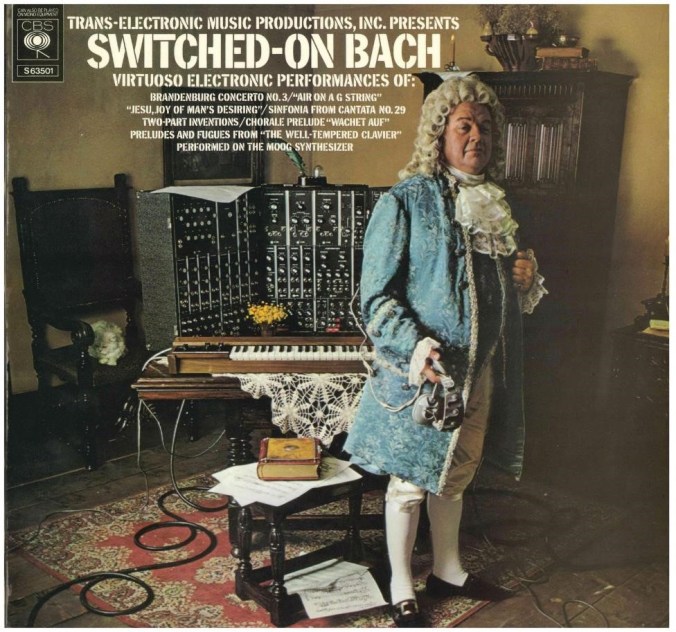
Look what I found in the classical record collection that I inherited from my father.

During the two years since he died, I’ve been listening to my dad’s records whenever I exercise on my elliptical strider at home. It’s a way of getting healthier, figuring out which records I’d like to keep, and remembering him.

I’m about halfway through the stack and probably have another two years to go, unless I start exercising a whole lot more.

As a child, I used to hang out in my dad’s “radio room” when he played music after supper. I remember some of the albums vividly, others not so much.

I don’t recall this album (“Switched-on Bach” played on Moog synthesizers) and somehow don’t think it’s going to make my cut! Although all classical music is retro, this is just a little too retro-techno for me.

I wonder what possessed my father to purchase it? Maybe he thought it was cutting-edge at the time.

According to an article this spring in the Syracuse New Times, “Switched-on Bach” was released in 1968.  It “dropped like a bunker buster on the world of classical music, fostering incredulity and pushback from classical music purists, who considered such treatment to be blasphemous.”

Apparently, those objections were quickly quashed by enthusiasm from younger listeners who were otherwise not interested in classical music. The album vaulted to the top of the classical charts where it remained for 49 weeks. It was honored with three Grammies in 1970: Classical Album of the Year, Best Classical Performance by an Instrument Soloist, and Best Engineered Classical Album.

It even sold one million copies (!) – the first classical album to achieve that status.

*   *    *

Okay, I just listened to it. My judgement hereby is that the music does not stand the test of time despite all the awards it won.

Sorry dad, this one’s going in the rummage sale pile.

My Neighborhood Rezoning War is OVER!

20181113_174853

One of my neighborhood warriors testifies at a planning commission meeting.

We’re having a party in Marie’s Meanderings Blog world tonight. I just returned from a Duluth Planning Commission meeting where the motion to rezone my residential neighborhood for development was denied.

If you’ve been following this issue on my blog and in the news, you know that this is GOOD NEWS for my neighbors and myself.  (See Part 1 and Part 2.)

It’s been a long five-month haul. I went into this latest planning commission meeting feeling downtrodden and doomed because the planning department had changed their original plans to include even more of my neighborhood in the rezoning. They went from impacting only eight or nine houses to over thirty homes!

I was like, WTH? And one of the new homes included in the rezoning was mine. Before, I was just a few houses away from the proposed rezoning area. Back then, I was protesting on behalf of my neighbors who were directly affected. Now, as if in payback for my squawking, my house was included, too.

So I did my due diligence and wrote another letter urging the commission to deny the rezoning plan. One of the arguments I used was that there is already a shortage of affordable single-family homes in our city. Why potentially remove so many of them? I also repeated my previous argument that the neighborhood is a strong, well-functioning community.

When I arrived at the commission chambers, I was heartened to see it full of my neighbors again. Several spoke well-reasoned and impassioned arguments against the plan. I was so proud of them!

Only one person spoke in favor of the plan, and he is a developer who owns property in the neighborhood.

After some strategic moves and hemming and hawing, which made me wonder if the commission really knew what it is doing, the vote was taken. All but one commission member was opposed to the rezoning plan, so it was denied. Everyone applauded, just like we were in a freakin’ movie. (One with a happy ending.)

The reasons the commissioners gave for the denial were that when the plan was developed that recommended rezoning of my neighborhood, it was in a time before many of the current apartment buildings and business existed. They heard us that “enough development is enough.” The commission didn’t feel the neighborhood could sustain more development without even more traffic problems and other issues occurring.

Another reason given was that my neighborhood is a socially strong, well-functioning place. Why fix what isn’t broken? They also were impressed by the numbers of us who turned out to protest the plans and they wanted us to feel like they were listening.

I am so proud of our planning commissioners! I raise a toast to everyone.

I’m glad this is over and sure hope it doesn’t rear its ugly head in another form.

Can a Writer Learn How to Paint?

My creative horizons expanded recently when I used a gift certificate for painting lessons at a local gallery.  “Learn how to paint” is on my list of things to do when I retire, but thanks to this gift, why not get an early start?

My certificate was for the Art on the Rocks Studio, which is located in Duluth’s Canal Park business district. They offer group painting lessons, where everyone paints the same image, or you can arrange for personal lessons.

The idea of a group lesson did not appeal to me. As you all know, I enjoy photography, and have found myself wanting to paint a few of my recent photos. So I arranged for a private lesson. The image I decided to start with is this one I took from my 2016 trip to Scotland. We stayed in an historic fishing village called Crovie. I immediately fell in love with the place and its quaint cottages on a ledge by the sea.

SCOTLAND! 024

I brought a print out of the image with me to the studio. As instructor Chelsey and I sat at our easels and were about to start, she asked when I last sketched. “High school?” I answered.

Chelsey said that was okay. She just wanted to know what she was dealing with.

What she was dealing with is someone who has only used her fingers for typing for many many decades. And the last thing I ever painted was a watercolor scene in high school.

Before I could psyche myself out in an artsy panic, Chelsey started to show me how to organize my canvas and print out into quadrants to figure out what goes where. Easy peasy, right? Yes, actually, it wasn’t that hard. Then we picked up our pencils and drew in the scene.

I had to keep reminding myself that the sketch didn’t need to be elaborate. I’d be covering it up with paint eventually. I just needed a general guide to work with.

That done, we started painting. Chelsey squirted a bunch of acrylic colors onto a paper plate, which served as my fancy palette. She showed me how to mix colors and explained which brush to use to create different effects on the canvas.

We started with the background first, coloring in the sky and the grassy hills. By this time, a group class had arrived and Chelsey needed to flit between them and me. By now, I had mustered some artistic bravado and did not panic at her absence.

After two hours, I needed to leave for another appointment. Chelsey graciously said I could leave my painting there and come back again, which I did the next week.

At the next lesson, she gave me tips for painting the houses and the boat. I finished almost everything during that session except for some nets and flotsam that are next to the boat. This time, I took my painting home to finish.

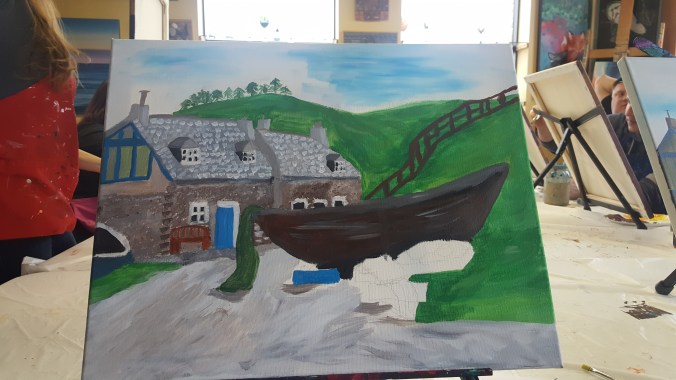
I just need to find some time to buy some brushes and paint and I’ll finish it up and fine-tune the details. Here’s what my painting looks like at this point. It’s painfully elementary, but I’d like to think it’s not too terrible. Who knows, maybe it’s the start of something?!

20181110_144831

Wolf Reintroduction on Isle Royale

ISRO wolves MI tech

The last two resident wolves on Isle Royale National Park. Image courtesy of Michigan Technological University.

People keep asking me what I think about the latest efforts to reintroduce wolves on Isle Royale National Park. I suspect their questioning has something to do with the novel I wrote about the topic. (Do ya think?!)

Well, my novel “Eye of the Wolf” was more about the wolves saving themselves than human efforts to save them. But I wrote it because of my interest in the wolves’ real-life plight: the packs on the island were dying out due to long-term inbreeding and disease. This continued until only two wolves, a male and a female father/daughter combo were left.

My past blog posts about the wolves may have also spurred peoples’ questions. So I suppose I should share my thoughts.

I haven’t done so sooner because my interests have moved on to other endangered animals in the region. Nevertheless, I have been following the wolf reintroduction effort just for old time’s sake, and to see how the real story plays out.

Okay, enough caveats. Here we go.

I wish the National Park Service had waited to reintroduce new wolves until the two resident wolves lived out their lives. My fear is that the new, younger wolves will rip apart the old ones. It just seems disrespectful, and it could look bad for the park service. I can see the headlines now: Resident Isle Royale Wolves Slaughtered by New Wolves.

This fall the park service released four wolves on the island that were captured nearby in Minnesota. Their genetic rescue plan is to release at least 15 (and up to 25) more in the next three years. I just don’t think the old wolves stand a chance.

When this concern was voiced at one of the public meetings I attended about the reintroduction, the park biologist dismissed it, saying the resident wolves know the best hiding places because they’ve lived on the island longer than the newcomers. Somehow, that answer wasn’t comforting.

My other concern is that the new wolves, which are from the Grand Portage Ojibwe Reservation, will leave the island this winter if an ice bridge forms, thus wasting all the effort and taxpayer expense of transporting them there. Research has shown that transplanted wolves do try to find their way back home once they’re released.

I understand that the park service wanted to restock the island with wolves that are used to hunting moose, but I question whether having the first ones come from an area so close to the island is a good idea. It might have been better to get wolves from farther away, especially for these initial efforts. I fear another headline that reads something like: Reintroduced Wolves Leave Island for Home on Ice Bridge.

I also feel bad for the transplanted wolves. They are basically kidnapped from their packs and home territories, and dropped someplace strange on an island in the middle of Lake Superior. Is keeping wolves on Isle Royale worth that kind of disruption? I don’t know. It just seems kind of extreme.

Drugging wolves is also dangerous – one wolf slated for the reintroduction died in the process. [Update on November 13: one of the transplanted wolves was reported dead, cause unknown.] Is keeping wolves on Isle Royale worth that risk? The park service and the wolf researchers obviously think so.

Let me just say that although I’m supportive of reintroducing wolves to the island, I’m not optimistic things will work out as planned. Life and Mother Nature seem to find ways to mess up the best-laid human plans.

The story continues….

Isro female wolf 9-26

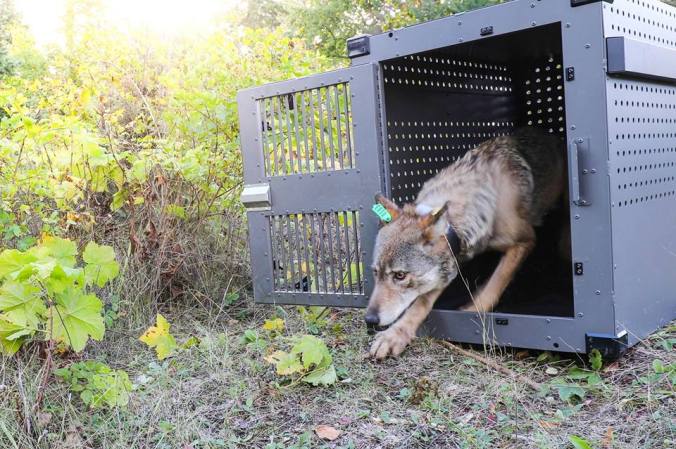
A female wolf — one of the first reintroduced to the island this fall. National Park Service image.

* * *

Update: In early February 2019, one of the wolves reintroduced to the island (the female pictured above) walked back home to Grand Portage, Minn., on an ice bridge that formed on Lake Superior during cold weather. I hate to say it, but one of the headlines I feared happening has come true!

Autonomous Sensory Meridian Response: A Morning TV Breakthough

800px-Molly_Shannon_by_David_Shankbone

Molly Shannon image by David Shankbone.

I owe Molly Shannon (formerly of Saturday Night Live) a fathomless debt of gratitude.

I saw her on Good Morning America the other day. She was being interviewed about her new movie, “A Private Life.” In the beginning, she mentions how she loves being checked and patted down by airport security. It gives her a relaxed, spine-tingling feeling.

This captured my attention because of a blog post I wrote in 2015 about “A Scalp-Tingling Feeling” I get when someone writes on a chalkboard or I’m at a bookselling event and there’s the white noise of peaceful conversation in the background. It zones me out and is very pleasant.

I called it scalp-tingling contentment. Some of my readers called it “flow” or bliss, but thanks to Molly Shannon, I now know the syndrome is more properly defined as ASMR, which stands for Autonomous Sensory Meridian Response.

It’s an actual thing! I’m not crazy! There’s even a Facebook group for it!

People started working in 2007 to define it and by 2010, an organization was founded called the ASMR Group to support people who experience this feeling and to investigate it further.

Wikipedia says that, “ASMR signifies the subjective experience of “low-grade euphoria” characterized by “a combination of positive feelings and a distinct static-like tingling sensation on the skin.” It is most commonly triggered by specific auditory or visual stimuli, and less commonly by intentional attention control.” (Whatever that is.)

It’s amazing what you can learn from morning TV sometimes.

Lean Into Your Fear: Whitewater Rafting on the St. Louis River

pebd794cc-6d1a-4b89-a8a0-43eaca9722a7_c41a24d2-f4b0-4067-a203-838e20a4a2f3_m

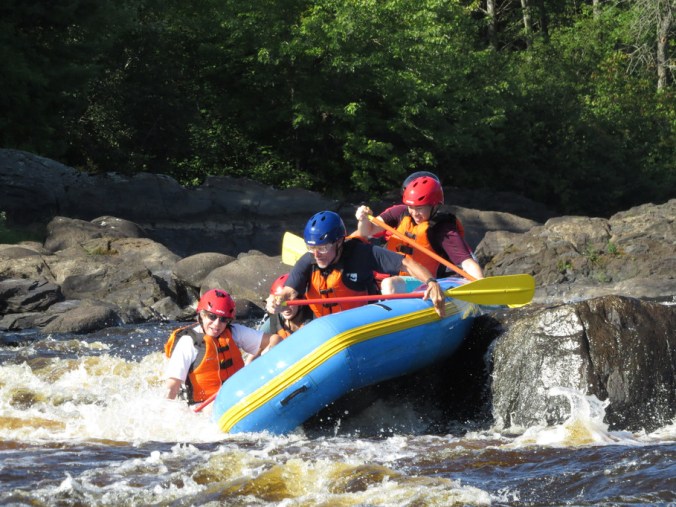
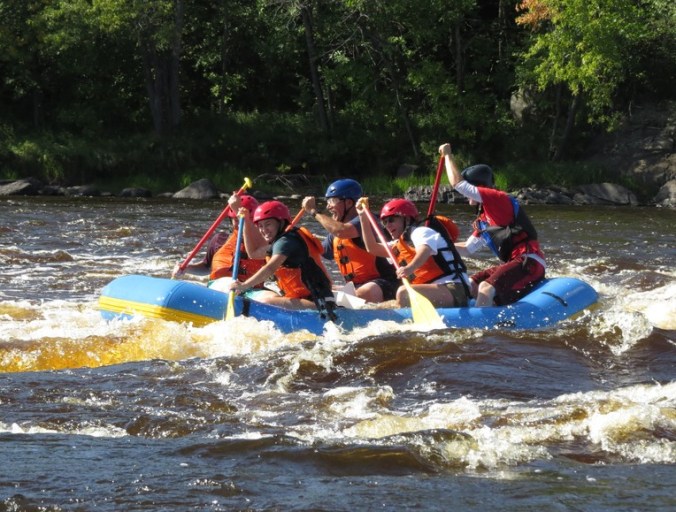
Me (on the left in the red helmet) leaning into my fear on the St. Louis River.

When I write a travel post, because my blog’s name has the word “meander” in it, I usually open by saying I “meandered” here and there.

Well, I can’t use that term this time. It’s more accurate to say that I reluctantly agreed to go on a whitewater rafting trip down the St. Louis River this past weekend, and promised to scream all the way!

It all started when my friend Russ, who is an experienced kayaker, won a silent auction item at a fundraiser for the St. Louis River Alliance a few months ago. He won two tickets for whitewater rafting through Minnesota Whitewater Rafting, a local company that operates out of Scanlon, Minnesota.

Upon my insistence, we agreed to wait for the trip until the water was warm, to make it a more comfortable experience. Now it was August, month of warm weather and water, and I was out of excuses not to go. We gathered everything the company’s information sheet instructed rafters to bring: a dry change of clothes, snug-fitting footwear, windbreaker, towel, etc. And off we went.

Once we arrived, I was surprised by the number of other people who wanted to fling themselves into an inflatable raft at the mercy of the river – twenty-eight of us, to be exact, of all ages and fitness levels.

We started our three-hour journey by choosing one of the seven blue-and-yellow rafts lined up on the shore. Russ and I ended up paired with a young couple from St. Paul. A guide was assigned to each raft. Ours was named Logan.

To us oldsters, all of the guides looked like they were about twelve, but we hoped they knew what they were doing or they wouldn’t have been hired. Thankfully, this proved true!

The ensuing safety talk by the operations guy, named Blu, included instruction to ignore your instincts and “lean into” whatever fearful obstacle the raft encounters. He explained that if you lean away from the rock or high wave, you are more likely to lose your seat and fall out of the raft. Not that falling out of the raft is the worst thing that can happen, but most people like to stay with their group.

The other useful instruction was to keep your feet up if you fall overboard. This is helpful in avoiding sharp rocks and logs, etc., that are on the bottom. Plus, most people aren’t strong enough to withstand the current standing up, so you might as well just go with the flow until one of the kayak patrollers (who go with every trip) retrieve you.

Blu said that in a group our size, it’s common for at least one person to fall overboard. I sure hoped it wouldn’t be me.

I thought the “lean into” rule was particularly deep. Psychologically speaking, sometimes facing your fears is the best way to overcome them. Also, it reminded me of the book “People of the Lie” by M. Scott Peck, who says that most people’s psychological problems arise from trying to avoid emotional pain instead of addressing (leaning into) it.

I decided then and there to change my attitude about the trip – to stop seeing it as something fearful, and instead see it as something to relish, and an opportunity to know the river better. I mean, I’ve lived by it most of my life. I’ve canoed on it, paddleboarded it, boated on it, but I’d never immersed myself in it.

As the company’s website and instruction sheet promised, you will “see the river, feel the river, ride the river,” and you will get wet! On this sunny warm day, I was up for that.

Blu explained we’d encounter six sets of rapids ranging from Class I to III, and two sets of riffles. Each set of rapids would get more challenging along the four-plus-mile stretch until we reached the quiet-water reservoir formed by the Thompson Dam.

Safety talk over, we set out upon the water. Our first task was to run through a “slalom” course between the pylons of the freeway bridge that goes across the river. This let us practice paddling different directions and experience what it feels like when the raft bumps into things.

Then we paddled through a set of riffles called “Warm-Up Rapids.” Everyone came through unscathed and, after stopping for an orientation, we continued to a set of surfing waves at “First Hole” rapids.

Have you ever seen standing waves that form behind an underwater rock in a river? That’s what we surfed on – if your idea of surfing involves your raft filling with water, which ours did. We surfed several times, bailing out between sessions with the handy bailers provided in each raft.

p9091eedc-1216-426c-9429-98f3600b2324_671929cc-bda5-4d31-b3db-2344e2e28a00_m

Surfing the hole and having fun!

After another group orientation session, we were onto “Two Hole” rapids. I think it was this one that had a big rock in the middle of it. Logan, our guide, thought it would be a good and fun idea to smash our raft into the rock.

On purpose.

Why he thought this was a good idea, I’ll never know! I always thought the whole idea of river rafting was to avoid the rocks. I guess I’ve been wrong all this time.

Granted, he did give us a choice, so we were complicit in the decision. I blame it on the adrenaline rush.

Paddling as hard as we could, our raft went up and over the rock, then started sliding sideways. I was on the outside side – the tippiest side – and remembered to lean into the rock to avoid falling out of the raft. I almost floated out, but managed to stay in by the skin of my teeth. Rather like dental surgery, it felt so good once it was over!

Our next stop was a canyon that featured a couple of small beaches in a slow section of the river. We grounded our rafts and had the chance to swim for a while, clothes, lifejackets and all.

Russ went all the way in. I was fine going waist deep, not because I was worried about polluted water or anything, but because the water was rather chilly to me even for a warm day.

At this point I realized I had never been this far into the river before; me—who had even worked for the St. Louis River Alliance whose sole purpose is to protect the river. I marveled at the brown water – tea stained from the many wetland plants steeping at its headwaters and along the way. The white pines and bare rock faces along the shore looked primeval, like we could have been miles into a wilderness. The beauty filled me  and gave me a new sense of appreciation for the river.

Our rest stop over, it was time for the big guns in terms of rapids. We made it through “Hidden Hole” just fine, then it was onto “Electric Ledge,” which is a Class III rapids that consists of a four-to-six-foot drop.

I had heard the name of this rapids whispered in awe among my kayaker friends for years. Now we were about to go over it! And we were about to go over it before any of the others. Logan explained that our raft had the first aid kit in it, and we needed to go first in case the other rafts needed assistance once they ran the ledge.

Not only were we in the first raft, but Russ and I were sitting in the FRONT of the first raft. Oh, lucky us.

We didn’t have much time to wonder at our luck as the ledge was approaching. I repeated all the rules: lean into your fear, keep your feet up. Then we slid over it, sideways and steep. Russ grabbed onto my arm for support.

Luckily, that steadied him and we both stayed in the boat. So did the rest of our crew, but I can’t say that for one of the other rafts, which did indeed lose one person over the ledge. The person remembered the rules, however, and they were uneventfully picked up not far downriver.

The final set of rapids, “Little Kahuna,” is more technical than terrifying. After some twists and turns, we made it through just fine. From there, a somewhat longish paddle across peaceful water (known as the Boundary Waters to the staff) took us to the end of our journey and a bus that was waiting to drive us back to our starting point.

So, in summary, I did scream as initially promised, but it was from fun, not out of fear. I think this was due to the great job the staff did at letting us know what to expect from each set of rapids. I hadn’t had that on other rafting trips.

I would totally do it again on some warm day (although they do provide wet suits if it’s cold and you want one). And I would totally bring family members on such an adventure. Don’t let a little fear stop you if you have a hankering for some whitewater!
pb4537e2e-9595-42bc-b3f2-dbdd9d761701_cddf1de5-0eef-4962-8d2c-b16f78487c4b_m

Yee haw!

Yin Yoga in a Yurt

Hartley new yurt

Image credit: Hartley Nature Center

I seem to have a tendency to try different forms of yoga. Several years ago, I began regular yoga, then I tried hot yoga, then Thai yoga, and then aerial yoga.

Although I often practice regular yoga and hot yoga, in keeping with my yoga adventurousness, this week I tried yin yoga in a yurt.

The class was offered by Runa Yoga in Duluth. In addition to classes in their studio, they offer classes in different locations around town, including a Yoga + Beer class at a microbrewery.

We met at a city park inside a yurt owned by Hartley Nature Center. You may already know that a yurt is a round canvas tent with a wooden frame. This one was nestled in the woods, offering views of red pine tree trunks all around, and was large enough to fit 30 yogis.

The teacher said that yin yoga focuses more on stretching ligaments and joints than other forms of yoga. Our session featured live ambient music performed by two local musicians. I found it strange, however, that these musicians showed absolutely no emotion while performing. Even when the instructor introduced them, they remained stone-faced.

Is robotic-like behavior a prerequisite for ambient music performers? I have no idea. They DID smile after the class was all over, though.

It’s a mystery.

Their music was so ambient and so relaxing that at the end of class, when we were all in our final resting poses, I swear the guy in front of me started SNORING. Thankfully, he awoke once it was time to go, saving himself from further embarrassment. I wonder if anyone would have woken him at the end if he had just kept sleeping?

Yet another mystery.

Despite all the mysteries, or perhaps because of them, yin yoga in a yurt was cool. If you’re looking to switch up your routine, I recommend it. Just bring a friend along to wake you up in case it gets a little too relaxing.

Still Living in a War Zone

Planning Comm Mtg KBJR-TV

The Duluth Planning Commission. Image by KBJR-TV.

The rezoning plans for my neighborhood in Duluth are still alive. (For background info, see my previous post.)

The process is dragging out. Plans to rezone parts of Kenwood from Traditional Residential to Mixed Use Neighborhoods (and thus open them up to commercial developments) were supposed to be voted on at a planning commission meeting last month. But that meeting got postponed until this month.

In some ways, the delay is good because we were able to notify more neighbors about the plans. I drafted a form letter and distributed it to help give my neighbors ideas on how to respond to the commission, and they distributed it to other neighbors who were interested. We also had neighborhood meetings as part of National Night Out, and invited our city councilor to attend and offer advice on how to organize. (He is not in favor of the plans.)

In other ways, the delay is bad because it just drags out the uncertainty longer. At least one home on my street has been put up for sale because of the impending rezoning. I have delayed a much-needed backyard landscaping project because I don’t want to invest a bunch of money in a house that might one day overlook a parking lot or a bunch of business dumpsters instead of the current nicer view of my neighbors’ homes and large trees.

The fight also wears people down, so I’ve been careful not to let it consume me too much. I only pay attention to it when I have to. I’d much rather pay attention to Duluth’s ephemeral summer outdoor activities.

Things came to a head earlier this week when the rezoning plan was brought before the planning commission for a vote. Dozens of my neighbors packed the top floor of Duluth City Hall in the city council chambers, which are not air conditioned and were easily ninety degrees. Lucky me had the joy of hot flashes added on top of that.

True to form with this process, the first part of the meeting dragged out. We sat on the hard wooden benches for two hours before our rezoning issue was brought forward. It took so long that our city counselor had to leave for another engagement and wasn’t able to speak on our behalf. I was so disappointed in that!

The meeting was also held on primary voting night. Who does things like that? It almost makes one wonder if the planning department was trying to bring up the issue on a night when people had conflicts.

In the letter we received informing us of the delay in the meeting date, the planning commission threw us a bone, perhaps because they were receiving so many letters in opposition to the rezoning. They offered to “downzone” two outer areas in our neighborhood that currently could feature commercial development, in effect, making them Traditional Residential Neighborhoods in exchange for “upzoning” my neighborhood and several surrounding areas.

This downzoning was the first of our neighborhood issues brought before the council. During the public hearing time, nobody spoke in opposition to this move, although one planning commissioner was concerned that approving it would “tie the city’s hands” in terms of future development options, depending on what happened with the discussion of “upzoning” our neighborhoods.

So the issue was combined with the discussion of our neighborhoods. The commission gave first speaking rights to those in favor of the rezoning. Only one person spoke: Dave Holappa, a realtor who owns a house in the rezoning area. He whined (it’s my blog, so I can have opinions!) that when he bought the house in 2006, comments by city staff gave him the impression that rezoning would happen faster than it has. It’s pretty obvious that he wants to buy more properties in the neighborhood so that he can sell them to a developer because “developers want a significant land parcel in place.”

Then came the time for those opposed to the project to speak. Five people did so. The first was Jim P. who lives in my neighborhood. He eloquently said that it makes no sense to allow for the possibility of commercial development in a healthy, functioning neighborhood with families. He stressed the city’s need for single-family housing, of which our neighborhood has plenty.

“Development would totally change the neighborhood,” he said. “Why take an achieved goal to try and reach another goal? You’re telling our neighborhood that our homes are not as important as more commercial development.” He stressed that our neighborhood already has enough such developments (Kenwood Village, the shopping mall, a Walgreens, etc.)

As Jim left the podium, he asked all of those in the room who agree with him to stand. In a moving show of solidarity, almost everyone did. I suspect those who didn’t were in the room for other issues on the agenda. (Oh, and I bet Dave Haloppa didn’t stand.)

The next speaker was Tom B. He said that there’s already a lot of apartment buildings in the neighborhood and that it can’t sustain more. Right now, the area has many good neighbors and that the rezoning proposal would not make for good neighbors.

The third speaker was Chad R., who lives in a street behind Kenwood Village, a new apartment development. He listed all the problems that the new development caused for residents of his street, punctuating each one with a tap of his finger on the podium. He argued that the issues caused by previous developments need to be solved before new developments are built. The audience applauded him when he was done.

Another speaker made the point that traffic in the neighborhood is so bad it already takes him ten minutes every day just to get out of his driveway. Because there’s no development project pending for the rezoning area, he didn’t see the necessity of pre-emptive rezoning.

After a lengthy discussion, the planning commission decided they needed more information to make their decisions. They tabled both rezoning issues as topics for a “brown bag discussion.” They will be taken up again next month.

So, the good news is that after we all passed three hours sweating and gaining sore butts from sitting on those hard benches, the rezoning didn’t pass. The bad news is that the war will be dragged out even longer. But at least the commission is taking the matter seriously and is putting time into it.

As I left the building, one of my neighbors commented, “If this is government at work, then it’s obvious that government needs a better budget for air conditioning!”

That, at least, I can agree with. And I’m going to bring a pillow to the next meeting.

“I was blown up eating cheese.”

That’s my favorite quote from the 1932 movie, “A Farewell to Arms,” starring Gary Cooper. He says it when he’s in the hospital after being wounded in a bombing. His doctor friend is about to operate on him and asks if he was doing anything heroic during the bombing. All Gary Cooper can come up with is, “”I was blown up eating cheese.” LOL!

Somehow, I don’t think a line like that would ever happen in today’s movie industry.

Gary Cooper