The Vortex Made Me Do It: Adventures in Northern Arizona, Part 4

Sedona 2017 016

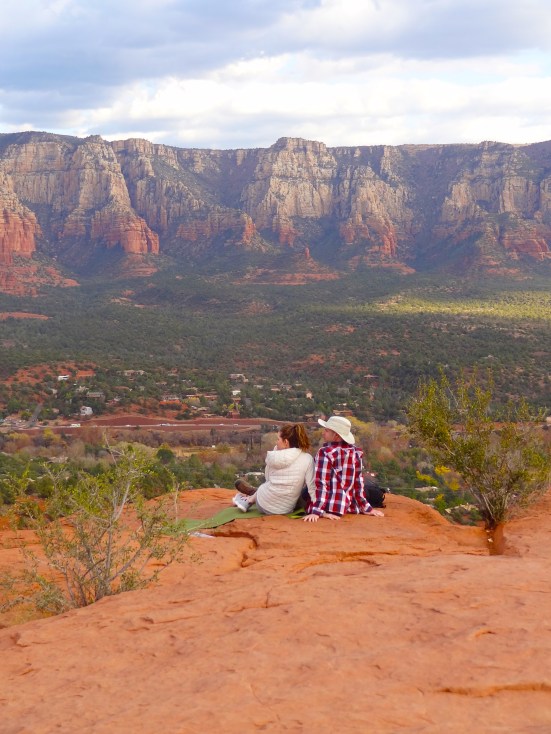
Linda (left) and I on Airport Mesa, before we knew it was a vortex area.

You know how, when you go on trips, you sometimes end up with a running joke in your conversations? The joke can be related to an event, a person you met, or a hapless comment made along the way. Well, for Linda’s and my Sedona trip, our running joke was The Vortex.

Because Linda and I are from Minnesota, we were mainly familiar with Polar Vortexes. You know, that’s when all the cold air comes down from the arctic and tries to freeze everything in its path. Although we had heard of Sedona’s reputation as a vortex center before we began our trip, we didn’t know any specifics.

Personally, I just thought the whole place was the site of mysterious energies. Little did I know that there are specific locations and different types of energies to be had.

Let me back up and define the word vortex (plural = vortices or vortexes). Merriam Webster says that a vortex is something that resembles a whirlpool. I assume all of you, dear readers, have watched water swirl down a drain. That’s a whirlpool — except that in Sedona, the swirling involves invisible energy more than it does water or freezing arctic air.

Our Vortextual Education

Our resort offered various programs for its patrons. Among the classes, which had titles like “Crafting a Festive Wine Glass for Christmas,” was one about vortexes. We decided we had to attend to learn more about this phenomenon. The presentation was given by a local Reiki healer.

She described the concept of vortexes and said the energies involved come from the rocks because of their mineral composition. She passed out a sheet that listed eight locations that are thought to be vortices and it described their different kinds of energies.

Some of the energies come out of the rocks (upflow), some flow into the rock (inflow), some are combinations of upflow and inflow, and some are horizontal (lateral). The lateral flow places involve the energy from nearby rivers and streams.

The sheet she gave us was an excerpt from a book entitled, “Scientific Vortex Information,” which was written by an author who claims to have been educated at the Massachusetts Institute of Technology.

I don’t know. The title seemed like an oxymoron. “Science” and “Vortex” don’t really go together in my world, where I move among scientists every day. I suspected there wasn’t that much science behind the information — more like wishful, imaginative thinking.

Once I got back home, I looked inside the first few pages of the book on Amazon, hoping to see proof that scientific instruments were used to actually measure electromagnetic fields at these locations, but all I saw were explanations of inflow and outflow, with nary any hard proof in sight.

But that’s okay. We weren’t in Sedona for the science. We were there for the experience. We were there for . . . The Vortex!

Our Vortextual Experiences

Sedona 2017 026

Oak Creek Canyon.

While looking at the list of locations, Linda and I discovered we had already visited a vortex the previous day. The site was Airport Mesa, which is easy to access because it’s right in town.

While we were enjoying the view there, we had noticed a couple of people sitting on the rocks in a lotus position. We didn’t think much of it – maybe they were just doing it because the scenic view inspired meditation. But after reading the list, we knew better. Those lotus people were trying to feel The Vortex.

We decided we needed to try that. Our journey the next day involved a trip north to Flagstaff, so we made plans to stop at the Oak Creek Canyon Overlook, which is on the way. The overlook scenic vista is located at the top of the switchbacked road at the end of the canyon about 15 miles from Sedona. A short walk on a paved path leads to an impressive overlook.

I sat on a bench near the overlook and Linda stood near the wall. Neither of us were hard core enough at this point to get into a lotus position (which is sort of hard on a bench, after all). So we just closed our eyes and tried to feel the feels.

I felt my own internal vortex more than any external one. My heartbeat rocked my body and made it sway a little. The Arizona sun felt good on my face and the breeze whispered its secrets.

After having our moments, we conferred. Linda said she didn’t really feel anything. We walked back to our car, but along the way, we stopped to look at some Navaho jewelry being sold at stand along the walkway. I was drawn like a magnet to one ring that featured a bright blue opal. I picked it up and it fit perfectly. I had to buy it.

We joked later that The Vortex made me do it. Who knows, maybe it did? It was like the ring was calling to me.

20171207_153459

Cathedral Rock

A few days later, after a day of hiking, we visited Cathedral Rock, which is thought to be home to an upflow/inflow combination vortex. We hiked up to the flat rock plateau below the formation.

Someone had scratched two spirals into the rock about ten feet away from each other. Linda and I thought they looked like logical places to sit for people like us who were trying to find a vortex, so we sat with legs crossed and eyes closed.

The day had been breezy, but not particularly so. A few moments after we got into position, big gusts of wind started buffeting us. They were so powerful that Linda’s hat flew off.

We opened our eyes and quickly stood, spooked. The wind stopped.

We headed down the rock toward our car. We didn’t joke as much about vortexes after that.

The Beauty Way: Adventures in Northern Arizona, Part 3

Sedona 2017 015

Young lovers on Airport Mesa, Sedona.

These words from the Navaho prayer, The Beauty Way, kept going through my head during a hike among the red rocks in Sedona. It’s hard to get exercise when all you’re doing is gawking all around you. But perhaps that offers exercise of a different sort….

I walk with beauty before me. I walk with beauty behind me.
I walk with beauty below me. I walk with beauty above me.
I walk with beauty around me. My words will be beautiful.

20171207_123728

Bell Rock as seen from the Bell Rock Pathway.


20171207_140144

20171203_140249BW

20171205_143734

Red rock, white trees, Red Rock State Park.

Sedona 2017 049

May you walk in beauty…

How My Dog Got Me Out of a Traffic Ticket

BuddyNose

Buddy. Image by Amanda Jo Dahl Sales.

Two springs ago, I decided to go to Duluth’s (Bob) Dylan Fest musical gathering at a bar downtown. I wanted to arrive early to ensure nabbing a chair to sit on. I had hurt my foot or hip or something, I don’t recall now, and knew there was no way I could stand up and listen to music for several hours without pain.

I rushed out of the house and made it to the bar in plenty of time. As I walked from the parking lot to the building, I realized that I had left my Dylan Fest tickets at home. Cursing, I got back in my car and raced home.

Apparently, I raced a little too fast, because a cop stopped me a few blocks from my house.

“Do you know how fast you were going?” he asked.

“Um, about 43 mph?” I admitted.

“Yep. This is a 30 mph zone and you were going over the speed limit.”

I explained about leaving my tickets at home and not wanting to be late to the event. (I didn’t get into my medical reasons, though.)

The policeman took my license and went back to his patrol car to run a check. When he returned to my driver’s window a few minutes later, he said, “Hey, aren’t you Buddy’s mom?”

I looked at him, dumbfounded for a few seconds. Then I realized he must be the cop who lives in my neighborhood. I had spoken to him and his wife a few times while I was out walking my goldendoodle, Buddy. They LOVE goldendoodles.

I smiled and answered in the affirmative. I told him it was nice to see him again.

“Buddy’s a great dog,” he said. “I’ll let you off with a warning.”

I drove to my house, thankful, yet a little chagrined that I got let off from a ticket not because the cop knew me and thought I was a great person, or even because I am a world-famous blogger, but because of my dog, who is way more famous than I am. 🙂

What’s Your Prison?

Alcatraz 006

Alcatraz Island at night. San Francisco.

Walls all around us, inside us. Some built of fear, some of strength.

Alcatraz 021

A typical Alcatraz prison cell.

What’s it like inside your walls? Cozy? Snug? Cold? Dark? Rotten?

Are they keeping your heart safe, or are they keeping it lonely? Are they keeping others safe?

Whispers filter through the chinks. Come out, come out and play, they say.

The voices won’t wait forever. Someone else will grasp their warm hand and walk them toward the grassy dunes, open in the ocean wind.

Alcatraz 003 Blue

Alcatraz 032

Alcatraz Lighthouse

Hemingway’s Cats

61002_452570391475917_416832289_n

A descendant of Hemingway’s polydactyl (many-toed) cats sits sleepily in a box on the front porch. My son took this photo.

I read in the New York Times recently that the multi-toed descendants of Ernest Hemingway’s cats at his house in Key West, Florida, all survived Hurricane Irma. The house fared well, too.

DSC02211

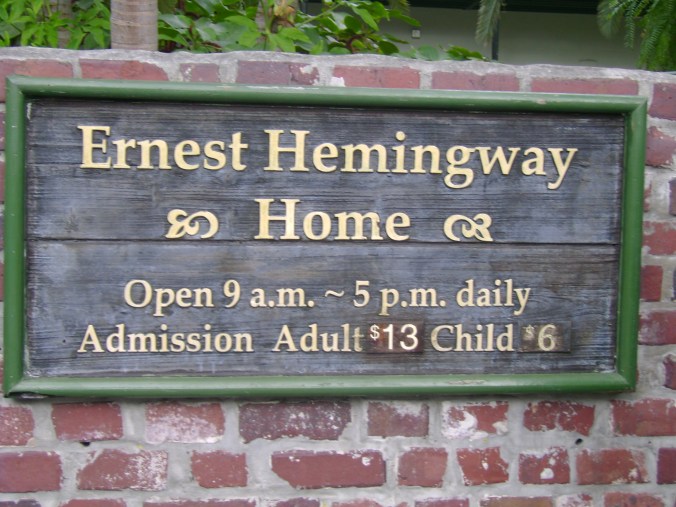
Hemingway’s home in Key West, Florida.

My youngest son and I visited Hemingway’s house about five years ago. We delighted in seeing the cats, which lounged around in the yard and in the house. One was even sleeping on Hemingway’s bed, below a painting on the wall that depicted the house surrounded by cats.

DSC02203

DSC02207

I am glad to hear that everything is okay there.

DSC02210

Hemingway’s writing studio above the pool house.

DSC02198

Thinking of St. Martin Island . . .


St. Martins 1 038

Children in a Carnival Parade on St. Martin Island, 2012.

According to the New York Times, 95% of buildings on St. Martin Island have been damaged by Hurricane Irma. This is such a tragedy, I can’t even begin to imagine it. The island is such a magical place. Please see my post about my trip there five years ago.

My thoughts are with the tourists and residents there, and on all the other islands affected by the storm.

Okay, so I’m Being Lame

fountain-pen-on-paper

I think it’s lame when bloggers write about how they don’t have anything to write about. Or they start off a story by apologizing for not writing in a while. Seriously, I don’t think anyone notices they’ve been gone (well, maybe their stalkers notice – grin).

I believe bloggers should just write a story when they have an idea and get on with it. Stop apologizing first!

But here I am saying that I haven’t written in a while and that I don’t really have much to write about. I do have an idea for a book review, but I haven’t finished the book yet. So, I’m in a holding pattern of sorts. Maybe I’m gathering strength for the next four years of blogging?

Anyway, I’m still alive, still out here. Just living life, enjoying the last of a fleeting summer, and waiting for my meandering thoughts and feelings to gel into something worthy.

Fun with Apostrophes

DSC04196

As a writer, I care about the written word. I care about proper grammar. While I have been known to dangle a preposition at the end of my sentences, I usually try to do what’s proper, especially in my writing for hire.

I had an instance this week where I wanted to confirm the name of a bay in the Duluth-Superior Harbor. Someone who works for an agency in another state asked me to review a web site about this bay, which is the subject of a federal cleanup project because it’s contaminated. My office coworker is also helping with the project by providing engineering advice.

The title of the web page was first thing I noticed. It was called “Howards Bay,” which just screams out for a possessive apostrophe, doesn’t it? (Howard’s Bay.) Unless, of course, the bay was named after someone with the last name of Howards vs. the first name of Howard.

I’ve run across instances before where proper grammar for place names flies out the window because some mapmaker hundreds of years ago labelled places incorrectly on local maps. As such, writers like myself are required to grit our teeth and perpetuate the mistake because what’s on the map has become the actual factual name for those places. One example is the St. Marys River, which empties out of Lake Superior and into Lake Huron. It makes me cringe every time I write it, but there’s no possessive apostrophe in that name due to a mapmaker’s error.

Hoping against hope that wasn’t the case for Howards Bay, I investigated. I looked on the internet. I found that newspaper stories about the bay gave Howards an apostrophe. I found that many government documents (but not all) did not. I asked friends if they knew which form was correct, and received helpful suggestions about where else to check. I looked it up on the U.S. Board of Geographic Names website. It had “no data available” about this name.

Along the way, I discovered that that state of Wisconsin (where Howards Bay is located) has a state Geographic Names Council. Who better to ask? So I sent them an email. While I was awaiting their reply, I learned more about the organization. They seem mainly formed to approve new names for lakes and other geographic features.

They have a list of rules for new names. Among them is one that says, “newly acquired proper names for geographic features shall not be designated with ” ‘s ” or “s”, indicating possession, following the name. For example: Mott Lake, rather than Mott’s Lake or Motts Lake.”

Geez, I wish they would have had that rule in place when Howards Bay was being named!

The next day, I received the geographic names councilperson’s reply to my apostrophe question. Here’s what he said: All of our records that I have been able to find have no apostrophe for Howards Bay. I’ve attached a state sediment sampling document as evidence. I cannot give a more definite answer to the “official” name but I would say that the consistency in our records would point to this being the correct spelling.

In the meantime, with my dogged grammatical passion, I had asked the state cleanup project manager for Howards Bay the same question. He said: The apostrophe question has come up before.  I have not been able to determine which version is correct and occasionally catch myself using both. For consistency, the project team chose to perpetuate the mistake and go with the original name shown on maps, i.e. “Howards.”

Aaargh! Why are we at the grammatical mercy of ancient map makers? I say that modern writers should rise up and free themselves from this typographical tyranny! Add the apostrophe “s” and may the mapmakers be dammed!

Who’s with me?

____________________________________________________________________________________________

**Update** August 9, 2017

A friend of mine asked a research librarian with the Superior Public Library the origin of the name of Howards Bay (also called Howards Pocket). She said it’s named for John D. Howard who held an interest in a sawmill on Connors Point. He died in 1891.

So there really should be an apostrophe because it is Howard’s Bay. Darn those mapmakers! And there should be an apostrophe in Connors Point, too, but I’m not even going to go there. 🙂

Enough with “Farm-Raised” Ingredients, Already!

512px-Hen_chicken

By Thegreenj (Own work) [GFDL (http://www.gnu.org/copyleft/fdl.html) or CC-BY-SA-3.0 (http://creativecommons.org/licenses/by-sa/3.0/)%5D, via Wikimedia Commons.

You all know how I love critiquing television commercials. I just saw another one that reminds me of the 2015 ad for Lay’s “farm-raised” potato chips. This commercial was for Beneful grain-free dog food, which employs advertising professionals who are trying to sell us on the merits of all that “farm-raised” chicken in their dog food. The phrase is mentioned at least three times during the ad.

I ask you, WHAT OTHER KIND OF CHICKEN IS THERE? When’s the last time you heard of a flock of wild chickens captured and used for dog food? Never, I warrant.

While I have nothing against farms, and I am happy that chicken is the number one ingredient in Beneful’s dog food, the fact that it is “farm-raised” only makes me laugh.