Coronavirus Chronicles – The Invisible Enemy

Coronavirus CDC

The coronavirus. Image courtesy of the Centers for Disease Control.

Well, I won’t be meandering anywhere but between my house and grocery store anytime soon. Although nobody in Duluth, Minn., has tested positive for coronavirus yet, most people are limiting their travel and hunkering down at home. At work, we were told to start telecommuting last Monday, so I’ve been working at home — much to Buddy’s delight!

When Russ and I went grocery shopping earlier this week, it felt a bit like venturing into a war zone – one with an invisible enemy. Is it safe to touch this box of cereal, or are virus germs on it? Is it okay to talk to this person we know in the grocery aisle or should we stand farther away? When we bring the groceries into our home, is the virus hitchhiking along?  Wait, did I just touch my face? Aaagh! Should we wash our hands before we put the groceries away, or after? We decided to be extra careful and wash our hands twice.

Both Russ and I are in high-risk categories. Russ because he is older than me and male. Me because I am recovering from surgeries and have some lung issues due to allergies. So that’s a source of concern. Another source of concern are the things I learned when I took an epidemiology class for my master’s degree in public health journalism. I learned enough to know that this virus could be very bad. My instructor told us that the world was overdue for a pandemic. Usually, they occur every hundred years. The last one was in 1918 with the Spanish flu. Predictions were for the disease to originate in China because of the close living conditions there between people and farm animals.

Well, we made it 102 years. Not bad! But here we are, dealing with something with which few people have experience (except for these two ladies who are in their 100s.)

One of my writer friends, Lucie Amundsen, wrote an opinion piece recently for our local newspaper (“Our caring can be this crisis’s silver lining”) where she exhorted people to commit compassionate acts in the community as a way of coping with coronavirus. “Nothing combats fear and anxiety like action,” she said. “Do something. Do that thing you’re good at and share it up and down your street.”

While lying in bed this morning, I thought about what I’m good at that could be shareable. I don’t think it’s wise to share things face-to-face on my street, but I have this blog. I’d like to think of you all as my virtual neighbors. I’d also like to think I’m pretty good at writing. This thought train led me to remember a quarantine romance parable I wrote a few years ago, which is especially apropos for these times.

As with many writers, I take care not to share stories on my blog that I think could be published. (Publishers usually want stories that have not been published elsewhere, not even on personal blogs.) But, due to the nature of this story and the nature of the circumstances we find ourselves in, I am going to share my short story, “The Shower Singer,” as a serial in my blog.

The tale is set in Minneapolis. The story does not provide all the answers. It makes readers think. It’s one of a series that I’m working on for an anthology on the theme of deceiving appearances. I’ve completed five stories and am currently working on a sixth. I figure once I have seven done, I might have enough for a book.

I will start the series tomorrow. I hope it offers a fun, but relevant distraction during these trying times for you, my virtual neighbors, as we fight an invisible enemy together.

Wowed by a Pow Wow

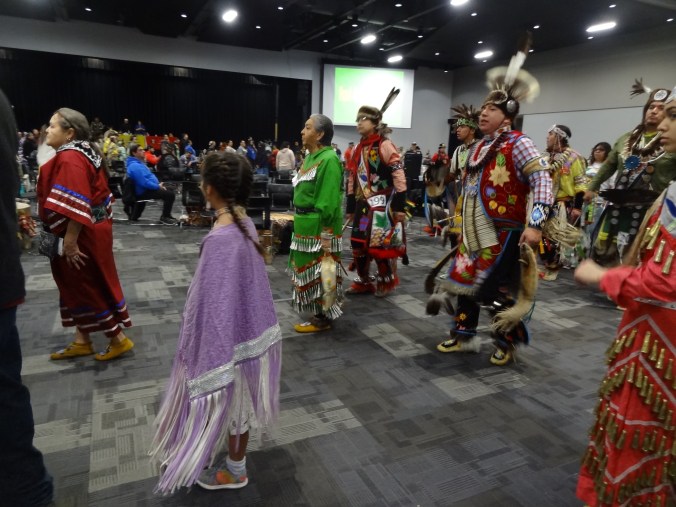
DSC05701I meandered just a bit south to Carlton, Minn., to attend an Ojibwe pow wow for work. More like I white-knuckled it on the drive due to a snowstorm.

I made it to the venue and ended up glad I endured the stressful drive. Why? Because pow wows are fascinating and fun! If you ever have the chance to attend one, you should.

I’ve been to a handful in various locations across the U.S. Every time, I come away impressed by their friendly vibe and the dose of a different culture.

It’s also refreshing to be in the minority for once. Being outnumbered by Native Americans for a few hours administers a dose of empathy for what they must feel most of the time in larger society. And the regalia the dancers wear is so impressive. I could tell they spent a lot of time and effort to make and choose their dress.

I attended the pow wow as part of a teacher workshop I’m doing a story about for work. The workshop offered educators from Wisconsin and Minnesota the opportunity to learn more about Ojibwe culture and their relationship to water to bring into their classroom lessons. Attending the pow wow was part of the experience for the educators.

Before the pow wow, we were given an etiquette sheet so we could avoid making clueless-white-person faux pas.

20200118_134851 (2)I thought I’d share a few of the more interesting points with you. The first is that a pow wow dancer’s clothing is called “regalia,” not a costume. The info sheet says, “Costumes are worn to present yourself as something you are not.”

The sheet does not say what regalia is, but one could assume from the definition of costume that regalia is clothing that reflects a dancer’s true identity. Think of a queen. Her ceremonial clothing wouldn’t be called a costume (unless someone who was not a queen wore it.) It reflects her regal status.

The dictionary offers three definitions of regalia. One is, “the emblems, symbols, or paraphernalia indicative of royalty.” The other is, “decorations or insignia indicative of an office or membership.” The last is, “special dress (especially finery).”

I suspect the last two definitions are the most appropriate when thinking of pow wow clothing – the dancer’s clothes reflect their membership in the tribe(s), and they are clothes not worn every day.  But I also like the idea that their clothing shows their true identity, and that identity is royal.

Another interesting guideline is not to touch a dancer’s regalia. It’s considered rude. I can see how having someone else’s hands all over something so personal could be an invasion of personal space and privacy.

The last is not to pick up an eagle feather that has fallen off someone’s regalia, or take photos of it being retrieved. The etiquette sheet states: “If you see a feather or regalia on the ground, do not touch it but do inform one of the dancers. They will take care of it properly.”

Eagle feathers are sacred to Native Americans, as is their regalia, so it makes sense they don’t want just anyone’s grubby hands on them. I also assume some ceremonies must be associated with retrieving a fallen feather.

End of lesson. Now you know few rules. Go out and find yourself a pow wow! It will be good for you.

The Year 2020 in a Cartoon

I was listening to a recent episode of National Public Radio’s “Wait, Wait, Don’t Tell Me” podcast when my heart leapt with joy. The guests were talking about the year 2020 and the grandiose ideas people had in the past about how we would be living today.

What got my heart going was when the host mentioned the “Sealab 2020” cartoon.

I had been thinking about that cartoon lately, with it being the year 2020 now.  Until listening to the podcast, I was beginning to wonder if anyone else but me remembered the short-lived series.

“Sealab 2020” only ran from September until December 1972, but it made a big impression on me – with my proclivities toward all things watery. The setting was an underwater lab. The dramas and intrigue of the 250 “oceanauts” featured heavily, as they faced challenges ranging from environmental disasters to attacks from giant squid.

As a nine-year-old, I envisioned myself as one of the oceanauts by the time 2020 came around. Alas, I am still landlocked, and I don’t think there are any large underwater labs in operation at this time.

My dream did not come to pass. But at least I work for Sea Grant, and that’s almost as good!

The Top 4 Marie’s Meanderings Posts of 2019

NRRI image

Me, staffing the Water Bar. Have a drink! Image courtesy of the Natural Resources Research Institutue.

We made it through another year of blogging, dear readers! It felt like I didn’t blog quite as frequently as during the past six other years of this blog, but I have enough content that search engine-directed visits keep the stats steady.

In fact, during 2019, the number of people visiting my blog almost doubled, going from 7,100 to 13,300, with over 15,400 views.

Here are the four most popular stories from this year. Why four? Because it’s a nice even number.

#1 Bellying up to the Water Bar – This post was connected to my job for a water research organization. We hosted a water bar, where people could taste water from different parts of the state. The event was designed to celebrate the importance of clean water. People mentioned in it shared the post, which accounts for its popularity. But I’d also like to think it’s also because people care about water.

#2 The Jayme Closs Case and the Importance of News Headlines – This was my rant about a local kidnapping case and the headlines it generated when the young lady was “found.” I thought the headlines should have read that she escaped her captor, instead. I Tweeted this opinion, which blew up the Twitterverse and freaked me out good, because I had only just started a personal account on that platform. Jayme seems to be recovering well from her ordeal, thanks to the support of her family and community. And Jayme, if you are ever ready to tell your side of the story, remember, I am here to help! (And a gazillion other enterprising writers, I bet.)

#3 Five Things to do in Freeport, Bahamas – Russ and I traded in the white snows of Minnesota for the white sands of the Bahamas last February. I must have been in an odd-numbered frame of mind, sharing five popular locations and activities to do there — from creating your own perfume, to wave riding for miles on the ocean.

#4 In Which my Writing Inspires Theft – This post offered a peek into the glamorous life of a local author. A lady I met in my church bathroom told me she liked my story on American martens that was in Lake Superior Magazine so much, she stole it out of her doctor’s office so she could send it to her grandchildren in Japan. High praise, indeed!

Thank you again for meandering with me, and Happy New Year wherever you may be . . .

The Cat Who Liked to Swim

Canoe Cat_Page_1

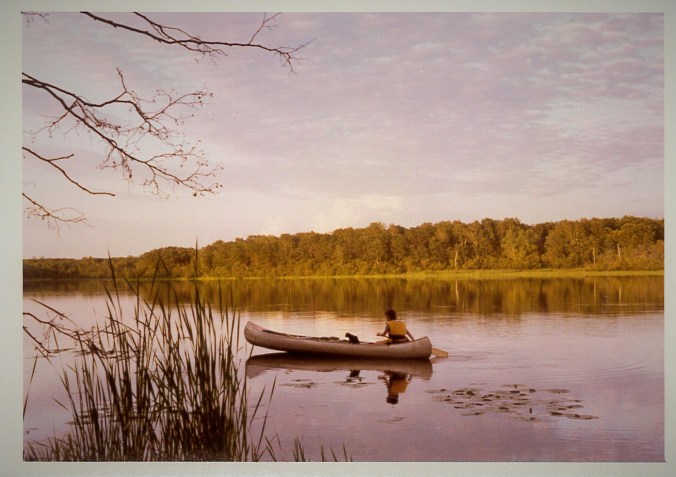
Inky and me, Star Lake, Minn., July 1977. Image by Dorothy Pramann.

I grew up with a black cat named Inky. She was a stray a neighbor boy brought to us because he knew we recently lost a cat. That previous cat was a calico we named Muffin. Alas, Muffin ran away when we were on a camping trip while she was under the care of a neighbor. Perhaps because of that, we took Inky along on all our camping trips.

She did not enjoy car rides – she would disappear under the driver’s seat and not emerge until we’d reached our destination – but she liked being outdoors in the campgrounds where we stayed. We’d leash her to a picnic table so we wouldn’t lose her.

One place we liked to stay for extended periods was Star Lake, a Methodist Church Campground in northern Minnesota. Because we’d stayed there several times and we didn’t need to travel the next day, we’d let Inky off her leash to come and go as she pleased, like she did at home.

We owned an old Grumman aluminum canoe that I used to paddle around the lake. One day, I got the idea of bringing Inky along.

Canoe Cat_Page_2

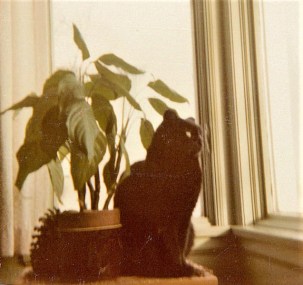
Inky at home, 1975.

She seemed to like the canoe ride better than a car ride. She perched on the gunwale a few feet in front of me, leaning out over the water.

With each canoe outing, she’d lean farther and farther over the side. It seemed like she wanted to go into the water. One day, I tipped the canoe slightly, giving her some “help.”

Plop! Into the water she went.

We weren’t far from the shore of our campsite – only about 30 feet — and she swam in that direction. I can’t recall if she meowed as she swam, or if she swam silently. (My memory has fuzzed during the four decades since this occurred.) She made it to shore just fine and seemed no worse for wear.

The next time I took Inky out for a canoe, as we neared our site again, she jumped out of the canoe by herself!

Could it be, she liked to swim? I’d never heard of a cat who liked to swim, but apparently, I had one. By the end of our stay, her swims from the canoe to our campsite were a regular thing.

Inky the swimming black cat lived to a ripe old age, despite getting hit by a car once, breaking her leg. I’ve had other cats since then, but none who liked to swim like she did.

I just researched swimming cats. Although most cats would rather avoid water, some do like it. (Read stories here.)

My youngest son is allergic to cats, so I have since switched to dogs. But in my home, I keep this photo my mother took of Inky and me canoeing. I think of my swimming cat whenever I pass it.

Star Lake was the only place I ever took her canoeing. I wonder what she would have thought of the Boundary Waters Canoe Area Wilderness? I bet Inky would have liked it.

Another Random Act of Decorating Kindness

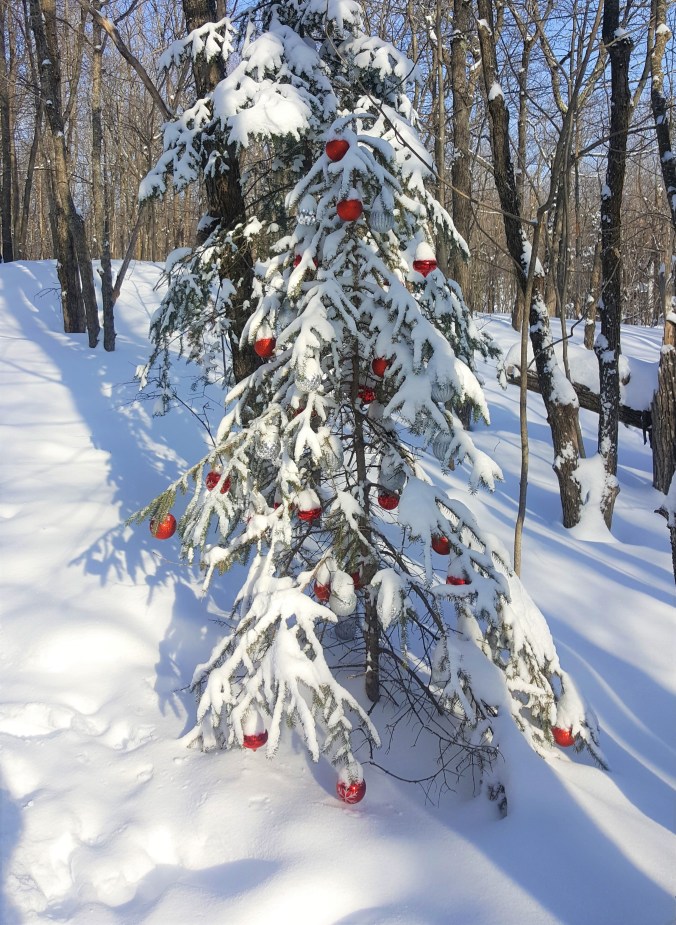
20191210_121551Someone is decorating outdoor trees in my neighborhood. If you have an excellent memory, you may recall that in 2015, I came across a small tree decorated on a trail where Buddy and I habitually walk. This unexpected act of decorating kindness lifted our spirits, and no doubt, the spirits of others who walk the trail.

The problem was, nobody undecorated the tree. As the winter wore on, some of the ornaments broke. Eventually, I ended up freeing the tree of the clutter at winter’s end. The next two years, no mysterious decorations appeared. I missed them, so last year, I ended up decorating the same small tree with several old ornaments that I no longer had room for on my personal indoor Christmas tree.

Well, somebody beat me to it this year. Red and silver ornaments magically appeared on a larger tree. And these weren’t just a few cast-off decorations like el-cheapo me used. They are numerous and new-looking. Plus, Buddy and I noticed another tree sporting similar decorations on a roadside in our neighborhood.

Could the same little elves have decorated both trees? Perhaps.

I don’t want to think about it too hard. I just want to enjoy the gesture. And I would like to wish a Merry Ho Ho to all and to all a good night.

The Secret Bank Account

Woman's hand holding US banknotes

Image from time.com.

One of my first jobs out of college was as secretary for a local factory that made bakery machinery. As part of my job, I was in charge of handling credit union transactions for the workers. (This was way before the days of online banking and at the dawn of the age of computers.)

One day, a worker was absent and he received a payment from the credit union. I believe he must have been on vacation. As plant secretary, I had access to index cards containing personal information for all the workers, including their home phone numbers.

I thought I would be super helpful and let the man — let’s call him Butch — know his payment was waiting. If he was home, maybe he’d want to pop over to the office and pick up the check.  I phoned his home. Nobody answered, so I left a message.

A few days later, I got called into the plant manager’s office. He told me Butch was upset I had left the message about his credit union payment. You see, his wife didn’t know about this account and she heard the message. You can guess what happened at home!

Anyway, the plant manager chewed me out and told me not to call workers at home about their credit union payments. I was officially reprimanded.

As I was on a walk the other day, I remembered this event and started musing about the chutzpah, or perhaps it’s male privilege, that allowed the worker to complain to his boss that I had outed his secret bank account. And then for the manager to blame me for the problem.

It made me wonder whether it was common practice at this factory for workers to have secret bank accounts – to hold money back from their families. How would the families know? The deposits were automatically deducted from their paychecks. The transactions all occurred at work.

Instead of meekly agreeing to the reprimand, I wish I had laughed at the absurdity of the plant manager chewing me out for innocently not keeping a worker’s dirty little secret. But that probably would have gotten me fired on the spot.

I can’t recall if I was actively seeking employment elsewhere at the time, but I knew I wasn’t happy in that work environment and didn’t plan to stay long. I ended up working there for two years before resigning and finding a job better-suited to my career goals.

I am so glad I didn’t let the security of a paycheck keep me tied to a place and a job that didn’t suit me.

Adventures in Acupuncture

Oliver dixon jpeg

This is not me, but this is how I felt! Image by Oliver Dixon.

I realized I haven’t updated you all on my “Fun with Acupuncture.” Dear readers, as you may recall, I decided to visit a local acupuncturist for help with my hot flashes. That was in July. Now it is over two months later. What’s the verdict?

During the first week or so, I thought the treatment wasn’t working. It involved an acupuncture session and herbal supplements to take later. Then I realized I wasn’t taking the proper dose of the supplements. When I fixed that, things seemed to improve.

I’ve done well avoiding chocolate, as the acupuncturist suggested. Not so well avoiding wine, but I have cut back quite a bit.

I went back for a follow-up session a few weeks ago. This time, she wanted to stick her needles a few new places to help my allergies and my stuffy sinuses. She asked me if she could stick some needles in my face.

Let me say that again: MY FACE. Stupidly, I said yes.

I LET HER STICK NEEDLES IN MY FACE. Specifically, I let her stick two needles in that space between my upper lip and my nose. (Also known as the philtrum.)

I felt nothing with the first needle. I felt the second needle go in, plus she twisted it a bit. She also stuck a needle in the TOP OF MY HEAD. That one started to sting.

I asked her if it was normal for it to sting. She said she thought it would calm down after a while.

Happily, the pain did lessen, but it was rather disconcerting for a few minutes. Lying on the table for 20 minutes was a bit easier this second time. I think it helped that I couldn’t see the needles she stuck in my face. They were so close to my eyes that they were blurry. She also gave me an additional herbal supplement for my allergies.

For the first day or two, I had no hot flashes. Then they started returning at night, but only a few times a night. I’ve also had them during the day, but not as often as before I started treatment.

The supplement she gave me for my allergies worked like a charm.

Overall, I’d say that my hot flashes have improved by about 65%. And the flashes I get are not as extreme. They are more like warm flashes than hot flashes. I am sleeping better and plan to continue taking the supplements until I feel like I don’t need them any more (or I get sick of them, whichever comes first.)

If you are thinking of trying acupuncture for help with hot flashes, I say go for it.

Personally, I feel like I’ve had enough sessions with the needle for now. I fear a continuing escalation of where she’ll want to stick needles next, and I’d rather not go there.

Free Stuff and Boring Place Names: A Road Trip Through America’s Heartland

We recently returned from an epic road trip straight south. Our mission? To take my youngest son to college in Arizona. He wanted to have his car with him at school, so thus the necessity of driving it 1,700+ miles.

It’s been a while since I’ve taken a long road trip and I was looking forward to it. I’d also never driven across Kansas or Oklahoma before, so was itching to cross those states off my driving list.

20190820_170403

Photo taken by Hunter Zhuikov, somewhere along the Kansas Turnpike.

Two themes soon emerged: free stuff and boring geographic names.

The free stuff started with our first lunch while we were still in Minnesota. We stopped at a Perkins Restaurant. Unbeknownst to us, Mondays are free pie days at the chain. Our waitress thought that everybody knew this and that’s why we stopped there. When she announced our free pie choices, we just stared at her in dumbstruck wonder. Afterward, we continued our drive, fortified by a few hundred extra free calories.

Our luck continued that night in Kansas City where we ate at a Red Lobster for supper. Due to a computer glitch, our food order did not make it to the cooks in a timely manner, so, even though we weren’t upset by the wait, the manager offered us a free dinner and two desserts. More free food, yippee!

The next day our luck changed from food to transportation. We were at a tollbooth on the end of the Kansas Turnpike when the machine malfunctioned. The toll operator let us pass through without paying because it was going to take too long to reboot the machine. Yeehaw!

We thought our luck was over when no free stuff appeared for the next 24 hours, but we were wrong. On our third and final day of the trip, we decided to stop at White Sands National Monument in New Mexico because it was right next to the highway and it looked picturesque. We could only spend about a half-hour there, however, because relatives were waiting for us in Arizona. As we drove up to the entrance fee booth, we noticed it was empty. Yay! Free scenery!

20190821_143021

White Sands National Monument

If you ever get the chance to visit White Sands, be sure to do so. The piles of white gypsum flow in spectacular dunes, which you can access right off the park road. We had enough time to drive to a boardwalk trail and hike to the end of it, taking photos along the way.

Now for boring geographic names. C’mon Kansas, you can do better. Examples: there’s a town named Rock, another named Urbandale. How generic can you get? A river called Whitewater. Another town named Grove.

Ugh. As if driving through farmland isn’t already mind-numbing, the place names in Kansas, at least those before Witchita, were totally uninspiring.

After Witchita, things changed. We ran into town called Smoots. Another called Pretty Prairie. That’s better, Kansas. Keep it up! We crossed the Ninnescah River about three times. I probably liked this name because it sounded Minnesotan. Thank goodness the place names got better or I might have fallen asleep behind the wheel.

Other things of note: We passed the world’s largest hand-dug well in Greensburg, Kansas. We did not stop, but maybe we should have. I mean, the thing has its own visitor center, it’s so huge! We also passed the world’s largest pistachio. This was in New Mexico. It’s not a real pistachio, but a “mammoth outdoor sculpture” to advertise a pistachio tree ranch. We didn’t stop there, either, having already used all our spare time at the White Sands.

We were also impressed by all the wind turbines in Kansas and Oklahoma. It seems as if wind power is alive and well in those states.

I am happy to report that my son’s car survived the journey, and so did we! My son is ensconced in his dorm room and starting his classes now. Once we flew back home, the house was eerily silent without his presence. We are still adjusting.

20190822_103411

Moving into the dorm.

A Plethora of Pronouns

20190815_201016My recent Florida trip mixed work with pleasure. The work part was a conference about podcasting. I produce a podcast for work (called Wisconsin Water News) and I was looking for ideas and information to make it better.

Three thousand people attended the conference. I never dreamed that podcasting was such a huge thing! One of the tidbits I learned during the event is that there are over 700,000 active podcasts and that 72 million people listen at least once per month.

20190815_201001Something else I learned is that pronouns are a “thing.” Conference organizers offered buttons so that people could affix the pronoun to themselves by which they want to be referred. (He/him, they/them, she/her.) Also, some of the speaker panels featured introductions where the speakers told the audiences which pronoun the prefer.

As a hick from Duluth, this was new to me. I guess it’s about time I got with the program. Are pronouns a thing in your workplace or community?