Seeing Red

Here’s yet another side detour from my New England travelog. Don’t worry, I’ll get back to it!

The other night Russ and I meandered around the backroads north of Duluth, joining many others who parked their cars in random spots and looked up to the spectacle happening in the sky.

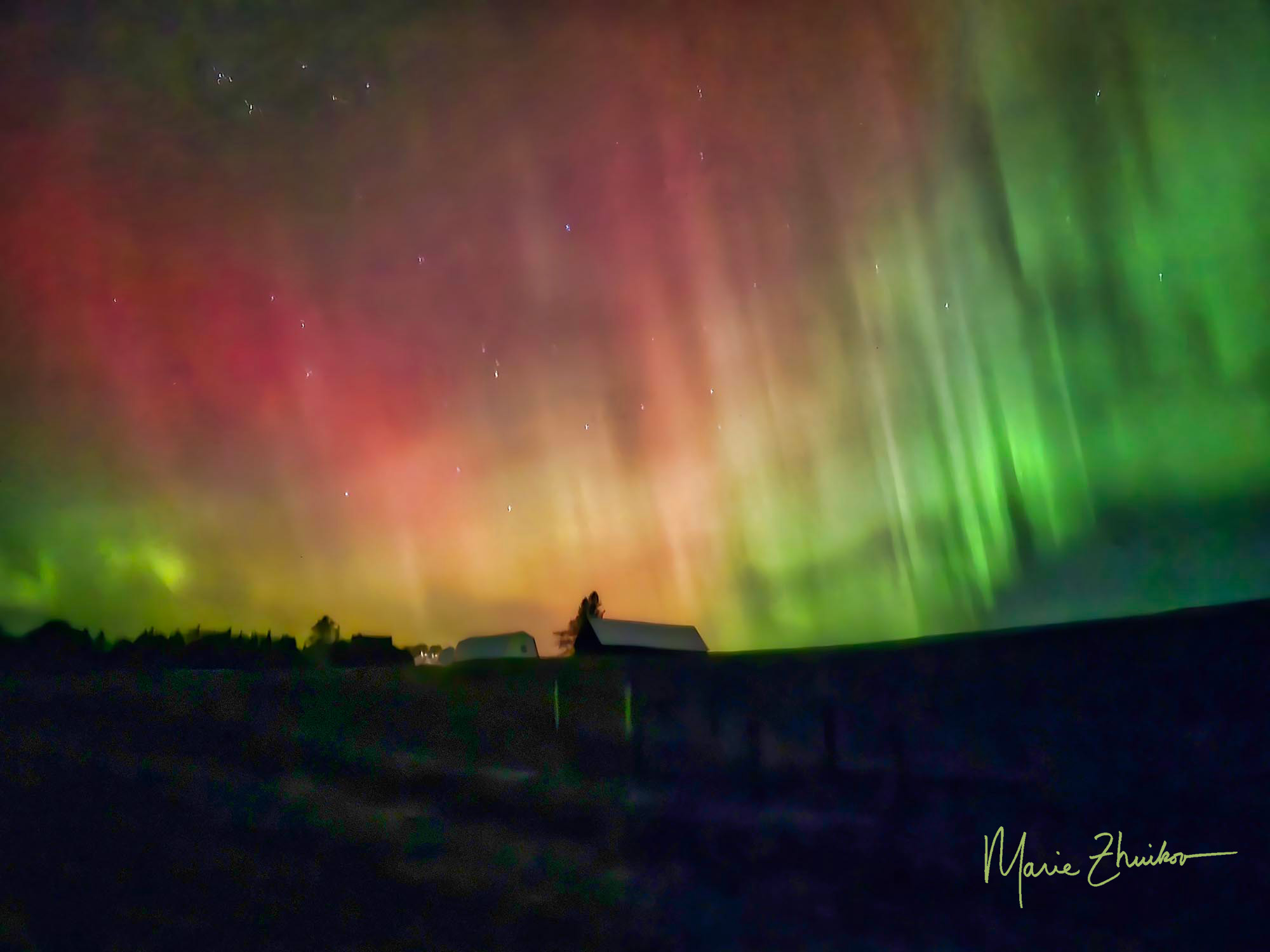
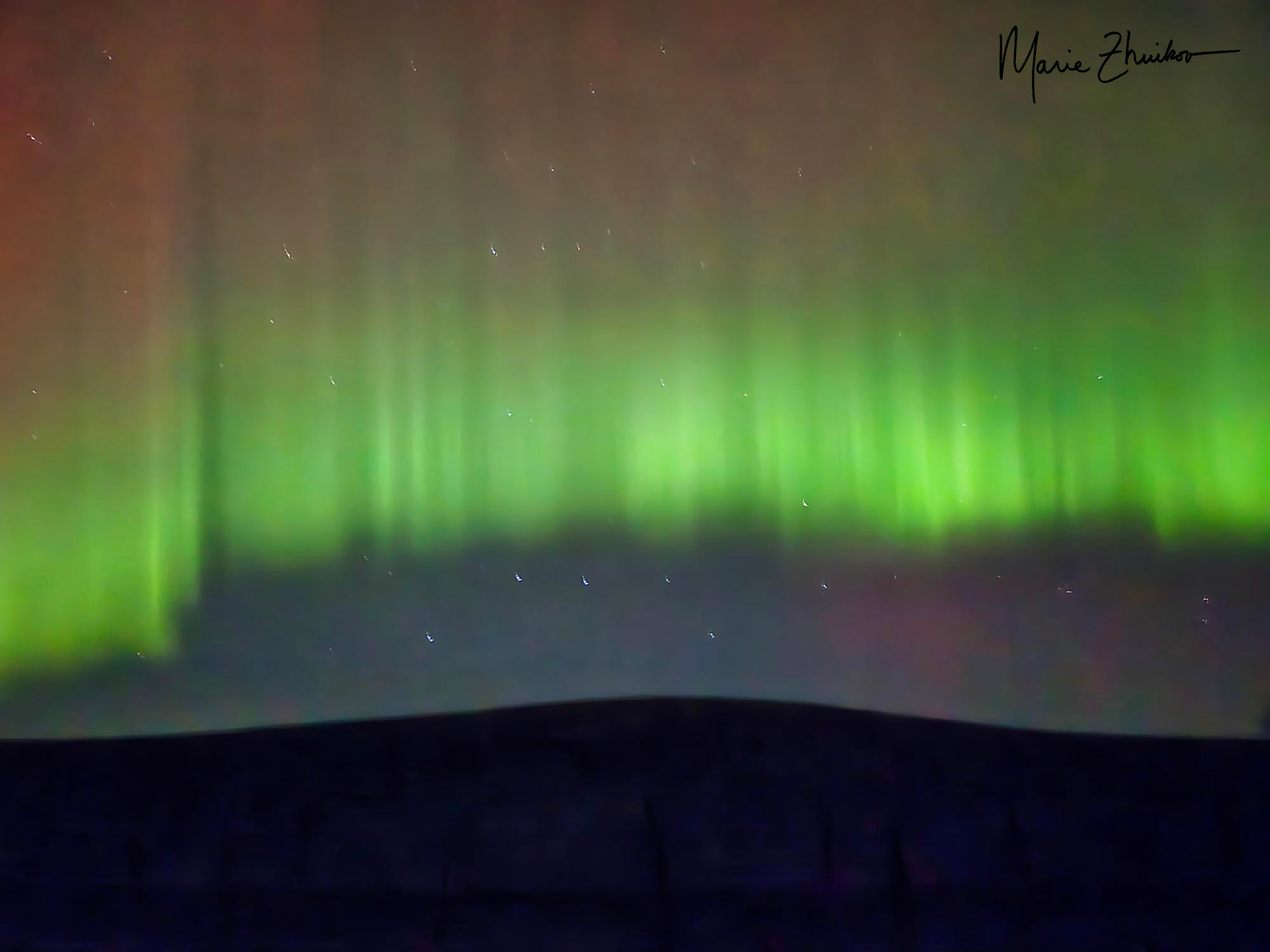
That spectacle was the northern lights. I took these photos the second night of the show at about 8:30 p.m. It was so kind of the aurora to happen before bedtime! We found a spot on a gravel road where we could see a whitish curtain of aurora on the horizon. We first stopped at a town hall but there were too many lights, so we went back down the road until we found a dark area. I took a few test shots with my phone camera and wowza! Jackpot.

A green curtain filled the sky, with some red overtones. As the lights continued to dance, the red intensified. This color is rare in auroras.

Here’s an explanation from a local astronomer, Astro Bob (King). I don’t totally understand it, but here’s what he said about that storm:

Red aurora occurs high up in the atmosphere at an altitude of around 150-300 miles. Green emission happens at lower altitudes, around 75 miles. Both are produced when incoming charged particles strike and energize oxygen atoms. After the impacts, the atoms release that energy in the form of green and red light when they return to their original relaxed state.

At high altitude, the number of atoms drops sharply — it’s basically a hard vacuum up there. After it’s struck by a charged particle, an oxygen atom needs almost two minutes to release that energy. If a neighboring atom were to bump into it during the transition, it would short-circuit the process. But because there are so few atoms at that altitude, oxygen has time to release red light before a collision occurs.

There’s so little oxygen to begin with at high altitude, a strong storm is required to crank up enough oxygen atoms to produce the red aurora. Seeing red is a good sign that a significant storm is underway. Overall, the Nov. 11 storm reached the G4 (severe) level, with aurora reported in all 50 states (including Hawaii) and as far south as the tropics.

A farm house and barn stood off to the side and provided more visual interest to the shots. Eventually, the cold got the better of us and we crawled back into our car to return to our modest home filled with artificial light.

A Fall Bike Ride

Last month, Russ and I continued our quest to cycle different sections of the Mesabi Trail, which crosses northern Minnesota’s Iron Range. Amid the crunch of fallen leaves and the brilliant red of sumac, we biked from Nashwuak to Calumet with a side trip to Pengilly.

A warm breeze offered one of those final temperate days between summer and fall. The trail began in Nashwauk at a nondescript parking lot near a closed restaurant with the suggestive name of Big O’s Chef House. (Maybe that’s why it went out of business?) Except for a few frost heaves, the mostly flat trail was in good condition. It parallels the highway ,so the distant noise of cars is ever-present.

Much of the land surrounding the trail is owned by Mesabi Metallics Co., an iron ore and taconite mining company. We passed huge piles of mine tailing waste and overgrown past mining roads as a few vultures circled overhead.

In the sleepy Sunday town of Calumet, we rested at a public picnic shelter. The only evidence of life was a man throwing a ball for his black lab. Then we turned around and made our way back to Nashwauk. Along the way, we took a short spur trail to the town of Pengilly just for a change of scenery.

Scenery along the trail.

Once, a pair of teenagers on an ATV surprised us (they’re not supposed to go on the trail). Several times, we had to dodge Halloween-colored (black and orange) woolly bear caterpillars inching their way across the trail. Folklore says they can predict how harsh the winter will be by the width of the colored bands on their bodies: more black equals a harsher winter. We were trying too hard not to squish these fuzzy forecasters, so we didn’t notice their band patterns.

Apparently, science has not confirmed the caterpillars’ weather-forecasting abilities. Even so, the woolly bear remains a symbol of autumn. Its presence offered us a gentle reminder that the season is turning, and nature is preparing for the quiet, cold months ahead. This will probably be our last long ride of the season.

Total distance: 14 miles. For more information about other sections of the trail, please see these previous posts:

Bicycling from Keewatin to Nashwauk

Biking the Mesabi Trail from Ely West

The Mesabi Bike Trail from Mt. Iron to Kinney, MN

Biking the Mesabi Trail from Hibbing to Chisholm

Biking Along the Giant’s Ridge

Biking Across Minnesota’s Tallest Bridge

Northern Lights and Lightning Bugs

A rare show lit up the sky above our cabin last night. Russ and I meandered down roads in the dark, feeling our way by the gravel crunching under our shoes. We made it to a bog that has a good view north.

As the aurora silently danced above in curtains of reds and greens, lightning bugs danced closer to the ground, their feeble white lights the last of summer.

If you’d like to see my photo page with lots of other images (organized by topic: water/wood/stone/sky/travel and lighthouses) please visit my photography page and choose a topic: https://mariezwrites.com/photography/.

Making Puffed Wild Rice (and Donuts)

A hearty bowl of puffed wild rice.

Wild rice, the kind of rice native to the Great Lakes and other parts of North America, is not only delicious in soups and other dishes, it makes a great and healthy snack.

A few years ago, I was gifted a copy of The Good Berry Cookbook by Tashia Hart. The author is a member of the Red Lake Anishinaabe (northern Minnesota) and she’s a culinary ethnobotanist, artist, photographer, writer, and cook. The book is more than a cookbook. It’s everything you ever wanted to know about wild rice.

A wild rice triple chocolate donut. Doesn’t it look tasty?

I’ve made several recipes from the book, notably, one for wild rice chocolate donuts (Triple Chocolate Donuts). As someone who’s always on the lookout for alternatives to wheat and corn, I was attracted by this recipe. They turned out looking great but were a bit gritty. Maybe I didn’t grind the rice into flour as fine as I should have. Since then, I’ve found other wheat- and corn-free recipes I like better.

This weekend, I went to a Harvest Festival in Duluth, which features produce from local farmers and artisans. One booth offered puffed wild rice in several flavors (for instance, cheese pizza!) I tried a sample of salted rice puffs. They were very good. Done this way, the wild rice tastes almost like popcorn, but with a richer, nuttier flavor. I would have bought some, but the vendor used popcorn salt, which usually contains cornstarch, so I passed.

Seeing the puffed wild rice reminded me that the Good Berry cookbook had a recipe for it, so when I returned home, I made some. It requires wild rice that has been picked and parched in a traditional manner. This makes it a lighter color (dull brown) versus the paddy-grown wild rice, which is dark and shiny.

All you do is heat a few inches of oil (I used canola) in a pan at a high temperature. I used setting 7 out of 9 on my stovetop. Wait until the oil is good and hot, then place a small amount of wild rice in a sieve (2-3 tablespoons) and lower it into the oil. It should puff up quickly if the oil is hot enough. Then spread the rice on a plate lined with paper towels to drain. I seasoned mine with sea salt (which usually contains no cornstarch).

If you’ve ever had puffed wheat cereal, you’ll recognize puffed wild rice, although the rice kernels are smaller and skinnier. It tasted great!

Marie tries her hand at harvesting wild rice, St. Louis River, MN.

Russ has developed the habit of eating popcorn in the evenings, which is sort of torture for me because I can’t have it. (Do you think he’s doing this on purpose??) Now, I have an alternative.

Tashia also offers a recipe for wild rice chocolates. Basically, you take the puffed wild rice and pour melted chocolate chips over them. I have some leftover puffed wild rice. That’s next on my list!

For a story about my “immersive” experience harvesting wild rice, visit this link.

Update: 9/10/25

I made the puffed wild rice chocolates. Very good! The recipe calls for making them in a flat sheet, but I chose to clump them instead. They taste rather like a Nestle crunch bar.

Bicycling from Keewatin to Nashwauk, MN

The Hawkins Mine Pit in Nashwauk. We heard peregrine falcons on the cliffs to the right.

Russ and I have been biking short sections of the 150+ mile-long Mesabi Trail in northeastern Minnesota. Stretching from the Mississippi River to the Boundary Waters Canoe Area Wilderness, the trail will be complete in the next year or two. At that point, it will be 165 miles long, making it one of the longest paved trails in the country.

We’ve biked the trail twice this summer (and many times in the past – a list of other posts included at the end). Those recent trips weren’t very noteworthy, so I didn’t blog about them.

This section of the trail took us between two iron ore mining towns. We began in Keewatin, which was formed during the iron ore mining boom in the early 20th century. The town’s name comes from the Ojibwe word for “north” or “north wind,” and the soil is a rusty red from all the iron it contains.

The 11-mile round trip seemed like a gradual climb both ways to me. I’m not sure how that worked! Only one short, steep hill gave me pause, otherwise it was smooth cycling. The first part out of Keewatin follows an old highway/road that’s no longer in use.

We passed several lakes and mine pits, namely O’Brien Reservoir, Hawkins Mine Pit, and LaRue Pit Lake. A cold rain shower caught us about halfway to Nashwauk. I had to stop and clean off my sunglasses. Sometimes I think they need little windshield wipers! The rain didn’t last long, so we kept on going and the breeze dried our clothes.

Downtown Nashwauk, MN

When we reached Nashwauk, we stopped at an overlook at the Hawkins Mine Pit. It used to be an open pit iron ore mine but is now unused and filled with water. Steep red and tan cliffs topped with green trees line the “lake.” As we admired the view, we heard some squawking that sounded suspiciously like peregrine falcons. I’ve heard that they sometimes nest on the mine pit ledges, so perhaps there was a nest at the Hawkins Pit?

It’s believed that Nashwauk was named after a river in New Brunswick, Canada. The word is said to be from the Algonquin language and means “land between.”

As we turned around and headed back to Keewatin, we noticed a spur trail with a sign about the LaRue Pit Lake. The sign said the area features a boat landing, fishing pier, and is a tourist attraction. We decided to check it out.

Our bikes needed a rest at the LaRue Pit lake. We were fine, of course.

The spur trail came out on a paved road. Unsure which way to go, we chose to turn right, which ended up being the correct direction. The road took us down a steep hill to a picturesque lake. It looked like the “tourist attraction” was still under construction – no grass, just bare dirt that was being graded. An angler floated offshore in his boat, trying his luck with the fish. The LaRue Pit began as an underground mine in 1903-1905. The park looks like it will be a nice place, once finished.

The LaRue Pit lake near Nashwauk.

Then we biked back UP the road and rejoined the trail. Not far from the spur, we stopped at a memorial we had passed earlier. The name on the weathered white wooden cross was James Dorgan and it was dated 12/22/1973. The memorial looked in such good shape, we weren’t sure if that was the day he died or the day he was born. Once back home, I did a bit of sleuthing and discovered that it was his death date. James was a former Keewatin resident living in St. Paul who died in a car accident when he stopped to help his ex-wife, whose car was stalled. Another driver apparently hit him.

We were impressed by how well the memorial has been kept up for fifty-two years. Colorful plastic flowers decorated a flower box, and a wind chime hung from a post nearby. Solar lights illuminate the memorial at night.

We mostly had the trail to ourselves. Saw a few squirrels hightailing it across the pavement. Saw a few walkers. We passed a couple of other cyclists in town. Heard some ATVs but didn’t see any.

From rainstorms to pit lakes to falcons to ghosts, this is a good stretch to ride to get a feel for how important mining is to this part of the country.

Wishing everyone a good Labor Day Weekend!

For more information on other sections of the Mesabi Trail, check out my previous posts:

Biking the Mesabi Trail from Ely West

The Mesabi Bike Trail from Mt. Iron to Kinney, MN

Biking the Mesabi Trail from Hibbing to Chisholm

Biking Along the Giant’s Ridge

Biking Across Minnesota’s Tallest Bridge

Boundary Waters Adventures

Our canoe at our campsite on Brule Lake.

Russ and I sacrificed a 40-day winning streak on the NY Times Connections word game to head to the Boundary Waters Canoe Area Wilderness where there is no phone or internet service. We traveled with our friends Sharon and Mike to Brule Lake – a place I last visited 35 years ago.

To go easy on our aging bodies, we decided to do a canoe trip without any portages. (Portages are where you carry your canoe overturned atop your shoulders on a rugged trail to the next lake.) Brule Lake is large enough to spend several days there without needing to go anywhere else.

We were partially successful in meeting our goal. The only “failure” came on our third day of tent camping when Sharon and Mike decided to portage to a small lake for better fishing. We hiked the portage without our canoe to see if the lake was worth the effort of hauling it there. With forested hills and a cute island, the beauty of the new lake and the short length of the portage convinced us to bend our no-portage rule. It was a true wilderness lake with no campsites or other signs of human habitation.

To share the pain of portaging, we opted for a two-person carry, where we carried the canoe over the portage with one of us on each end of the watercraft – no hefting it up onto one person’s shoulders.

We were glad we did; canoeing on the lake offered views of a loon and its baby. We found the loon’s nest on the small island, where we ended up eating lunch much to the delight of the ants there. Our presence was probably the most exciting thing to happen to them in years! Sharon and Mike caught enough fish to feed us all dinner that night.

After we spent several hours on the lake (which I am purposefully not naming because Minnesotans don’t do that with good fishing lakes), the sky began to darken. We decided to head back to our campsite on Brule Lake. We couldn’t relay this to Sharon and Mike because they were at the far end of the lake.

We made it across the portage and out into the bay when the storm broke. The first drops of rain were huge and cold. We were wearing our swimsuits because we expected rain, so we didn’t mind being wet. What we did mind was the wind and the thunder/lightning! Yelling through the gale, we briefly considered riding out the storm on land, but we were so close to our campsite and the lightning was far away enough that we decided to power through and hope we didn’t get struck. (That was reckless of us, I don’t recommend staying on the water in a thunderstorm. Don’t try this at home!)

Our cute tent in dryer times.

We made it to camp and I quickly climbed into the tent to get into dry clothes. Russ was already so wet, he stayed outside. Once I changed clothes, the wind picked up even more. Russ had to tie down our lightweight Kevlar canoe to keep it from blowing away. From inside the tent, I held down the side the wind was hitting so that the stakes wouldn’t pull out of the ground. After what seemed like hours, the storm abated.

Our tent bottom (and a sleeping pad), drying out in the sun after the storm.

We were a little worried about Sharon and Mike, but this wasn’t their first BWCA Wilderness trip, so we assumed they’d be okay. But as the hours ticked by and the sun lowered, we began to discuss how long to wait until beginning a search for them. Not long afterwards, we heard them paddling back to our campsite. We greeted them with shouts of “You’re alive!”

They explained that they also stayed on the water during the storm, riding it out next to shore. (That was reckless of them, I don’t recommend staying on the water in a thunderstorm. Don’t try this at home!) Then they stayed on the unnamed lake to fish more. We ate the fruits of their efforts with relish that night – the first non-freeze-dried dinner Russ and I had eaten in days.

Mmmmm, wilderness walleye filets!

The next morning, our final morning, another thunderstorm rolled through, but it wasn’t as strong as the previous one. Once it stopped, we packed up our soggy gear and headed to the canoe landing, wanting to cross Brule Lake as quickly as possible in case another storm was gathering. Sharon and Mike planned to leave later.

We made it back to the landing. Driving home, we appreciated the gradual return to civilization. Backwoods gravel roads gave way to pavement that led us past homes and eventually to the small town of Lutsen. The day turned hot and muggy, so we stopped for ice cream on the way home to Duluth.

Our campfire on Brule Lake.

Now we’re back winning Connections again: 6 games so far. But we both agree this wilderness trip and the memories of spending time with good friends, listening to loons yodel, telling stories around the fire, and surviving thunderstorms were more than worth breaking our streak.

Paddles and sunset on Brule Lake.

‘Murica!

The weather for Independence Day in northern Minnesota was perfect: hot and sunny. I thought I’d share some images from it.

I can’t believe that my phone camera caught this firework on its way into the sky, looking like a space rocket. An empty brandy bottle served as a fine launch pad.

No 4th of July is complete without my mother’s potato salad recipe. It features extras like black olives, hard-boiled eggs, mustard, onion, dill, and paprika. I made enough to last our crew for several days!

Back in Colonial days, cakes used to be a “thing” for Independence Day. As for us, we devoured a fruit pizza, which is basically a huge sugar cookie covered in cream cheese, whipped cream and fruit that matches the day’s color scheme (red, white and blue).

We ended the day at a community parade. I’d never been to it before and was surprised by the number of people who attended, especially since there aren’t that many people who live in the area. The parade was filled with ATVs, floats from local businesses, and people tossing candy to children. One guy was even handing out fireball whisky shots! There were also a few disturbing “Don’t Tread on Me” flags on the ATVs (a symbol for the alt-right) and much Trump paraphernalia in sight, but that’s the politics of this rural area, as it is in many small towns across the country.

This was the cutest float in the parade. While many of the ATVs were trailing beer cans, he chose pop cans. Note the patriotic dudes in the background.

We had a great time with family and friends. I hope your 4th was memorable, as well. What are your traditions?

World on Fire

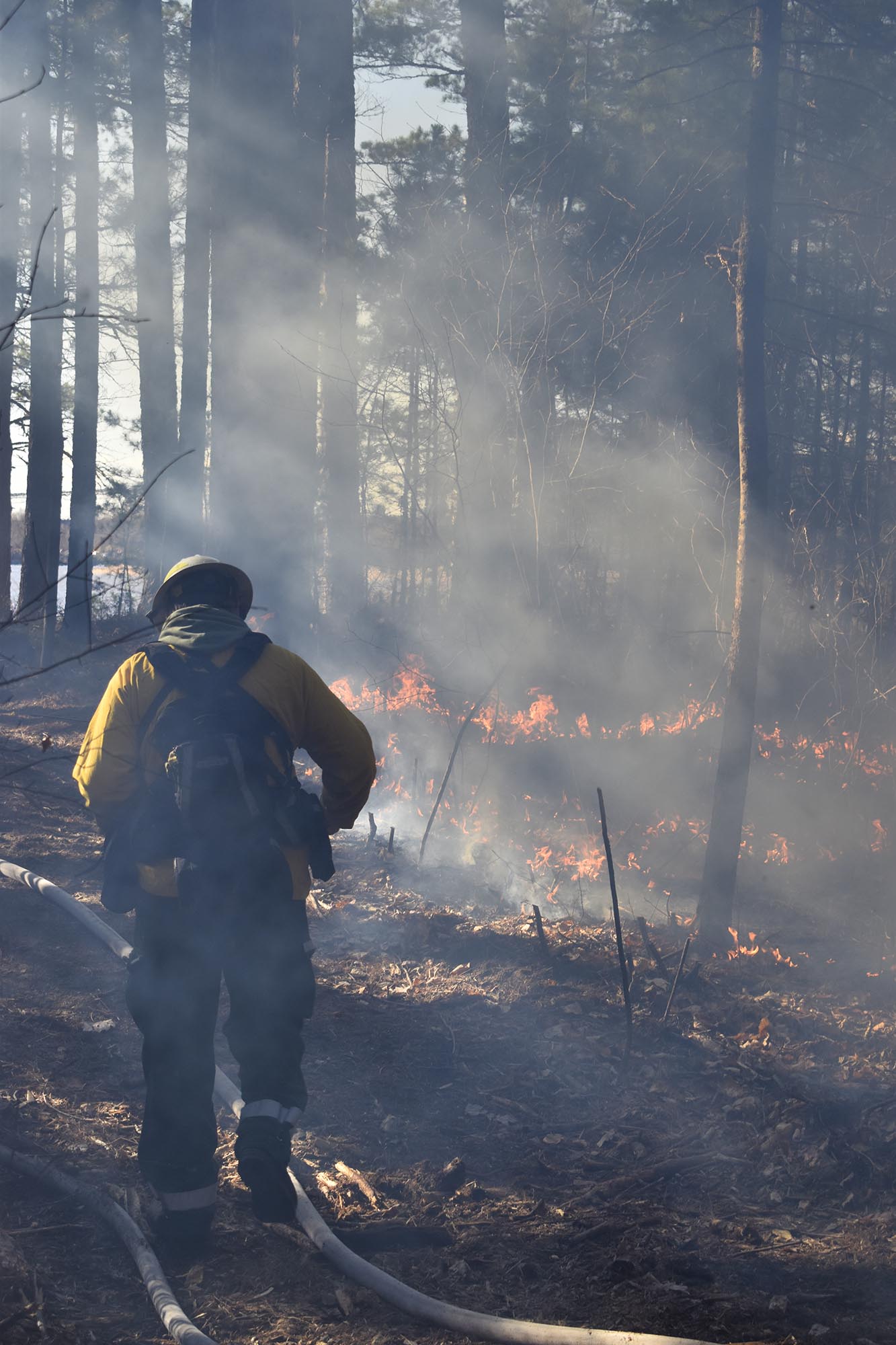
Results of the fire near our cabin.

What is it about possessing things? Why do we feel the need to own what we love? And why do we become such jerks when we do? We’ve all been there. You want something, you possess it  –  and by possessing it, you lose it. – Chris Stevens (Chris-in-the-Morning), “Northern Exposure” TV series

When we returned home from Grand Cayman, northern Minnesota was on fire. Three wildfires from natural causes were burning, adding to the smoke from Canadian fires. During our vacation, the smoke blanketed Duluth, causing air quality warnings. Thankfully, we missed that, but once we were home evacuation warnings sounded for areas near our cabin.

What could we do against a wildfire if it chose to overrun our cabin? We live an hour away and weren’t sure how worried we should be. One of my relatives called me and suggested we stand outside our cabin with garden hoses. Luckily, a cabin neighbor was fighting the fire and was able to give us a clue about the conditions. He thought we’d be okay. But out of an abundance of caution, a few days later when the fire had crept within two miles of our cabin, we decided to evacuate some belongings “just in case.”

Deciding what to evacuate was an interesting exercise. It wasn’t easy, but we were thankful that we weren’t like many people who only had minutes to evacuate. Eventually, we decided on bringing our Scamp trailer camper home, which was stored in our cabin garage. We needed it in the next few weeks for a trip to Colorado, and it would have been very inconvenient to have it burned to a crisp!

My photos were the other things we saved. We decorated the cabin with many canvases and metallic prints of images that you’ve probably seen in past blog posts. I have a photo show coming up in July, and it would have been a bummer to have those all burned up. Not to mention, expensive to replace. (To see my online photo collection, visit my website.) We decided to leave the furniture until a more imminent threat arose. Some of our good friends volunteered the use of their truck if we needed it and we felt lucky to have such support.

I think this used to be a mobile home, located near where the fire began.

Thankfully, we didn’t need their help. Due to the efforts of state and local fire folks, the blaze was stopped soon after we evacuated our belongings. I’m glad our cabin survived and I’m glad no lives were lost in the blaze. Our firefighter friend told us the fire began due to a spontaneous combustion of a hay bale on a farm.

Once it was over, we drove down the road that flanked the fire. Several trailer homes were lost and possibly one “regular” home, plus many trees. The damage was sobering, and I was glad that we took the measures that we did. However, we would have been much more nervous if the fire had threatened our primary home.

Besides people and pets, what would you save if a fire came for your home? It’s something to consider.

Three Neighborhood Bear Fiascos

Photo by Tomu00e1u0161 Malu00edk on Pexels.com

My home on the shores of Lake Superior in Duluth, Minnesota, lies next to a large and wild city park. We’re often blessed by visits from local wildlife. While I was on a walk earlier this week, I learned a new bear story from one of my neighbors, and it reminded me of two other stories about neighborhood bears.

The story my neighbor told me happened years ago at the house next to mine. The incident involved honey, a black bear, and guns. Warning: things do not end well for the bear.

My neighbor said that the event even got written up in the newspaper, so when I returned home, I began a search. I found it! The headline from the Sept. 25, 1958, Duluth News Tribune reads: “Honey-Loving Bear Killed. Elaborate Trap Ends Bee Hive [sic] Raids.”

Ole Martinson used to live in the house next door. He was a beekeeper and had several hives. Oak trees also grace the yard, and bears are drawn to the acorns. That fall, a 250-pound bear was bulking up for winter and raided the hives. Martinson complained to his neighbors, who decided to help him with his plight. The article says that the residents, “had fired about 15 shots at the bear in three days, but never were successful in hitting the animal.”

Can you image people discharging firearms within city limits like that now? (Currently in Minnesota, it’s illegal to discharge a firearm within 500 feet of a dwelling or occupied building unless you have written permission from the owner or occupant.)

After the unsuccessful hunt, a policeman who lived at the end of the road (Royce Hanna), and another neighbor concocted a plan with Martinson. They strung a line of light bulbs from a garage to a field and a lookout was posted to whistle when the bear approached in the night. The whistle was the signal for the lights to be switched on.

According to my neighbor, who witnessed the event, the first night they tried this scheme, the lookout mistook moonlight glinting off the lightbulbs for the bear’s eyes and Hanna shot out a lightbulb instead of a bear. (Apparently, they didn’t turn the lights on before Hanna shot!)

The second night, the bear walked into the trap “with 35 to 40 spectators hidden nearby. . . Someone whistled at the right time, the lights flashed on and Hanna opened fire. The policeman’s first shot wounded the bear. His second killed the animal.”

My neighbor told me that Hanna almost lost his job because he had called in sick that day and then his boss read about it in the newspaper. I guess the lesson is, don’t give interviews to newspaper reporters when you’re supposed to be sick! He also said that someone else in the neighborhood had skinned the bear and kept the hide.

The second story happened last fall. The people who now live in Martinson’s house had multiple bear raids on their garbage can, which they unwisely left outside all the time. I could tell the culprit was a bear by the scat left behind. Have you ever seen bear scat? It can look like a pile of chocolate soft serve ice cream in a pile as large as a dinner plate, depending on the size of the bear.

To deter the animal, they rigged the garbage can lid with straps to hold it down, plus tied the container to a tree in their yard. I just laughed when I saw this. Like a few little straps would deter a huge bear! Here’s a photo of what their container looked like the next morning.

Score one for the bear! After this, my neighbors cleaned out their garage enough that they could fit their garbage and recycling containers in it. I’m not sure why they didn’t do that in the first place. Must be slow learners. Or maybe they thought it was only a racoon.

Anyway, knowing that the house next door has been a bear target for years is sort of fun. At least this time, the bear got away with its life.

The third story happened in my own back yard about fifteen years ago. We were eating breakfast when we noticed the bear. My former husband was so excited, he burst out of the house clutching some doughnuts AND RAN TOWARD THE BEAR. I ran after him, asking what he was doing. “I want to feed the bear!” he said. I must mention that my former husband was from Russia. I guess that’s just what they do.

The bear took one look at this crazy Russian running toward him and promptly turned tail. He climbed a tree in a yard a few houses away. Disappointed, my husband left the doughnuts at the base of the tree for the bear once he climbed down.

I don’t recall if the bear ever ate the doughnuts, but this story was forever cemented in the annals of family history. Remember that time your dad chased a bear?