Lost Lights

christmas-2016-034

My grandchildren
will never see
the lighted tunnel
with the penguin for wishing.
(Rub its head.)

15665867_10154826364384841_4860803215423004416_n

Image by Amanda Jo Dahl.

They will never see
the sugarplum fairy
high in the tree;
the unicorn that changes colors;
Cinderella’s carriage
bedecked with white lights.

They will never walk
the driftwood path
to the dark and quiet lake;
the stars overhead
dimmed by green laser lights on the sand;
city lights pulsing on the hillside beyond.

15672628_10154826364169841_9077664158330475617_n

Image by Amanda Jo Dahl

They’ll never drink hot cider
in the garden house;
never roast marshmallows
in the outdoor fire here;
never laugh at their reflections
in the low slung, slanting mirrors.
When they are older,
they will never kiss that special someone
under this frosted mistletoe.

My grandchildren
will never know this tradition
unless
I spark the light
behind their eyes
with words.

10262099_1156722037690434_5622356832139128331_n

This is a tribute to a Christmas lighting display on Park Point in Duluth, Minn. Marcia Hales (seen lighting a wish lantern in my photo from 2015) has invited the public to enjoy the display in her yard for years. She recently announced that 2016 will be the last year for her display. I wrote this poem very quickly after spending last evening in her lights.


UPDATE: Jan. 7, 2107 was proclaimed Marcia hales Day in Duluth. It was supposed to be the last day for people to visit her light display, but after the proclamation reading, Marcia announced the lights will go on! She’s getting a lot of community support to keep them glowing into the future.

Just Your Average Winter’s Day Walk and Squirrel Attack

attack-squirrel

Image credit: DailyMail.com

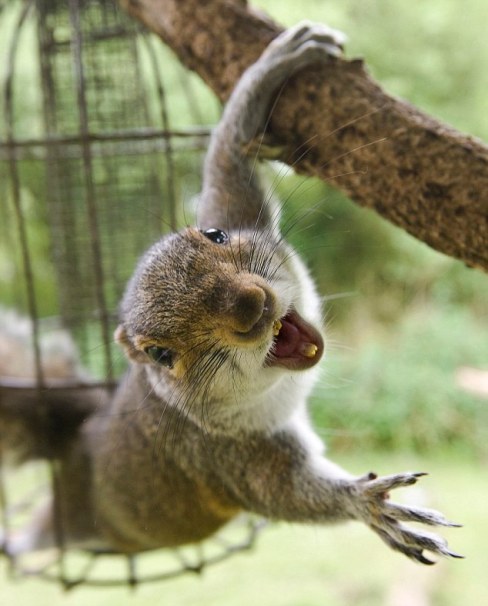
My daily noon dog walk yesterday began like many others. Buddy and I took off down my street, heading toward the woods. Snow was falling with a few inches accumulating on the ground. As we neared the intersection at the end of my street with the forest beckoning beyond, I noticed what looked like a pile of brownish-gray leaves on the curb.

Buddy immediately perked up, and before I knew it, he was running at the leaf pile. His retractable leash played out its full fifteen feet, and my shoulder jerked in its socket as Buddy kept trying to run at the leaf pile, which had unfurled into the form of a gray squirrel.

I have learned the hard way that when it comes to my dog and squirrels, the health of my shoulder muscles is more important than trying to save the squirrels from his hunting instincts, so I let the leash go. By this time, Buddy was behind the squirrel, which came running out into the snowy intersection.

One would think that the squirrel would run anywhere but toward another threat (me). But this squirrel headed right at me, my dog on its heels. The squirrel hopped through the snow sluggishly. Whether this was because of the snow depth or because there was something wrong with it, I couldn’t tell.

As the squirrel came closer, its course stayed true — right toward me. I remembered a time when I was young and a wild squirrel climbed up my leg to get my peanut butter sandwich.

I spread my legs a bit wider to discourage the squirrel from any leg-climbing ideas. Did it think I was some sort of stumpy tree? The squirrel kept coming, passing directly between my boots. Buddy was a few feet behind, his leash dragging through the snow.

Uh-oh. Buddy was headed directly between my legs, too. He is a very tall, eighty-pound dog. I lifted up one leg so he could pass under.

Then I heard the tires of a vehicle slowly crunching through the snow. I looked away from Buddy and saw a white pickup truck approaching. More chaos. Just what we needed!

The squirrel continued its sluggish trajectory to a tree in a neighbor’s yard. In the meantime, I was able to grab Buddy’s leash and command him to “Leave it!” (As in leave the squirrel alone.) The command actually worked. He stopped and I grabbed up the slack in his leash, holding him tight and out of the truck driver’s way. The squirrel was now high in the tree.

The driver, seeing that all was under control, eased into the intersection. Beneath my scarf I began laughing at the scene that must have confronted him. Through his frosty window, I saw that he was laughing, too.

We waved at each other and he continued on his way.

Shunned by the World’s Largest Rubber Duckie

DenisSullivanTallShips 008

The World’s Largest Rubber Duck turns its back on me.

Duluth is hosting a Tall Ships Festival this weekend. A newcomer to the event is the “World’s Largest Rubber Duck.” I put that in quotes because equally large or larger rubber ducks exist in the world overseas. It’s just that the U.S. creator (who happens to be a Duluthian, too) of this particular duck trademarked the phrase.

Even so, I was intrigued to view this giant yellow floating bathtub toy – in part to see if it could nudge me out of my doldrums following my father’s death – but also just because it’s novel. Like others who have attended these festivals over the years, I’ve seen plenty of tall ships, but never a sci-fi movie-sized duck. Also, I needed to attend the festival for work, to deliver some keys to a co-worker who was on one of the tall ships (the Denis Sullivan).

DenisSullivanTallShips 009

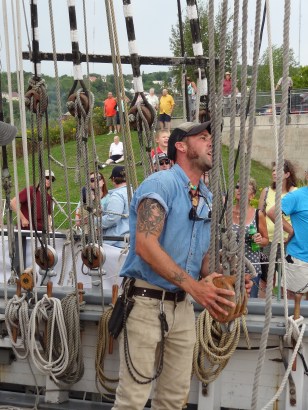
A crew member barks orders on the Denis Sullivan.

The duck was participating in the opening ceremony for the festival, called the Parade of Sail. For this spectacle, all of the ships sail into the Duluth-Superior Harbor through the ship canal and under Duluth’s iconic Aerial Lift Bridge.

I left in what I thought was enough time to catch the parade. But I didn’t anticipate the number of other people who also wanted to attend. I expected a lot of people, and planned my travel route to the festival via a back way, but there were not just a lot of people. There were HORDES.

After being turned away from one event parking lot because I didn’t pre-pay a parking ticket, I ended up waiting in line for 40-something minutes for another lot.

I knew I was going to miss the beginning of the parade, so enterprising me got out of line to bribe a local business to let me park in their lot. They weren’t open to my bribe (or perhaps it was not large enough!), so I got back in line, even father back.

DenisSullivanTallShips 003

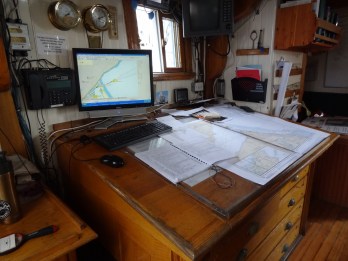
The chart room, below decks in the Denis Sullivan.

As I was waiting, and gazing out my car window through a fence and a tangle of tansy weed, I saw the head of a large yellow duck gliding past in the nearby harbor. I was missing the duck!

Alas, failed bribery attempt already past, there was nothing more I could do to improve my situation. I could only hope the duck would still be around once I made my way to the event grounds.

By the time I got to the parking lot entrance, the attendants were only letting cars in once other cars came out. After another 15 minutes or so, I finally got to park my car in a swampy spot and hoof it to the harbor.

The duck apparently did not like that I was late, and would not show its face to me. It was far away by this time, across the harbor at its docking site — its back turned in disapproval at my lack of strategic event attendance planning skills. Sigh.

KKline

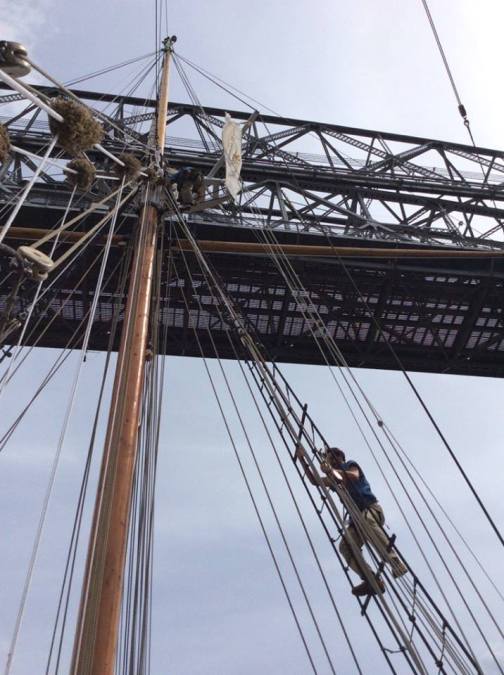
A crew member climbs the rigging on the Denis Sullivan as it sails under Duluth’s Aerial Lift Bridge. Image courtesy of Kathy Kline, Wisconsin Sea Grant.

But my spirits lifted when I ended up getting a free tour of the Denis Sullivan. I found my co-worker among the hordes and she let me aboard. The Sullivan’s home port is Milwaukee, and the ship is used for educational purposes. My co-worker had just completed a five-day sail with about a dozen Great Lakes teachers, instructing them on lake ecology and maritime history.

Enjoy the photos!

WDSETV

What the duck looked like to everyone else. Image courtesy of WDSE-TV.

Hangin’ on the South Pier

I had to wait for some work colleagues on a pier on Duluth’s Ship Canal last week. They were late. I had a camera. Enjoy the fruits of my boredom!

ChinWu Wave Pressure Gauge 003

ChinWu Wave Pressure Gauge 008

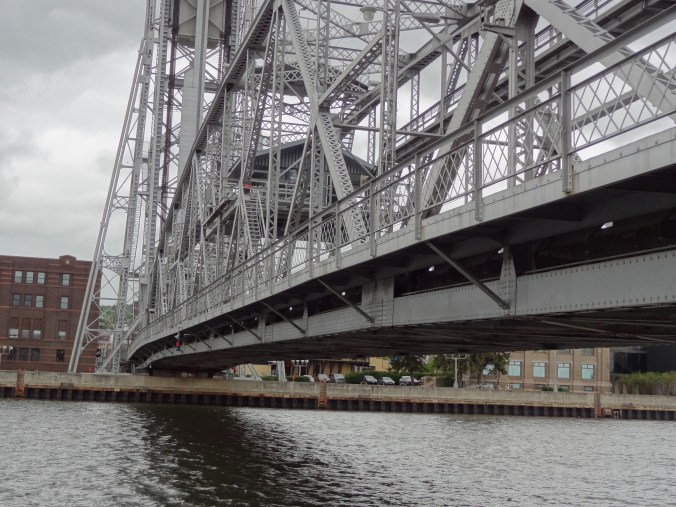
Duluth’s Aerial Lift Bridge (from a different perspective than usual.)

ChinWu Wave Pressure Gauge 024

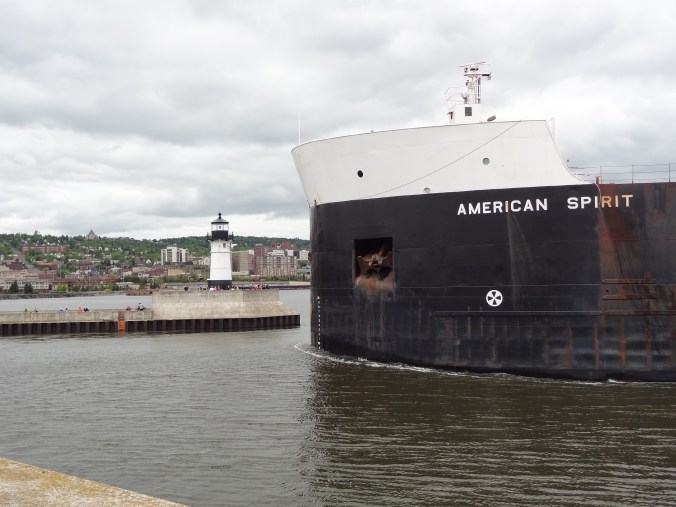
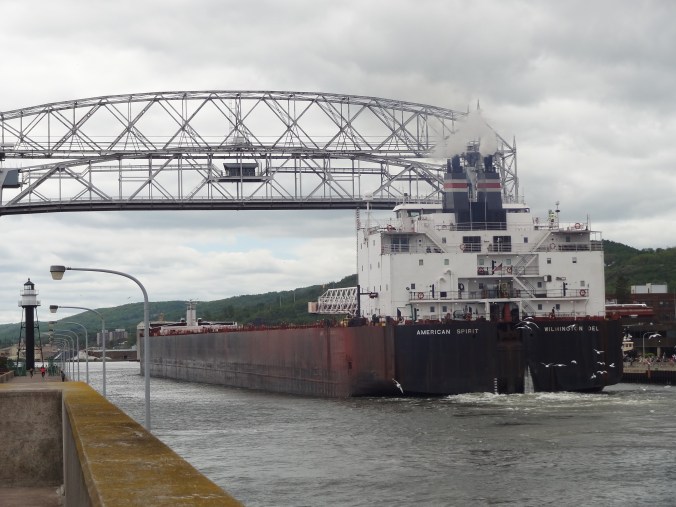
A ship, the American Spirit, enters the ship canal. Looks like it’s going to crash, doesn’t it?

ChinWu Wave Pressure Gauge 029

ChinWu Wave Pressure Gauge 039

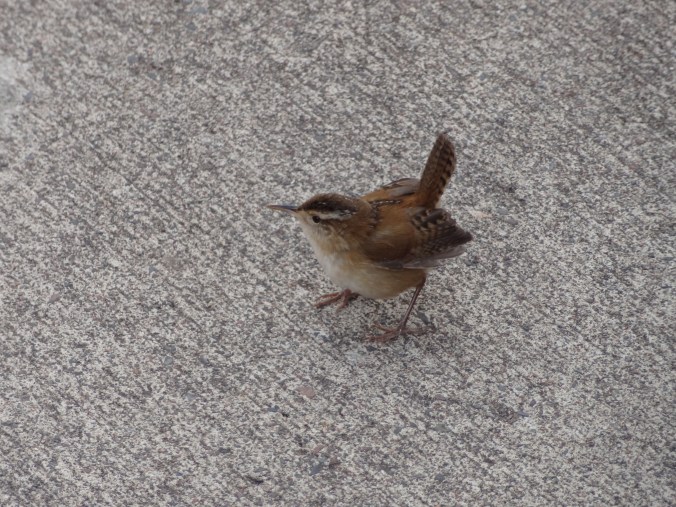
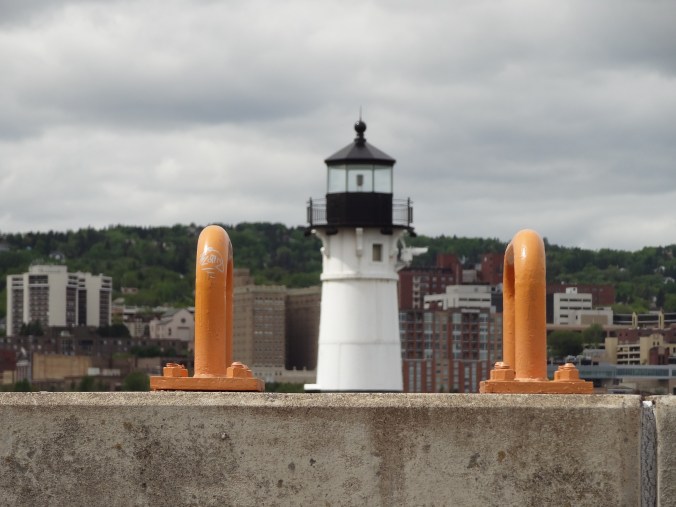
A friendly little house wren kept me company. It was catching bugs behind the lighthouse on the pier.

ChinWu Wave Pressure Gauge 034

When my colleagues arrived, they installed a wave gauge pressure sensor off the pier that will be used to help detect and predict the presence of rip currents, which can sweep unwary swimmers out into Lake Superior. The local newspaper wrote a (front page!) story about the project. Read it here.

Monarch Mania

20160521_125303

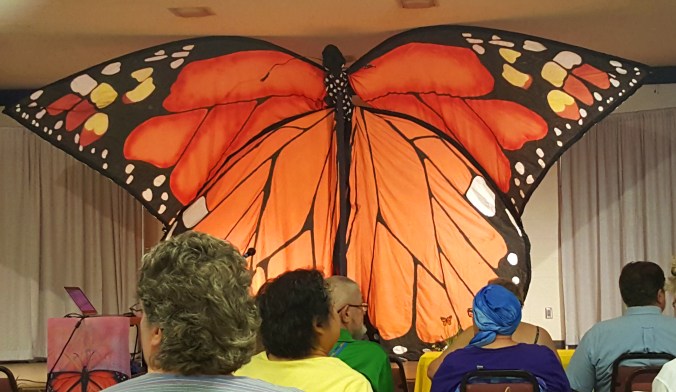
Any minute now the first monarch butterflies will wing their way into the northland on their annual migration. Thanks to the first-ever Duluth Monarch Festival this weekend, I learned that the butterflies that return to Minnesota aren’t the ones that left in fall for Mexico, but are their offspring that grew up in early spring somewhere in the southern U.S.

If they aren’t the butterflies that left here, how do they know to return? How can an insect that weighs about the same as a paperclip survive the long flight? These are just some of the intriguing questions that surround monarchs.

On the street where I grew up, milkweed (the monarch caterpillar’s favorite plant food) flourished in a vacant lot kitty-corner from our house. I had a little round wire mesh insect container where I would grow the caterpillars into butterflies indoors. I can’t recall exactly how I learned to do this, but suspect my older brothers taught me. I raised dozens, fascinated by the transformations the caterpillars went through in becoming the beautiful black, orange and white butterflies that are so distinctive and a joy to see.

My attachment to the creatures even extended to the schoolyard. On one of my first days on the kindergarten playground, a boy killed a monarch caterpillar. I thought he was the cruelest person on the planet, and begged him not to kill it because, “These are the ones that make butterflies!” Other than that, I lacked the communication skills to tell him why I was so upset. I ended up burying the caterpillar underneath a pile of playground pebbles. Now I understand his actions were just the casual cruelty of boys (and because he had probably never raised caterpillars), but for the rest of my grade school career, I shunned him as The Boy Who Kills Caterpillars.

DSC02677

A monarch caterpillar on a milkweed plant.

Playground killings aside, the monarch population has dropped significantly over the years due to habitat loss, pesticide use, and a wacky climate — to the point that the fall migration to Mexico is in danger of disappearing. The last two years have had the lowest counts in history. Instead of taking up 18 hectares of roosting forest in Mexico (1996), the butterflies now only take up 2-4 hectares.

One relatively painless way to learn more about the plight of the monarch is to read “Flight Behavior,” a novel by Barbara Kingsolver.

The monarch festival I attended is one effort to help this beleaguered bug, and the organizers hope to make it an annual event. The goal was to educate citizens about monarchs and to help people become involved in restoring monarch habitat. One of the speakers was Prof. Karen Oberhauser from the University of Minnesota. She said an estimated two million more milkweed plants are needed for the monarch population to stabilize. To that end, a local group (Duluth Monarch Buddies) was giving away milkweed seeds. Milkweed plants and other butterfly-friendly plants were available for sale.

They were also encouraging people to sign up to be monarch larva (caterpillar) monitors. The Monarch Larva Monitoring Project is a citizen science effort where volunteers track how many monarch eggs and caterpillars are in a local milkweed patch. How I would have loved to do this when I was a child! Heck, I intend to do it now. Monitors visit their sites once a week and enter observations onto a data sheet. The goal is to better understand the health of local monarch populations and how they change over time.

I picked up a packet of milkweed seeds. I can’t wait to plant them and do my small part to save the monarchs. Take that, Boy Who Kills Caterpillars!

Songs that Should be in Movies

BobbieD

Bob Dylan

Duluth is gearing up for Dylan Fest this coming week. For those unaware, singer Bob Dylan was born here and lived in northern Minnesota through his high school days. Although some local controversy exists about Dylan’s perceived slights of his hometown, many people here like his music and I expect the events will be full.

Not long ago on the radio I heard Dylan performing Rodgers and Hammerstein’s “Some Enchanted Evening.” Hearing him sing it in his nasally voice was funny and sort of surreal. It made me pull off the road and start a list of “Songs that Should be in Movies.” Who knows, such a list could come in handy if movies are ever made from my novels. (Grin.) I can see Dylan’s song accompanying a slow dance scene.

Other songs I’ve heard since then that I’ve added to my list are:

Running with the Wolves,” by Cloud Cult. This would make a good road trip song.

From a Payphone in the Rain” and “Me, You & the Universe,” by Teague Alexy. The payphone song is so heart-wrenching, it made me glad that Teague doesn’t record such songs very often. (Just stab me in the heart with a pencil and twist it, why don’t you?!) These songs are stories in themselves – maybe too specific for a movie soundtrack — but they’d make for good closing credits songs; ones to hear while you’re feeling the after-effects of a movie and you want to prolong the agony (or ecstasy) of the story and chill out before you stand up and go out into the real world.

That’s it for my list so far, but I’m still adding to it. Any suggestions?

Nobody Dies in Spring in Duluth

Marsh_marigolds_near_a_stream,_Lydiard_Park_-_geograph.org.uk_-_1249758

Marsh marigolds. Credit: Brian Robert Marshall [CC BY-SA 2.0 (http://creativecommons.org/licenses/by-sa/2.0)%5D, via Wikimedia Commons.

April is National Poetry Month in the U.S. I couldn’t let it pass without posting a poem. This is one I just finished, inspired by a poetry class taught by Duluth Minnesota’s Poet Laureate Jim Johnson, based on Philip Appleman’s poem, “Nobody Dies in Spring.” Try your own version! It’s a fun exercise. I hope this Spring finds you well.

Nobody Dies in Spring in Duluth

Nobody dies in Spring in Duluth.
That’s when we hold gloved hands
with total strangers on the Lakewalk.
We sing sweet nothings to our dogs,
who have been lying by the fireplace
all winter, gazing up at us
with walk-hopeful eyes.
Kids yell and splash bikes through street potholes.
High school students don shorts
when the mercury hits forty-five.
Fathers take a year’s worth of family refuse
in pickup trucks to the dump.
Pussy willows sprout gray fuzzy nubbins
for mothers to cut and bring inside.
Shy yellow marigolds beckon in marshes.
White gulls cry and fly over melting snowdrifts.
The sun reaches down with tentative warm caresses.
Nobody dies in Spring in Duluth.

©2016 Marie Zhuikov


The World’s Largest Freshwater Sandbar

Barkers & WI Point 047

Even though Wisconsin Point on Lake Superior is not truly part of “the world’s largest freshwater sandbar,” it’s still pretty.

It’s a common local point of pride in Duluth to say that Minnesota Point (a.k.a. Park Point) and Wisconsin Point form the “World’s Largest Freshwater Sandbar.” I am sorry to burst the community bubble but . . . NOT.

Way back so many years ago I can’t even find it on the Internet, Duluth sent a delegation of kayakers to Lake Baikal in Russia. They returned with tales of a sandbar or two on this freshwater lake that were even larger than MN/WI points. Maybe I was the only one who listened then because local tourism organizations and media outlets continued to refer to our sandbar as the “world’s largest.”

A couple of years ago (2014), I decided to fact-check the claim because I was editing a government report that repeated it. Lo and behold, I found a provincial park in Canada that claimed the same thing (Sandbanks Provincial Park).

I also asked several scientific types who are in the know about such things and received a response from a researcher at the University of Minnesota Duluth’s Large Lakes Observatory. Prof. Ted Ozersky did some Google Map comparisons and found that Jarki Island at the northernmost tip of Lake Baikal sports a sandbar that is 18 kilometers long. MN/WI points are 16 km long.

He also found a series of long sandbars on Proval Bay along the eastern shore of Lake Baikal that collectively stretch for 40 km.

So, in the document I was editing, I changed the wording to MN/WI points as comprising “one of the largest freshwater sandbars in the world.”

The issue arose again just last week when a fellow blogger made the “world’s largest” claim in his post. Why? Because he saw it elsewhere on the Web.

I figure it’s high time to get definitive news out on the Web that, alas, Minnesota and Wisconsin Points ARE NOT the largest freshwater sandbar in the world. Even the park in Canada has downgraded their claim to say instead that they have the “world’s largest baymouth barrier dune formation.”

In short, it’s okay to say that MN/WI points are the largest freshwater sandbar in the country, or one of the largest freshwater sandbars in the world, but not “THE largest freshwater sandbar in the world.”

Class dismissed.

Crawling out From Under my Musical Rock

truman-no-brad2

A Band Called Truman. Photo by Tanja Heckert.

Is there something your community is known for that you aren’t tuned into? It could be a sports team, an industry (like craft breweries), or some other cultural/historical thing. For me, it’s the local music scene. And now I’m making up for lost time.

For years, I’ve been squished under the rock of my responsibilities so I haven’t been able to enjoy the local music scene. I also haven’t had friends or acquaintances who were into it, so I plodded along, deaf to all the musically talented people around me. And Duluth has a lot of them. Case in point: Gaelynn Lea, who just won National Public Radio’s Tiny Desk Concert Competition. Her unique style surpassed that of 6,000 other people and wowed the judges.

Sure, I knew about the symphony and high school bands – wider community kinds of music, but not so much individual local musicians. I realized I needed to rectify this. As a writer, I appreciate the creativity involved in songwriting and singing, and I feel it is my duty to become more familiar with the local music scene. Besides, I just like it!

I’ve had the good fortune to meet several local musicians/band members (including A Band Called Truman, Teague Alexy, Michael Monroe, Mary Bue, Georganne Hunter, and Jerree Small) and others I’ve managed to see play live or I’ve plucked them out of the “local music” CD section in the library. These include the Hobo Nephews of Uncle Frank, Cloud Cult, Low, Charlie Parr, Bill and Kate Isles, Ryan Lane, Rachael Kilgour, Sara Thomsen, Woodblind, and Jamie Kallestad.

I don’t know what I would do without the library’s help in catching up on twenty-something years of missed local music. Thank god for libraries! I know I’m missing many local musicians in this list, but I’m only halfway through the alphabet in the library section. 🙂

The thing is, I didn’t even know what I was missing until a series of chance encounters, life changes, and opportunities arose. It’s been a fun ‘research project,’ and the experiences will no doubt find their way into my fiction writing.

Is there something in your life that you don’t even know is missing? Something available in your community that’s being wasted on you? Here’s hoping someday you have the ability to take advantage of this food for the soul.

A Lake Superior Cruise

I stopped freelance writing a few years ago, choosing instead to focus on writing fiction and poetry. (And this blog!) I was tired of hiring out my brain for somebody else’s use, since that’s what I do all day at work already. Thankfully, I also no longer had a financialLSMagazineMay16 need to freelance, so I made the conscious decision to stop.

That worked well until about a year ago, when I took a cruise on Lake Superior aboard the Wenonah, the ship that took me on my first trip across the lake.

The cruise dredged up old memories. I considered blogging about them, but once I started writing, I realized I had a story I could sell, dang it!

Alas, I succumbed to freelancing, but at least the story was one I truly wanted to write. I know, poor me. It’s a good problem to have.

My story was recently published in Lake Superior Magazine. It’s a superb magazine — pick up a copy and check it out! (Page 14.)

They also published a couple of my photos. But I have gobs of other photos I took that day, which I thought I would share with you. Please enjoy this virtual cruise along Lake Superior’s North Shore.

DSC02270

The Wenonah at Silver Bay Marina.


DSC02290

The tip of Gold Rock, site of a shipwreck in 1905 that claimed a life.

DSC02298

That turquoise water looks like the Caribbean, doesn’t it? I wouldn’t jump in though. It’s a bit nippy.

DSC02303

Coming around Split Rock Lighthouse. Not many people get to see the lighthouse from a mariner’s view.

DSC02310

A more classic view of the lighthouse.

DSC02322

People frolicing with gulls on an island off Silver Bay.

DSC02327

Piles of taconite pellets waiting to be shipped south to be made into steel.

DSC02333

The taconite plant in Silver Bay, although it looks more like a cloud factory. Perhaps it’s not beautiful, but it’s part of the cultural landscape of this area.

DSC02275

The rugged coastline of Lake Superior’s North Shore.