When is a Bridge a Bong?

St. Louis River Trip 2015 001

The Bong Bridge as seen from the water.

I was giving directions to an out-of-town acquaintance the other day when I told them they’d need to drive over the Bong Bridge. They looked at me, wide-eyed, and started snickering.

Yes, it’s true. In Duluth-Superior we have a bridge by the name of Bong. The Richard I. Bong Memorial Bridge, to be exact. It’s named after a World War II flying ace, but out-of-towners and the uninitiated don’t know that. The name always provokes some kind of reaction.

I was away at college when the bridge was being built and named in the early 1980s. Whenever I returned home and drove on the freeway down the hill into town, I would notice more bridge pillars in the harbor as it slowly came into being. I can’t recall if there was a lot of controversy about the name, but I assume there must have been some.

Although the name is a nice tribute to a local war hero, the people who thought up the name HAD to know it would get shortened to just “Bong Bridge” or just “Bong” in the local vernacular. After all, we have another bridge that spans the same body of water, which is named after John A. Blatnik. Everybody just calls it the “Blatnik.”

“Take the Blatnik to Superior,” we say. Now we can also say, “Take the Bong to Superior.” Most locals know that won’t get you into trouble with the law.

It’s just such a questionable name. I can’t believe it got through the transportation department’s approval process. But Richard Bong must have had a big fan club that overwhelmed common sense when it came to bridge names.

Bong Museum

A mural of Richard Bong and his wife Marge from the Bong Museum in Superior.

We even have a Bong Museum. But it doesn’t contain what you think it might. Not even one. I know. I checked.

The name does make the Bong Bridge easy to remember, I’ll say that for it. While it’s confusing having two bridges that start with a “B” in the area, differentiating between them is easy. The Blatnik is the bridge closest to Lake Superior and it’s named for a guy. Then there’s the other bridge farther inland that’s named for drug paraphernalia.

Maybe the name was a good idea, after all?

Attack of the Killer Turkeys

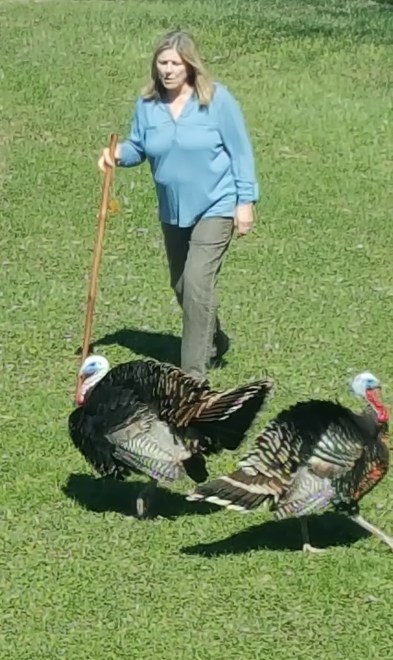
Today I meandered over to a gathering at the home of some friends who live in the woods outside of town. I had been to their house before, but this time was different. Instead of my friends meeting me once I got out of my car, I was met by some wild turkeys. Two toms and a hen walked up to my driver’s door before I could get out. The toms were both displaying in an aggressive manner and the hen pecked the ground a few feet away.

It unnerved me that the turkeys knew which car door I would exit. “This can’t be good,” I thought. After futilely waiting a few minutes for them to budge, I decided on an alternate exit strategy. I clambered over the stick shift console and went out the passenger door.

20170507_104836The turkeys immediately spotted me and followed. I walked faster. They walked faster. Soon I was running for my life to the house door. Just in time, my friend opened the door. She deterred the turkeys with a big stick and ushered me quickly into the house. I swear the turkeys would have followed me right inside, had it not been for that stick.
She apologized for the turkeys, saying they “just showed up” about a month ago. Although the turkeys live in the woods, they are obviously imprinted on people for food.

Despite trying several methods, the only way my friends have found to deal with them is to carry sticks whenever they go out. My friends say the turkeys also stand at their sliding glass doors and watch them while they watch television. Creepy!

As others arrived for the gathering, our main source of entertainment was watching their various reactions to the attack turkeys. Most people got off easier than I did because my friends made it out there sooner with their sticks.

Once I eventually left, the turkeys chased my car the whole way down the long driveway, as if getting back at me for my earlier escape. They kept at it until I was able to leave them in a cloud of dust on the main road.

Wild turkeys have been in the news lately because they are becoming more common in northern Minnesota. People are wondering if the department of natural resources (DNR) has stocked them or something. Nope, says the department.

In my travels between the southern and northern parts of Minnesota over the years, I have noticed turkeys along the highway. Every year, they are farther north. (Opossums are coming, too. Yuk!) I guess it was just a matter of time before they reached my friends’ yard.

The DNR calls the turkeys’ range expansion “one of Minnesota’s greatest conservation success stories.” Last year, the DNR expanded the turkey hunt to include all of northeastern Minnesota. The spring season is open from now until May 31.

Turkey hunters, if you are having trouble finding your prey, I know where a couple are. Just ask. 🙂

Remembering Black Sunday in Duluth

DSC04059

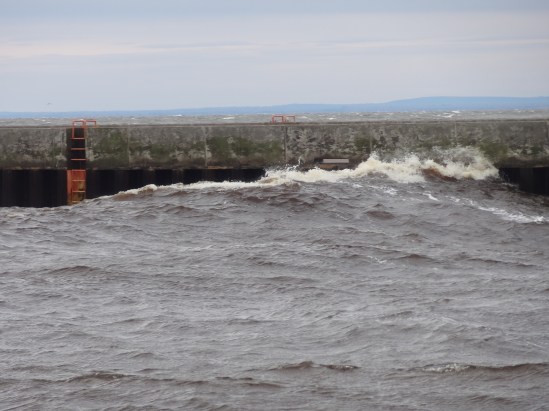
As waves threatened to overtop the pier walls and wind whipped the words from people’s mouths, an intimate ceremony was held earlier this week in Duluth’s Canal Park. The gathering marked 50 years since three brothers and a Coast Guardsman who was trying to find them were swept off the pier during a late April blow. (For more details, please read my earlier post.)

DSC04052

Ron Prei (left) and Tom Mackay.

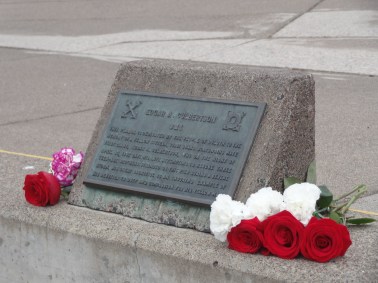
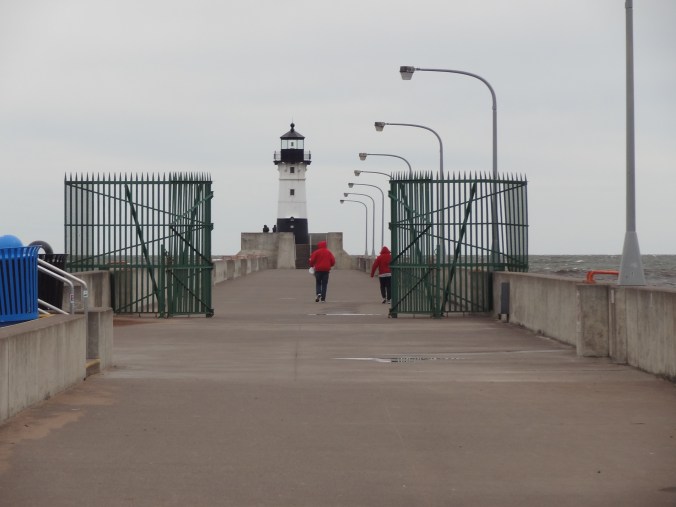
Tom Mackay, a friend of the Coast Guardsman, organized the Black Sunday event. It was simple – no microphones, no chairs – just a bunch of people who wanted to remember. We stood on the North Pier near the shore and the Marine Museum, where the plaque for Guardsman Culbertson rests. It’s not far from the gates put up after the drownings to discourage people from walking the piers during bad weather.

Mackay talked about why he feels it’s important to remember the events of that night long ago. He talked about his friend who died. He talked about the power of the lake. He painted a picture of young lives cut short.

Mackay laid four flowers next to the plaque as he does every year on April 30 – one for each death, and then invited Ron Prei, another Coast Guardsman who was part of the rescue attempt, to talk. The soft-spoken Prei’s words were lost to the wind, but in a WDIO-TV news interview, he described the harrowing conditions of that night and how he’ll never forget.

DSC04055The Halvorson brothers were my cousins – first cousins once removed, or something like that. I was too young when the tragedy happened to remember them, but I remember the effect it had on my family, and the Halvorson family. Later, when we would visit the Halvorson home for dinner, there was the sense of the missing brothers – a blackness that hung in the background and was not overtly acknowledged – at least not when I was around. A certain liveliness was missing. Those feelings were quickly overshadowed by the exuberance of the family’s four other children and the warmth of conversation.
It was good to be part of this public recognition for the boys, the man, and the force that is the lake.

Afterwards, the crowd dispersed, hunched against the cold wind. And we remembered.

DSC04058

The Lake, it is Said, Never Gives up her Dead

Black Sunday

The original newspaper article about “Black Sunday’ as it is known locally. Darn paper got the twin’s names mixed up.

Fifty years ago on this day, I remember by mother and sister crying. I was seated at the dining room table and they were in the living room across the way sobbing their hearts out. I was so young, I didn’t understand what was happening. I only knew this wasn’t usual behavior for them. It scared me.

Eventually they came over and tried to explain. They said three of our cousins had drowned in Lake Superior – 17-year-old Eric, and 16-year-old twins Art and Nate. A Coast Guardsman who was trying to save them also drowned. A wind storm had whipped up the waves on the lake and the boys had driven down to the pier in the evening after a church youth group gathering to watch the power of the lake.

Whose idea was it to try and make it to the lighthouse at the end of the pier? As my family tells it, a common game among teenagers at the time was to run on the pier wall, racing the waves from light post to light post until making it to the end. Then you had to make it back. It was a local rite of passage.

According to witnesses, two of the brothers made it to the lighthouse. The third brother, close behind, lost his footing and was swept off the pier. The other two turned back to save him, but soon they were lost from sight in the frigid water.

I guess it doesn’t matter whose idea it was to race the waves. The brothers can’t tell us, and their bodies were never found.

In response to a call for volunteers to search for the boys that night, three Coast Guardsmen tethered themselves together with rope and made their way to the end of the pier. Finding nothing but wind and furious waves, they were making their way back when one of them, Edgar Culbertson, was washed over the side by a wave. The other two could not save him. I assume he was still attached to the rope and by the time they got to shore, Culbertson was drowned.

In commemoration of my cousins and the men who tried to rescue them, a ceremony was held today at the pier. Since I am the only member of my family left in town, I attended to represent. I’ll write more about that in my next post.

You Know it’s Bad When the Scientists are Marching

20170422_101727

Marchers for Science in Duluth, Minn.

Last weekend I marched with about 1,200 other people along the shores of Lake Superior in support of science. This was a cause I could easily get behind since I work for a water science research organization (Please refer to my previous post, “Why Sea Grant is a Kick-Ass Program (And Not Just Because I Work There)”).

I walked with a few other Sea Granters and recognized many of the researchers our organization funds among the crowd. It was encouraging seeing so many people upholding the value that science brings to our society and supporting full federal funding for scientific programs.

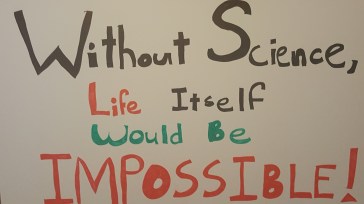
20170422_082249The sign I made for the march said, “Without Science, Life Itself Would be Impossible!” Does that ring a bell with anyone? I wanted something unique, but maybe it was a bit too unique.

I meant it as a play on a terribly blatant propaganda campaign that Monsanto ran in the 1970s in support of the idea of manmade chemicals. Their slogan was, “Without Chemicals, Life Itself Would be Impossible.” It featured a cute Aryan-haired little boy and his doggie. Surely, Monsanto-produced chemicals are just as harmless as this adorable duo. (NOT!)

Monsanto chemicals adI figured only people alive in the 1970s might “get” my sign. I tested a few of my age-appropriate friends as we made our way to the march, but nobody spontaneously recalled the Monsanto campaign. After explaining it, a few remembered, but they did not immediately start applauding my brilliance. I suspect they just thought my sign was saying that medical science is important to human life. That’s okay. My friend had a sign that was as obvious as mine was obtuse. Hers said “Marching for Science.”

You know these events are all about the signs. If you have a boring sign or one that people can’t understand, you might as well stay home.

While sitting on a bench waiting for the march to start, I was mulling over the lameness of my sign when I noticed a TV news crew filming it from afar as it rested on the ground propped up against the bench legs. Maybe it was my sign’s pretty colors or maybe it was the pithy message – anyway, it lured the reporter and cameraman over to our small group. The reporter asked if she could interview us for a story. My friend, her mother, and I readily agreed.

Little did the news crew know, but they had stumbled into a nest of trained media relations professionals. We were able to espouse our key messages and put in a plug for Sea Grant. We ended up being the only ones interviewed for their story. (Which turned out pretty well, given that it was Fox News.)

What didn’t get into the story was my friend Sharon’s explanation about her year-long climate change art project, “Penguins with a Purpose.” She’s a ceramic artist and after the presidential election, decided to put her skills and frustration to use by making large clay penguins to draw attention to one of the issues the president is trying to silence, namely, climate change.

Her goal is to make 100 penguins by the end of the year, which she will sell and donate part of the proceeds to climate science and policy. Each penguin is unique and has a purpose.

She carried one of her heavy penguins for the whole march. We saw dozens of people we knew and had many side conversations along the way. Even though the march took energy, I completed it feeling energized by the crowd.

For now, hopeful noises are coming out of Washington D.C. that my Sea Grant colleagues and I will still have our jobs after next week. It’s sounding like Congress will pass a continuing resolution on the budget for the rest of the year instead of going with President Trump’s plan to fund his wall on the Mexican border with the entire Sea Grant budget (and those of other agencies).

This may just delay the wall-funding issue until the next budget cycle at the end of the year, but it’s comforting to think we’ll have our jobs for a few more months. Thank you to everyone who’s written their Congressperson. Every little bit helps.

20170422_100312

Standing strong for science in Duluth.

It’s Christmas on Easter!

20170416_155329

A book project I’ve been working on for about a year-and-a-half is complete! Copies of the book arrived this weekend, so I feel like it’s Christmas even though it’s really Easter.

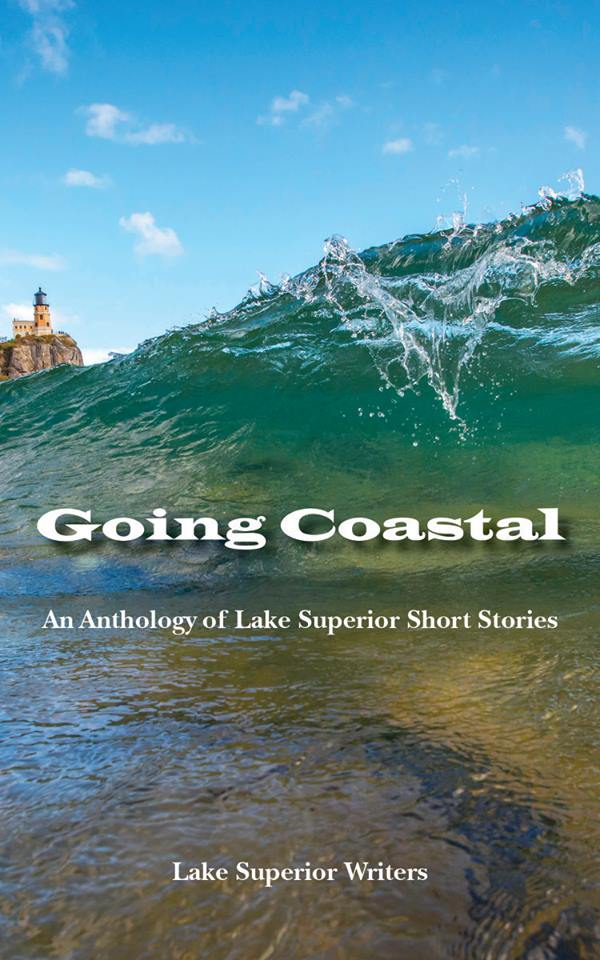
The book is called “Going Coastal.” It’s an anthology of Lake Superior-inspired short stories written by nine local (northeastern MN and northern WI) authors, including myself. My story, “Water Witch,” is the first short story I’ve ever written, so I feel honored that it’s included.

All of the writers are members of Lake Superior Writers, a local nonprofit group that “supports the artistic development of writers and fosters a vibrant literary arts community.” Proceeds from book sales support this group.

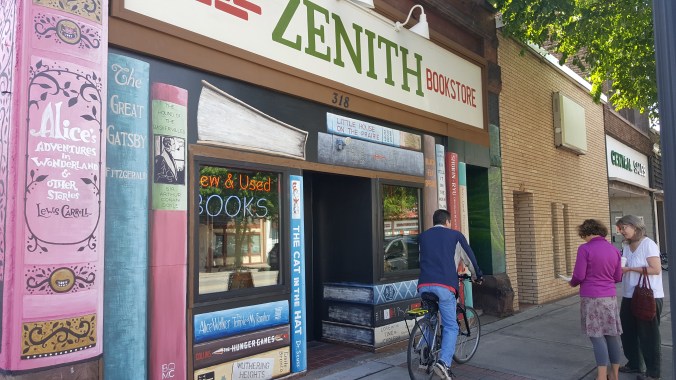
The idea for the anthology started with a conversation I had with the manager of a bookstore in Duluth.  She asked me what I was working on and I told her “short stories.” She said, “You know what customers come in and ask me for? Short stories about Lake Superior. I have to tell them I don’t have any.”

**Bing** Lake Superior Writers has an annual contest. What if we made the contest theme this year about Lake Superior? And what if we were able to find a publisher for the stories? And what if the book could be sold in this bookstore? (And others, of course.)

I’m a board member of the group and brought the idea up at a meeting where we were discussing the contest. The other board members thought it was a great idea, too. And a project was born. After the contest was over and the judges had chosen the winning stories, I started contacting publishers about the project. Several were interested, but I ended up going with North Star Press, the publisher of my novels.

The name of the writing contest was “Going Coastal,” and the board thought that was also a good name for the anthology, and so did the publisher, so it stuck. Then came the need for a cover image. I’m on Facebook probably way more than is healthy for me, and I recalled seeing an image there by a local photographer who often gets into Lake Superior to take his photos. His stunning photo showed the iconic Split Rock Lighthouse seemingly swamped by a large Lake Superior wave. Perfect!

I worked with the authors to edit their stories, and then needed to decide how to organize them in the anthology. I offered the other board members the opportunity to help with this task (which was new to me) but they said I could have the “honor.”

Shoot – how was I ever going to decide? Well, a couple of the stories had Native American themes in them. Some were more mystical than others. A couple focused on ships. A couple others were about rocks. One was about a lighthouse. Another was about a family drama and had a super strong ending. Some stories were short, others were long.

I finally decided to organize them along themes, but I also kept story length in mind and tried to switch that up for variety. Figuring out the story order was as much an art as writing one of the stories itself, and was a fun exercise. I hope it worked.

If you like lighthouses, ships, beaches, ghosts, road trips, history, storms, agates, islands, family drama, and the mystical power of Lake Superior, you’ll enjoy this book.  It costs $12.95 and is available from North Star Press, but also Barnes and Noble and Amazon, which have it as an e-book, too. Take a read!

Anthology authors are Theresa Allison-Price of Superior; James Brakken of Cable; Evan Sasman of Ashland, Johnna Suihkonen of Lakeville; and Judy Budreau, Eric Chandler, Phil Fitzpatrick, Maxwell Reagan and me of Duluth.

We’re having a book launch sponsored by The Bookstore at Fitger’s on Sat., April 29 from 4-6 p.m. in the August Fitger Room on the third floor of Fitger’s Mall (600 E. Superior St., Duluth). There will be free appetizers from The Boat Club Restaurant and a cash bar. Each author (except for one who can’t make it) will read from their story.

Come on out and keep that Christmas spirit going through April!

Skiing (and Waxing) Nostalgic

korkkinordic1977

Marie at the start of her first cross-country ski race, waiting for Charlie Banks to signal the start.

Last weekend, a friend and I revisited the Korkki Nordic Ski Trail, where I competed in my first cross-country ski race forty years ago. The year was 1977 and I was in eighth grade, part of my junior high school’s ski team. My equipment included wooden skis and bamboo poles with black rubber baskets. Clad in bell-bottom jeans and a ‘fashionable’ down vest, my head protected from the cold by a knit hat with a huge ball atop it, I ended up winning the race and the city championship for my grade.

Winning the first race I ever entered – you would think it would be a good experience and I’d return to the same trail dozens of times to relive the glory. But I didn’t. Why did it take me four decades?

20170116_145524That’s what I was trying to figure out as I shooshed down the trail on my fiberglass skinny skis (waxable ones) last weekend.

Now, the thing you need to understand is that Korkki Nordic is Old School. Only one track winds its way through pines on land tucked in the highlands along Lake Superior’s North Shore. And the trees are close enough to lean over and kiss as you go by – not ten feet away on either side like most ski trails. Classic skiing only; none of that fancy-schmancy skate-skiing.

20170116_143519

My friend, on the trail.

The trail system is maintained by a nonprofit organization and was started by the very man who kept time during my first ski race. Charlie Banks is no longer with us, but his legacy lives on.

The trail is sort of out of the way. With so many good ones in Duluth, that could be one reason why I didn’t come out here. It wasn’t a place my parents usually skied, and they were the ones driving the car when I was young. But still, why didn’t I come here when I was older?

As my friend and I started skiing, I noticed the timekeeping house was still near the trailhead. After we traveled down the trail a ways, I recalled how clueless I was during my race. Our “coach” didn’t even ski himself, and he did little to prepare us. I only knew that racing meant going as fast as you could until you reached the finish line, so that was my strategy after the staggered start. This led to overtaxed lungs and leaden arms and legs. But I kept going, although I was alone and scared by this new experience and unfamiliar trail. Finally overcome, I paused a time or two to catch my breath on the uphills, terrified that another skier would pass me, but I never saw anyone.

My friend and I continued skiing and I recognized the feel of the trail – lots of small hills, nothing too scary — especially if you take the easy route options, which I did, having nothing left to prove. We skied four kilometers, which I suspect was the same distance as the race. The finish line banner we crossed under looked suspiciously like the exact same one from my stressful race.

Was that it? Even though I won the race, was the stress of it so unpleasant that I had no desire to return to the scene until forty years later? Could be. I recall that in subsequent ski races, somehow I learned more about pacing and didn’t get as burned out.

As I crossed under the banner last weekend, I realized that whatever kept me away for so long, I’m finally over it!

I’m gonna return soon to this little woodland ski trail gem.

Two other local writers have written about their memories of Korkki Nordic, read here for Eric’s and here for Eddy’s.

20170116_145545_001

Lost Lights

christmas-2016-034

My grandchildren
will never see
the lighted tunnel
with the penguin for wishing.
(Rub its head.)

15665867_10154826364384841_4860803215423004416_n

Image by Amanda Jo Dahl.

They will never see
the sugarplum fairy
high in the tree;
the unicorn that changes colors;
Cinderella’s carriage
bedecked with white lights.

They will never walk
the driftwood path
to the dark and quiet lake;
the stars overhead
dimmed by green laser lights on the sand;
city lights pulsing on the hillside beyond.

15672628_10154826364169841_9077664158330475617_n

Image by Amanda Jo Dahl

They’ll never drink hot cider
in the garden house;
never roast marshmallows
in the outdoor fire here;
never laugh at their reflections
in the low slung, slanting mirrors.
When they are older,
they will never kiss that special someone
under this frosted mistletoe.

My grandchildren
will never know this tradition
unless
I spark the light
behind their eyes
with words.

10262099_1156722037690434_5622356832139128331_n

This is a tribute to a Christmas lighting display on Park Point in Duluth, Minn. Marcia Hales (seen lighting a wish lantern in my photo from 2015) has invited the public to enjoy the display in her yard for years. She recently announced that 2016 will be the last year for her display. I wrote this poem very quickly after spending last evening in her lights.


UPDATE: Jan. 7, 2107 was proclaimed Marcia hales Day in Duluth. It was supposed to be the last day for people to visit her light display, but after the proclamation reading, Marcia announced the lights will go on! She’s getting a lot of community support to keep them glowing into the future.

Just Your Average Winter’s Day Walk and Squirrel Attack

attack-squirrel

Image credit: DailyMail.com

My daily noon dog walk yesterday began like many others. Buddy and I took off down my street, heading toward the woods. Snow was falling with a few inches accumulating on the ground. As we neared the intersection at the end of my street with the forest beckoning beyond, I noticed what looked like a pile of brownish-gray leaves on the curb.

Buddy immediately perked up, and before I knew it, he was running at the leaf pile. His retractable leash played out its full fifteen feet, and my shoulder jerked in its socket as Buddy kept trying to run at the leaf pile, which had unfurled into the form of a gray squirrel.

I have learned the hard way that when it comes to my dog and squirrels, the health of my shoulder muscles is more important than trying to save the squirrels from his hunting instincts, so I let the leash go. By this time, Buddy was behind the squirrel, which came running out into the snowy intersection.

One would think that the squirrel would run anywhere but toward another threat (me). But this squirrel headed right at me, my dog on its heels. The squirrel hopped through the snow sluggishly. Whether this was because of the snow depth or because there was something wrong with it, I couldn’t tell.

As the squirrel came closer, its course stayed true — right toward me. I remembered a time when I was young and a wild squirrel climbed up my leg to get my peanut butter sandwich.

I spread my legs a bit wider to discourage the squirrel from any leg-climbing ideas. Did it think I was some sort of stumpy tree? The squirrel kept coming, passing directly between my boots. Buddy was a few feet behind, his leash dragging through the snow.

Uh-oh. Buddy was headed directly between my legs, too. He is a very tall, eighty-pound dog. I lifted up one leg so he could pass under.

Then I heard the tires of a vehicle slowly crunching through the snow. I looked away from Buddy and saw a white pickup truck approaching. More chaos. Just what we needed!

The squirrel continued its sluggish trajectory to a tree in a neighbor’s yard. In the meantime, I was able to grab Buddy’s leash and command him to “Leave it!” (As in leave the squirrel alone.) The command actually worked. He stopped and I grabbed up the slack in his leash, holding him tight and out of the truck driver’s way. The squirrel was now high in the tree.

The driver, seeing that all was under control, eased into the intersection. Beneath my scarf I began laughing at the scene that must have confronted him. Through his frosty window, I saw that he was laughing, too.

We waved at each other and he continued on his way.