Spending Time in Front of Minnesota’s Largest Stone Fireplace

DSC04597In conjunction with my trip to see Minnesota’s Tallest Waterfall, I also got to spend time with the state’s largest stone fireplace, or so the claim goes. The structure is located inside the dining room of Naniboujou Lodge on Lake Superior, near the Canadian Border.

Now, if you’ve read my novel, “Eye of the Wolf,” the lodge’s name might sound familiar. That’s because I describe Native American stories about Nanabozho in it. Naniboujou or Nanabozho is the trickster god, the god of chaos and practical jokes, a mythical figure of the outdoors and even creation itself.

DSC04602The trickster god myth “belongs” to more than just one tribe. The lodge gets its spelling and images from the Cree version. In my book, I concentrate on the Ojibwe version. Nanabozho’s mother was human and his father was the west wind. He’s a shapeshifter, often appearing as a rabbit or a human with rabbit ears and legs.

A wonderful local painter, Rabbett Before Horses Strickland, centers his work around Nanabozho. You MUST see his work if you ever get the chance!

Anyway, back to the lodge. You know you’re in for something different when first setting eyes upon it. Only two stories high, the building is long and low, covered in shaker shingles with windows outlined in bright orange red.

After checking in at the lobby, your eye will be immediately drawn to the adjacent dining room, which features a high ceiling and walls painted iridescent red, yellow, orange, and blue designs.

DSC04636

The record-breaking stone fireplace anchors the end of the hall, its neutral colors providing a respite for the eye. It looks like the stones could have been collected from the rocky Lake Superior beach, which lies only a few yards away.

The lodge, which is on the National Register of Historical Places, was built in the 1920s as a private hunting club, just before the stock market crash. The club was sold and the building became a public hotel, owned by a series of different people and organizations.

Although the lodge is closed to the public during the winter, it is open for private group events, and that’s how I had the opportunity to see it for a weekend stay. One thing to note is that alcohol is not sold on the premises, but you can bring your own.

The lodge will open back up in the third week of May, when guests can once again experience the dreams of the lodge’s founders, which were to:

Live and learn. Learn why the raspberry follows the fireweed; learn how the fern seed clings to its fronds; learn the ways of the kingbird, the haunts of the wood thrush; learn the pasturage of moose and deer and the home life of the beaver.

If you ever meander up Lake Superior’s North Shore, be sure to check it out!

DSC04594

French artist, Antoine Goufee, painted the lodge’s dining room. This is his version of the lodge’s namesake, Naniboujou.

A Visit to the Tallest Waterfall in Minnesota

20180324_155408Filtered

The High Falls in Grand Portage State Park, Minnesota.

My traveling companion and I meandered north along Lake Superior with migrating bald eagles toward the Canadian Border last weekend. Although temps are still freezing, the long spans of daylight and slackening snows have a feel of spring about them.

We decided to cover some new territory by visiting the High Falls at Grand Portage State Park along the border. The 120-foot falls are the highest in Minnesota, so, in order to be proper Minnesota residents, we figured it was about time we saw them.

A short and slippery hike (wear your Yak Trax!) brought us to a giant white-frosted wedding cake of a waterfall. Most of the falls were encased in ice, but underneath, the Pigeon River flowed with unstoppable abandon. A large crack across the middle foretold of the eventual cutting of the cake once temperatures rise.

Once done with this quest, we drove back south to our resort (the Naniboujou Lodge, which I will write about separately). We vowed to stop at the intriguing and picturesque harbors we had seen on our way up, but were too goal-oriented to explore.

20180324_160746VignetteWe stopped several times along the highway, but the best place was one without a ready-made scenic parking lot. We glimpsed a bay that whispered of Norway and ice and stillness. We drove back and forth, looking for the best access road. There were no roads, only private driveways.
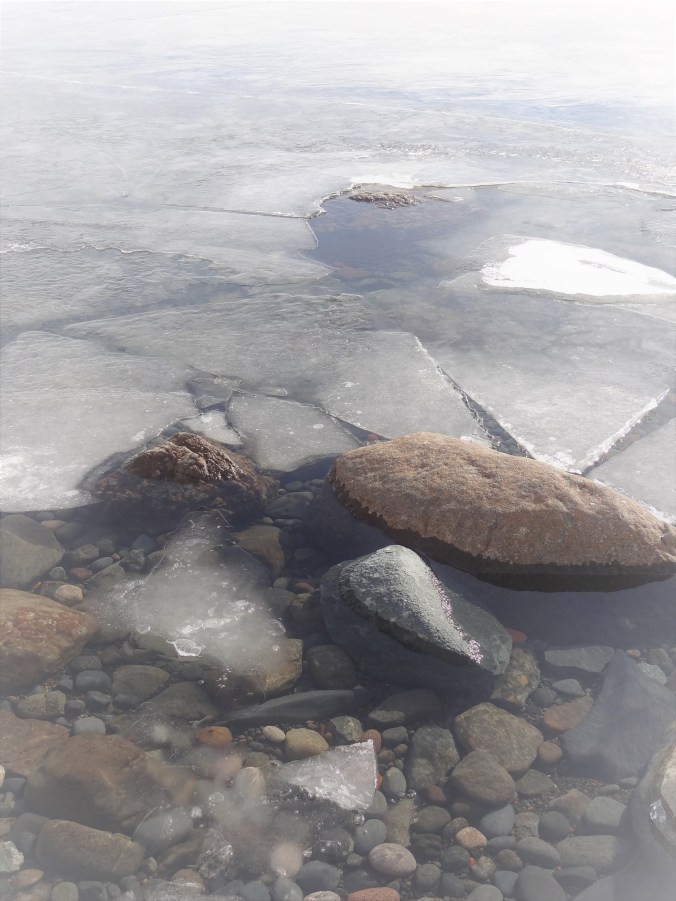
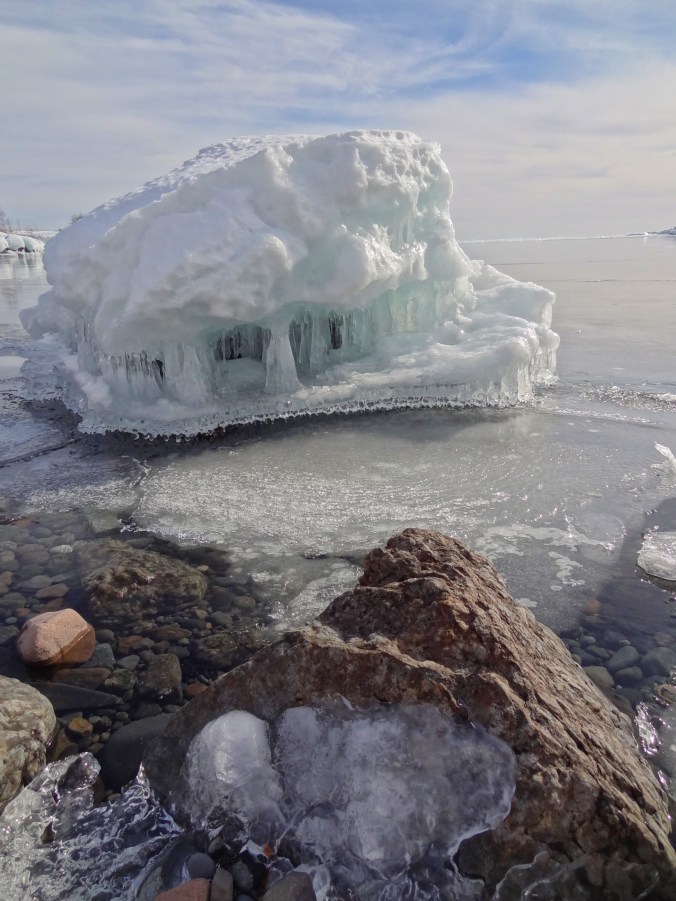
Finally, we chose one that looked the closest to the bay. As we pulled in, we could see from the untrammeled whiteness of the driveway that no one had driven on it for most of the winter. However, there was a foot trail through the snow that we could follow. So, after some hemming and hawing, and getting out of the car, we did.

A short crash through the underbrush brought us out to the view, which now SHOUTED of Norway and ice and stillness. Oh, it was gorgeous and well-worth a little harmless trespassing! Please enjoy these images of our “Secret Cove.”

20180324_160813Zekefilter

DSC04625Soft

DSC04628

Taking an Old-School Snowshoe

20180120_121621It’s been about twenty years since I used my own snowshoes. I had the chance this week to dig them out and tromp around the grounds of a local mansion that’s open to the public for nighttime outdoor tours.

It was an expansive experience. What do I mean by that? Well, please, read on.

My snowshoes are old-school — made in Canada of wood with rawhide lacings. Tapering from a rounded nose to an elongated straight tail, they are four feet long. Their only nod to modernity are the plastic buckles and synthetic foot straps.

Not familiar with the various types of snowshoes, I looked mine up so I could describe them to you. I discovered they are an Alaskan snowshoe, which is supposed to work well on flat and rolling country with a deep snow pack. However, their length makes turning difficult.

My snowshoes were a Christmas present. I used them several times, but then my circumstances changed and I just didn’t have the motivation or opportunity to get out on them. But this nighttime snowshoe excursion sounded like fun, so off I went. It was held on the grounds of Glensheen Mansion, which is in Duluth, on the shores of Lake Superior. A group of about thirty people met and were divided among two tour guides who led us onto the grounds.

The quiet night air was about 20 degrees with little wind. Stars twinkled overhead as we shuffled over land that, in bygone days, held greenhouses where banana trees grew.

What I had forgotten about snowshoes is that they are like the land rovers of winter gear. You can walk up or down any kind of snowy slope with those things without worrying about slipping. That is, except for stairs. I don’t recommend their use on stairs!

At one point, we arrived on the shore of Lake Superior. We stood, rooted, listening to ice slush tinkling and crunching with the motion of low waves. The constellation Orion shown overhead, his slanted belt seeming to point down directly at us.

The sky was dark and huge over the lake. Even though we were within the city, we might as well have been miles away in a wintery wilderness. Almost immediately, a calmness descended on the group and we stopped talking, except for some exclamations of beauty.

I’ve been reading lately about how people’s brain wave patterns and emotions change when they view vistas like a great lake or an ocean, or even an empty desert landscape. We have a primal need for these wide-open natural places as much as we need the comforts of civilization.

A Northern Minnesota writer, Sigurd Olson, described these effects so well in his books about wilderness that I won’t even try to match him. But, as we stood on the shore, our hearts and our minds expanded — just for a moment — until it was time to catch up to the tour guide again.

20180117_190232

The snowshoe hike ended at a cozy bonfire.

The Taste of Hope

20171126_181632

Chef Sean Sherman

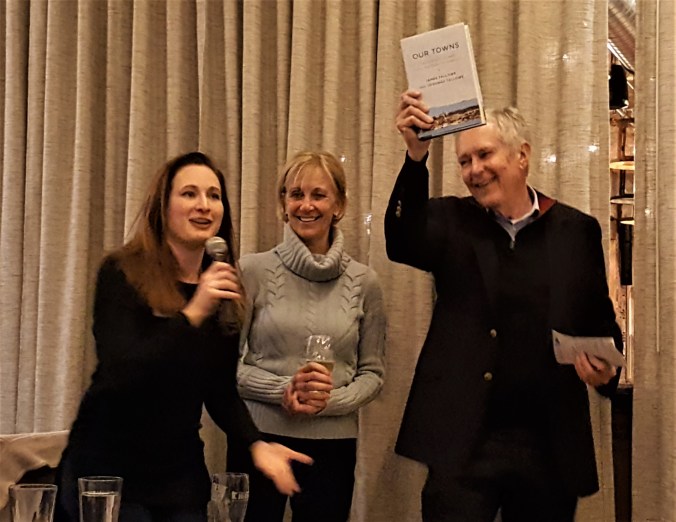
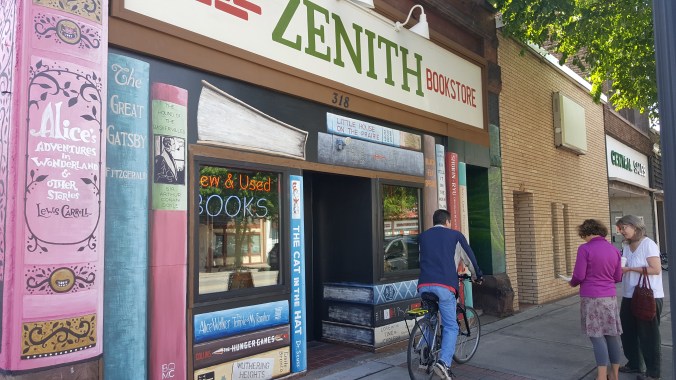
Native American chef, Sean Sherman, visited my fair town several weeks ago to promote his book, “The Sioux Chef’s Indigenous Kitchen.” Given my interest in cooking and gathering wild edibles, I had to go. He spoke to a packed house along with his co-author, Beth Dooley, who is the food editor for the Minneapolis Star Tribune. The event was sponsored by Zenith Bookstore.

One of the first things Sherman did was to disabuse the audience of the notion that Native American cuisine involves any type of fry bread. He works with pre-colonization food made with ingredients the natives grew themselves or foraged. These are things like squash, wild rice, chestnuts, fish, berries, and cedar boughs.

Sherman talked about how natives used all parts of edible plants and animals and how every one of those things had a purpose, “Except for wood ticks. They don’t have a purpose,” he joked.

A member of the Sioux tribe, Sherman grew up in a hardscrabble life on the Pine Ridge Reservation in South Dakota.  He became interested in learning about the foods of his ancestors when he was twenty-nine and was burned out from working as an executive chef in Minneapolis.

He took a year off in Mexico and ended up consulting for a restaurant there that focused on local foods. In his book, Sherman writes, “In an epiphany, I tasted how food weaves people together, connects families through generations, is a life force of identity and social structure. After seeing how the Huicholes held on to so much of their pre-European culture through artwork and food, I recognized that I wanted to know my own food heritage. What did my ancestors eat before Europeans arrived on our lands?”

Re-energized, Sherman returned to the U.S. with a plan in mind. After a lot of research and consulting, he formed The Sioux Chef in 2014 in Minneapolis.  He worked with other indigenous team members to cater events, operate a food truck, host pop-up dinners, and soon they will open a restaurant.

Sherman’s vision for revitalizing indigenous foods reaches beyond the Midwest. He hopes to spread an indigenous food system model across the country, which involves providing education and tools to native communities to reclaim their ancestral cuisines and an important part of their cultures.

And why not? It’s a diet that is hyperlocal and uberhealthy in more ways than just the physical. At the end of his talk at Beaner’s Coffee House (thank you Beaner’s!), samples of cedar tea sweetened with maple syrup were passed around. Man, was that good!

As I drove home with his book on the car seat beside me, I was excited to learn more about Native American cuisine. I could still taste the tangy cedar and sweet syrup on my tongue. To me, it tasted like hope – hope that this movement will undo some of the damage to native cultures, and hope that it will interest more people in taking care of the natural world. You don’t pollute places where you gather your food. If we look on our whole landscape as a big grocery store, perhaps we will take better care of it.

Minnesota Singer/Songwriter Jacob Mahon

jacob-mahon

At first he catches your attention because he pauses during his songs. And what’s he doing with his mouth?

Then you wonder what he’s singing about. Then you wonder how someone just out of high school can have such a powerful, gravelly voice. Then you marvel at his guitar skills. Then you notice that he sounds like Adam Sandler’s Waterboy character sometimes.

He sings a song from the perspective of a goldfish that’s about more than a fish.

He croaks a song about old people. Is he poking fun or offering a critical commentary on how society devalues the elderly?

This guy’s got talent. He’s like a male version of Lorde. Watch him go.

Perfect Duluth Day Interview: https://www.perfectduluthday.com/2017/04/06/duluth-band-profile-jacob-mahon/

KUMD Radio Christine Dean Interview:
http://kumd.org/post/55-live-studio-jacob-mahon#stream/0

A Visit From the Book Fairies . . .

20170917_175009

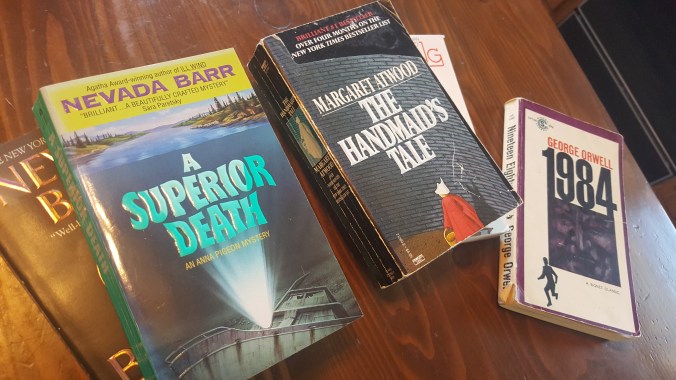
The books I hid today in a local shopping mall as part of International Hide a Book Day.

You may not know it, but today is Hide a Book Day. “Book fairies” around the world are hiding books in public places to encourage a love of reading and to celebrate the ten-year anniversary of Goodreads.

I had recently cleaned out one of my bookshelves and was going to give away these books anyway. There are some oldies, but goodies by Margaret Atwood, George Orwell and Nevada Barr. After watching the Emmys last night, I thought it especially appropriate to be giving away “The Handmaid’s Tale,” which won so many awards and fits with our current political times.

So if you’re in the Kenwood Shopping Center in Duluth today, keep an eye out for these gifts from Marie the Book Fairy. Enjoy and read in good health!

The Joys of “Going Coastal”

thumbnail_IMG_8808

Six of nine “Going Coastal” authors. From L to R, Evan Sasman, Maxwell Reagan, James Brakken, Judy Budreau, Marie Zhuikov, Eric Chandler. Image by Ryan Swanson.

I’ve been working a lot lately to promote a new anthology of Lake Superior short stories, called “Going Coastal.” I’m finding that promoting a book written by a bunch of other authors versus a book written just by myself is a lot more fun. Having others to share in the workload of doing readings and events is well, way less solitary, and I enjoy helping to promote their writing careers.

We just had an event at a new local bookstore this week. A superb description of it can be found in “Ennyman’s Territory,” a local arts and culture blog written by Ed Newman. His story also includes a link to a recent review of the book.

And if you are ever in the Duluth area, stop by our newest independent book store, Zenith Books. If you love to read, you’ll feel right at home there.

20170701_104542

DSC04153Crop

Zenith Book Store owners Angel and Bob Dobrow with a copy of “Going Coastal.”

Sexual Harassment, Wilderness-Style

Mt Lake

A couple of my crewmates clowning around during a break on a bluff above Mountain Lake in the Boundary Waters Canoe Area Wilderness.

Back in the early 1980s, my first summer job in college was as a volunteer for a U.S. Forest Service trail crew in northern Minnesota. This was the first year the Superior National Forest ran a volunteer program, and I looked forward to spending time in the woods after living in a big city where trees grew out of cement. Our task was to clear several long-neglected hiking trails along the Canadian Border in the Boundary Waters Canoe Area Wilderness.

The experience not only taught me how to use a crosscut saw, but also an effective and rather devious method to counter sexual harassment. (No saws involved, however!) You see, I was the only female crew member. One woman and four men tromping around and living in the wilderness together, 24-9 (twenty-four hours per day for nine-day shifts). You do the math. Between each shift, we had five days to recover.

Because the boundary waters is a federally designated Wilderness, we were not allowed to accomplish our task via any motorized or mechanical means. This meant we carried in all our gear by hiking or canoe. This gear consisted of hand tools such as axes, saws, nippers, and shovels, plus our own food and camping equipment. We tented on lakes near the trail and fixed up the campsites along the way, too – digging new latrine holes and smoothing out the dirt tent pads.

Volunteering had seemed like such a good idea at the time. But after about four days, I started asking, What have I gotten myself into? We hiked for miles each day. It was June and the blackflies, mosquitoes, and ticks were out in full force. I could easily slap twenty mosquitos into my jeans with one swipe. We used government-issue bug dope that could take the varnish off of furniture – slathering it on at least five times per day. I’d also never cut through a tree before, and learning new sawing and chopping skills was challenging.

Portaging a canoe was new, too. The crew decided a good initiation for me was to carry our heavy aluminum canoe (this was before the era of Kevlar) up the 120+ steps on Stairway Portage between Rose and Duncan lakes. I made it, although my legs were shaking quite badly once I reached the end of the portage.

I tried not to let all the challenges discourage me. After all, I was in the outdoors that I loved. I was reading John Muir and Sigurd Olson’s books and was buoyed by their idyllic descriptions of nature. I wanted to help the wilderness.

I wrote this in my journal:

Save this space
for that lone bird
blending with the sky
and hill-green water.
Save it
for that flight.

I did not complain, and in fact, volunteered for extra work like hiking back to camp to collect a forgotten canteen, or going on a reconnaissance hike with our crew leader to assess the next day’s trail work. It looked overwhelming. The trail hadn’t been maintained in years, and massive piles of fallen trees blocked our path. In some instances, it was going to be easier just to reroute the trail instead of trying to cut through the deadfall.

Randy*, our crew leader, was a 225-lb. fair-haired Swede who was at the mercy of his vices of drinking and smoking cigars. Another notable crew member was Peter*, a divorced 29-year-old who worked odd jobs in Minneapolis – everything from dish washing to acting in television commercials. Handsome, but mercurial and insecure, he seemed mature at times, but at others, like he had a chip on his shoulder. His perpetual five-o’clock-shadow gave him the look of a stereotypical prison convict. He was also always sharpening his knife, which gave me the willies.

Our evenings were spent around the campfire. Collectively, the guys had brought enough liquor to fill a whole backpack, which came out at that time. Their conversations, which centered around whisky, wilderness, women, and hopping trains, were punctuated by swearing. “Sh*t” and “motherf**ker” were their favorites. They called the tourists that we came across “peasants,” as if they were the wilderness-poor who could only stay in the boundary waters for a short time, while we were truly rich because we got to stay here for most of the summer. I tended to agree with them on that point.

Because I was a woman, I slept in my own tent. The guys slept two or three together in the other tents. Near the end of our second trip, several of the guys started making comments at night when we were all in our sleeping bags. They’d yell over, half-joking, half-not, “Hey Marie!  What does it feel like to have a c**t? Hey Marie, come over here, I have something I need your help with.” You get the drift.

I had never encountered anything like this before. I can’t remember if I acknowledged their taunts or not. And where was crew leader Randy during all this? I don’t know. Probably asleep, or feigning sleep. By the second or third night, I was finding their comments tiresome.

The next day, after the hard labor of constructing erosion control bars on a steep portage, the guys went skinny dipping while I was in my tent reading.

After a while, they mentioned getting cold and that they were thinking of coming out of the water. Instantly inspired, I made my move. I came out of my tent and sat on a rock not far from the lake, enjoying the view and all that nature had to offer.

With me sitting there in all my femininity, the guys did not have the courage to walk naked out of the water. So I sat, not talking, for a good long time. After their teeth started to chatter, I stayed a few minutes more, then nonchalantly ducked back into my tent.

You know what? The vulgar comments stopped, and I didn’t even need to complain to any authority figures. I only needed to muster a little spunk and show them what it felt like to be vulnerable (and very cold and shriveled) because of their gender.

The gender thing wasn’t all bad, however. One evening before the harassment started, Peter volunteered to heat up water over the fire and help me wash my hair while the other guys were gone fishing. He rinsed the suds out onto the ground instead of into the lake, which was our drinking water. His fingers massaging the luxurious warm water through my hair felt divine.

We had a nice talk around the fire afterwards, during which he asked me out to a play in the nearest small town. I don’t recall my exact answer, but it was probably something non-committal, given that I had a boyfriend of sorts back at college. And then there was all that knife-sharpening he liked to do….

I found out later from the other crew members that Peter had in fact just gotten out of the state prison, so it was probably a good thing that the hair washing didn’t woo me.

The harassment didn’t stop me from eventually working for the Forest Service. I volunteered again as a photojournalist on another ranger district in the same forest during my first summer after college. That eventually led to my hire as the forest public affairs specialist.

During the five years I was a Forest Service employee, I never got harassed by another employee. But that could be because I had a reputation. 🙂

*Names have been changed.

Clearwater Lake

The view from one of our campsites on Clearwater Lake.

How Seeing a Bob Dylan Exhibit Made me Happy not to be Famous

20170527_135900

Lyrics to the “Ballad of Donald White.” Dylan wrote them on the cover page in a library book of the people he was staying with in NY City. Needless to say, they did not return the library book. Dylan’s name is on the checkout form on the opposite page.

This weekend I had a chance to visit the Bob Dylan exhibit at Karpeles Manuscript Library Museum in Duluth. I went there for a talk about Dylan given by someone I know. Unbeknownst to me, the time of the talk was changed to an hour later, so I had a long stretch to look at the exhibit beforehand.

And I’m glad I did. I mean, how can I consider myself a true Duluthian if I don’t know at least a little about one of its most famous personages? I learned a lot of new things, and re-remembered some old. But mostly I came away with the sense that it would be creepy to be that famous.

Dylan was born in Duluth in 1941 in the same hospital I was. He lived here until he was five (so said my friend who gave the talk, but Wikipedia says he was six). His father contracted polio (get your vaccinations, people!), necessitating a move to be nearer to relatives in Hibbing, Minn. Dylan graduated from high school in Hibbing and then went to college at my alma mater, the University of Minnesota in Minneapolis. He dropped out after a year and went to seek his fortune (and Woody Guthrie) in New York City.

20170527_141741

A copy of Dylan’s 2016 Nobel Prize diploma for literature.

What both impressed and creeped me out was that the exhibit had things like a copy of Dylan’s birth announcement from the local newspaper, and photos of his early girlfriends, including a letter by his NYC girlfriend, Suze Rotolo, to her mother. In the letter, Suze is chewing out her mother, who obviously didn’t care for Dylan. The exhibit also featured a short note that Dylan wrote to the people he was staying with in NYC, letting them know where he was going and when he’d be back (1 a.m.). He told them not to wait up.

I just can’t imagine being the object of that must interest. I mean, a short note like the one he wrote in NYC would be thrown out by most people. And can you imagine seeing an exhibit under glass filled with photos of your early romantic interests?

But it was obvious that Dylan courted the fame. I mean, even before he was famous he was writing lyrics for friends as keepsakes, and signing his name to them. He went looking for the fame, and found it. Or maybe I am being too hard on him. Maybe he was just expressing and sharing his creativity, and look what happened as a result?

Anyway, I hope I never become that famous. (Although I hardly think there’s any danger of that.) Seeing the exhibit made me much happier to keep writing away in relative obscurity, thank you.

Free Books!

Going Coastal

If you’re active on Goodreads, a book giveaway is currently open for “Going Coastal.” This book is a collection of short stories about Lake Superior. Authors hail from northeastern Minnesota and northern Wisconsin. (A story by yours truly is included.)

The stories were chosen by a panel of judges during a contest offered by Lake Superior Writers last year. Lake Superior Writers is a nonprofit group with over 200 members that supports the artistic development of writers and fosters a vibrant literary arts community.

“If you like lighthouses, ships, beaches, ghosts, road trips up the shore, history, storms, agates, islands, family drama, and the mystical power of water, you’ll enjoy this book,” said Marty Sozansky, board chair of Lake Superior Writers.

Like the horizon blurs between sky and water, reality and fantasy merge in these tales of human struggle on the edge of one of the world’s largest lakes. Click here to enter the giveaway and the chance to win one of two copies. The giveaway is open until June 24, 2017.

If you don’t win, you can always purchase the book for $12.95 at Fitger’s Bookstore in Duluth and online through North Star Press, Amazon.com, and Barnes and Noble. Sales support Lake Superior Writers.