Lean Into Your Fear: Whitewater Rafting on the St. Louis River

pebd794cc-6d1a-4b89-a8a0-43eaca9722a7_c41a24d2-f4b0-4067-a203-838e20a4a2f3_m

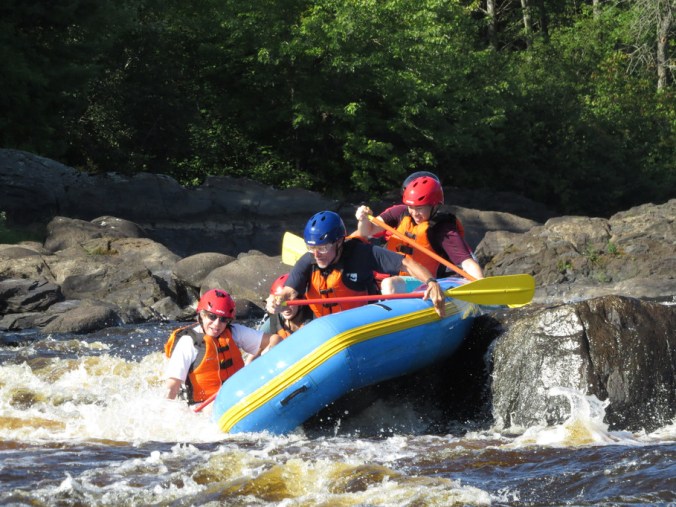
Me (on the left in the red helmet) leaning into my fear on the St. Louis River.

When I write a travel post, because my blog’s name has the word “meander” in it, I usually open by saying I “meandered” here and there.

Well, I can’t use that term this time. It’s more accurate to say that I reluctantly agreed to go on a whitewater rafting trip down the St. Louis River this past weekend, and promised to scream all the way!

It all started when my friend Russ, who is an experienced kayaker, won a silent auction item at a fundraiser for the St. Louis River Alliance a few months ago. He won two tickets for whitewater rafting through Minnesota Whitewater Rafting, a local company that operates out of Scanlon, Minnesota.

Upon my insistence, we agreed to wait for the trip until the water was warm, to make it a more comfortable experience. Now it was August, month of warm weather and water, and I was out of excuses not to go. We gathered everything the company’s information sheet instructed rafters to bring: a dry change of clothes, snug-fitting footwear, windbreaker, towel, etc. And off we went.

Once we arrived, I was surprised by the number of other people who wanted to fling themselves into an inflatable raft at the mercy of the river – twenty-eight of us, to be exact, of all ages and fitness levels.

We started our three-hour journey by choosing one of the seven blue-and-yellow rafts lined up on the shore. Russ and I ended up paired with a young couple from St. Paul. A guide was assigned to each raft. Ours was named Logan.

To us oldsters, all of the guides looked like they were about twelve, but we hoped they knew what they were doing or they wouldn’t have been hired. Thankfully, this proved true!

The ensuing safety talk by the operations guy, named Blu, included instruction to ignore your instincts and “lean into” whatever fearful obstacle the raft encounters. He explained that if you lean away from the rock or high wave, you are more likely to lose your seat and fall out of the raft. Not that falling out of the raft is the worst thing that can happen, but most people like to stay with their group.

The other useful instruction was to keep your feet up if you fall overboard. This is helpful in avoiding sharp rocks and logs, etc., that are on the bottom. Plus, most people aren’t strong enough to withstand the current standing up, so you might as well just go with the flow until one of the kayak patrollers (who go with every trip) retrieve you.

Blu said that in a group our size, it’s common for at least one person to fall overboard. I sure hoped it wouldn’t be me.

I thought the “lean into” rule was particularly deep. Psychologically speaking, sometimes facing your fears is the best way to overcome them. Also, it reminded me of the book “People of the Lie” by M. Scott Peck, who says that most people’s psychological problems arise from trying to avoid emotional pain instead of addressing (leaning into) it.

I decided then and there to change my attitude about the trip – to stop seeing it as something fearful, and instead see it as something to relish, and an opportunity to know the river better. I mean, I’ve lived by it most of my life. I’ve canoed on it, paddleboarded it, boated on it, but I’d never immersed myself in it.

As the company’s website and instruction sheet promised, you will “see the river, feel the river, ride the river,” and you will get wet! On this sunny warm day, I was up for that.

Blu explained we’d encounter six sets of rapids ranging from Class I to III, and two sets of riffles. Each set of rapids would get more challenging along the four-plus-mile stretch until we reached the quiet-water reservoir formed by the Thompson Dam.

Safety talk over, we set out upon the water. Our first task was to run through a “slalom” course between the pylons of the freeway bridge that goes across the river. This let us practice paddling different directions and experience what it feels like when the raft bumps into things.

Then we paddled through a set of riffles called “Warm-Up Rapids.” Everyone came through unscathed and, after stopping for an orientation, we continued to a set of surfing waves at “First Hole” rapids.

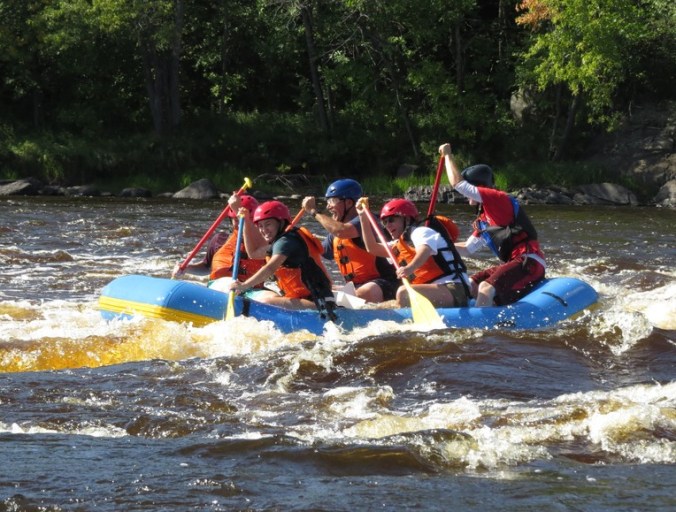
Have you ever seen standing waves that form behind an underwater rock in a river? That’s what we surfed on – if your idea of surfing involves your raft filling with water, which ours did. We surfed several times, bailing out between sessions with the handy bailers provided in each raft.

p9091eedc-1216-426c-9429-98f3600b2324_671929cc-bda5-4d31-b3db-2344e2e28a00_m

Surfing the hole and having fun!

After another group orientation session, we were onto “Two Hole” rapids. I think it was this one that had a big rock in the middle of it. Logan, our guide, thought it would be a good and fun idea to smash our raft into the rock.

On purpose.

Why he thought this was a good idea, I’ll never know! I always thought the whole idea of river rafting was to avoid the rocks. I guess I’ve been wrong all this time.

Granted, he did give us a choice, so we were complicit in the decision. I blame it on the adrenaline rush.

Paddling as hard as we could, our raft went up and over the rock, then started sliding sideways. I was on the outside side – the tippiest side – and remembered to lean into the rock to avoid falling out of the raft. I almost floated out, but managed to stay in by the skin of my teeth. Rather like dental surgery, it felt so good once it was over!

Our next stop was a canyon that featured a couple of small beaches in a slow section of the river. We grounded our rafts and had the chance to swim for a while, clothes, lifejackets and all.

Russ went all the way in. I was fine going waist deep, not because I was worried about polluted water or anything, but because the water was rather chilly to me even for a warm day.

At this point I realized I had never been this far into the river before; me—who had even worked for the St. Louis River Alliance whose sole purpose is to protect the river. I marveled at the brown water – tea stained from the many wetland plants steeping at its headwaters and along the way. The white pines and bare rock faces along the shore looked primeval, like we could have been miles into a wilderness. The beauty filled me  and gave me a new sense of appreciation for the river.

Our rest stop over, it was time for the big guns in terms of rapids. We made it through “Hidden Hole” just fine, then it was onto “Electric Ledge,” which is a Class III rapids that consists of a four-to-six-foot drop.

I had heard the name of this rapids whispered in awe among my kayaker friends for years. Now we were about to go over it! And we were about to go over it before any of the others. Logan explained that our raft had the first aid kit in it, and we needed to go first in case the other rafts needed assistance once they ran the ledge.

Not only were we in the first raft, but Russ and I were sitting in the FRONT of the first raft. Oh, lucky us.

We didn’t have much time to wonder at our luck as the ledge was approaching. I repeated all the rules: lean into your fear, keep your feet up. Then we slid over it, sideways and steep. Russ grabbed onto my arm for support.

Luckily, that steadied him and we both stayed in the boat. So did the rest of our crew, but I can’t say that for one of the other rafts, which did indeed lose one person over the ledge. The person remembered the rules, however, and they were uneventfully picked up not far downriver.

The final set of rapids, “Little Kahuna,” is more technical than terrifying. After some twists and turns, we made it through just fine. From there, a somewhat longish paddle across peaceful water (known as the Boundary Waters to the staff) took us to the end of our journey and a bus that was waiting to drive us back to our starting point.

So, in summary, I did scream as initially promised, but it was from fun, not out of fear. I think this was due to the great job the staff did at letting us know what to expect from each set of rapids. I hadn’t had that on other rafting trips.

I would totally do it again on some warm day (although they do provide wet suits if it’s cold and you want one). And I would totally bring family members on such an adventure. Don’t let a little fear stop you if you have a hankering for some whitewater!
pb4537e2e-9595-42bc-b3f2-dbdd9d761701_cddf1de5-0eef-4962-8d2c-b16f78487c4b_m

Yee haw!

Communing with Duckies

20180825_192404

Last weekend I meandered up the Gunflint Trail in northeastern Minnesota near the Canadian border. I was able to spend time on Gunflint Lake with friends, old and new. I also made friends with this trio of ducks who were out for a peaceful evening swim.

Yin Yoga in a Yurt

Hartley new yurt

Image credit: Hartley Nature Center

I seem to have a tendency to try different forms of yoga. Several years ago, I began regular yoga, then I tried hot yoga, then Thai yoga, and then aerial yoga.

Although I often practice regular yoga and hot yoga, in keeping with my yoga adventurousness, this week I tried yin yoga in a yurt.

The class was offered by Runa Yoga in Duluth. In addition to classes in their studio, they offer classes in different locations around town, including a Yoga + Beer class at a microbrewery.

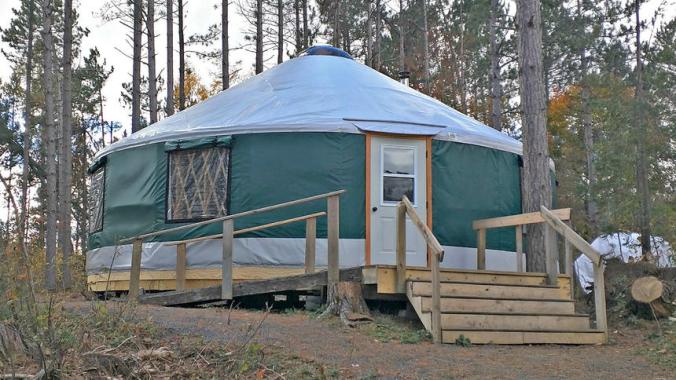
We met at a city park inside a yurt owned by Hartley Nature Center. You may already know that a yurt is a round canvas tent with a wooden frame. This one was nestled in the woods, offering views of red pine tree trunks all around, and was large enough to fit 30 yogis.

The teacher said that yin yoga focuses more on stretching ligaments and joints than other forms of yoga. Our session featured live ambient music performed by two local musicians. I found it strange, however, that these musicians showed absolutely no emotion while performing. Even when the instructor introduced them, they remained stone-faced.

Is robotic-like behavior a prerequisite for ambient music performers? I have no idea. They DID smile after the class was all over, though.

It’s a mystery.

Their music was so ambient and so relaxing that at the end of class, when we were all in our final resting poses, I swear the guy in front of me started SNORING. Thankfully, he awoke once it was time to go, saving himself from further embarrassment. I wonder if anyone would have woken him at the end if he had just kept sleeping?

Yet another mystery.

Despite all the mysteries, or perhaps because of them, yin yoga in a yurt was cool. If you’re looking to switch up your routine, I recommend it. Just bring a friend along to wake you up in case it gets a little too relaxing.

Biking in the Rain on the Alex Leveau Trail

20180730_125149

A view from the Alex Leveau Trail in Carlton.

We heard through the bicycling grapevine that the Willard Munger Bike Trail was all repaired (from the storm damage a few years ago) and open now in its entirety. So my friend Russ and I headed to Carlton, Minnesota, to catch the trail there and bike to our hearts’ content.

The only problem was, the bicycling grapevine was WRONG. When we got to the Munger Trail parking lot in Carlton and started biking toward the trailhead, we found a large sign that said the trail was closed!

Another trail is accessible from the same area, named the Alex Leveau Memorial Trail if you head southeast across the railroad tracks. I had biked it a few years ago, and remembered it was there.

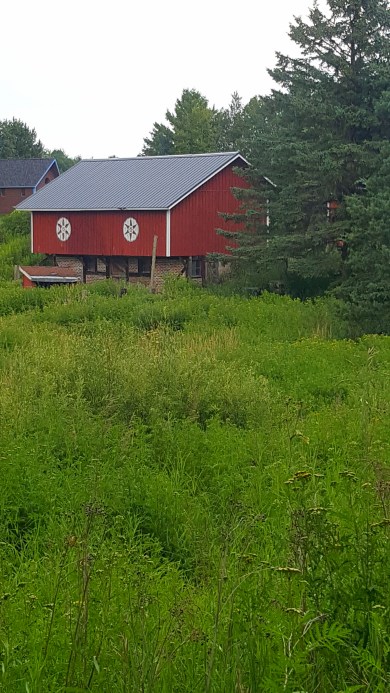
Somewhat disconsolate, we biked that instead. But our mood soon lifted because the trail is just so gosh darn nice. It features views of wetlands and farmlands, barns and raspberries. Without huge hills, it’s an easy ride, and would be a good trail for children to try. But it’s not too monotonous either.

20180730_125246The segment we travelled is 6.5 miles long. Most of it is a paved trail, but when you get near Wrenshall, you have to follow the highway for a while. At the 6.5-mile milepost, the trail seems to dead end at a highway. We weren’t sure where to go from there, so we just turned around and went back to Carlton, although I think there might be other parts of it farther on.
The trail was named in memory of a former county commissioner and dairy farmer who was an advocate for using abandoned railways as public trails.

As we biked back to the parking lot, a series of “pop-up” rainstorms popped up. We thought they would miss us until the wind changed and one caught us. The rain spatters were cold, but we kept warm by biking.

If this had been a romance novel, getting caught in the rain could have led to a passionate embrace in rain-slicked bike clothes. But it’s kind of hard to kiss when you’re both wearing bike helmets and you’re trying to go fast enough to ward off the chill.

So we opted for just being thankful to arrive back to our vehicle wet, but no worse for wear – no road rash from slippery pavement, no lightning strikes nearby. Sometimes, in your elder years, that’s as good as it gets.

A Lake Superior Sailing Experience, Part One: Chocolate Milk and Biting Flies

DSC04737

I recently meandered out onto Lake Superior on my first extended sailboat trip across it with some friends. We left Duluth, Minnesota, and headed to Wisconsin’s Apostle Island National Lakeshore, and then traversed the western arm of the lake to Grand Marais Harbor in Minnesota.

Since I am writing this, you know I survived the three-day trip. If fact, I would like to think I thrived, despite turning green with seasickness once (I avoided hurling, though!) and having to wear all my winter gear, plus hand warmers, on the 4th of July.

I learned a lot about sailing, but still have more to know. And I got a firsthand look at conditions on the lake, which is useful for my job, since we fund research projects on Lake Superior.

Two things struck me and my sailing companions. The first was the color of the water. Almost all the way to the Apostles it was the hue of chocolate milk. The large extent and persistence of the coloring was unusual. There were also floating logs to watch out for.

According to a news story I read upon returning home, the condition is due to a series of recent heavy rains that have sent thousands of tons of silt into the lake. Chequamegon Bay, on the other side of the Apostles, is also experiencing heavy sedimentation.

Usually, the chocolate milk dissipates within a few days, but this round of it is lasting longer than usual because we kept having downpours every few days. Most of the sediment comes from the Nemadji River and its red clay banks, along with the St. Louis River.

We also had more than double the amount of usual rainfall for the month of June. Anglers and charter captains are having to travel farther than usual out into the lake to find clear water for fishing.

DSC04795

Stable flies covering jeans during a beach walk. Good thing they can’t bite through denim!

The second notable thing were the flies. Known locally by the name of “ankle-biters” or sand flies, stable flies look like a common housefly but they are meaner because they bite – usually a person’s ankles. I can attest that there are roughly a gazillion of them out on the lake and its shores this summer.

The only thing that saved us from certain insanity on a shore trip to Outer Island was the fact that we were wearing jeans, which they couldn’t bite through.

The flies congregated in seething clusters from our knees down, rarely venturing farther up our legs. Thank goodness they had no interest in our bare arms or we would have had to run screaming back to our dinghy!

According to a story on National Public Radio, researchers have figured out how and why the flies and other biting insects like mosquitos do this. They think these biting bugs target feet and ankles because we are less likely to notice (and therefore kill) them. They hone in on their target by smell, and apparently, the sweat and skin on our ankles smells different from that of the rest of our body.

Besides wearing jeans, we found it helpful to elevate our feet off the ground while we were on the boat. They didn’t seem to be able to find our ankles if they were level with the rest of our legs. Conditions on the boat never got bad enough that we needed to apply repellant, but we were glad we had some along, just in case.

Although the water wasn’t its typical crystal-clear blue, and we had many insect stowaways aboard our sailboat, Lake Superior was still magical. I greatly enjoyed spending time on it, and hope to do so again someday.

DSC04785

DSC04790

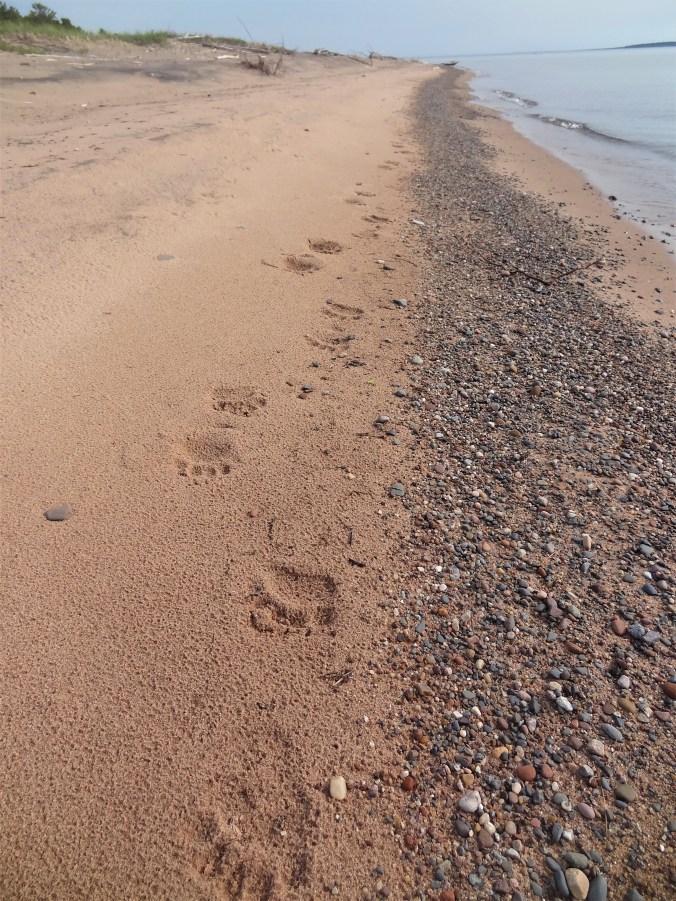
A bear got to this beach before we did.

“Going Coastal” Wins Honors

20180524_201802

The “Going Coastal” anthology sporting its snazzy Northeastern MN Book Awards seal.

An anthology of Lake Superior short stories that contains one of my tales was awarded an honorable mention in the fiction category of the Northeastern Minnesota Book Awards competition. “Going Coastal” contains stories written by nine writers who live around the lake in Minnesota and Wisconsin.

Here’s what the awards committee had to say about the book:

The stories in Going Coastal are all deeply personal, and reflect the lake as a source of beginnings and endings-a source of inspiration, loss, and renewal. The anthology contains a variety of very different stories, touching us in many ways, and connecting us to the power of Lake Superior.

The award was established to recognize books that substantially represent northeastern Minnesota in the areas of history, culture, heritage, or lifestyle. For a list of other winning books for 2018, check here.

To learn how this book project happened, read this previous blog post.

How a Print Writer With a Lisp Turns to Radio

20180318_080010

Tools of the trade for the Twin Ports Newspaper of the Air.

On a recent Sunday morning, I faced a test of my skills when I led a radio broadcast for the Twin Ports Newspaper of the Air (TPNA) for the first time. This is a service of the Lighthouse Center for Vision Loss in Duluth. I am one of about seventy volunteers who read local newspapers every morning for two hours over a closed-circuit radio system for people who can’t read the newspaper themselves. Some are blind and some have had strokes and can no longer hold a newspaper.

Now, if you know me, you realize that getting up early on a weekend morning is definitely not in my character. But I enjoy reading the Sunday paper. I was looking for an organization to volunteer for, and because I have a background in audio work, this just seemed sort of fun.

Once a month, I haul myself out of bed at 6 a.m. and head down to the Lighthouse Center. We have two copies of the newspaper and read in teams of two, switching off every other story. The leader opens the broadcast, keeps track of time, reads public service announcements and the weather forecast, and has final say on which stories get read.  All the other person needs to do is read their assigned stories. It’s much easier not to be the leader!

We don’t have time to read everything in the paper, so we concentrate on news listeners can’t hear elsewhere – the local stories. Other broadcasts focus on national stories, so we don’t need to read those. The obituaries are a big draw, so we are required to read them at the top of the hour. Some people tune in just for those.

It’s tricky because the broadcast is live. If you mess up something, you need to muddle through the best you can. If you have a coughing fit, you need to run out of the room and cough outside, with your partner taking over instead. If you need to pee, you have to hold it until it’s your partner’s turn to read a longer story so that you have enough time to go.

20180318_080050None of these things have happened to me yet, although I did lose track of a story once. With all the story page jumps in the newspaper, it can be confusing to know which page to find it on. Thankfully, my partner noticed my confusion and handed me his copy of the article.

Besides having to overcome my natural weekend laziness, another reason this volunteer job is a challenge is because of the speech impediment I had as a child. In elementary school, while my classmates were out playing during recess, I was sitting in a room with four or five other children, practicing my “s”es.

I wasn’t aware I had a lisp until I got singled out for Speech Class. In fact, when I first heard about the class from my teacher, I thought it involved learning how to stand up in front of people and give speeches. I imagined that might be sort of fun.

It wasn’t until I started going to the class that I understood it involved the drudgery of practicing how to speak correctly. Once a week, we would sit around a table, concentrating on how our tongue moved in our mouths. I needed to learn to redirect the tip of my tongue to the roof of my mouth when speaking, instead of thrusting it forward against the back of my front teeth.

We practiced tongue-twisters and were drilled on certain sounds over and over again until we got it right. I don’t recall how many weeks I was in Speech Class, but I must have made progress because I was able to rejoin my classmates full-time.

My foray into audio began years later in graduate school, when I decided that learning how to do a radio show would be a more interesting capstone project than writing yet another article.

Some nice ladies at KUMD Radio (Thanks Christine Dean! Thanks Lisa Johnson!) were willing to show me how to record and work with the files, and I produced a pre-recorded series called Listening to the Lake, which had public health and environmental themes.

I found my “radio voice,” and this led to a later series called Superior Science News on KUWS Radio, which was produced by Dani Kaeding. Lo and behold, nobody complained about my “s”es.

Along the way, I got to see these radio professionals at work, and always marveled at their ability to simultaneously load CDs, remember to announce the time, and find the day’s weather forecast to read.

Now here I was, groggy on a Sunday morning, put to the test to see if I measured up to my radio lady role models.

I’m happy to report that everything came off without a hitch. They, and my speech teacher, would have been proud.

Communing with Vultures on Ely’s Peak

20180428_180725

One of the views from Ely’s Peak.

Last weekend, a friend and I meandered up 200-300 feet in elevation to the top of Ely’s Peak near Gary-New Duluth. I don’t have a more specific elevation to give you because the different trail guides that I consulted are inconsistent on that point. But I can say that for my 50-something-year-old legs, it felt more like 300 feet. Also, some of the guides say it’s a 1.5-mile round-trip hike. Others that it’s 1.8 miles. I vote for the latter.

20180428_181031We chose the trail to see a new place and because the crisp and sunny spring air seemed to demand it. We didn’t go seeking a vision quest like Native Americans are said to have done on the peak, nor to seek our spirit animals, but we just might have had a dose of both of those things along the way, too.

The trailhead is off of Becks Road. On this particular day, the trailhead parking area was easy to find from the many other cars gathered there.

I followed the directions given on this website, although I would argue that the “beginner” level trail classification is not accurate. I would rate it as “moderately hard” because near the peak, I found myself thinking it would have been helpful to be part mountain goat. And a young mountain goat at that.

(I would say that this trail is not for 80-year-old mountain goats, but for all others it should work as long as you are reasonably fit and coordinated.)

At the start, a boardwalk invites you into a spindly birch forest. The boardwalk gives way to a muddy climb up an incline to an old railroad bed for the Duluth, Winnipeg and Pacific Railway.

20180428_155924

Inside the railroad tunnel.

Follow the railroad bed to the right until you come to a rocky tunnel. The tunnel was built for the railway in 1911. There are trails on the other side of it, but we did not attempt to go through the tunnel because of the sheet of ice layering the way. You may run into some rock climbers, who practice on the craggy basalt in the tunnel.

Although it may seem counter-intuitive, from the tunnel, you should follow the main trail, which goes down the hill to the right. Don’t take the spur that goes up along the side of the tunnel, unless you really are a mountain goat and want to test your mettle.

Don’t be impatient, you will come to an incline soon enough. You are now on the Superior Hiking Trail, which is marked by blue blazes on the trees and rocks. Keep to the left and follow the blazes up the blazing &!*()%$ hill.

Soon enough, wide vistas will offer views of the St. Louis River and the Gary-New Duluth neighborhood.

20180428_162157(0)

Dogs like the Ely’s Peak Trail, too.

No leaves were out on the trees yet – everything looked stark and clean.

The peak offers breath-taking 360-degree views. It was named after Edmund Ely, a Presbyterian missionary from Massachusetts who began teaching the Fond Du Lac Native American community in 1834. Local lore says that this was one of his favorite spots.

As we sat, resting, we noticed several turkey vultures lazily circling the thermals below us. The more we watched, the more vultures seemed to appear from nowhere. Eerily quiet and patient, they circled and circled. We joked that they were probably looking for hapless hikers who fell down the trail.

There’s a school of thought that says if you sit out in nature long enough, an animal will appear that has a lesson to impart. Were the vultures trying to tell us something?

Once back home (and safely out of a vulture’s gullet), I looked up what vultures symbolize. Here’s what I found: the vulture is considered a symbol of cleansing, renewal, and transformation. Vultures are viewed as fearless of death – they stare it in the face and eat death for breakfast (literally)!

I did feel cleansed after that hike. It was like the sunshine and clear air burned off all the old gunk. Perhaps it’s only to make way for more new gunk (ha ha), but I’d like to think I’ll have some time before I get clogged up again.


A Funny Thing Happened at Bent Paddle Taproom . . .

20180424_203354

Laura Mullen, co-owner of Bent Paddle Brewery, introduces Deborah and James Fallows to writers in Duluth, Minnesota. James holds up their new book, “Our Towns.”

Yesterday, I meandered over to the new taproom of one of Duluth’s noted microbreweries, Bent Paddle, even though I don’t like beer (I know, gasp).

Amongst other local literati, I listened to a panel discussion in the brewery’s back room about how to apply for arts grant funding. The event was hosted by Lake Superior Writers, a group that fosters the literary scene in these parts.

The panel was sooooo interesting. Four writers and one person from an arts granting agency shared their experiences and insights. I now feel less intimidated by the idea of applying for one of these grants, should I ever be so inclined.

During the intermission, the coolest thing happened. Just by chance and happenstance, James Fallows, a long-time writer for The Atlantic Magazine was in the taproom, filming a segment for CBS News Sunday Morning. The segment will promote a new book he wrote with his wife Deborah, called “Our Towns: A 100,000-Mile Journey into the Heart of America.”

Deborah was with him, too, and when they heard from the owner (Laura Mullen) that a bunch of writers were in the back room, they HAD to come speak with us. Although it was hard to hear them over the din of the taproom, here’s what I gleaned.

James first came to Duluth to do a story about Cirrus Aircraft, a local company that makes private planes, which deploy their own parachute in times of peril. He also became familiar with Bent Paddle Brewery, which was just starting up at the time. Then he and Deborah had an idea for a book project that would allow them to take the social pulse of America as it stands now. In their own Cirrus plane, they flew to a dozen cities for their research, concentrating on ones that weren’t too large like Greenville, South Carolina; Columbus, Missouri; Burlington, Vermont; Fresno, California; and Duluth, of course.

When asked, James and Deborah said their favorite cities on their tour were the ones with “heart.” They included Duluth in this list. And they said they were so glad to see that the brewery was thriving. James offered us intel on what the Atlantic is publishing these days and even gave us his email address in case we have story ideas to pitch.

How cool is that?!

In preparation for the book’s release on May 8, they had decided to come back to Bent Paddle to film the promo segment. They also filmed in Greenville. The segment will air on CBS Sunday Morning on May 6.

I suspect I unwittingly got filmed for it earlier in the evening when I followed another writer to where the taproom offers three different kinds of water on tap (sparkling, ambient and chilled). We were talking about short stories. When we turned around from the water taps, we were met with the glare of camera lights and shadowy cameramen behind them.

We didn’t think much of it, continuing on our writerly ways, trying to look nonchalant. But after the event was over, I excitedly told my writer friend that our backs might be on national television! Can’t wait to see if we made the cut.

It just goes to show, you never know what can happen when you follow your passions, and that good things can happen in a brewery, even for people who prefer wine over beer.

Jazz at the “O”

oldenburg

Patty Peterson sings during a jazz evening at the Carlton Room in the Oldenburg House. (Note their logo on the ceiling!)

If you like jazz in an intimate setting paired with great food, the Oldenburg House in Carlton, Minnesota, is for you. One weekend each month the homeowners turn their living room into a jazz club called the Carlton Room, pulling in talent from Chicago, the Twin Cities, and other far-flung places.

They don’t ignore local talent, either – including one guy who lives right in the house. Co-owner Glenn Swanson is a leading drummer in his own right, and he performs during the sessions.

When I attended earlier this month, brother/sister Ricky and Patty Peterson from Minneapolis were performing. Ricky is best known for his twenty-year association with saxophone legend David Sanborn and for having produced, written and played keyboards for Prince. Patty is an award winning vocalist, live jazz radio host, and inspirational speaker; she has received the coveted Minnesota Music Award seven times for best vocalist.

We sat at a round table with several other couples. The food was great. The music even better. There’s no better way to spend a snowy spring evening. Someday, I would like to go back during the summer to see the grounds of the house. Under all that snow lie fountains and gardens among the rocky outcroppings that are a signature of the small town of Carlton.

The house itself is on the National Register of Historic places. The owners have oodles of other things going on besides jazz. A blogger friend of mine, Ed Newman, has written many stories about the place. Check out this one for a good overview.