Me, happily ricing, unaware of what lies ahead. Image credit: Wisconsin Sea Grant
I had a chance to harvest wild rice in the St. Louis River near Duluth recently for work. It wasn’t the first time I’d been ricing, but it’s the most memorable.
You can read about my little adventure on the Wisconsin Sea Grant blog through this link. Enjoy, and happy meandering!

I had the chance to meander to Stockton Island, one of several islands in the Apostle Islands National Lakeshore in Lake Superior a couple of weeks ago. I was there to cover what the National Park Service is doing to make their facilities on the island more accessible to disabled people. I’ll be writing a story about that for work, but I also got a tour of the island by former park ranger, Neil Howk, who gave us (there were about 8 of us) the skinny on the history of black bears on the island.
Neil Howk imparts his knowledge about bears.
Neil worked for many years in the Lakeshore and is now on the board of the Friends of the Apostle Islands, which organized the tour on a sunny, breezy Friday. Neil took us on a short hike on the trail that leads through the campground on Stockton Island to the signpost for campsite number 4. We took a sharp right and began bushwhacking into the woods. Neil knew there was a bear den nearby.

After not too much whacking or getting whacked by tree branches, we came to a deadfall – a tree that had been blown over by wind. Neil said the bear had made its den among the tree roots, which provided a fairly snug place to spend the winter.
He felt okay taking us to this location because: 1) It’s not winter, so no bear will be actively hibernating there, and 2) Bears usually only use a hibernation site once, so disclosing its location should not endanger the privacy of any bears (except if another one ends up using it!)
Besides overwintering in dens in rocks or tree roots, black bears have also been known to hibernate inside hollow trees and even in eagle’s nests. I did not know the eagle’s nest thing. I also learned many other new bear trivia, such as: bears don’t poop all winter. Neil said they eat grass in spring to get their bowels going again.
The deadfall bear den that Neil Howk showed us on Stockton Island.
Also, cannibalism is normal for bears. Males will sometimes eat cubs – presumably ones that aren’t related to them, in order to bring females into estrus sooner so that they can procreate with them. And bears will also eat meat (besides the berries, ants, and other things that bears are known to consume). Neil said that deer fawns and chipmunks are among their favored meaty fare.
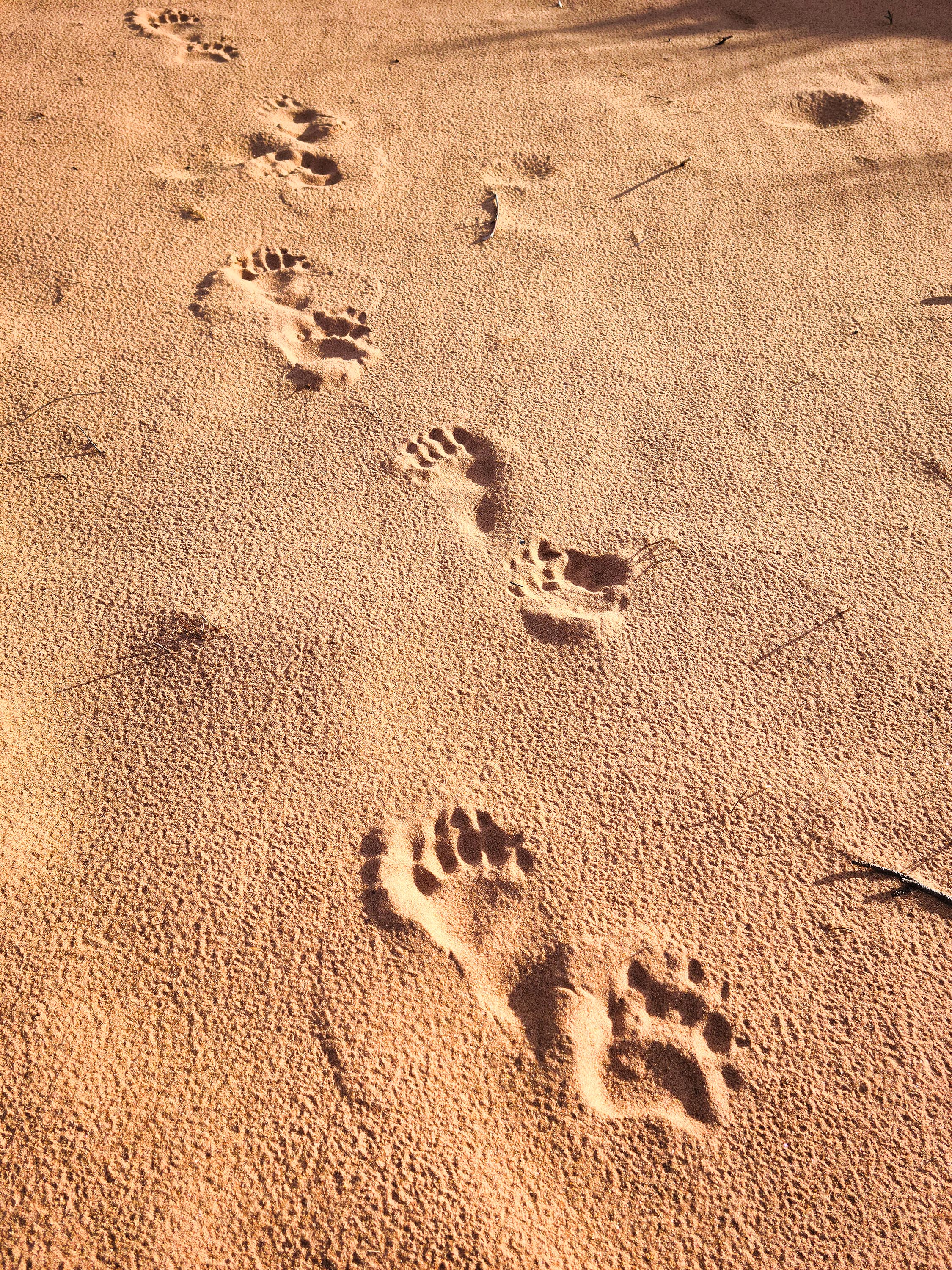
Another fact that Neil conveyed is that when bears were first counted on Stockton Island – sorry, I’m not sure when that began – there were only a couple. But now there are 20 known to live there. I can attest to their presence. On my several trips there, I’ve seen many bear tracks on the island’s beaches. (I’ll try to dig up some of my photos of those for this post.)
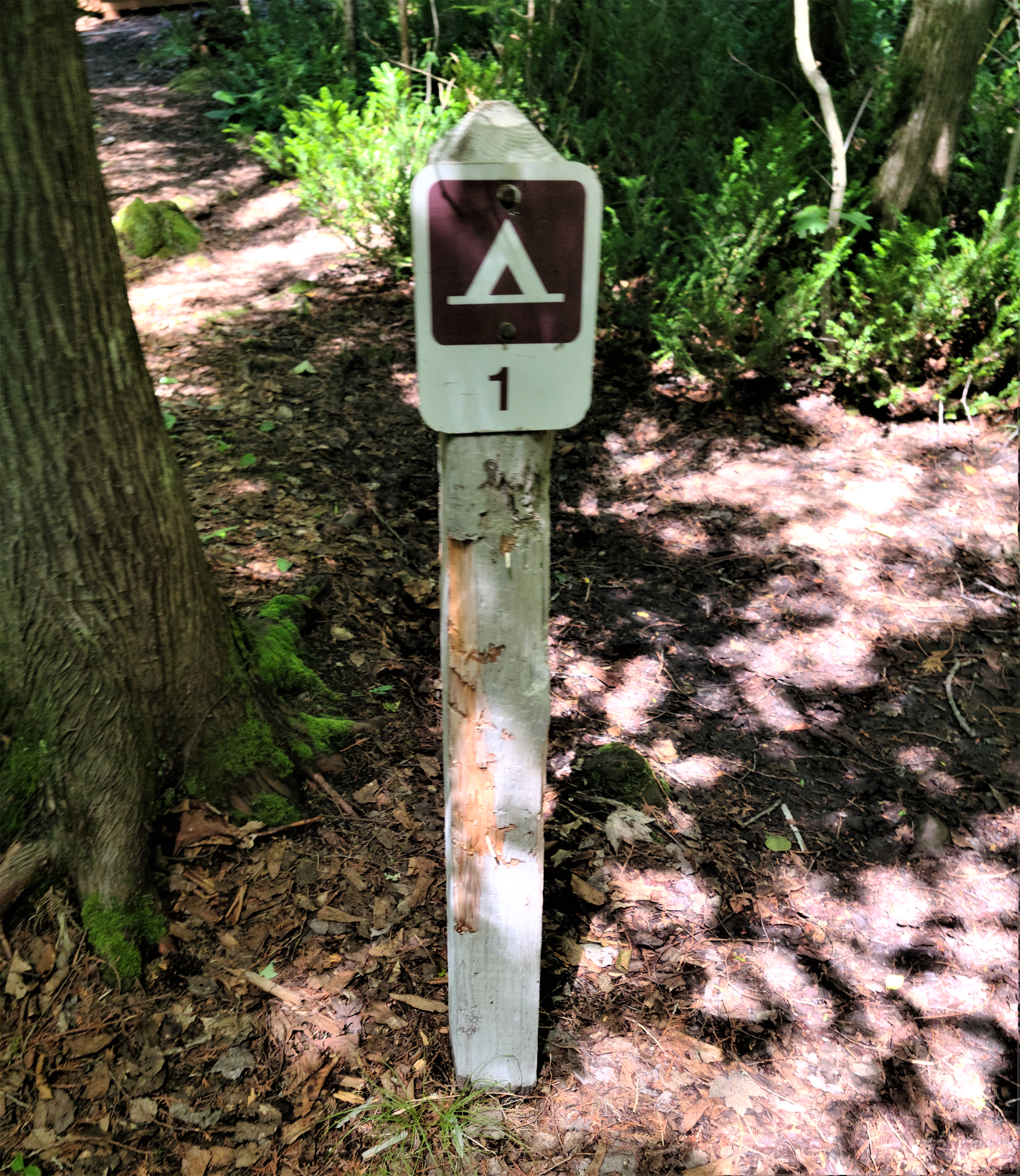
Black bears like to gnaw upon and otherwise dismember the wooden campsite markers on Stockton Island.
One memory that emerged during the tour came from a trip I made to Russia many years ago. One of my former husband’s relatives bragged about a bear he had shot. Granted, this relative liked his vodka and ended up chasing one of my young sons around the picnic table where we were eating – he was a rather scary, imposing figure, somewhat bearish. At some point, he showed us photos of his triumphant hunt. From the snow in the photo and the location, it became obvious that he had shot a hibernating bear. So much for sportsmanship, but I guess maybe they do things differently in Russia!
Anyway, I learned some things I didn’t know about bears from this tour, and I hope you did, too.
The Isle Royale Lighthouse on Menagerie Island. Image courtesy of the National Park Service.
I recently had an article published in Lake Superior Magazine about a family of lighthouse keepers who spent their summers on a remote, rocky island that’s part of Isle Royale National Park. Here’s how the story (“Romancing the Stone”) came about.
Last December, I was hawking my books at a table at Fitger’s Bookstore in Duluth. Many holiday shoppers passed by, but one couple stopped to chat. Somehow, we got on the topic of Isle Royale, and I told them that my first novel was set on this island in Lake Superior.
The husband said something like, “Well, I’ve got a story for you. My ancestors were lighthouse keepers for two generations on Isle Royale.” The husband’s name was John Malone. His wife was LaRayne, and she mentioned they got engaged while on a trip to the “family’s lighthouse,” which was the Isle Royale Light on Menagerie Island. John mentioned that his lighthouse keeper great-grandfather had 11 children who lived out on the remote (and very small) island.
Although intrigued, I had plenty of story ideas in my head to keep me occupied for months. I told them I’d consider it but couldn’t promise anything.
But the more I thought about it afterward, the more interested I became in the story of the Malone Family. I checked with the Lake Superior Magazine editor to see if they’d ever featured a story about the Isle Royale Lighthouse and the Malone Family. She told me they hadn’t and that she would be interested in it.
I couldn’t find John Malone in the phonebook, but I was able to connect with him through social media. I reminded him who I was and told him I was interested in doing a story about his ancestors and family. On New Year’s Eve, he replied to me with his phone number. I called him to get more information so that I could pitch the story to the magazine.
Not long after, I pitched it, and the story was a go!
Then the work began. I was lucky that the Malones had a copy of a copy of the Isle Royale Lighthouse Keepers’ log, which they loaned me when I visited their home for an interview. Also, the National Park Service had done oral history interviews with two Malones a few decades ago. These Malones were now deceased, so those interviews were invaluable. I was able to combine those interviews with the ones I did with John.
After the last lighthouse keeper in the Malone Family quit his job on Isle Royale, he piloted yachts for the wealthy in Duluth. One of those families were the Congdons who built Glensheen Mansion, which is a tourist attraction now in the city. John Malone told me a tale about how his ancestor had been aboard the yacht when it sunk due to a fire. He had this great information (which is in my magazine story), but he didn’t think that the staff at Glensheen Mansion had heard the history.
It so happens that my daughter-in-law used to be a docent at the mansion and still has ties there. I consulted with her and she consulted with the staff at Glensheen to see what they knew about the sinking. It seemed as if a meeting between John and the mansion staff was in order, so I arranged it.
We met at the mansion and met with a Glensheen historian and the education manager. John got to tell his tale and I recorded it for my story. The mansion staff was excited to learn this new information. I hope they work it into the information that they provide to the public. And I think John was touched to have someone value the historic information he was privy to.
The Lake Superior Magazine editor only wanted a 1,200-word story, but I gave her more like a 2,000-word story. I apologized, saying the more I learned, the more there was to tell! But it paid off in the end because she dedicated much of that issue to maritime history.
Trying to sell books to people passing in a hallway can be depressing. I sometimes feel like one of those poor souls who stand on a street corner with a cardboard sign. My sign would say, “Will write for pay.” But this is one case where several good things came from putting myself out into the world.
Architectural drawings for the Isle Royale Lighthouse.This did not make it into my magazine story. Illustration courtesy of the National Park Service, U.S. Department of the Interior, Isle Royale Light Building Proposal, ISRO Archives, ACC#ISRO-00999, Cat#ISRO 20175.
A giant burbot replica found in the lobby of Duluth’s Great Lakes Aquarium.
My recent post about a trip to a local fish market in Cornucopia, Wisconsin, to buy some burbot piqued readers’ curiosities about its taste and my experience eating this ugly looking fish for the first time. I’m here to say that I survived and that I’m no longer a Burbot Virgin!
The experience is memorialized in “The Fish Dish,” a podcast I co-host for work. We chose a Valentine’s Day theme for the show because Feburary is an important time in the burbot’s life cycle: a time for LOVE.
See photos and hear all about it at this Fish Dish link. And while you’re at it, get your sweetie a card with a big burbot on the front for that special day. Such smooth moves might not work on everyone, but you just never know . . . .
A coworker and I meandered over to Cornucopia, Wisconsin the other day. This is a small town (more officially known as a census-designated place) on the South Shore of Lake Superior, population 98.
Our goal was to speak with some of the good folks with Halvorson Fisheries for our “Fish Dish” podcast. Our next episode is about burbot – a slimy bottom-feeder of a fish that tastes great and is under-appreciated. Halvorson’s is a fifth- or sixth-generation commercial fishery in Cornucopia and they know their burbot and other, more typical Lake Superior fish like lake trout and whitefish.
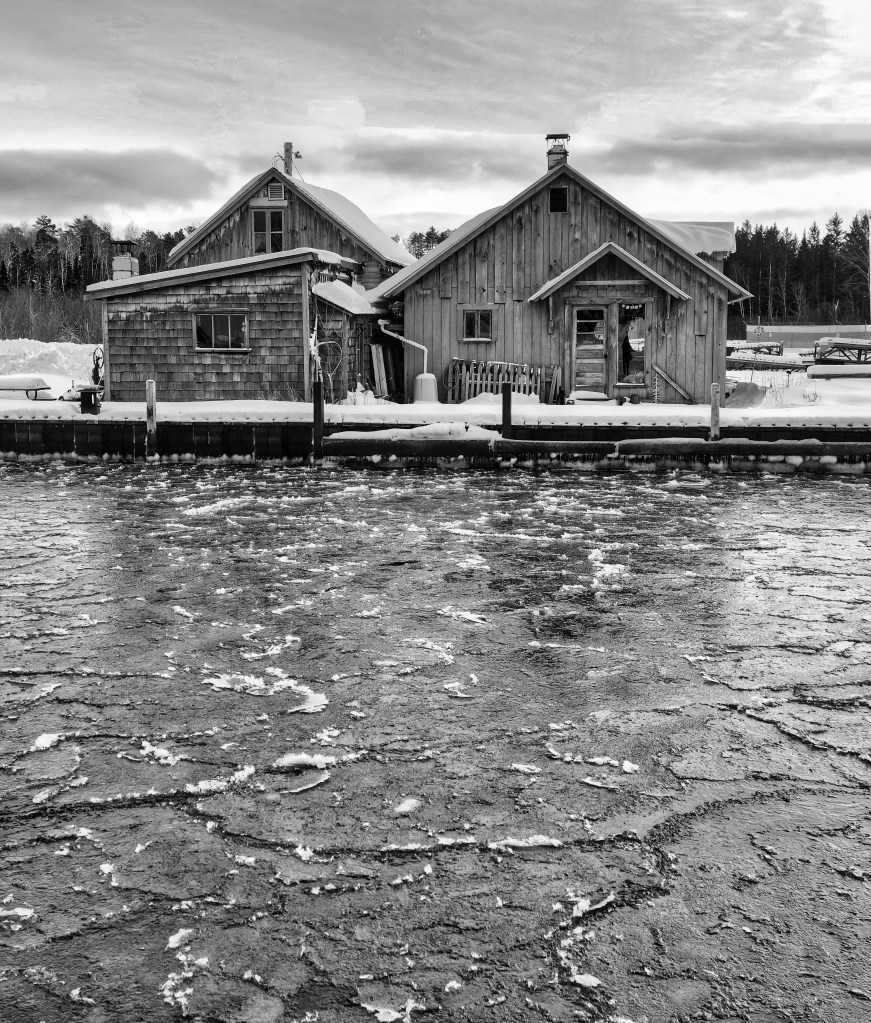
We arrived at their business on the harbor, but nobody was around. While my coworker made some calls and wrote texts, I had a chance to wander and take photos of the icy harbor and boats. These are the results. I felt like it was time well-spent!
After cooling our heels in the only open restaurant in town (along with about 40 snowmobilers), we were able to meet with the Halvorsons, do our interview, and get burbot. The problem was they had decided to stop fishing for the season but hadn’t anticipated that when my coworker made arrangements to speak with them a few days previously. But that’s life on the lake. You gotta go with the flow.
We haven’t cooked the burbot yet. That comes this week. I’ve never eaten burbot before, so am looking forward to the experience. I’ll include a link to our podcast in this post once it’s available.
In the meantime, please enjoy the scenery.
Update: You can hear all about my burbot-eating experience on “The Fish Dish” podcast. The eating part comes at about 18:18. It was great! Today I’m going to make burbot chowder – substituting burbot for steelhead in my chowder recipe you can find here.
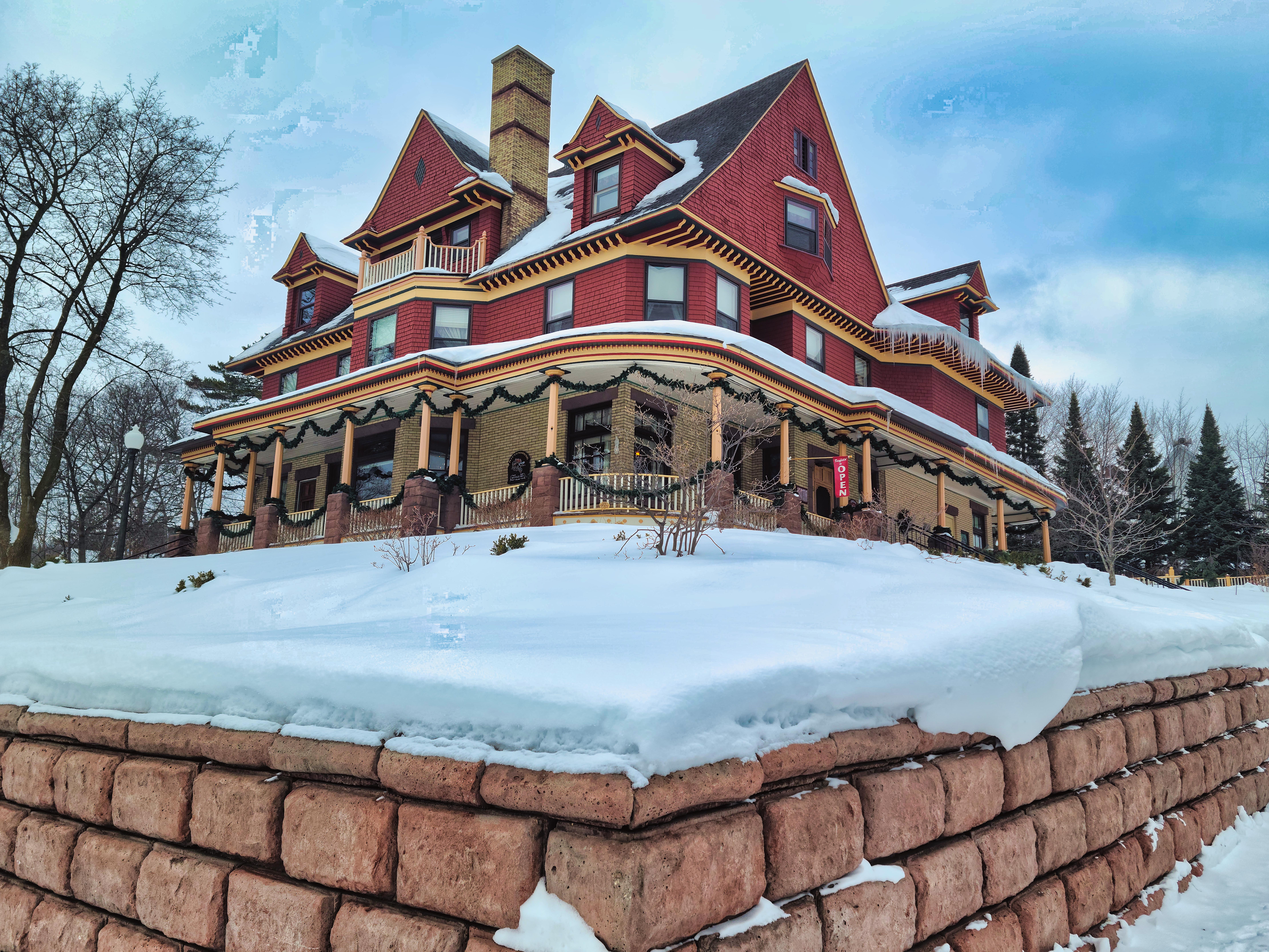
For the end of 2022, Russ and I meandered over to Bayfield, Wisconsin, to stay at the Rittenhouse Inn. If you’ve ever been to Bayfield, you’ve seen the place: a huge maroon-red mansion on the left side of the main street as you head toward Lake Superior in this northern town.
This was Russ’s first stay at the inn and my fourth, but it had been years since I’d been there. For my birthday last spring, Russ gave me the choice of two local trips, and this was the one I chose. So, we combined two occasions into one: my birthday and New Year’s Eve.
Built in 1890, the Rittenhouse is a Queen Anne Victorian home. It’s one of three properties in Bayfield owned by Mary and Jerry Phillips. But it was the first one they purchased, back in 1973. Check out their website (link in the first sentence of this post) to learn more.

The Christmas tree at the Rittenhouse Inn.

We checked in on the afternoon of New Year’s Eve and had just enough time to change into clothing befitting a six-course dinner at the Inn’s Landmark Restaurant, which is on the first floor of the inn. Our room was on the third floor in Suite #10. This was originally the home’s ballroom. I got a glimpse of it during a tour on one of my first stays at the inn and was impressed by its spaciousness, double-sided fireplace, and view of the lake. I vowed to stay there one day.
Descending the floors on the stunning cherry staircase in my emerald-green velvet dress, I felt like I belonged to the place. Russ looked dapper in his khakis and pressed blue and white shirt. We were seated by the hostess in one of three rooms used for dining. There’s a green room, a red room, and a blue. We were shown to the red room, which features ornate wallpaper, lavish holiday decorations, and a fireplace. Actually, all the dining rooms feature that, just in different colors!
The special New Year’s dinner featured an appetizer (I had mussels in cream sauce), soup (I had oyster soup – sense a theme here?), salad (kale and pomegranate in the shape of a wreath), a palate cleanser of cranberry sorbet, main course (champagne chicken), and dessert (crème brulee with whipped cream and blueberries). It also included a champagne cocktail with a sugar cube in the bottom of the glass and an orange peel curlicue.
The meal was exquisite. Although the portions were reasonable, I’m not used to that much food anymore and have since sworn off all multi-course dinners! But it made for a memorable and tasty evening.
Afterward, we retired to our room and played a rousing game of Mexican Train Dominoes (I won, as usual). We brought our own bottle of champagne and Chombard liqueur (raspberry). We mixed them together and rang in the New Year.
Some things have changed about the inn since my last stay. For instance, they no longer use real wood in their fireplaces. Instead, they offer those fake logs you can buy at the grocery store, which are easy to light. This was disappointing – I wanted the crackle of a real fire – but it was better than an electric fireplace.
The fireplace in our suite.
They also no longer recite the menu orally. This was a thing on my first visit in the 1990s. The waiters, who all seemed trained in voice or drama, would recite the menu options from memory, adding luscious words and embellishments – so many that it felt like you had eaten a meal by the time they completed voicing the options. That left a lasting impression on me and I discovered the instigator of that past practice was still working at the inn. We met him the next morning at breakfast (which is included in the cost of your room). His name is Lance and he’s worked at the inn since 1974, just a year after it opened.
When I bemoaned the lack of an oral menu, he admitted that the recitation was one of his schemes. I didn’t get to ask him what stopped the practice, but I suppose it was hard to keep up over time, especially if new hires didn’t have talents in those areas.
Not much was stirring in Bayfield on New Year’s Day. Russ and I walked down the main street (Rittenhouse Ave.) and only found one store open, besides the grocery store and coffee shop. But that one store was enough, because I found a birthday present for a friend of mine who was born on January 2. What an awful time to have a birthday! Everyone is “presented” out by then from Christmas. But this year, I revived my present-finding skills quickly, and acquired something I think my friend would like.
The inn’s restaurant was not going to be serving dinner that evening, and we were staying another night, so we asked around and found out which other places in town would be open. We had two options to choose from: a bar and a bistro. We chose the bistro.
But before dinner, we exercised off some of our six-course dinner and scrumptious breakfast calories by cross-country skiing at Mt. Ashawabay Ski Area just outside of town. Besides downhill runs, the ski area offers 40K of ski trails. Because I’m recovering from a broken ankle, we stuck to the easy trails. They were perfect, although the tracks were a bit icy and I could have used a warmer (sticker) wax. But we made of the best of it for 1-1/2 hrs, and I did not reinjure my ankle.
We skipped lunch, so were hungry once we returned to Bayfield. We ate at the bistro and spent our evening curled up by the (fake log) fireplace, reading. Heavenly! The next morning, we had another lovely Rittenhouse Inn breakfast and then headed home to Duluth.
I felt fortunate to have finally stayed in Suite #10 and to spend such a peaceful New Year’s in elegant surroundings. The Rittenhouse or one of its other properties are definitely the pinnacle of places to stay in Bayfield, should you ever have the chance.
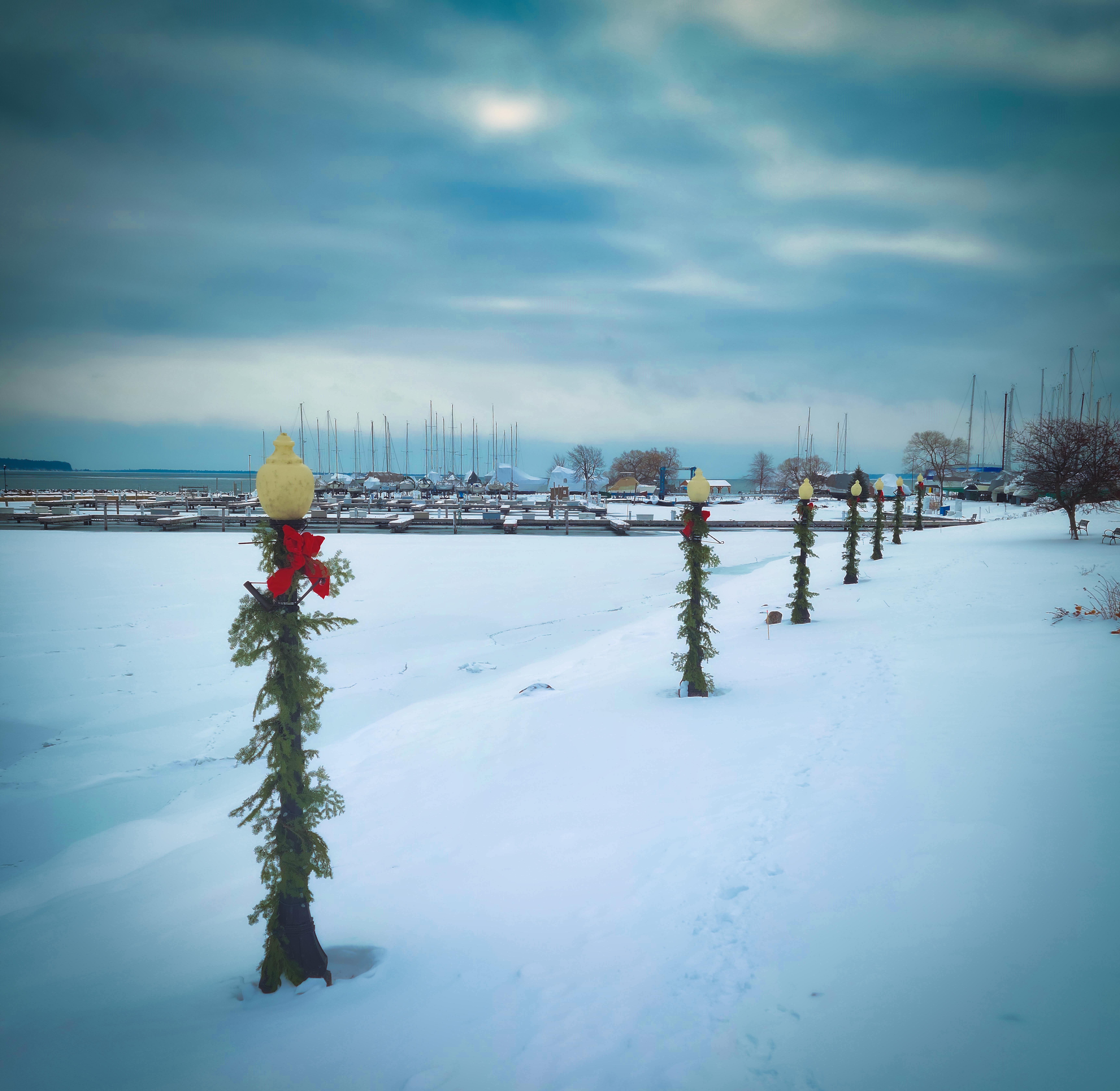
The Bayfield waterfront, decorated for the season.
Debut novelist Carol Dunbar is living a dream. She’s been slogging along in the local writing trenches of the Duluth-Superior area for years. She gained some local notoriety and then hit it big, signing with an agent and getting a two-book deal with a national publisher.
But it almost didn’t happen. During a recent Wisconsin Writers Association (WWA) conference Dunbar said that ten years into her twelve-year journey writing her novel, a flood in her office made her want to quit. She printed out a draft of her manuscript and was about to begin querying agents. She had written notes in the margins and on the backs of pages – things she wanted to address before she sent out the document.
Carol Dunbar discusses her book at its launch in Duluth, Minnesota, earlier this year.
Dunbar’s writing office lies underneath two 250-gallon water tanks that serve her off-the-grid home in the woods. The tanks developed a leak. For twenty minutes, water poured into her 10 x 10-foot office and onto her manuscript.
“Water is death to all things writing,” Dunbar said. Her draft was illegible. The books lining her office were destroyed. She couldn’t see how to recover from this catastrophe, and she began to cry.
At some point in the devastation, the voice of one of her characters cut through to her. It was Ethan Arnasson, the father-in-law of Elsa, the novel’s main character. Dunbar said that Ethan told her, “Carol, just give it time.” She knew he was right and felt giddy that, “My fictional character was giving me personal life advice!”
Lucky for us, Dunbar persisted. “The Net Beneath Us,” is set in remote northern Wisconsin, where Elsa, a cossetted city girl turned country widow, must determine how to carry on with two her two children in the unfinished home her husband was building for them. To cope with the challenges she faces, Elsa forges a deeper relationship with the land, learning from the trees her husband loved.
As the book jacket says, the novel is a lyrical exploration of loss, marriage, parenthood, and self-reliance; a tale of how the natural world – without and within us – offers healing, if we can learn where to look. The story is written in a rotating third-person perspective and covers the course of a year.
As a writer with a nature bent, myself, I loved Dunbar’s descriptions of Elsa’s growing connection to the forest that surrounds her home. From a floating puffball that seems sentient, to the underground fungal connections that foster communication among trees, to a mysterious white stag, nature reigns supreme in the story.
However, be prepared. A slow grief lays heavy over it, also. Dunbar’s true account about her husband, which appeared this year in the New York TimesModern Love column, offers a huge hint about the source of her dark inspiration.
I gave the book five stars on Goodreads. The writing is so beautiful, I hesitate to nitpick. But it wouldn’t be a full review without some nits. I found that the middle section dragged just a bit. Through multiple examples, this part highlights all the various ways that Elsa feels out of place in her off-the-grid home. I felt like there were too many of these instances. I found myself thinking, “We get it, already!” The other nit occurs near the end where the symbolism of the unfinished second story of Elsa’s home is compared to an unfinished aspect of Else’s psyche. I felt like it would have been stronger and more “literary” not to spell this out for readers so clearly.
At the WWA conference, Dunbar said her book editor encouraged her to change the ending from one “where the dog dies,” (a no-no in literary fiction these days) to something else. After much thought and gnashing of teeth, Dunbar did this, opting instead for the drama of a lost child. This revision works, and it anchors the story even more strongly into the trees and to the white deer.
So, this local woman made good, and we are all the richer for it. I can’t wait to see what gifts her next book will hold for us.
When last we met, Russ, Captain Dave and I were on our way from Stockton Island in the Apostle Islands National Lakeshore in Wisconsin on our way to Madeline Island. This particular island isn’t part of the national lakeshore because it is inhabited. But the island is near the Lakeshore and offers many opportunities for natural fun.
Our trip to Madeline Island was not as speedy as our trip to Stockton. The wind was slight, and we only made a top speed of 2 knots, far from the 9 knots we made on our way previously. We had to tack several times (zigzag) to reach our destination, but at least the sun was out.
We anchored in Big Bay, which is home to both a town park and a Wisconsin State Park. Many impressive homes lined the shoreline. Seeing how they had protected their shoreline against erosion was interesting. Lake Superior’s water levels have been at record highs the past few years, and the toll that’s taken is obvious along the island’s edges.
A few homeowners have cleared all the trees and vegetation down the water line on their properties, leaving just an expanse of green lawn. This does not seem like a very wise idea in terms of erosion control. For my work with Wisconsin Sea Grant, I write stories about this issue, so I know a bit of whereof I speak.
After we reached Big Bay in the afternoon, we clambered aboard Tinkerbell the dinghy and rowed ashore. The state park offers a boardwalk that parallels the beach and it morphs into the town park, which also sports a boardwalk to a lagoon. We hiked 3-1/2 miles along the shore, visited several times by a buck who also was taking an evening stroll.

A beach teepee on Big Bay, Madeline Island.
Some enterprising person or persons had built a structure out of driftwood on the beach. What are these things called – beach teepees? Enlighten me, please, if you will.
That night we were rocked to sleep on Lake Superior’s swells. It reminded me of slumbering in the cradle as a child. I kept thinking that someone should market a rocking bed for adults – there could be money to be made!
When we weighed anchor the next day, we saw a large vessel with strange implements sticking out of it coming our way. Later, we were able to discern with binoculars that it was the U.S. Environmental Protection Agency’s Lake Explorer research ship. They steamed into the bay, pushing a huge bow wave, and then stopped abruptly. We were too far away at this point to see what they were doing, but I would guess they were either checking some fishing nets that were in the bay or taking water samples for research.
I’ve written about the Lake Explorer for work several times, but this was the first time I’d seen it out on the water in action – an impressive sight!
Remember when I said (in the previous post) that Russ and I had forgotten much of our sailing skills during the pandemic? Russ has a background in sailing so remembered much more than I did. He usually handled the anchor and navigated while we were under sail. I was good at steering the Neverland when it was motoring. Capn Dave had been very patient with us the first two days of our trip, but not so much this third day.
I felt like we made up for it on our fourth (and last) day of the trip when we successfully navigated the Neverland into the Port Superior Marina without mishap. Capn Dave seemed rather pleased with that. Maybe he’ll invite us back sometime? At least we didn’t run the boat aground. He doesn’t invite those people back. 😊
There’s a saying that it pays to be “brave enough to totally suck at something new.” Sailing is like that for me. It takes a certain amount of hutzpah to try something for which you have no background. Once we docked the boat and Capn Dave took time to show me how to secure the line to a dock cleat, I felt a bit more worthy.
Once we returned home, I kept feeling like I was still on the boat, especially when I was in the shower (an enclosed space complete with the sound of water). I just learned today that the term for that is “landsickness” or “disembarkment syndrome.” It’s where you still feel the rocking of the boat even after you’ve been off it for several days. According to the Wiktionary, it most often afflicts women between the ages of 30 and 60 (which I fit). It’s the reverse of sea sickness, and is something that sailors and passengers experience when going ashore after a long voyage. I’ve felt the same thing since my 20s, so it must just be part of my makeup. Or maybe it means I’m supposed to be at sea most of the time.
Does a case of landsickness mean I’m a real sailor? I don’t think so. I don’t feel like a real sailor yet. I don’t think I could handle a sailboat all by myself. I still don’t know the names of all the lines and sails on the boat. But I’m getting there, slowly.
Let this trip be a lesson in not being afraid to try something relatively new. If there’s something you want to try, go for it! Life is too short to sit on shore, wishing you could be at sea.
The “Neverland” anchored in Presque Isle Bay, Stockton Island.
Russ and I meandered east a few hours to the Bayfield Peninsula in Wisconsin last week. We met our sailing friend, Captain Dave, at the Port Superior Marina for a trip to the Apostle Islands National Lakeshore on Lake Superior.
We hadn’t been sailing since before the pandemic. We were apprehensive because we were sure we’d forgotten what skills we had gained, but we were more than ready for an adventure. Our plan was to sail around Stockton Island and Madeline Island over the course of four days.
Although I’d been to both places many times, this would be the first time I’d be doing it by sail, and the first time in the off-season: appealing prospects.
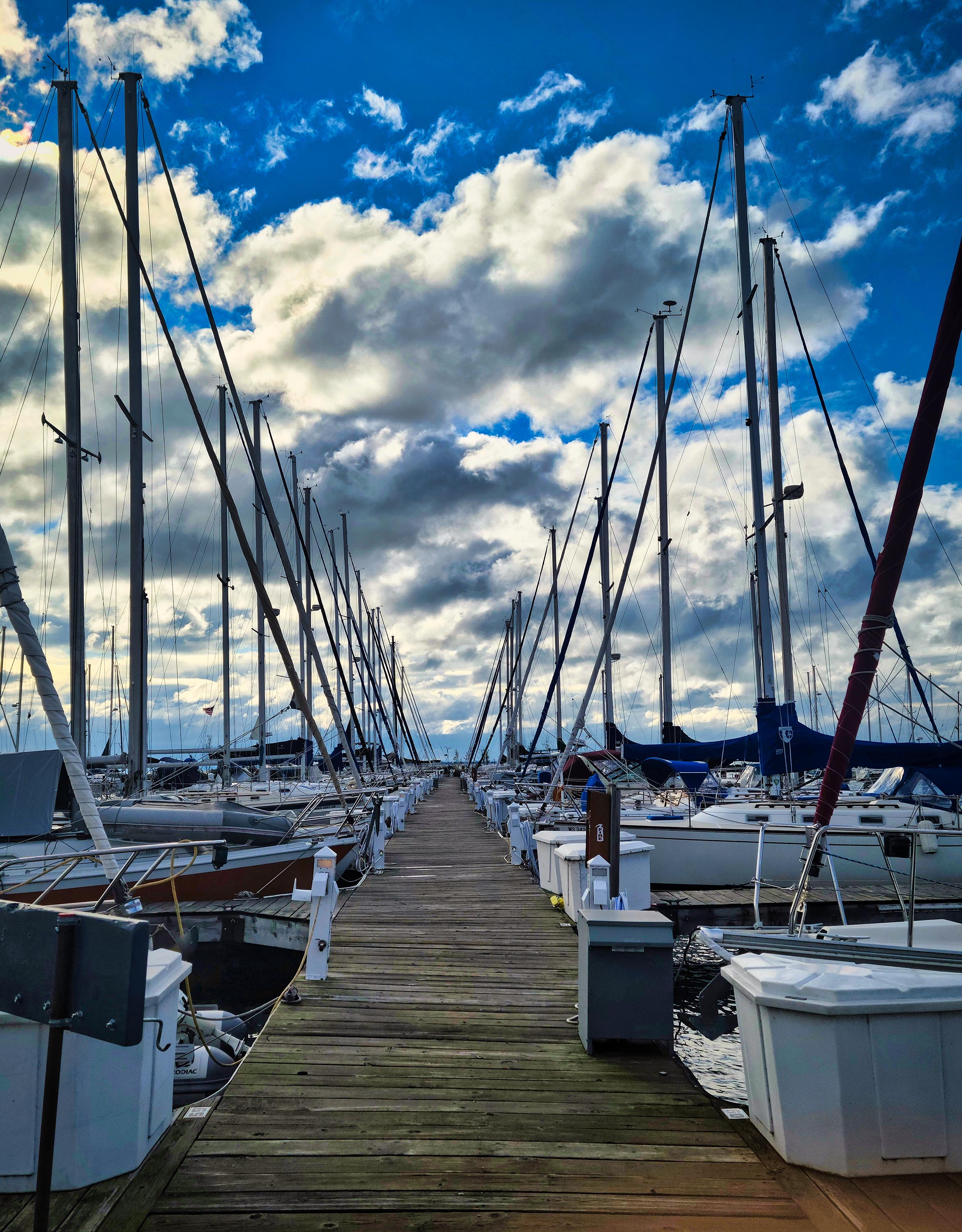
We met in the evening at the marina. After loading our gear onto the “Neverland” (a 32-foot Westsail), we headed down the long pier dock to our car in the parking lot so we could go into Bayfield and find an open restaurant – not an easy task on a Sunday evening after tourist season is over.
Ominous clouds had filled the sky. They chose the “perfect” time to unload their watery burden once we were too far down the pier to seek shelter back on the Neverland. We did not have our rain gear on and got soaked before we reached the car. We were immersed in nature immediately, whether we wanted to be or not.
The Port of Superior Marina near Bayfield, WI.
The squall passed by the time we reached Bayfield. Our goal was to eat at the Pickled Herring. We heard they made an awesome whitefish liver appetizer. Captain Dave had eaten there and raved about it. Alas, they were closed, so we chose to eat at Greunke’s Restaurant instead. This would also be a new experience.
We were seated at a table that featured John F. Kennedy Junior memorabilia on the wall. I was not aware that he had visited Bayfield, much less dined at Greunke’s. The restaurant had saved his receipt; he spent $104 on his meal. I hope he didn’t eat all that food by himself!
We noticed that they also offered whitefish livers on the menu. We decided to order them so that Capn Dave could tell us if they measured up to the Pickled Herring’s dish. They come either fried or sautéed with green peppers and onions. We ordered the latter version.
I thought they were passable fare, but Dave said they weren’t as good as their competitor’s. He said the Pickled Herring put some sort of extra spice on theirs that made all the difference. The rest of our food was excellent. In keeping with the theme, I ordered broiled whitefish, which was prepared just right – not too dry/overdone.
Our whitefish liver appetizer. Yum!
We, on the other hand, were not quite dry by the time we returned to the marina. We changed out of our rain-soaked clothes and spent the night in the belly of Neverland, lulled asleep by the creak of dock lines. In the morning, we awoke to the xylophone of sail lines banging on masts in the stiff wind. It was gusting to 25 knots and the sky was overcast — an exciting day to sail!
It only took us a few hours to get to Stockton Island. The Neverland reached its top speed, which is a little over 9 knots. That isn’t as fast as most sailboats go – Capn Dave explained that Westsails are considered “Wet Snails” when it comes to speed, but they are a very safe, heavy boat.
Black bear tracks on Julian Bay Beach, Stockton Island.
We anchored in Presque Isle Bay on the island and rowed ashore in the dinghy, appropriately named “Tinkerbell.” We beached at the end of the park service campground. I was used to seeing people in the campground, so walking past the deserted sites was strange, a little unnerving. We continued onto Julian Bay where we hiked down the beach of the singing sands to the lagoon. We saw a long trail of black bear tracks on that beach as well as the one where we landed Tinkerbell. The island bears were probably roaming far and wide to find enough food to fatten up for winter. A bald eagle flew overhead. A partial rainbow seemed to end over the neighboring island across the lake.
The rainbow ends on Michigan Island.
Back on the Neverland that night, the sky was painfully clear and cold. The Milky Way was easy to see, split by the occasional falling star. Capn Dave fired up the small wood stove inside Neverland, which kept us cozy for an evening of gin rummy and reading.
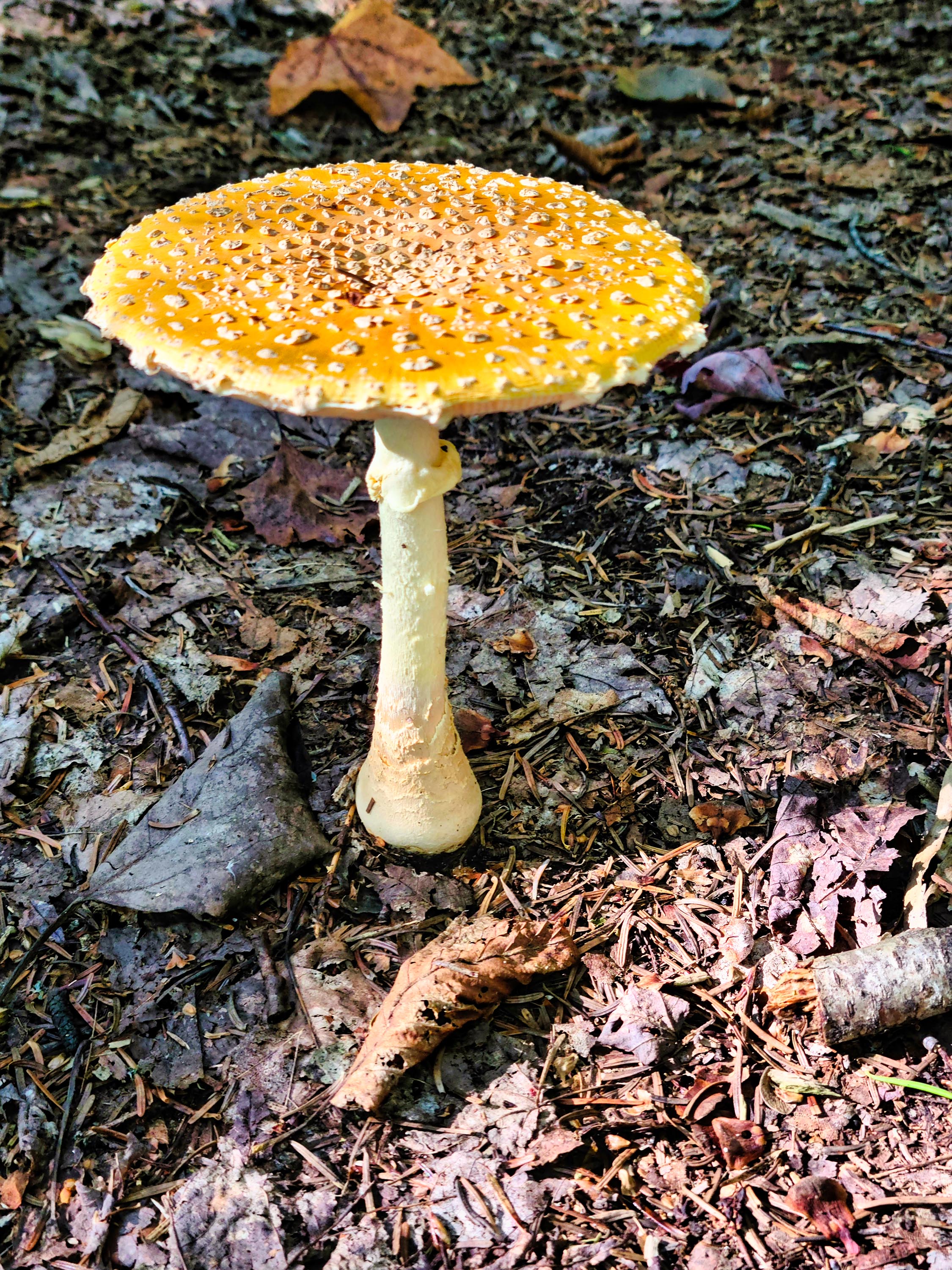
Fortified in the morning by a breakfast of haggis and eggs, we rowed back ashore and hiked the Quarry Trail, which eventually leads to an old brownstone quarry (no longer in service). We stopped before the quarry and spent and pleasant time on a sandstone ledge, enjoying sun on the lakeshore. Hundreds of colorful mushrooms piqued our interest during the 6-1/2-mile stroll – purples, oranges, reds, yellows, browns. It’s a good fall for mushrooms around here.
A fly agaric mushroom, toxic but not lethal if ingested. Found along the Quarry Trail, Stockton Island.
After another chilly night, we left the following day for Madeline Island. More on that in my next post.
The Neverland anchored in Presque Isle Bay, Stockton Island.
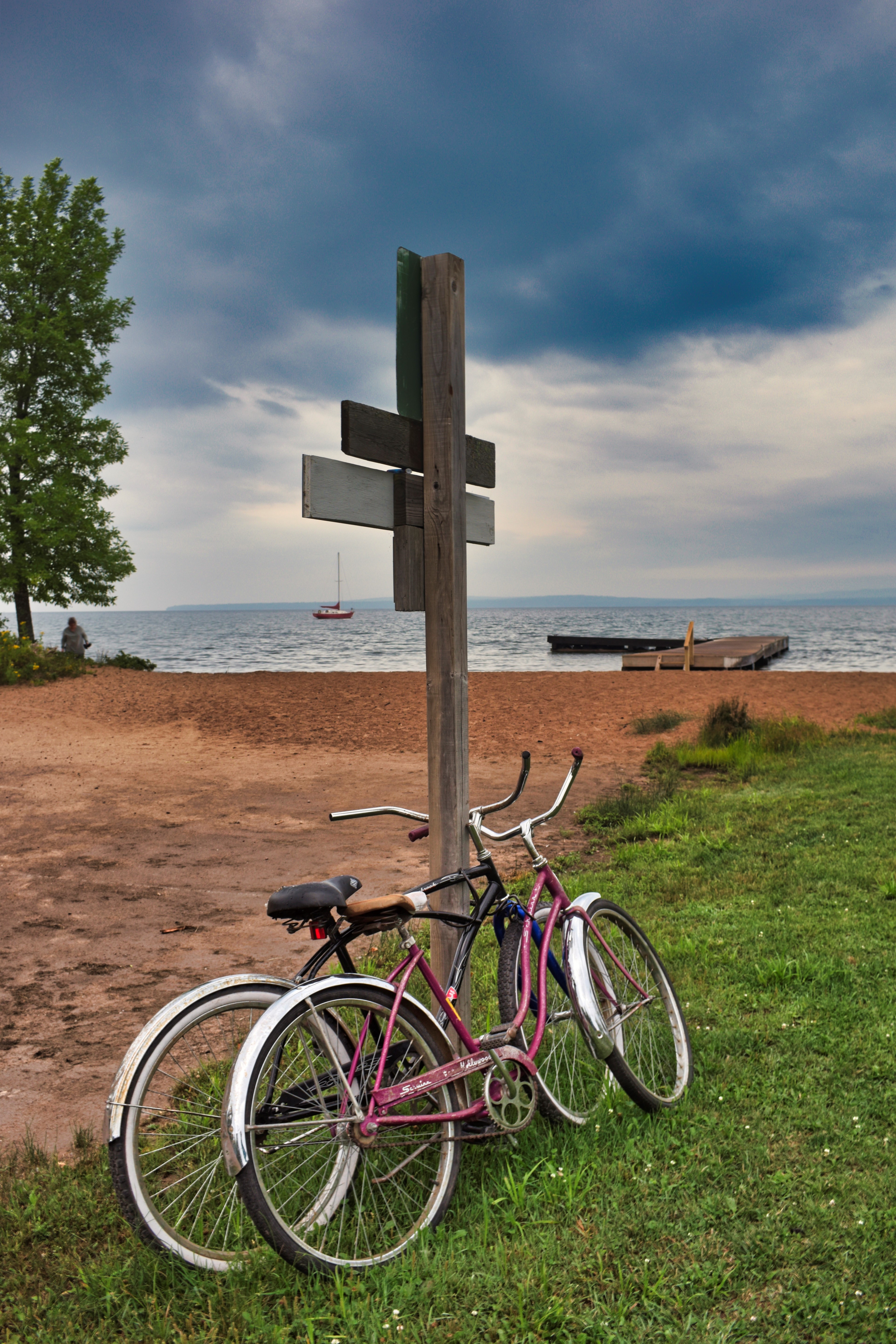
“Bikes Before the Storm,” taken at Joni’s Beach on Madeline Island in Lake Superior.
A photo I took last summer earned an honorable mention in a national “Coastal Love” contest organized by the National Oceanic and Atmospheric Administration’s Office for Coastal Management. The images chosen celebrate America’s coastlines – both salt and freshwater.
Sailboats moor off the beach and I suspect the bikes were there for boaters to use to get around town after they row ashore in their dinghies. I was on the beach for a sunrise shoot, but as you can see, the sun was not cooperating.









 Marie's Meanderings