Vinny with a Y not an IE

grey wolf

grey wolf (Photo credit: Wikipedia)

I was walking my dog through the local forest the other day when I met a 12-year-old neighbor boy for the first time. His name is Vinny; spelled with a Y on the end, not an IE. “People mix that up all the time,” he said. He was walking a chocolate lab who was also 12 years old. His lab got along well with my goldendoodle so we let them off their leashes to romp.

Vinny was the talkative sort. I’m always amazed at how much kids unknowingly reveal about their lives and their parents’ lives to strangers. While on the one hand, I’m glad children are still trusting, on the other hand, I shudder to think what could happen if the information made it into the wrong ears.

During our short walk, and with hardly any prompting from me, I learned about all of Vinny’s former and current pets, that Vinny’s parents are hiring a nanny for the summer to drive him to his soccer games, that he has a sore knee but his mom said that some exercise walking the dog would probably be good for it (I had to smile at that one), and that Vinny’s dad shot a wolf.

Of course, as a wolf novelist, this last bit of news gave me pause. I can’t even remember how the topic came up, but suddenly, there it was, as unexpected and pungent as blood on leaves. I do remember that Vinny was explaining how he likes to deer hunt. He was in his deer stand when he was 7 and a wolf appeared and scared him. From questioning and further conversation, I got the impression he was in the stand alone, but that his dad was nearby, possibly in a different stand. Vinny ended up meeting up with his dad and telling him about the wolf. That’s when he told me his dad shot the wolf.

Oh, there were so many things I could have said and so many routes our conversation could have taken. My first instinct was to trot out the fact that wolves have not been documented to kill a human in the U.S. but once in recent history; that they are shy and normally do not approach humans. But I didn’t. I wasn’t there in the forest in a deer stand with a scared young boy. Obviously, something the wolf was doing scared him and concerned his dad enough that he decided to kill it. And during my book signings in northern Minnesota and Michigan, I’ve heard many stories from people about wolves. I understand that they are capable of all sorts of behaviors, many of which are seen as threatening by humans.

Instead, I said something about wolves usually being curious more than anything else. I wanted to ask him if his dad reported the shooting, because I’m sure at that point in history (5 years ago) the wolf was still considered an endangered species and thus illegal to kill. But I really didn’t want to know.

Vinny then went on to describe a plan he and his dad made in case Vinny ever felt threatened by a wolf again. He told me the special kind of ammunition they would use, which would hurt/scare the wolf but not kill it. This gave me a bit of consolation. At least they knew that killing the wolf was wrong and either got the special ammunition idea from a conservation officer or his dad had thought about it enough to figure it out. I doubt that shooting a wolf with anything is a good idea because the wolf could die of an infection, but I kept my mouth shut about this, also. I didn’t want to criticize Vinny’s dad because that could shut Vinny off for future conversations about wolves.

Our conversation ended with Vinny asking me if my youngest son likes to hunt. I told him we weren’t hunting people, but that my son enjoys fishing. By that time, we were at a crossroads and we separated, each to our own homes. I hope I meet Vinny again. Maybe I’ll have another chance to educate him more about wolves. I sure hope so.
Chickadees Don’t Lie

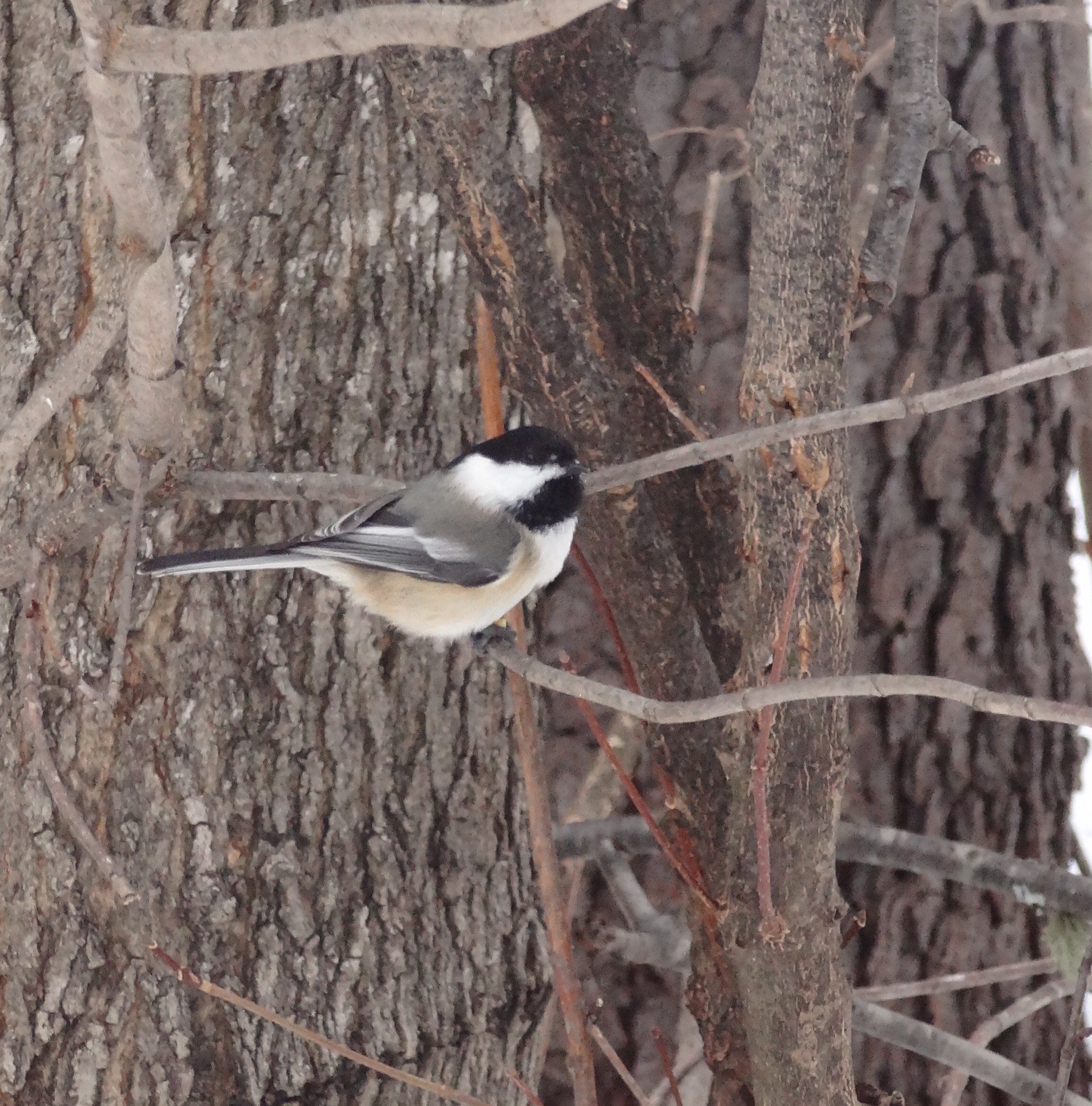
Chickadee
My dog and I took a forest walk today. I’m fortunate to live next to a large and wild city park that sports the occasional bear or moose. The black-capped chickadees were singing. Not their signature “chicka-dee-dee-dee” call but their two-toned “phee-bee” song that means spring is coming and I‘m in love.

Okay, romanticism aside, the song most likely has the mixed meaning of the male chickadee saying “stay out of my territory” and “baby, come over here.” But to me, it sounds like spring.

Wait a minute. It’s only the first week in March. In northern Minnesota. It’s still only 25 degrees outside, tops. Plus we just got a bunch of snow dumped on us. And the chickadees started singing this tune at least a couple of weeks ago. Who would want to mate this early? How could spring be coming?

But it is. The amount of daylight we’re receiving feels downright decadent compared to a few weeks ago. The ravens and crows are returning, along with the gulls. My dog is already leaving muddy footprints across the white kitchen linoleum.

Soon the world will become “mud-luscious and puddle-wonderful” (thank you E. E. Cummings). After the snow melts, the landscape will become the color of meatloaf (thank you Barton Sutter).

I know spring is coming because the chickadees said so. And chickadees are honest. Would this feisty panda bear of birds lie about something so important? I don’t think so.

Tribute to a Tree

Old Maple
My favorite tree is dying. Chunks of it lay scattered around my yard, courtesy of an industrious pileated woodpecker with its jackhammer-strong bill and bright red topknot.

The tree is a maple of some sort; probably a sugar maple, maybe a red maple. I haven’t wanted to define it in that way so I haven’t tried to figure it out. The tree grows at a slight angle, as if a north wind blew continuously for decades. My shed and garage bask in its shade.

Up until about ten years ago, its branches used to almost touch the second floor of the house. After a ball of lightning entered and toured around my sleeping baby’s bedroom as his father put him in his crib, those branches are gone. We decided to cut off the lightning travel route in case it does strike twice. Thankfully, the lightning ball exited without hurting anyone; just scared us real good and fried several electrical appliances. The baby even slept through it all.

The tree still bears a scar down its middle from that strike. Squirrels climb it and knock off bark pieces. In summer, its leaves are deformed with a shag carpet of red bumps caused by gall mites.

I know the maple is old and it’s on its way out, but I love that tree and don’t want to see it go. It’s one of the reasons I bought my house. On summer days, I sit on the bench beneath it and play with my dog. In fall, I lie inside on the couch appreciating its brilliant colors. The tree greets me on cold winter mornings when I shovel the back porch.

Come spring I will need to cut it down to keep it from falling on my garage or shed. I’m not looking forward to that day. I suppose we will find someone to use the wood and then plant a new tree, or several, to take its place. I’ll move some young maples that grow behind the shed. I’m sure they must be the old maple’s children. But it won’t be the same. They will be small and it will take years before they form a magnificent shape.

I feel like we’ll need to perform a ceremony of thanks for the maple and to mark its passing. If you have any ideas, please let me know.

Old Wood: A Love Story – Part 2

JudyPeres(1) Old Globe Elevator Bin Roof 008
Sixty-something-year-olds David Hozza and Judy Peres could be working in cushy office jobs or enjoying retirement in a warm, sunny locale. Hozza used to be an investment banker in St. Paul and Peres was an editor with the Chicago Tribune. But they ditched their jobs and invested most of their retirement savings into the Old Globe Elevator project (a description is in Part 1). Now they wear work boots, buy from thrift stores, and live in a one-bedroom apartment in the northern hinterlands of Superior, Wis.

The two met through an online dating service when both were living in Chicago several years ago. Although Peres was outside of Hozza’s desired geographic range, she said she convinced him to meet her halfway. And the rest, as they say, is water under . . . the grain elevator. The two eventually mixed their professional lives and personal lives and took on the task of selling reclaimed wood from a 125-year-old grain elevator and grain storage buildings along the harbor in Superior.

But then the recession hit, bringing sales to a halt, despite some great local and regional media coverage. And now the pair is facing bankruptcy, but they are facing it head on. They have a fund raising effort to try and keep their operation afloat for another 6 months and have ramped up media efforts to national outlets. They even had a project party at a local pizza place that was standing-room only.

I had lunch with Peres and Hozza at a venerated local dive, the Anchor Bar. Over double-decker burgers and fries they shared some of the reasoning behind their adventure. They do it for the love of old wood and for the love of each other. Even though the project has brought a different kind of stress, the pair talked about how happy they are to live in the northland, where people are friendly. We talked about how fear keeps people from trying something different, and how people miss truly living by not following their dreams.

Plus there’s just something about old-growth timber. It’s dry and cracked with a natural character that can’t be manufactured. When you touch the wood it transports you back to the quiet forest it came from. Spending time with two people working together on a common project was inspiring. I wish them the best and hope this blog helps in some small way. These pieces of local history should not go up in smoke.

* * *
June 27, 2013 Update: I am sorry to report that the project did get foreclosed on recently. Such a shame!

Old Wood: A Love Story – Part 1

Old Globe Elevator and Angels 004    Old Globe Elevator and Angels 001

Back in the late 1880s, timber was cut like there was no tomorrow, rich iron ore was scraped out of the ground, and grain was carted elsewhere in the world via trains and ships during the heyday of resource use in northern Minnesota and Wisconsin.

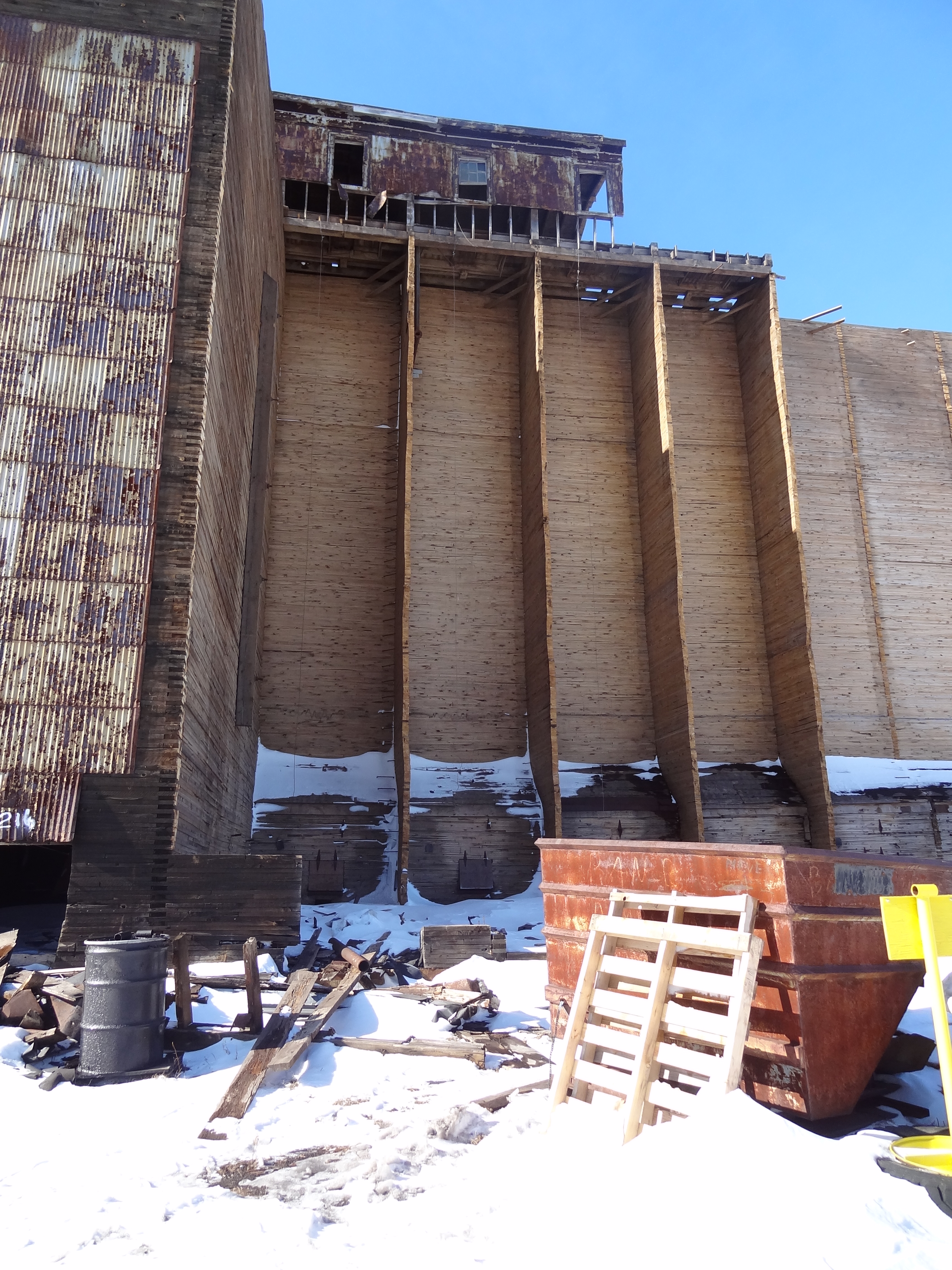
A testament to this era lies down a snowy gravel road on the edge of Superior, Wis. It’s called the Old Globe Elevator and includes a grain elevator and two massive storage bins that sit like relics along the shore of the Duluth-Superior Harbor.

The buildings are made from wood (and a lot of it) that’s hard to find any more – mostly old growth white pine and white oak from the first cutting in these northern forests. When the main elevator was built in 1887, it was the largest of its kind in the world. But the buildings are no longer used.

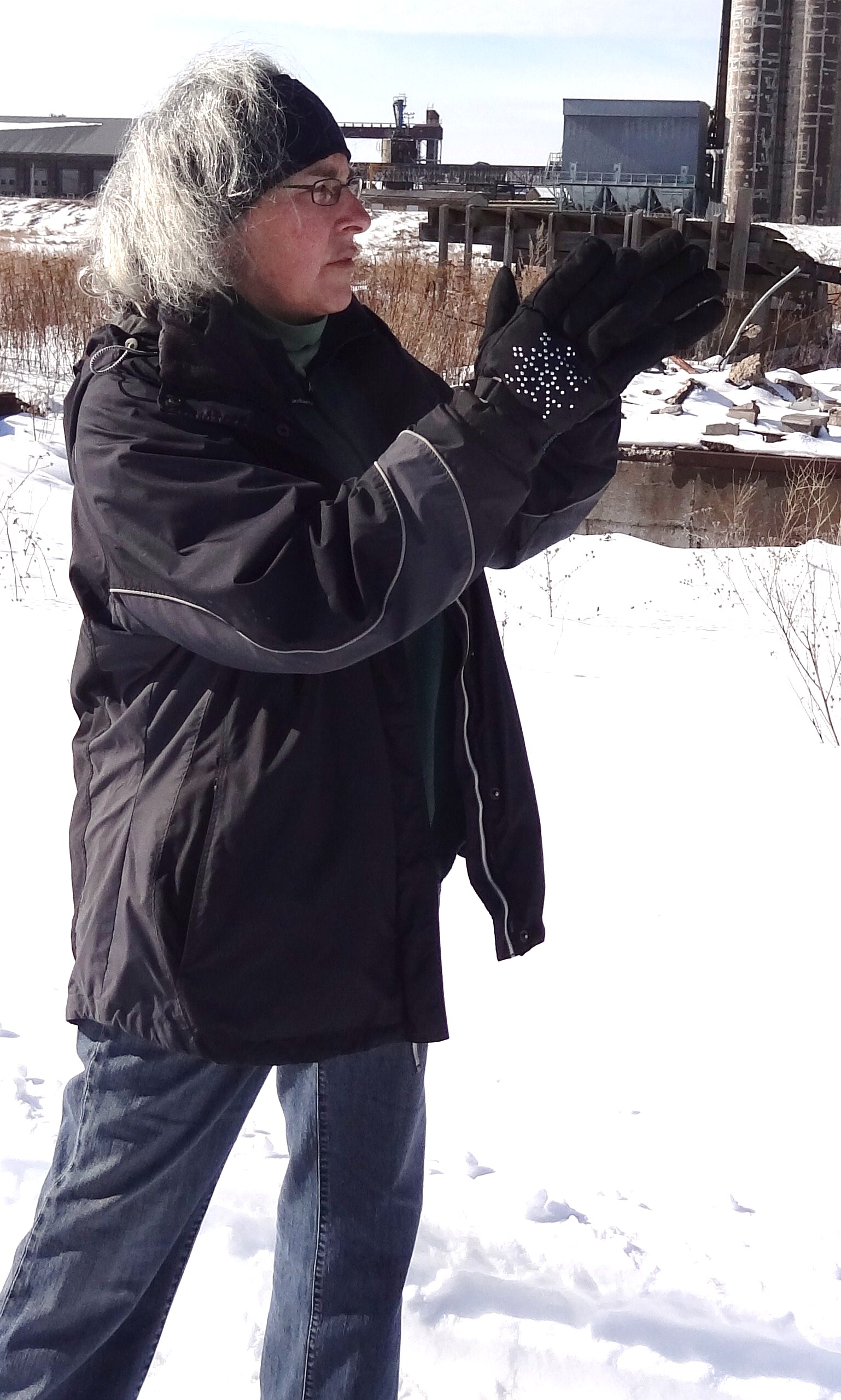
Instead of helping an investor buy the property and tear down the structures in favor a marina and RV park, entrepreneurs Judy Peres and Dave Hozza started purchasing the site themselves in 2006 to salvage the wood. They just couldn’t stomach all that lovely timber being burned or tossed into a landfill. At the equivalent of 20,000 trees-worth (which Peres says is about the amount of an entire forest), the duo has their hands full, in more ways than one.

I adore old wood and agree with what Peres and Hozza are doing, so I decided to learn more. When I visited last week, their tiny office in a yellow metal shed was abuzz with frenetic activity. The project was recently featured on cable TV’s History Channel’s Ax Men program, prompting calls from people far and wide who want reclaimed lumber for various projects. Plus a public television crew was coming the next day to film.

Peres, who seems to handle most of the administrative work, says she’s good at multi-tasking but admits the amount of activity is overwhelming. And 68-year-old Hozza, crouched on the floor getting wood ready for shipment comments with a mix of levity and seriousness, “I’m too old for this!”

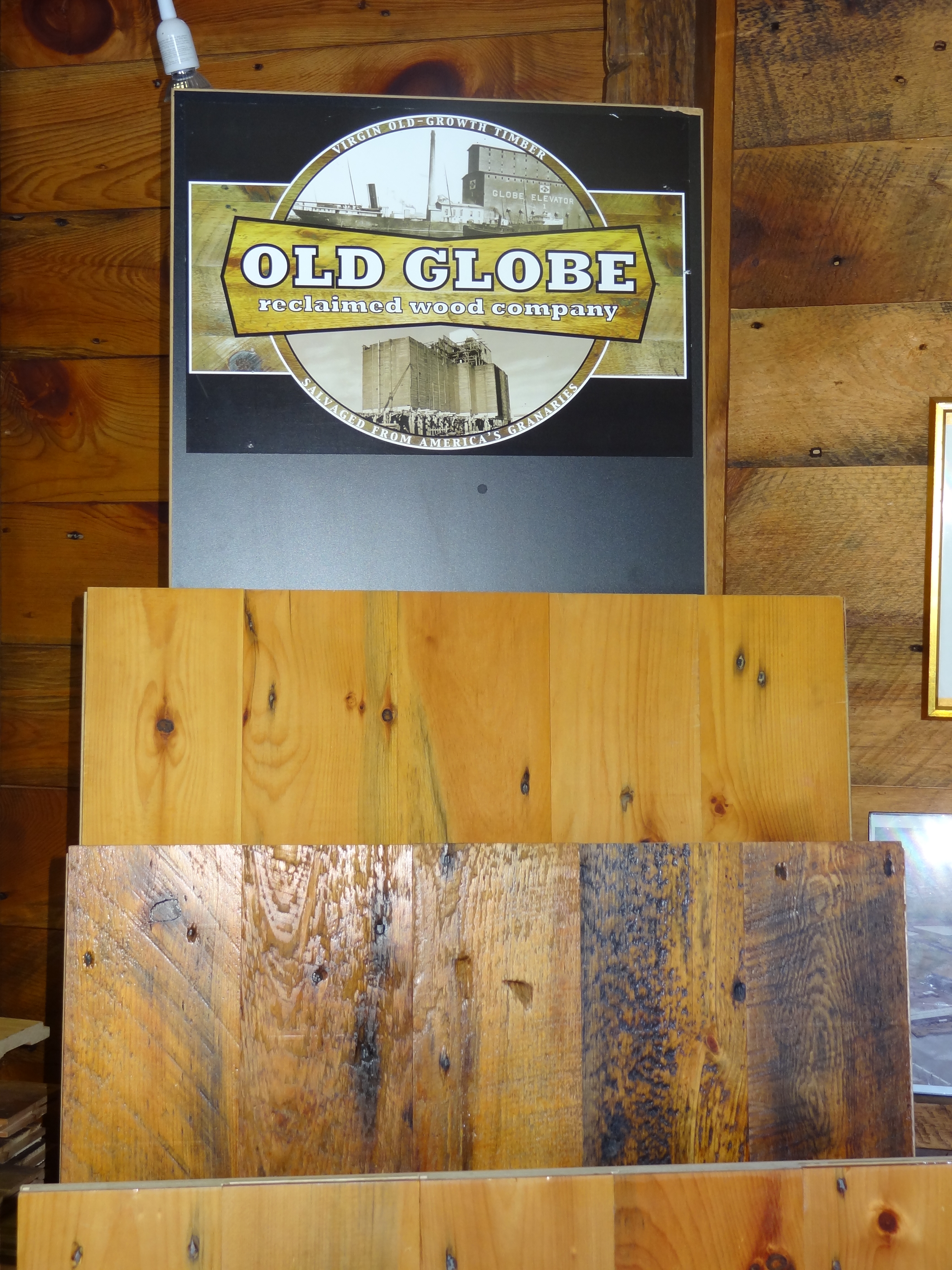
They need an administrative assistant, but can’t afford to hire one because the project is facing bankruptcy. While I was there, it seemed the orders were for small bits and pieces of wood. Although they appreciate every order, what they need are HUGE orders, say for flooring or paneling large buildings. Examples of how Old Globe wood has been used can be found on the company’s web site and in Duluth’s new Amsoil Arena, the Minnesota Wine Exchange downtown, and the Legendary Waters Resort and Casino in Red Cliff.

So, the activity is a good thing, but also a challenge. Hozza and Peres could just sit back and fill out the bankruptcy paperwork, but they have chosen to fight. Why put themselves through it? Part of it, I’m sure is to win. They want to complete what they started despite the odds and the vagaries of the economy.

But another part of it is for love. It has to do with a man and a woman, and a love for old wood.

More on that coming in Part 2.

Snow Angels with a Cause

Snow Angel 019B

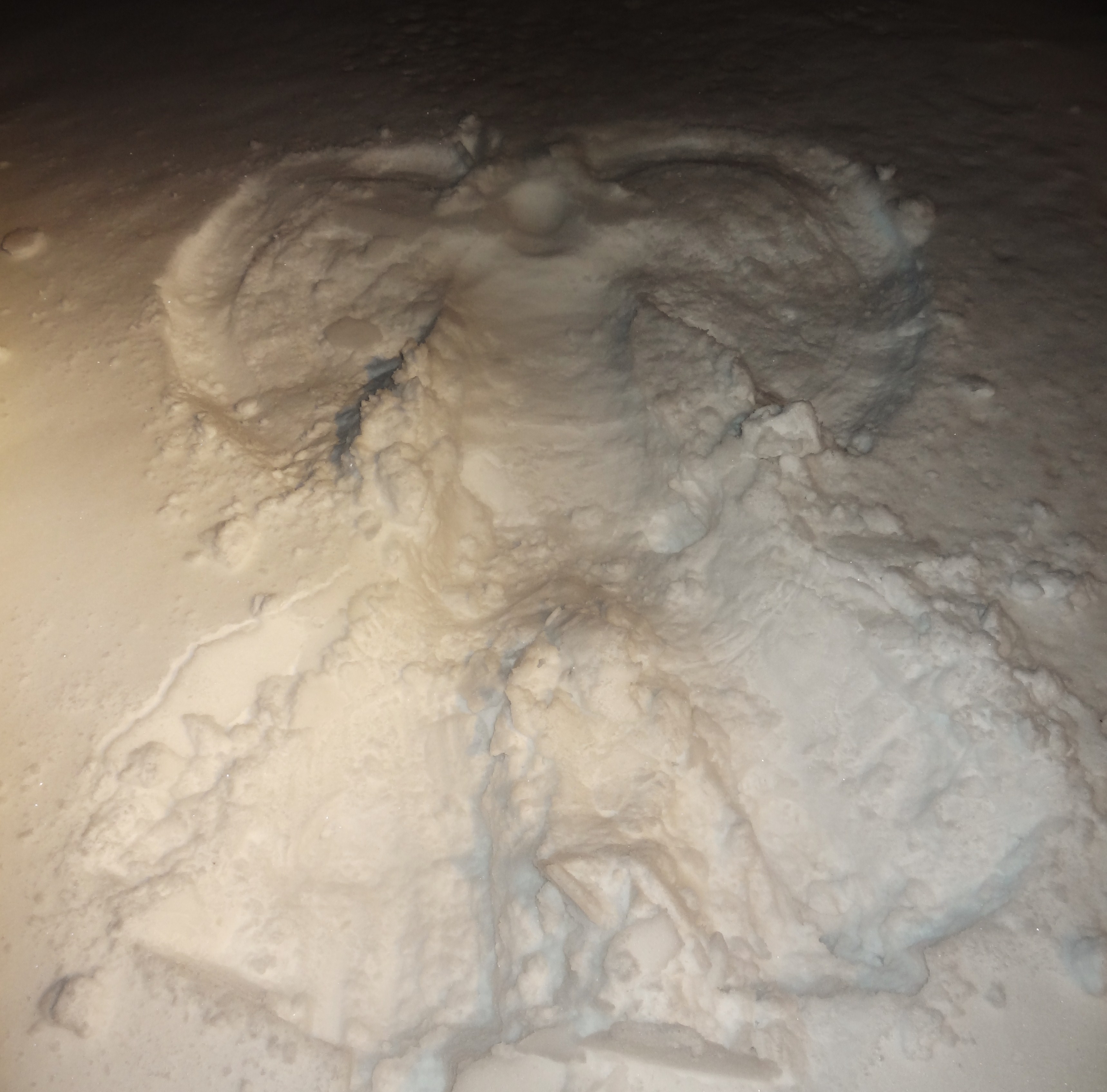
Making a snow angel harkens back to a northern childhood winter ritual, usually performed with friends. It’s just not something you do alone. You flop down and swish your arms back and forth, usually ending up with a cold face full of snow. I remember creating many while growing up. Ever the perfectionist, I worked hard to get up and out of my angel without leaving evidence of footprints or handprints; as if the angel truly fell from the sky into the snow.

Last weekend, about 2,000 people lay down in the snow together, flapping their arms and legs. They gathered at the University of Minnesota Duluth’s football stadium, trying to break a world record for the most snow angels created simultaneously.

I’ll cut the suspense; no record was set (we would have needed about 9,000 people for that) but the event raised money for a good cause: clean water for Ethiopians. It was organized by a Duluth Rotary Club and Proctor High School DECA.

I attended with my teenage son, two of his friends, and one of the boy’s mothers. Although things were a bit confused, and certain people’s feet got cold because they didn’t listen to their mother and wear boots (ahem), the mood of the crowd was one of hope and whimsy.

The hope wasn’t centered so much around breaking a record as it was on bringing the community together for a common purpose. There’s something about so many people gathered to do the same thing that serves as a reminder of the power of the individual.

Whimsy was present, of course, in the act of creating the snow angels. It was also in the costumes some wore so they would be able to pick themselves out in the aerial photo taken by a helicopter that flew overhead at the appointed time.

Hope and whimsy: it was in this spirit that all of us gathered. And for a few minutes, we truly were snow angels with a common cause.

The Music of Nature

LS Podcast Logo
Nature isn’t just what we see. It encompasses all our senses. Think of the vanilla essence of Ponderosa Pines, the rough grains of sandstone, and the sound of a dolphin’s exhale as it surfaces. We’re so used to the visual it’s challenging to remember other senses, especially in environmental and scientific work. I recently learned there’s a field that specializes in sound and the environment. It’s called acoustic ecology.

Acoustic ecology explores the relationship between living beings and the environment through sound. This can take many forms, from delving into what a forest sounded like 70 years ago when different species of birds lived there, to the affect of car alarms on the urban environment.

On a blustery day this past October I had the chance to talk with an acoustic ecologist. Chris Bocast is a talented musician who specializes in the field. He just finished producing a podcast about Lake Superior for our joint employer, Wisconsin Sea Grant. The series isn’t an example of acoustic ecology per se, but it does show how sound can illustrate environmental topics.

Because I’ve worked around Lake Superior for many years, Chris wanted to include me in the series. And of course, I couldn’t let him get away without covering the St. Louis River Estuary, too.

We met during a Sea Grant conference in downtown Duluth. For the interview we walked next door to the historic Greysolon Plaza Hotel. We sat in the hotel’s ornate and quiet mezzanine lounge.

In the middle of our conversation, Chris asked, “What’s the function of an estuary in an ideal ecosystem?” I replied that I happened to have written a poem about that, and darned if the poem didn’t make it into the series. It’s “Two Sisters” from my last entry.

Click here to listen to the Lake Superior podcast series. My poem can be found near the end of program #7 (Superior’s Sister).

The piano-based ambient music Chris created for the podcasts is unnamed. He told me it’s designed to evoke a sense of the pristine. I don’t know about you, but I could bliss out on his music all day.

Two Sisters

Fishing Field Trip 2012 017

I used to have a sister. She died years ago under unfortunate circumstances, and Lake Superior holds her ashes. If you’ve read my novel “Eye of the Wolf,” what happened to the main character’s sister (Melora’s sister) is similar to what happened to my sister.

People often ask me if parts of the novel are autobiographical. Of course, the story is drawn from my experiences, and I combined the traits of several friends to make up a character or two. (They know who they are!) But I wouldn’t go so far as to say it’s autobiographical, especially not the werewolf parts. (Grin) It’s the same with the poem below. It’s not about my sister but it contains her essence. I remember feeling like the ugly duckling compared to her more classical beauty.

Although I know that poems are supposed to speak for themselves, I would like to explain this one. The poem is about two things I love: Lake Superior and the St. Louis River Estuary. (The river in Minnesota, not Missouri.)

My love for the estuary came second and was harder won than my love for the lake. Lake Superior is what the tourists come to see. It’s picturesque and impressive; easy to love. The estuary is part of the less glamorous, roll-up-your-sleeves-and-let’s-work Duluth-Superior Harbor. It’s where taconite, coal and grain are unloaded from trains onto ships, where salt and cement dust sit in stockpiles, where polluted Superfund sites were left for us by our forebearers. But farther upstream, the river gets as wild as any federally designated wilderness. You just have to get out there and experience it to know.

I came to appreciate the estuary when I worked for Minnesota Sea Grant and the St. Louis River Alliance, both water-related organizations. Lake Superior is so huge, it’s hard to feel like you’re having an impact, whether one is a polluter or a restorer. The estuary is more manageable, and impacts can be seen more easily. I liked feeling that the work I did made a difference to the local environment.

The appreciation took a few years to grow, but it’s in me now and doesn’t diminish the respect I have for the lake. It’s like the parental cliché about adding another child to one’s home. Your capacity to love simply widens to encompass two instead of one.

Or it’s like having a sister. I hope you enjoy the poem.

Two Sisters

I am the quiet, hard-working one.
My sister gets all the attention.
She is larger than life, loud, showy.
I am slender, forgotten, kind to animals.
Her eyes are icy blue.
Mine are a warm brown.

My sister has a temper.
You know when she’s angry.
She’ll slap you and swallow you whole.
I am calmer, still dangerous, but
my hands are gentler.

These days, people are taking notice of me.
A team is giving me a make-over.
I may never be as popular as my sister, but
I have a lot to offer. It’s all a matter of
making the most of my assets,
repairing the neglect and over use,
restoring the smooth skin of my youth.

My sister, she might get jealous, but what can she do?
I’m protected by my friends who stand in a line between us.
Besides, what does she have to be mad about?
My life flows into hers.
What helps me, helps her.

©2013 Marie Zhuikov

Cold as a Cage


I’m a northern Minnesotan. I was born here and have chosen to live here. On purpose. Despite weather like we’ve been having of late, with 30-below windchills.

I have a large dog who needs frequent walks or he will find creative ways to get into trouble. So I get out more than most and like to think of myself as fairly well acclimatized. We often walk in the forest by my house or along the shores of Lake Superior.

Today was a shore day. As soon as we stepped outside, the cold enveloped us; its fingers reaching between the threads of clothing, touching thighs, invading noses and ears, causing eyes to tear not from sadness but as a simple physical reaction to sub-zero temperatures.

With his wooly coat, my dog is not as affected by cold as am I, except for his feet, which get super-cooled by salt crystals spread on the road to melt snow for cars. The cold doesn’t strike until he is off the road and back into the snow. He gingerly picks up his feet, begging me to wipe off the snow and salt layer so he can continue our walk in comfort.

I oblige and he trots off along the shore, sticking his nose into snowdrifts and romping with abandon. I wish I felt so free in the cold. For a human, to disrobe at these temperatures would mean inviting death. Not right away, but surely in an hour, maybe two if one sports a seal-like layer of fat.

The cold defines our movements. Northern Minnesotans walk with shoulders hunched and hands in pockets, limiting our time outside to the bare minimum for the task at hand. Cars hibernate in driveways, with oil congealed like coagulated blood. For those whose cars survive, travels are confined to the necessary: groceries to get through the next few days, gas for the car, meetings that can’t be avoided. Even crimes decrease.

Living in this cold is like living in a giant cage. We have no one to blame but ourselves. If we hated it enough, we would move. We have free will. Maybe not always enough money, but if a person dislikes something enough they will find a way to change it. We’ve all heard of people who couldn’t take it and moved elsewhere after only one winter or part of a winter. We may complain, but not too much, because we expect the cold. Maybe, we’re even a bit proud of it.

The cold is our cage and we learn to live within it, or we escape. Some take trips to warmer climes. February is my favorite time. It’s usually the coldest month, and the change seems supremely decadent. Others wait for spring.

Spring brings with it a gradual yet overwhelming sense of freedom. With the warmer temperatures and budding greenery, we can go outside without worrying about frostbite or death. We can disrobe as much as modesty and civilization permit. Our senses are overloaded with smells of plants long dormant. Spring fever is altogether real here for good reason.

But for now, we live in the cage. Besides dressing in layers, one trick to survival is not to let your mind be confined. It’s all right to slow down during this season, but keeping creativity alive can prevent emotions from congealing like car oil and sending you in a downward spiral. Starting this blog is my answer to that.

Read a book. Heck, write a book. Help others. Watch a dog run in the snow. Whatever you do, keep moving and keep creating. Spring will come soon enough. But until then, we need to make our own seasons of the mind.