Creativity, Motherhood and Rats: How They All Go Together

Mom rat and baby

Image by Howcast.com.

I was asked to give a short talk today on creativity and motherhood for a local organization. Here’s the result:

When I became pregnant with my first child 26 years ago, I started to panic. It wasn’t that I was afraid something would be wrong with my baby or that I was afraid of the labor process — although these are justified fears and I did think about those things.

The real issue was, I was afraid that the idea I had for a novel would be subsumed by the demands of a newborn. Having a child would strike a death-knell for my creative dreams. My story would never see the light of day. I had floundered around with writing it, and had come to the realization that I needed help. This fear was foremost in my mind when I signed up for a novel-writing correspondence course offered by Writer’s Digest Magazine soon after I found I was pregnant.

I had heard all the cultural messages that tell women that being creative and having children are incompatible, and I believed them.

The novel-writing course provided me with structure that saw me through the rest of my pregnancy and motivated me to keep working on the story once I had my baby boy. The instructor’s encouragement also helped.

Even so, it took me a long time to finally finish my novel and to get it published — as long as it takes to grow a child into adulthood.

The thing that held me back wasn’t motherhood, it was waiting for the right moment to feel creative – the moment when I wasn’t busy, stressed, or emotional. I was too much at the whim of my outside life. I hadn’t learned yet how to control my inner life and allow room for the creativity to flow no matter what was happening “outside.”

A recent article in The Atlantic Monthly magazine backs up the premise that having children does not harm creativity. In fact, it can change the biology of the mother in ways that can allow for even greater creativity.

Kelly Lambert, a professor of behavioral neuroscience at the University of Richmond, studies the maternal brains of rats. Yes, on Mother’s Day, I am going to talk to you about rats, and their brains, no less. Lambert found that when rats become mothers, their brains, which are closer in structure to a human’s than even those of mice or dogs, start reprogramming themselves.

Their sensory and motor systems sharpen. Their circuitry becomes more efficient. Maternal rats are more direct and lethal hunters, catching their prey four times faster than non-mom rats.

Even after having their babies, the changes persist. Lambert found that the mother rats experience less memory decline in old age and have quicker navigation skills than non-mothers, outsmarting them in mazes.

Although neuroscientists do not yet understand what direct impact pregnancy and childbirth have on the human maternal brain and creativity, I am here to testify that, yes, it is possible to be a mother and be creative, too. And I’m sure plenty of other women can testify to this. It’s just that sometimes when you’re a parent, you have to find more creative ways to allow for that creativity.

If you have a partner, have them take care of the kids for a while so that you can go on a writing retreat. Don’t allow your creativity to take a back seat to the other demands of life. Try different things until you find something that works for you.

I learned how to make this inner creative space while I wrote my second novel. Even though I had a second child by this time, after reading a story about right-brain, left-brain thinking and how to make both sides of your brain work together to foster creativity, I learned how to put myself in that elusive creative mind zone, instead of waiting for the zone to come to me. Thanks to this, it only took me two years to write and publish the second one.

You don’t need to be superhuman to have children and to be creative. Mothers have been doing it forever. As the magazine article said, creativity takes time and periods of reflection, and a willingness to let go of ideas that don’t work and move on to better ones.

Learning to look at the world through the eyes of your children, be they yours biologically or children of your heart, is not a bad way to make your own thinking more flexible.

Communing with Vultures on Ely’s Peak

20180428_180725

One of the views from Ely’s Peak.

Last weekend, a friend and I meandered up 200-300 feet in elevation to the top of Ely’s Peak near Gary-New Duluth. I don’t have a more specific elevation to give you because the different trail guides that I consulted are inconsistent on that point. But I can say that for my 50-something-year-old legs, it felt more like 300 feet. Also, some of the guides say it’s a 1.5-mile round-trip hike. Others that it’s 1.8 miles. I vote for the latter.

20180428_181031We chose the trail to see a new place and because the crisp and sunny spring air seemed to demand it. We didn’t go seeking a vision quest like Native Americans are said to have done on the peak, nor to seek our spirit animals, but we just might have had a dose of both of those things along the way, too.
The trailhead is off of Becks Road. On this particular day, the trailhead parking area was easy to find from the many other cars gathered there.

I followed the directions given on this website, although I would argue that the “beginner” level trail classification is not accurate. I would rate it as “moderately hard” because near the peak, I found myself thinking it would have been helpful to be part mountain goat. And a young mountain goat at that.

(I would say that this trail is not for 80-year-old mountain goats, but for all others it should work as long as you are reasonably fit and coordinated.)

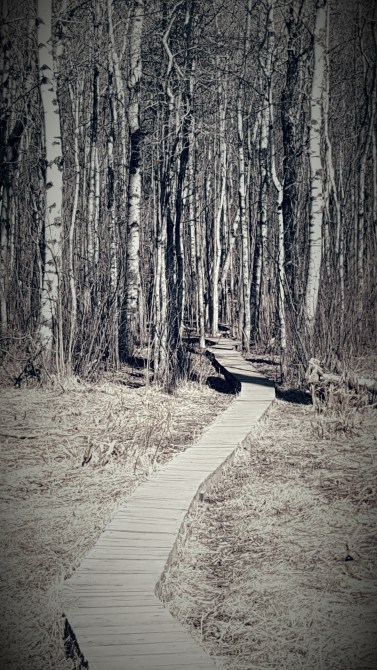
At the start, a boardwalk invites you into a spindly birch forest. The boardwalk gives way to a muddy climb up an incline to an old railroad bed for the Duluth, Winnipeg and Pacific Railway.

20180428_155924

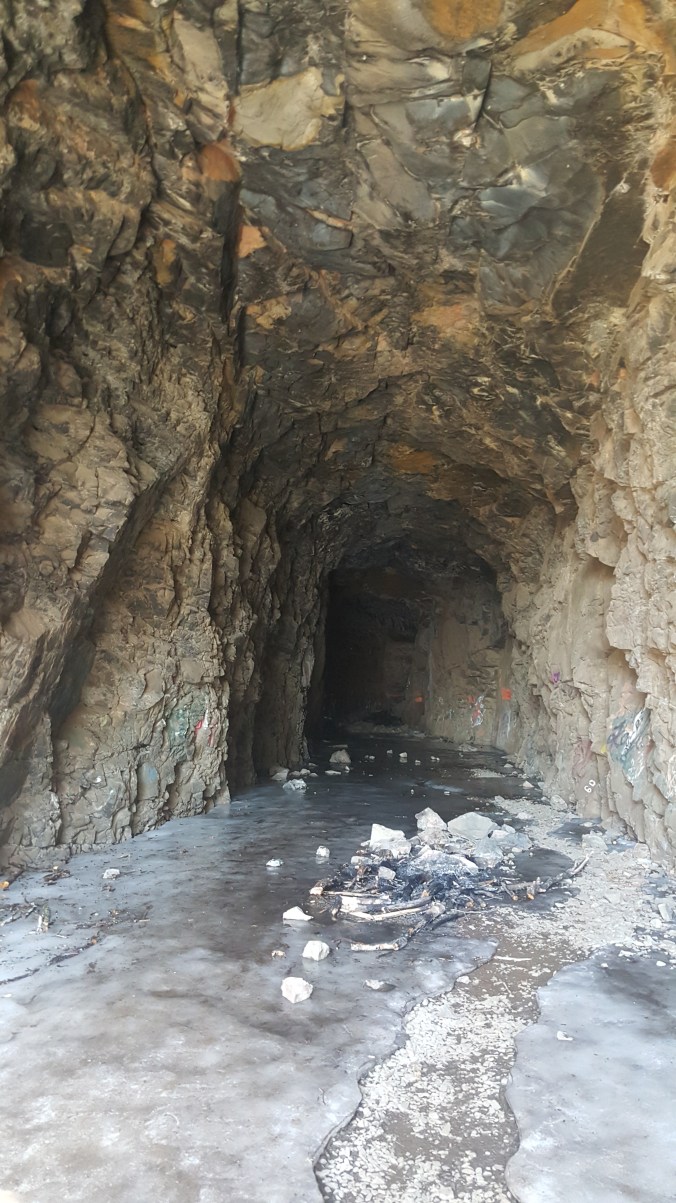
Inside the railroad tunnel.

Follow the railroad bed to the right until you come to a rocky tunnel. The tunnel was built for the railway in 1911. There are trails on the other side of it, but we did not attempt to go through the tunnel because of the sheet of ice layering the way. You may run into some rock climbers, who practice on the craggy basalt in the tunnel.

Although it may seem counter-intuitive, from the tunnel, you should follow the main trail, which goes down the hill to the right. Don’t take the spur that goes up along the side of the tunnel, unless you really are a mountain goat and want to test your mettle.

Don’t be impatient, you will come to an incline soon enough. You are now on the Superior Hiking Trail, which is marked by blue blazes on the trees and rocks. Keep to the left and follow the blazes up the blazing &!*()%$ hill.

Soon enough, wide vistas will offer views of the St. Louis River and the Gary-New Duluth neighborhood.

20180428_162157(0)

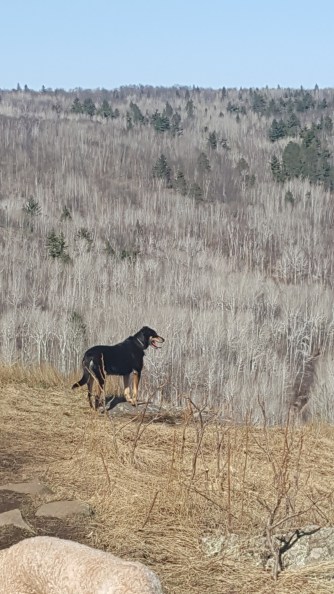
Dogs like the Ely’s Peak Trail, too.

No leaves were out on the trees yet – everything looked stark and clean.

The peak offers breath-taking 360-degree views. It was named after Edmund Ely, a Presbyterian missionary from Massachusetts who began teaching the Fond Du Lac Native American community in 1834. Local lore says that this was one of his favorite spots.

As we sat, resting, we noticed several turkey vultures lazily circling the thermals below us. The more we watched, the more vultures seemed to appear from nowhere. Eerily quiet and patient, they circled and circled. We joked that they were probably looking for hapless hikers who fell down the trail.

There’s a school of thought that says if you sit out in nature long enough, an animal will appear that has a lesson to impart. Were the vultures trying to tell us something?

Once back home (and safely out of a vulture’s gullet), I looked up what vultures symbolize. Here’s what I found: the vulture is considered a symbol of cleansing, renewal, and transformation. Vultures are viewed as fearless of death – they stare it in the face and eat death for breakfast (literally)!

I did feel cleansed after that hike. It was like the sunshine and clear air burned off all the old gunk. Perhaps it’s only to make way for more new gunk (ha ha), but I’d like to think I’ll have some time before I get clogged up again.


A Visit to the Tallest Waterfall in Minnesota

20180324_155408Filtered

The High Falls in Grand Portage State Park, Minnesota.

My traveling companion and I meandered north along Lake Superior with migrating bald eagles toward the Canadian Border last weekend. Although temps are still freezing, the long spans of daylight and slackening snows have a feel of spring about them.

We decided to cover some new territory by visiting the High Falls at Grand Portage State Park along the border. The 120-foot falls are the highest in Minnesota, so, in order to be proper Minnesota residents, we figured it was about time we saw them.

A short and slippery hike (wear your Yak Trax!) brought us to a giant white-frosted wedding cake of a waterfall. Most of the falls were encased in ice, but underneath, the Pigeon River flowed with unstoppable abandon. A large crack across the middle foretold of the eventual cutting of the cake once temperatures rise.

Once done with this quest, we drove back south to our resort (the Naniboujou Lodge, which I will write about separately). We vowed to stop at the intriguing and picturesque harbors we had seen on our way up, but were too goal-oriented to explore.

20180324_160746VignetteWe stopped several times along the highway, but the best place was one without a ready-made scenic parking lot. We glimpsed a bay that whispered of Norway and ice and stillness. We drove back and forth, looking for the best access road. There were no roads, only private driveways.
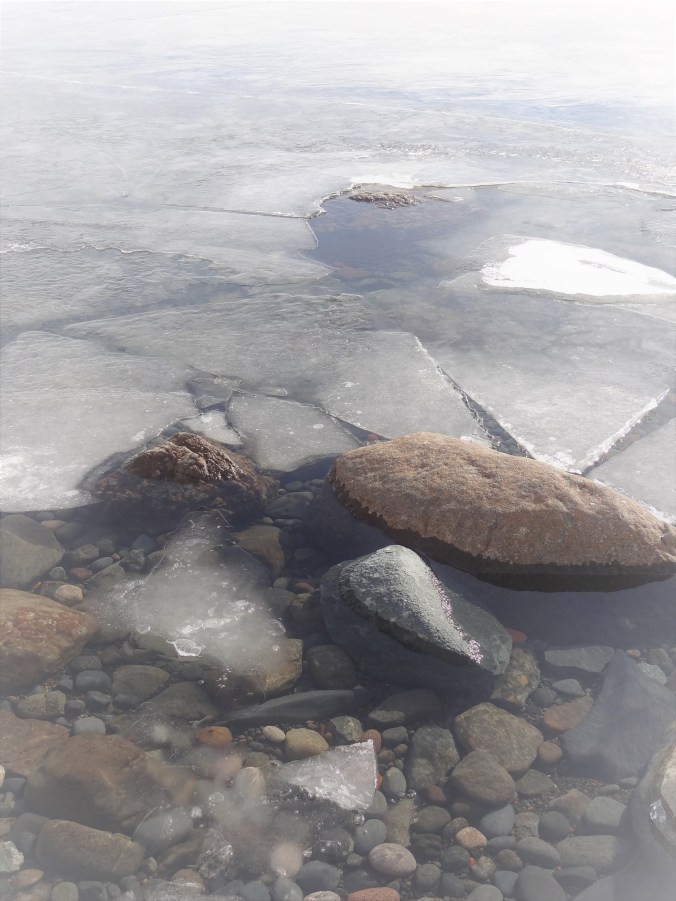
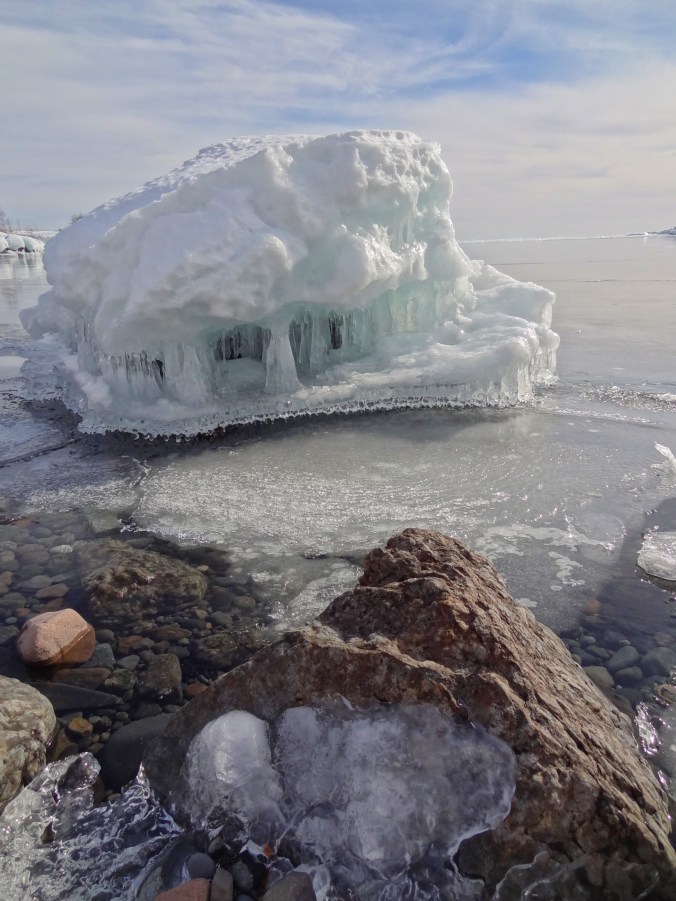
Finally, we chose one that looked the closest to the bay. As we pulled in, we could see from the untrammeled whiteness of the driveway that no one had driven on it for most of the winter. However, there was a foot trail through the snow that we could follow. So, after some hemming and hawing, and getting out of the car, we did.

A short crash through the underbrush brought us out to the view, which now SHOUTED of Norway and ice and stillness. Oh, it was gorgeous and well-worth a little harmless trespassing! Please enjoy these images of our “Secret Cove.”

20180324_160813Zekefilter

DSC04625Soft

DSC04628

Taking an Old-School Snowshoe

20180120_121621It’s been about twenty years since I used my own snowshoes. I had the chance this week to dig them out and tromp around the grounds of a local mansion that’s open to the public for nighttime outdoor tours.
It was an expansive experience. What do I mean by that? Well, please, read on.

My snowshoes are old-school — made in Canada of wood with rawhide lacings. Tapering from a rounded nose to an elongated straight tail, they are four feet long. Their only nod to modernity are the plastic buckles and synthetic foot straps.

Not familiar with the various types of snowshoes, I looked mine up so I could describe them to you. I discovered they are an Alaskan snowshoe, which is supposed to work well on flat and rolling country with a deep snow pack. However, their length makes turning difficult.

My snowshoes were a Christmas present. I used them several times, but then my circumstances changed and I just didn’t have the motivation or opportunity to get out on them. But this nighttime snowshoe excursion sounded like fun, so off I went. It was held on the grounds of Glensheen Mansion, which is in Duluth, on the shores of Lake Superior. A group of about thirty people met and were divided among two tour guides who led us onto the grounds.

The quiet night air was about 20 degrees with little wind. Stars twinkled overhead as we shuffled over land that, in bygone days, held greenhouses where banana trees grew.

What I had forgotten about snowshoes is that they are like the land rovers of winter gear. You can walk up or down any kind of snowy slope with those things without worrying about slipping. That is, except for stairs. I don’t recommend their use on stairs!

At one point, we arrived on the shore of Lake Superior. We stood, rooted, listening to ice slush tinkling and crunching with the motion of low waves. The constellation Orion shown overhead, his slanted belt seeming to point down directly at us.

The sky was dark and huge over the lake. Even though we were within the city, we might as well have been miles away in a wintery wilderness. Almost immediately, a calmness descended on the group and we stopped talking, except for some exclamations of beauty.

I’ve been reading lately about how people’s brain wave patterns and emotions change when they view vistas like a great lake or an ocean, or even an empty desert landscape. We have a primal need for these wide-open natural places as much as we need the comforts of civilization.

A Northern Minnesota writer, Sigurd Olson, described these effects so well in his books about wilderness that I won’t even try to match him. But, as we stood on the shore, our hearts and our minds expanded — just for a moment — until it was time to catch up to the tour guide again.

20180117_190232

The snowshoe hike ended at a cozy bonfire.

Grand Canyon Joy

20171208_143044

“Wherever you have friends, that’s your country, and wherever you receive love, that’s your home.” A Tibetan saying.

20171208_121345

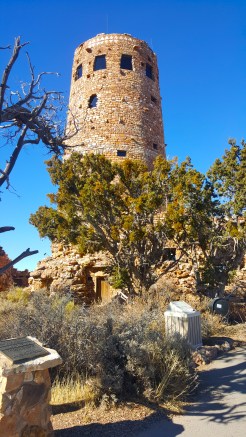
The Observation Tower on the South Rim of the Grand Canyon.

“Pain is inevitable; suffering is optional.” Dali Lama.

“Whoever gives you love, that’s your parent.” Dali Lama

“The brave man is not he who does not feel afraid, but he who conquers that fear.” Nelson Mandela

These quotes, which are worthy of pairing with Grand Canyon scenery, came from “The Book of Joy.”

20171208_135431

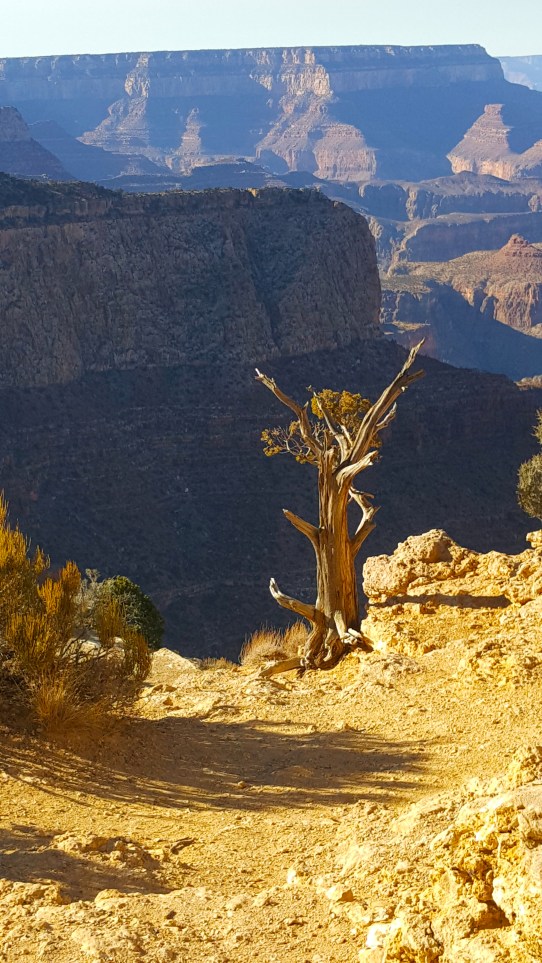
The Grand Canyon in Arizona.

The Vortex Made Me Do It: Adventures in Northern Arizona, Part 4

Sedona 2017 016

Linda (left) and I on Airport Mesa, before we knew it was a vortex area.

You know how, when you go on trips, you sometimes end up with a running joke in your conversations? The joke can be related to an event, a person you met, or a hapless comment made along the way. Well, for Linda’s and my Sedona trip, our running joke was The Vortex.

Because Linda and I are from Minnesota, we were mainly familiar with Polar Vortexes. You know, that’s when all the cold air comes down from the arctic and tries to freeze everything in its path. Although we had heard of Sedona’s reputation as a vortex center before we began our trip, we didn’t know any specifics.

Personally, I just thought the whole place was the site of mysterious energies. Little did I know that there are specific locations and different types of energies to be had.

Let me back up and define the word vortex (plural = vortices or vortexes). Merriam Webster says that a vortex is something that resembles a whirlpool. I assume all of you, dear readers, have watched water swirl down a drain. That’s a whirlpool — except that in Sedona, the swirling involves invisible energy more than it does water or freezing arctic air.

Our Vortextual Education

Our resort offered various programs for its patrons. Among the classes, which had titles like “Crafting a Festive Wine Glass for Christmas,” was one about vortexes. We decided we had to attend to learn more about this phenomenon. The presentation was given by a local Reiki healer.

She described the concept of vortexes and said the energies involved come from the rocks because of their mineral composition. She passed out a sheet that listed eight locations that are thought to be vortices and it described their different kinds of energies.

Some of the energies come out of the rocks (upflow), some flow into the rock (inflow), some are combinations of upflow and inflow, and some are horizontal (lateral). The lateral flow places involve the energy from nearby rivers and streams.

The sheet she gave us was an excerpt from a book entitled, “Scientific Vortex Information,” which was written by an author who claims to have been educated at the Massachusetts Institute of Technology.

I don’t know. The title seemed like an oxymoron. “Science” and “Vortex” don’t really go together in my world, where I move among scientists every day. I suspected there wasn’t that much science behind the information — more like wishful, imaginative thinking.

Once I got back home, I looked inside the first few pages of the book on Amazon, hoping to see proof that scientific instruments were used to actually measure electromagnetic fields at these locations, but all I saw were explanations of inflow and outflow, with nary any hard proof in sight.

But that’s okay. We weren’t in Sedona for the science. We were there for the experience. We were there for . . . The Vortex!

Our Vortextual Experiences

Sedona 2017 026

Oak Creek Canyon.

While looking at the list of locations, Linda and I discovered we had already visited a vortex the previous day. The site was Airport Mesa, which is easy to access because it’s right in town.

While we were enjoying the view there, we had noticed a couple of people sitting on the rocks in a lotus position. We didn’t think much of it – maybe they were just doing it because the scenic view inspired meditation. But after reading the list, we knew better. Those lotus people were trying to feel The Vortex.

We decided we needed to try that. Our journey the next day involved a trip north to Flagstaff, so we made plans to stop at the Oak Creek Canyon Overlook, which is on the way. The overlook scenic vista is located at the top of the switchbacked road at the end of the canyon about 15 miles from Sedona. A short walk on a paved path leads to an impressive overlook.

I sat on a bench near the overlook and Linda stood near the wall. Neither of us were hard core enough at this point to get into a lotus position (which is sort of hard on a bench, after all). So we just closed our eyes and tried to feel the feels.

I felt my own internal vortex more than any external one. My heartbeat rocked my body and made it sway a little. The Arizona sun felt good on my face and the breeze whispered its secrets.

After having our moments, we conferred. Linda said she didn’t really feel anything. We walked back to our car, but along the way, we stopped to look at some Navaho jewelry being sold at stand along the walkway. I was drawn like a magnet to one ring that featured a bright blue opal. I picked it up and it fit perfectly. I had to buy it.

We joked later that The Vortex made me do it. Who knows, maybe it did? It was like the ring was calling to me.

20171207_153459

Cathedral Rock

A few days later, after a day of hiking, we visited Cathedral Rock, which is thought to be home to an upflow/inflow combination vortex. We hiked up to the flat rock plateau below the formation.

Someone had scratched two spirals into the rock about ten feet away from each other. Linda and I thought they looked like logical places to sit for people like us who were trying to find a vortex, so we sat with legs crossed and eyes closed.

The day had been breezy, but not particularly so. A few moments after we got into position, big gusts of wind started buffeting us. They were so powerful that Linda’s hat flew off.

We opened our eyes and quickly stood, spooked. The wind stopped.

We headed down the rock toward our car. We didn’t joke as much about vortexes after that.

A Vision of Abundance

Alexandra Cousteau

Alexandra Cousteau

Like many baby boomers, I could be found on Sunday evenings in the 1970s, cozied up to the television, watching a gnarly red-capped Frenchman exploring the depths of the ocean. The opening music to “The Underwater World of Jacques Cousteau” — full of violins and trumpets, with a playful xylophone riff — conveyed a sense of adventure and wonder that was unmatched by any other television show at the time.

The series inspired me to pursue a career as a marine biologist. Although that did not come to pass, I write about aquatic science, which is just about as good.

Like many young girls who watched the program, I had a crush on Cousteau’s son, Philippe. His other son, Jean-Michel, was okay, but Philippe – oooh la la! I was devastated when he died in an aircraft crash. And I thought Calypso crewman Falco had the coolest name.

Even as a poor college student, I donated money to the Cousteau Society and followed their adventures after the television show no longer aired.

So it was inevitable that I attended a talk last week by Philippe’s daughter, Alexandra. She was the keynote speaker at a celebration in Superior, Wisconsin, for the Lake Superior Research Institute.

The leggy blonde, whose mother was a model, is coming into her own as an icon for water issues. She founded a water organization, called Blue Legacy International, and was honored by the National Geographic Society as an Emerging Explorer.

Her talk centered on the theme of the importance of conservation and sustainable management of water for a healthy planet. However, Cousteau doesn’t like the word “sustainable.” She thinks that to most people, it means they must sacrifice something to achieve it, and that what is achieved is only marginal, not like things were before environmental problems happened.

The status of the oceans before humans started impacting it was one of abundance – huge schools of fish, giant pods of dolphins, a bay covered with oysters. Cousteau argued that we should have a vision of abundance instead of one of meager sustainability. It’s something people can be more enthused about and it’s an easier concept to imagine.

Given the realities of human abundance on the planet, this may be a pipe dream. But what a happy pipe dream!

Cousteau also thinks we focus too much on the environmental problems that exist and not on the vision we want to achieve. She gave the example of a tip from her downhill ski instructor, who told her not to look at the trees while she was skiing. “Because that’s where you’ll end up.” He advised her to focus instead on where she wanted to go.

Since I had just listened to a talk about sustainability by Andrew Revkin, I found Cousteau’s concept of abundance intriguing. I think those two should get together and compare notes, if they haven’t already!

I didn’t have my notebook with me, so am writing this all from memory. Two other things that struck me were her story about a child who was banned from watching the Cousteau TV show, and her story about how she learned scuba diving from her grandfather, Jacques.

Cousteau said that people usually gush about her grandfather’s television show (much like I did at the beginning of this post). But a man who attended one of her talks said he would get too excited by impending peril in the underwater adventures. When Cousteau would enter a cave filled with sharks, the boy would jump up and down on the couch, yelling at the divers not to go into the cave. He’d end up hyperventilating every episode until his parents took matters in hand and banned him from watching the show. Funny!

Cousteau said she learned how to swim before she could walk. At age seven, Jacques decided she was old enough to learn how to scuba dive (a technology he invented). As she sat on the edge of the boat, getting used to the regulator in her mouth and the gear on her body, she decided she didn’t like it. She was about to tell Jacques that she didn’t want to do it when he gave her a little push, and into the water she went. The undersea world has captivated her ever since.

Cousteau’s talk ended with a question and answer session. One of the last questions came from a tearful fifteen-year-old. She said that the students in her high school were all pessimistic and hopeless about the environment. She wanted to know how to offer them hope.

After taking a moment to compose herself, Cousteau, who was tearing up too, offered stories about things that are making the environment better. But perhaps, sensing the inadequacy of this in the light of teenage angst, offered to continue the conversation with the girl through her web site.

By now, most of the crowd was wiping away tears, including the director of the Lake Superior Research Institute, who closed the session in a choked voice.

Like her grandfather, this Cousteau has the ability to move people with her storytelling. I hope she inspires a whole ‘nother army of marine biologists and aquatic scientists. And a whole bunch of people who can tell the story of the environment, showing us where to go without crashing into the trees along the way.

Hope for Sea Grant

Border_Wall_at_Tijuana_and_San_Diego_Border

The Mexico–United States barrier at the border of Tijuana, Mexico and San Diego, USA. The crosses represent migrants who died in the crossing attempt. Some identified, some not. Image credit: © Tomas Castelazo, http://www.tomascastelazo.com / Wikimedia Commons / CC BY-SA 4.0

The federal funding situation is looking up for the provider of my livelihood, despite President Trump’s wishes. As you may recall from a previous post, I work as a writer for a state branch of the National Sea Grant College Program. Basically, Sea Grant provides federal money to university researchers to explore and protect our oceans, lakes, and rivers.

My job is to explain what the researchers find to the taxpayers who fund the program. (Which is most of you who are reading this.) I do this through storytelling, and my stories are published on our program’s website, blog, newsletter, news releases, etc.

President Trump proposed drastic cuts to the rest of our 2017 budget, and he zeroed out the program in his proposed 2018 budget to Congress. He thinks the money spent on our program would serve the country better if it went toward building a wall along the entire Mexican border.

Sea Grant’s 2017 budget was spared because Trump agreed to delay his push for wall money until the 2018 budget battle. Congress passed a continuing resolution for 2017, meaning that our funding remained steady. Thus, I still have my job!

I am very thankful for that, and very thankful for all the support I’ve heard for the program from my federal representatives, community, friends, and fellow bloggers.

Preparations for the 2018 federal budget have begun, and I have good news to report on that front, also. At the end of June, a House of Representatives subcommittee met to develop their version of the budget for the departments of Justice, Science, and Commerce (of which Sea Grant is a part). Their budget bill keeps Sea Grant’s funding at its current level.

According to the director of my program, who is ‘in the know’ about such things, this is a big deal because the House is typically the group that lowers budgets. Their rejection of the President’s recommendation to zero out our program is a crucial first step in the 2018 budget process.

The budget process isn’t over yet, but this news made all of us Sea Granters breathe a sigh of relief and enjoy celebrating the nation during the recent 4th of July weekend a lot more. It’s good to know that at least part of the government supports the work we do, even if the leader of the nation doesn’t.

Onward!

Attack of the Killer Turkeys

Today I meandered over to a gathering at the home of some friends who live in the woods outside of town. I had been to their house before, but this time was different. Instead of my friends meeting me once I got out of my car, I was met by some wild turkeys. Two toms and a hen walked up to my driver’s door before I could get out. The toms were both displaying in an aggressive manner and the hen pecked the ground a few feet away.

It unnerved me that the turkeys knew which car door I would exit. “This can’t be good,” I thought. After futilely waiting a few minutes for them to budge, I decided on an alternate exit strategy. I clambered over the stick shift console and went out the passenger door.

20170507_104836The turkeys immediately spotted me and followed. I walked faster. They walked faster. Soon I was running for my life to the house door. Just in time, my friend opened the door. She deterred the turkeys with a big stick and ushered me quickly into the house. I swear the turkeys would have followed me right inside, had it not been for that stick.

She apologized for the turkeys, saying they “just showed up” about a month ago. Although the turkeys live in the woods, they are obviously imprinted on people for food.

Despite trying several methods, the only way my friends have found to deal with them is to carry sticks whenever they go out. My friends say the turkeys also stand at their sliding glass doors and watch them while they watch television. Creepy!

As others arrived for the gathering, our main source of entertainment was watching their various reactions to the attack turkeys. Most people got off easier than I did because my friends made it out there sooner with their sticks.

Once I eventually left, the turkeys chased my car the whole way down the long driveway, as if getting back at me for my earlier escape. They kept at it until I was able to leave them in a cloud of dust on the main road.

Wild turkeys have been in the news lately because they are becoming more common in northern Minnesota. People are wondering if the department of natural resources (DNR) has stocked them or something. Nope, says the department.

In my travels between the southern and northern parts of Minnesota over the years, I have noticed turkeys along the highway. Every year, they are farther north. (Opossums are coming, too. Yuk!) I guess it was just a matter of time before they reached my friends’ yard.

The DNR calls the turkeys’ range expansion “one of Minnesota’s greatest conservation success stories.” Last year, the DNR expanded the turkey hunt to include all of northeastern Minnesota. The spring season is open from now until May 31.

Turkey hunters, if you are having trouble finding your prey, I know where a couple are. Just ask. 🙂